METAL WORKING INDUSTRY SPRING SOLUTIONS

Die springs and tooling springs for stamping, forming and machine tools.

Press tools compress springs on every stroke inside tight pockets. Load, deflection and space must be balanced so springs last and strip evenly.

Metal Working Industry Spring Solutions spring application

Metalworking tools use springs to hold, strip, clamp and return. The workhorse is the die spring in stamping and forming dies; machine tools add disc spring stacks and wave springs for clamping and preload. We have supplied fixture clamping springs, and we make die, disc, wave and compression springs to your drawing or sample. The sections below explain how to specify them for a tool.

Key Takeaways

  • Die spring life depends mainly on how far the spring is compressed relative to its free length, so the review starts with installed height and stroke.
  • Die spring colors indicate load class, but color schemes differ between standards and suppliers; the drawing, not the color, defines the spring.
  • Springs that share one stripper plate should be replaced as a set.
  • We produce wire diameters from 0.1 mm to 80 mm, respond to drawings within 24 hours, and are certified to ISO 9001 and IATF 16949.
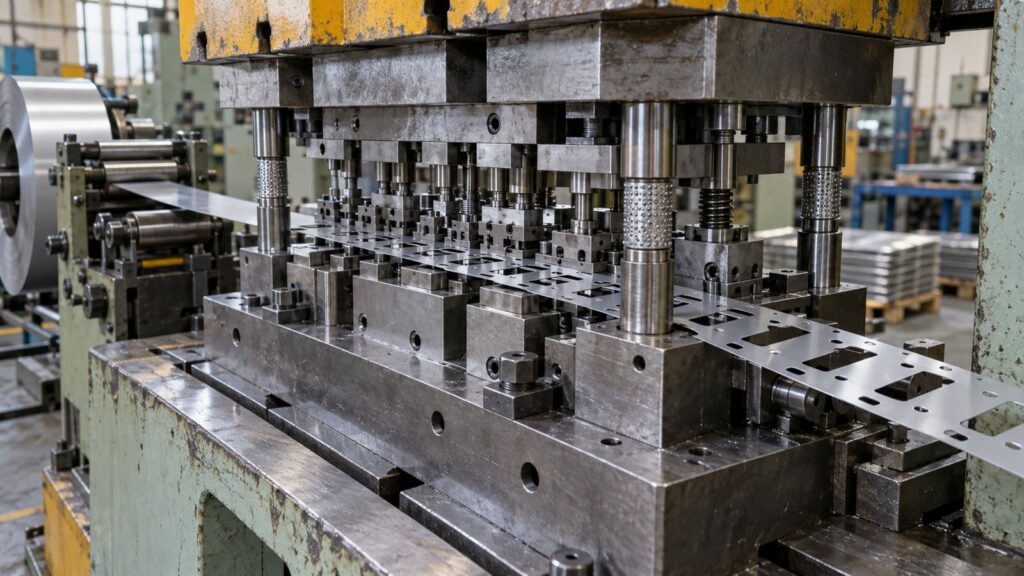
Illustration: a progressive stamping die in a press with a steel strip feeding through the tooling.
Illustration

Which springs metalworking uses and why

Die springs in stamping and forming dies

A die spring is a heavy compression spring, usually wound from rectangular or shaped wire. A rectangular section puts more steel into the same coil diameter than round wire, so it delivers more force in a pocket whose size is already fixed by the die design.

In the tool, the spring is preloaded at installed height, then compressed further on every press stroke. Stress rises with total deflection, so the deeper it goes, the fewer strokes it survives. Die spring makers usually publish recommended maximum deflections by load class, so the allowable deflection for your spring is confirmed at review rather than assumed.
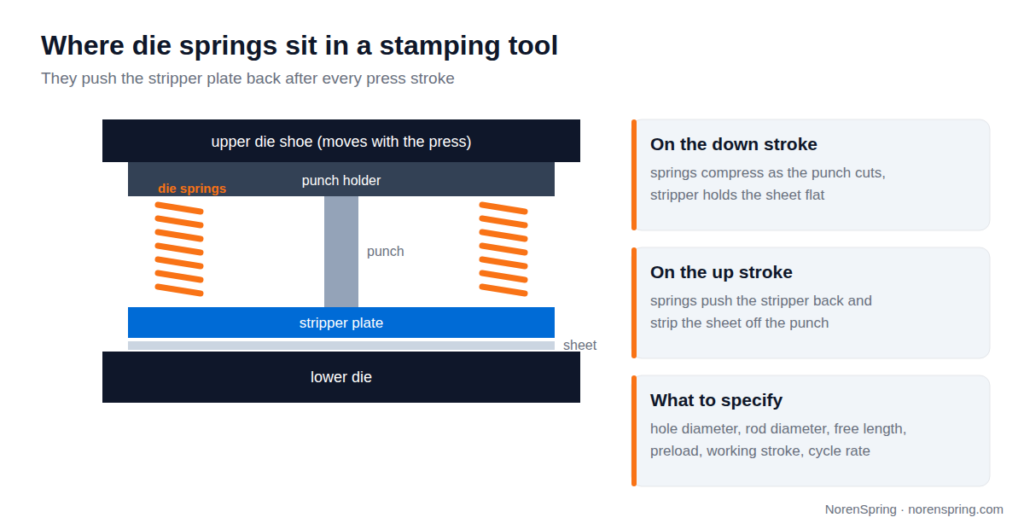
Cross-section schematic of a stamping die with the upper shoe, punch holder, two die springs, punch, stripper plate, sheet and lower die, with notes on what the springs do on the down stroke and up stroke and what to specify.

Guide each die spring on a rod or in a pocket with the recommended clearance to prevent buckling (the outside diameter grows slightly as it compresses), and replace springs that work together as a set. A mix of new and fatigued springs tilts the stripper plate.
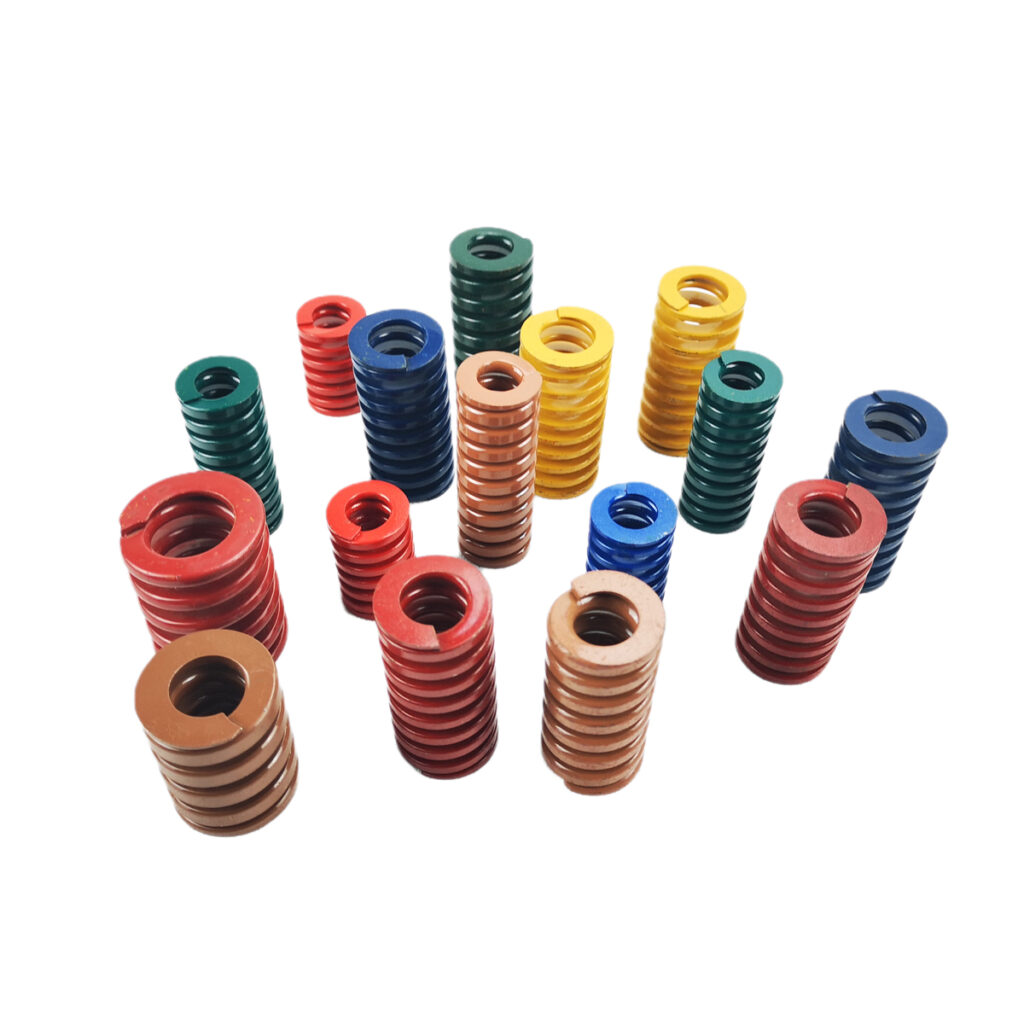
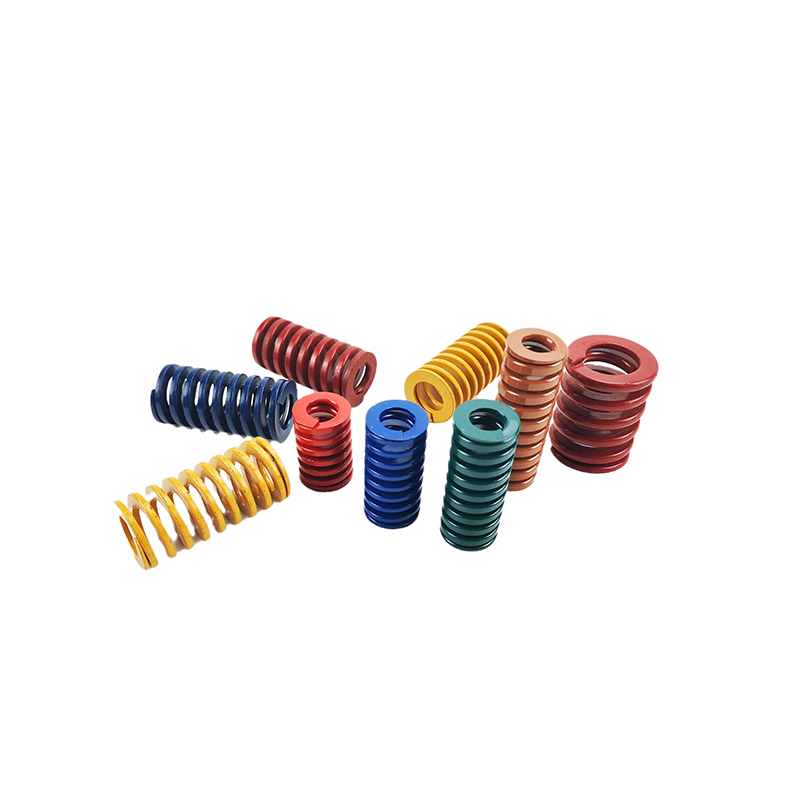
Die springs with color-coded coatings in several sizes and load-class colors.

Compression springs in fixtures and ejectors

Where loads are lighter, standard round-wire compression springs handle pilots, knockouts, ejector pins and clamp returns in jigs and welding fixtures.

Disc and wave springs in machine tools

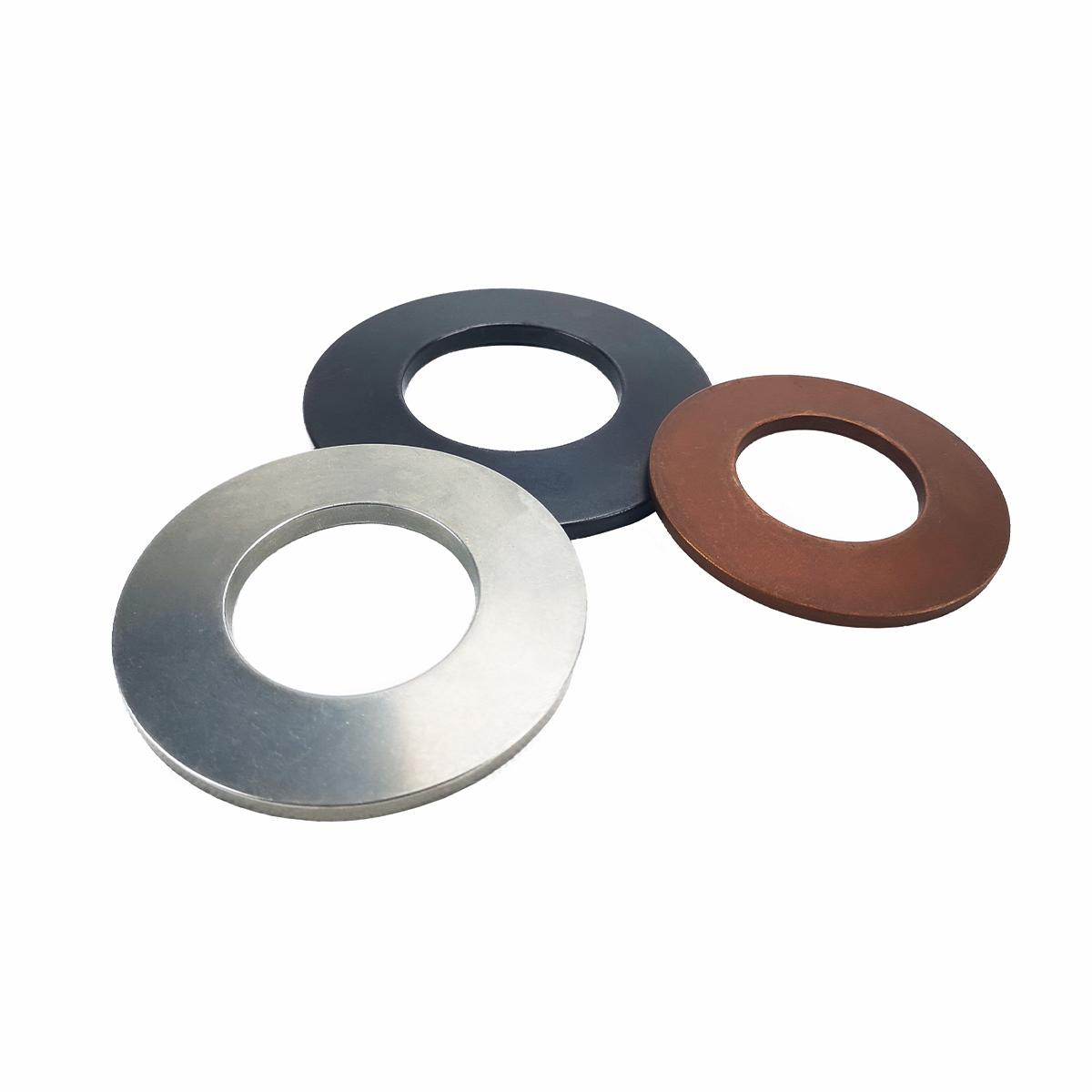
Disc springs deliver high force in very short axial height, which is why stacks of them are used to clamp tools in many spindle drawbars. Wave springs provide axial preload where a coil spring would be too tall.

Choosing material and finish for press shops and machining areas

Option Where it fits What to weigh
Alloy spring steel Die springs and disc springs under high load Standard choice for heavy, high-stress tooling springs
Silicon-chrome spring steel Die springs with deep deflection or warm tools Higher fatigue strength and better resistance to relaxation at moderate heat
Oil-tempered wire Heavier general compression springs Economical for larger wire sizes
Carbon spring wire Light fixture and ejector springs Economical; oiled or plated against rust
Stainless steel 304 Springs splashed by water-based coolant Corrosion resistance at lower strength
Color coating or plain oiled Die springs Color identifies load class; oil protects in storage

What to send for an engineering review

  • Pocket diameter and guide rod diameter.
  • Free length available and installed height.
  • Working stroke and the force needed per spring at installed height and at full stroke.
  • Number of springs per tool and expected press speed.
  • The catalog number or a sample of the spring you use now, if you are replacing one.
  • Any color or load-class convention your tool room follows.

For more parameter guidance, read how to specify a custom compression spring.

Frequently asked questions

Can you match die springs from another supplier?

We can work from a physical sample or a drawing. Send the spring or its dimensions and load data, and we confirm manufacturability before quoting.

Do you make small batches for tool builds?

Yes. There is no fixed MOQ; small batches and high-volume runs are both supported.

What files can we send?

DWG, DXF, STEP, PDF, JPG or PNG, or a sample spring or catalog number of the spring you use now.

Send your tool data or a sample spring through our contact page for an engineering review.

INDUSTRY REQUIREMENTS

Start from the pocket, the stroke and the load.

Die springs are sized from the hole or rod diameter, the free length the tool allows, the working stroke and the force each spring must deliver. We review those values before recommending wire, section and material.

Deflection versus service life

The further a die spring is compressed as a share of its free length, the shorter its fatigue life, so preload and stroke are set with margin.

Fixed space inside the tool

Pockets and guide rods fix the outer and inner diameters, so extra force has to come from wire section, material or a different spring type.

Lubricant, coolant and heat

Springs in presses and machine tools meet drawing lubricants, coolant and process heat, which shape material and finish choice.

TYPICAL APPLICATIONS

Stamping & Progressive Dies

Stamping & Progressive Dies

Die springs for stripper plates, pressure pads and lifters, and compression springs for pilots, knockouts and part ejectors.

Relevant spring families:

Machine Tools & Spindles

Disc spring stacks for tool clamping and preload, wave springs for axial preload in short spaces, and return springs in tool-change mechanisms.

Relevant spring families:

QUALITY EVIDENCE

Load at Preload & Full Stroke

Force is measured at the installed height and at the bottom of the stroke defined on the drawing.

Free Length & Fit Dimensions

Free length, outside diameter and inside diameter are checked so springs drop into the pocket and over the guide rod.

Lot Identification for Tool Sets

Springs that work side by side in one tool can be identified by production lot, which helps keep load even across a stripper plate.

FROM REQUIREMENT TO RELEASE

01

Application Review

We review the tool, pocket or rod size, installed height, stroke and the force needed per spring.

02

Spring, Material & Prototype

Wire section, material and free length are defined, and samples are supplied for load checks and a trial in the tool.

03

Controlled Production

Approved tooling and coiling settings keep free length, outside diameter and load repeatable between lots.

04

Validation & Records

Load at the working heights, free length and key dimensions are checked before release, with records as agreed.

Bring the application. We will define the spring program.

Share your drawing, load, environment, volume and required records.

COMMON QUESTIONS

Answers Before You Ask

Clear answers to common purchasing questions.

Still have questions?
Can you manufacture from my drawing without a standard part number?

Yes. Most of our projects start from a customer drawing or application sketch. We review the geometry, material and performance needs, then confirm manufacturability before quoting.

What is your minimum order quantity?

We support both small-batch prototypes and high-volume production. There is no fixed MOQ — quantities are evaluated based on the spring type, tooling and material requirements.

How do you handle springs for high-temperature or corrosive environments?

We select materials (such as Inconel, stainless steel or special alloys) and surface treatments matched to the operating environment. Our engineers can recommend options based on temperature range, media exposure and cycle life.

What documentation can you provide with production orders?

We supply inspection reports, material certificates, dimensional records and traceability documentation as agreed during project setup. PPAP and FAIR packages are available for automotive and aerospace programs.

What is the expected lead time?

Lead time depends on the spring type, material, tooling, quantity and approval requirements. We confirm the production and sample schedule during quotation.

How are payment and delivery terms confirmed?

Commercial terms, delivery address and documentation requirements are confirmed with the quotation before production starts.

What support is available after delivery?

After-delivery questions can be routed through the project contact for drawing questions, quality documents, repeat orders and application feedback.

Can you provide samples before mass production?

Yes. Prototype and pre-production samples can be arranged for dimensional, load and application approval before the full production order proceeds.