











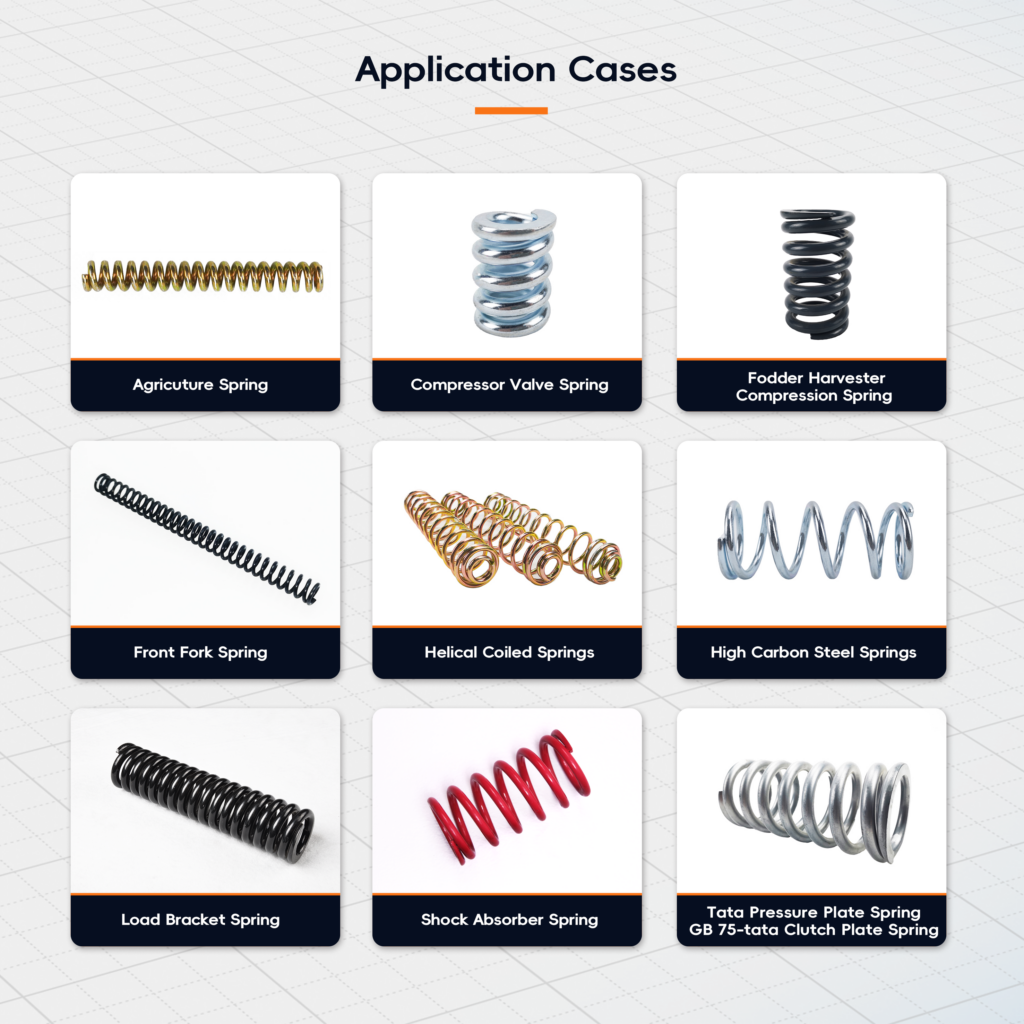
This page shows nine compression springs from NorenSpring’s application cases, used in harvesters, front forks, shock absorbers, a vehicle clutch, a compressor and general machinery. For each part we explain what the spring does in its machine and which parameters decide whether a new or replacement spring will work. It is written for OEM buyers specifying a new design and for replacement-parts distributors matching an existing one.
Key Takeaways
- The nine parts cover farm machinery, vehicle suspension, clutch clamping, compressor valves and load support.
- NorenSpring works with wire diameters from 0.1 mm to 80 mm across its range and can start from a drawing, a sketch or a physical sample.
- An anonymized project below shows how a shock spring that lost force in field use was reworked from a sample for a farm-machinery buyer in the USA.
- Engineering feedback or a quote comes back within 24 hours, with no fixed minimum order.
The nine parts in this portfolio
| Part | Equipment | What the spring does |
|---|---|---|
| Agriculture spring | Farm implements | Long spring that returns or preloads a linkage |
| Compressor valve spring | Compressor | Returns the valve element to its seat after each stroke |
| Fodder harvester compression spring | Forage harvester | Holds a working part under load and absorbs shock |
| Front fork spring | Two-wheeler front fork | Supports the front end and absorbs road impacts |
| Helical coiled springs | General machinery | Return and cushioning duty |
| High carbon steel springs | General machinery | General-purpose open-pitch springs |
| Load bracket spring | Support bracket | Supports a bracket under load |
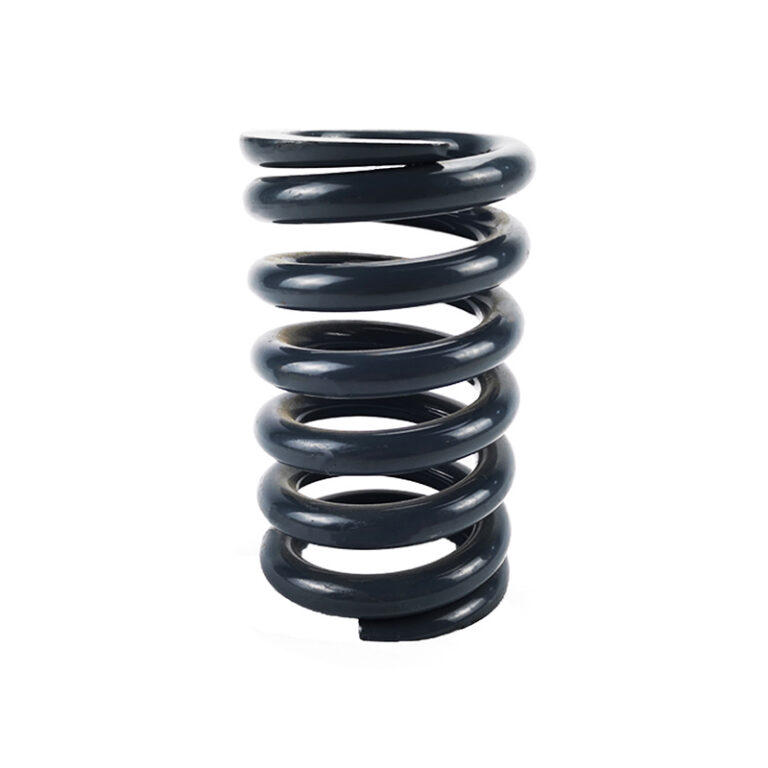
| Shock absorber spring | Coil-over shock absorber | Carries vehicle load around the damper |
| Pressure plate spring | Vehicle clutch | Replacement spring compatible with Tata clutches; one of a set clamping the clutch disc |
Where these springs work
Harvesting and farm implements
Farm springs run in dust and crop residue and take shock loads when a part hits stones or hard ground. The fodder harvester spring is coiled from heavy wire so it can take those impacts. See agricultural spring applications.
Two-wheelers and vehicles
Fork, shock absorber and clutch springs cycle whenever the vehicle moves. A fork spring is slender, but the fork tube guides it. A clutch pressure plate uses several springs in a ring, so spring-to-spring load consistency matters as much as the load itself. More on automotive springs.
Compressors and industrial equipment
A compressor valve spring works with every piston stroke, so it sees many cycles at short travel. The bracket, helical and high carbon steel springs are industrial equipment parts where fit, load and finish come first.
Example project: a shock spring for farm machinery
A buyer in the USA needed a replacement steel shock spring, a coil compression spring used in the shock-absorbing system of agricultural machinery.
- Problem. In long field operation the original spring took constant impact and vibration and lost force over time, which made the machine less stable.
- What we changed. Working from the original sample, our engineers re-analyzed the material, wire diameter, coil count and working height. They adjusted the heat treatment and added spring force testing to the control plan.
- Result. Samples passed installation testing, spring stability improved, and the part met the customer’s requirement for long-term use.
Customer details are kept confidential.
What we check before quoting a part like this
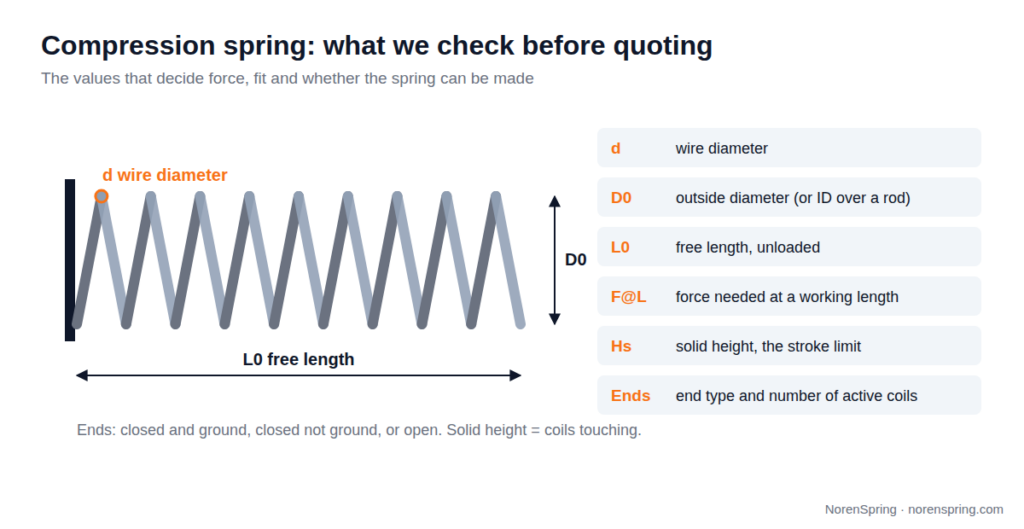
A compression spring is defined by a few dimensions and at least one load at a known length. Our engineers review:
- Load at working length. The force needed at installed height and at full stroke. This matters more than a rate alone.
- Solid height. The length with all coils touching. The shortest working length must stay above it.
- Wire diameter, OD and free length. Wire diameter has the largest effect on stiffness. OD grows slightly under load, so springs in a bore or fork tube need clearance.
- End type. Closed and ground ends give a square seat, which heavy springs usually need.
- Slenderness. A long, thin spring can buckle unless a tube or rod guides it.
- Duty. Valve and suspension springs cycle constantly; a bracket spring may carry a mostly static load. This changes material choice and stress limits.
For every input in detail, read how to specify a custom compression spring.
From sample or drawing to repeat production
Our team of 28+ engineers reviews each project, and we produce more than 4,000,000 springs a month for customers in 60+ countries.
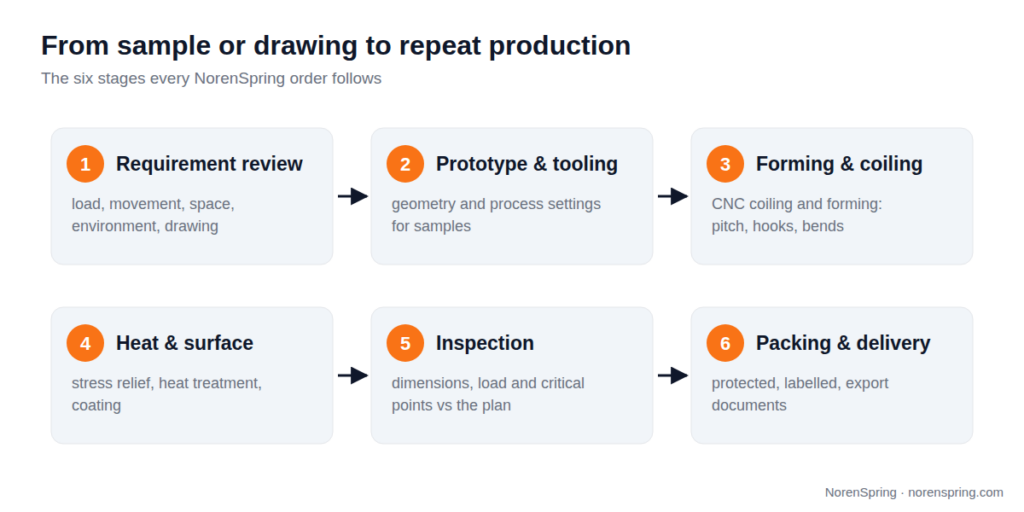
- Requirement review. Load, movement, space, environment and drawing are checked for manufacturability before quoting.
- Prototype and tooling. Samples are made for dimensional, load and application approval.
- Forming and coiling. CNC coiling controls diameter, pitch and free length.
- Heat and surface process. Stress relief, heat treatment and the agreed finish.
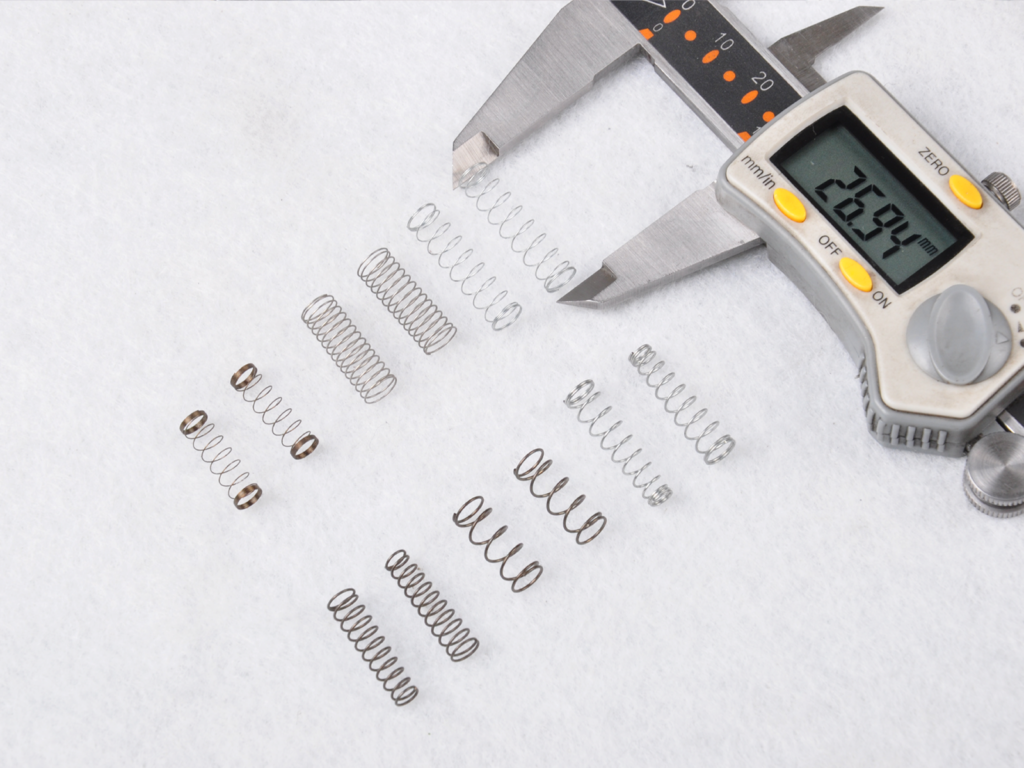
- Inspection and validation. Free height is checked with a Mitutoyo height gauge, and load, rate and working height on spring tension and compression testers, against the agreed control plan. The lab also runs fatigue testers, Rockwell and micro-Vickers hardness testers, a salt spray chamber and a material analyzer.
- Packing and delivery. Parts are protected, identified and shipped with export documentation.
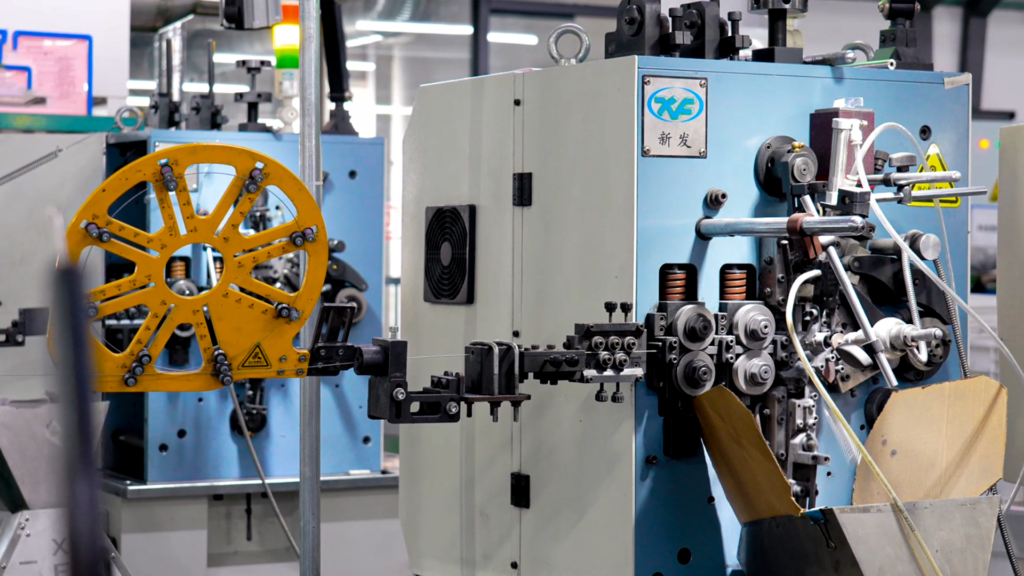
Samples typically take 7 to 15 working days and production 15 to 30 working days. The exact lead time is confirmed at quotation, since it depends on material, tooling, quantity and approvals. See our capabilities for the equipment behind each stage.
Materials, wire sizes and finishes for these parts
The table gives the material, wire diameter range and usual finish for each part, as supplied by our production team, with the main markets each part ships to.
| Part | Material | Wire diameter | Usual finish | Main markets |
|---|---|---|---|---|
| Agriculture spring | 50CrVA or 65Mn | 3–12 mm | Black oxide or phosphate | USA, Germany, India |
| Compressor valve spring | SWOSC-V or 50CrVA | 1–5 mm | Zinc plating or oil tempering | USA, Japan |
| Fodder harvester compression spring | 60Si2Mn or 50CrVA | 5–10 mm | Phosphate coating | Germany, USA |
| Front fork spring | SWOSC-V | 3–8 mm | Black oxide | India, Thailand |
| Helical coiled springs | High carbon steel | 2–15 mm | Oil tempering or painting | USA, Europe |
| High carbon steel springs | 65Mn or 50CrVA | 2–20 mm | Phosphate | Global |
| Load bracket spring | 60Si2Mn | 3–8 mm | Zinc plating | USA, Mexico |
| Shock absorber spring | SWOSC-V | 8–20 mm | Powder coating | USA, Japan |
| Pressure plate spring | 50CrVA | 2–6 mm | Phosphate | India |
Grades are listed as our production team specifies them: 50CrVA (chromium-vanadium), 65Mn and 60Si2Mn are Chinese GB spring steels, and SWOSC-V is a Japanese JIS oil-tempered silicon-chromium wire. Photos may show a different finish from the usual one listed in the table.
Other materials and finishes
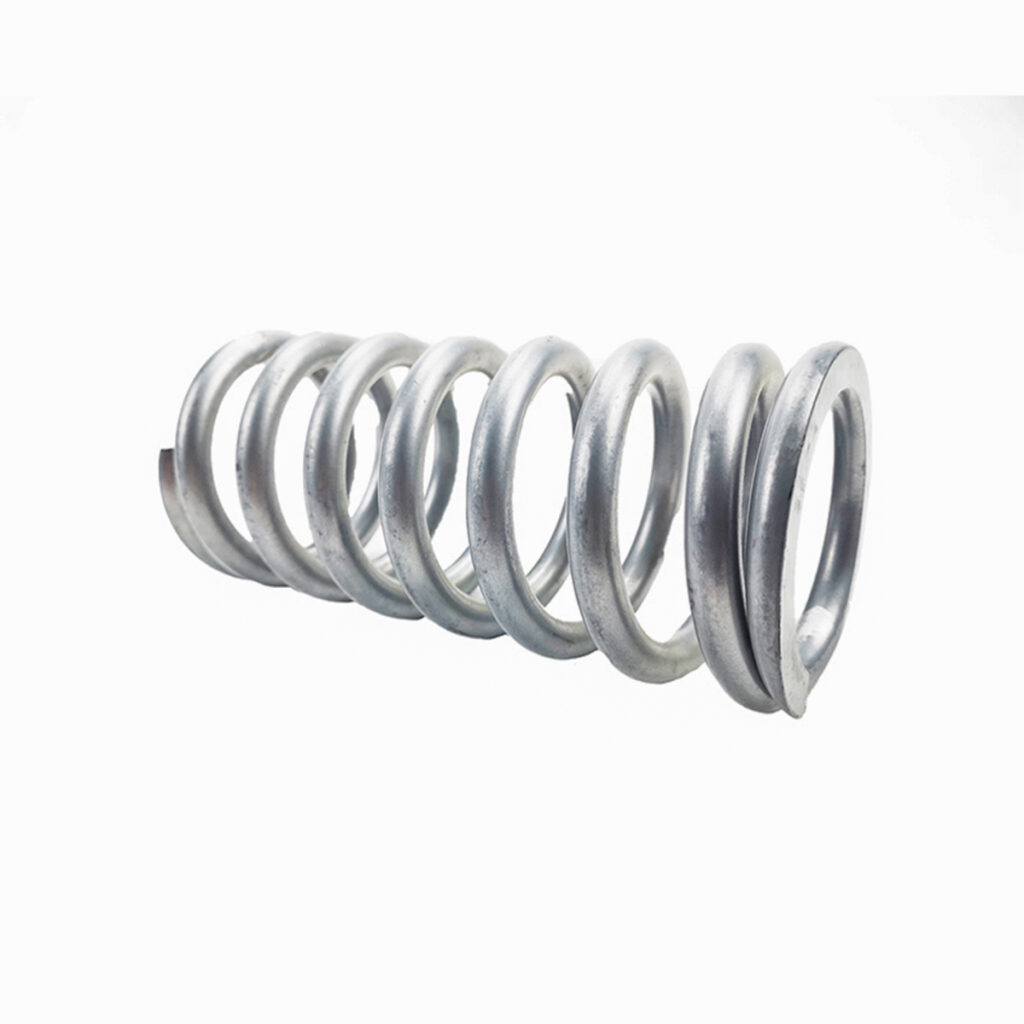
Materials we can quote include carbon spring wire, music wire, oil-tempered wire, silicon-chrome and alloy spring steels, stainless 304 and 316, beryllium copper, phosphor bronze, and nickel and titanium alloys. Inconel and other special alloys can be reviewed for heat or corrosion.
Frequently asked questions
What do you need to quote a compression spring without a drawing?
Wire diameter (d), outside diameter (D0) and free length (L0) are enough to start. Add the working force and environment if known, or send a physical sample.
Can you supply automotive documentation for clutch or suspension springs?
NorenSpring holds IATF 16949 certification, valid to February 4, 2028. Inspection reports, material certificates, dimensional records and traceability are agreed at project setup, and PPAP packages are available for automotive programs.
Is there a minimum order quantity?
No fixed MOQ. Prototype batches and high-volume production are both supported; quantity is evaluated by spring type, tooling and material.
Send a drawing or a sample
Need a spring like one of these, or a replacement for one you already use? Send your drawing, sketch or sample details in DWG, DXF, STEP, PDF, JPG or PNG. An engineer will reply within 24 hours. Or browse our compression springs.
