R&D PROTOTYPING & DESIGN ENGINEERING SPRING SOLUTIONS

Spring prototyping for R&D teams, from a sketch or sample to approved parts.

New designs need fast feedback, small quantities and a clear route from the first sample to repeat production without changing the spring.

R&D Prototyping & Design Engineering Spring Solutions spring application

You can start a spring prototype with a drawing, a hand sketch or a physical sample. We confirm manufacturability before quoting, reply quickly with a quotation or engineering questions, and have no fixed minimum order. That means a small prototype lot and later volume production go through the same engineering review.

Key Takeaways

  • Send a DWG, DXF, STEP, PDF, JPG or PNG file, or post us a physical sample.
  • With no drawing, wire diameter (d), outside diameter (D0) and free length (L0) are enough to start.
  • No fixed MOQ. Quotation or engineering feedback within 24 hours.
  • Prototype and pre-production samples are supplied for dimensional, load and application approval, typically within 7 to 15 working days.

Which springs R&D projects use and why

Early designs often change spring type. A mechanism that pushes back needs a compression spring, one that pulls a part home needs an extension spring, and a lid, lever or hinge that rotates usually needs a torsion spring. Clips and retaining parts are often simpler as wire forms.

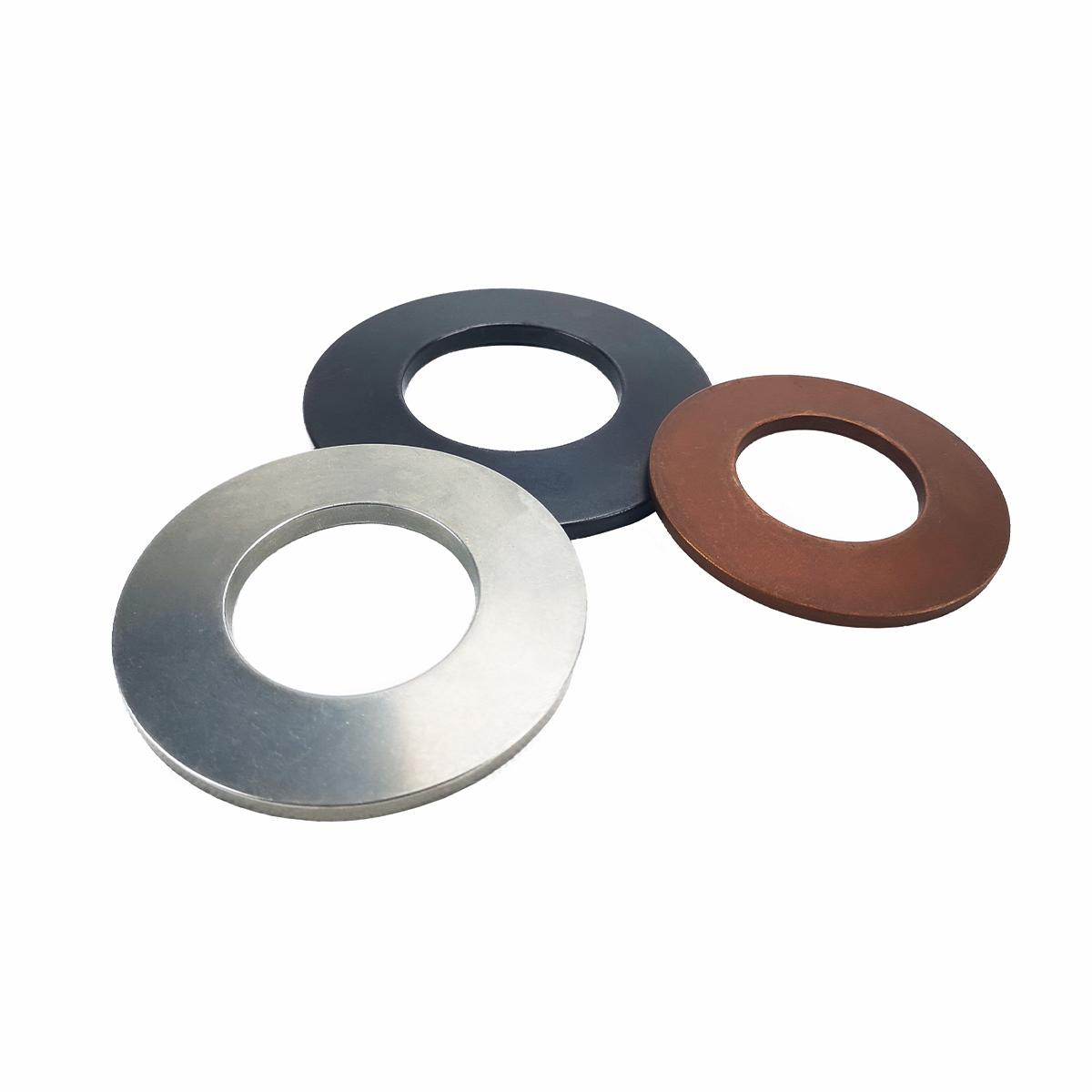
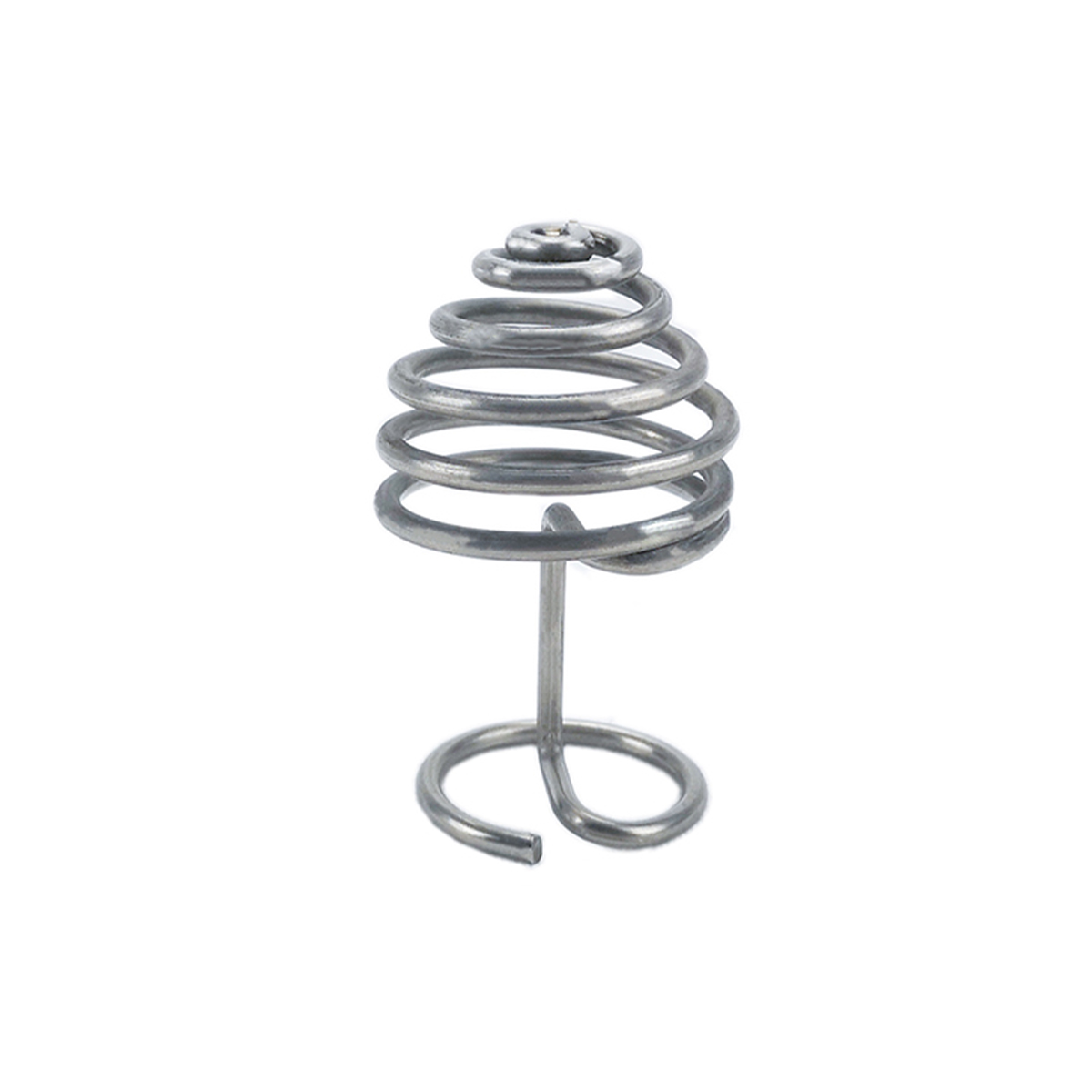
Space is the most common reason a first concept fails. When a coil spring is too tall, a wave spring can often give similar load in less axial height. A conical spring can be designed so its coils nest, giving a lower solid height. Disc springs carry high loads over short travel. Our wire range runs from 0.1 mm to 80 mm, so miniature and heavy-duty versions of a design can both be reviewed here.
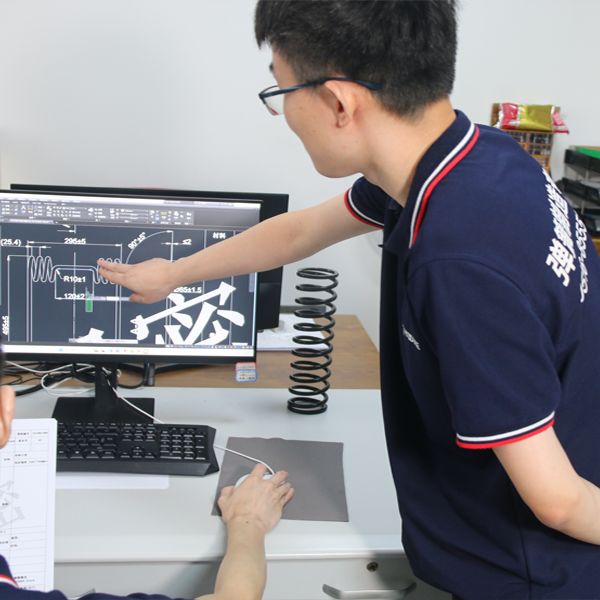
An engineer reviews a spring model on a CAD screen.

Our team of 28+ engineers includes Senior Engineers Pei Jianhua and Chen Zhiyuan, R&D Engineer Li Chengyuan and Export Engineer Ji Minli. Technical content on this site is reviewed by Feng Yulin, General Manager and senior structural engineer, who has 15 years of experience in spring R&D and more than 30 national patents.
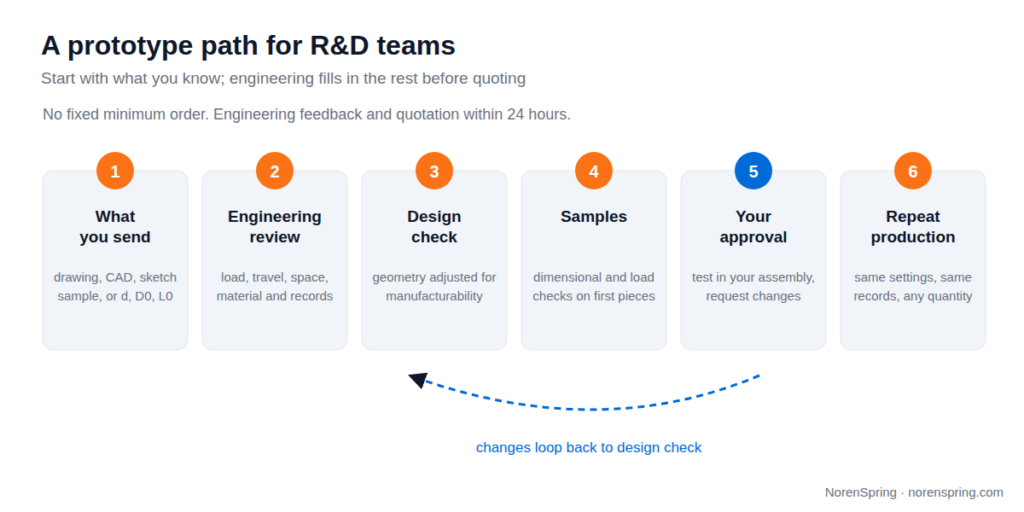
Six steps from what the customer sends, through engineering review, design check, samples and customer approval, to repeat production, with a loop from approval back to design check for changes.

Prototype and tooling is stage 2 of the six-stage process described on our capabilities page, so a prototype goes through the same requirement review as production parts.

Choosing material and finish for prototype and pilot builds

Prototype in the material you plan to produce in. A load test on a substitute wire tells you little, because modulus and strength change the rate and the safe stress level.

Material Why choose it for a prototype Check before approval
Carbon spring wire, piano/music wire High strength, common for general mechanisms Needs a coating or oil where corrosion matters
Oil-tempered wire, silicon-chrome, alloy spring steel Higher stress and larger wire sizes Heat treatment is part of the process
Stainless 304 / 316 Corrosion resistance without plating Lower strength than music wire at the same size
Phosphor bronze, beryllium copper Electrical contact or non-magnetic needs Lower strength than steel; confirm load margin
Nickel alloy, titanium alloy Severe corrosion; nickel alloys also for high temperature, titanium where weight matters Material cost and availability; confirm at quotation

Usual finishes on our parts include zinc and nickel plating, black oxide, phosphate, powder coating, painting, passivation and polishing. A coating adds thickness, so tell us whether the drawing dimensions apply before or after finishing.
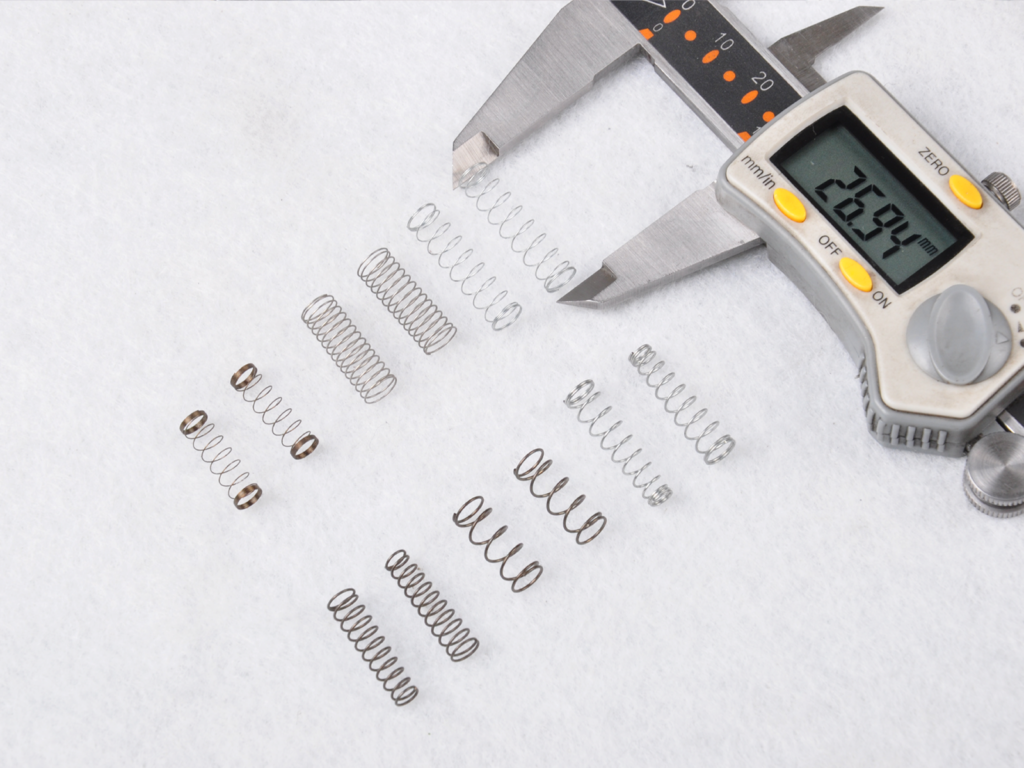
Small springs being measured with a digital caliper during inspection.

What to send for an engineering review

  • Geometry: drawing, sketch or sample. At minimum d, D0 and L0.
  • Load and movement: force or torque at the working position, and travel or angle.
  • Material and environment: temperature, corrosion, cleanliness and expected service life.
  • Quantity and records: prototype quantity, expected production volume, and any inspection reports, material certificates or traceability you need.

Our guide on how to specify a custom compression spring walks through each parameter.

Frequently asked questions

Can you make a prototype from a sample with no drawing?

Yes. We work from the sample and confirm manufacturability before quoting.

Is there a minimum quantity for prototypes?

There is no fixed MOQ. We evaluate quantity by spring type, tooling and material, and we support both small prototype lots and high-volume production.

What records come with prototype samples?

Documentation is agreed at project setup. It can include inspection reports, material certificates, dimensional records and traceability.

Ready to test a design? Share your drawing, sketch or sample details to start the engineering review.

INDUSTRY REQUIREMENTS

A prototype is only useful if it can be built again.

We confirm manufacturability before quoting, so the spring you approve as a sample is one we can reproduce in pilot and volume runs.

Incomplete design data

Many projects start from a hand sketch or a physical sample. Wire diameter, outside diameter and free length are enough to open an engineering review.

Small lots and changing revisions

There is no fixed MOQ. Prototype quantity is evaluated by spring type, tooling and material, so early revisions can be quoted as the design moves.

Moving from sample to production

Geometry, material and process are defined at the prototype stage so pre-production samples match the design you approved.

TYPICAL APPLICATIONS

QUALITY EVIDENCE

Sample Dimensional Checks

Critical dimensions on prototype samples are measured against your drawing or the reference part you sent.

Load at Defined Positions

Force or torque is checked at the working positions you specify, so results can be compared between design revisions.

Sample-to-Production Records

The material certificates and inspection records agreed for samples continue with the approved design into production.

FROM REQUIREMENT TO RELEASE

01

Application Review

We review the mechanism, loads, movement, space and environment from your drawing, sketch or sample, and reply with a quotation or engineering questions within 24 hours.

02

Spring, Material & Prototype

Spring geometry, material and finish are defined, then prototype samples are made for dimensional, load and application approval.

03

Controlled Production

After sample approval, tooling, process settings and in-process checks carry the same design into pilot and volume runs.

04

Validation & Records

Inspection results and the records agreed with you, such as dimensional reports or material certificates, are supplied with samples and batches.

Bring the application. We will define the spring program.

Share your drawing, load, environment, volume and required records.

COMMON QUESTIONS

Answers Before You Ask

Clear answers to common purchasing questions.

Still have questions?
Can you manufacture from my drawing without a standard part number?

Yes. Most of our projects start from a customer drawing or application sketch. We review the geometry, material and performance needs, then confirm manufacturability before quoting.

What is your minimum order quantity?

We support both small-batch prototypes and high-volume production. There is no fixed MOQ — quantities are evaluated based on the spring type, tooling and material requirements.

How do you handle springs for high-temperature or corrosive environments?

We select materials (such as Inconel, stainless steel or special alloys) and surface treatments matched to the operating environment. Our engineers can recommend options based on temperature range, media exposure and cycle life.

What documentation can you provide with production orders?

We supply inspection reports, material certificates, dimensional records and traceability documentation as agreed during project setup. PPAP and FAIR packages are available for automotive and aerospace programs.

What is the expected lead time?

Lead time depends on the spring type, material, tooling, quantity and approval requirements. We confirm the production and sample schedule during quotation.

How are payment and delivery terms confirmed?

Commercial terms, delivery address and documentation requirements are confirmed with the quotation before production starts.

What support is available after delivery?

After-delivery questions can be routed through the project contact for drawing questions, quality documents, repeat orders and application feedback.

Can you provide samples before mass production?

Yes. Prototype and pre-production samples can be arranged for dimensional, load and application approval before the full production order proceeds.