












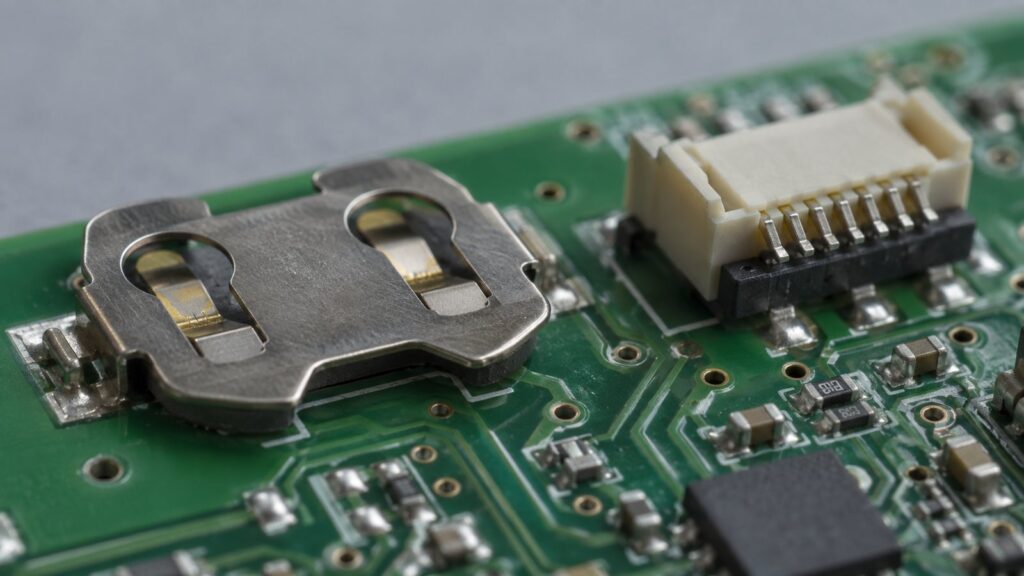
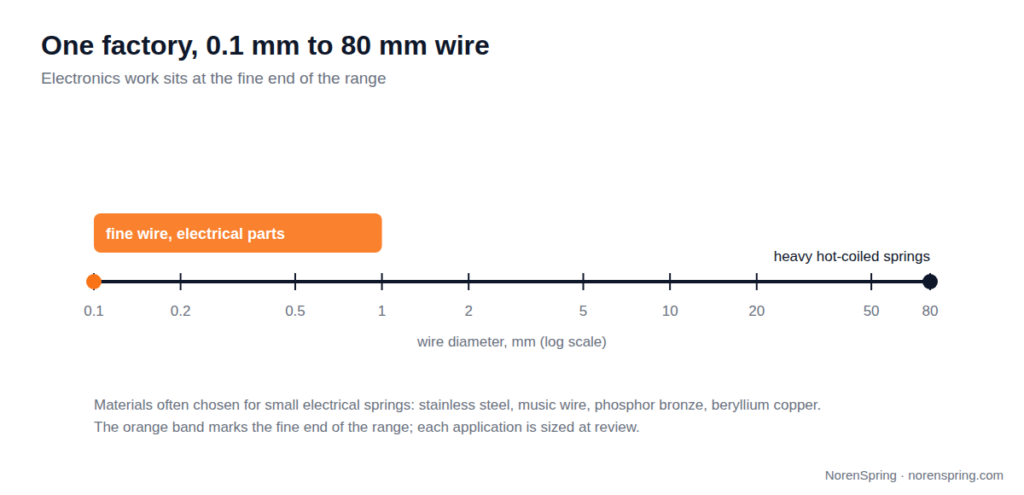
Springs in electronic products are usually small, low-force parts that must hold a contact, return a key or keep a cover shut at a precise height. We coil and form wire from 0.1 mm and offer copper-alloy options such as phosphor bronze and beryllium copper. We have supplied wire-form contact springs for electronic connectors.
Key Takeaways
- Wire diameters start at 0.1 mm, suitable for fine compression, conical and torsion springs.
- Material options include phosphor bronze, beryllium copper, stainless 304 and 316, and music wire.
- The quality system is certified to ISO 9001, with an in-house testing laboratory for inspection.
- No fixed MOQ, so prototype lots and production quantities are both quoted.
Which springs electronic devices use and why
Compression springs hold contacts, return keys and load plungers. The working specification is force at a stated height. Too little force can make an electrical contact unreliable, while too much can wear the mating surface or make a key feel heavy. See our compression springs.
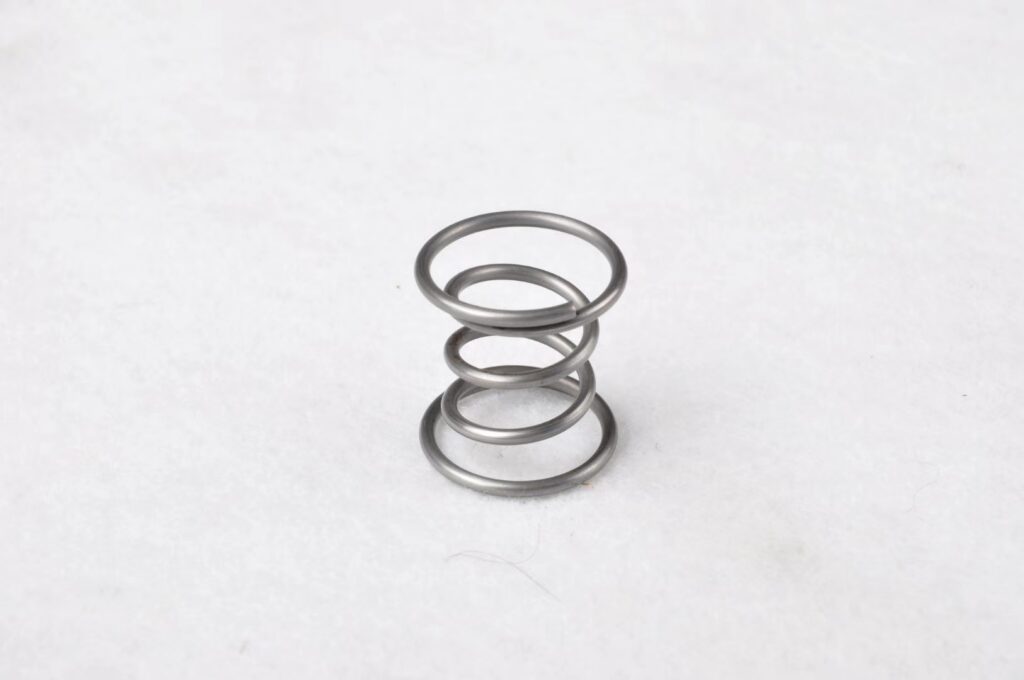
Conical springs are common behind battery cells. When designed so the coils nest inside each other, they compress to a lower solid height than a straight coil of similar diameter and keep the cell centered. Our conical springs page covers the geometry.
Torsion springs return lids, doors and card trays on hinges. The leg angle at the installed position sets the torque, so the drawing should show both the free angle and the working angle. See torsion springs.
Wire forms and clips retain parts, ground a housing or act as simple contacts. Bend angles and leg lengths matter more here than coil geometry. See wire forms.
Choosing material and finish for contacts and enclosures
Start by deciding whether the spring carries current. If it only provides force, a steel wire is often stronger and cheaper. If it conducts, a copper alloy is usually the better base.
| Material | Typical reason in electronics | Consider |
|---|---|---|
| Phosphor bronze | Better conductivity than steel, good corrosion resistance, non-magnetic | Lower strength than steel wire, so wire may need to be larger |
| Beryllium copper | Higher strength than phosphor bronze with good conductivity | Usually age-hardened after forming; tell us if your program restricts beryllium-containing alloys or requires a material declaration |
| Stainless 304 / 316 | Corrosion resistance where the spring is not the main conductor | Poor conductor; cold-drawn 304 spring wire is usually noticeably magnetic, 316 less so |
| Music wire / carbon spring wire | High strength at low cost | Magnetic and needs a coating against corrosion |
If a contact needs plating, put the plating type and thickness on the drawing, and we will confirm at review whether it can be supplied.
What to send for an engineering review
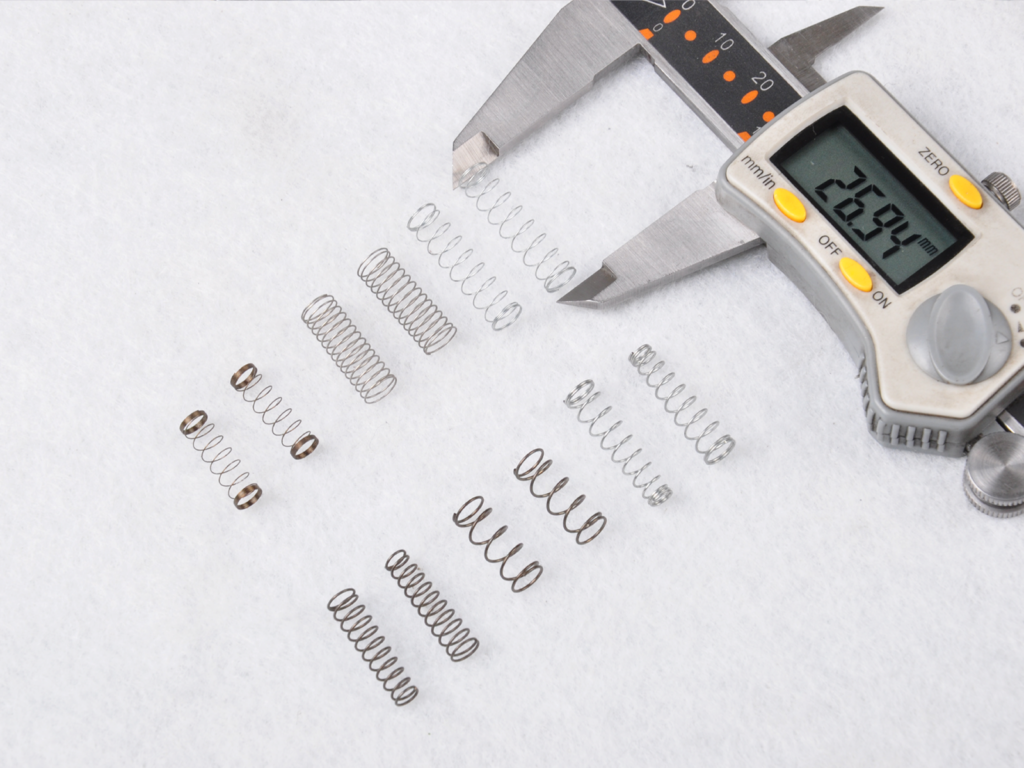
- Geometry: drawing, or at minimum wire diameter (d), outside diameter (D0) and free length (L0).
- Force: force at one or two working heights, travel, and the maximum solid height the space allows.
- Electrical role: does the spring carry current, ground a housing, or neither? Note any non-magnetic requirement.
- Material and surface: base material, plating and any cleanliness requirement.
- Quantity and packing: prototype and production quantities, and whether parts can ship loose or need separating.
We accept DWG, DXF, STEP, PDF, JPG and PNG files. For a related precision application, see our medical and precision devices page.
Frequently asked questions
What is the finest wire you can coil?
Our wire range starts at 0.1 mm and runs up to 80 mm. Whether a specific fine spring is feasible depends on its spring index (mean coil diameter divided by wire diameter) and tolerances, which we confirm at review.
Can you supply phosphor bronze or beryllium copper springs?
Yes. Both are on our material list, together with stainless and carbon spring wires.
Do I need a full drawing to get a quote?
No. Wire diameter, outside diameter and free length are enough to start, and we reply within 24 hours.
Have a contact, key or hinge spring to source? Send your drawing or dimensions for an engineering review.


 Upload a Drawing