












Medical and drug-delivery devices use small compression springs to drive dose mechanisms, fire lancets and return buttons. We have supplied precision compression springs for insulin pens, where the spring drives the dose mechanism, and for lancet devices, where it fires the lancet. As a medical spring manufacturer, we coil wire from 0.1 mm (0.004 in), with materials that include stainless 304 and 316.
Key Takeaways
- We have supplied compression springs for insulin pens and lancet devices.
- Certified to ISO 13485 and ISO 9001; details below.
- Wire from 0.1 mm, with stainless 304 and 316 among the available materials.
- In-house image measuring system, micro-Vickers hardness tester and material analyzer for small stainless springs.
Which springs medical devices use and why
Dose and drive springs
In an insulin pen, a precision compression spring drives the dose mechanism. Force at the working heights has to stay within a narrow band so the device behaves the same from pen to pen. In springs this small, a slight change in wire diameter or active coils changes force noticeably, so tolerances on wire diameter, free length and load are agreed early.
Lancet springs
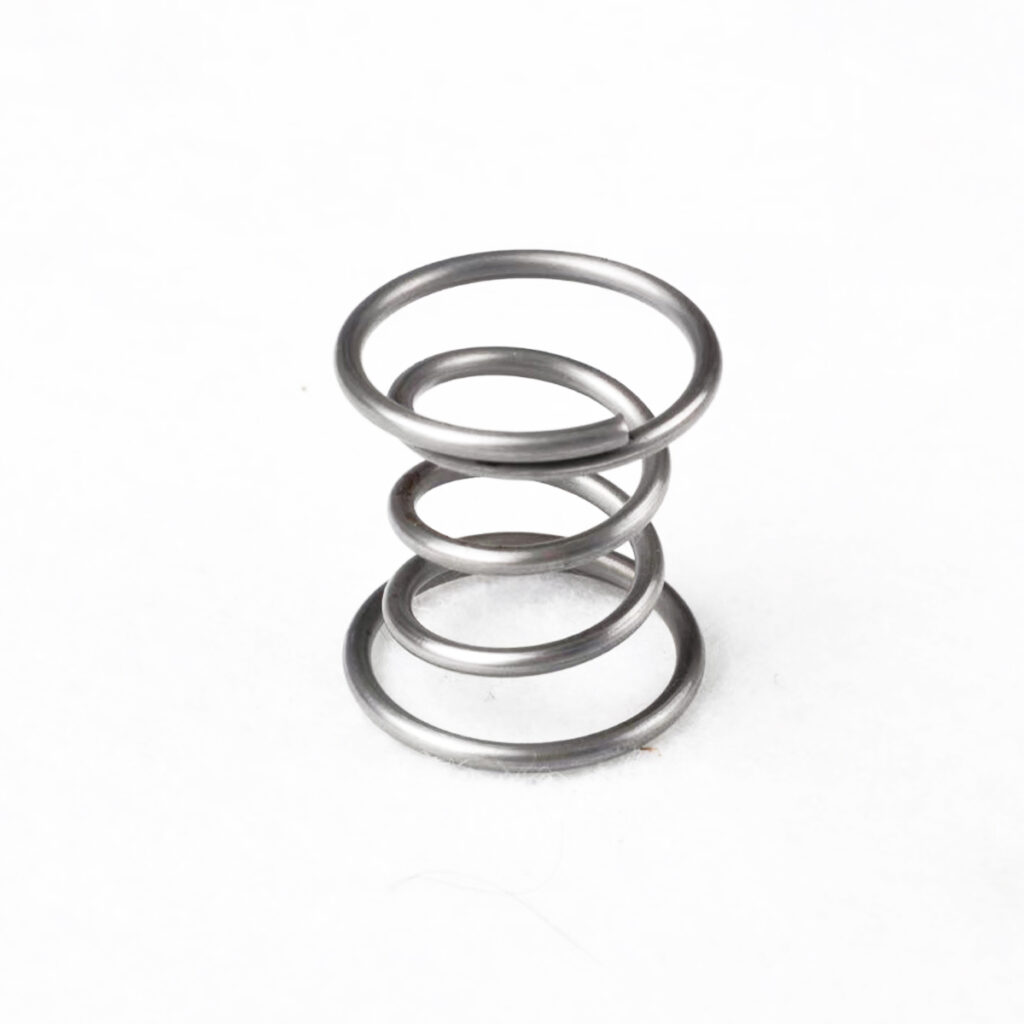
A lancet device uses a compression spring to fire the lancet. The spring releases its stored energy quickly, so firing consistency depends on the force at the cocked and fired positions and the spring rate between them. The cocked height must also stay clear of solid height.
Auto-injectors and other devices
For auto-injectors and other drug-delivery springs, we can review your drawing and confirm manufacturability before quoting; this page does not describe past supply for those devices. Conical springs are worth considering where solid height is tight, and torsion springs suit hinged covers and latches.
Choosing material for medical device springs
| Material | Where it fits | Consider |
|---|---|---|
| Stainless 304 | General device springs | Lower strength than music wire at the same size |
| Stainless 316 | Where higher corrosion resistance is specified | Slightly lower strength than 304 |
| Music wire | Small, high-force springs inside sealed housings | Needs protection against corrosion |
| Titanium alloy spring wire | Where a lighter or non-ferrous option is requested | Higher cost; availability in fine sizes confirmed at review |
| Phosphor bronze or beryllium copper | Springs that also carry current in powered devices | Lower strength than steel |
Our material analyzer confirms stainless 304 or 316 composition, and the micro-Vickers hardness tester is used for stainless and medical springs that are too small for a coarser hardness test. If your device file calls for a specific cleanliness, surface treatment or packaging requirement, list it in the inquiry; each item is confirmed or declined at review.
ISO 13485 for the design and manufacture of medical springs
Our quality management system is certified to ISO 13485:2016, valid to March 26, 2028, alongside ISO 9001. The certificate scope is the design and manufacture of springs for medical devices, and the certificate is shown on our about page. In practice, the steps behind your spring are documented and controlled: requirement review, purchasing, production, inspection, identification and traceability, handling of nonconforming parts, and records.
Certification doesn’t approve your device or the spring inside it. Design verification, biocompatibility and regulatory submissions stay with the device manufacturer. Our job is to design or make the spring to your requirements and supply the records your own quality system needs, as agreed at project setup.
If your supplier agreement requires notice before changes to material, process or production site, include it in the inquiry so the terms are agreed before the first order.
Surface finish and passivation for stainless medical springs
Stainless 304 and 316 springs normally go into a device without a coating. Passivation is a finish we supply on SUS304 springs: a nitric or citric acid treatment that removes free iron and other contamination left by coiling and handling, so the chromium oxide film forms evenly. It adds no thickness and doesn’t change the color, which matters on springs with tight diameter tolerances. ASTM A967 is a widely cited specification for passivation and the tests that confirm it.
Some device makers also specify electropolishing for a smoother, brighter surface. It removes a small amount of metal, so on fine wire it changes diameter and load, and the drawing should say whether dimensions apply before or after polishing.
Music wire springs inside sealed housings still need corrosion protection, usually an oil film or plating, and zinc-plated springs are baked after plating to relieve hydrogen embrittlement.
Write the finish, its specification and any cleaning or packaging requirement on the drawing, and we’ll confirm at review whether each one can be met. Our spring finishes guide compares the options in more detail.
What to send for an engineering review
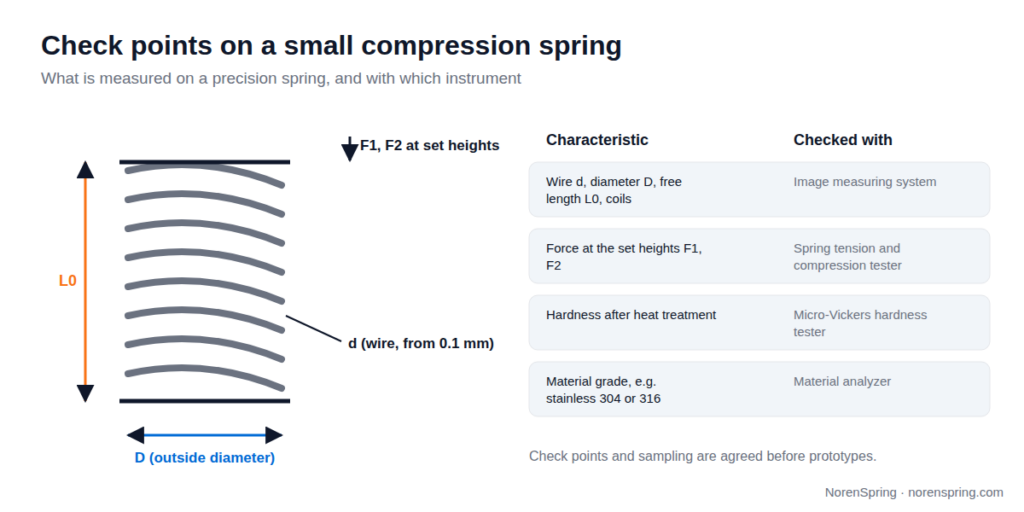
- Geometry: drawing with revision, with critical-to-function characteristics marked.
- Load and movement: force at one or two working heights with tolerance, and travel.
- Space: bore diameter, guide or rod diameter, available solid height.
- Material: grade, finish and any cleanliness requirement.
- Records: material certificates, inspection reports, dimensional records and traceability.
- Quantity: prototype, pilot and production volumes.
For early-stage device work, see our research and development page; fine-wire springs for small assemblies are also covered on the electronics page. Our full process is on the capabilities page.
How small medical springs are inspected and documented
Medical is one of the industries we supply today, and the springs we’ve supplied include precision compression springs for insulin pens and lancet devices. Each batch is checked against the control plan agreed for your part: dimensions, load at the working heights, and every characteristic you’ve marked as critical to function.
The table shows the in-house equipment that fits each kind of check. Which checks apply to your spring is set in the control plan.
| Check | Equipment |
|---|---|
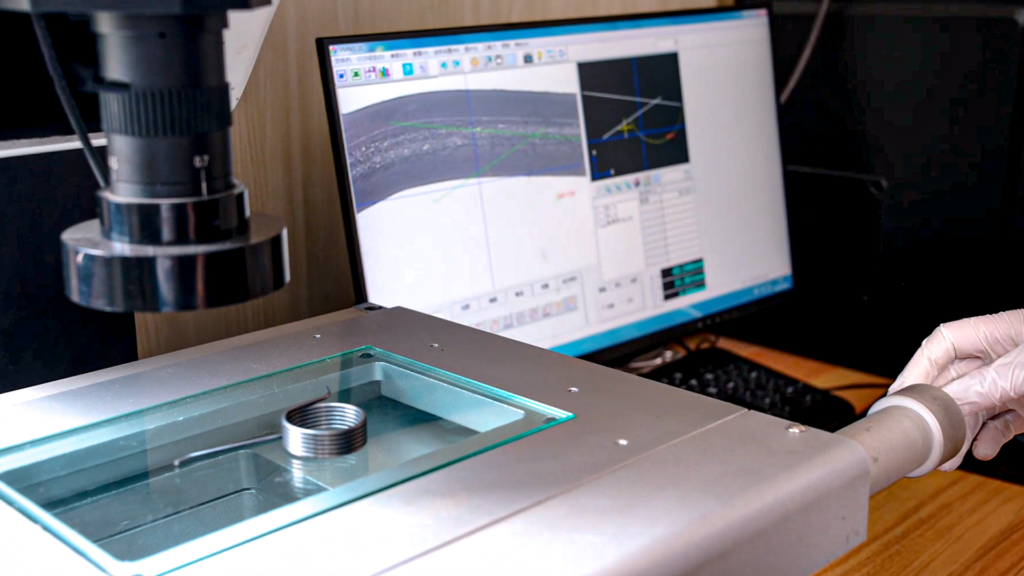
| Wire diameter, outside diameter, free length and coil count on small springs | Keyence IM-8000 image measuring system |
| Free and working heights | Mitutoyo LH-600 height gauge |
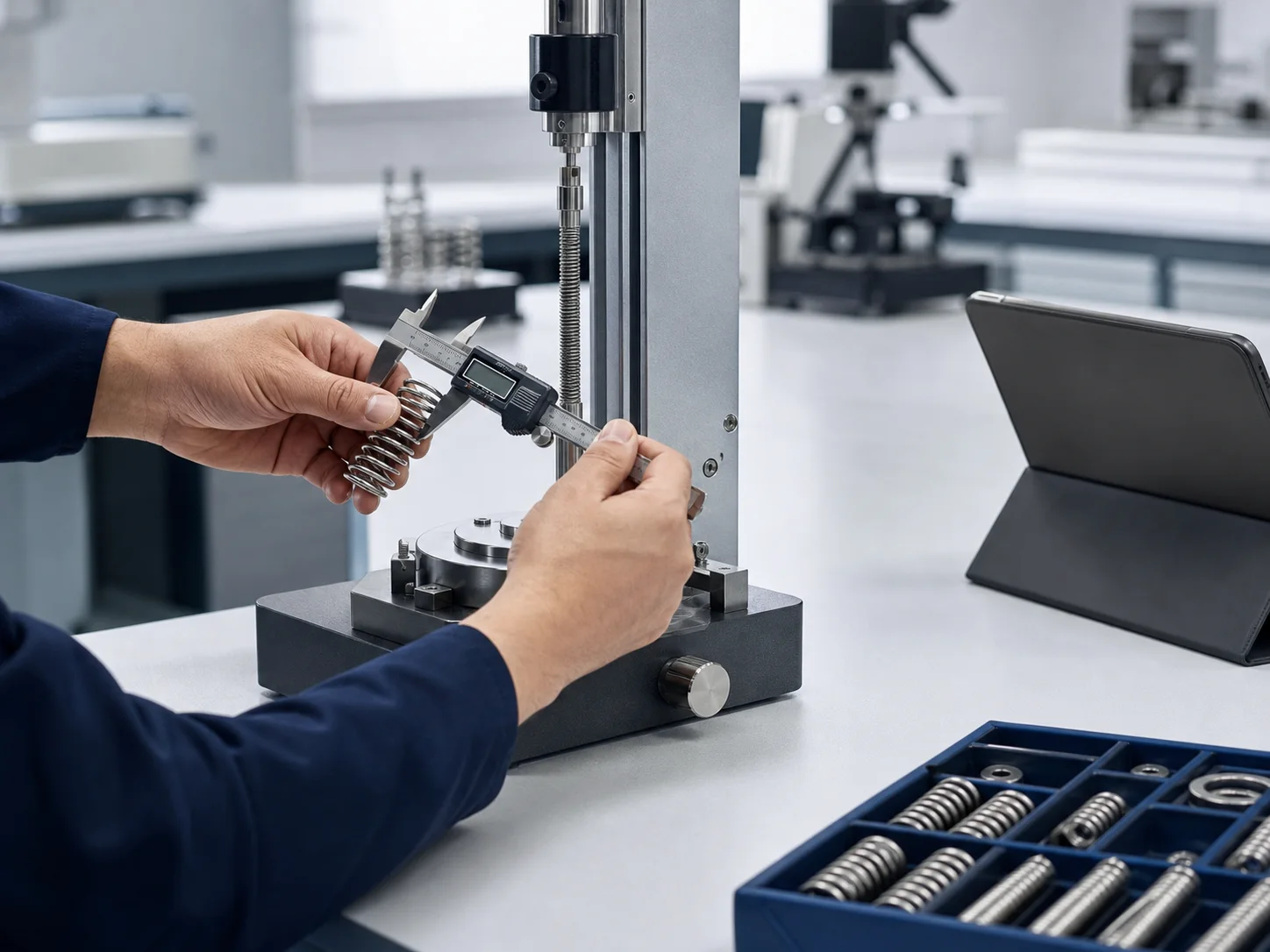
| Load at working height and spring rate | JISC and Aikoh spring testers |
| Automatic load and rate testing on production batches | ALGOL automatic spring tester |
| Hardness of springs too small for a Rockwell test | Mitutoyo HM-200 micro-Vickers hardness tester |
| Corrosion resistance, when a salt spray test is specified | Q-Fog salt spray chamber |
| Record | What it shows | When you get it |
|---|---|---|
| Material certificate | Wire grade and lot, traced to the wire supplier’s certificate | As agreed at project setup |
| Sample approval records | Measured dimensions and load on prototype or pre-production samples | Before production is released |
| Inspection report | Results for the characteristics in the control plan | As agreed at project setup |
| Dimensional records | Measured values for the dimensions you’ve specified | As agreed at project setup |
| Traceability | Link from the shipped lot back to the wire lot and production records, with identified packing | As agreed at project setup |
Tell us in the inquiry which records you need, in what format, and how long they must be kept, so the first shipment arrives with the right paperwork. For the spring types themselves, see our compression springs made to your drawing.
Technically reviewed by Feng Yulin, General Manager (senior structural engineer, 15 years of spring R&D). Last reviewed: 2026-10-16.
Frequently asked questions
What is the smallest wire you can coil?
0.1 mm. Whether a specific small spring can be made depends on its index, coil count and tolerances, which we confirm at review.
Which certification covers medical springs?
See the certification section above. The records supplied with each shipment are agreed at project setup.
Can we get prototypes before production?
Yes. Prototype and pre-production samples are available for dimensional, load and application approval, with no fixed MOQ. Samples typically take 7 to 15 working days and production 15 to 30 working days; the exact lead time is confirmed at quotation.
Send your drawing through our contact page for engineering feedback within 24 hours.




 Upload a Drawing