HYDRAULICS SPRING SOLUTIONS

Valve, brake and preload springs for hydraulic and fluid-power components.

In a pressure valve the spring sets the pressure. Small errors in rate or free length shift the opening point, so force at installed height is the key figure.

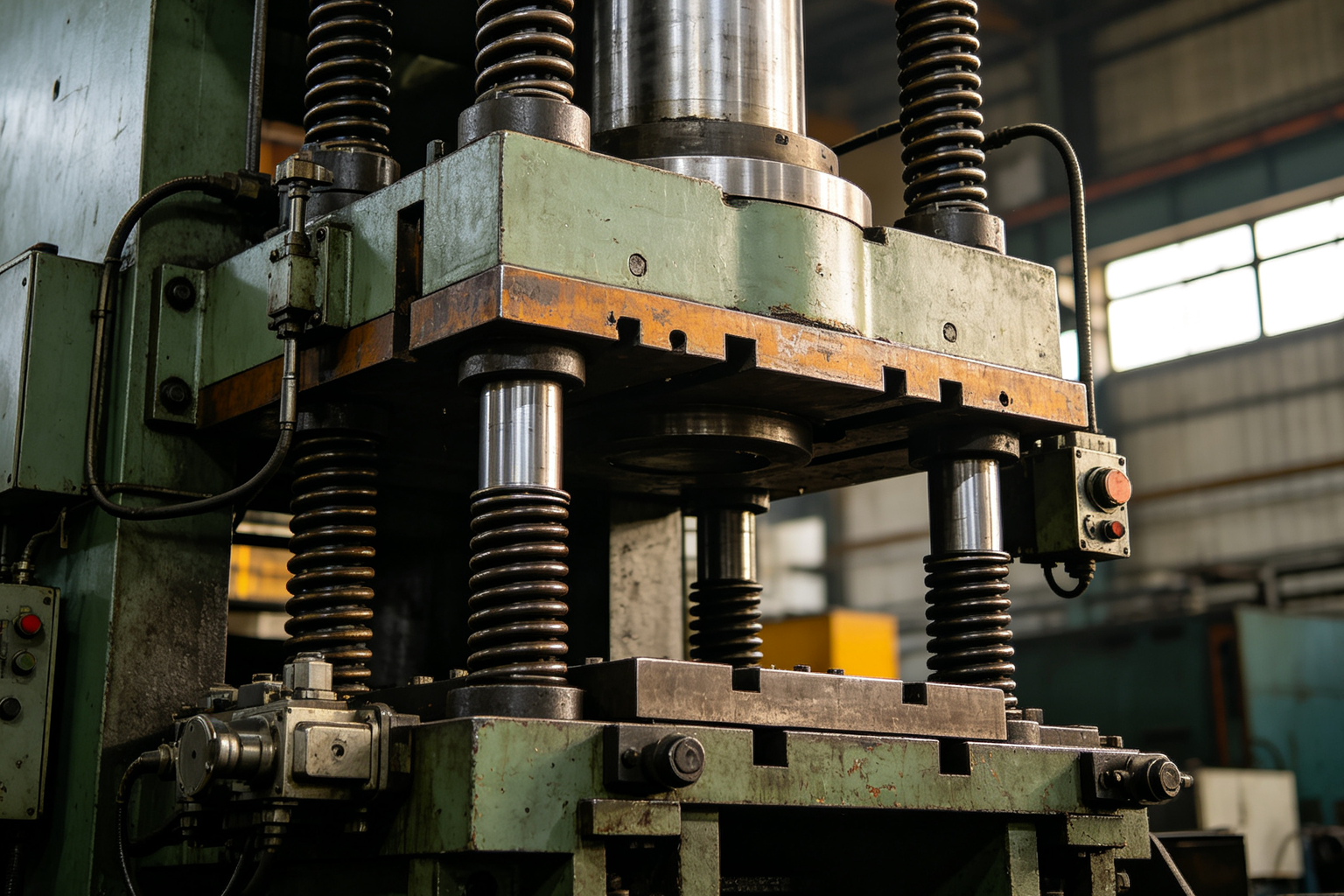
Hydraulics Spring Solutions spring application

Hydraulic and fluid-power components use springs to set pressure, center spools, return pistons and apply brakes that hydraulic pressure then releases. Compression springs and disc springs do most of this work. We have supplied heavy-duty die and compression springs for the return systems of hydraulic presses, and we make compression and disc springs to your drawing or sample. The sections below cover what sets their force and what to send for a review.

Key Takeaways

  • In a direct-acting relief valve, spring force divided by the seat area sets the opening pressure, so load at installed height is the controlling specification.
  • Disc springs stacked in parallel add force; stacked in series they add travel.
  • Our compression portfolio includes a compressor valve spring, and disc springs are part of our product range.
  • Material certificates and inspection reports are available as agreed at project setup.
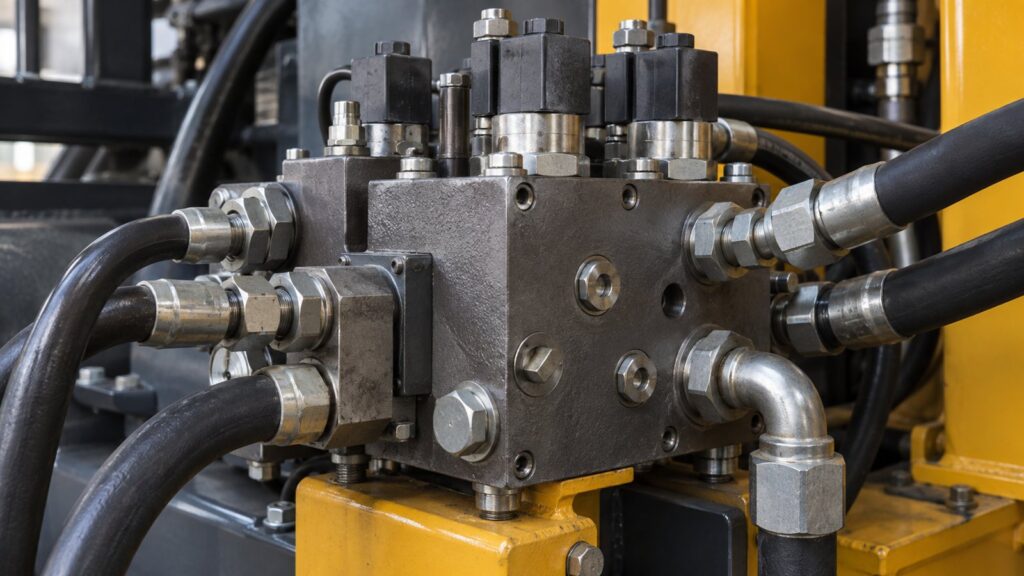
Illustration: a hydraulic valve block with steel fittings and high-pressure hoses on machinery.
Illustration

Which springs hydraulic components use and why

Valve springs

In a direct-acting relief or check valve, a compression spring holds a poppet or ball on its seat. The valve opens when fluid pressure times seat area exceeds the spring’s installed force. As the valve opens further, the spring compresses more and force rises with the spring rate, which is one reason pressure climbs above the cracking setting at full flow. A lower rate keeps that rise smaller but usually needs a longer spring.

The compressor valve spring in our portfolio works in a compressor rather than a hydraulic valve, but the design questions are similar: short lift, frequent cycling and a precise force at the seat.

Conical springs are worth considering where solid height is tight, since, when designed to telescope, their coils nest inside each other when compressed.

Centering and return springs

Directional control valves often use a pair of springs to return the spool to center. Matching the two springs’ installed force keeps the center position repeatable. Single-acting cylinders use a return spring, and wave springs can replace coil springs where axial height and stroke are short.

Disc springs for brakes and clamps

Spring-applied, hydraulically released brakes need high force in little space and must hold when pressure is lost. Disc springs suit this. Stacking discs in alternating directions (series) multiplies deflection; nesting them in the same direction (parallel) multiplies force. Parallel stacks add friction between discs, which creates a difference between loading and unloading force.
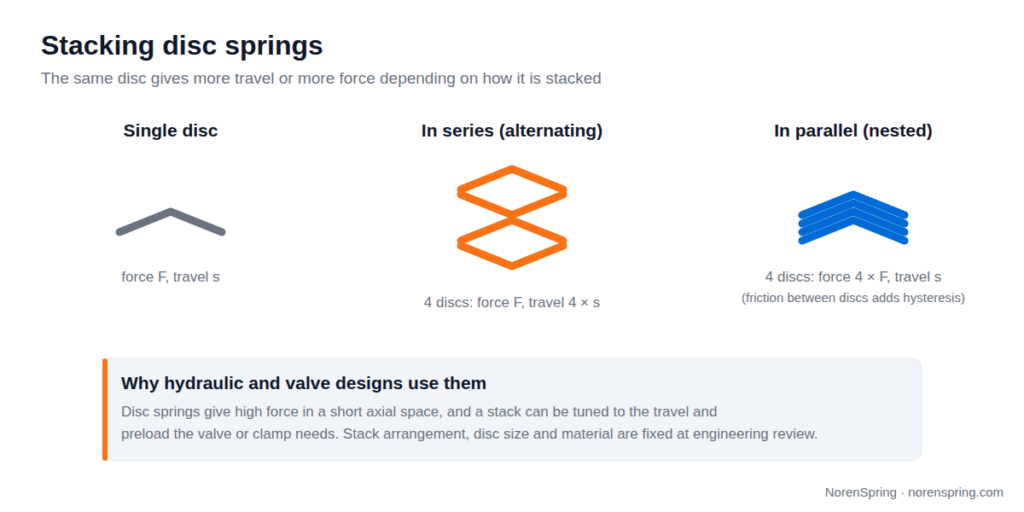
Three schematics: a single disc spring with force F and travel s, four discs stacked in series giving the same force and four times the travel, and four discs nested in parallel giving four times the force and the same travel.
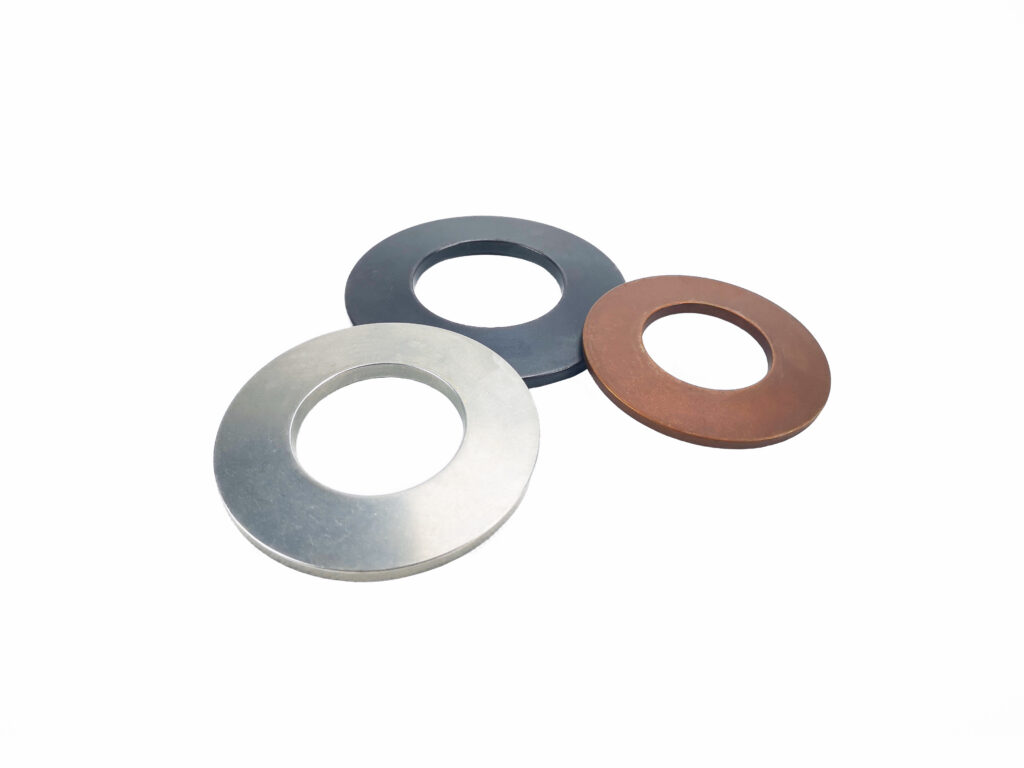
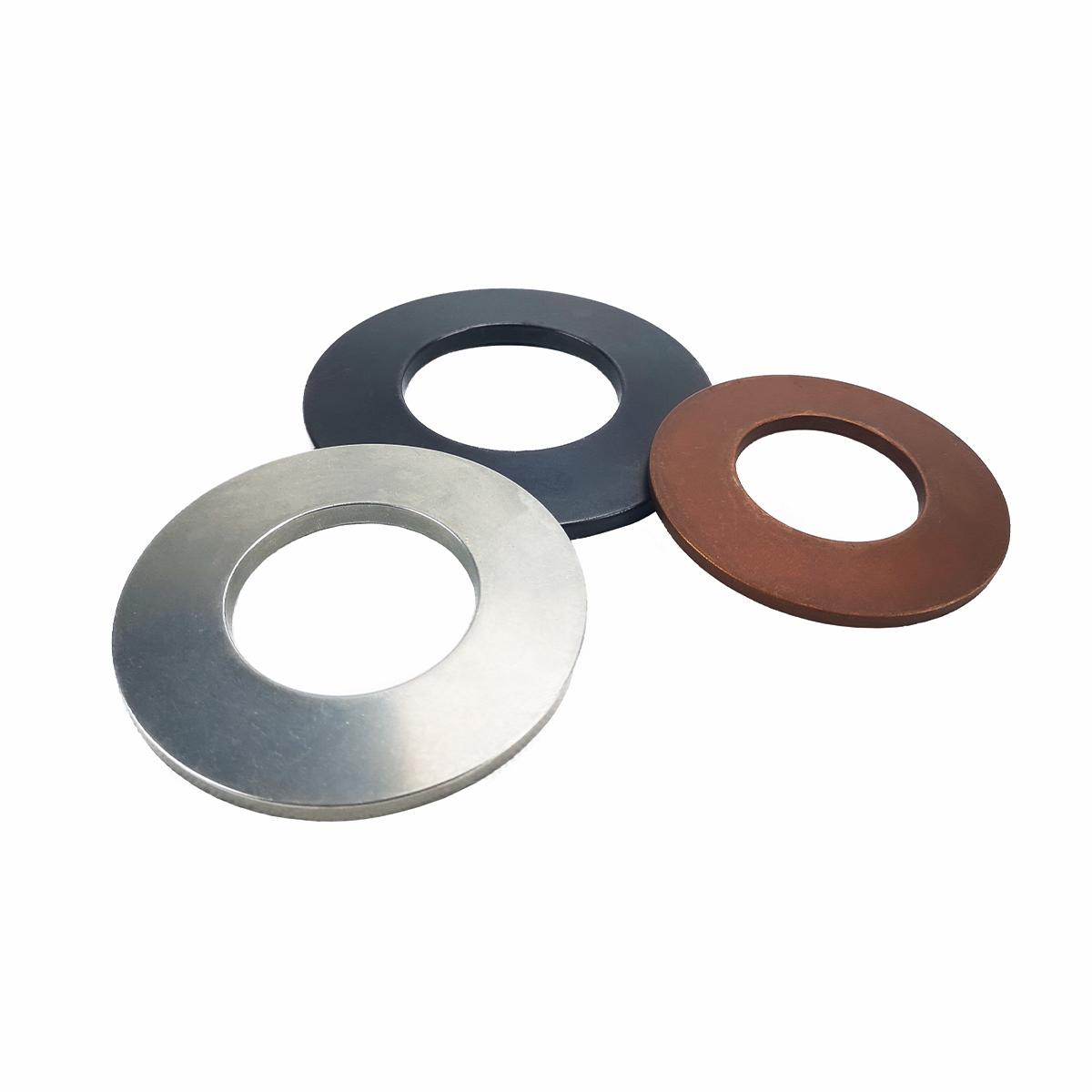
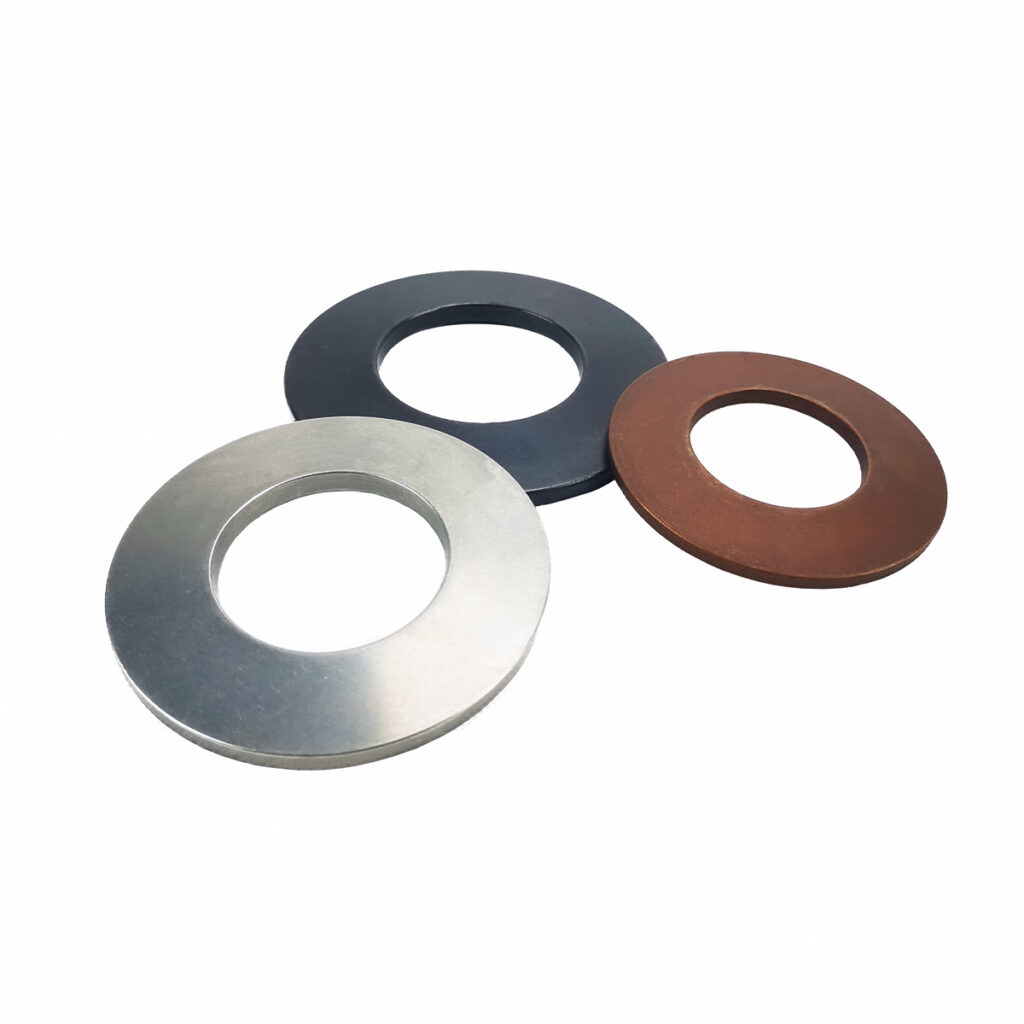
Disc springs in black, bright steel and bronze finishes, in several diameters.

Choosing material and finish for hydraulic fluid and temperature

Option Where it fits What to weigh
Music wire Small pilot and check valve springs High strength in fine sizes
Oil-tempered wire Larger valve and return springs Common choice for dynamic springs in oil
Silicon-chrome spring steel Valve springs with high stress or warm oil Better relaxation resistance at elevated temperature
Alloy spring steel Disc springs and heavy brake springs Suited to high static and dynamic load
Stainless steel 304 / 316 Water-based fluids or wet outdoor actuators Corrosion resistance; lower strength than spring steel
Plain or oiled finish Springs immersed in oil No coating to shed particles into the fluid; cleanliness needs agreed at review
Three disc springs photographed together.

What to send for an engineering review

  • Valve or actuator type and a sectional drawing if you have one.
  • Installed height and force, plus open height and force (or the pressure setting and seat diameter).
  • Space limits: bore diameter, rod or guide diameter, available solid height.
  • Fluid type, operating temperature and any cleanliness requirement.
  • Quantity and required records.

Wire diameter d, outside diameter D0 and free length L0 are enough to start if you have no drawing. See our capabilities for the full process.

Frequently asked questions

What if we only know the pressure setting?

Send the pressure setting and seat diameter with the installed height; if you have the spring, wire diameter d, outside diameter D0 and free length L0 are enough to start.

Can we get samples for bench testing?

Yes. Prototype and pre-production samples are available for dimensional, load and application approval.

What quality records are available?

As agreed at project setup: inspection reports, material certificates, dimensional records and traceability. We are certified to ISO 9001 and IATF 16949 and run an in-house testing laboratory.

Send your valve data or sample through our contact page for engineering feedback within 24 hours.

INDUSTRY REQUIREMENTS

Pressure setting starts with force at installed height.

We review the valve or actuator, the force needed at the installed and open positions, the fluid, the temperature and any cleanliness requirement before proposing geometry and material.

Narrow force windows

Relief and check valves open at a set pressure, so load tolerance at installed height and spring rate across the lift are defined first.

Fluid, temperature and cleanliness

Springs run immersed in oil or water-based fluid, so material, surface condition and loose particles are considered with the circuit in mind.

High force in short height

Spring-applied brakes and clutches need large force in little axial space, where disc spring stacks often fit better than coil springs.

TYPICAL APPLICATIONS

Relief, Check & Pressure Valves

Compression and conical springs that set opening pressure and reseat poppets and balls; our compression portfolio includes a compressor valve spring.

Relevant spring families:

Spool Centering & Cylinder Return

Centering springs for directional control spools and return springs for single-acting cylinders and actuators, including wave springs where height is short.

Relevant spring families:

Spring-Applied Brakes & Clutches

Disc spring stacks and heavy compression springs that hold a brake or clutch engaged until hydraulic pressure releases it.

Relevant spring families:

QUALITY EVIDENCE

Force at Installed Height

Load is measured at the installed height that corresponds to the valve's pressure setting.

Rate Across the Lift

A second load point at the open position confirms the rate, which governs how pressure rises as the valve opens.

Material & Surface Records

Material certificates and agreed surface condition records stay linked to each lot of valve or brake springs.

FROM REQUIREMENT TO RELEASE

01

Application Review

We review the valve or actuator, pressure setting, installed height, lift or stroke, fluid and temperature.

02

Spring, Material & Prototype

Geometry, material and end form are defined, and samples are made for force checks and bench trials in your valve.

03

Controlled Production

Approved tooling and coiling settings keep free length and rate consistent, since both move the pressure setting.

04

Validation & Records

Force at installed and open heights, key dimensions and other agreed characteristics are checked before release, with records as agreed.

Bring the application. We will define the spring program.

Share your drawing, load, environment, volume and required records.

COMMON QUESTIONS

Answers Before You Ask

Clear answers to common purchasing questions.

Still have questions?
Can you manufacture from my drawing without a standard part number?

Yes. Most of our projects start from a customer drawing or application sketch. We review the geometry, material and performance needs, then confirm manufacturability before quoting.

What is your minimum order quantity?

We support both small-batch prototypes and high-volume production. There is no fixed MOQ — quantities are evaluated based on the spring type, tooling and material requirements.

How do you handle springs for high-temperature or corrosive environments?

We select materials (such as Inconel, stainless steel or special alloys) and surface treatments matched to the operating environment. Our engineers can recommend options based on temperature range, media exposure and cycle life.

What documentation can you provide with production orders?

We supply inspection reports, material certificates, dimensional records and traceability documentation as agreed during project setup. PPAP and FAIR packages are available for automotive and aerospace programs.

What is the expected lead time?

Lead time depends on the spring type, material, tooling, quantity and approval requirements. We confirm the production and sample schedule during quotation.

How are payment and delivery terms confirmed?

Commercial terms, delivery address and documentation requirements are confirmed with the quotation before production starts.

What support is available after delivery?

After-delivery questions can be routed through the project contact for drawing questions, quality documents, repeat orders and application feedback.

Can you provide samples before mass production?

Yes. Prototype and pre-production samples can be arranged for dimensional, load and application approval before the full production order proceeds.