











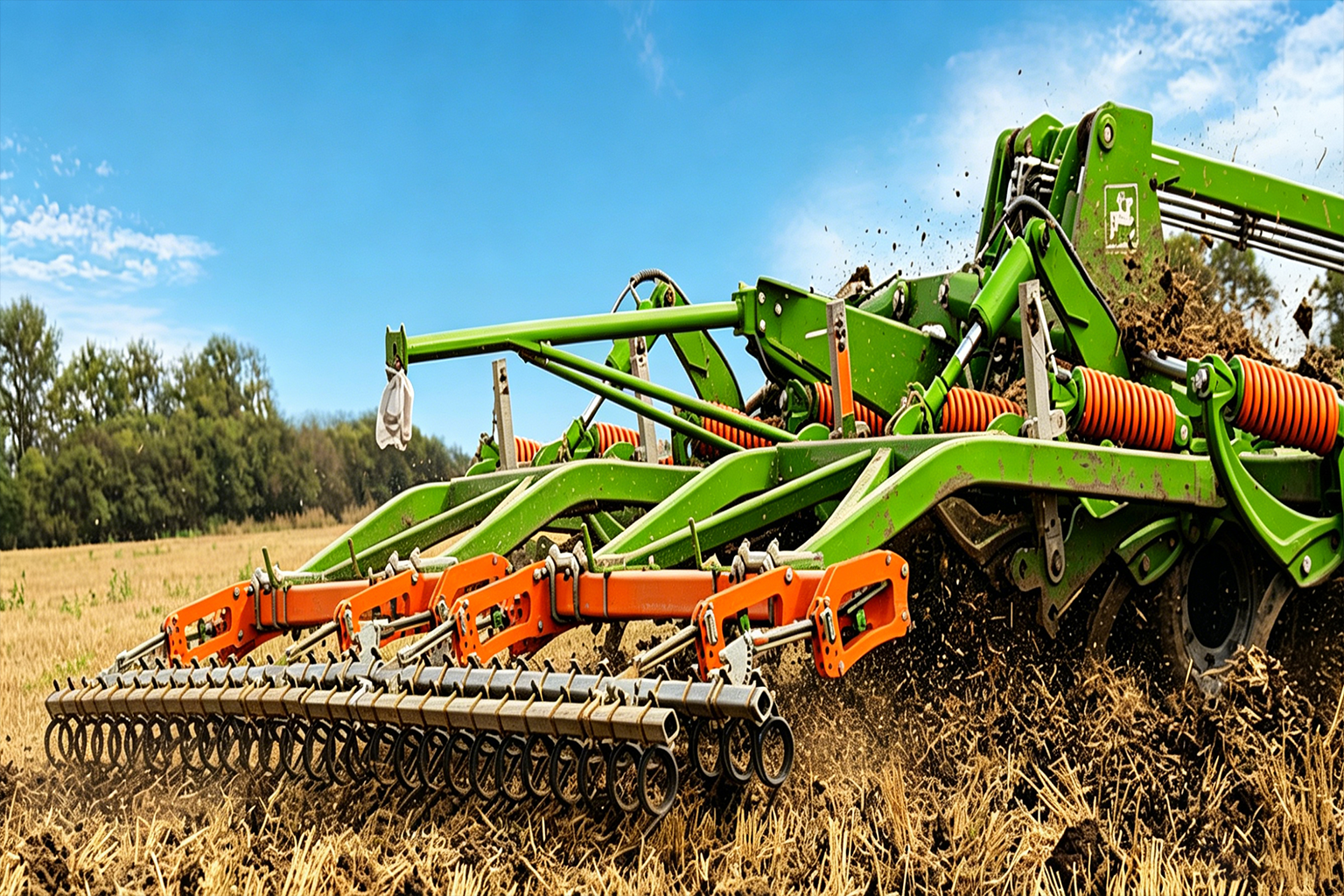
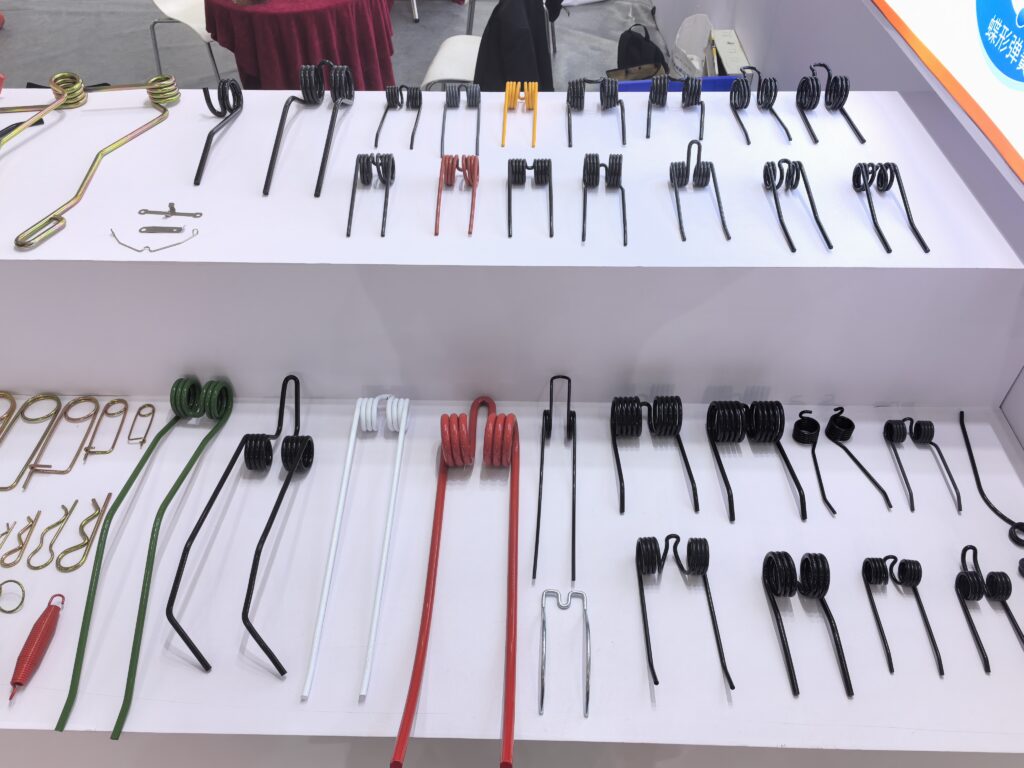
Agricultural machines need springs that flex under crop and soil loads, survive impacts and return to shape season after season. We make harvester reel tines, baler tines, tillage tines, cultivator springs and tractor pedal springs to customer drawings or physical samples. Agriculture is the largest group in our published wire form and torsion application cases.
Key Takeaways
- 16 of the 36 parts shown in our four application case images are agricultural, including reel tines, baler tines, tillage tines, cultivator springs and tractor pedal springs.
- We can start from a drawing, a sketch or a physical sample, which suits replacement parts that have no drawing.
- Wire diameters run from 0.1 mm to 80 mm, with no fixed minimum order quantity.
- Engineering feedback or a quotation comes within 24 hours.
Which springs agricultural machinery uses and why
Harvester headers and pickups
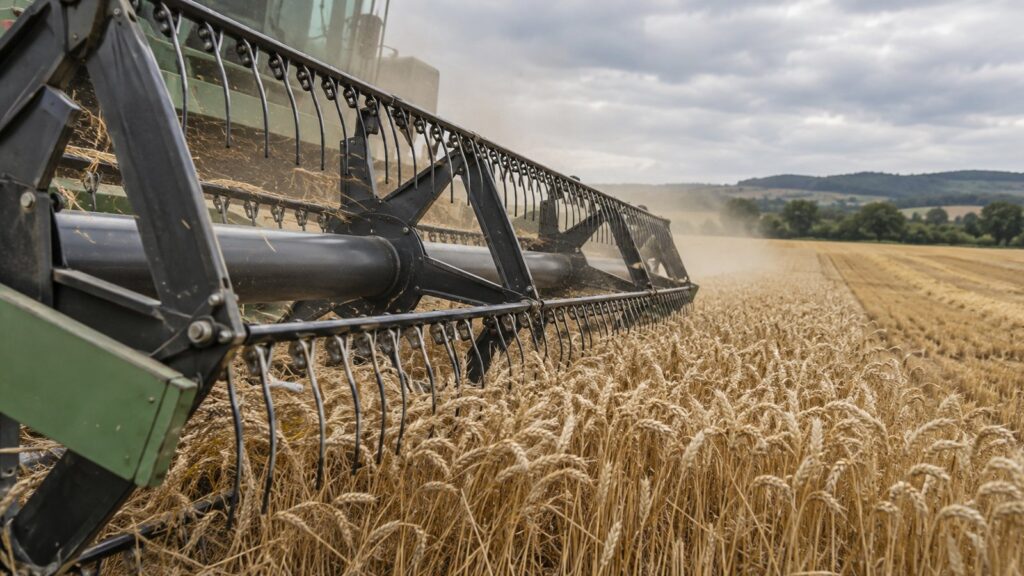
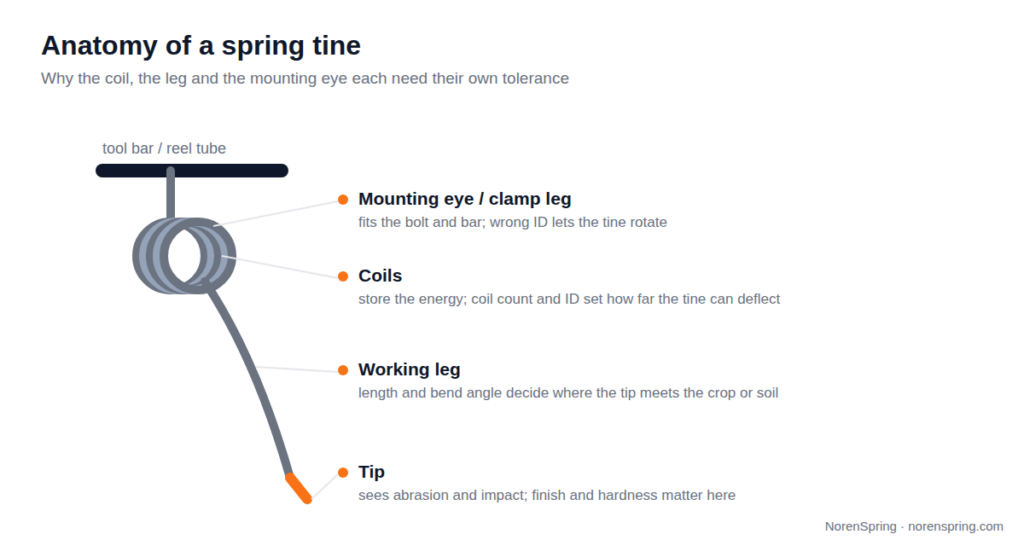
Reel tines and pickup fingers lift and feed the crop. Each tine is a wire form whose coils act as a torsion spring: when the tip strikes the ground or a heavy clump, the coil lets it swing back, then returns it. Coil count, wire diameter, coil diameter and leg length set the stiffness. Our portfolio includes reel tines and finger springs, among them replacement tines compatible with Claas Lexion and Tucano headers.
Balers and forage harvesters
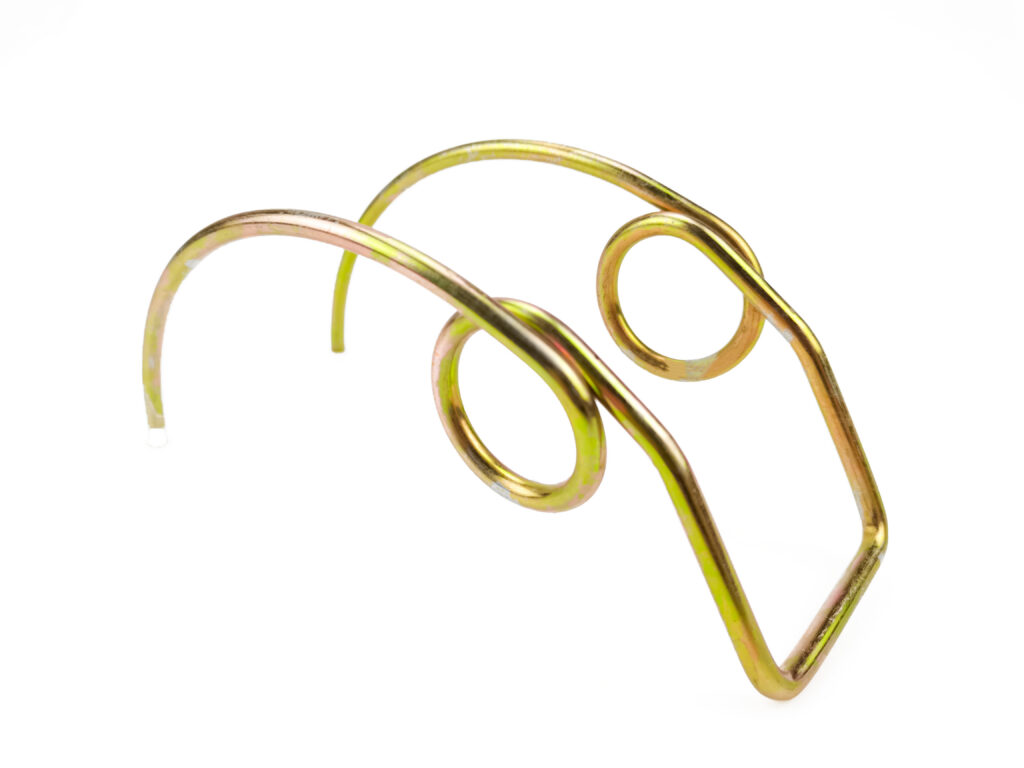
Baler pickup tines are usually double torsion springs: two coils joined by a loop that clamps to the tine bar. The coils and the bends where the wire leaves the coil, into the tine leg or the mounting loop, carry the highest stress, so bend radii are reviewed carefully. Our portfolio includes replacement baler tines compatible with McHale balers and compression springs for fodder harvesters. To measure a worn tine and specify a replacement, see our spring tines guide for balers, rakes and tedders.
Tillage equipment
Harrow, cultivator and subsoiler tines work inside the soil and take repeated shocks from stones. A coil that deflects and recovers protects the tine and the frame. Cultivator coil springs and extension springs hold working parts against the ground.
Tractor controls
Pedal return springs bring brake, clutch and accelerator pedals back to rest. They need steady force at the installed position and hooks or legs that match the pedal bracket. Examples include brake pedal springs suitable for Mahindra tractors and an accelerator foot spring suitable for Massey Ferguson tractors. The brand names only show which tractors these replacement springs fit.
Choosing material and finish for field conditions
Field springs meet water, mud, fertilizer and crop sap, then sit in storage between seasons. The choice balances fatigue strength against corrosion resistance.
| Option | Where it fits | What to weigh |
|---|---|---|
| Oil-tempered wire | Larger tines, cultivator springs | Good fatigue strength; needs a finish outdoors |
| Carbon spring wire | Pedal and extension springs | Economical; relies on plating or coating |
| Silicon-chrome spring steel | High-stress tines under shock | Higher strength at the same wire size; higher cost |
| Stainless steel 304 / 316 | Constant wet or corrosive contact | Lower strength than spring steel at equal diameter, so geometry may change |
| Yellow or bright zinc | Parts exposed to weather | Yellow zinc is visible on the reel tine shown on this page |
| Black, red or blue coating | Parts matching the original’s appearance | Color confirmed at review |
Electroplated high-strength spring steel is normally baked soon after plating to reduce the risk of hydrogen embrittlement, so the finish and any post-plating treatment are agreed at review.
What to send for an engineering review
For a replacement part with no drawing, a physical sample is enough to start. Otherwise send:
- A drawing (DWG, DXF, STEP or PDF) or a photo (JPG or PNG) with key dimensions.
- For a coil spring: wire diameter d, outside diameter D0 and free length L0 are enough to start.
- For a tine: wire diameter, number of coils, wind direction, leg lengths, the angle between legs and the mounting eye size.
- The machine and position where the part fits.
- Load at the working position, if known, plus quantity and the records you need.
Lead time is confirmed at quotation, which helps when you plan stock ahead of harvest. See our six-stage process for what follows.
Download our Agricultural Springs brochure (PDF) for the full range, or meet us at Booth N19B03 at CIAME 2026 in Tianjin, October 26–28, 2026.
Frequently asked questions
Can you copy a worn tine if we have no drawing?
Yes. We can work from a physical sample, confirm manufacturability before quoting, and make prototype samples for fit and load approval before production.
Is there a minimum order for replacement tines?
There is no fixed MOQ. Small batches and high-volume runs are both supported; the practical quantity depends on spring type, tooling and material.
What records come with an order?
As agreed at project setup: inspection reports, material certificates, dimensional records and traceability. We hold ISO 9001 and IATF 16949 certification.
Send your drawing, photo or sample through our contact page and we will reply with engineering feedback or a quotation within 24 hours.



 Upload a Drawing