










A wire form is spring wire bent into a shape rather than coiled into a helix, though some include a coil or two. The nine wire forms on this page, from NorenSpring’s application cases, fall into two families: tines that work crop and soil on harvesters, balers, harrows and subsoilers, and clips that hold parts in place. For both, the shape is the specification. This page is for OEM buyers of implement parts and for dealers and distributors who stock replacement tines and clips. If you are replacing worn pickup or rake tines, our spring tines guide shows what to measure on a sample.
Key Takeaways
- Six of the nine parts are tines for harvester reels, balers and soil-working implements; three are circlips, retaining springs and clips.
- The reel harvester tine, the single torsion spring tines and the spring clips include torsion coils; the other parts are bent wire only.
- Our group company Chaofan Spring (Jiangsu Chaofan Spring Manufacturing Co., Ltd.) has exhibited at an agricultural-machinery parts show in China under the banner “one-stop solution for agricultural machinery spring parts”.
- There is no fixed minimum order, so small replacement batches and high-volume runs can both be quoted.
- An anonymized project below shows how R-pin clips for farm machinery in Thailand were made consistent enough for smooth assembly.
The nine parts in this portfolio
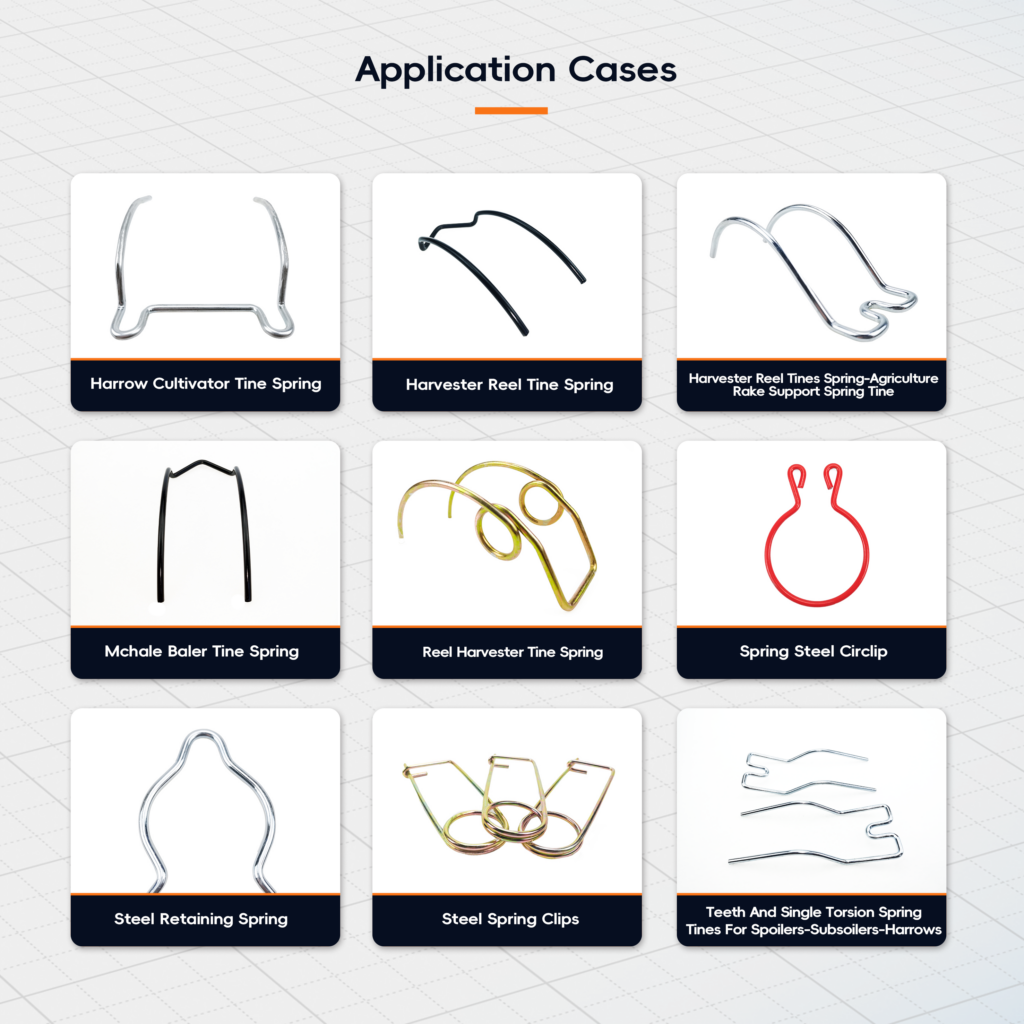
| Part | Equipment | What the wire form does |
|---|---|---|
| Harrow cultivator tine spring | Harrow or cultivator | U-shaped double tine that clamps to the frame and works the soil surface |
| Harvester reel tine spring | Harvester reel | Curved tine that lifts and feeds crop toward the cutter bar |
| Harvester reel tine / rake support spring tine | Harvester reel or rake | Tine with a hooked mounting end that supports and guides crop |
| Baler tine spring | Baler pickup | Replacement tine compatible with McHale balers; a double tine that lifts the swath into the baler |
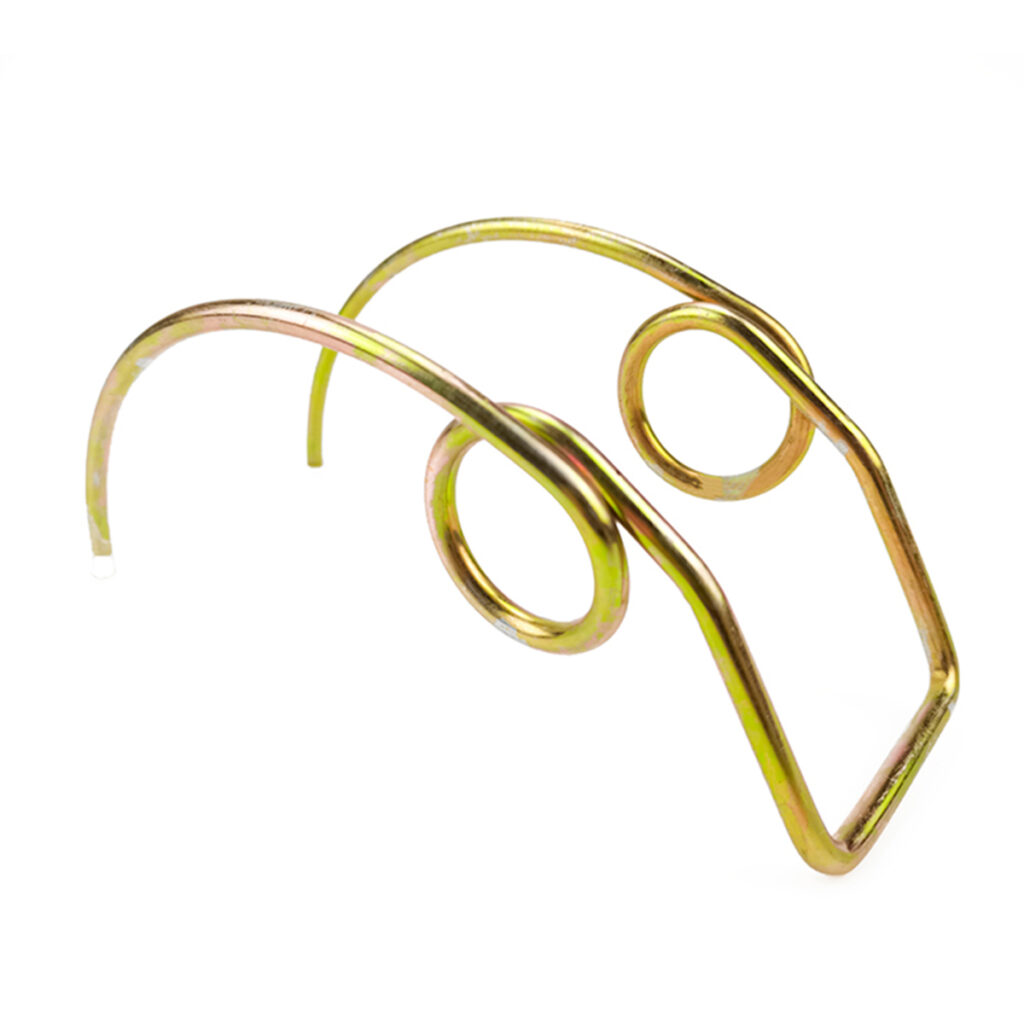
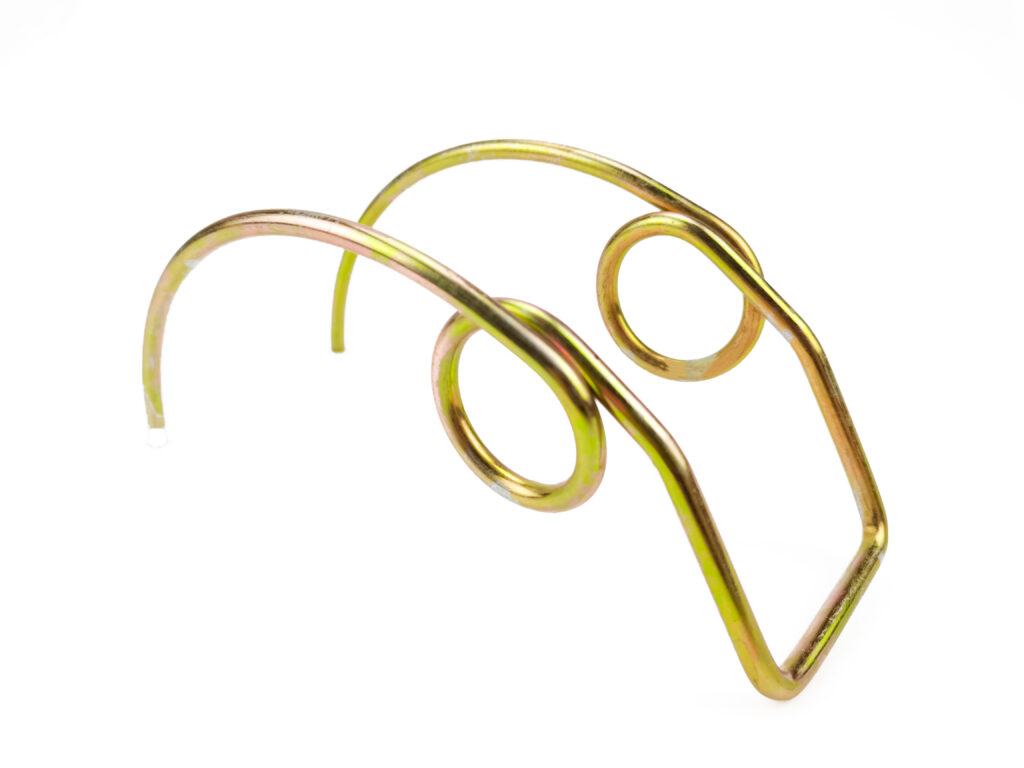
| Reel harvester tine spring | Harvester reel | Double tine with torsion coils for flexibility |
| Spring steel circlip | Shaft or pin assembly | Wire ring with two end eyelets that retains a part in a groove on a shaft or pin |
| Steel retaining spring | Machine assembly | Shaped spring that holds a component in place by clip action |
| Steel spring clips | Machine assembly | Clips with a coil and hooked ends for quick fitting |
| Teeth and single torsion spring tines | Soil-working implements such as subsoilers and harrows | Cranked wire tines that work or level the soil |
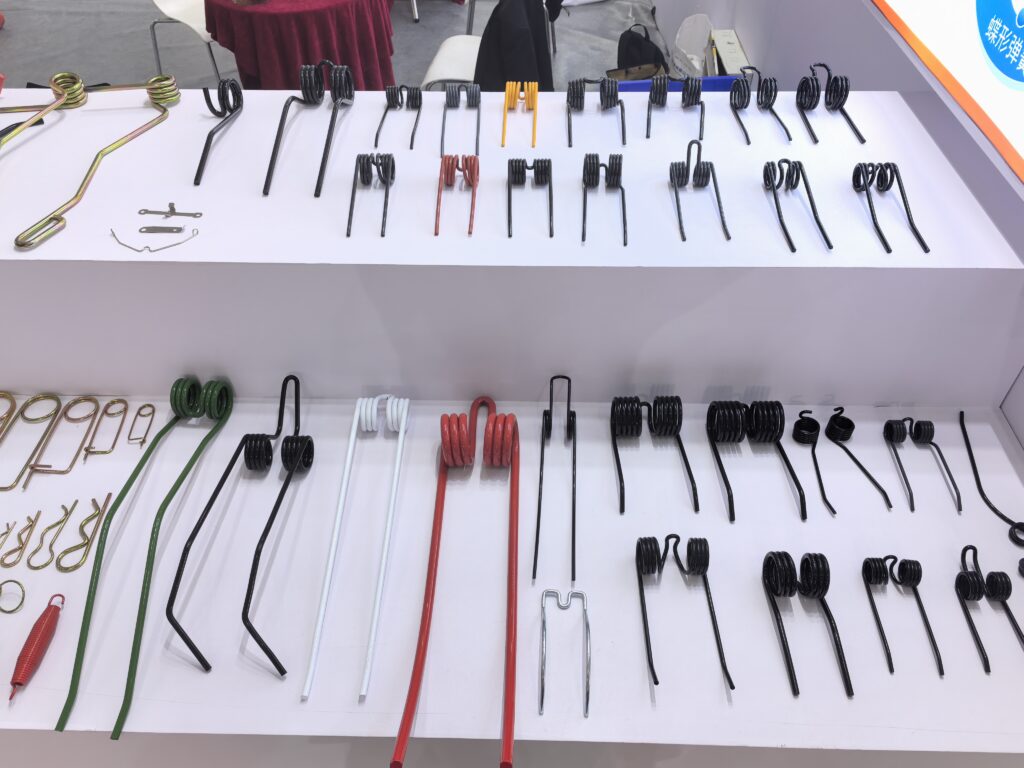
Where these springs work
Harvester reels and baler pickups
A crop tine is only as good as its bends: it hits stubble and stones on every turn of the reel, and a crack starts at the tightest radius. Its mounting end also has to match the reel bar or pickup tube exactly.
Harrows, cultivators and subsoilers
Soil-working tines carry heavier, more constant loads than crop tines and wear from abrasion. Tine length and the angle at which the tine enters the soil set how it works the ground. See farm implement springs and tines.
Retaining clips and fasteners
Circlips, retaining springs and spring clips hold pins, shafts and covers in place. What matters is that the clip fits its groove or hole and keeps enough grip after repeated removal. These parts suit general industrial equipment.
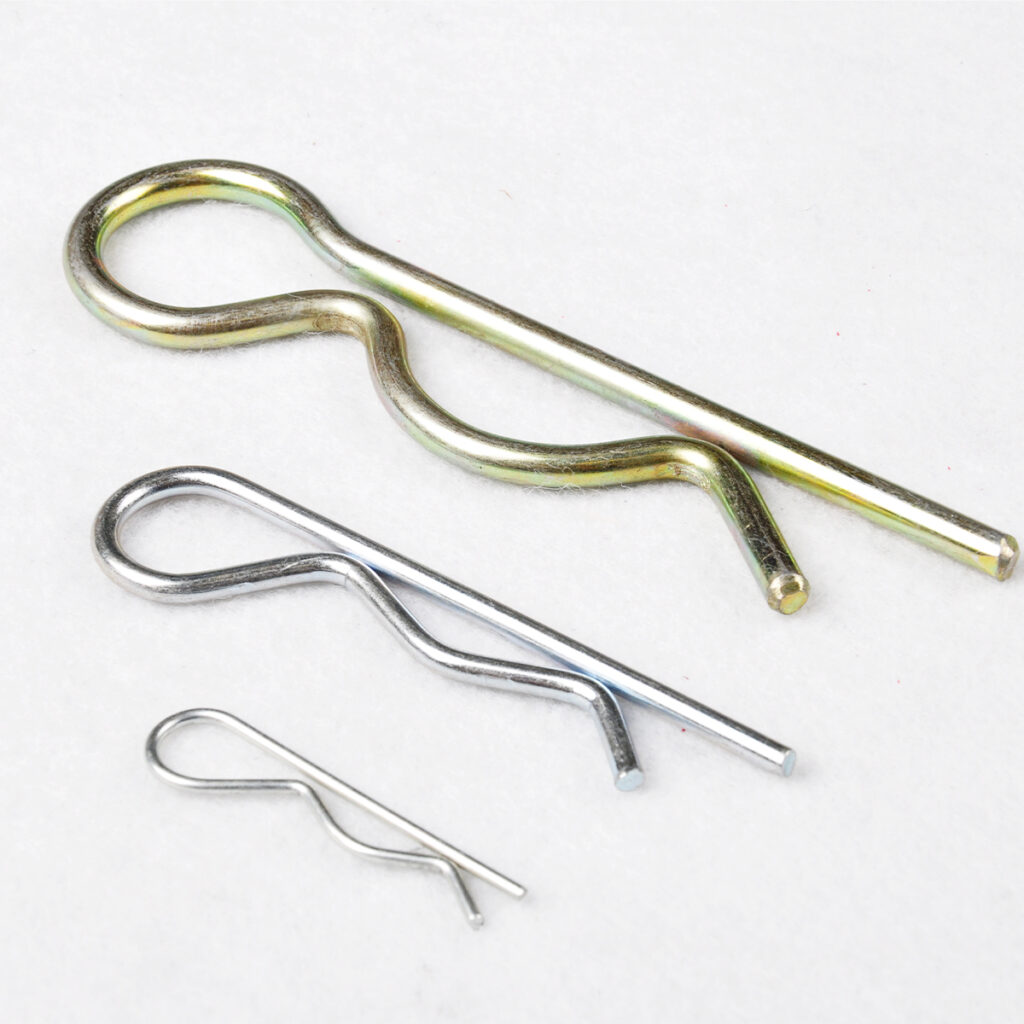
Example project: R-pin clips for farm machinery
A buyer in Thailand needed white-zinc steel R-pin clips used to secure pins on agricultural machinery.
- Problem. Parts from their previous supplier varied in size, so some clips did not fit properly during assembly.
- What we changed. We optimized the forming parameters on our CNC wire forming machines to control the opening size, and tightened control of wire diameter and zinc plating quality.
- Result. The clips are now in stable batch production, assembly runs more smoothly and corrosion resistance has improved.
Customer details are kept confidential.
What we check before quoting a part like this
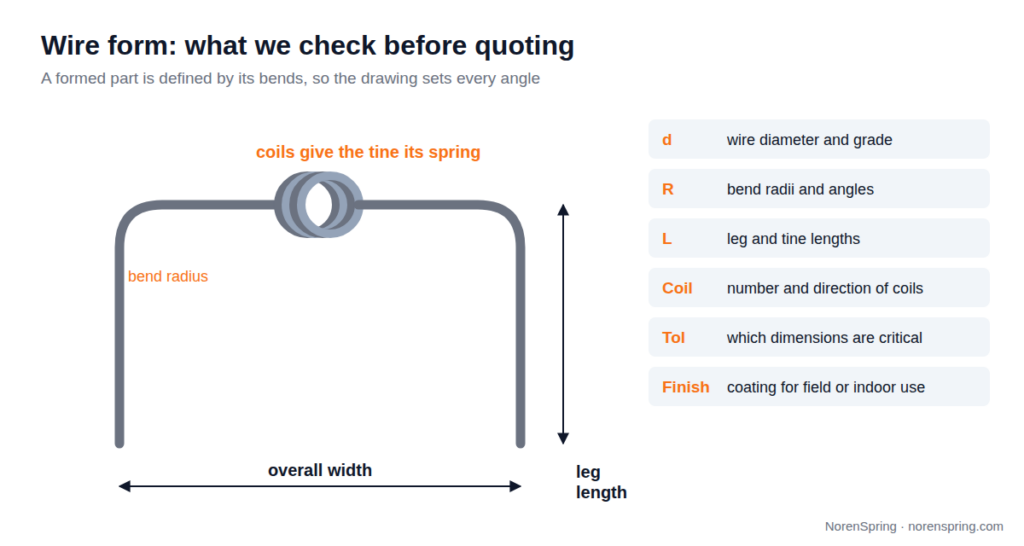
A wire form drawing is mostly geometry, so our engineers focus on the shape and how it mounts:
- Bend angles and springback. Spring wire springs back after bending, so each angle is formed past its final value. State which angles are critical.
- Bend radius. Tight inside radii concentrate stress and can crack hard wire. Tines that flex in service need a radius the wire can take.
- Leg and tine lengths. Give overall length and each straight section, measured to a stated reference point.
- Mounting features. Eyes, loops, coils and hooks must match the bolt, bar or hole they fit. Tell us the mating part size.
- Flatness and symmetry. Double tines and U-forms need both sides to match so they sit square on the implement.
- Clip fit. For circlips and retaining springs, give the groove or shaft diameter and how often the clip is removed.
Our wire forms design guide explains bend radius, datums, tolerances and finish allowances in more detail.
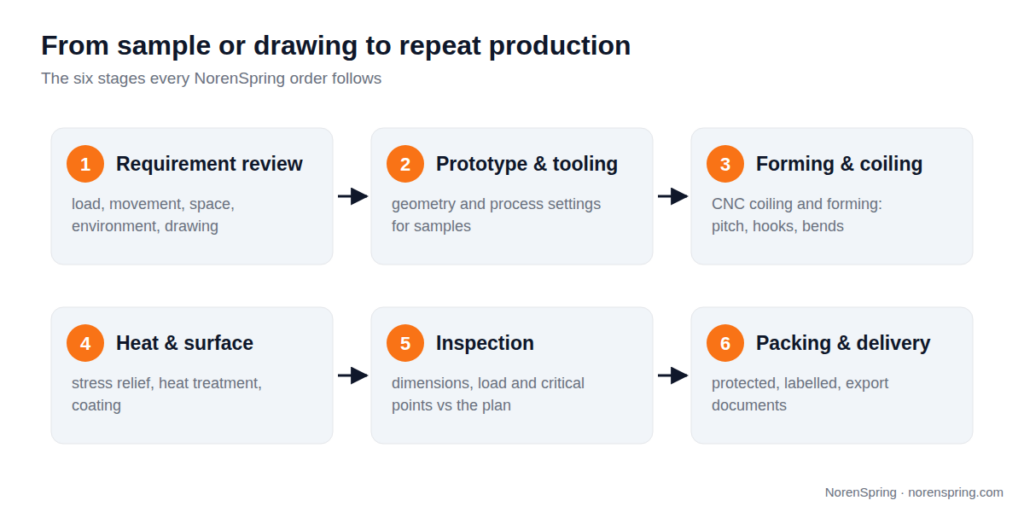
From sample or drawing to repeat production
Our team of 28+ engineers reviews each project, and we produce more than 4,000,000 springs a month for customers in 60+ countries.
- Requirement review. Shape, mounting, loads, environment and your drawing or sample are checked before quoting.
- Prototype and tooling. Forming tools are prepared and samples made for fit and application approval.
- Forming and coiling. CNC forming controls bend angles, lengths, coils and wire geometry.
- Heat and surface process. Stress relief after forming, then the agreed coating or plating.
- Inspection and validation. Shape, bend angles and openings are measured on a video measuring system, and hardness on Rockwell testers, against the agreed control plan.
- Packing and delivery. Parts are protected, identified and shipped with export documentation.
Samples typically take 7 to 15 working days and production 15 to 30 working days. The exact lead time is confirmed at quotation, since it depends on material, tooling, quantity and approvals. See how we form and finish parts.
Materials, wire sizes and finishes for these parts
The table gives the material, wire diameter range and usual finish for each part, as supplied by our production team, with the main markets each part ships to.
| Part | Material | Wire diameter | Usual finish | Main markets |
|---|---|---|---|---|
| Harrow cultivator tine spring | 50CrVA | 6–12 mm | Phosphate | USA, Australia |
| Harvester reel tine spring | 50CrVA | 5–9 mm | Powder coating | Germany, USA |
| Harvester reel tine / rake support spring tine | 50CrVA | 5–10 mm | Phosphate | Europe |
| Baler tine spring | 50CrVA | 5–10 mm | Black oxide | Ireland, USA |
| Reel harvester tine spring | 50CrVA | 5–12 mm | Painting | Germany |
| Spring steel circlip | 65Mn or SK5 | 0.5–3 mm | Black oxide | Japan, USA |
| Steel retaining spring | Carbon steel | 1–5 mm | Zinc plating | Europe |
| Steel spring clips | Carbon steel or stainless steel | 0.5–3 mm | Zinc or nickel plating | USA, Germany |
| Teeth and single torsion spring tines | 50CrVA or SWOSC-V | 5–12 mm | Phosphate or powder coating | USA, Germany, Australia |
Grades are listed as our production team specifies them: 50CrVA (chromium-vanadium) and 65Mn are Chinese GB spring steels, SWOSC-V is a Japanese JIS spring wire, and SK5 is a Japanese high-carbon tool steel. Photos may show a different finish from the usual one listed in the table.
Other materials and finishes
Choose the finish by where the part works: exposed tines meet mud, crop and abrasion, while clips inside an assembly are more sheltered.
Tines and clips can be quoted in carbon spring wire, oil-tempered wire, silicon-chrome and alloy spring steels, or stainless 304 and 316.
Frequently asked questions
Can you make small replacement batches of tines?
Yes. There is no fixed MOQ. Quantity is evaluated by part type, tooling and material, and both small batches and high-volume production are supported.
Which quality certifications do you hold?
IATF 16949 (valid to February 4, 2028), ISO 9001 (to December 11, 2026), ISO 13485 (to March 26, 2028), ISO 14001 and ISO 45001 (both to April 17, 2028).
How are wire forms packed for export?
Parts are protected and identified for transport and shipped with export documentation. Packing details can be agreed at quotation.
Which material should a tine be made from?
Tell us the machine, load and working environment. An engineer will propose a grade from the materials above.
Send a drawing or a sample
Looking for a replacement tine or clip, or a new wire form? Send your drawing or a sample with the mounting dimensions. We reply with feedback or a quote within 24 hours. Or browse our wire forms range and torsion spring portfolio.
