












We build springs to print from your drawings and can supply material records, dimensional records, traceability and FAIR packages as agreed at project setup. This page describes what we can make, not past aerospace programs. Requirements beyond our certifications, such as program quality approvals, special process approvals or named specifications, are reviewed case by case before we quote. If we cannot meet a requirement, we decline it at that stage rather than after an order.
Key Takeaways
- Springs are built to print from your drawing, with wire from 0.1 mm to 80 mm.
- Records as agreed: material certificates, dimensional records, inspection reports and traceability, plus FAIR packages for aerospace programs.
- We don’t hold AS9100 or NADCAP; the certifications we hold are listed below.
- Our in-house lab has image and video measuring systems, hardness testers, spring testers and a material analyzer.
Certifications we hold, and the ones we don’t
The table lists the certifications we hold. We don’t hold AS9100 or NADCAP, and we have no aerospace program, special-process or MIL-spec approvals.
| Certification | Valid to |
|---|---|
| IATF 16949 | Feb 4, 2028 |
| ISO 9001 | Dec 11, 2026 |
| ISO 13485 | Mar 26, 2028 |
| ISO 14001 | Apr 17, 2028 |
| ISO 45001 | Apr 17, 2028 |
Certificates are available on our about page.
Aerospace buyers often flow AS9100 down to every supplier of flight hardware. If your purchase order or quality clauses require it, we aren’t the right supplier for that part, and it’s better for both of us to know now. Where your quality team accepts an ISO 9001 or IATF 16949 supplier with FAIR and material records, for example on actuation and latch mechanisms in ground-support equipment, tooling or test rigs, send the drawing and we’ll review it.

Which springs aircraft and aerospace equipment use, and why
Springs in aircraft and other aeronautical equipment do familiar mechanical jobs, with tighter limits on space, weight, temperature and documentation. Typical places include access panel and stowage bin latches, control linkages and actuators, valves in fuel, hydraulic and pneumatic lines, seat and galley mechanisms, ground-support equipment and test rigs. The notes below describe the spring types and what to specify, not past aerospace programs.
Compression springs load latches, return actuator plungers and hold valve poppets on their seats. Force at a defined installed height is usually the controlling specification, and its tolerance is often tight. See our compression springs.
Wave springs preload bearings and load seals where axial space is short. A wave spring can give a similar force to a coil spring in a much lower working height. See wave springs.
Torsion springs return access panels, hinged covers and levers. The drawing should define leg angles and wind direction. Load should close the coils, and the body diameter shrinks as it does, so allow arbor clearance. See torsion springs.
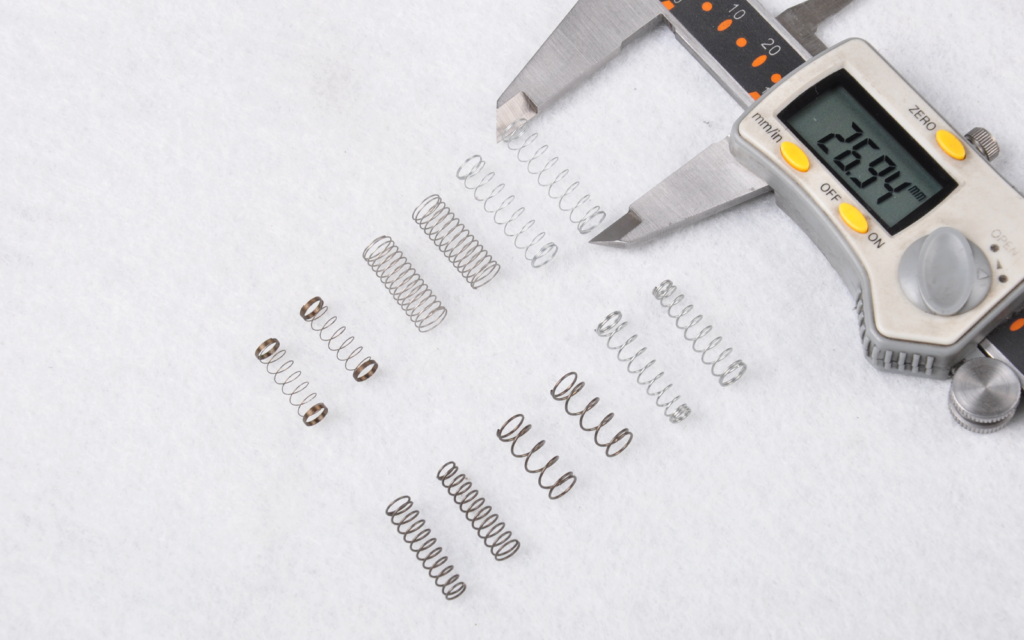
Choosing material and finish for temperature, weight and corrosion
| Material | Where it fits | Consider |
|---|---|---|
| Stainless 304 / 316 | Corrosion resistance without a coating | Lower strength than spring steel at the same size |
| Nickel alloy spring wire | High temperature or severe corrosion | Higher cost; availability confirmed at review |
| Titanium alloy spring wire | Parts where weight matters | Lower stiffness than steel changes the geometry; higher cost |
| Silicon-chrome spring steel | High stress in a compact space | Needs a coating; plating high-strength steel carries hydrogen-embrittlement risk, so state any plating and baking requirement on the drawing |
| Music wire | Small precision springs in protected locations | Needs corrosion protection |
If the drawing names a material, finish or process specification, we confirm at review whether it can be sourced and met. Any proposed alternative goes to your engineering authority for approval before samples are made.

Hydrogen embrittlement in plated aerospace springs
Every zinc-plated spring we make is baked after plating to drive out hydrogen, with the bake temperature set by the applicable national standard.
Acid cleaning and electroplating release hydrogen at the steel surface, and some of it diffuses into the metal. In high-strength spring steel, that hydrogen can cause delayed brittle cracking under sustained load, sometimes hours or days after the spring is installed and with no visible warning. The risk rises with hardness and tensile strength, so spring steels and silicon-chrome wire need particular care. Industry practice is to bake soon after plating, before any conversion coat, to drive most of the hydrogen out. Baking lowers the risk but doesn’t guarantee freedom from it.
On the drawing, state:
- the plating specification, type and thickness
- the bake requirement, or the specification that defines it, if it differs from a standard relief bake
- any embrittlement test needed on plated parts, such as a sustained-load test
We’ll confirm at quotation whether a named bake specification or test can be met. If plating risk is a concern, stainless steel or a non-electrolytic coating such as zinc flake avoids electroplating. Our spring finishes guide covers the plating and baking standards in more detail.
What to send for an engineering review
- Drawing: current revision and every referenced specification.
- Load and movement: force or torque at the working positions, and travel.
- Environment: temperature range, vibration, fluids and corrosion exposure.
- Records: the documents needed with each lot, including any first-article requirement.
- Quantity: prototype quantity, batch size and expected repeats.
First article inspection (FAIR) for aerospace springs
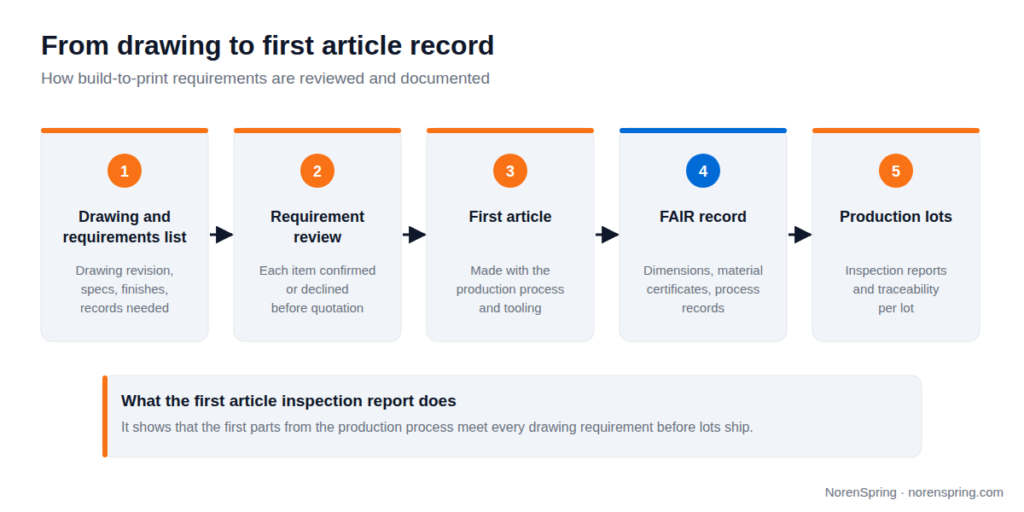
A first article inspection report (FAIR) shows that the first part made with production tooling and the production process meets every requirement on the drawing. FAIR packages are available for aerospace programs, and their content and format are agreed at review, before the first article is made. A typical sequence:
| Step | What happens |
|---|---|
| 1. Requirement review | The drawing revision, every referenced specification and the list of required records are confirmed. Anything we can’t meet is declined at this stage. |
| 2. Characteristic list | Each dimension, load, note and specification on the drawing gets a number, usually on a ballooned copy of the drawing. |
| 3. First article | The spring is coiled, heat treated and finished with the tooling and process intended for production. |
| 4. Measurement | Each numbered characteristic is measured or verified, and the actual result is recorded next to the requirement. |
| 5. Supporting records | Material certificates, finish records and test results are attached, as agreed at review. |
| 6. Disposition | Any nonconforming characteristic is resolved and re-checked before production is released. |
| 7. Repeat FAIR | A full or partial FAIR is normally due after a drawing revision, a change of material source, process or production site, or a long gap in production. |
Many aerospace buyers use the AS9102 forms for FAIRs. If yours does, say so at inquiry and we’ll confirm whether we can supply the report in that format. The full production sequence is on our capabilities page.
If your drawings or specifications are subject to export-control rules, confirm that you are permitted to share them with a manufacturer in China before you send them.
Similar record requirements are covered on our defense page. Our process is on the capabilities page and company background on the about page.
Frequently asked questions
Can you supply a FAIR?
Yes. FAIR packages are available for aerospace programs. The content and format are agreed at review, before the first article is made.
What are your MOQ and lead times?
There is no fixed MOQ. Samples typically take 7 to 15 working days and production 15 to 30 working days; the exact lead time is confirmed at quotation.
Do you hold AS9100 or NADCAP?
No. See the certification table above for what we hold.
What if our program needs an approval you do not hold?
Tell us at inquiry. It is reviewed case by case, and if we cannot meet it, we decline before quoting.
Technically reviewed by Feng Yulin, General Manager (senior structural engineer, 15 years of spring R&D). Last reviewed: 2026-10-16.
Have an aerospace drawing to review? Send the drawing and your full requirements list for engineering feedback within 24 hours.


 Upload a Drawing