











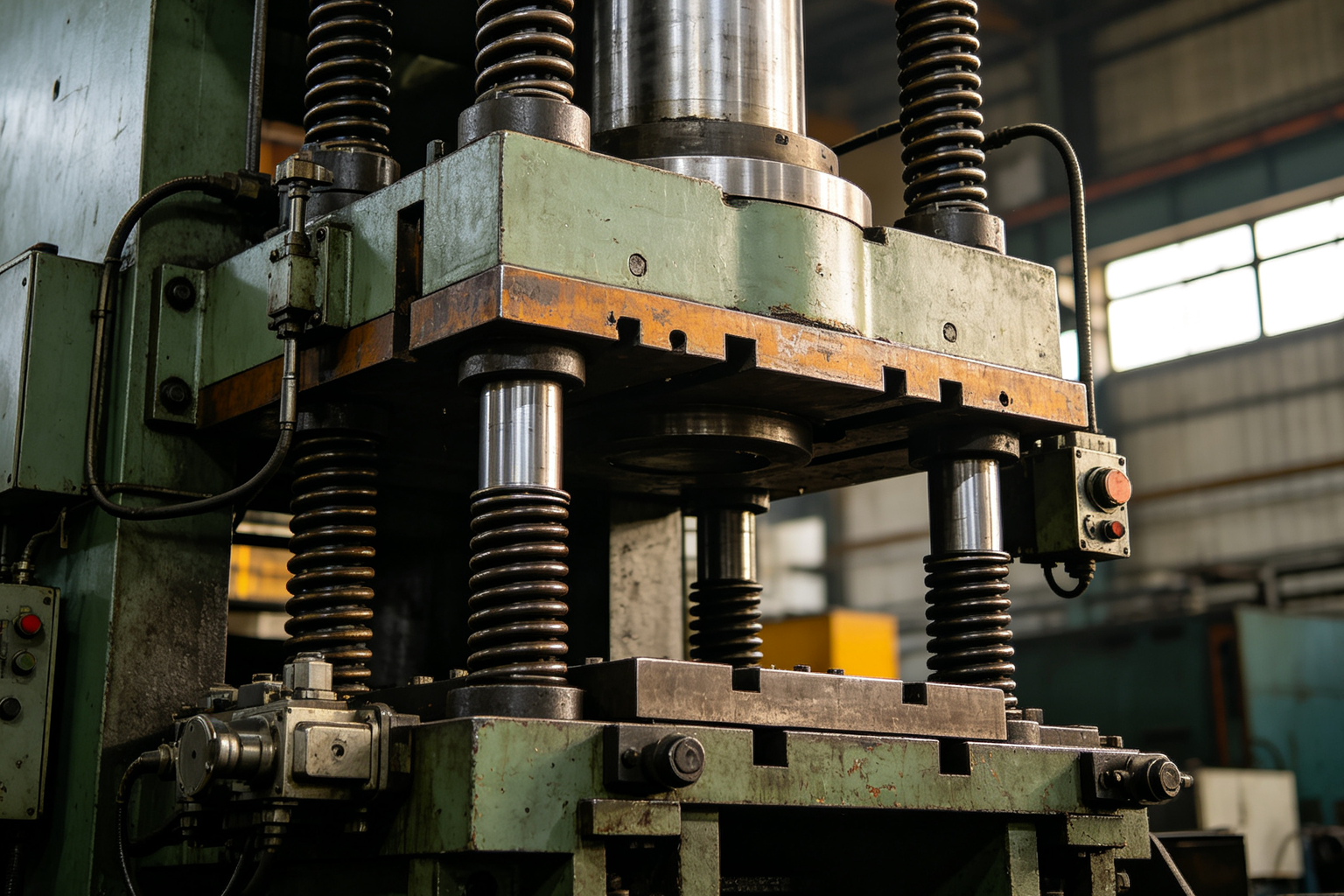
Hydraulic and fluid-power components use springs to set pressure, center spools, return pistons and apply brakes that hydraulic pressure then releases. Compression springs and disc springs do most of this work. We have supplied heavy-duty die and compression springs for the return systems of hydraulic presses, and we make compression and disc springs to your drawing or sample. The sections below cover what sets their force and what to send for a review.
Key Takeaways
- In a direct-acting relief valve, spring force divided by the seat area sets the opening pressure, so load at installed height is the controlling specification.
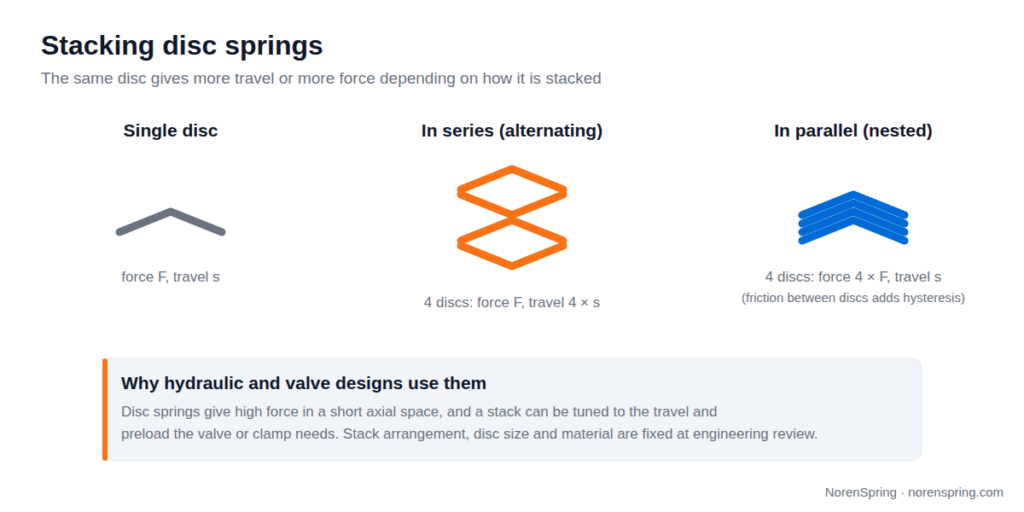
- Disc springs stacked in parallel add force; stacked in series they add travel.
- Our compression portfolio includes a compressor valve spring, and disc springs are part of our product range.
- Material certificates and inspection reports are available as agreed at project setup.
Which springs hydraulic components use and why
Valve springs
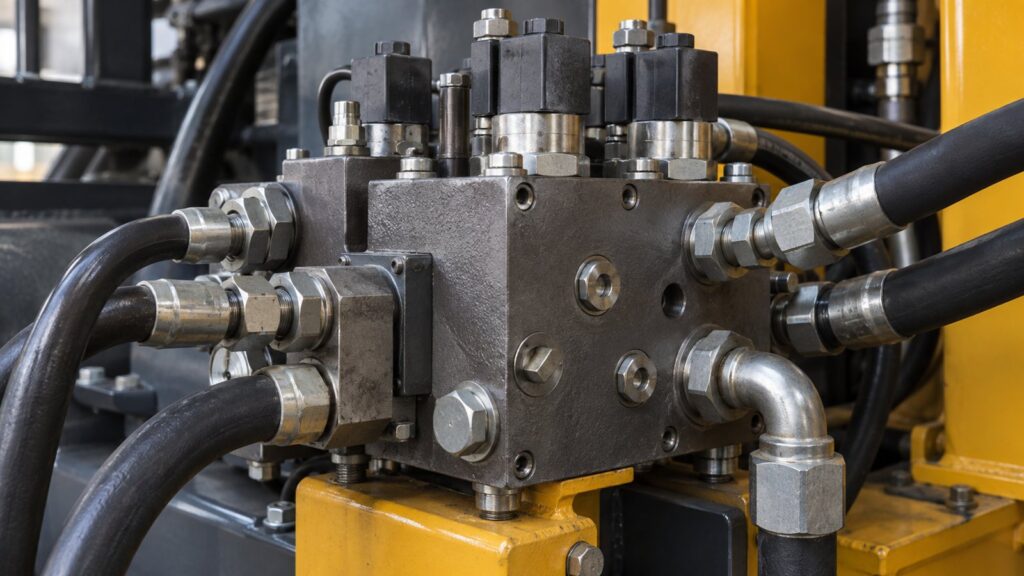
In a direct-acting relief or check valve, a compression spring holds a poppet or ball on its seat. The valve opens when fluid pressure times seat area exceeds the spring’s installed force. As the valve opens further, the spring compresses more and force rises with the spring rate, which is one reason pressure climbs above the cracking setting at full flow. A lower rate keeps that rise smaller but usually needs a longer spring.
The compressor valve spring in our portfolio works in a compressor rather than a hydraulic valve, but the design questions are similar: short lift, frequent cycling and a precise force at the seat.
Conical springs are worth considering where solid height is tight, since, when designed to telescope, their coils nest inside each other when compressed.
Centering and return springs
Directional control valves often use a pair of springs to return the spool to center. Matching the two springs’ installed force keeps the center position repeatable. Single-acting cylinders use a return spring, and wave springs can replace coil springs where axial height and stroke are short.
Disc springs for brakes and clamps
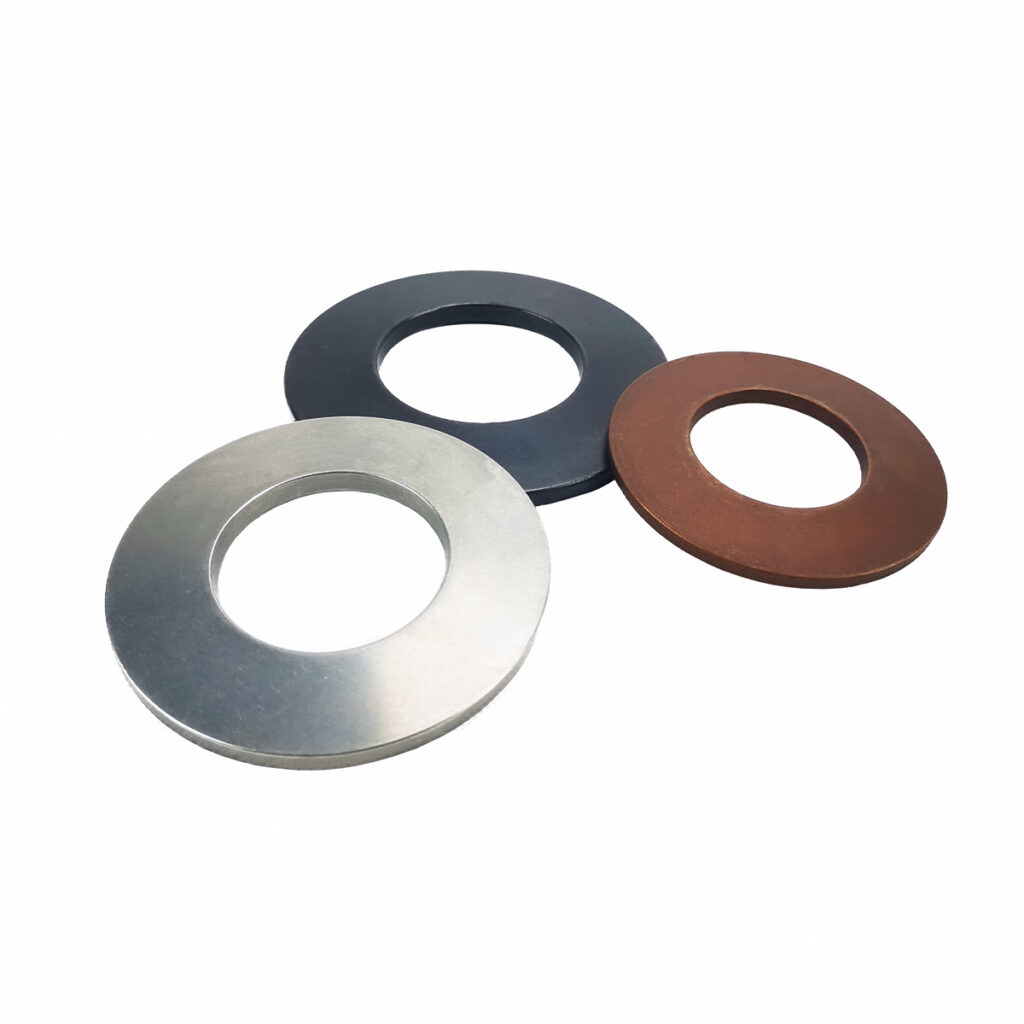
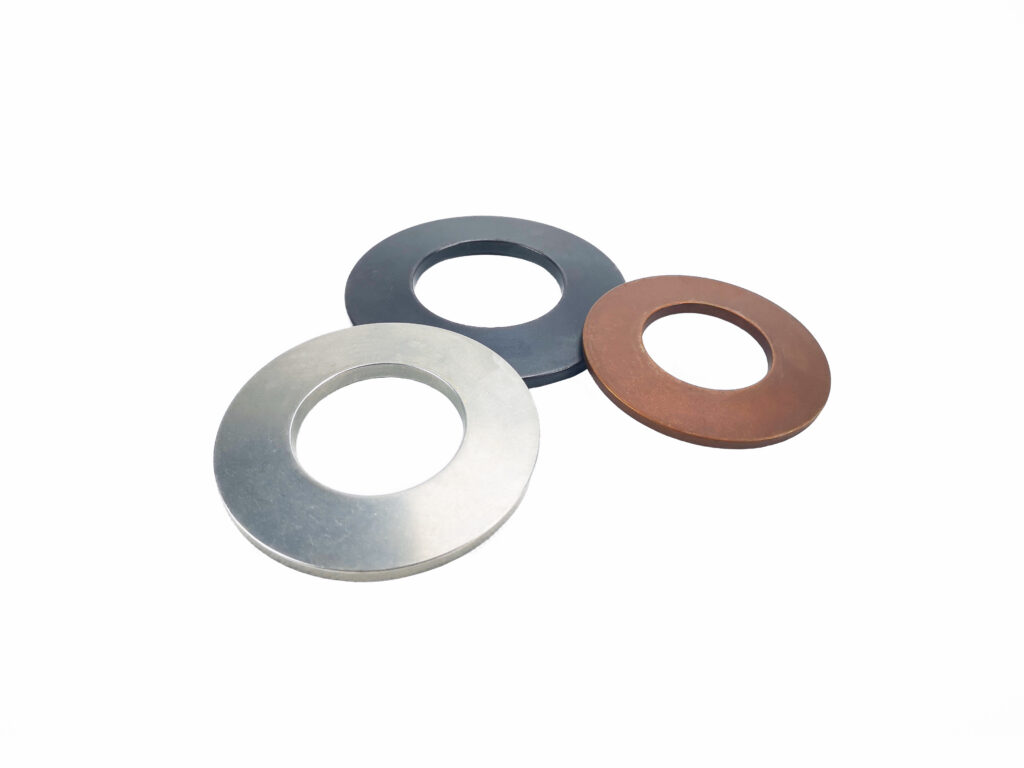
Spring-applied, hydraulically released brakes need high force in little space and must hold when pressure is lost. Disc springs suit this. Stacking discs in alternating directions (series) multiplies deflection; nesting them in the same direction (parallel) multiplies force. Parallel stacks add friction between discs, which creates a difference between loading and unloading force.
Choosing material and finish for hydraulic fluid and temperature
| Option | Where it fits | What to weigh |
|---|---|---|
| Music wire | Small pilot and check valve springs | High strength in fine sizes |
| Oil-tempered wire | Larger valve and return springs | Common choice for dynamic springs in oil |
| Silicon-chrome spring steel | Valve springs with high stress or warm oil | Better relaxation resistance at elevated temperature |
| Alloy spring steel | Disc springs and heavy brake springs | Suited to high static and dynamic load |
| Stainless steel 304 / 316 | Water-based fluids or wet outdoor actuators | Corrosion resistance; lower strength than spring steel |
| Plain or oiled finish | Springs immersed in oil | No coating to shed particles into the fluid; cleanliness needs agreed at review |
What to send for an engineering review
- Valve or actuator type and a sectional drawing if you have one.
- Installed height and force, plus open height and force (or the pressure setting and seat diameter).
- Space limits: bore diameter, rod or guide diameter, available solid height.
- Fluid type, operating temperature and any cleanliness requirement.
- Quantity and required records.
Wire diameter d, outside diameter D0 and free length L0 are enough to start if you have no drawing. See our capabilities for the full process.
Frequently asked questions
What if we only know the pressure setting?
Send the pressure setting and seat diameter with the installed height; if you have the spring, wire diameter d, outside diameter D0 and free length L0 are enough to start.
Can we get samples for bench testing?
Yes. Prototype and pre-production samples are available for dimensional, load and application approval.
What quality records are available?
As agreed at project setup: inspection reports, material certificates, dimensional records and traceability. We are certified to ISO 9001 and IATF 16949 and run an in-house testing laboratory.
Send your valve data or sample through our contact page for engineering feedback within 24 hours.


 Upload a Drawing