










In this article
- Key takeaways
- What are zig zag springs and where are they used?
- Which gauge should a zig zag spring be?
- How does the loop shape set the stiffness?
- How long should a zig zag spring be?
- How are zig zag springs fitted and tied?
- Zig zag springs compared with coil springs
- What to specify for zig zag springs
- Frequently asked questions
- References
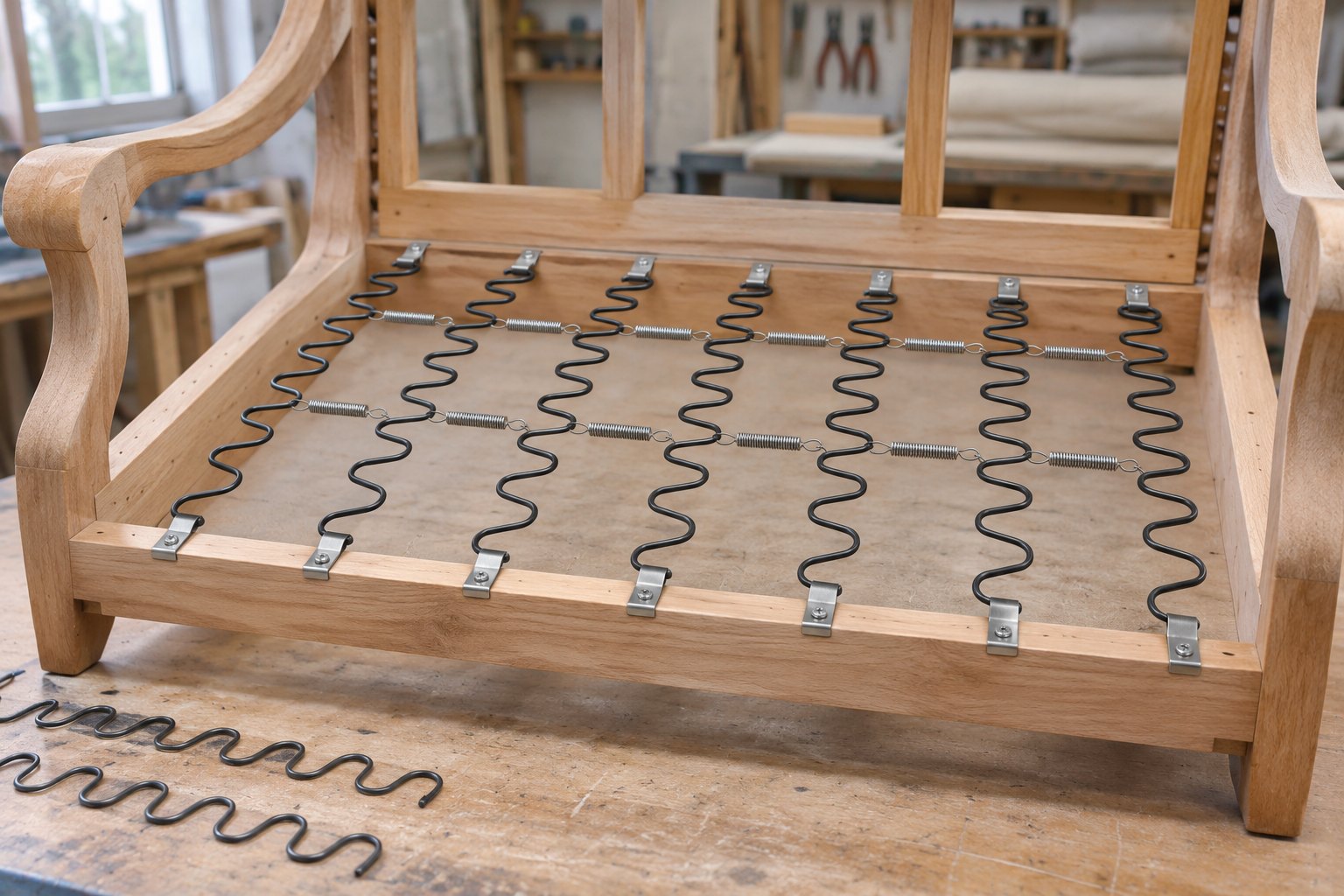
Cover image: an AI-generated illustration of a generic sofa frame, based on a photo of wire forms we make; it does not show a specific furniture brand.
Zig zag springs are lengths of steel wire bent into a continuous S-shaped wave, clipped to the front and back rails of a seat frame or the top and bottom rails of a back. Upholsterers also call them sinuous, serpentine, S-coil or no-sag springs; one supplier describes them as “also known as no-sag springs, sinuous springs, or serpentine springs” [1].
This guide is written for furniture and seating manufacturers, upholstery suppliers and automotive seat makers who buy sinuous springs in volume. It compares the common wire gauges, explains how the loop shape sets the stiffness, works out how much a small error in cut length changes the crown height and ends with a specification checklist. For bent wire parts in general, see our wire form design guide.
Key takeaways
- Gauge matters more than it looks. Going from 11 gauge (0.1205 in) to 9 gauge (0.1483 in) wire makes a strand about 2.3 times as stiff, because stiffness rises with the fourth power of wire diameter.
- The U-bends do most of the flexing. In our example strand, the bends carry about 93 % of the flexibility, so loop width and bend radius change the feel as much as the gauge does.
- Cut length controls the crown. On a 24 in span with a 2 in crown, a strand only 1/8 in longer raises the crown by about 0.28 in.
- Specify the strand, not just the size. A drawing should state wire grade and tensile range, gauge, loop width, loop pitch, flattened length with tolerance, crown and end form.
What are zig zag springs and where are they used?
A sinuous spring is a flat wire form in which straight legs run across the strand and are joined by U-shaped bends, so the strand can stretch and flex along its length. In a sofa, rows of these strands run from front to back across the seat and from bottom to top in the back. A UK supplier describes them as “usually stretched from the front to the back of your seat” and sells them in set lengths [2].
A US patent filed in 1936 by Morris Freund describes “flat, sinuous springs” for vehicle seats, made of steel wire “bent to sinuous shape” [4]. The No-Sag Spring Co, whose name became a common trade name for the springs, published its first patent the same year [5]. By the time the University of Minnesota extension bulletin Reupholstering at Home was printed, it was already telling home upholsterers to order “No-Sag nails and the No-Sag clips” for repairs [9].
Today zig zag springs appear in:
- Sofa and chair seats, where 9 gauge or 8 gauge strands carry the sitter.
- Sofa and chair backs, where lighter 11 gauge strands are common.
- Ottomans, benches and theatre seating, with short strands across the frame.
- Vehicle seats, especially older and classic car seats; one retailer lists its springs for “automotive seating and theater chairs” [7].

Which gauge should a zig zag spring be?
Sinuous springs are sold mostly in 8, 9 and 11 gauge steel wire. One supplier recommends 9 gauge “for seat bottoms” and 11 gauge “for seat backs” [1]. The diameters below are the standard steel wire gauge sizes:
| Gauge | Wire diameter | Typical use | Stiffness vs 11 gauge (our calculation) | Bend stress at equal load (our calculation) |
|---|---|---|---|---|
| 11 gauge | 0.1205 in (3.06 mm) | Seat backs (supplier guidance) | 1.00× | 1.00× |
| 9 gauge | 0.1483 in (3.77 mm) | Seat bottoms (supplier guidance) | 2.29× | 0.54× |
| 8 gauge | 0.162 in (4.11 mm) | Stiffest of the three; a step up from 9 gauge | 3.27× | 0.41× |
We worked out the last two columns with the standard bending equations for round wire [8]. With the same loop shape and length, the stiffness of a bent wire form scales with the fourth power of the wire diameter, while the bending stress at a given load scales with the inverse cube. A 23 % thicker wire (11 to 9 gauge) therefore gives a strand more than twice as stiff, which runs at roughly half the stress for the same load.
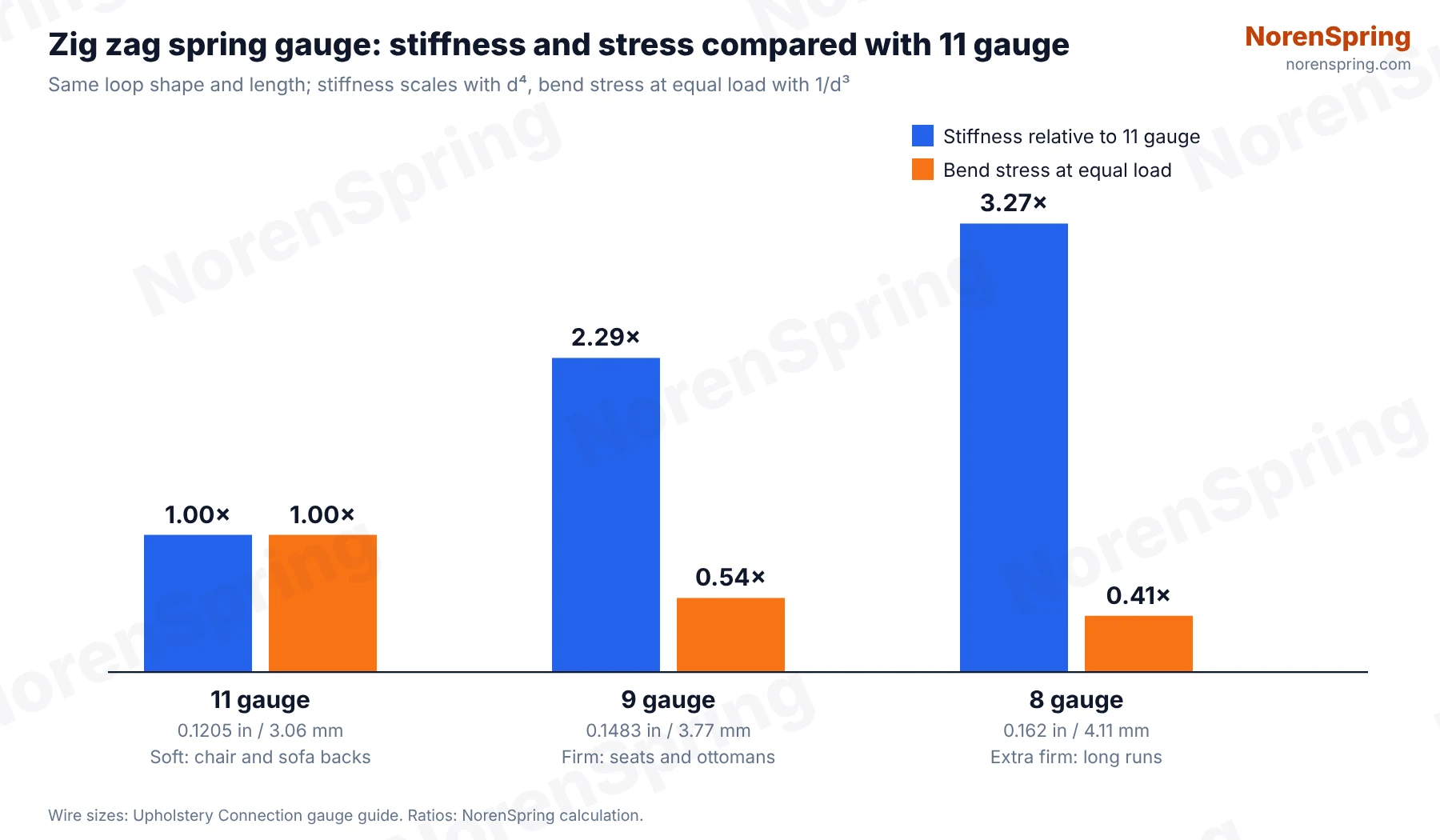
This explains two things buyers see in practice. First, a back spring cannot simply be swapped for a seat spring: an 11 gauge strand under seat loads runs at nearly twice the stress of a 9 gauge one and is more likely to take a set. Second, moving up a gauge on a seat changes the feel far more than the small change in diameter suggests: 8 gauge is about 43 % stiffer than 9 gauge. One buyer who fitted 11 gauge strands to chair seats wrote that they “should have bought the next size larger” [7].
The wire itself is high-carbon steel. One supplier describes its springs as made “with a high-carbon steel” [2]. ASTM A417 covered cold-drawn wire for zig-zag, square-formed and sinuous upholstery spring units, with sinuous wire listed as Type C [6]; ASTM’s store now lists that standard as historical, so check which grade your drawing calls up. Wire makers supply high-carbon seating wire in the 3.2 to 4.0 mm range at about 1,570 to 1,770 N/mm² tensile strength [10]. For how wire grade affects spring life, see our spring wire material guide.
How does the loop shape set the stiffness?
When a sitter loads a crowned strand, the crown flattens and the strand is forced to change length between the clips. The resistance to that change comes from the wire bending in the plane of the strand. Using Castigliano’s method on one loop, the bending moment at any point is the strand force times the distance from the strand’s centre line. The U-bends sit furthest from that line, so they carry the largest moment and do most of the flexing.
To put numbers on this, we modelled a 24 in strand with a 2 in loop width (measured on the wire centre line) and 1/2 in bend radius, which gives a 1 in loop pitch. These dimensions are an example for the calculation, not a published standard; measure your own springs before using the figures.
| Example strand, 24 in | Stretch rate | Stress per 100 N of strand force |
|---|---|---|
| 11 gauge | 1.85 N/mm (10.6 lb/in) | 906 MPa |
| 9 gauge | 4.24 N/mm (24.2 lb/in) | 486 MPa |
| 8 gauge | 6.04 N/mm (34.5 lb/in) | 373 MPa |
In this example, the bends account for about 93 % of the strand’s flexibility and the straight legs for only 7 %. Loop width therefore has a strong effect. Holding the 9 gauge wire and 1/2 in bend radius, the stretch rate falls from 8.0 N/mm with 40 mm loops to 4.2 N/mm with 51 mm loops and 2.3 N/mm with 64 mm loops. A wider loop makes a softer seat, but it also raises the stress in the bends at a given force. That is why the loop width and pitch belong on the drawing, not only the gauge.
Tight bend radii add a further stress penalty on the inside of each bend. Our wire form guide shows the curvature correction rising from 1.12 at an inside bend radius of three wire diameters to 1.63 at half a diameter, and explains why a radius of at least one wire diameter is the usual minimum.
How long should a zig zag spring be?
A sinuous spring is cut longer than the clip-to-clip span so that it arches upward when fitted. That arch, or crown, is what lets the seat give under load and recover. One supplier advises: “Measure existing springs pressed flat to the floor to get an accurate measurement for replacements” [2]. A New Zealand supplier adds that zig zag can be bought flat or rolled, is fixed with clips “nailed or screwed onto the frame” and is tied between strands to stop them spreading [3].
Crown height is the height of the fitted strand’s arch above the line between its two clips. The crown uses surprisingly little extra length. For a shallow arc of height h over a span L, the extra length is about 8h²/3L. On a 24 in span, a 1.5 in crown takes only 0.25 in of extra strand, a 2 in crown takes 0.44 in and a 3 in crown takes 1.0 in.
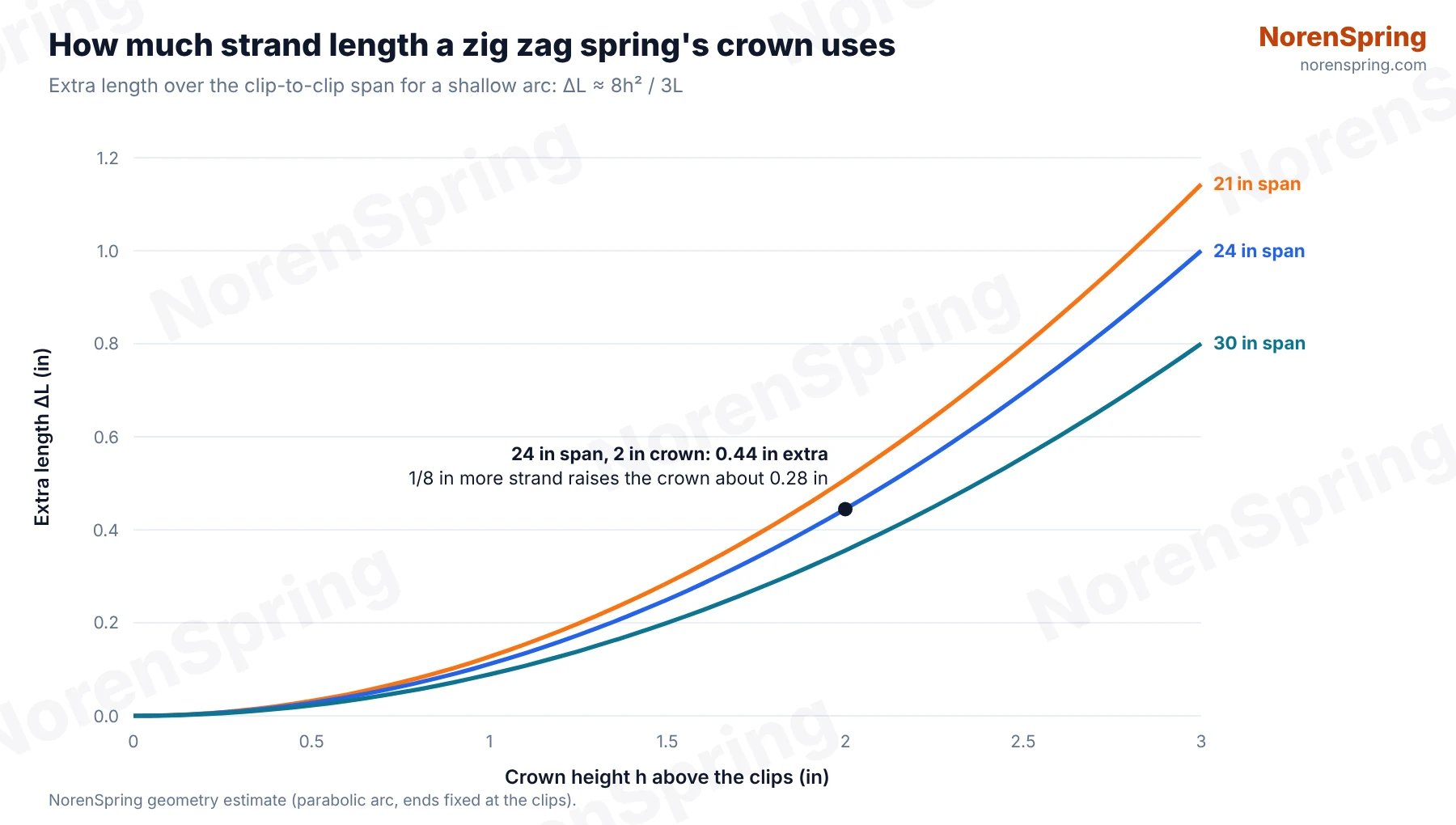
The same geometry shows why cut length is a critical dimension. Near a 2 in crown on a 24 in span, each extra 1/8 in of strand raises the crown by about 0.28 in; on a 30 in span it is about 0.35 in. A batch of springs cut 1/8 in long or short will therefore sit visibly higher or lower in the frame and feel firmer or softer, even though every strand is “the right size”. For volume buying, state the length along the flattened strand and give it a tolerance that matches the crown you need.
| Span, clip to clip | Crown | Extra length over span | Crown change per 1/8 in of length |
|---|---|---|---|
| 21 in | 2 in | 0.51 in | 0.25 in |
| 24 in | 2 in | 0.44 in | 0.28 in |
| 27 in | 2 in | 0.40 in | 0.32 in |
| 30 in | 2 in | 0.36 in | 0.35 in |
Clip position matters for the same reason. If clips on a production frame vary by 1/8 in from rail to rail, the crown will vary as much as it would with a length error, so fixture the clip positions as tightly as the spring length.
How are zig zag springs fitted and tied?
- Clips: each end sits in a clip nailed or screwed to the rail. Suppliers sell matching clips; one sells them in packs of “3 Pairs with Nails” [2].
- Spacing: strands are “installed in rows a few inches apart, either side-to-side or front-to-back” [1]. One car owner reported five rows per seat frame on a classic sports car [7].
- Ties: strands are tied together with twine so they do not spread [3].
- Ends: cut ends are usually bent so they cannot slip out of the clip. One buyer who cut springs from a roll bought a spring bender for the ends [7].
Because neighbouring strands are tied, a seat behaves as a sprung panel rather than separate springs. For seats that recline or tilt, see our guide to recliner springs, which covers the extension and torsion springs in the mechanism.
Zig zag springs compared with coil springs
| Zig zag (sinuous) springs | Hand-tied coil springs | |
|---|---|---|
| Depth needed | Shallow; fits low, modern frames | Deep; springs of 4, 5, 6 or 8 in were standard sizes [9] |
| Fitting | Clipped strands, quick to install | Each spring sewn or stapled down and tied |
| Feel | Firm, even support across the seat | Softer, more point-by-point give |
| Main variables | Gauge, loop width, pitch, length, crown | Wire size, coil height, number of springs |
The extension bulletin noted that “the average chair has five or nine springs” when hand-tied coils were used [9].
What to specify for zig zag springs
| Item | Example |
|---|---|
| Application | Sofa seat, front to back, clip-to-clip span 24 in, five strands tied with helical tie springs |
| Wire | High-carbon steel wire, tensile range stated (for example 1,570 to 1,770 N/mm²) |
| Gauge | 9 gauge, 0.1483 in (3.77 mm) |
| Loop form | Loop width and loop pitch on the wire centre line, inside bend radius |
| Length | Flattened length with tolerance, for example 24-7/16 in ± 1/16 in |
| Crown | Preformed arc height, or supplied flat or on rolls |
| Ends | End bend shape for the clip type you use |
| Finish | Plain or oiled for upholstered frames; coated where the strand is visible or exposed |
| Checks | Flattened length and loop pitch on every lot; set test after loading a sample strand |
If you buy sinuous springs for automotive seats, add the vehicle maker’s material and approval requirements. We supply PPAP packages for automotive programmes, and our article on a Spanish automotive client’s audit of our seat wire form production shows what such an audit covers.
Send your drawing, a sample strand or your frame dimensions through our contact page, and our engineers will review it and reply within 24 hours. Our wire forms page shows the bent wire parts we make, and our automotive solutions page lists the seat and chassis springs we supply. You can also read more about our company and its certifications. This guide was compiled by our editorial team with our spring engineers.
Frequently asked questions
What gauge zig zag springs do I need for a sofa?
One supplier recommends 9 gauge (0.1483 in) wire for seat bottoms and lighter 11 gauge (0.1205 in) for seat backs [1]. 8 gauge is the step up when a seat needs to be firmer. Match the original gauge when repairing: 9 gauge is about 2.3 times as stiff as 11 gauge, and 8 gauge about 43 % stiffer than 9 gauge.
How do I measure zig zag springs?
Take an old strand out and press it flat, then measure its full length from end to end [2]. Note the gauge, the loop width and the clip type too. Measuring along the arch in the frame gives the wrong length.
Why does my sofa seat sag with zig zag springs?
Sagging usually means the strands have taken a set, a clip has pulled out of the rail or the ties between strands have broken.
Are sinuous springs and no-sag springs the same thing?
Yes. Sinuous, serpentine, zig zag and no-sag springs are names for the same flat wave-form spring. “No-Sag” began as a company and trade name in the 1930s [5].
References
- Albright’s Supply, “Blog: Springs”. https://www.albrightssupply.com/blog/springs
- Heritage Components, “Sofa Springs Zig Zag”. https://heritagecomponents.co.uk/products/sofa-springs-zig-zag
- Mollies, “How to measure & install zig zag springs”. https://mollies.nz/blogs/mollies-diy-blog/how-to-measure-install-zig-zag-springs
- Freund M., “Wire spring for cushioned seats of vehicles”, US Patent 2,133,611 (filed 1936, granted 1938). https://patents.google.com/patent/US2133611
- GoodIP, No-Sag Spring Co patent portfolio. https://goodip.io/iq/assignee/no-sag-spring-co
- ASTM A417-93(1998), “Standard Specification for Steel Wire, Cold-Drawn, for Zig-Zag, Square-Formed, and Sinuous-Type Upholstery Spring Units”. https://store.astm.org/a0417-93r98.html
- Desertcart, zig zag 11 gauge 10 ft roll listing and customer reviews. https://www.desertcart.co.za/products/34087265-zig-zag-11-gauge-10-ft-roll-auto-furniture-upholstery
- Shigley’s Mechanical Engineering Design, Chapter 10 Mechanical Springs, lecture slides, Istanbul Technical University. https://web.itu.edu.tr/~halit/Makel/Ch_10_slides_m.pdf
- Matheis H. H., “Reupholstering at Home”, Extension Bulletin 262, University of Minnesota Agricultural Extension Division. https://conservancy.umn.edu/bitstreams/f17b85b2-2011-4b57-8cbf-e9249dd34ad6/download
- Bekaert, “Bedding and seating wire”. https://www.bekaert.com/en/product-catalog/content/bedding-and-seating-wire



