In this article
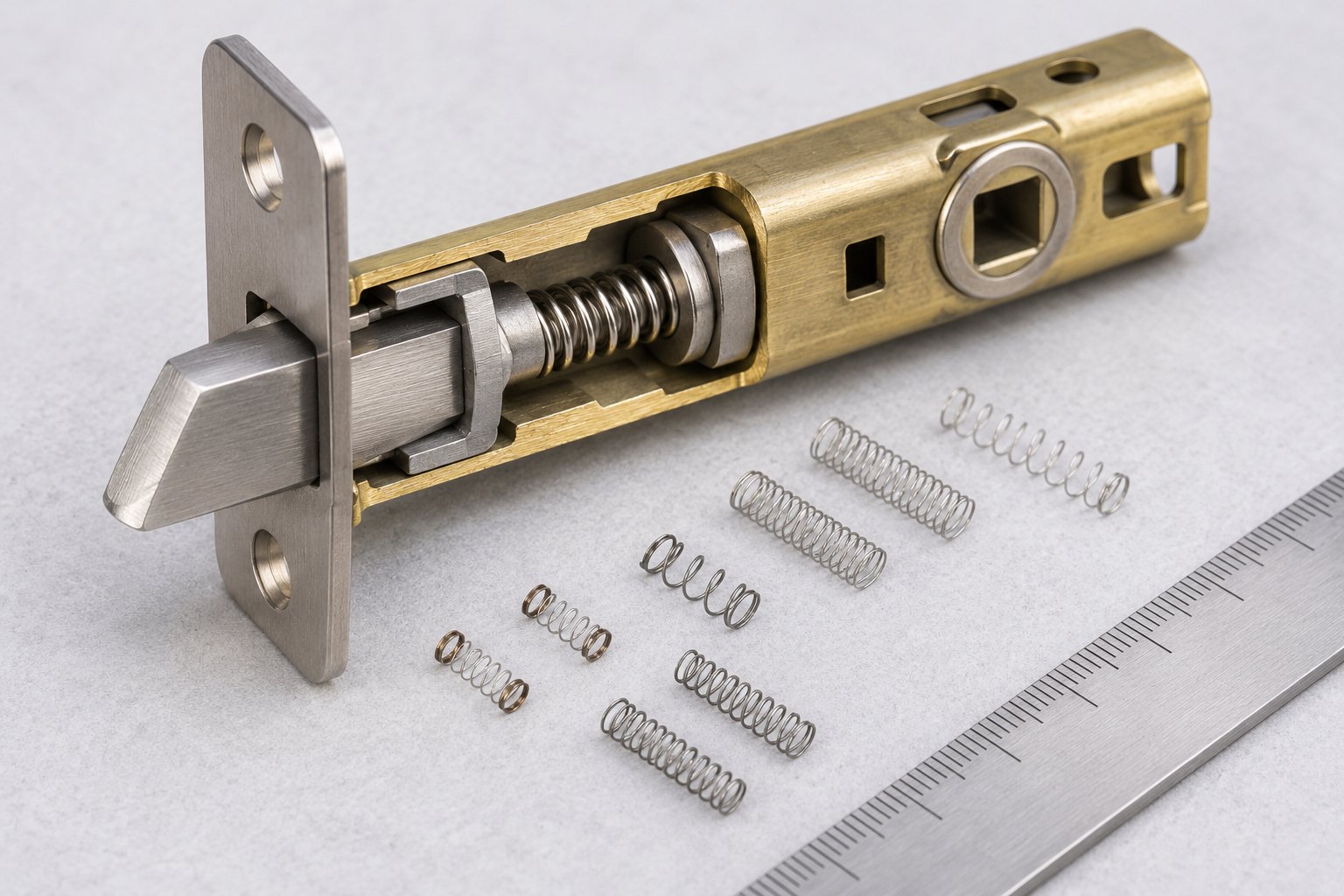
Cover image: an AI-generated illustration of a generic safety cover installation, based on a photo of stainless compression springs we make; it does not show a specific cover brand.
Pool cover springs are the stainless steel springs at the end of each strap on a safety pool cover. One end of the spring takes the strap, the other end has a ring that hooks over a brass anchor in the deck, and the spring keeps the cover tight while letting it give under wind, snow and the cover’s own stretch. Meyco’s installation manual lists the part plainly: “STAINLESS STEEL COMPRESSION SPRINGS one for each cover strap” [1].
This guide is for safety cover makers and distributors who source these springs, and for pool owners matching a replacement. It sits alongside our stainless steel springs guide, which covers the wire grades in more depth.
Key takeaways
- The spring sits between the strap and the deck anchor. The strap laces through a squared end; a round ring at the other end hooks onto the anchor with an installation rod.
- Cover makers ask for different compression. Meyco says about halfway, Merlin 50 % to 75 % for mesh and 65 % to 80 % for solid covers, and Loop-Loc 85 % to 90 % at installation, then 70 % to 75 % once the mesh has stretched.
- A cover is tested as a system. Royal Swimming Pools cites ASTM F1346-91, under which a safety cover “must hold a minimum of 485 lbs” [6]; the spring is one link in that chain.
- Same pull, different margin. In our worked example, five stainless springs give the same 200 N at half compression, but the stress when the coils close ranges from 29 % to 91 % of the wire’s tensile strength.
- Specify force at two compressions and the solid stress, not just the length, so a replacement spring behaves like the original.
How do pool cover springs work?
A safety cover is held over the pool by webbing straps sewn into its edge. Each strap runs onto the deck, through an adjustment buckle, and ends at a spring. Loop-Loc’s guide tells installers to “Lace straps around the squared-off end of springs” so the strap can be shortened or let out later [2]. Leslie’s describes the same step for a three-slot buckle: “loop the strap through the square end of the spring, and then back up through the center slot” [11].
The other end of the spring is a ring. With the spring pulled onto the strap, the installer puts a notched rod through that ring and levers it over the anchor head. Loop-Loc’s instruction is to “Insert Installation Rod through retaining ring on end of spring” and then pull the rod handle away from the cover edge until the ring slides over the anchor bolt [2]. As the ring goes on, the strap tension shortens the coil, which is why the guides talk about the spring being compressed or, in Merlin’s wording, “collapsed” [3].
What are pool cover spring covers for?
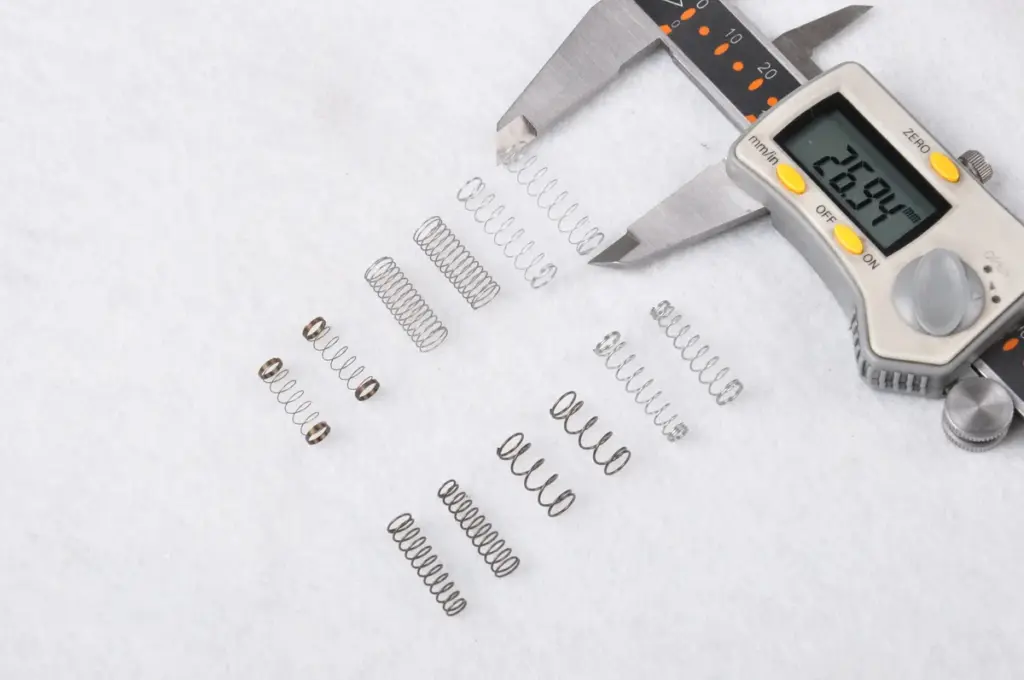
Most new covers come with a vinyl sleeve over each spring. In The Swim explains why: “the purpose is to prevent the springs from scratching delicate deck materials, such as wood or travertine stone” [5]. The sleeve sets a limit on the spring’s outside diameter, so a replacement spring has to fit inside the sleeves already on the cover.
How tight should pool cover springs be?
Each cover maker gives its own figure, and the figures differ because cover materials behave differently. The table collects them. None of the guides define the percentage; we read it as the share of the spring’s travel from free length to the point where the coils touch.
| Source | Compression asked for |
|---|---|
| Meyco installation manual | “Tighten straps so that springs are compressed about halfway” [1] |
| Latham manual safety cover | “Each spring should be compressed about 50% or slightly less” [4] |
| Merlin installation instructions | Anchors marked to give “a 50% to 75% collapsed spring”; “For Solid Covers, it’s good to have a 65% to 80% collapsed spring” [3] |
| Loop-Loc mesh covers | At least 85 % to 90 % at installation, retightened after 2 to 3 weeks to stay “approximately 70-75% compressed at all times” [2] |
| Loop-Loc Ultra-Loc solid covers | “initial spring compression for our Ultra-Loc covers should be set to approximately 60%” [2] |
| In The Swim (retailer blog) | “springs should be between 1/3 and 2/3 compressed, or about half-way” [5] |
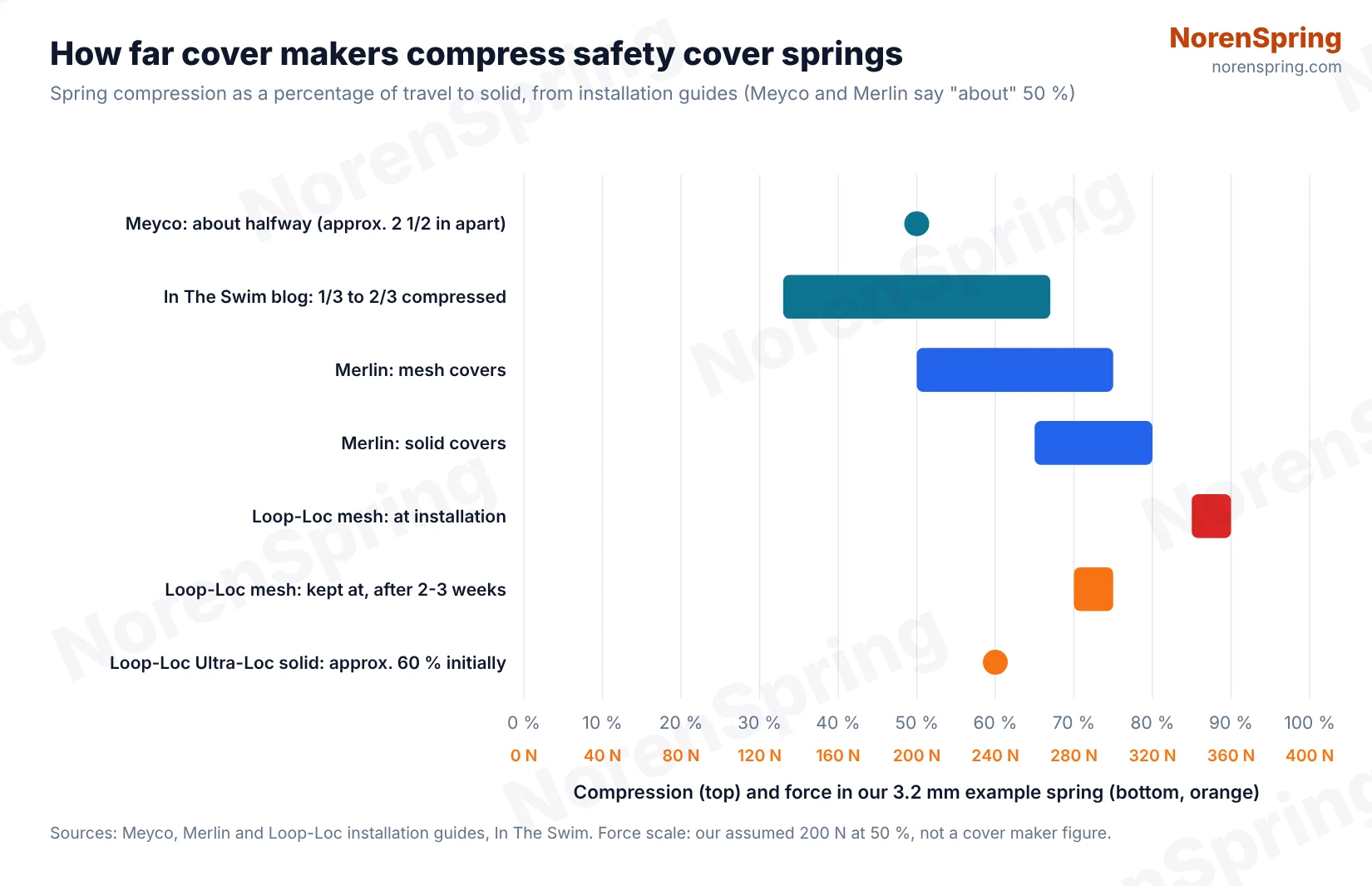
Loop-Loc gives the reason for its high figure: “New mesh covers tend to shrink in their cartons”, and compressing the springs almost fully at first lets the cover “stretch back to its normal size” [2]. Its solid Ultra-Loc cover gets a lower setting “Due to the very minimal stretch of Ultra-Loc material” [2].
There is also a reason not to go all the way. In The Swim warns: “Too tight and the springs have no slack or room to move when under a heavy snow load” [5]. A spring compressed to 90 % has only a tenth of its travel left before the coils touch; after that it acts as a solid link and passes every extra load straight to the anchor.
Standard, short and double springs
Replacement springs are sold in a few overall lengths. INYOPools sells a short stainless spring, part WS016, and answers a customer that “The entire piece is approx 5″ in length” [7]. Meyco supplies an “O-RING SHORT SPRING” for limited decking, where there is not room for the standard strap and spring run [1]. Leslie’s lists an “8 inch long Stainless Steel Safety Cover Spring with double springs”, one on each side [8]. Match the overall length, the ring type and the end that takes the strap when ordering a replacement.
Do the springs set the cover’s weight rating?
Not on their own. Royal Swimming Pools explains that safety covers are designed to ASTM F1346-91, which “states that a safety cover must hold a minimum of 485 lbs”, and adds that the actual “breaking point is usually around 1500 to 2500 lbs” depending on cover type and installation [6]. Cover fabric, straps, anchors, deck and springs all share that load. What the spring decides is how much stretch the system has before the coils close.
Worked example: a stainless pool cover spring
To show what separates a good cover spring from a poor one, we designed five springs that all pull 200 N (45 lbf) at 50 % compression. The 200 N working pull and the 160 mm free length of the coil are our assumptions, not figures from any cover maker. All five use ASTM A313 type 302/304 stainless wire with squared (closed) ends, and we checked them with the methods and tables in Shigley’s Mechanical Engineering Design, chapter 10 [9]: tensile strength from Table 10-4 for 302 stainless, shear modulus 69.0 GPa, and the static stress limits in Table 10-6.
| Item | 2.5 mm | 2.8 mm | 3.2 mm (our choice) | 3.5 mm | 4.0 mm |
|---|---|---|---|---|---|
| Outside diameter | 24 mm | 25 mm | 26 mm | 27 mm | 28 mm |
| Active coils | 10.7 | 13.7 | 17.8 | 19.9 | 22.8 |
| Rate | 3.18 N/mm | 3.53 N/mm | 4.28 N/mm | 5.01 N/mm | 7.02 N/mm |
| Solid length | 34 mm | 47 mm | 67 mm | 80 mm | 103 mm |
| Travel to solid | 126 mm | 113 mm | 93 mm | 80 mm | 57 mm |
| Force at 50 % / 90 % / solid | 200 / 360 / 400 N | 200 / 360 / 400 N | 200 / 360 / 400 N | 200 / 360 / 400 N | 200 / 360 / 400 N |
| Stress at solid, % of tensile strength | 91 % | 70 % | 50 % | 40 % | 29 % |
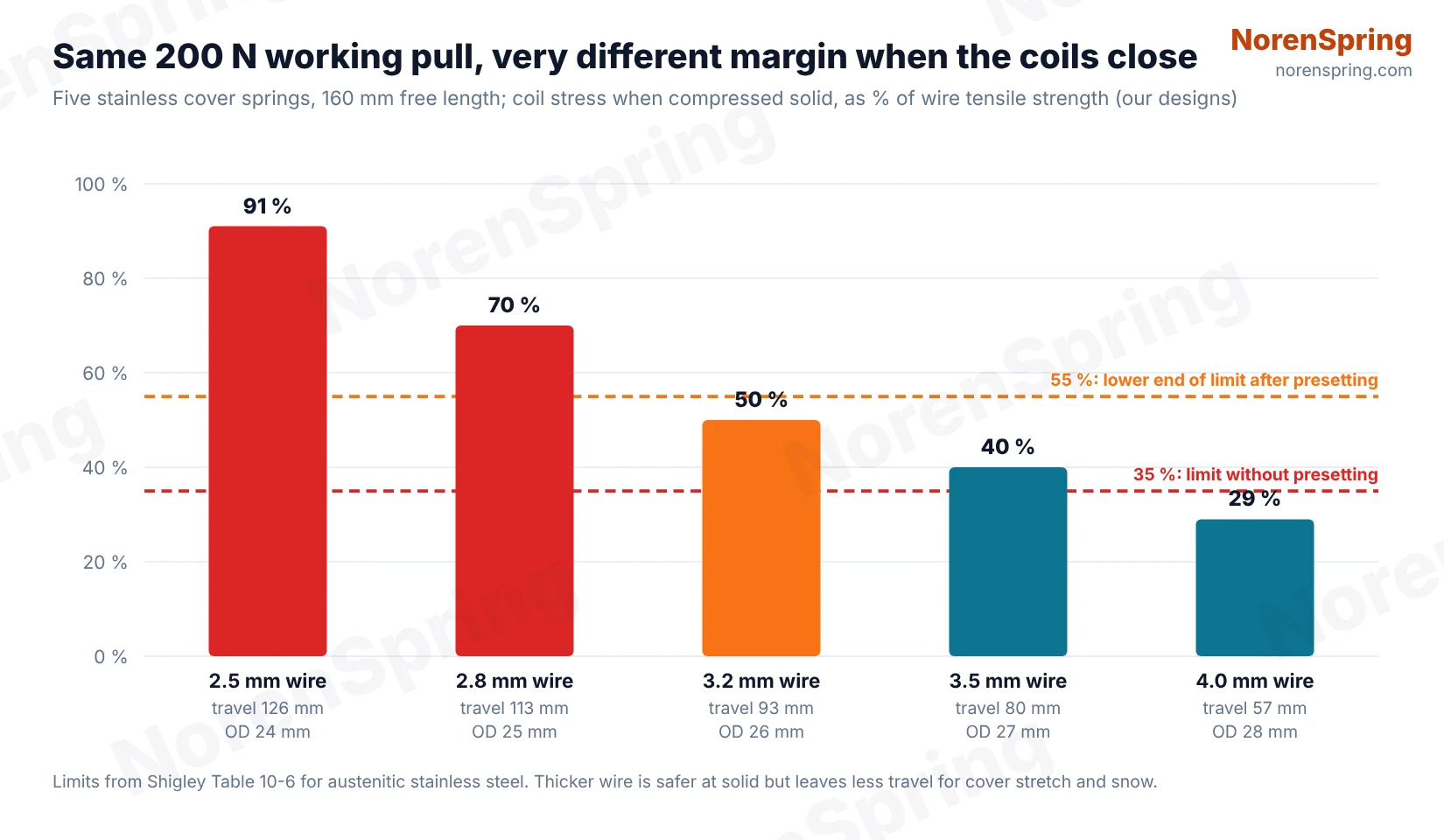
All five springs give the same pull at every compression, so a quick force check at the installed length would pass them all. The difference shows when the coils close. Shigley’s Table 10-6 allows austenitic stainless compression springs 35 % of tensile strength at solid if they are not preset, and 55 % to 65 % after set removal [9]. The 2.5 mm spring reaches 91 % and the 2.8 mm spring 70 %. Both are over the limit even after presetting, so an over-tightened strap or a snow load that drives them to coil bind can leave them with a permanent set: they come back shorter and pull less.
The 4.0 mm spring is safe at solid without any extra step, but it has only 57 mm of travel. At Loop-Loc’s 90 % setting that leaves about 6 mm before the coils close, which is little room for snow load or a cover that has not finished stretching.
We chose the 3.2 mm spring. It has 93 mm of travel and reaches 50 % of tensile strength at solid, which is inside the 55 % limit once the spring is preset. Shigley describes the process: “Set removal or presetting is a process used in manufacturing a spring to induce useful residual stresses.” The spring is coiled longer than needed and pressed to solid, so it settles to its final free length in the factory rather than on the pool deck. Shigley also notes that “Set removal is not recommended when springs are subject to fatigue” [9]. A cover spring is loaded mostly when the cover goes on in autumn and comes off in spring, with wind and snow on top, so we treat it as a static spring here; a design with many load cycles would need a fatigue check as well. Our compression spring design guide walks through the same checks step by step, and our spring rate guide explains the rate formula used for the table.
Which stainless steel for pool cover springs?
Cover springs spend the winter outdoors on the pool deck, near chlorinated pool water and deck cleaners. Euro Inox, the European market development association for stainless steel, separates outdoor pools from indoor halls. For outdoor pools it says “the atmospheric conditions are much less corrosive than in indoor swimming pools, because rainfall naturally cleans the stainless steel surfaces and washes the chloride-bearing compounds away”, and it lists grade 1.4301 (304) among the grades suitable for outdoor pool parts [10]. Indoor pools are a different case: the same document says highly alloyed stainless steels “are a must for instance in fasteners for suspended ceilings in indoor swimming pools” [10], so springs for indoor or enclosed pools need their own material review.
The springs in the maker and retailer listings above are all stainless steel. Passivation after coiling removes free iron from the surface; our spring finishes guide explains how it compares with plating.
Signs that pool cover springs need replacing
- The coils stay closed or nearly closed after the strap is released. The spring has taken a set and no longer gives the tension it was made for.
- The cover sags or bounces in the wind even after the straps are tightened. In The Swim lists “a saggy cover that bounces up and down in the wind” as the result of springs set too loose [5].
- The ring is bent open or slips off the anchor head.
- Rust staining on the coils or on the deck under the spring.
- A broken coil or a cracked ring. Our guide to why springs fail shows how to read a broken end.
Use the installation rod for every spring. Latham’s manual is direct: “Do not kick or in any way abuse the springs upon removal. Failure to use the rod voids the warranty.” [4]
What to specify when ordering pool cover springs
For a cover maker or distributor, a pool cover spring drawing should carry the items in our compression spring specification guide, with these points made explicit:
- Force at two compressions, for example at 50 % and 90 % of travel, each with a tolerance, so the spring matches the cover maker’s tension instructions.
- Free length, solid length and travel, because the compression percentage in the installation guide depends on them.
- Stress at solid, stated as a design requirement, and whether the springs are preset.
- Wire grade and diameter, such as ASTM A313 type 304, with the mill certificate.
- Maximum outside diameter, so the spring fits inside the vinyl spring cover.
- Ring inside diameter and wire bend, to fit the anchor head and the installation rod notch.
- Strap end shape and width, to suit the webbing and buckle.
- Overall length, such as the standard 8 in or the short 5 in style.
- Finish, usually passivated bright stainless.
For the 3.2 mm spring above, the key lines of the drawing would look like this. The tolerances are our example values, to agree with the cover maker.
| Drawing item | Example value |
|---|---|
| Wire | 3.2 mm ASTM A313 type 304 stainless, passivated |
| Outside diameter | 26.0 mm maximum |
| Coils | 17.8 active, ends squared (closed), not ground |
| Free length (coil) | 160 mm after presetting |
| Solid length | 66.6 mm maximum |
| Force at 50 % travel (113.3 mm long) | 200 N ± 10 % |
| Force at 90 % travel (75.9 mm long) | 360 N ± 10 % |
| Presetting | Pressed to solid three times; free length checked after |
Send your cover’s strap layout, the compression your installation guide asks for and the spring length you use now through our contact page, and our engineers will review the spring and its stress at solid. Our compression springs page shows the ends and finishes we make, and you can read more about our company and its certifications. This guide was compiled by our editorial team with our spring engineers.
FAQ
What are the springs on a pool cover for?
They connect each strap to its deck anchor and keep the cover tight. The spring lets the cover move a little under wind, snow and stretch.
How much should pool cover springs be compressed?
It depends on the cover maker. Meyco and Latham say about half, Merlin 50 % to 75 % for mesh and 65 % to 80 % for solid covers, and Loop-Loc 85 % to 90 % at installation, then 70 % to 75 % after two to three weeks. Follow the guide for your cover.
Are pool cover springs compression or extension springs?
Compression springs. Meyco lists them as “STAINLESS STEEL COMPRESSION SPRINGS” [1], and the installation guides describe the spring as being compressed or collapsed when the strap is tightened.
Can I use any stainless spring of the same length?
Not safely. Springs of the same length can pull very differently, and even springs with the same pull can take a set when the coils close, as our five designs show. Match the overall length, ring, strap end and pull of the original, or ask the cover maker for its spring.
Why do my pool cover springs stay compressed?
A spring that does not return to its free length has taken a permanent set: at some point it was pushed to a stress above what the wire can carry, for example by being pulled to coil bind. Replace it.
Sources
- Meyco Safety Pool Covers, “Safe Installation Procedures and Care Manual”. assets.poolweb.com
- Loop-Loc, “Inground Cover Installation Guide”. propools.com
- Merlin Industries, “Safety Cover Installation Instructions”. propools.com
- Latham Pool Products, manual safety cover installation instructions. propools.com
- In The Swim, “On Adjusting Safety Pool Cover Straps”. intheswim.com
- Royal Swimming Pools, “What Is the Weight Limit for a Safety Cover?”. knowledgebase.royalswimmingpools.com
- INYOPools, “Short Stainless Steel Spring for Pool Safety Cover 5”, part WS016. inyopools.com
- Leslie’s, “SS Safety Pool Cover Spring, 8 inch Double Spring”. lesliespool.com
- Shigley’s Mechanical Engineering Design, chapter 10 lecture slides (mechanical springs), Istanbul Technical University. web.itu.edu.tr
- Euro Inox, “Safe use of stainless steel in swimming pool environments”. edelstahl-rostfrei.de
- Leslie’s Pool Blog, “How to Install a Safety Pool Cover”. blog.lesliespool.com