










In this article
- Key takeaways
- Why choose stainless steel for a spring?
- Which stainless steel grades are used for springs?
- How much strength do you lose against music wire?
- Why is a stainless spring softer?
- What changes for compression, extension and torsion springs?
- Is a stainless steel spring magnetic?
- Passivation and finish
- Where stainless springs fail: chlorides and heat
- What to put on the drawing or RFQ
- Need a stainless spring made to your drawing?
- Frequently asked questions
- About the authors
- Sources
Cover image: an AI illustration based on a photograph of one of our extension springs, placed in a new setting.
Stainless steel springs are made from cold-drawn stainless spring wire, almost always one of three grades: 302/304, 316 or 17-7 PH. Grade 302/304 is the default for wet, washdown and food-contact service. Choose 316 when chlorides such as salt water or cleaning chemicals are present. Choose 17-7 PH when you need more strength or more heat resistance than the 300 series gives. All of them are weaker and less stiff than carbon spring wire, so a spring converted from music wire to stainless usually needs a new design, not just a new material callout.
This guide compares the grades on the numbers that change a spring design: tensile strength, shear modulus, allowable stress, temperature, magnetism and corrosion. It ends with a checklist of what to put on a drawing or RFQ for a stainless compression, extension or torsion spring.
Key takeaways
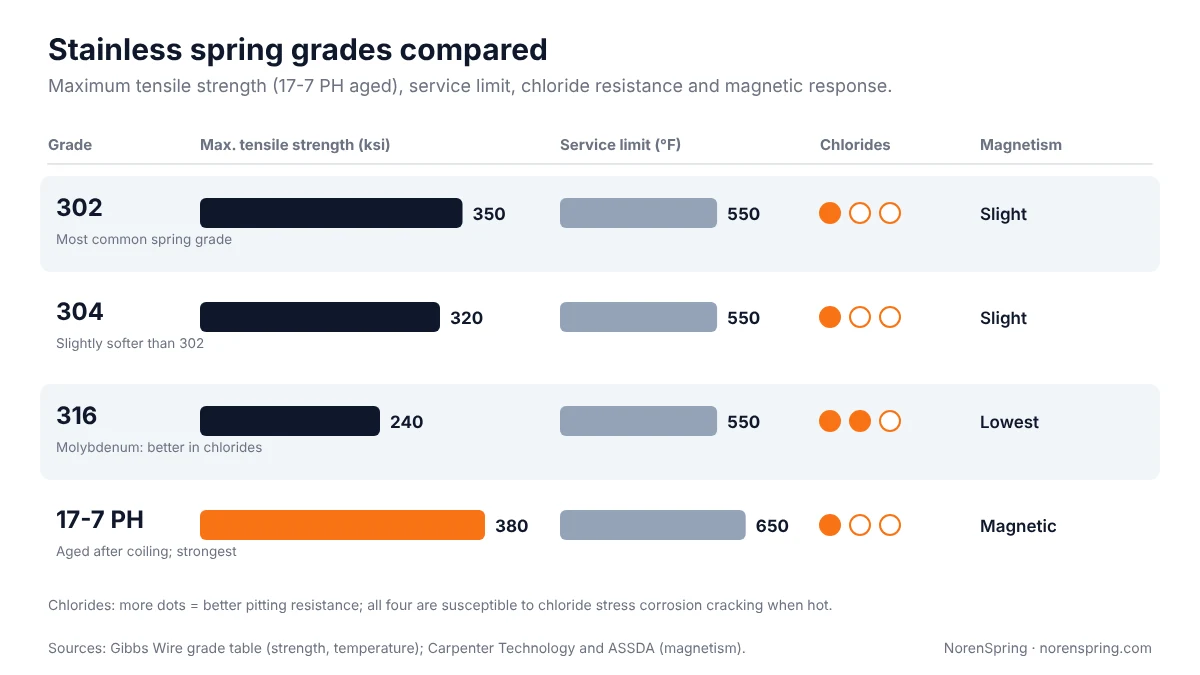
- 302/304 is the workhorse. It is the most common stainless spring grade, cheap enough for general use and resistant to fresh water, steam and most food and cleaning environments.
- 316 is for chlorides, at a strength cost. Its molybdenum improves pitting resistance, but its maximum wire strength is about a third lower than 302.
- 17-7 PH is the strong one. It is coiled soft and then aged at about 900 °F (482 °C), which raises its strength above 302 and its service limit to about 650 °F (343 °C).
- Stainless gives a softer spring. Its shear modulus is about 13% lower than carbon spring steel, so the same geometry gives about 13% less rate.
- Design stress is lower too. Shigley’s guidance allows 35% of tensile strength for austenitic stainless compression springs, against 45% for music wire, before set removal.
- A slightly magnetic 302/304 spring is normal. Cold drawing turns some austenite into martensite. If the spring must be non-magnetic, write a permeability limit on the drawing.
Why choose stainless steel for a spring?
Choose stainless steel when the spring will be wet, washed down, in contact with food, skin or medication, or visible, and a plated or painted carbon spring would not last. Stainless does not need a coating to resist corrosion, so there is no zinc to wear off and no electroplating step that can put hydrogen into a high-strength steel (see our guide to spring finishes and coatings for that risk).
Stainless also keeps its properties at higher temperatures than carbon wire. The 300 series is commonly rated to about 550 °F (288 °C) and 17-7 PH to about 650 °F (343 °C) [5], well above the limits usually given for music wire and hard-drawn carbon wire. Our guide to high temperature springs compares stainless with the other spring materials by temperature.
It is not always the right answer:
- Cost. Shigley’s relative cost index puts 302 stainless wire at 7.6 to 11 times hard-drawn carbon wire, against 2.6 times for music wire [4].
- Strength. A stainless spring needs more wire, more coils or more space to carry the same load at the same stress as a carbon or chrome-silicon spring.
- Rain-only outdoor service. A spring on equipment that gets wet and dries out is often fine in zinc-plated or powder-coated carbon steel, at lower cost.
In our own records, stainless 304 shows up on an exhaust pipe spring, a polished gym equipment spring and an industrial chain tensioner spring. All three are finished by passivation or polishing; heat, moisture and appearance are the usual reasons for choosing stainless in parts like these. For exhaust joints specifically, see our guide to exhaust springs.
Which stainless steel grades are used for springs?
Almost all stainless springs use one of the grades below. ASTM A313 is the US specification for stainless spring wire and covers all of them [1]. In Europe, the long-standing wire standard EN 10270-3 was withdrawn in 2020 and replaced by EN ISO 6931-1, so you will see both on drawings [2].
| Grade | Also called | What it is | Typical use |
|---|---|---|---|
| 302 | 1.4310, X10CrNi18-8; SUS302-WPB | 18-8 austenitic, hardened only by cold drawing | The most common stainless spring grade |
| 304 | 1.4301, X5CrNi18-10; 06Cr19Ni10; SUS304-WPB | 18-8 austenitic, slightly lower carbon than 302 | Interchangeable with 302 for most springs; very common in Asia |
| 316 | 1.4401, X5CrNiMo17-12-2; SUS316-WPA | Austenitic with about 2–3% molybdenum | Salt water, chloride cleaners, chemical and food plants |
| 17-7 PH | Type 631, 1.4568, X7CrNiAl17-7; SUS631J1-WPC | Precipitation-hardening grade with aluminium | High-strength or hotter springs |
Chinese drawings usually name the steel by its GB designation (for example 06Cr19Ni10 for 304 or 07Cr17Ni7Al for 17-7 PH) and the wire to GB/T 24588. Japanese drawings use JIS G4314 names such as SUS304-WPB. Treat the table as a guide to equivalents, not a substitution rule: the strength classes and tolerances differ between standards, so confirm the exact grade and standard with your spring maker before you change a callout.
Gibbs Wire, a stainless wire distributor, sums up the differences in one line each: 302 is the most common spring grade with high strength and good corrosion resistance, 304 is typically a little softer, 316 has superior corrosion resistance but lower strength, and 17-7 PH has the highest strength after heat treatment with corrosion resistance similar to 302 [5].
How much strength do you lose against music wire?
At the same wire diameter, 302 stainless wire is roughly 15% to 28% weaker than music wire between 0.5 and 6 mm, and the gap widens as the wire gets thicker. Shigley’s curve fits for minimum tensile strength give about 2,210 MPa for 1 mm music wire against about 1,870 MPa for 1 mm 302 stainless, and about 1,750 MPa against about 1,350 MPa at 5 mm [4].
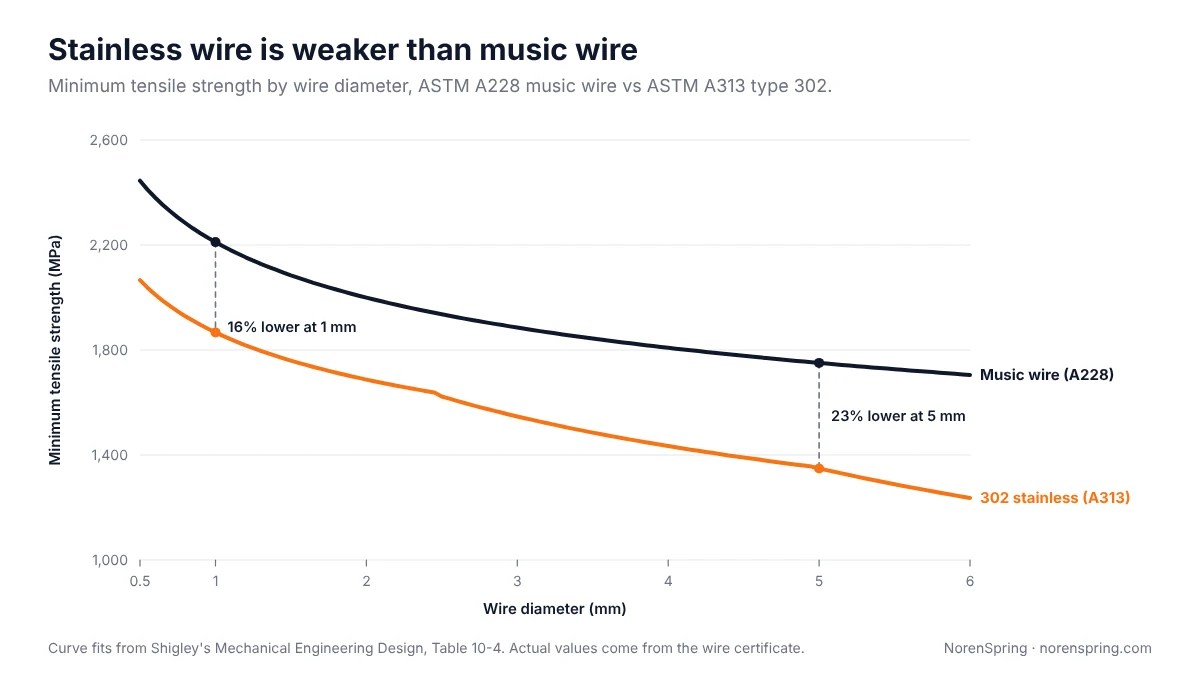
The allowable stress falls further than the tensile strength. Shigley’s table of allowable torsional stress for helical compression springs, before set is removed, gives 45% of tensile strength for music wire and cold-drawn carbon steel, but only 35% for austenitic stainless steel [4]. At 2 mm wire, that is roughly:
| 2 mm wire | Minimum tensile strength | Allowable stress (before set removal) |
|---|---|---|
| Music wire (A228) | about 2,000 MPa | about 900 MPa (45%) |
| 302 stainless (A313) | about 1,690 MPa | about 590 MPa (35%) |
The same geometry carries the same stress whatever the material, so a spring that works at its limit in music wire will run about 50% above the stainless allowable (about 900 MPa against about 590 MPa) if it is simply made in 302 stainless. Removing set during manufacture raises the allowable stress for both materials (to 55–65% for stainless in Shigley’s table), but the gap remains [4]. This is the most common reason a stainless “copy” of a carbon spring takes a set in service. Our guide to why springs fail covers set and relaxation in more detail.
Why is a stainless spring softer?
A stainless spring has a lower rate because stainless wire has a lower shear modulus (G), and spring rate is directly proportional to G. Shigley lists G as 69.0 GPa (10.0 × 10⁶ psi) for 302 stainless and 75.8 GPa (11.0 × 10⁶ psi) for 17-7 PH, against 79.3 GPa (11.5 × 10⁶ psi) for hard-drawn carbon wire and up to 82.7 GPa for fine music wire [4].
In practice:
- 302 (304 and 316 are normally designed with the same G): about 13% less rate than carbon steel and about 17% less than fine music wire at the same geometry.
- 17-7 PH: about 4% less rate than carbon steel.
To recover the rate in 302, you can use a slightly thicker wire or fewer active coils, but both raise the stress, which is already the limiting factor. That trade-off is why stainless springs often end up a little larger than the carbon springs they replace. Our spring rate guide has a calculator for checking the effect of G, wire size and coil count, and the compression spring design guide walks through a full stress check.
What changes for compression, extension and torsion springs?
The same grade choice applies to all three spring types, but each has one stainless-specific point to watch.
- Stainless steel compression springs. Rate and stress are the limits, as above. Ask for the spring to be preset (set removed) if it works close to solid. See how to specify a custom compression spring.
- Stainless steel extension springs. The achievable initial tension can be lower than in music wire of the same index, so confirm it with your spring maker, and remember that hooks see the highest stress in the part. Stainless 302 or 316 is often specified for exposed return springs; check the hook stress at the lower allowable. See how to specify a custom extension spring.
- Stainless steel torsion springs. Bending stress in the legs and body limits the deflection. Expect fewer degrees of safe rotation than the same spring in music wire. See how to specify a custom torsion spring. For small stainless parts, see our small torsion springs guide.
- Wire forms and clips. 302/304 forms well; 17-7 PH can be formed in its as-drawn condition and then aged, which gives a strong formed part without forming fully hardened wire.
Heat treatment after coiling
Coiling leaves residual stress in the wire, so stainless springs are heated after forming. The usual practice is a stress relief of about 700 °F (371 °C) for one hour for the 300 series. For 17-7 PH, the springs are coiled from Condition C wire and then aged at about 900 °F (482 °C) for one hour, which raises tensile strength by roughly 30,000 psi (about 200 MPa) or more, to Condition CH [5]. If your drawing simply says “17-7 PH”, say whether it means Condition C or the aged condition, because the strength is very different.
Is a stainless steel spring magnetic?
A 302 or 304 stainless steel spring is usually slightly magnetic, and that does not mean it is the wrong material. Annealed austenitic stainless is essentially non-magnetic, with a DC permeability of about 1.003 to 1.005 [6]. Spring wire, however, is heavily cold drawn, and cold work turns part of the austenite into martensite, which is magnetic. Carpenter Technology notes that the increase in permeability can be “appreciable” for Types 302 and 304 [6]. The Australian Stainless Steel Development Association explains that the effect is smaller in alloys with more austenite stabilisers such as nickel [7]. So 316, with more nickel, usually responds less to a magnet than 302 after the same cold work.
17-7 PH is different again: after aging, it is clearly magnetic, as are most precipitation-hardening stainless steels [6].
If magnetism matters, for example near a sensor, a compass or an MRI room:
- Write a maximum relative permeability on the drawing (for example “μr ≤ 1.05 at a stated field strength”), not just “non-magnetic”.
- Ask for 316 or a higher-nickel alloy, and accept that the strength will be lower.
- Agree on how the permeability will be measured on samples.
A magnet test is not a way to tell 304 from 316, or to check corrosion resistance. Our factory uses Thermo Scientific Niton XL2 series and OES material analysers to confirm grades and tell SUS304 from SUS316.
Passivation and finish
Passivation is the standard finish for a stainless spring. Its purpose is to remove free iron left on the surface by drawing, coiling and handling, so the chromium oxide film can form evenly [5]. The treatment is usually a nitric or citric acid bath. Without it, iron particles embedded during coiling can show as rust spots even on 316. ASTM A967 specifies passivation treatments for stainless steel parts, and ASTM A380 covers cleaning, descaling and passivation practice [9][10]. Name the specification and the test method you want, because A967 offers several treatment and verification options.
Other finishes you will see:
- Polishing or electropolishing for appearance, hygiene or a smoother surface. The gym equipment spring in our records is polished.
- No coating. Stainless springs are normally not plated or painted. If you need colour for identification, ask about a coating that will not trap moisture against the wire.
- Shot peening. It can raise fatigue life in stainless as in carbon steel; specify it when the spring is cycled hard.
Where stainless springs fail: chlorides and heat
Stainless resists general rusting but has three limits that matter for springs.
- Pitting in chlorides. Salt water, de-icing salt, swimming-pool air and chloride cleaners can pit 302/304. Pits are fatigue-crack starters in a spring. 316 resists pitting better because of its molybdenum. Our pool cover springs guide covers stainless springs on outdoor pool decks.
- Chloride stress corrosion cracking. A spring is always under tensile stress, which is one of the conditions for this type of cracking. SSINA notes that fully immersed stainless steels rarely show chloride stress corrosion cracking below about 60 °C (140 °F), and that standard 304/304L and 316/316L are “very susceptible” to it [8]. Evaporating or condensing conditions can crack them at lower temperatures, as in indoor swimming-pool atmospheres [8]. Where these conditions cannot be avoided, consider higher-nickel or duplex alloys [8].
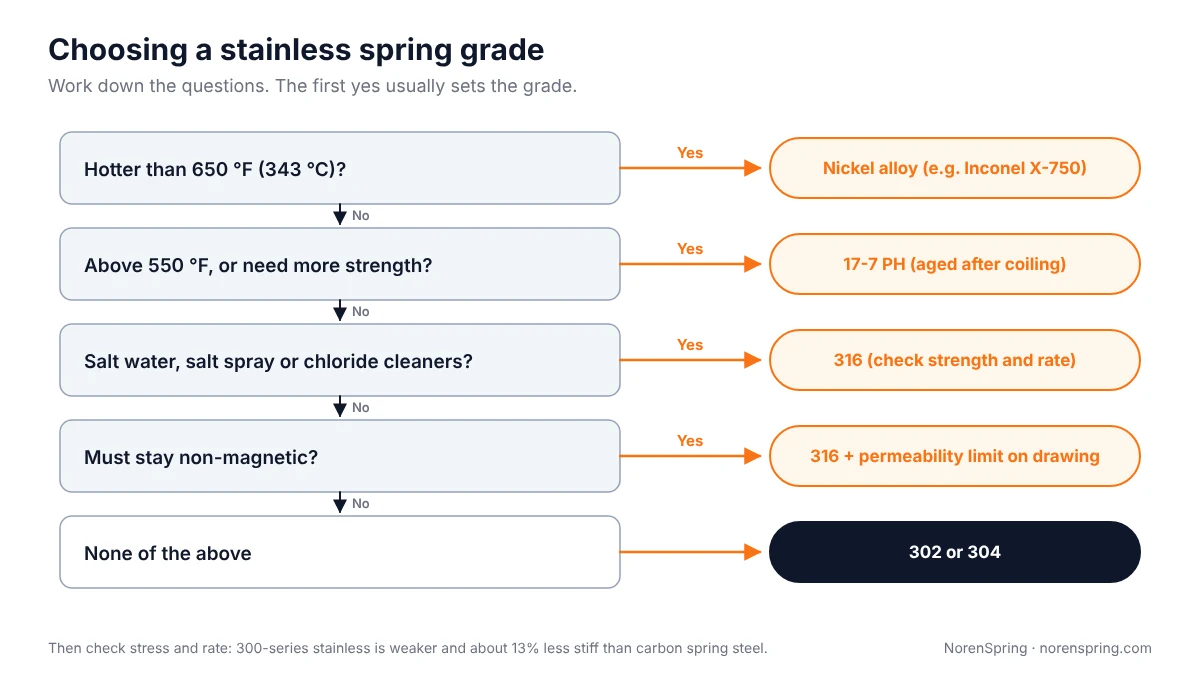
- Temperature. Above about 550 °F (288 °C) for the 300 series, or 650 °F (343 °C) for 17-7 PH, springs relax and lose load. For hotter service, nickel alloys such as Inconel X-750 are used; our Inconel springs guide explains tempers and temperature limits [5]. See our spring wire material guide for the wider choice.
What to put on the drawing or RFQ
A clear stainless spring callout saves a round of questions and avoids getting a cheaper grade than you meant. Include:
| Item | Example |
|---|---|
| Grade and wire standard | “Stainless steel wire ASTM A313 Type 316” or “EN ISO 6931-1, 1.4401” |
| Condition and heat treatment | “Stress relieved after coiling”; for 17-7 PH, “aged to Condition CH after forming” |
| Wire diameter and spring dimensions | Wire, OD or ID, free length, coils, ends or hooks, as for any spring |
| Loads and working heights | Load at a stated length (or torque at a stated angle) with tolerance |
| Preset | “Remove set” if the spring works near solid |
| Finish | “Passivate per ASTM A967”, or “electropolish” |
| Magnetic limit (if needed) | Maximum relative permeability and test method |
| Corrosion test (if needed) | Test type and duration agreed with the supplier |
| Documents | Mill certificate and an EN 10204 3.1 inspection certificate if you need lot traceability |
If you only write “stainless steel”, most suppliers will quote 302 or 304. That is fine for many springs, but not if the spring will see salt water or needs to stay non-magnetic.
For checks on delivery, see our guide to compression spring testing and acceptance.
Need a stainless spring made to your drawing?
We make custom stainless steel compression springs, stainless extension springs and custom torsion springs and wire forms in stainless 304 and 316 as well as carbon and alloy steels. Send a drawing, a sample or the key dimensions and the environment the spring works in, and our engineers will check the grade, stress and rate before quoting. Contact our engineering team.
Frequently asked questions
Is 304 or 316 better for springs?
For most springs, 302/304 is the better choice because it is stronger and cheaper. 316 stainless steel springs make sense mainly when the spring will see chlorides, such as salt water, salt spray or chloride cleaning chemicals, or when a lower magnetic response matters. Gibbs Wire lists the maximum strength of 316 spring wire at about 240 ksi against 350 ksi for 302 [5], so a 316 spring may need to be redesigned.
Do stainless steel springs rust?
They can. Stainless resists general rust, but iron particles left on the surface by coiling can rust if the spring is not passivated, and chlorides can cause pitting on 302/304. Passivation, the right grade for the environment and keeping chloride deposits from building up are the main defences.
Is 17-7 PH stainless magnetic?
Yes. A 17-7 PH stainless steel spring is clearly magnetic in the aged condition, like most precipitation-hardening stainless steels [6]. If you need a non-magnetic spring, use an austenitic grade such as 316 and put a permeability limit on the drawing.
What temperature can stainless steel springs handle?
The 300 series grades are commonly rated to about 550 °F (288 °C) and 17-7 PH to about 650 °F (343 °C) [5]. These are upper limits. A spring that must hold its load closely, or works at high stress, should be designed for a lower temperature, or made from a nickel alloy.
Can I replace a music wire spring with a stainless one of the same size?
Usually not without a check. The stainless spring will have about 13% to 17% less rate, and it will run at a higher share of a lower allowable stress, so it may take a set. Recalculate the spring with stainless properties, then adjust the wire size, coils or working range. Our guide to music wire springs lists the tensile strength and shear modulus of music wire by size, so you can compare the two directly.
About the authors
This guide was prepared by the NorenSpring engineering team, which designs and manufactures custom compression, extension and torsion springs and wire forms in Xuzhou, China. Technical review by Feng Yulin, General Manager and senior structural engineer, who has 15 years of spring R&D experience and more than 30 national patents. NorenSpring holds IATF 16949, ISO 9001, ISO 13485, ISO 14001 and ISO 45001 certifications. More about NorenSpring. Sources and figures were last checked on October 18, 2026.
Sources
The numbers in square brackets in the text refer to this list.
- ASTM International, ASTM A313/A313M, Standard Specification for Stainless Steel Spring Wire. Covers austenitic, austenitic-ferritic and age-hardenable grades, including 302, 304, 316 and 631 (17-7 PH). Retrieved 2026-10-18.
- Estonian Centre for Standardisation, EVS-EN 10270-3:2011, Steel wire for mechanical springs, Part 3: Stainless spring steel wire, standard history showing withdrawal on 15 September 2020 and replacement by EN ISO 6931-1:2020. Retrieved 2026-10-18.
- BSI, ISO 6931-1, Stainless steels for springs, Part 1: Wire. Retrieved 2026-10-18.
- R. G. Budynas and J. K. Nisbett, Shigley’s Mechanical Engineering Design, 9th edition, McGraw-Hill, 2011, chapter 10. Source for the tensile strength curve fits and relative cost (Table 10-4), the shear moduli (Table 10-5) and the allowable torsional stresses for compression springs (Table 10-6).
- Gibbs Wire & Steel, A Layman’s General Guide to Stainless Wire. Source for the grade table (maximum strengths), the 550 °F and 650 °F service limits, stress relief at 700 °F and aging of 17-7 PH at 900 °F for one hour, and the purpose of passivation. Retrieved 2026-10-18.
- Carpenter Technology, Stainless Steel Magnetic Properties. Source for annealed permeability of 1.003 to 1.005, the appreciable increase for Types 302 and 304 after cold work, and the ferromagnetism of most precipitation-hardening grades. Retrieved 2026-10-18.
- Australian Stainless Steel Development Association, Magnetic effects of stainless steels. Retrieved 2026-10-18.
- Specialty Steel Industry of North America, Chloride Stress Corrosion Cracking. Retrieved 2026-10-18.
- ASTM International, ASTM A967/A967M, Standard Specification for Chemical Passivation Treatments for Stainless Steel Parts. Retrieved 2026-10-18.
- ASTM International, ASTM A380/A380M, Standard Practice for Cleaning, Descaling, and Passivation of Stainless Steel Parts, Equipment, and Systems. Retrieved 2026-10-18.



