










In this article
- Key takeaways
- When do you need an Inconel spring?
- Which Inconel alloys are used for springs?
- X-750 tempers and heat treatment: which one fits your temperature?
- How much stress can an Inconel X-750 spring take?
- Worked example: one hot spring, four conditions
- X-750 or 718?
- Heat treatment and finishing rules for Inconel springs
- Where Inconel springs are used
- How we review an Inconel spring inquiry
- What to send for an Inconel spring quote
- Frequently asked questions
- About the authors
- Sources
Cover image: an AI illustration based on a photograph of small compression springs we make, placed in a new setting.
Inconel springs are springs coiled or formed from nickel-chromium superalloy wire, most often INCONEL® alloy X-750 or alloy 718, and then age hardened. Engineers choose them when a spring must keep its load in heat that would make stainless or carbon spring steel relax. Typical places are aircraft and engine hardware, gas turbines, hot valves and exhaust or furnace equipment.
The alloy name alone does not make a good high-temperature spring. The same X-750 wire can be rated for about 371 °C or for 649 °C, depending on its temper and the heat treatment after coiling. This guide is for design engineers and buyers who need custom compression springs or wave springs for hot service. It explains the tempers, the stress limits, the load loss you should expect, and what to put on the drawing.
Key takeaways
- Temper and aging set the limit, not the alloy name. For X-750 springs, Special Metals rates spring temper wire aged at 1200 °F (649 °C) for high strength up to about 700 °F (371 °C), and triple heat treated spring temper for 850–1200 °F (454–649 °C) (Special Metals X-750 datasheet).
- Hotter service means lower allowed stress. The datasheet design stress falls from 100 ksi (689 MPa) to 55 ksi (379 MPa) when you move to the triple heat treatment for 1000 °F service (Special Metals X-750 datasheet). In our worked example, that makes the wire about a third thicker for the same load.
- A hot spring pushes less before it relaxes at all. The shear modulus of X-750 drops about 18% from room temperature to 1000 °F, so the force at the same length drops by the same share (Special Metals X-750 datasheet, Table 5).
- Alloy 718 is the other common choice. Special Metals credits it with excellent relaxation resistance in springs up to 1100 °F (593 °C) (Special Metals 718 datasheet).
When do you need an Inconel spring?
Use a nickel alloy when the temperature at the spring, not at the heat source, is above what stainless steel can hold. In our stainless steel springs guide we use about 288 °C (550 °F) for the 300 series and about 343 °C (650 °F) for 17-7 PH as upper limits. Above that, a stainless spring loses load over time, and that loss is called relaxation. For a side-by-side list of temperature limits from carbon steel to Inconel 718, see our guide to high temperature springs. If the spring stays below about 350 °C and weight matters more than heat, compare titanium springs as well.
Relaxation is the slow drop in force of a spring that is held at a fixed length. In the X-750 datasheet tests, it is the reduction of load needed to keep the spring at a constant height (Special Metals X-750 datasheet). A latch spring that relaxes will no longer latch firmly. A valve spring that relaxes lets the valve leak or chatter. Our guide on why springs fail covers set and relaxation in more detail.
There are two other reasons to choose Inconel even at moderate heat:
- Corrosion and oxidation. X-750 is a nickel-chromium alloy with at least 70% nickel and 14–17% chromium, and it resists oxidation at high temperature (Special Metals X-750 datasheet).
- Cold service. The same datasheet says X-750 has excellent properties down to cryogenic temperatures and is used for springs from sub-zero temperatures up to 1200 °F (Special Metals X-750 datasheet).
Inconel costs much more than stainless spring wire and is harder to buy in small lots. If the spring only sees short heat peaks, a stainless spring with a lower working stress may be enough. That is worth checking before you pay for a superalloy.
Which Inconel alloys are used for springs?
Two age-hardenable alloys cover most Inconel springs. Both get their strength from a precipitation (aging) heat treatment after the spring is formed.
| Alloy | UNS / W.Nr. | Spring service range in the maker’s data | Notes for springs |
|---|---|---|---|
| INCONEL alloy X-750 | N07750 / 2.4669 | Sub-zero to 1200 °F (649 °C) (Special Metals X-750 datasheet) | The classic spring grade. Two wire tempers and three common heat treatments give different temperature ranges |
| INCONEL alloy 718 | N07718 / 2.4668 | Up to 1100 °F (593 °C) for springs (Special Metals 718 datasheet) | Excellent relaxation resistance; used for springs, fasteners and instrumentation parts (Special Metals 718 datasheet) |
Other nickel and cobalt alloys exist for springs, but they are rarer and harder to source in wire. A NASA study of springs for 1000 °F vacuum service listed Inconel 718 and X-750, René 41, A-286 stainless steel, cobalt-base L605 and S816, Haynes 25 and Udimet 700 as candidates (NASA CR-107740).
Chinese drawings often use GB superalloy grades. GH4169 is the grade usually cross-referenced to alloy 718 (Total Materia), and GH4145 is often listed for X-750. Treat a cross-reference as a starting point. Confirm the composition, the wire standard and the heat treatment before you accept a substitute.
X-750 tempers and heat treatment: which one fits your temperature?
X-750 spring wire comes in two tempers. No.1 temper is cold reduced about 15–20% after the last anneal. Spring temper is cold reduced about 30–65%, so it starts much stronger (Special Metals X-750 datasheet). The spring is coiled first and aged afterwards. The aging cycle you choose decides the strength and the temperature range.
| Wire temper | Heat treatment after coiling | AMS spec | Service range | Min. wire tensile strength |
|---|---|---|---|---|
| Spring temper | 1200 °F (649 °C) for 4 h, air cool | AMS 5699 | High strength up to about 700 °F (371 °C) | 220 ksi (1,517 MPa) for 0.012–0.250 in. wire |
| No.1 temper | 1350 °F (732 °C) for 16 h, air cool | AMS 5698 | Best relaxation resistance at about 700–850 °F (371–454 °C), and at low to moderate stress to about 1000 °F (538 °C) | 155–165 ksi (1,069–1,138 MPa) |
| Spring temper | 2100 °F/2 h + 1550 °F/24 h + 1300 °F/20 h (“triple” heat treatment) | AMS 5699 | Maximum relaxation resistance at about 850–1200 °F (454–649 °C) | 145–150 ksi (1,000–1,034 MPa) |
Source: Special Metals, INCONEL alloy X-750 datasheet, Tables 6 and 31 (Special Metals X-750 datasheet). Metric values are our conversions.
Notice that the hottest condition has the lowest strength. The triple heat treatment grows a uniform coarse grain in the cold-worked wire, and the datasheet explains that a uniform coarse grain gives better relaxation strength (Special Metals X-750 datasheet). You trade strength at room temperature for load retention in heat.
Cold work also matters below 900 °F. A No.1 temper spring aged at 1350 °F and loaded at 70 ksi relaxed only 3% in 500 hours at 800 °F. An identical spring made from spring temper wire relaxed 12% (Special Metals X-750 datasheet). That is why the No.1 temper is the usual pick for the 370–480 °C band.
How much stress can an Inconel X-750 spring take?
Special Metals publishes design stresses for helical X-750 springs at each temperature. They are based on the stress that produces 5% relaxation in 7 days (Special Metals X-750 datasheet). Figure 1 plots them in metric units.
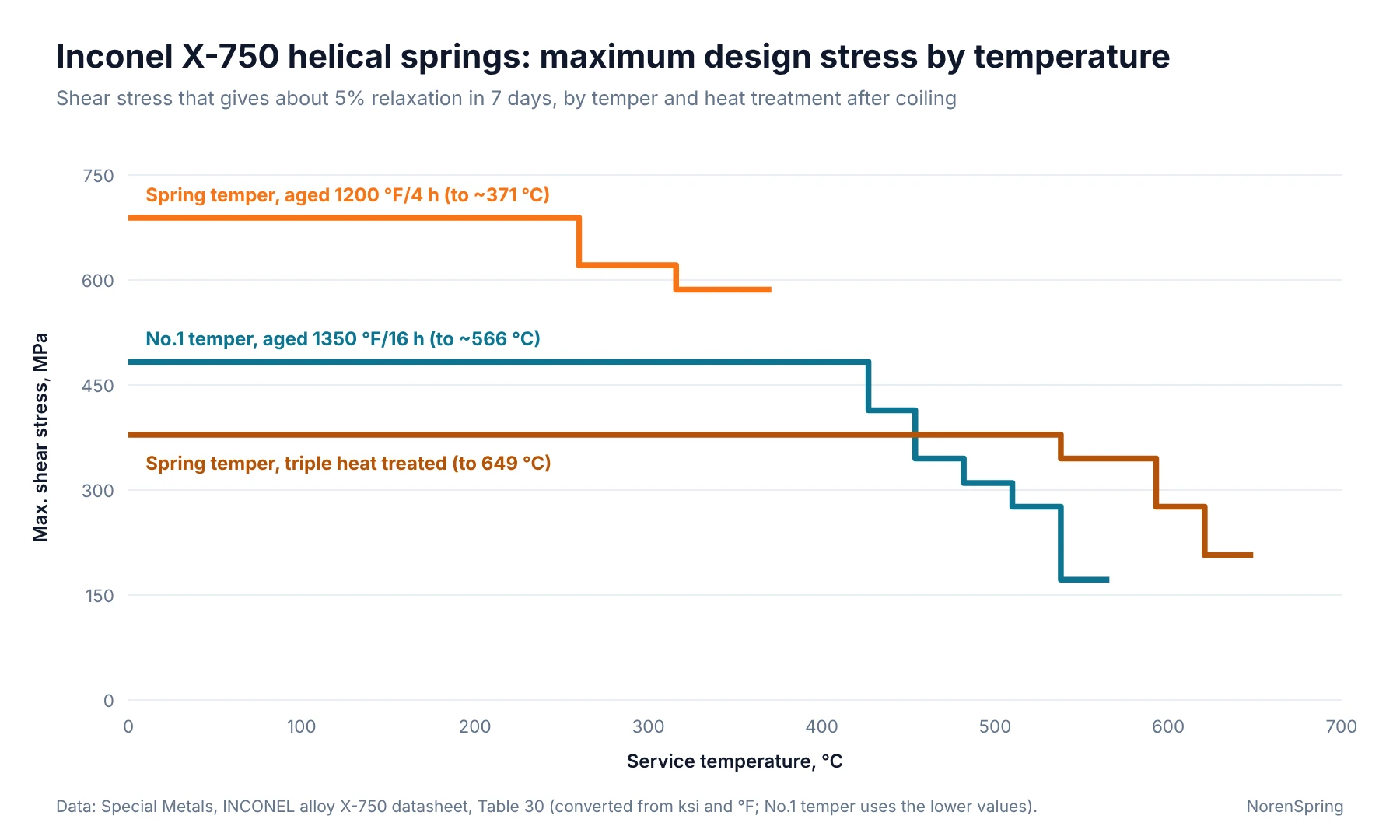
Read the chart this way:
- Up to about 371 °C: spring temper aged at 1200 °F allows the most stress, 100 ksi (689 MPa) up to 500 °F and 85 ksi (586 MPa) at 650–700 °F.
- About 370–540 °C: No.1 temper aged at 1350 °F allows 70 ksi (483 MPa) up to about 800 °F, then falls quickly.
- About 540–650 °C: only the triple heat treated spring temper is rated. It allows 55 ksi (379 MPa) up to 1000 °F, 50 ksi up to 1100 °F and 30 ksi (207 MPa) at 1150–1200 °F.
These are shear stresses for helical springs, corrected for coil curvature. Use the stress at the highest load the spring sees in service, not at the installed load. The datasheet also notes that, if no cold data exist, springs for cryogenic service may be designed on room-temperature properties, because strength and modulus rise as temperature falls (Special Metals X-750 datasheet).
Fatigue is a separate check. For flat springs made from spring temper strip, the datasheet shows that a 2,000,000-cycle life cuts the allowed design stress from 120 ksi to 70 ksi (Special Metals X-750 datasheet). If your spring cycles as well as runs hot, tell your spring maker the cycle count.
Worked example: one hot spring, four conditions
Example scenario (an illustration, not a customer record). A compression spring must push 150 N at its installed length. The space allows a spring index of 8, which means the mean coil diameter is 8 times the wire diameter. How thick must the X-750 wire be at each service temperature?
How we calculated it: we compiled the numbers below with the standard spring formulas from our spring rate guide. Stress is τ = K · 8FD / (πd³), with the Wahl factor K = 1.184 for an index of 8. Rate is k = G·d⁴ / (8·D³·n). The allowed stresses come from Figure 1, and the shear modulus G at each temperature comes from Table 5 of the X-750 datasheet (Special Metals X-750 datasheet).
| Condition | Service temperature | Allowed stress | Minimum wire diameter for 150 N |
|---|---|---|---|
| Spring temper, aged 1200 °F/4 h | up to 260 °C (500 °F) | 689 MPa | 2.29 mm |
| No.1 temper, aged 1350 °F/16 h | up to 427 °C (800 °F) | 483 MPa | 2.74 mm |
| Spring temper, triple heat treated | up to 538 °C (1000 °F) | 379 MPa | 3.09 mm |
| Spring temper, triple heat treated | at 649 °C (1200 °F) | 207 MPa | 4.18 mm |
Going from warm service to 538 °C makes the wire about a third thicker, and the spring a third larger in diameter. At 649 °C, the wire is nearly twice as thick. Space is often the real limit on a hot spring, so check it before you fix the housing.
Now take the 538 °C design with 3.2 mm wire, a 25.6 mm mean diameter and 6 active coils. At room temperature, its rate is 9.88 N/mm, and it needs 15.2 mm of deflection to give 150 N. The stress at that load is 353 MPa, inside the 379 MPa limit. Figure 2 shows what happens when the same spring heats up at the same installed length.
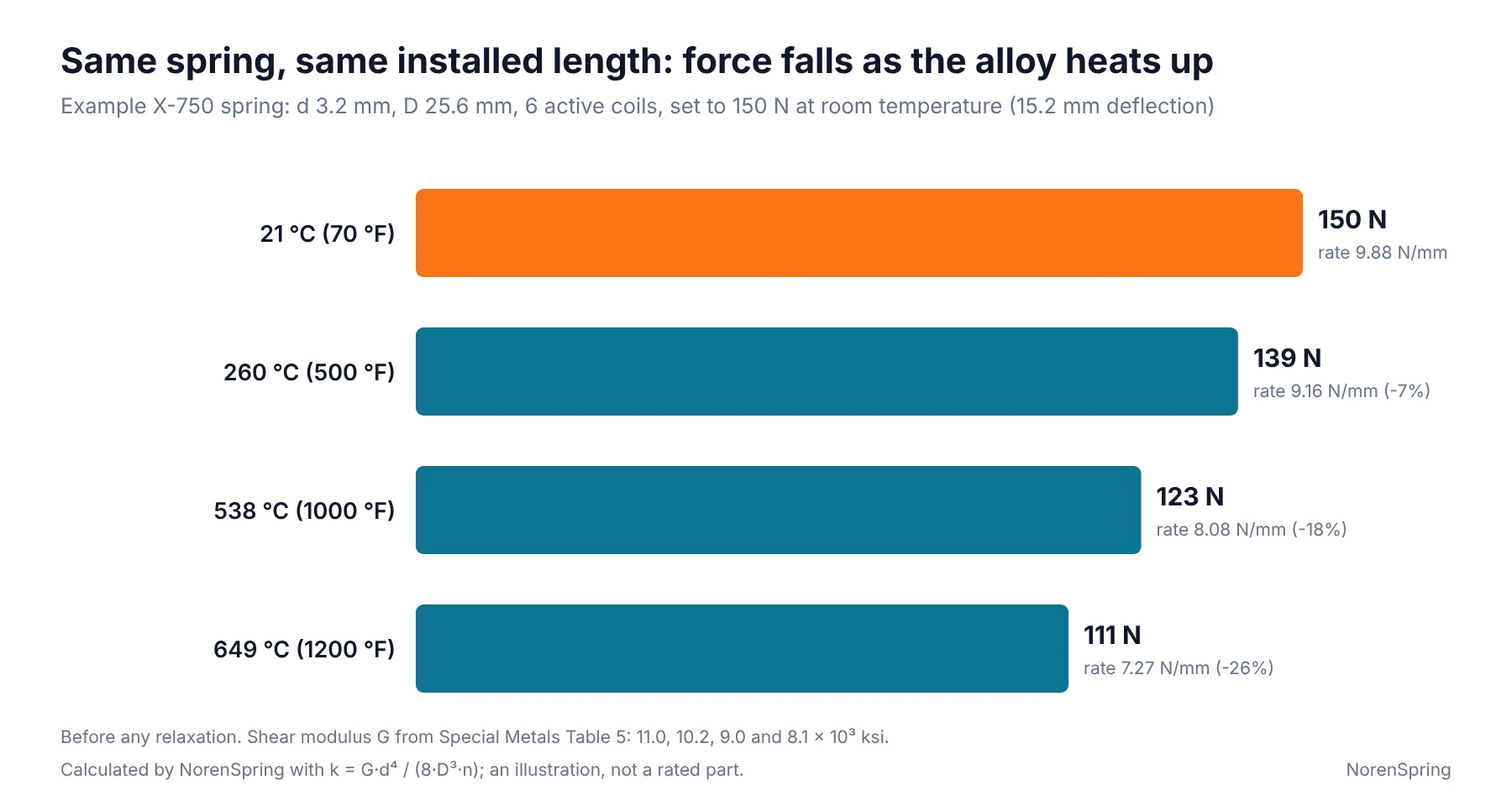
At 538 °C, the force is about 123 N, nearly a fifth below the cold value, only because the alloy gets less stiff. If the spring then loses another 5% to relaxation, the design basis of Figure 1 (Special Metals X-750 datasheet), it holds about 117 N. Two drawing rules follow:
- Say at what temperature the force applies. “150 N at 538 °C after 100 h” is a very different spring from “150 N at room temperature”.
- Allow for relaxation in the minimum load. If the mechanism needs 120 N hot, a spring checked at 150 N cold may be too weak by the end of the first week.
X-750 or 718?
Both alloys make good springs. The choice usually comes down to temperature, availability of the wire size, and what your industry already specifies.
- Alloy 718 has excellent relaxation resistance in springs up to 1100 °F (593 °C). Special Metals shows relaxation tests of helical springs at 1000–1100 °F and 60–70 ksi (Special Metals 718 datasheet). It is also widely used for fasteners, so it is common in engine programs.
- Alloy X-750 covers the widest range, from cryogenic service to 1200 °F (649 °C) with the triple heat treatment (Special Metals X-750 datasheet). The published spring data are very complete, which makes the design easier to defend.
NASA’s study for space power switchgear is a useful real case. It needed compression springs that would run at 1000 °F in vacuum for a minimum of 10,000 hours. After reviewing the candidate alloys, the team chose Inconel 718 with a triple heat treatment. Tests over 2,000 hours at 1000 °F showed low relaxation and good performance (NASA CR-107740). The report also noted that the design had to be conservative to keep relaxation low.
Heat treatment and finishing rules for Inconel springs
The X-750 datasheet gives several practical rules (Special Metals X-750 datasheet). They are worth writing into the purchase order, because they are easy to miss:
- Support the spring during the triple heat treatment. The 2100 °F solution step can make the spring sag. The fix is to heat treat it on an arbor that fits its inside diameter snugly.
- Leave the oxide on. Aging leaves a thin oxide film that helps corrosion resistance. Pickling after aging can attack grain boundaries or cause pitting. Removing the oxide mechanically lowers relaxation resistance.
- Heat-set springs for hot service, not cold-set ones. Cold pressing after aging helps springs for low-temperature service, but it adds cold work and increases relaxation in heat. For high-temperature springs, the datasheet recommends prestressing at temperature. Clamp the spring at about 10% above the maximum working load, then hold it for 1 hour at about 100 °F above the maximum service temperature (Special Metals X-750 datasheet).
- Keep the aging cycle on the drawing. A note such as “X-750, spring temper, AMS 5699, triple heat treated” tells everyone which column of Figure 1 the design used.
Plating is rarely needed on Inconel springs, and the alloy does not need corrosion protection the way carbon steel does. If a coating or a dry-film lubricant is specified, check that it survives the service temperature.
Where Inconel springs are used
The X-750 datasheet lists gas turbine parts, rocket-engine thrust chambers, airframe thrust reversers and hot-air ducting among the alloy’s uses, and springs and fasteners from sub-zero temperatures to 1200 °F (Special Metals X-750 datasheet). Alloy 718 is used in liquid-fueled rockets, gas turbine engine parts and cryogenic tankage (Special Metals 718 datasheet). In spring terms, that means:
- Aerospace hardware: latch, actuator and retention springs near engines, ducts and brakes. Our page on aerospace springs explains the records and first-article checks these programs usually need.
- Valves and seals: wave springs, compression springs and energizer springs in hot or corrosive valves. A wave spring saves axial space where a hot spring has to grow in wire size. See our wave springs page.
- Exhaust, furnace and test equipment: springs that clamp joints or hold parts in heat. Our exhaust springs guide compares stainless and Inconel for that job.
How we review an Inconel spring inquiry
Nickel alloy spring wire, including Inconel grades, is on our material list. Every Inconel project starts with an engineering review, because wire availability and the aging cycle change the cost and the lead time more than they do for stainless. What you can expect from NorenSpring:
- Engineering feedback within 24 hours on the drawing, with any change we would suggest to wire size, index or coil count.
- Material identity checks. Our in-house Thermo Scientific Niton XL2 analyzer is used for material composition checks on incoming wire, and material certificates trace each lot to the wire supplier.
- Load and dimension checks with our Keyence image measuring system and JISC and Aikoh spring testers, against the control plan agreed for your part.
- First article (FAIR) packages for aerospace programs, plus dimensional records and traceability as agreed at project setup.
- Plain answers on approvals. We hold IATF 16949, ISO 9001, ISO 13485, ISO 14001 and ISO 45001. We do not hold AS9100 or NADCAP. If your program needs an approved source for flight hardware, tell us at the start so you can decide early.
Prototype and pre-production samples are available, with no fixed MOQ. Lead time is confirmed at quotation, because it depends on the wire, the heat treatment and the quantity.
What to send for an Inconel spring quote
Use this checklist with our general guide on how to specify a custom compression spring:
- Drawing or sketch with revision, critical dimensions marked, and the spring type.
- Alloy, temper and heat treatment, for example “X-750, No.1 temper, AMS 5698, aged 1350 °F/16 h”. If you are unsure, give the temperature and let us propose one.
- Temperature profile: steady service temperature, peaks, and the time at each.
- Loads and lengths, with the temperature at which each load applies, and the minimum load the mechanism needs after relaxation.
- Cycles, if the spring moves in service, and the expected life.
- Environment: gases, fluids, vacuum, or anything that touches the spring.
- Finish and records: heat-set requirement, oxide or clean finish, material certificates, FAIR or other documents, and quantity.
Send the file through our contact page and our engineers will review it.
Frequently asked questions
What temperature can Inconel springs handle?
It depends on the alloy, the temper and the heat treatment. X-750 springs are rated from cryogenic temperatures up to 1200 °F (649 °C) when made from spring temper wire with the triple heat treatment. Spring temper wire aged at 1200 °F is rated for high strength up to about 700 °F (371 °C) (Special Metals X-750 datasheet). Alloy 718 springs are used up to about 1100 °F (593 °C) (Special Metals 718 datasheet).
Is Inconel X-750 or 718 better for springs?
Neither is better everywhere. X-750 covers a wider temperature range and has very complete published spring data. Alloy 718 has excellent relaxation resistance up to 1100 °F and is common in engine programs. Choose by temperature, wire availability and what your specification already calls for.
Why does an Inconel spring lose force when it is hot?
Two reasons. First, the alloy gets less stiff as it heats up: the shear modulus of X-750 falls from 11.0 to 9.0 × 10³ ksi between room temperature and 1000 °F, so the spring rate falls by about a fifth (Special Metals X-750 datasheet). Second, a spring held at high stress and temperature relaxes over time. The design stresses in Figure 1 limit that relaxation to about 5% in 7 days.
Are Inconel springs magnetic?
Inconel X-750 is not magnetic at room temperature. Its datasheet gives a Curie temperature of −193 °F (−125 °C) after the triple heat treatment, well below normal service (Special Metals X-750 datasheet). If your application has a magnetic permeability limit, put the limit on the drawing so it can be checked.
About the authors
This guide was prepared by the NorenSpring engineering team, which designs and manufactures custom compression, extension and torsion springs and wire forms in Xuzhou, China, since 2001. Technical content reviewed by Feng Yulin, General Manager and senior structural engineer, who has 15 years of spring R&D experience and more than 30 national patents. Our certificates are shown on our about page. The cover is an AI illustration based on our own product photo. The worked example is a calculation to show the method, not a rated part. INCONEL® is a registered trademark of Special Metals Corporation; NorenSpring is not affiliated with Special Metals. Sources were last checked on November 2, 2026.
Sources
The numbers in square brackets in the text refer to this list.
- Special Metals Corporation, INCONEL alloy X-750 technical bulletin. specialmetals.com. Source for composition, uses, wire tempers, heat treatments and AMS specifications (Tables 6 and 31), design stresses for springs (Table 30), shear modulus by temperature (Table 5), relaxation and finishing guidance. Retrieved 2026-11-02.
- Special Metals Corporation, INCONEL alloy 718 technical bulletin. specialmetals.com. Source for the use of 718 in springs up to 1100 °F, spring relaxation data and applications. Retrieved 2026-11-02.
- A. H. Powell, General Electric Company, Compression Springs for Long Time Operation in Vacuum at 1000 °F, NASA CR-107740, 1971. NASA Technical Reports Server. Retrieved 2026-11-02.
- Total Materia, GB GH 4169 nickel alloy record. totalmateria.com. Retrieved 2026-11-02.



