










In this article
- Key takeaways
- What is a titanium spring?
- Beta C vs Ti-6Al-4V for springs
- Why titanium springs are lighter
- How a low shear modulus changes the spring design
- Strength, fatigue and shot peening
- Temperature and corrosion
- Design limits to check before you choose titanium
- Where titanium springs are used
- How to specify a titanium spring
- Frequently asked questions
- About the authors
- Sources
Cover image: an AI-generated illustration (two titanium springs balancing one steel spring) set in our workshop, not a photograph of a specific titanium order.
A titanium spring is a coil spring wound from titanium alloy wire, usually the beta alloy Ti-3Al-8V-6Cr-4Mo-4Zr (Beta C) or, less often, Ti-6Al-4V. Titanium has about 60% of the density of steel and about half its shear modulus, so a titanium spring designed for the same rate and stress can weigh roughly 30% of the steel part. That is why titanium springs appear in aircraft, racing suspension and other places where every gram counts. The trade-offs are cost, a service temperature limit near 350 °C for Beta C, and a tendency to gall.
This guide compares the two titanium grades with spring steel, shows where the weight saving comes from, works through a steel-to-titanium conversion, and lists the design limits to check before you send a drawing.
Key takeaways
- Two common grades. Beta C (UNS R58640, wire to AMS 4957) is the usual titanium spring alloy; ATI lists “high strength coil springs” among its uses [1]. Ti-6Al-4V is the general-purpose titanium alloy.
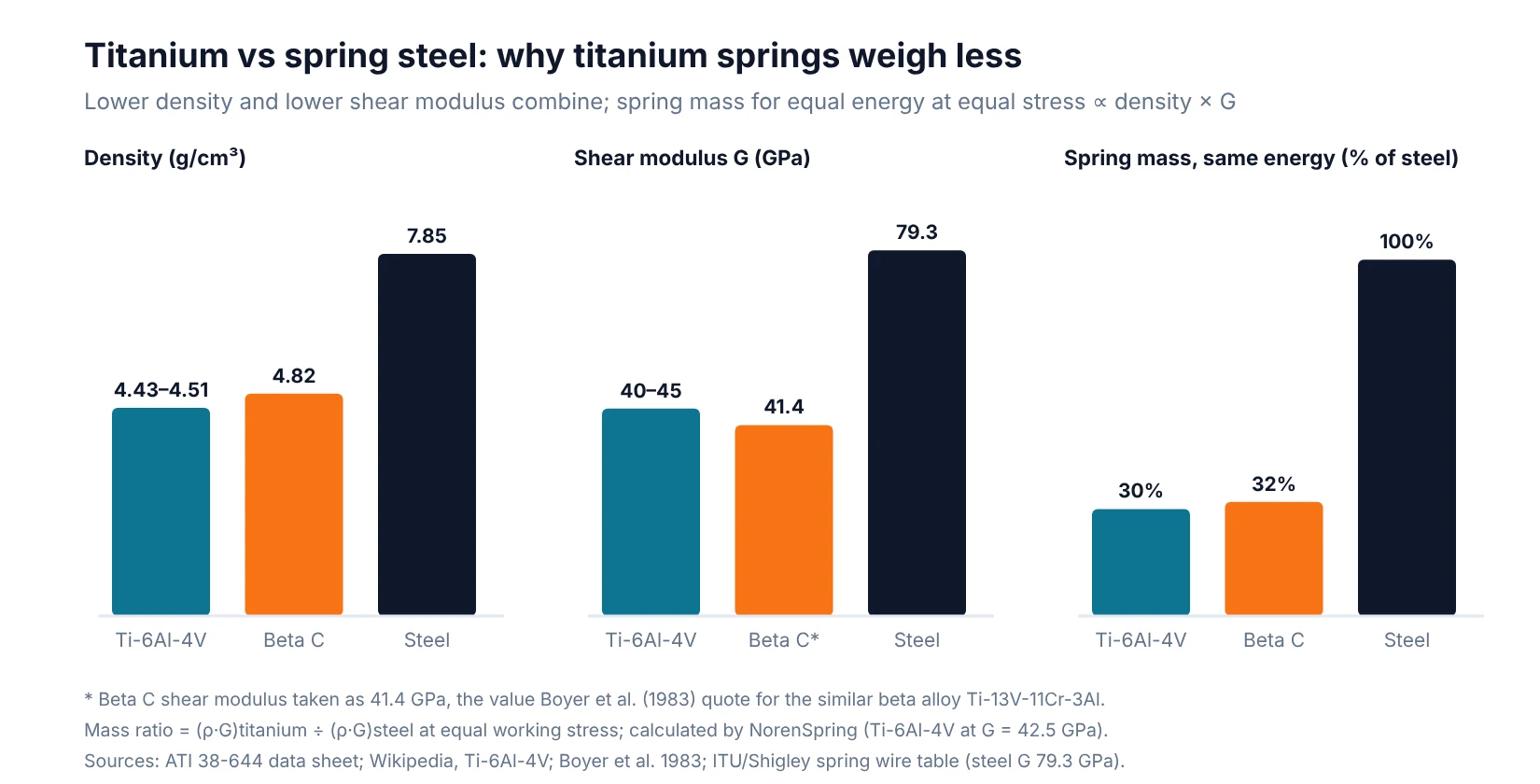
- Lighter. Density is 4.43–4.51 g/cm³ for Ti-6Al-4V [3] and 4.82 g/cm³ for Beta C [1], compared with 7.85 g/cm³ for steel.
- Softer in shear. Ti-6Al-4V has a shear modulus of 40–45 GPa [3], compared with 79.3 GPa for spring steel [7]. The same geometry gives about half the spring rate.
- Up to about 70% lighter. At equal working stress, spring mass scales with density times shear modulus, which puts titanium at 30–32% of the steel mass in our calculation. Industry sources quote “up to 70% lighter” [6].
- Know the limits. Beta C is rated for extended use below 349 °C (660 °F) [1], titanium galls in sliding contact [5], and the wire costs several times more than steel.
What is a titanium spring?
A titanium spring is any spring, usually a helical compression spring, made from titanium alloy wire instead of steel. The alloy is cold drawn, coiled and then heat treated (aged) to reach spring strength. Commercially pure titanium is too weak for most springs, so nearly all titanium springs use a heat-treatable alloy.
The material has a long track record in aviation. A 1983 symposium paper by Boeing, McDonnell Douglas and RMI engineers notes that the first commercially used high-strength beta titanium springs were installed on the DC-10 by 1970 [2]. Today the same weight argument drives titanium springs in motorsport, high-end bicycle and motorcycle suspension, and lightweight vehicles [6].
Beta C vs Ti-6Al-4V for springs
Beta C is the beta titanium alloy Ti-3Al-8V-6Cr-4Mo-4Zr (UNS R58640, also sold as ATI 38-644) and the alloy most spring makers mean by “titanium spring wire”. It is a metastable beta alloy that is soft enough to draw and coil after solution treatment and then gains strength in an ageing treatment. ATI gives its aged elastic modulus as 14–16 Msi (about 97–110 GPa), its density as 4.82 g/cm³ and its ageing treatment as 454–538 °C (850–1,000 °F) for 4 to 24 hours [1]. Carpenter describes it as heat-treatable to a wide range of strength levels with a low elastic modulus and excellent fatigue resistance [4].
Ti-6Al-4V (Grade 5) is the most widely used titanium alloy, but it is an alpha-beta alloy with less spring strength. Typical values are 900–950 MPa ultimate tensile strength, 880–920 MPa yield and 104–113 GPa Young’s modulus [3]. It is chosen when the part must match other Ti-6Al-4V components, or when the wire is easier to source than Beta C.
| Property | Beta C (Ti-3Al-8V-6Cr-4Mo-4Zr) | Ti-6Al-4V (Grade 5) | Carbon spring steel |
|---|---|---|---|
| Density | 4.82 g/cm³ [1] | 4.43–4.51 g/cm³ [3] | 7.85 g/cm³ |
| Elastic modulus | 97–110 GPa, aged [1] | 104–113 GPa [3] | about 200–207 GPa |
| Shear modulus | about 41 GPa (similar beta alloy) [2] | 40–45 GPa [3] | 79.3 GPa [7] |
| Spring strength level | 1,241–1,379 MPa tensile in tested springs [2] | 900–950 MPa tensile [3] | higher; see our wire guide |
| Long-term temperature | below 349 °C [1] | check with supplier | about 120 °C for carbon wire, more for alloy wire |
| Wire specification | AMS 4957 [4] | AMS / ASTM grade 5 wire | ASTM A228, A229, A227 |
The shear modulus of Beta C is not given on the ATI or Carpenter pages. The 1983 Boeing paper quotes less than 41.4 GPa for the closely related beta alloy Ti-13V-11Cr-3Al [2], so we use 41.4 GPa in the calculations below. For a production design, ask the wire supplier for the measured value on the certificate, because it moves with the ageing condition.
For context on the steel column, our spring wire material guide gives tensile strengths for music wire, oil tempered and alloy wires by diameter.
Why titanium springs are lighter
The weight saving does not come from density alone. It comes from the combination of low density and low shear modulus. A helical spring stores energy by twisting its wire, and for a given maximum shear stress τ, the energy per unit volume of wire is proportional to τ² divided by the shear modulus G. The wire mass needed to store a given energy is therefore proportional to ρ·G/τ², where ρ is the density.
Put the numbers in at equal working stress, and the ratio is (4.82 × 41.4) ÷ (7.85 × 79.3) = 0.32 for Beta C, or (4.43 × 42.5) ÷ (7.85 × 79.3) = 0.30 for Ti-6Al-4V at the middle of its modulus range. In other words, a titanium spring that stores the same energy at the same stress needs only 30–32% of the wire mass of the steel spring, a saving of about 68–70%. That matches the “up to 70% lighter” figure quoted by industry sources [6].
There is a catch that brochures rarely mention: the saving assumes the titanium spring runs at the same stress as the steel spring. Beta C springs in the 1983 tests were aged to about 1,241–1,379 MPa tensile strength [2], which is below a good chrome silicon or music wire of the same size. If you have to lower the working stress by 15% to keep the same safety margin, the mass ratio rises by 1 ÷ 0.85², about 38%, and the saving drops from about 68% to about 56%. The saving is still large, but a fair comparison has to use the real allowable stress for each wire.
How a low shear modulus changes the spring design
The spring rate of a helical compression spring is k = G·d⁴ / (8·D³·Na), where d is the wire diameter, D is the mean coil diameter and Na is the number of active coils [8]. Because G for titanium is about 52% of the steel value, a titanium spring with the same wire, diameter and coil count has about half the rate. You cannot simply change the material on a steel drawing.
There are two practical ways to recover the rate:
- Fewer active coils. With the same d and D, Na can drop to about 52% of the steel value. This is where most of the weight is saved, and the spring also gets shorter at solid height.
- Thicker wire or a smaller coil diameter. Industry practice is to use a larger wire diameter with fewer coils to match the steel rate [6]. This also lowers the stress for a given load.
Our spring rate guide explains how each dimension changes the rate, and the compression spring design guide shows the full stress and solid-height checks.
Worked example: converting a steel spring to titanium
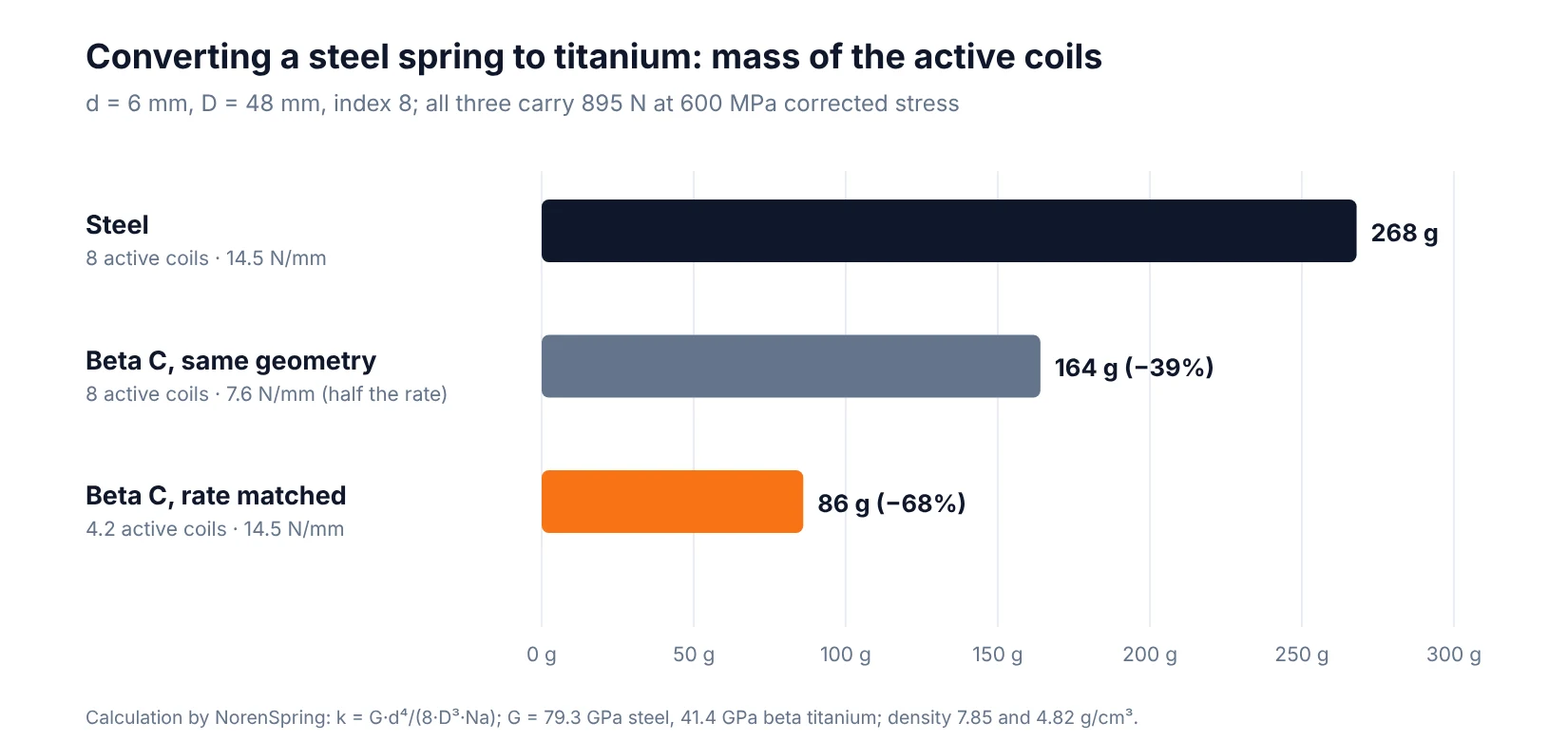
To show the effect, we calculated one spring both ways. The steel spring has 6 mm wire, a 48 mm mean diameter (spring index 8) and 8 active coils. With G = 79.3 GPa, its rate is 14.5 N/mm. The Wahl factor at index 8 is 1.184, so a corrected shear stress of 600 MPa is reached at about 895 N, after 62 mm of deflection.
| Case | Active coils | Rate | Load at 600 MPa | Deflection at 600 MPa | Mass of active coils |
|---|---|---|---|---|---|
| Steel, d 6 mm, D 48 mm | 8 | 14.5 N/mm | 895 N | 62 mm | 268 g |
| Beta C, same d, D and coils | 8 | 7.6 N/mm | 895 N | 118 mm | 164 g |
| Beta C, coils cut to match rate | 4.2 | 14.5 N/mm | 895 N | 62 mm | 86 g |
With the same geometry the titanium spring is only 39% lighter, because the saving from density alone is modest, and it has half the rate. Once the coil count is reduced to 4.2 to recover the 14.5 N/mm rate, the titanium spring carries the same load over the same travel at the same stress, and its active coils weigh 86 g instead of 268 g, a 68% saving. The pitch becomes coarser, so check the pitch angle and buckling ratio; our buckling guide covers the slenderness limits.
Strength, fatigue and shot peening
Beta C springs can have good fatigue lives, but the condition of the wire matters. In the 1983 study, springs were fatigue tested at a maximum stress of 1,034 MPa (150 ksi), R = 0.1 and 30 Hz. Wire aged to a lower strength lasted longer, which the authors put down to increased ductility and decreased notch sensitivity [2]. The same paper recommends about 35% cold work in the wire, finding 50% detrimental, and shot peening at an intensity of 0.016–0.018 A or higher [2].
Two practical points follow. First, aim for a consistent ageing treatment rather than the highest possible strength, because a slightly lower tensile strength can give a more fatigue-tolerant spring. Second, plan for shot peening on dynamically loaded titanium springs, just as you would on steel valve or suspension springs. Our shot peening guide explains how peening intensity and coverage are specified.
Temperature and corrosion
Titanium springs resist corrosion far better than carbon steel springs. Ti-6Al-4V has excellent corrosion resistance and is used in marine service [3], and Beta C resists saline environments and acids and can be qualified for sour oilfield service to NACE MR0175 / ISO 15156 at a maximum hardness of HRC 42 [5]. No plating is needed, which also removes the hydrogen embrittlement risk that comes with zinc plating high-strength steel.
Temperature is a firmer limit. ATI states that Beta C can be used for extended periods below 349 °C (660 °F) [1]. That is well above the roughly 120 °C limit of carbon spring wire, but well below nickel alloys. ATI also warns that the alloy can pick up hydrogen during processing [1], so pickling and heat treatment need to be controlled. Above about 350 °C, look at Inconel 718 or X-750; our Inconel springs guide compares those grades.
Design limits to check before you choose titanium
Titanium is not a drop-in replacement for steel. Check these five points first:
- Galling and wear. Beta C is “not recommended in high-wear applications due to its tendency to gall” [5], and titanium’s long-term wear resistance is lower than steel’s [6]. Avoid titanium coils rubbing on a titanium guide rod or bore, or add a coating or a polymer sleeve.
- Hooks and extension springs. Hook stresses can be twice the coil stress, and the 1983 paper does not recommend reduced-strength Beta C for tension springs [2]. Titanium is much easier to justify in compression springs than in extension springs.
- Lower stiffness. Half the shear modulus means more deflection per newton. Recheck the natural frequency and surge in fast-cycling springs,.
- Cost. Titanium has traditionally cost six to seven times more than steel [6], before the extra cost of ageing and peening. It pays off only where weight or corrosion is worth that premium.
- Lead time. Beta C wire in a specific diameter is not a stock item at most mills, so the wire supply often sets the lead time. Confirm availability before fixing the design.
Where titanium springs are used
Titanium springs are used where weight savings or corrosion resistance justify the higher material cost. Typical examples include:
- Aerospace. Actuator, door and landing gear related springs, building on the beta titanium springs first flown on the DC-10 [2] and Beta C’s use in landing gear parts [5].
- Motorsport and vehicle suspension. Lighter coil springs reduce unsprung mass. Our custom suspension springs guide explains what to specify for a coilover or shock spring.
- Bicycle and motorcycle shocks. Titanium shock springs are a popular upgrade where riders pay for every gram.
- Corrosive and offshore service. Springs in seawater, brines and chemical equipment, where stainless steel is not enough and nickel alloys are heavier.
How to specify a titanium spring
A titanium spring drawing or inquiry should state everything a steel spring drawing does, plus the titanium-specific items:
- Alloy and wire specification, for example Beta C to AMS 4957.
- The required ageing condition or the tensile strength range after ageing.
- Working loads and lengths, so the rate can be checked with the titanium shear modulus rather than the steel value.
- Whether shot peening is required, and the intensity.
- The mating parts (guide rod, bore, seats) and their material, so galling can be reviewed.
- Operating temperature and environment.
Titanium alloy spring wire is one of the materials listed on our inquiry form, next to stainless, nickel alloy and copper alloy wires. We review each titanium request against the wire that can actually be sourced in your diameter before quoting. You can send a drawing, a sketch or a steel sample through our contact page, or see our compression spring range for the sizes we produce.
Frequently asked questions
Are titanium springs better than steel springs?
They are lighter and far more corrosion resistant, but not stronger. A well-designed titanium spring weighs about 30–45% of the equivalent steel spring, depending on the working stress. Steel springs are cheaper, stiffer for a given size and can run at higher stresses, so steel remains the better choice unless weight or corrosion is a priority.
How much lighter is a titanium spring than a steel spring?
At the same working stress, about 68–70% lighter, because spring mass scales with density times shear modulus. In our worked example, the active coils dropped from 268 g in steel to 86 g in Beta C at the same rate and stress. If the titanium spring has to run at a lower stress, the saving is smaller, about 56% at 15% lower stress.
What titanium alloy is used for springs?
Mostly Beta C, Ti-3Al-8V-6Cr-4Mo-4Zr (UNS R58640), supplied as bar and wire to AMS 4957 [4]. Ti-6Al-4V is also used, but it reaches lower strength levels. Older aerospace springs used Ti-13V-11Cr-3Al (AMS 4959) [2].
Can I swap a steel spring for a titanium spring of the same size?
No. With the same wire, diameter and coil count, the titanium spring has only about half the rate, so it will sag or bottom out. The spring has to be redesigned, usually with fewer active coils or a heavier wire, to restore the rate.
What temperature can titanium springs handle?
Beta C is rated for extended use below 349 °C (660 °F) [1]. For higher temperatures, nickel alloys such as Inconel X-750 or 718 are the usual choice.
About the authors
This guide was prepared by the NorenSpring engineering team, which designs and manufactures custom compression, extension and torsion springs and wire forms in Xuzhou, China, since 2001. Technical content reviewed by Feng Yulin, General Manager and senior structural engineer, who has 15 years of spring R&D experience and more than 30 national patents. Our certificates are shown on our about page. The worked example and mass ratios are our own calculations. Sources were last checked on November 8, 2026.
Sources
- ATI, ATI 38-644 Beta C titanium alloy technical data sheet (UNS R58640): density, modulus, heat treatment, service temperature and specifications. atimaterials.com. Retrieved 2026-11-08.
- Boyer, Bajoraitis, Greenwood and Mild, Ti-3Al-8V-6Cr-4Mo-4Zr wire for spring applications, Beta Titanium Alloys in the 80’s, TMS-AIME (1983). shotpeener.com. Retrieved 2026-11-08.
- Wikipedia, Ti-6Al-4V: density, elastic and shear modulus, tensile properties and corrosion. wikipedia.org. Retrieved 2026-11-08.
- Carpenter Technology, Ti 3Al-8V-6Cr-4Mo-4Zr alloy page: composition and specifications. carpentertechnology.com. Retrieved 2026-11-08.
- Wikipedia, Titanium Beta C: corrosion, galling and applications. wikipedia.org. Retrieved 2026-11-08.
- EV Design & Manufacturing, Titanium springs for vehicle lightweighting. evdesignandmanufacturing.com. Retrieved 2026-11-08.
- Istanbul Technical University, Mechanical Springs lecture slides based on Shigley’s Mechanical Engineering Design, chapter 10 (spring wire properties). itu.edu.tr. Retrieved 2026-11-08.
- AMES, Compression spring formulas. amesweb.info. Retrieved 2026-11-08.



