










In this article
- Key takeaways
- What is music wire?
- Music wire standards and equivalents
- How strong is music wire? Tensile strength by wire diameter
- Stiffness: the shear modulus of music wire
- Temperature limit and stress relief
- Corrosion and finishes for music wire springs
- Music wire vs hard-drawn, oil-tempered, chrome-silicon and stainless
- Which springs suit music wire?
- What to put on the drawing or RFQ
- How we work with music wire
- Frequently asked questions
- About the authors
- Sources
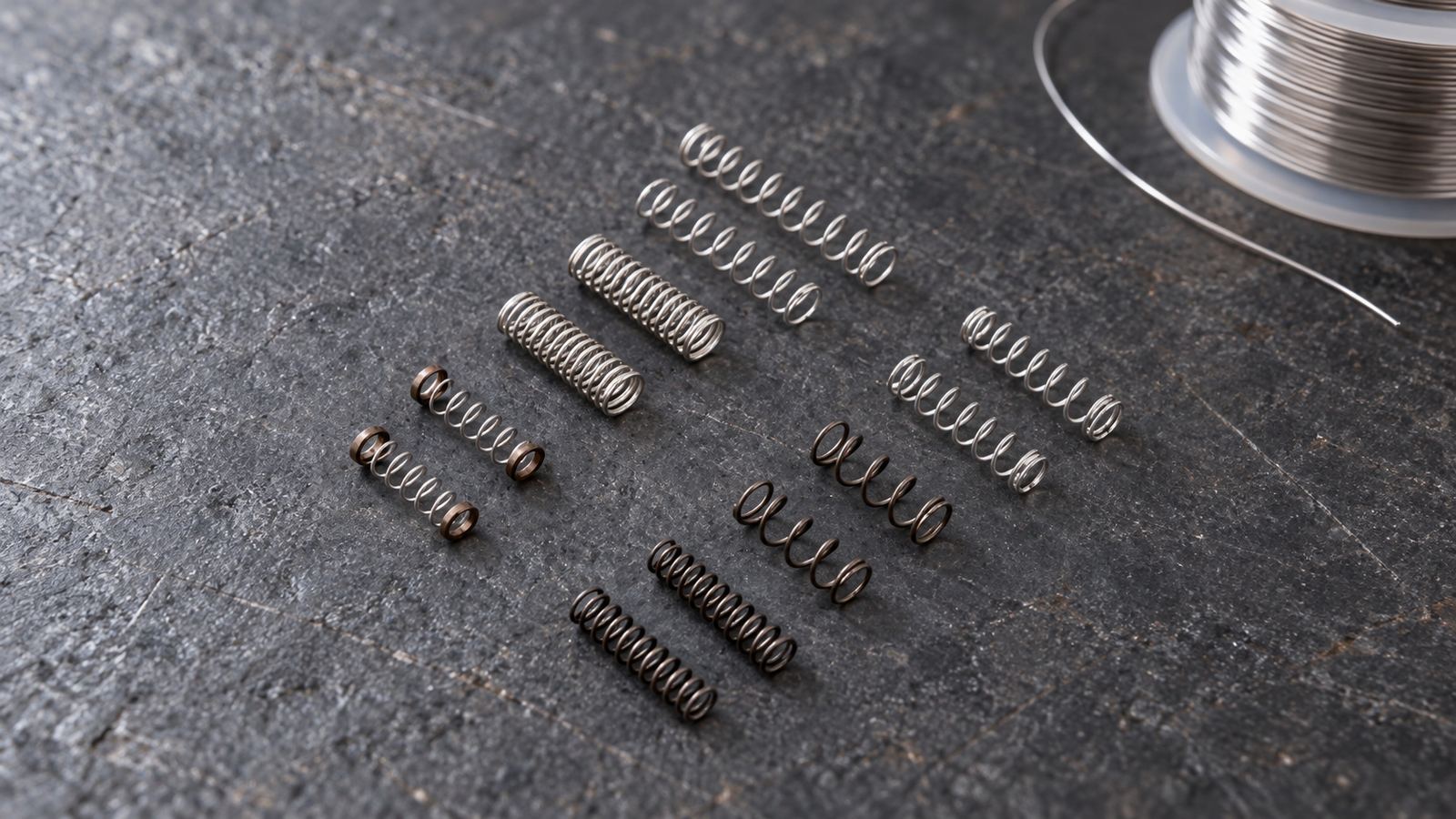
Cover image: an AI illustration based on a photograph of a set of our small compression springs, placed in a new setting.
Music wire springs are springs coiled from music wire, a high-carbon, cold-drawn steel wire made to ASTM A228 in the US, JIS G 3522 (grades SWP-A and SWP-B) in Japan and EN 10270-1 grade DH in Europe. It is the strongest of the common spring wires in small sizes: about 2,210 MPa minimum tensile strength at 1 mm and about 2,000 MPa at 2 mm [3]. That is why it is the default for small, highly stressed compression, extension and torsion springs.
It has two limits. It rusts if left bare, and it is rated only to about 121 °C (250 °F) [4]. Above that temperature, or in wet service with no protective finish, another wire family is the better choice.
This guide covers music wire spring material standards and their equivalents, strength by wire size, the temperature and corrosion limits, the finishes that suit music wire, how it compares with other spring wires, and what to write on a drawing or RFQ. For a wider comparison of all the families, see our spring wire material guide.
Key takeaways
- One wire, three names. ASTM A228 music wire, JIS G 3522 piano wire (SWP-A, SWP-B) and EN 10270-1 grade DH are commonly listed as counterparts by wire suppliers. They are close, not identical, so name one standard on the drawing.
- Thin wire is stronger. Minimum tensile strength falls from about 2,440 MPa at 0.5 mm to about 1,710 MPa at 6 mm [3].
- Small to medium sizes. Shigley’s data covers music wire from 0.10 to 6.5 mm. Larger springs normally move to oil-tempered or alloy wire.
- 121 °C and no bare outdoor use. Music wire needs a finish or oil for corrosion, and an alloy or stainless wire for heat.
- Plating needs baking. Zinc-plated music wire springs should be baked after plating to drive out hydrogen. We bake every zinc-plated spring and agree the baking cycle for other plated finishes.
What is music wire?
Music wire is a high-carbon steel wire that is patented (heat treated to a fine pearlite structure) and then cold drawn to size. The heavy cold drawing gives it its high strength. No heat treatment after drawing is needed to harden it. The name comes from its original use for piano and instrument strings, and Japanese standards still call it piano wire. Nippon Steel SG Wire, for example, lists piano strings (SWP-M) and spring wire grades SWP-A, SWP-B and SWP-V side by side [7].
ASTM A228 describes it as “music spring quality” wire, “intended especially for the manufacture of springs subject to high stresses or requiring good fatigue properties” [1]. The current edition covers two types of round, cold-drawn wire and calls for tension, wrap and torsion tests. Lee Spring’s material table gives its nominal carbon content as 0.70–1.00% (the purchased edition of A228 sets the exact chemistry limits), and describes it as highly magnetic, with a good surface finish and “generally good fatigue life due to high tensile strength” [4].
Music wire standards and equivalents
Use this table to read a drawing from another region. The equivalence is for sourcing, not for swapping one callout for another without approval.
| Region | Standard | Grade names | Notes |
|---|---|---|---|
| US | ASTM A228/A228M | Music wire (also SAE J178) | Current edition A228/A228M-18(2024)e1 [1] |
| Japan | JIS G 3522 | SWP-A, SWP-B; SWP-V | Revised March 2025. Based on ISO 8458-1 and ISO 8458-2 (modified), for springs under predominantly dynamic load [2]. SWP-A and SWP-B are the general spring grades; SWP-V is listed for valve springs or equivalent springs [7] |
| Europe | EN 10270-1 | SL, SM, SH (static duty); DM, DH (dynamic duty) | Edition EN 10270-1:2024 replaced the 2011+A1:2017 text [5]. DH, the high-strength dynamic grade, is the one wire suppliers commonly list against A228 and SWP-B [8] |
| International | ISO 8458-2 | Patented cold-drawn non-alloy wire | The ISO basis for JIS G 3522 [2] |
Two common mix-ups:
- SWP-B is not a valve-spring or heat-resistant grade. It is the higher-strength general grade of piano wire. Piano wire also has a separate grade for valve springs, SWP-V, which Japanese wire makers list alongside SWP-A and SWP-B [7]. The oil-tempered valve-spring wires, such as SWOSC-V (silicon-chrome), are in a different standard, JIS G 3561 [9].
- “Spring steel wire” is not music wire. Hard-drawn carbon wire (ASTM A227; JIS G 3521 SW-B and SW-C, often written SWC) is a lower-strength, lower-cost family; in Europe it falls under the lower and static-duty grades of the same EN 10270-1. A drawing that says only “spring steel” leaves the choice to the supplier. See our oil tempered vs hard drawn spring wire comparison for the two everyday carbon wires.
Our own records use the JIS name. In our own production, a cable reel extension spring is made in SWP-B with 1–4 mm wire, zinc plated and exported to the USA and Germany, and our general-purpose extension springs use hard-drawn SWC or piano wire (SWP) with 1–8 mm wire and zinc or nickel plating. Most of our other parts, such as agricultural tines and harvester springs, use 50CrVA, 60Si2Mn or 65Mn in larger wire, which shows where music wire stops being the right choice.
How strong is music wire? Tensile strength by wire diameter
Music wire is strongest in the finest sizes. Shigley’s curve fit for its minimum tensile strength, Sut = 2211 / d^0.145 (MPa, d in mm), gives these values [3]:
| Wire diameter | Minimum tensile strength | Allowable torsional stress, compression spring, before set removal (45%) |
|---|---|---|
| 0.5 mm | about 2,440 MPa | about 1,100 MPa |
| 1 mm | about 2,210 MPa | about 995 MPa |
| 2 mm | about 2,000 MPa | about 900 MPa |
| 4 mm | about 1,810 MPa | about 815 MPa |
| 6 mm | about 1,710 MPa | about 770 MPa |
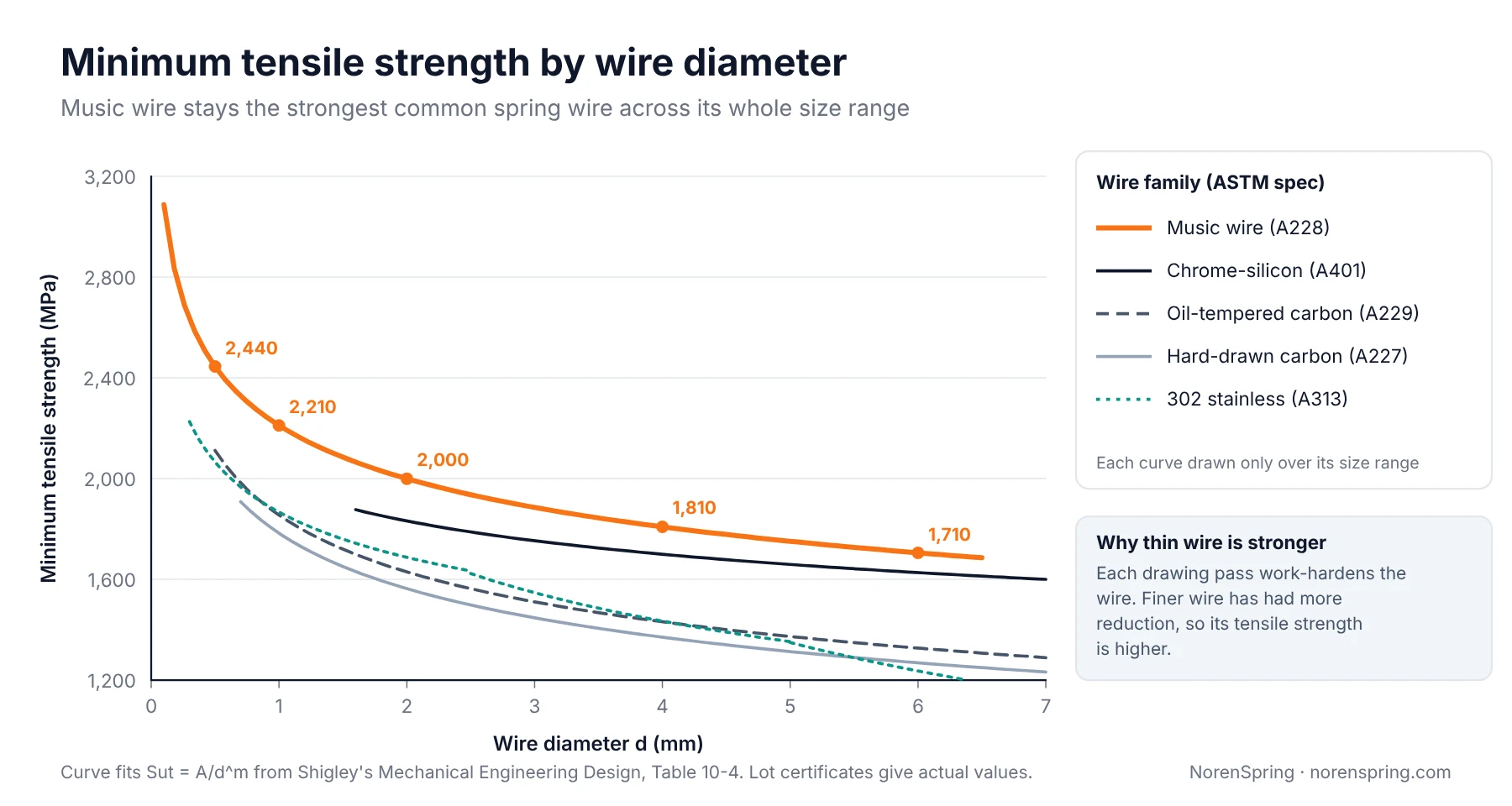
The allowable stress column uses Shigley’s static-service guideline for compression springs: 45% of tensile strength for music wire and cold-drawn carbon steel before set is removed, rising to 60–70% after set removal [3]. Cyclic springs need a fatigue check instead. At 1 mm, hard-drawn carbon wire (A227) has a minimum of about 1,780 MPa, so music wire gives you roughly 24% more allowable stress at the same size. In practice that buys a smaller spring, more deflection, or a margin against set.
Worked example. A static music wire compression spring in 1 mm wire is calculated to run at 900 MPa at its maximum working load. In music wire, the 45% guideline allows about 995 MPa (0.45 × 2,210), so the design passes. In hard-drawn A227 wire it allows only about 800 MPa (0.45 × 1,780), so the same spring would be overstressed and likely to take a set. Changing the material callout from A228 to A227 to save cost would need a redesign, for example a larger wire (with more active coils to keep the rate) or a smaller coil diameter.
Strength helps less in long-life fatigue than these numbers suggest. Shigley reports Zimmerli’s finding that, for spring steels under 10 mm, size, material and tensile strength have no effect on the endurance limit for infinite life [3]. For springs that must run tens of millions of cycles, surface condition, stress range and shot peening matter as much as the wire grade. Our guide to why springs fail covers fatigue in more detail.
Stiffness: the shear modulus of music wire
Spring rate is proportional to the shear modulus G. Shigley lists G for music wire from 82.7 GPa (12.0 × 10⁶ psi) for wire under 0.8 mm down to 80.0 GPa (11.6 × 10⁶ psi) above about 3 mm (0.125 in), and the elastic modulus E from 203.4 GPa to 193.0 GPa over the same sizes [3]. Many design tables round this to 11.5 × 10⁶ psi (79.3 GPa) for all carbon spring wires [4].
The difference is small for most parts, but it matters when you compare a calculated rate with a test result on fine wire. Our spring rate guide lists G for each material and includes a calculator. A music wire spring remade in 302 stainless (G = 69 GPa) loses about 14–17% of its rate at the same geometry, as our stainless steel springs guide explains.
Temperature limit and stress relief
Lee Spring’s table gives a maximum operating temperature of 250 °F (121 °C) for music wire, the same as hard-drawn and oil-tempered carbon wire [4]. Above that, a loaded spring relaxes faster and loses force. For comparison, the same table gives 425 °F (218 °C) for chrome-vanadium, 475 °F (246 °C) for chrome-silicon and 550 °F (288 °C) for 302 stainless [4].
Treat 121 °C as a ceiling, not a design point. A spring that must hold its load closely, or that works near its allowable stress, should run cooler. If the part sits near an engine, exhaust or heater, say so in the RFQ.
After coiling, music wire springs are normally given a low-temperature stress relief. It removes the residual stress from coiling so the spring holds its free length, but it does not raise the temperature limit. Springs that work close to solid height are also often preset (set removed) to raise the usable stress. Both are standard steps in spring making. The exact cycle should be agreed with your spring maker.
Corrosion and finishes for music wire springs
Bare music wire rusts. Indoors, in a dry and oiled mechanism, that may not matter. Anywhere else, the spring needs a finish or a different wire. The common options are:
- Oil or a light rust preventive. Enough for springs inside a lubricated assembly.
- Zinc plating with passivation. The usual finish for music wire springs exposed to humidity or occasional wetting.
- Nickel plating. Brighter and harder, used where appearance matters.
- Black oxide or phosphate with oil. Mild protection and a dark finish.
- Powder coating or paint. Mainly for larger springs. A thick coating can fill tight coil gaps on fine-wire springs.
Electroplating has one risk with high-strength steel: hydrogen embrittlement. Hydrogen picked up during cleaning and plating can cause delayed brittle fracture, sometimes days after assembly, and ASTM B850 gives baking treatments after plating to reduce the risk [6]. Nickel plating, like any electroplated finish, carries the same risk. We bake every zinc-plated spring and agree the baking cycle for other plated finishes. Our spring finishes guide compares the coatings in more detail.
If the spring will see salt, washdown or chemicals, stainless 302 or 316 is usually the safer answer than a plated music wire spring.
Music wire vs hard-drawn, oil-tempered, chrome-silicon and stainless
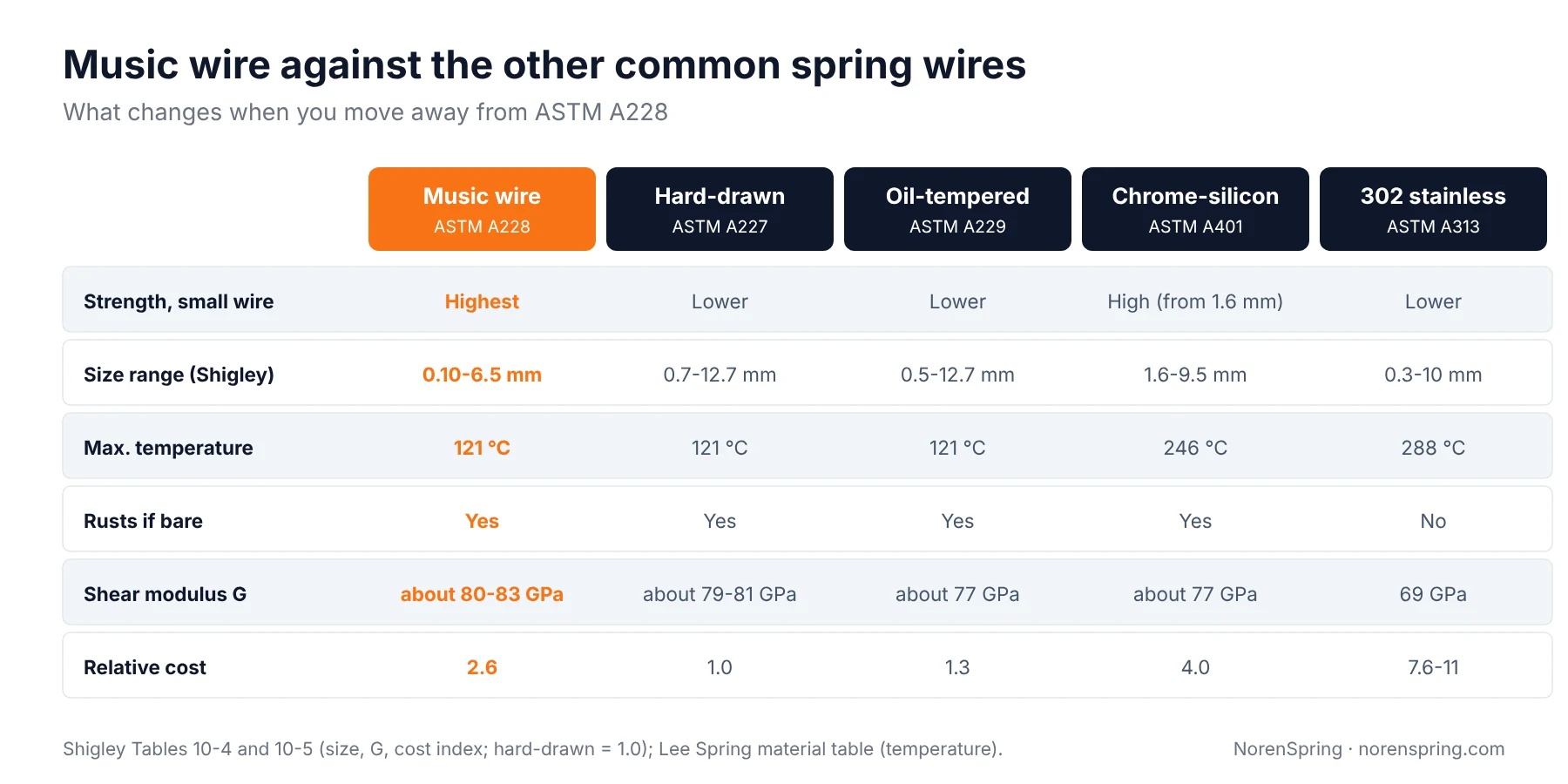
Choose by the first requirement that rules music wire out:
- Hotter than about 121 °C: chrome-silicon (A401) or chrome-vanadium (A231); stainless above about 246 °C, and nickel alloys above that. Our chrome silicon springs guide covers the A401 and SWOSC-V grades in detail.
- Wet, salty or washdown service: 302/304 or 316 stainless.
- Wire thicker than about 6.5 mm: oil-tempered carbon (A229) or an alloy wire such as chrome-silicon or 50CrV. Hot-coiled alloy steel takes over for heavy bar sizes.
- Low stress and lowest cost: hard-drawn carbon wire (A227). Shigley’s relative cost index puts music wire at 2.6 times hard-drawn wire, against 1.3 for oil-tempered, 4.0 for chrome-silicon and 7.6 to 11 for 302 stainless [3].
If none of these applies and the spring is small and highly stressed, music wire is usually the right choice.
Which springs suit music wire?
Music wire suits most small, cold-coiled springs that work at high stress in dry or protected conditions:
- Compression springs with wire up to a few millimetres, especially where space is tight and stress is high. See how to specify a custom compression spring.
- Extension springs, where its high strength helps carry hook stress and a useful initial tension. See how to specify a custom extension spring.
- Torsion springs with small wire, where the legs and body work in bending. See our torsion springs range.
- Small wire forms and clips that must spring back after installation. See our wire forms range.
It is less suited to large agricultural tines, vibrating-screen springs and other heavy parts, which need larger alloy or manganese steel wire.
What to put on the drawing or RFQ
| Item | Example |
|---|---|
| Material and standard | Music wire to ASTM A228; or SWP-B to JIS G 3522; or EN 10270-1 DH |
| Acceptable alternatives | “SWP-B or EN 10270-1 DH acceptable with written approval” |
| Wire diameter | 1.20 mm |
| Spring data | Free length, OD or ID, active and total coils, ends, loads at set heights |
| Heat treatment and setting | Stress relieve after coiling; preset to solid if required |
| Finish | Zinc plate with passivation (or nickel plate), baked for hydrogen relief; or oil only |
| Operating temperature | Continuous and peak, for example 60 °C continuous |
| Environment | Indoor dry / outdoor / humid / washdown |
| Documents | Material certificate for each wire lot; load test report |
A material callout without a standard, such as “spring steel” or “carbon steel”, leaves room for a lower-strength wire. If the part is safety-related or highly stressed, name the standard and the grade.
How we work with music wire
We coil compression, extension and torsion springs and wire forms to customer drawings or samples, with no fixed minimum order. For each project we confirm manufacturability and the wire grade at quotation, and agree the documents we will supply, such as material certificates, inspection reports and dimensional records. In our laboratory, load testers check forces and rates against the drawing, hardness testers check hardness where the drawing specifies it, and a spectrometer confirms material composition.
If your drawing lists a music wire grade from another region, we will tell you which grade we propose and ask for approval before we coil a sample. Browse our custom compression springs and custom extension springs.
Frequently asked questions
Is music wire the same as spring steel?
Music wire is one type of spring steel. It is a high-carbon, cold-drawn wire to ASTM A228, and it is the strongest of the common carbon spring wires in small sizes. “Spring steel” alone can also mean hard-drawn wire, oil-tempered wire, 65Mn or an alloy steel, so it is not a full specification.
Does music wire rust?
Yes. Music wire is a plain carbon steel and will rust if left bare in damp air. Protect it with oil, zinc plating, nickel plating or another finish, or use stainless steel where the spring will be wet most of the time.
What temperature can music wire springs handle?
Up to about 121 °C (250 °F), according to Lee Spring’s material table [4]. Above that the spring loses force more quickly. Use chrome-silicon or chrome-vanadium wire up to about 218–246 °C, and stainless steel or nickel alloys beyond that.
What is the difference between music wire and hard-drawn spring wire?
Both are cold-drawn carbon steel. Music wire (ASTM A228) has higher and more uniform strength and a better surface, and is meant for highly stressed springs. Hard-drawn wire (ASTM A227) costs less and suits low to average stress. At 1 mm, the minimum tensile strength is about 2,210 MPa for music wire and about 1,780 MPa for hard-drawn wire [3].
Is SWP-B the same as ASTM A228?
They are counterparts, not identical standards. Wire suppliers commonly list JIS G 3522 SWP-A and SWP-B against ASTM A228 and EN 10270-1 DH [8], but the tensile ranges, tests and tolerances are written differently in each standard. Name the standard you design to, and agree any substitute in writing.
About the authors
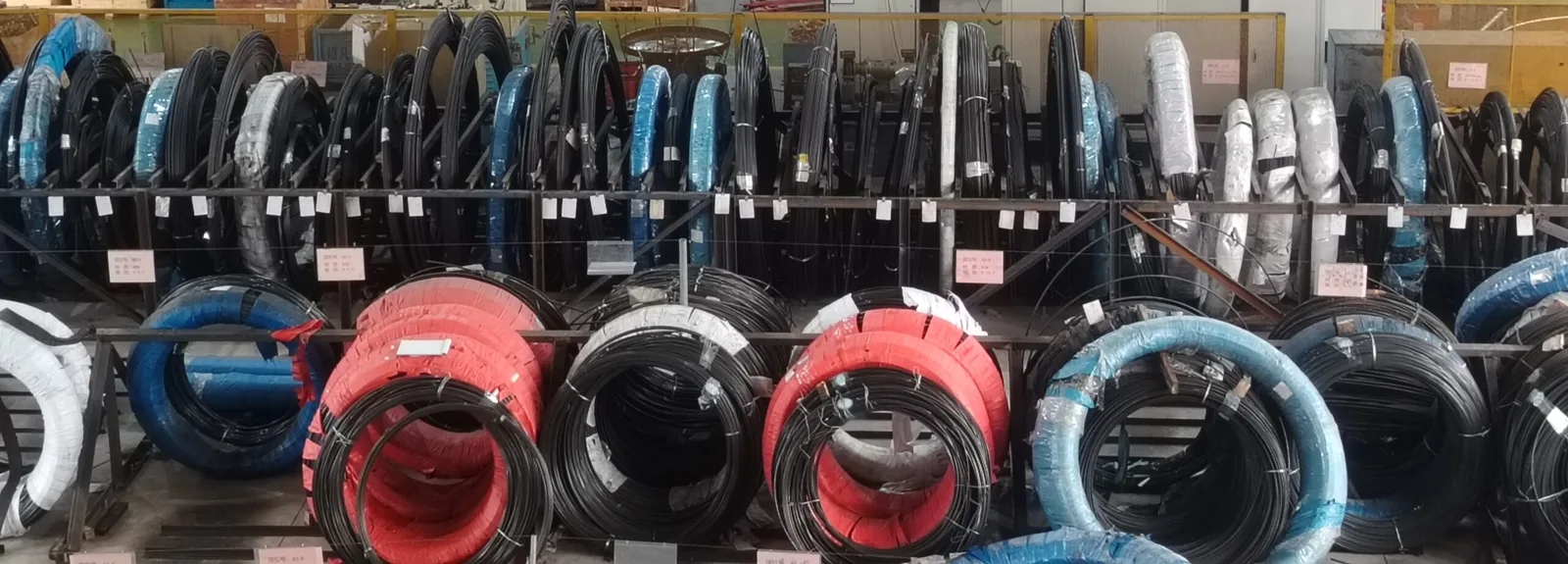
This guide was prepared by the NorenSpring engineering team, which designs and manufactures custom compression, extension and torsion springs and wire forms in Xuzhou, China. Technical review by Feng Yulin, General Manager and senior structural engineer, who has 15 years of spring R&D experience and more than 30 national patents. NorenSpring holds IATF 16949, ISO 9001, ISO 13485, ISO 14001 and ISO 45001 certifications. The photo of the wire store is from our own plant in Xuzhou; the cover is an AI illustration based on our own product photo. Sources were last checked on October 20, 2026.
Have a music wire spring to make or replace? Send us your drawing or sample with the load, space and operating temperature, and we will confirm the wire grade and finish with the quotation.
Sources
The numbers in square brackets in the text refer to this list.
- ASTM International, ASTM A228/A228M-18(2024)e1, Standard Specification for Steel Wire, Music Spring Quality. Source for the scope, the two wire types and the tension, wrap and torsion tests. Retrieved 2026-10-20.
- Japanese Standards Association, JIS G 3522:2025, Piano wires (English preview). Source for the 2025 revision date, the scope (springs under predominantly dynamic loading) and the basis on ISO 8458-1 and ISO 8458-2. Retrieved 2026-10-20.
- R. G. Budynas and J. K. Nisbett, Shigley’s Mechanical Engineering Design, 9th edition, McGraw-Hill, 2011, Chapter 10 (Mechanical Springs): Table 10-4 (tensile strength curve fits, size ranges and relative cost), Table 10-5 (E and G of spring wires), Table 10-6 (allowable torsional stress) and the discussion of Zimmerli’s fatigue data.
- Lee Spring, Spring Materials (material table: nominal chemistry, minimum tensile strength, E, G and maximum operating temperature for music wire, hard-drawn, oil-tempered, chrome-vanadium, chrome-silicon and stainless wire). Retrieved 2026-10-20.
- BSI, BS EN 10270-1:2024, Steel wire for mechanical springs, Part 1: Patented cold drawn unalloyed spring steel wire, the current edition (EN published 28 February 2024). It superseded EN 10270-1:2011+A1:2017, withdrawn in March 2024. Source for the scope (static and dynamic duty). Retrieved 2026-10-20.
- ASTM International, ASTM B850, Standard Guide for Post-Coating Treatments of Steel for Reducing the Risk of Hydrogen Embrittlement. Retrieved 2026-10-20.
- Nippon Steel SG Wire, Piano wire product list (SWP-M piano strings; SWP-A, SWP-B and SWP-V spring wire; SWP-V for valve springs or equivalent springs). Retrieved 2026-10-20.
- Toho International, Piano Wire product page (a wire supplier listing JIS G 3522 SWP-A standard grade and SWP-B high grade as equivalent to EN 10270-1 and ASTM A228, and to IS 4454 Part 1 grade DH). Retrieved 2026-10-20.
- Stella Corporation, Spring Wire product page (a wire trading company listing JIS G 3522 SWP-A and SWP-B piano wire separately from JIS G 3561 SWOSC-V oil-tempered valve-spring wire). Retrieved 2026-10-20.



