










In this article
- Key takeaways
- What is chrome silicon spring wire?
- Which chrome silicon grade should you specify?
- How strong is chrome silicon compared with music wire?
- How hot can chrome silicon springs run?
- How are chrome silicon springs made and finished?
- Which parts are usually made in chrome silicon?
- What to write on a chrome silicon spring drawing
- Frequently asked questions
- References
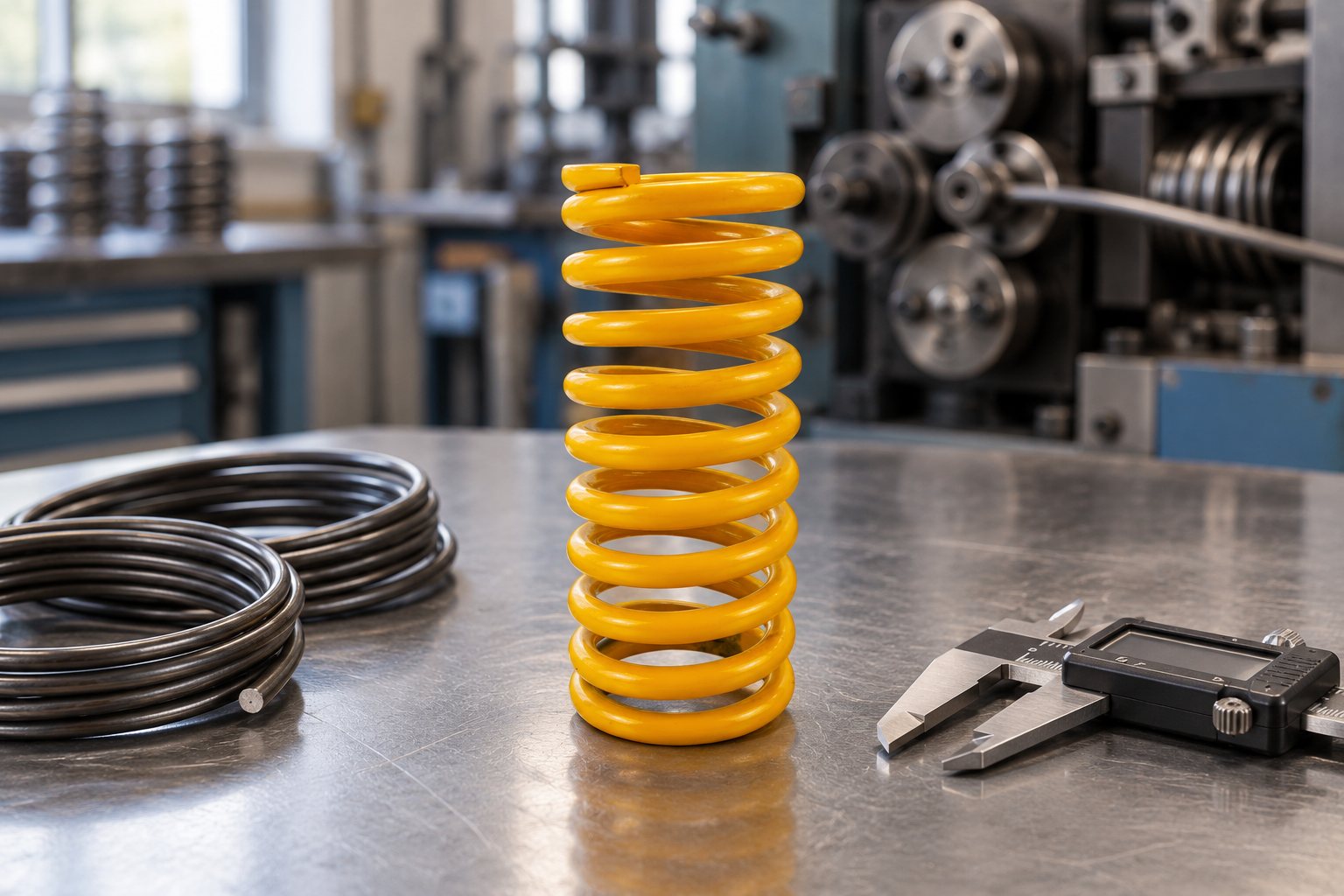
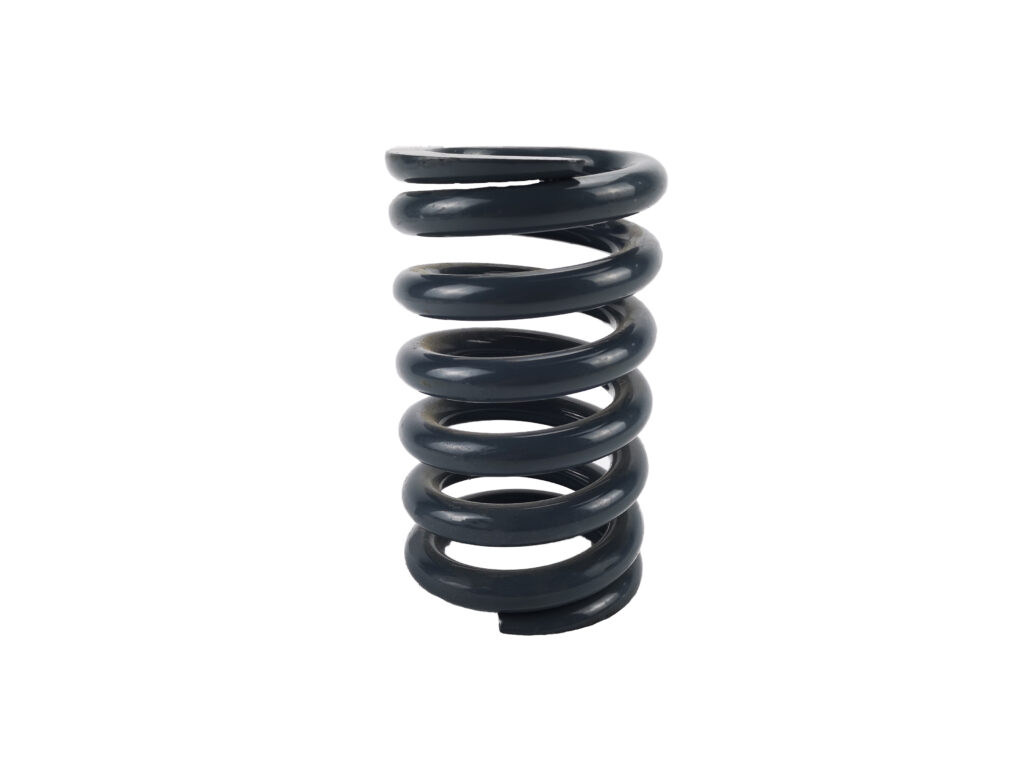
Cover image: an AI illustration based on a photograph of a powder-coated compression spring we make, placed in a new setting.
Chrome silicon springs are coiled from oil-tempered chromium-silicon alloy steel wire, a high-strength spring wire with about 0.55% carbon, 1.2 to 1.6% silicon and 0.5 to 0.8% chromium. It is made to ASTM A401 for general springs, ASTM A877 for valve springs, EN 10270-2 as the SiCr grades, and JIS as SWOSC-B and SWOSC-V. Engineers choose it when a spring is highly stressed, takes shock loads or runs warm, up to about 250 °C.
At room temperature, chrome silicon is not much stronger than music wire of the same size. Its advantages lie elsewhere: it holds its strength in larger wire sizes, it relaxes less when hot, and it comes in clean, fatigue-rated grades for engine valves and other cyclic springs. This guide covers the grades and equivalents, strength by wire size, the temperature limit, fatigue grades, finishes and what to put on a drawing. For a comparison of every spring wire family, see our spring wire material guide.
Key takeaways
- One alloy, several standards. ASTM A401 covers chromium-silicon wire for springs that resist set at moderately elevated temperatures; it points to ASTM A877 for high-cycle fatigue applications such as valve springs [1]. In EN 10270-2 the same family appears as FDSiCr, TDSiCr and VDSiCr for static, medium-fatigue and high-fatigue use [2].
- Strength is close to music wire, and it holds up in larger sizes. ASTM A401 sets a minimum tensile strength of 1,940 MPa at 2.0 mm and 1,640 MPa at 10 mm [1]. Music wire is about 2,000 MPa at 2 mm, but standard music wire data stop at about 6.5 mm.
- It is the warm-service carbon-alloy wire. One valve-grade wire maker rates its VDSiCr wire for good relaxation up to about 250 °C [3], against about 121 °C for music wire.
- High strength needs care with plating. Electroplated chrome silicon springs must be baked to reduce the risk of hydrogen embrittlement. Phosphate, powder coating and oil avoid the plating step.
What is chrome silicon spring wire?
Chrome silicon wire is a medium-carbon steel alloyed with silicon and chromium. Oil-tempered wire is wire that is hardened and tempered in a continuous oil-quench line before it reaches the spring maker, so it is already at full strength when it is coiled. The springs are coiled from the hardened wire and stress-relieved afterwards; they are not hardened again.
Wire makers’ data sheets agree on the chemistry within narrow limits:
| Element | ASTM A401 (commercial) | EN 10270-2 VDSiCr (valve grade) |
|---|---|---|
| Carbon | 0.51–0.59% | 0.50–0.60% |
| Silicon | 1.20–1.60% | 1.20–1.60% |
| Chromium | 0.60–0.80% | 0.50–0.80% |
| Manganese | 0.60–0.80% | 0.50–0.90% |
| Phosphorus / sulfur, max | 0.035 / 0.040% | 0.025 / 0.020% |
Sources: Gibbs Wire & Steel data sheet for ASTM A401 [4]; Pengg Penthor 854 data sheet for EN 10270-2 VDSiCr [3].
Silicon is the key element. It raises the temperature at which the steel can be tempered for a given hardness, which is why chrome silicon springs keep their load better when hot. Gibbs describes the commercial wire as suited to springs that must withstand “considerable shock and extreme heat” [4]. The tighter phosphorus and sulfur limits on the valve grade reflect its cleaner steel, which matters for fatigue.
Which chrome silicon grade should you specify?
Specify the grade by how hard the spring works in fatigue, not just by the alloy. Static and lightly cycled springs can use the commercial grade; springs with millions of load cycles, such as engine valve springs, need a valve-quality grade with controlled inclusions, surface defects and decarburization.
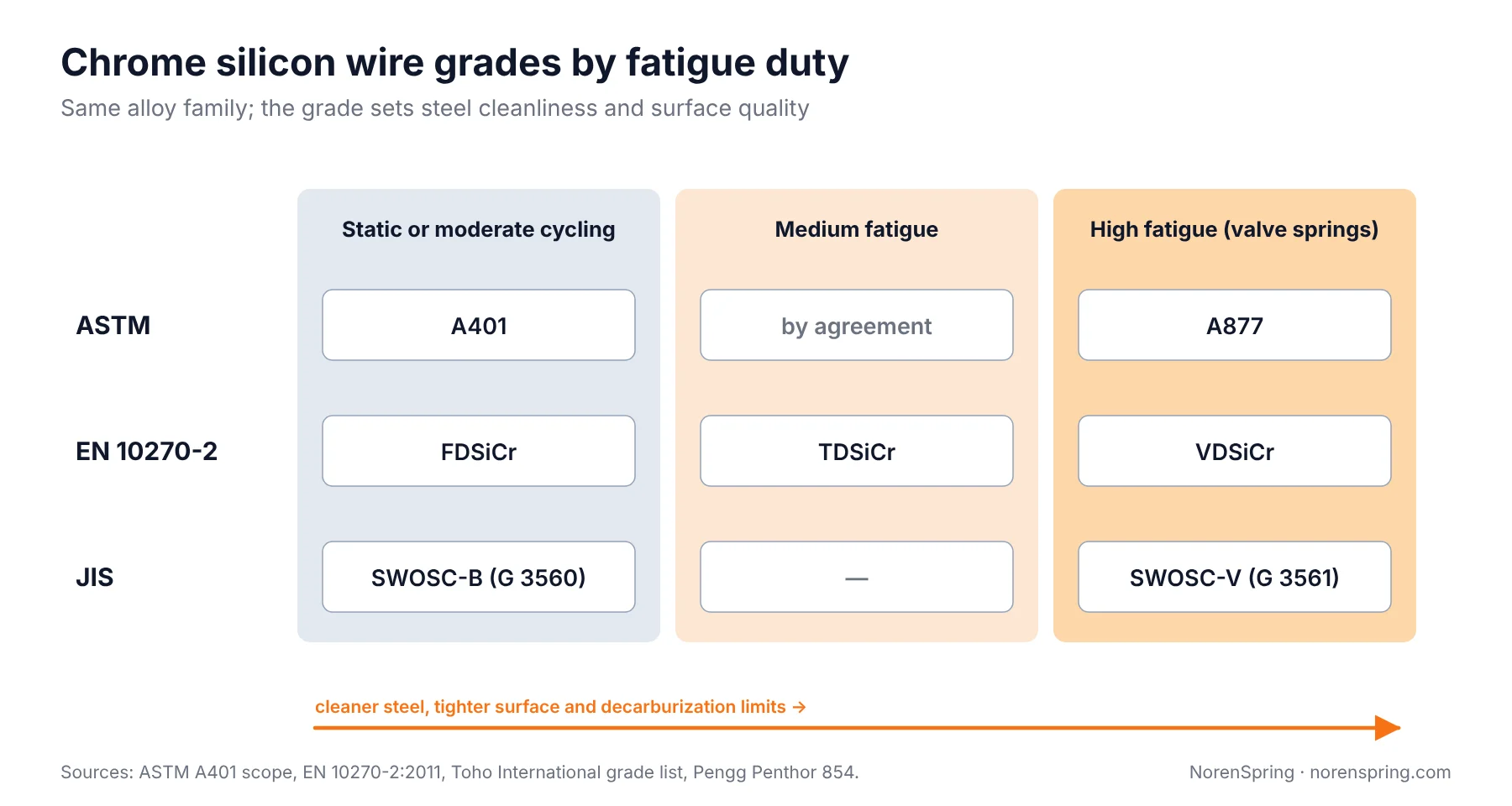
| Duty | ASTM | EN 10270-2 | JIS |
|---|---|---|---|
| Static or moderate cycling | A401 | FDSiCr | SWOSC-B (G 3560) |
| Medium fatigue | (A401 or A877 by agreement) | TDSiCr | — |
| High fatigue, valve springs | A877 | VDSiCr | SWOSC-V (G 3561) |
EN 10270-2 defines FD as the static grade and TD and VD as the medium- and high-fatigue grades, with “high steel cleanliness” and tighter controls on surface defects and decarburization for TD and VD; it lists diameters of 0.50 to 17.00 mm for FD and 0.50 to 10.00 mm for TD and VD [2]. A Japanese wire exporter lists SWOSC-B under JIS G 3560 as the mechanical-spring grade and SWOSC-V under JIS G 3561 as the valve-spring grade [5]. One valve-grade product is certified to EN 10270-2 VDSiCr, ASTM A877 Grade A and JIS G 3561 SWOSC-V at the same time [3], which shows how closely the three systems line up.
Two practical points follow. A drawing that only says “chrome silicon” leaves the fatigue grade open, so name the standard and grade. And if a part was originally made in SWOSC-V, quoting it in commercial A401 wire to save cost changes the fatigue performance, even though the chemistry looks the same.
How strong is chrome silicon compared with music wire?
At small sizes, chrome silicon and music wire are within a few percent of each other; above about 4 mm, chrome silicon is slightly stronger, and it continues to sizes where music wire is not made. The real gain is in larger, highly stressed springs and in warm service.
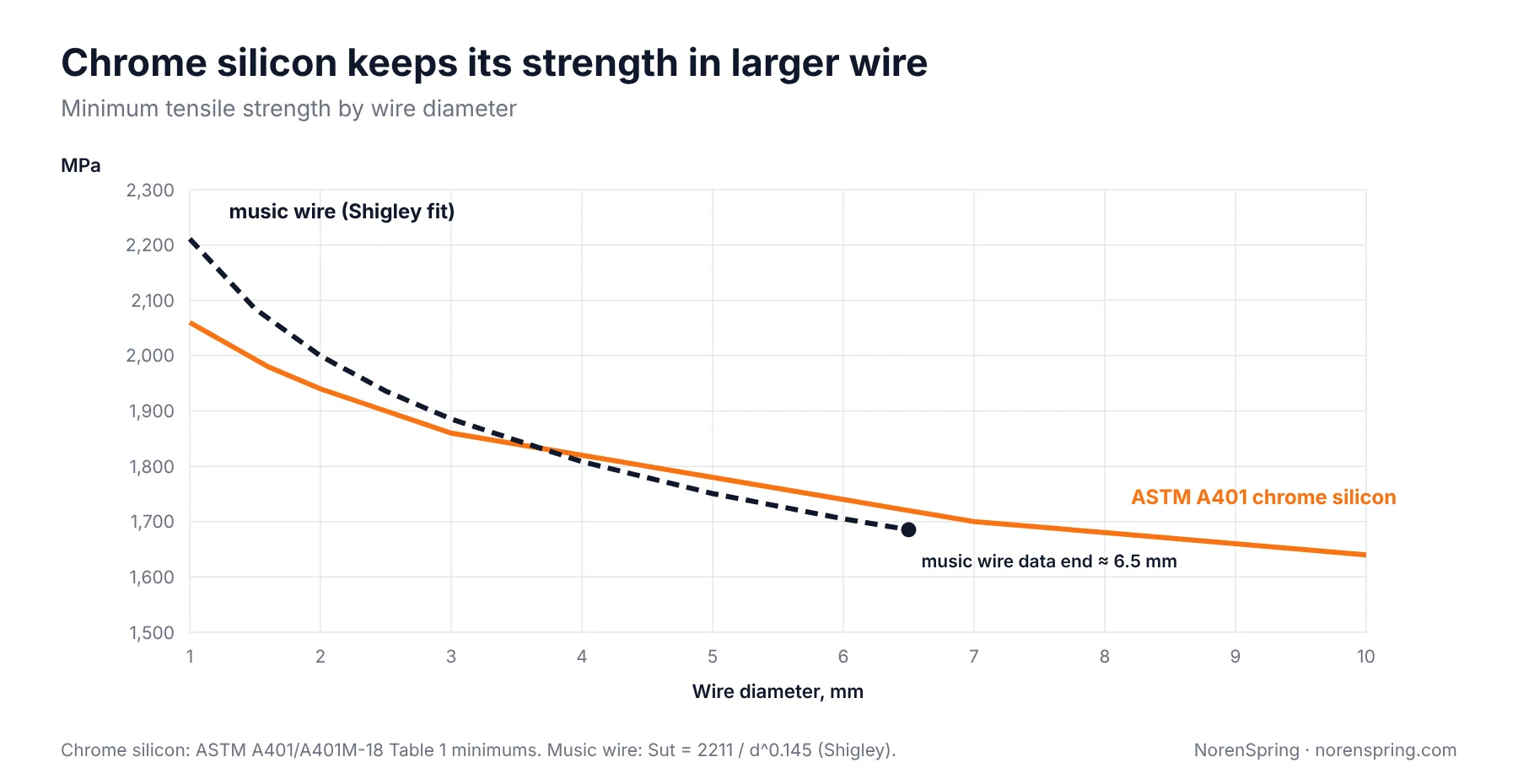
| Wire diameter | ASTM A401 Cr-Si, min tensile | Music wire, min tensile (approx.) | VDSiCr valve grade, range |
|---|---|---|---|
| 1.0 mm | 2,060 MPa | 2,210 MPa | 2,080–2,230 MPa |
| 2.0 mm | 1,940 MPa | 2,000 MPa | 2,010–2,160 MPa |
| 3.0 mm | 1,860 MPa | 1,890 MPa | 1,910–2,010 MPa |
| 4.0 mm | 1,820 MPa | 1,810 MPa | 1,860–1,960 MPa |
| 6.0 mm | 1,740 MPa | 1,710 MPa | 1,760–1,860 MPa |
| 10.0 mm | 1,640 MPa | beyond the usual size range | outside the listed range |
Sources: ASTM A401/A401M-18 Table 1 [1]; Pengg Penthor 854 for VDSiCr [3]; music wire values from Shigley’s fit, Sut = 2211 / d^0.145, as tabulated in our music wire springs guide.
Read the table this way: if a small spring in music wire is overstressed, switching to commercial chrome silicon will not fix it at room temperature. The valve grade is a little stronger, but the bigger lever is design: a larger wire, more coils or a lower stress. Chrome silicon solves different problems: a 6 to 10 mm spring that needs high strength, a spring that loses load in a hot place, or a cyclic spring that needs a fatigue-rated wire.
The elastic constants are the same as other spring steels. Pengg gives E = 206,000 MPa and G = 79,500 MPa for its VDSiCr wire [3], so changing from music wire to chrome silicon does not change the spring rate of a given geometry. Our spring rate guide has the formula and a calculator. Our guide what is spring steel explains why stronger spring steels are not stiffer.
How hot can chrome silicon springs run?
Chrome silicon is the usual choice for carbon-alloy steel springs that must hold their load up to about 250 °C. Above that, stainless steels and nickel alloys take over.
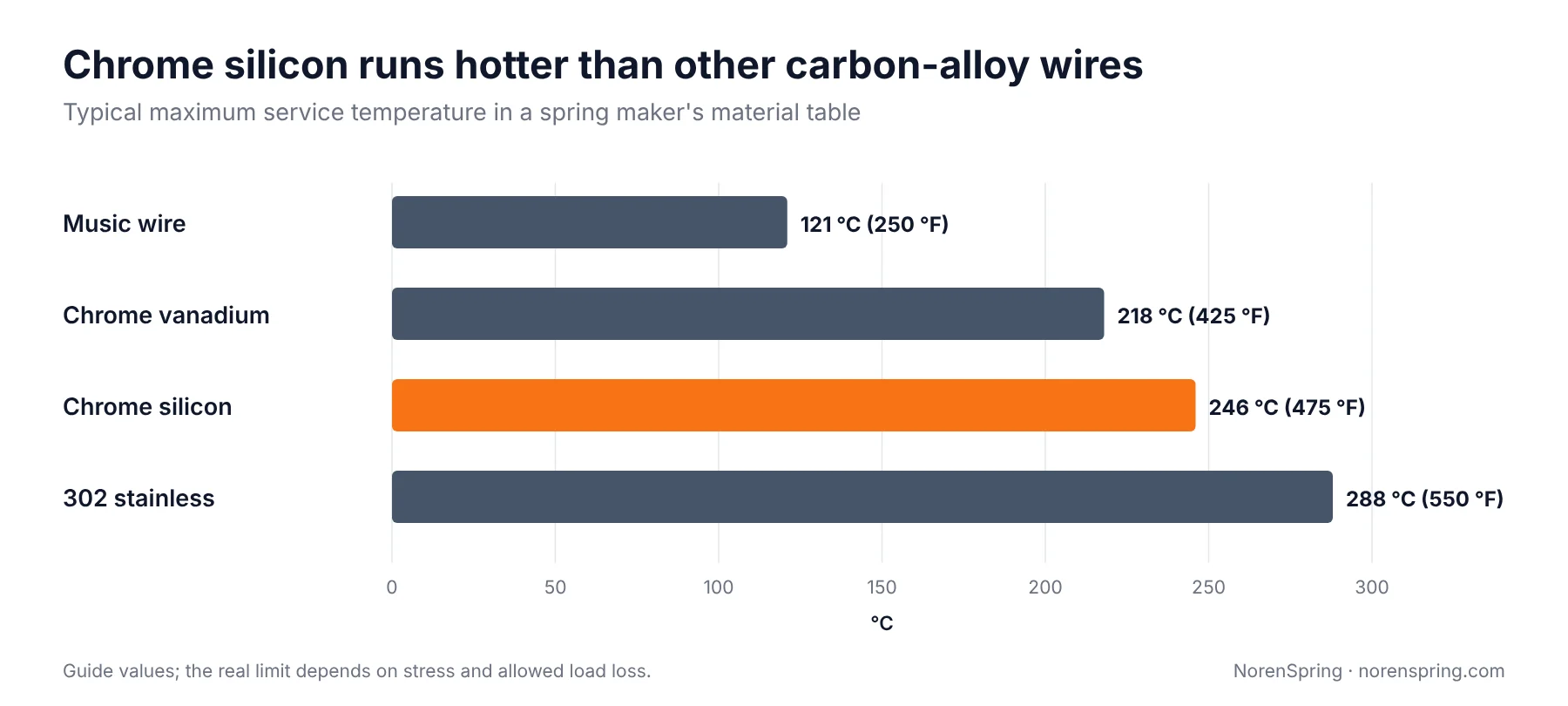
A widely used spring maker’s material table lists 121 °C (250 °F) for music wire, 218 °C (425 °F) for chrome vanadium, 246 °C (475 °F) for chrome silicon and 288 °C (550 °F) for 302 stainless. Pengg’s valve-grade data sheet describes “excellent relaxation properties at moderately elevated working temperatures (up to approx. 250 °C)” [3], and Gibbs notes that chrome silicon can be used at higher temperatures than chrome vanadium [4].
Relaxation is the gradual loss of spring load at a fixed length, and it speeds up with temperature and stress. These limits are not cliffs. A spring at high stress relaxes more at a given temperature than one at low stress, so state the working temperature and the allowed load loss on the drawing, for example “load at 40 mm not to fall more than 5% after 48 h at 150 °C”. That gives the supplier a test to design for. If corrosion is also a concern, our stainless steel springs guide compares the stainless grades for warm, wet service.
How are chrome silicon springs made and finished?
Chrome silicon springs follow the same route as other oil-tempered springs: coil, stress-relieve, grind ends if needed, shot peen for fatigue duty, then finish. The heat treatments are what differ.
- Stress relief after coiling. Gibbs recommends about 400 °C (750 °F) for 30 minutes [4]; Pengg gives 380 to 425 °C for 30 minutes, as soon as possible after coiling [3].
- Shot peening for fatigue. Peening puts the surface in compression and is standard industry practice for valve springs and other high-cycle chrome silicon springs. A second, lower stress relief of about 250 °C (480 °F) for 30 minutes is recommended after peening [4]. Valve spring makers have gone further: a US patent from a Japanese spring maker on high-strength SWOSC-V-based valve springs combines nitriding at 480 °C or above with repeated shot peening [6]. Our shot peening guide explains how the process works.
- Finish. Phosphate and oil, black oxide, powder coating and zinc plating are all used. Hydrogen embrittlement is a delayed brittle cracking caused by hydrogen absorbed during cleaning and electroplating. NASA’s plating process specification PRC-5007, for example, requires a hydrogen bakeout within four hours of plating for carbon and low-alloy steel parts at 180 ksi (about 1,240 MPa) tensile strength or more [8], a level every chrome silicon wire size in the A401 table exceeds. So chrome silicon springs are baked after plating. We bake every zinc-plated spring and agree the baking cycle for other plated finishes. Our spring finishes guide compares the options.
Forming is the other practical limit. High-strength wire is less forgiving of tight bends, so hooks, sharp torsion-spring legs and small bend radii need an engineering check before quoting. Plain compression springs with closed and ground ends are the easiest shape in chrome silicon.
Which parts are usually made in chrome silicon?
Chrome silicon suits springs that combine high stress with heat, shock or many cycles, such as parts in engines, compressors and suspensions. Typical examples include engine and compressor valve springs, clutch springs, suspension and fork springs, and heavy torsion springs in machinery. Our custom suspension springs guide works through a chrome silicon coilover spring example.
Parts we have supplied in SWOSC-V chrome silicon wire, alone or as an alternative to 50CrVA chrome vanadium, include:
| Part | Wire grade | Wire diameter | Finish | Main markets |
|---|---|---|---|---|
| Compressor valve spring | SWOSC-V or 50CrVA | 1–5 mm | Zinc plating or oil-tempered finish | USA, Japan |
| Front fork spring | SWOSC-V | 3–8 mm | Black oxide | India, Thailand |
| Shock absorber spring | SWOSC-V | 8–20 mm | Powder coating | USA, Japan |
| Torsion springs | SWOSC-V | 1–8 mm | Zinc plating | USA, Japan |
| Agricultural tines | 50CrVA or SWOSC-V | 5–12 mm | Phosphate or powder coating | USA, Germany, Australia |
The heavy springs are made as custom compression springs and checked on spring testers for load at the drawing’s working heights; our lab also has a spring fatigue tester (SAS CT series, with a customized servo test rig) for cycle requirements agreed on the drawing. Our heavy duty compression springs guide covers stress and buckling for springs of this size, and you can read more about NorenSpring, our certifications and our plant.
What to write on a chrome silicon spring drawing
A clear material callout prevents most quoting errors. Include:
- Standard and grade, for example “ASTM A401”, “EN 10270-2 VDSiCr” or “JIS G 3561 SWOSC-V”, not just “chrome silicon”.
- Wire diameter with tolerance, or the load and space if you want us to propose it.
- Loads at two working heights (or torques at two angles) with tolerances.
- Working temperature and the allowed load loss over time.
- Cycle life, if the spring is cyclic, and whether shot peening is required.
- Finish, with a note that plated parts must be baked for hydrogen embrittlement relief.
- End type, free length, outer or inner diameter limits and quantity.
If you only have a sample, send it with the application details: we can measure it, check the material and suggest a grade. Send your drawing or sample through our contact page and our engineers will reply with questions or a quotation.
Frequently asked questions
Is chrome silicon better than chrome vanadium for springs?
For warm service, usually yes. Chrome silicon is rated to about 246 °C in common spring tables against about 218 °C for chrome vanadium, and it has silicon to resist relaxation when hot. Chrome vanadium remains a good choice for shock-loaded springs at moderate temperatures. Our guide to chrome vanadium springs covers that grade in detail.
What is the JIS equivalent of chrome silicon spring wire?
SWOSC-B (JIS G 3560) for mechanical springs and SWOSC-V (JIS G 3561) for valve springs. SWOSC-V corresponds to EN 10270-2 VDSiCr and ASTM A877.
Can chrome silicon springs be zinc plated?
Yes, but the springs must be baked after plating to reduce the risk of hydrogen embrittlement, because the wire is a high-strength steel. Phosphate, oil, black oxide or powder coating avoid the plating step altogether.
Is chrome silicon stronger than music wire?
Only slightly, and only above about 4 mm. Below that size, music wire has similar or higher minimum strength. Chrome silicon is chosen for its higher temperature limit, its fatigue-rated valve grades and its availability in larger wire sizes.
References
- ASTM A401/A401M-18, Standard Specification for Steel Wire, Chromium-Silicon Alloy, sample pages (scope and Table 1). iTeh Standards preview. Retrieved 2026-10-29.
- EN 10270-2:2011, Steel wire for mechanical springs, Part 2: Oil hardened and tempered spring steel wire (catalogue summary). iTeh Standards. Retrieved 2026-10-29.
- Pengg Austria, Penthor 854 oil-tempered SiCr valve spring wire data sheet (EN 10270-2 VDSiCr, ASTM A877, JIS G3561 SWOSC-V), edition 04/2016. wire-pengg.com. Retrieved 2026-10-29.
- Gibbs Wire & Steel, Technical Data Sheet 1012, Oil Tempered Chrome Silicon Wire, Commercial Quality (ASTM A401). gibbswire.com. Retrieved 2026-10-29.
- Toho International, Oil Quenched and Tempered Wire (SWOSC-B, SWOSC-V). toho-intl.co.jp. Retrieved 2026-10-29.
- Aoki, Wakita and Sakakibara, US Patent 6,224,686 B1, High-Strength Valve Spring and Its Manufacturing Method (2001). shotpeener.com library. Retrieved 2026-10-29.
- Lee Spring, spring material properties table (maximum operating temperatures), as cited in our music wire springs guide. Retrieved 2026-10-20.
- NASA Johnson Space Center, PRC-5007 Rev. E, Process Specification for Electroless Nickel Plating (2020), Table 2 hydrogen bakeout criteria. nasa.gov. Retrieved 2026-10-29.



