










In this article
- Key takeaways
- What makes a compression spring “heavy duty”?
- Cold coiled vs hot coiled heavy springs
- Which steels are used for large coil springs?
- Ends, squareness and buckling on big springs
- Fatigue: stress, shot peening and presetting
- Where heavy duty compression springs are used
- Heavy duty compression spring vs die spring
- How to specify a heavy duty compression spring
- Frequently asked questions
- About the authors
- Sources
Cover image: an AI illustration based on a photograph of one of our heavy compression springs, placed in a new setting.
Heavy duty compression springs are large springs wound from thick round wire or bar, usually somewhere above 8 mm, to carry loads measured in kilonewtons rather than newtons. They hold up vibrating screens, absorb shock in rail and off-road vehicles, return heavy press tools and preload large valves. Two things set them apart from ordinary compression springs. Above about 16 mm the wire is normally too thick to coil cold, so the spring is coiled hot and then hardened. And at these sizes buckling, fatigue and end grinding decide whether the spring works, not just the rate.
This guide explains where cold coiling ends and hot coiling begins, which spring steels are used for large springs, how to check a heavy spring for buckling and fatigue, and what to put on a drawing or RFQ. A sizing calculator turns the two loads from your machine into a first design.
We make heavy duty compression springs to drawing, cold coiled and hot coiled, from wire and bar up to 80 mm, and batches are checked for dimensions and load before shipment. See our custom compression springs page for the full range.
Key takeaways
- There is no standard definition of “heavy duty”. In practice it means thick wire, high load and usually a low spring index, typically 3 to 8.
- Wire size decides the coiling route. EN 15800 covers cold coiled springs up to 16 mm wire; ISO 11891 covers hot coiled springs from 8 to 60 mm bar. Between 8 and 16 mm either route can be used.
- Hot coiled springs are made from spring steels that are quenched and tempered after coiling, such as 51CrV4, 61SiCr7 or their Chinese equivalents 50CrV and 60Si2Mn, supplied as hot rolled bar to EN 10089 or GB/T 1222.
- Long heavy springs buckle. A steel spring between flat, parallel, guided seats cannot buckle while its free length is less than about 5.3 times its mean diameter. Longer springs need a guide rod or sleeve, or a check against the EN 13906-1 buckling curve.
- Fatigue is the usual killer. Shot peening, a low share of tensile strength at the working load and a clean, decarburization-free surface do more for life than a heavier wire.
- Specify two loads at two lengths. That fixes the rate and the stress. Add the space limits, the duty and the quantity, and a spring maker can size the rest.
What makes a compression spring “heavy duty”?
A compression spring is called heavy duty when its load, wire size and coil diameter are large enough that it is built differently from a catalogue spring. No standard draws the line, and spring catalogues use the term loosely. Engineers usually mean one or more of these:
- Thick wire or bar. Large coil springs are wound from wire or bar of 8 mm and up. Our own range runs from 0.1 mm to 80 mm wire across both coiling routes, and the heavy end is where hot coiling takes over.
- High load per spring. A spring under a vibrating screen, a rail bogie or a press bolster can carry several tonnes. Springs under fans, pumps and chillers are sized by static deflection instead; see our guide to spring isolators.
- A low spring index. The spring index C = D/d is often 3 to 8 for heavy springs, lower than the 6 to 12 usual for small ones. A low index makes a stiff, compact spring, but it raises the stress at the inside of the coil (see our spring index guide).
- Hard duty. Shock, vibration, dirt, weather and millions of cycles are normal.
Die springs, the rectangular-wire springs used in press tools, are a separate family, covered further down.
Cold coiled vs hot coiled heavy springs
Up to about 16 mm, heavy springs are usually cold coiled from pre-hardened wire. Above that, they are hot coiled from bar and then quenched and tempered. The two routes overlap between 8 and 16 mm, where the choice depends on the coiling machines, the spring index and the quantity.
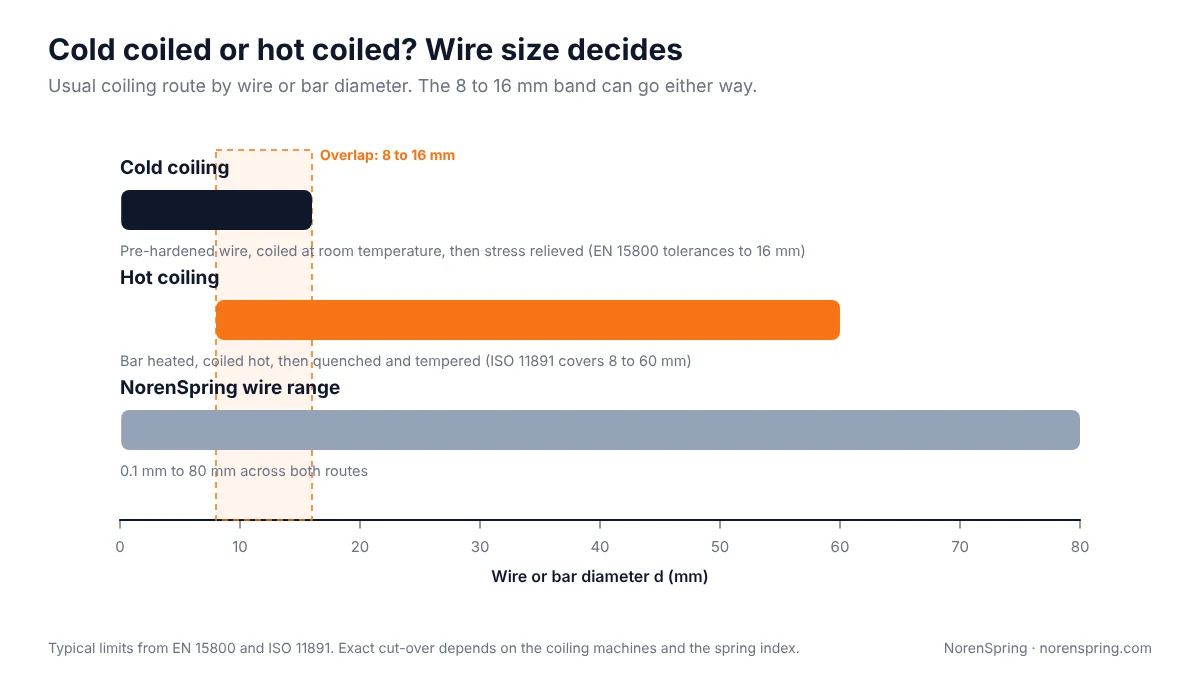
The standards mark out the two routes. EN 15800, the European quality standard for cold coiled compression springs, covers wire up to 16 mm and notes that springs from 16 to 20 mm are dealt with in an informative annex [1]. ISO 11891 covers springs “made from hot coiled round section steel bar, and then quenched and tempered”, from 8 to 60 mm bar diameter, up to 900 mm free length and with a spring index from 3 to 12 [2]. The Chinese standard GB/T 23934-2015 covers the same kind of hot formed compression springs with similar size limits [3]. In Germany, DIN 2096-1 sets quality requirements for hot formed springs [4].
| Cold coiled | Hot coiled | |
|---|---|---|
| Usual wire or bar size | Up to 16 mm (EN 15800), occasionally 20 mm | 8 to 60 mm (ISO 11891, GB/T 23934) |
| Starting material | Pre-hardened wire: oil tempered, Cr-Si, Cr-V | Hot rolled bar to EN 10089 or GB/T 1222 |
| Process | Coil at room temperature, then stress relieve | Heat bar, coil while hot, quench and temper |
| Spring index | 4 to 20 (EN 15800) | 3 to 12 |
| Tooling and set-up | CNC coiler, short set-up | Mandrel per coil diameter, longer set-up |
| Quality standard | EN 15800, GB/T 1239.2 | ISO 11891, GB/T 23934, DIN 2096-1 |
| Main surface risk | Coiling marks | Decarburization and scale from heating |
Hot coiling suits large springs because the bar is soft while it is wound, so a thick section can be coiled to a tight index without cracking. The spring gets its strength afterwards from the quench and temper. The trade-off is a heat-treatment step on the finished shape and a surface that must be protected from decarburization. Cold coiling is faster and holds closer tolerances on small and medium springs, because the wire is already at full strength. For the full process step by step, see our spring manufacturing process guide.
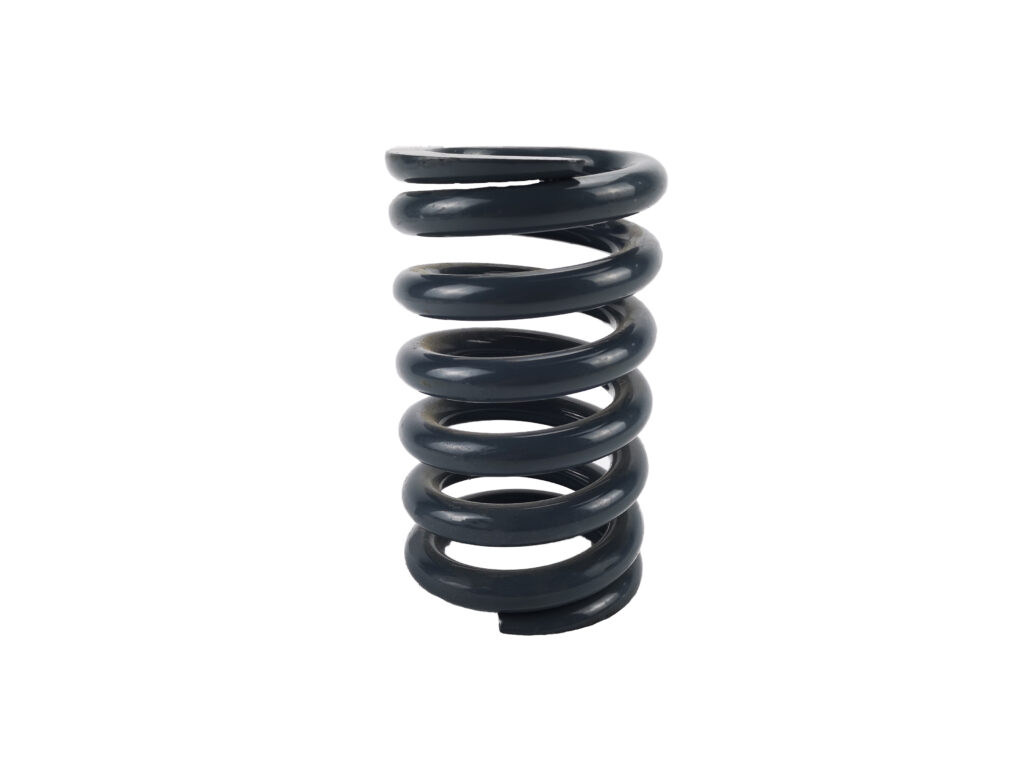
ISO 11891 states that it does not cover springs with special requirements such as railway and automotive suspension springs [2]. For vehicle springs, see our custom suspension springs guide. Rail vehicle suspension springs have their own standard, EN 13298 [13]. If your spring is in one of those applications, name the standard on the drawing.
Which steels are used for large coil springs?
Hot coiled springs are made from hot rolled silicon-manganese or chromium-vanadium spring steels that respond well to quenching and tempering. Cold coiled heavy springs use oil tempered, chrome-silicon or chrome-vanadium wire (see our chrome silicon springs guide for the chrome-silicon grades). The common grades and their approximate equivalents are below.
| Family | EN 10089 | GB/T 1222 | SAE / AISI | Typical use |
|---|---|---|---|---|
| Chromium-vanadium | 51CrV4 (1.8159) | 50CrV (50CrVA on older drawings) | 6150 | Heavy springs needing toughness and good hardenability in thick sections |
| Silicon-manganese / silicon-chromium | 61SiCr7 (1.7108) | 60Si2Mn | 9260 | General heavy duty springs, high strength |
| Silicon-chromium | 54SiCr6 (1.7102) | 55SiCr | 9254 | Suspension and high-stress springs |
Equivalents are approximate: compositions overlap but are not identical. Check the standard before substituting one grade for another.
EN 10089 is the European delivery standard for hot rolled steels for quenched and tempered springs, covering bars and rod for springs that are hot or cold formed and then heat treated [6]. Steel producers describe 61SiCr7 as “mainly used for heavy duty springs”, and list AISI 6150 as similar to 51CrV4 [7]. In China the grades come under GB/T 1222, revised as GB/T 1222-2025 with effect from 1 May 2026; the new edition revises the decarburized-layer and surface quality requirements, which matter most for hot coiled springs (see our note on GB/T 1222-2025) [8].
For cold coiled heavy springs, ASTM A229 covers quenched and tempered carbon spring wire and ASTM A401 covers chromium-silicon wire for springs that must resist set at moderately elevated temperatures [14][15]. Our spring wire material guide compares these wires in more detail. Stainless steel is rarely used for very large springs; if you need corrosion resistance, a coated alloy steel is usually the better choice.
Ends, squareness and buckling on big springs
A heavy spring should have closed and ground ends, a squareness tolerance on the drawing, and a slenderness ratio that keeps it from buckling. These three decide whether a large spring sits flat and loads its seats evenly.
Closed and ground ends. On a heavy spring the end coils are closed against the next coil and ground flat, usually over at least three quarters of a turn. This spreads the load on the seat and keeps the spring square. A hot coiled spring is usually ground after heat treatment.
Squareness and parallelism. A large spring that is out of square pushes sideways on its guide and loads one side of the seat. Put a squareness tolerance (the deviation of the spring axis from vertical, measured at the free length) and, where it matters, a parallelism tolerance for the ground ends on the drawing.
Buckling. A long, slender compression spring bows sideways before it reaches its working length. Whether it does depends on the slenderness ratio, free length L0 divided by mean diameter D, and on how the ends are held, expressed as an end factor ν (Shigley calls it α) [9][10]:
- ν = 0.5: both ends on flat, parallel seats that cannot move sideways. This needs ground ends.
- ν = 0.707: one end on a flat seat, the other pivoted.
- ν = 1: both ends pivoted, or both seats flat but one free to slide sideways.
- ν = 2: one end clamped, the other free.
A steel spring cannot buckle at any deflection while ν·L0/D is below about 2.63 [9]. For the best case of ν = 0.5, that means a free length up to about 5.3 times the mean diameter. Beyond that, EN 13906-1 gives the deflection at which the spring buckles [5]; the curve in Figure 2 shows how fast the safe deflection falls.
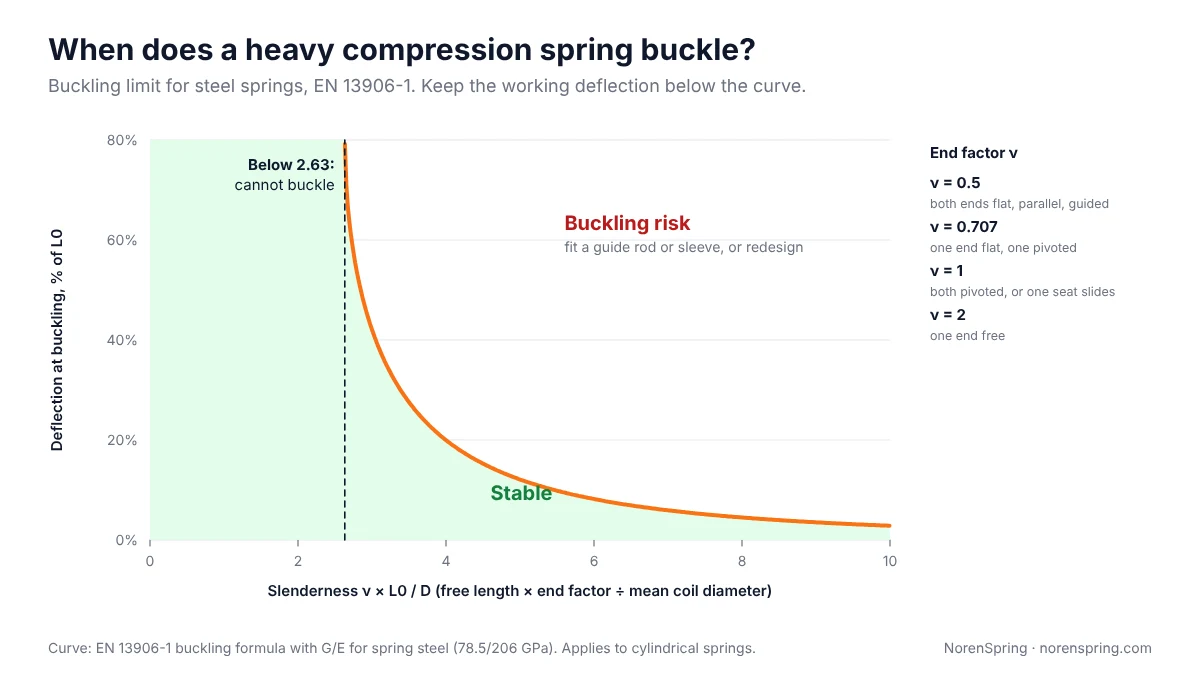
If the working deflection is close to the curve, the usual fixes are a guide rod inside the spring or a sleeve outside it, a larger coil diameter, or two shorter springs in series with a guided plate between them. A guide adds friction and wear, so leave a radial clearance and do not rely on it to carry side load. Our compression spring buckling guide compares these fixes on a worked example.
The sizer below runs these checks from the two loads in your machine.
Heavy duty spring sizer: from two loads to a first design
Enter the two loads and lengths from your machine. The sizer works out the rate, a wire diameter and coil count, the free length, the likely coiling route, buckling and natural frequency. Treat the result as a starting point for a drawing, not a finished design.
Assumptions: round steel wire, G = 78,500 MPa, density 7,850 kg/m³, closed and ground ends with 2 inactive coils, stress corrected with the Bergsträsser factor. Buckling uses the EN 13906-1 formula. The stress shares are cautious starting values, not limits from a standard; check springs that cycle against a fatigue (Goodman) diagram. The frequency check flags a spring whose own natural frequency falls within 10% of the machine speed or one of its first ten harmonics.
Example. A return spring on a heavy press tool carries 8,000 N at its installed length of 220 mm and 14,000 N at 190 mm. That is a rate of 200 N/mm and a free length of 260 mm. With an index of 6 and, for a moderate cycle count, a stress of 35% of a 1,600 MPa tensile strength at the working load, the sizer gives a wire of at least 21.7 mm and about 5 active coils, so this spring would be hot coiled. With ground ends on flat seats its slenderness ν·L0/D is 1.0, well inside the stable region. Compressed solid, it would reach 55% of tensile strength, so the drawing should state that the spring must not be driven to solid, or the wire should go up a size.
Fatigue: stress, shot peening and presetting
Most heavy springs in vibrating or cyclic service fail by fatigue, not by overload. Keeping the stress range low, the surface clean and compressive, and the material free of decarburization does more for life than adding wire.
Stress. The shear stress in a compression spring is τ = K·8FD/(πd³), where K corrects for the higher stress at the inside of the coil. With the Bergsträsser factor, K = (4C + 2)/(4C − 3) [9]. At an index of 4 the correction is 1.38; at 8 it is 1.17. For static springs of hardened and tempered steel, Shigley allows a maximum of 50% of tensile strength before set removal [9]. Springs that cycle need a lower figure from a fatigue diagram; our compression spring design guide works through the Goodman check.
Shot peening. Shot peening blasts the spring with small steel shot to put the surface into compression, which delays the start of fatigue cracks. ISO 26910-1:2023 sets out the general procedure for springs [11]. The gain is large: Zimmerli’s endurance data, quoted in Shigley for spring wire under 10 mm, raise the alternating stress the wire can carry from 241 MPa unpeened to 398 MPa peened, about 65% more [9]. Thick bar has not been tested the same way, but peening is widely used on large dynamic springs for the same reason. Shot peening also recovers much of the life lost to a decarburized surface. Researchers at Chalmers and Volvo Powertrain, testing quenched and tempered 51SiCr7 spring steel in bending fatigue, found a 45% improvement in the fatigue limit of decarburized specimens after shot peening [12]. A test on a 12.7 mm wire spring, compared process by process, is in our guide to shot peening springs.
Decarburization. Heating bar for hot coiling and hardening can strip carbon from the surface, leaving a soft skin where fatigue cracks start. The same study, written for truck components, notes that the maximum decarburized depth allowed is usually 0.1 to 0.2 mm, but up to 0.5 mm has been seen in production [12]. Ask for the decarburization limit, and how it is checked, on the drawing.
Presetting. Presetting (also called set removal or scragging) means making the spring slightly long and compressing it to solid, so it takes its permanent set in the factory rather than in your machine. Shigley notes it raises the static load capacity but is not recommended for springs subject to fatigue [9]. For a heavy spring that works mainly under static load, presetting keeps the free length stable. Springs under cyclic load are often preset as well and then shot peened, but the design stress has to allow for it, so agree the sequence with your spring maker rather than relying on presetting alone.
Our guide to why springs fail covers fatigue, set and corrosion failures in more detail.
Where heavy duty compression springs are used
Heavy compression springs carry static weight and absorb motion in large machines. The common applications, and what each one asks of the spring, are:
- Vibrating screens, feeders and tables. Vibrating screen springs carry the screen body and isolate its vibration from the structure. The spring sees millions of cycles, so fatigue, matched sets and resonance matter most. Many use reduced end coils that grip the mounting stud; see our vibrator springs page for what to specify. For springs under vibrating screens and feeders, check both the isolation frequency and the spring’s own surge frequency, as our spring natural frequency guide explains.
- Rail vehicles. Bogie suspension springs are hot coiled and made to EN 13298 or the operator’s own specification [13]. See our rail transit spring solutions.
- Construction and heavy equipment. Recoil springs, seat and cab suspension, and buffers on machines that work in dirt and weather; corrosion protection is part of the specification. The steel spring guards wrapped around their hydraulic hoses are a lighter, close-wound coil; our hose spring guard guide explains how to size one.
- Agricultural machinery. Heavy springs on tillage tools, balers and seeders carry shock loads from the ground (see our agricultural spring solutions).
- Presses, valves and industrial equipment. Return springs for heavy tools, safety valve springs and preload springs for large bearings and clutches (see industrial equipment springs).
Heavy duty compression spring vs die spring
A die spring is a compression spring wound from rectangular wire, made to standard sizes for press tools. Choose a die spring when you need a standard part that fits a standard pocket in a tool; choose a custom heavy duty compression spring when the load, size or duty does not match a catalogue.
| Heavy duty compression spring | Die spring | |
|---|---|---|
| Wire section | Round | Rectangular |
| Sizes | Made to your loads and space | Standard housing sizes, ISO 10243 |
| Load grades | Any rate you specify | Light, medium, strong, extra strong, colour coded |
| Typical use | Machine suspension, vibration, buffers, valves | Press tools, moulds, stripper plates |
| Wire up to | 60 mm and more, hot coiled | Limited by the standard housing sizes |
ISO 10243 defines the housing dimensions of die springs and a colour code for each of four rate grades [16]. If a die spring nearly fits but not quite, a custom round-wire spring is usually the simpler answer. See our die springs page for the rectangular wire springs we make. Our die spring guide explains the colour chart and how far each class may be compressed for a given life.
How to specify a heavy duty compression spring
The most useful thing you can send is two loads at two lengths. With F1 at the installed length L1 and F2 at the working length L2, a spring maker can work out the rate, the stress and the free length, and size the wire and coils to fit your space. For the general checklist that applies to any compression spring, see how to specify a custom compression spring; the items below add what matters for large, hot coiled springs.
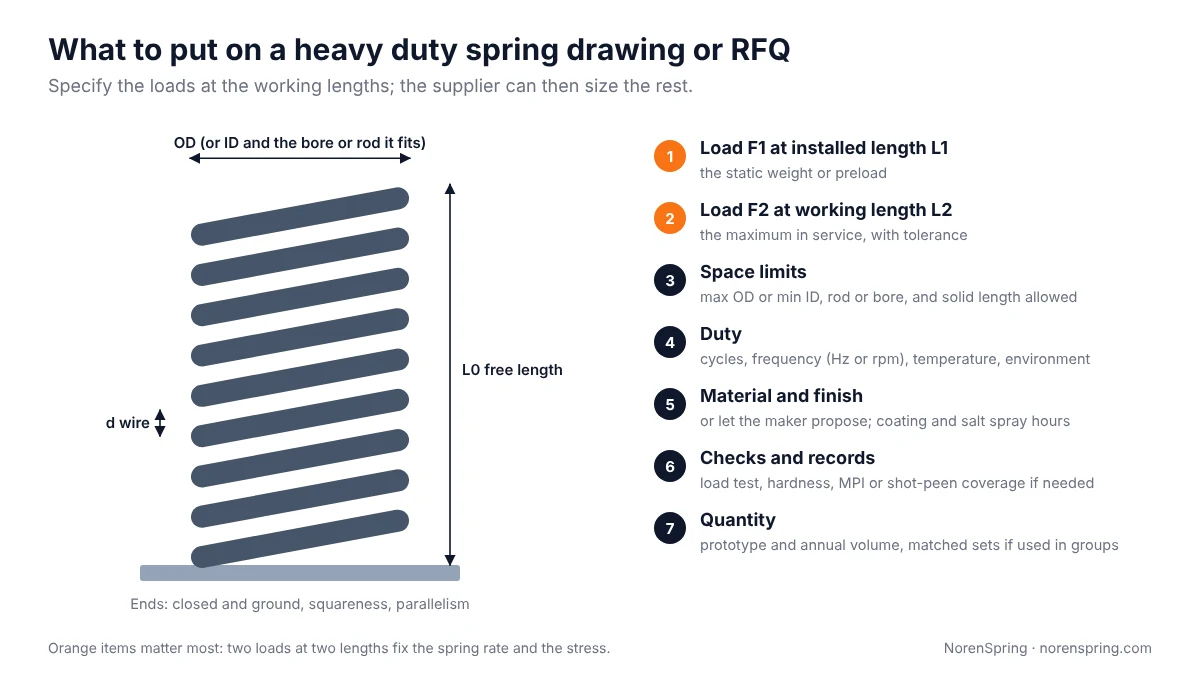
Send these with your enquiry:
- Load F1 at installed length L1, such as the static weight per spring or the preload.
- Load F2 at working length L2, the most compressed length in service, with the load tolerance you need.
- Space limits: the largest outside diameter or the smallest inside diameter, the rod or bore the spring fits, and the shortest length the spring may reach.
- Duty: static or cyclic; the number of cycles; the machine speed or vibration frequency; the temperature; and the environment (outdoor, wet, abrasive, chemical).
- Material and finish: a grade if you have one, or let the maker propose; the coating and any salt spray requirement. Zinc plated high-strength springs must be baked after plating to remove hydrogen (see our spring finishes guide).
- Checks and records: load test points, hardness, squareness, and any requirement for shot peening coverage, decarburization depth or crack inspection (for example magnetic particle inspection, MPI).
- Quantity: prototype, first batch and annual volume, and whether the springs are used in matched sets.
Without a drawing, the wire diameter, outside diameter and free length of a sample spring are enough to start. For how a batch of springs is checked against these numbers, see our guide to compression spring testing and acceptance.
Frequently asked questions
What is a heavy duty compression spring?
A heavy duty compression spring is a helical spring wound from thick round wire or bar, usually 8 mm and up, that carries loads measured in kilonewtons. Springs above about 16 mm wire are normally hot coiled and then quenched and tempered; smaller ones are cold coiled from pre-hardened wire.
How large can a heavy duty compression spring be?
The international standard for hot formed compression springs, ISO 11891, covers bar from 8 to 60 mm, free lengths up to 900 mm and mean coil diameters up to 460 mm [2]. Larger springs are made to special order. Our own wire range runs to 80 mm.
Should a hot coiled spring be shot peened?
If it works under cyclic load, yes, in most cases. Shot peening puts the surface into compression and recovers much of the fatigue strength lost to decarburization during heating [12]. For a spring that carries a mostly static load, peening adds less.
Can I use a die spring instead of a heavy duty compression spring?
Only if a standard die spring size fits your space and gives the load you need at your working length. Die springs are designed for press tool pockets and come in four standard rate grades [16]. For machine suspension, vibration or custom loads, a round-wire spring made to your loads is usually the better choice.
How do I replace vibrating screen springs?
Replace them as a matched set, not one at a time. Measure the wire diameter, outside diameter and free length of the old spring, note the diameter of the stud or seat each end fits, and ask the machine maker for the load per spring and the running speed. If the springs have reduced end coils, give the inside diameter of the ends as well.
About the authors
This guide was prepared by the NorenSpring engineering team, which designs and manufactures custom compression, extension and torsion springs and wire forms in Xuzhou, China, including hot coiled large springs. Technical review by Feng Yulin, General Manager and senior structural engineer, who has 15 years of spring R&D experience and more than 30 national patents. NorenSpring holds IATF 16949, ISO 9001, ISO 13485, ISO 14001 and ISO 45001 certifications. More about NorenSpring. Sources and figures were last checked on October 19, 2026.
Need a heavy spring made to your loads? Send us your drawing or two load points and our engineers will propose a design.
Sources
The numbers in square brackets in the text refer to this list.
- BSI, BS EN 15800, Cylindrical helical springs made of round wire, Quality specifications for cold coiled compression springs. Scope: wire up to 16 mm, with an informative annex for 16 to 20 mm. Retrieved 2026-10-19.
- BSI, ISO 11891:2012, Hot formed helical compression springs, Technical specifications. Scope: 8 to 60 mm bar, free length up to 900 mm, spring index 3 to 12, mean diameter up to 460 mm; excludes railway and automotive suspension springs. Retrieved 2026-10-19.
- GB/T 23934-2015, Hot formed helical compression springs, Technical requirement, summary at ChineseStandard.net. Retrieved 2026-10-19.
- DIN Media, DIN 2096-1, Helical compression springs made of round wire and rod, Quality requirements for hot formed compression springs. Retrieved 2026-10-19.
- DIN Media, DIN EN 13906-1:2013, Cylindrical helical springs made from round wire and bar, Calculation and design, Part 1: Compression springs. Retrieved 2026-10-19.
- BSI, EN 10089, Hot rolled steels for quenched and tempered springs, Technical delivery conditions. Retrieved 2026-10-19.
- Ovako Steel Navigator, 51CrV4 and 61SiCr7 grade data. Retrieved 2026-10-19.
- GB/T 1222-2025, Spring steels, issued 2025-10-31, effective 2026-05-01; see our summary of the standard.
- R. G. Budynas and J. K. Nisbett, Shigley’s Mechanical Engineering Design, 9th edition, McGraw-Hill, chapter 10. Source for the Bergsträsser factor, the buckling equation and end-condition constants (Table 10-2), allowable stresses (Table 10-6), Zimmerli’s peened and unpeened endurance data, and set removal.
- HEXAGON Industriesoftware, Infobrief 172, on buckling seating cases and DIN 2096 testing. Retrieved 2026-10-19.
- ISO, ISO 26910-1:2023, Springs, Shot peening, Part 1: General procedures, edition 2, October 2023. Retrieved 2026-10-19.
- K. Dalaei, K. Höijer, B. Åkerström and B. Karlsson, Influence of shot peening on fatigue durability of decarburized spring steels, Chalmers University of Technology and Volvo Powertrain, Shot Peener library document 2011030. Test material 51SiCr7, decarburization depths 0, 0.15 and 0.50 mm. Retrieved 2026-10-19.
- BSI, EN 13298, Railway applications, Suspension components, Helical suspension springs, steel. Retrieved 2026-10-19.
- ASTM International, ASTM A229/A229M, Standard Specification for Steel Wire, Quenched and Tempered for Mechanical Springs. Retrieved 2026-10-19.
- ASTM International, ASTM A401/A401M, Standard Specification for Steel Wire, Chromium-Silicon Alloy. Retrieved 2026-10-19.
- SIS, ISO 10243:2019, Tools for pressing, Compression springs with rectangular section, Housing dimensions and colour coding. Retrieved 2026-10-19.



