










In this article
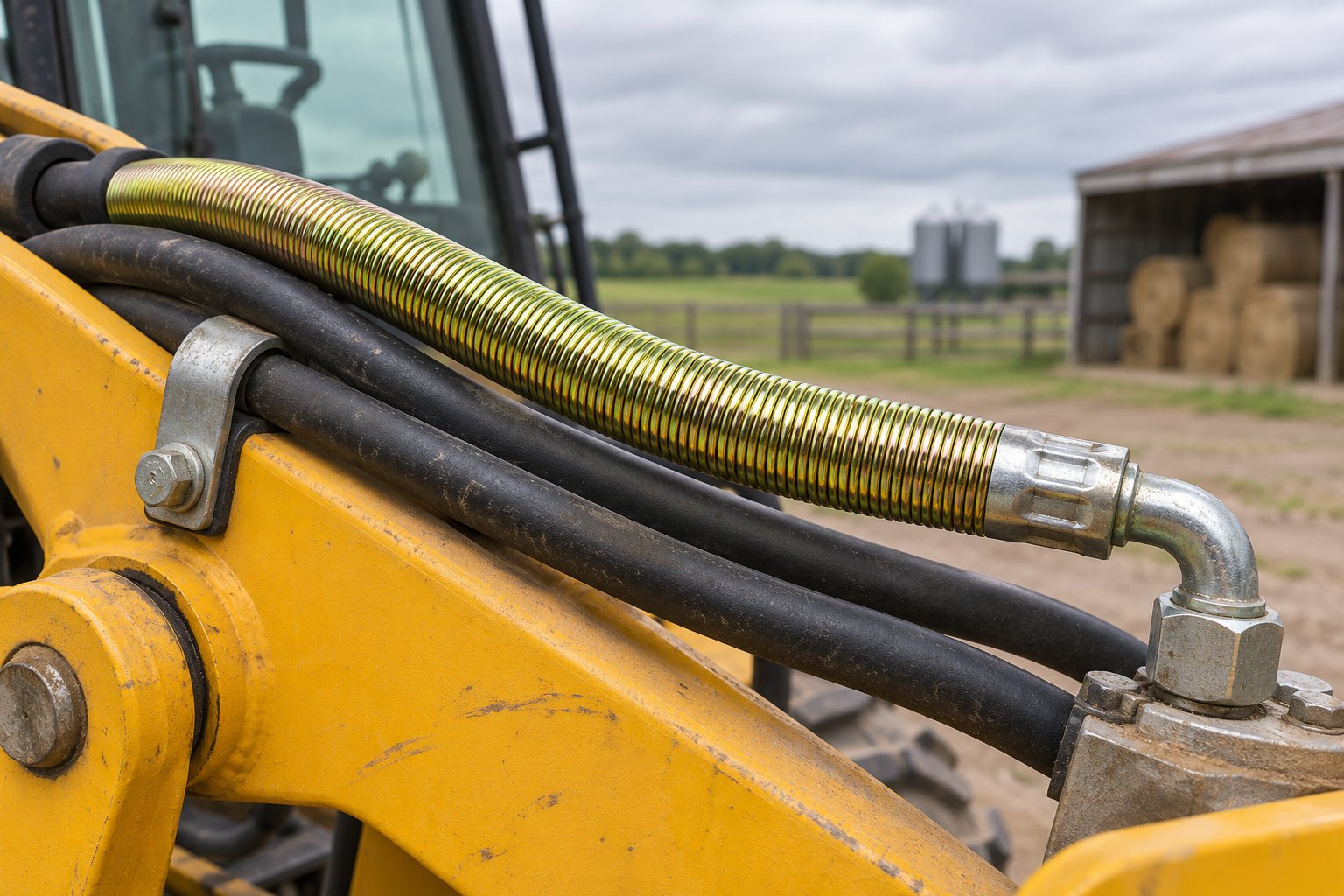
Cover image: an AI-generated illustration of a generic hydraulic hose with a spring guard, based on a photo of close-wound springs we make; it does not show a specific product.
A hose spring guard is a coil of steel wire wound around a hydraulic hose to protect its cover from abrasion, cuts and kinking. It looks like a long close-wound spring and is made the same way. A trade article on hose protection describes the metal spring guard as the form of protection often used when an exposed hose may encounter flexing, twisting, kinking, tensile or side loads, a tight bend radius or vibration [1].
This guide is written for hydraulic equipment manufacturers, hose assembly shops and distributors who buy spring guards in bulk or to their own specification. It explains what a guard does and does not do, works through a sizing example for a common two-wire hose, compares wire sizes and coil pitches, and lists the details that belong on a drawing. For coil spring drawings in general, see our compression spring specification guide.
Key takeaways
- A spring guard protects the hose cover, not the pressure rating. It guards against abrasion, cuts and local kinking, while the hose itself still carries the pressure.
- Size the inside diameter from the hose outside diameter. In our example, a 24.0 mm guard gives 1.8 mm of diametral clearance over a 22.2 mm hose.
- Wire size sets crush strength. Going from 1.6 to 3.0 mm wire raises the single-coil side load in our example from 121 N to 669 N, at about twice the mass per metre.
- A coil guard spreads a bend but does not stop one. For the inner coils to touch at the hose’s 180 mm minimum bend radius, the gap between coils would have to be only 0.16 mm.
- Fit the guard before the fittings are crimped, unless you specify a pre-made guard with ends designed to go over them.
What does a hose spring guard do?
Hose makers sell spring guards as a standard accessory. Parker’s listing, for example, says its spring guards prolong the life of hose lines exposed to rugged operating conditions, distribute bending radii to avoid kinking and protect hose from abrasion and deep cuts; the guards are constructed of steel wire and plated to resist rust [2]. Alfagomma describes its steel protective coil springs in almost the same terms, adding that they protect the hose from excessive wear caused by sharp edges [3].
The same trade article lists spring guards among several ways to keep hoses away from abrasive sources, together with clamps, bent-tube couplings, nylon ties and sleeving, and notes that exposed reinforcement is susceptible to rust and accelerated damage leading to failure [1]. In other words, the guard protects the rubber cover, and the cover protects the wire reinforcement that holds the pressure.
| Guard type | Construction | Best for | Main limitation |
|---|---|---|---|
| Round-wire spring guard | Close-wound or open-pitch steel wire coil | Abrasion, cuts, local kinking near fittings | Heavier; must go on before crimping |
| Pre-made spring guard | Short spring guard with formed ends | Strain relief at a fitting | Fixed length |
| Flat armor guard | Coiled flat steel strip | Heavier crush and abrasion | Stiffer and heavier |
| Spiral guard | Wrap-on polymer spiral | Light abrasion, bundling | Lower cut resistance |
| Hose bend restrictor | Rigid or interlocking sleeve | Holding a minimum bend radius | Not flexible along its length |
Parker’s own range includes most of these styles, from steel spring guards and flat steel armor guards to a hose bend restrictor and a spiral guard [5]. This guide covers the round-wire spring guard, which is a coil spring in everything but name.
Worked example: a spring guard for a -08 two-wire hose
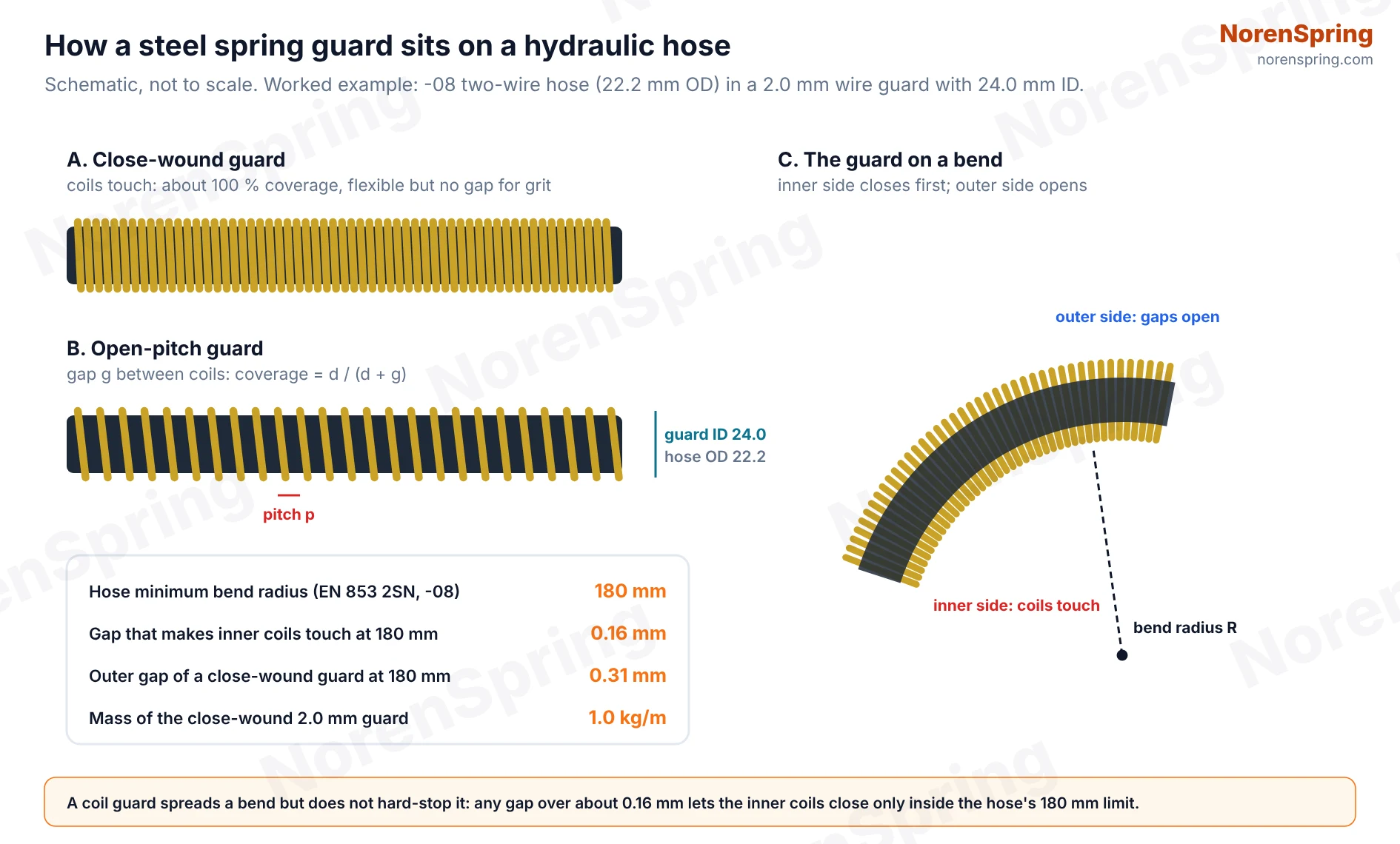
We sized a guard for a common hose: 1/2 in (-08) two-wire braided hose to EN 853 2SN. One maker’s datasheet lists this size with a 22.2 mm outside diameter, a 275 bar maximum working pressure and a 180 mm minimum bend radius [4]. Everything below is our own calculation for that hose, using hard-drawn spring wire (ASTM A227) and the wire strength equations in Shigley [6]; it is a worked example, not a published rating.
Clearance between hose and guard
The guard’s inside diameter needs to clear the hose outside diameter along its whole length, including the hose’s manufacturing tolerance and any growth under pressure, while staying close enough that it does not slide loosely and wear through the cover. We used a 24.0 mm inside diameter, which gives 1.8 mm of diametral clearance over the 22.2 mm hose. Alfagomma’s listing, for comparison, sizes each guard by hose type and dash size, with one 17.0 mm guard listed for DN8 one-wire hose and DN6 two-wire hose, supplied in 4 m coils [3].
Applying the same approach across the two-wire range gives the starting sizes below. Hose outside diameters and bend radii are from the same datasheet [4]; the guard inside diameter is the hose outside diameter plus about 1.8 mm, rounded up to the next 0.5 mm, and the wire sizes are our suggestions. Check your own hose maker’s figures, because outside diameters differ between brands. Our 17.0 mm result for -04 hose matches the 17.0 mm guard Alfagomma lists for DN6 two-wire hose [3].
| Hose (EN 853 2SN) | Hose OD | Hose minimum bend radius | Suggested guard ID | Suggested wire | Guard OD | Mass, close-wound |
|---|---|---|---|---|---|---|
| -04 (1/4 in) | 15.0 mm | 100 mm | 17.0 mm | 1.6 mm | 20.2 mm | 0.58 kg/m |
| -05 (5/16 in) | 16.5 mm | 115 mm | 18.5 mm | 1.6 mm | 21.7 mm | 0.62 kg/m |
| -06 (3/8 in) | 18.9 mm | 130 mm | 21.0 mm | 1.6 mm | 24.2 mm | 0.70 kg/m |
| -08 (1/2 in) | 22.2 mm | 180 mm | 24.0 mm | 2.0 mm | 28.0 mm | 1.01 kg/m |
| -10 (5/8 in) | 25.2 mm | 200 mm | 27.0 mm | 2.0 mm | 31.0 mm | 1.12 kg/m |
| -12 (3/4 in) | 29.2 mm | 240 mm | 31.0 mm | 2.5 mm | 36.0 mm | 1.62 kg/m |
| -16 (1 in) | 37.2 mm | 300 mm | 39.0 mm | 2.5 mm | 44.0 mm | 2.01 kg/m |
Wire size and crush strength
A stone, a bracket edge or a clamp presses on one or two coils at a time, not on the whole guard. We therefore treated a single coil as a thin ring loaded across its diameter, using the standard ring formulas from Roark’s Formulas for Stress and Strain, and calculated the load that brings the bending stress to 0.75 of the wire’s tensile strength. That limit is our working choice for a part that must not take a permanent dent.
| Wire | Guard OD | Tensile strength | Side load per coil at 0.75 of tensile strength | Coil squash at that load | Mass, close-wound |
|---|---|---|---|---|---|
| 1.6 mm | 27.2 mm | 1,631 MPa | 121 N | 0.59 mm | 0.79 kg/m |
| 2.0 mm | 28.0 mm | 1,563 MPa | 222 N | 0.46 mm | 1.01 kg/m |
| 2.5 mm | 29.0 mm | 1,498 MPa | 409 N | 0.37 mm | 1.28 kg/m |
| 3.0 mm | 30.0 mm | 1,447 MPa | 669 N | 0.31 mm | 1.57 kg/m |
The side load rises with the cube of the wire size, while the mass rises roughly in proportion to it. As a result, going from 1.6 mm to 3.0 mm wire multiplies the crush strength by 5.5 for about twice the weight. For most mobile equipment, 2.0 to 2.5 mm wire on a -08 hose is a reasonable balance; for heavy rock contact, a flat armor guard may suit better.
Can a spring guard stop a hose from over-bending?
Only partly. When a coil guard bends, the coils on the inside of the curve close up and the coils on the outside open. Once the inner coils touch, the guard stiffens, because any further bending must stretch the outside of the coil. That is why manufacturers describe guards as distributing bending radii [2], rather than as fixing a minimum radius.
We calculated the bend radius at which the inner coils touch for different gaps between coils. With wire size d, gap g, pitch p = d + g and mean coil diameter D, the inner coils touch when the guard’s centreline radius falls to R = (D/2) × p / g. For our 2.0 mm wire guard with a 26.0 mm mean diameter:
| Gap between coils | Pitch | Coverage of the hose | Inner coils touch at |
|---|---|---|---|
| 0.1 mm | 2.1 mm | 95 % | 273 mm |
| 0.16 mm | 2.16 mm | 93 % | 180 mm (the hose minimum) |
| 0.3 mm | 2.3 mm | 87 % | 100 mm |
| 0.5 mm | 2.5 mm | 80 % | 65 mm |
| 1.0 mm | 3.0 mm | 67 % | 39 mm |
| 2.0 mm | 4.0 mm | 50 % | 26 mm |
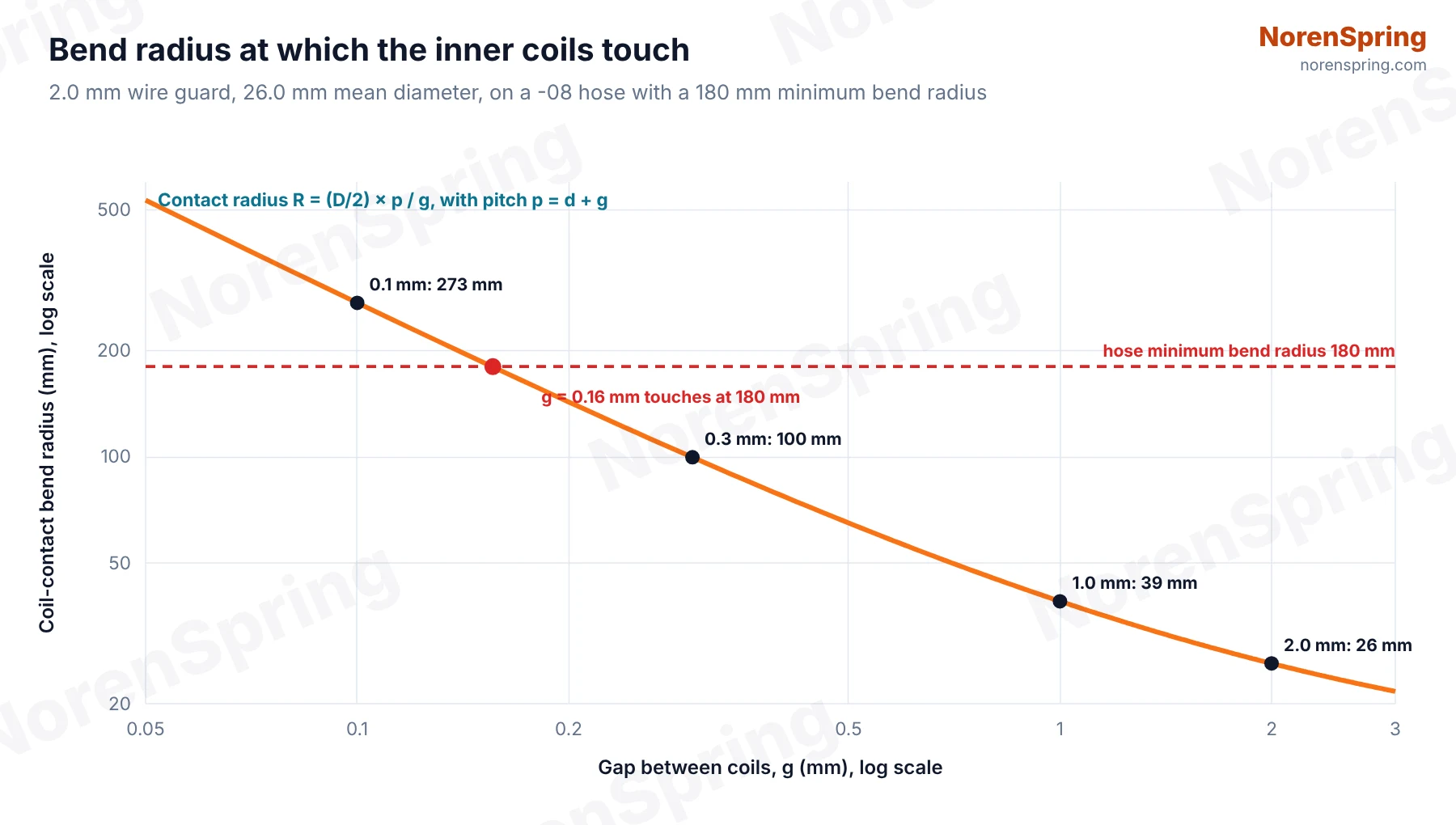
The result is clear. An open-pitch guard with a practical gap of 0.5 to 2 mm lets the hose bend far past its 180 mm limit before the coils touch, and holding a gap of 0.16 mm along a long guard is not realistic in production. A close-wound guard, on the other hand, starts to stiffen as soon as it bends; at the 180 mm minimum radius its outer coils open by only 0.31 mm, which still covers about 87 % of the hose on the outside of the bend. So where the real risk is a sharp bend at a fitting, specify a close-wound guard or a dedicated bend restrictor, and route the hose correctly in the first place. Where the risk is abrasion along a flexing run, an open pitch saves weight and lets grit fall through.
Material, finish and temperature
Most spring guards are plain carbon steel. Parker describes its pre-made guards as plated, hard-drawn steel wire [5], and Shigley’s lecture notes describe hard-drawn wire as the cheapest general-purpose spring steel, to be used only where life, accuracy and deflection are not too important [6]. That suits a guard, which carries no working load. Our article on oil-tempered vs hard-drawn spring wire compares the two common carbon wires.
| Material | Use | Notes |
|---|---|---|
| Hard-drawn carbon wire, zinc plated | General mobile and industrial hose | Lowest cost; plating sets corrosion life |
| Oil-tempered carbon wire | Heavier wire sizes, more crush resistance | Higher strength than hard-drawn |
| 302/304 stainless wire | Food plants, washdown, coastal equipment | No plating to wear off; slightly lower strength |
| Black oxide or coated carbon wire | Appearance, mild indoor service | Less corrosion protection than zinc |
Check the temperature rating of the whole assembly, not only of the hose. Parker, for example, lists a temperature range of 0 °F to +200 °F (−17 °C to 93 °C) for its spring guard [2]. For corrosive service, our stainless steel springs guide explains the grade choices, and our spring finishes guide compares zinc, black oxide and coatings.
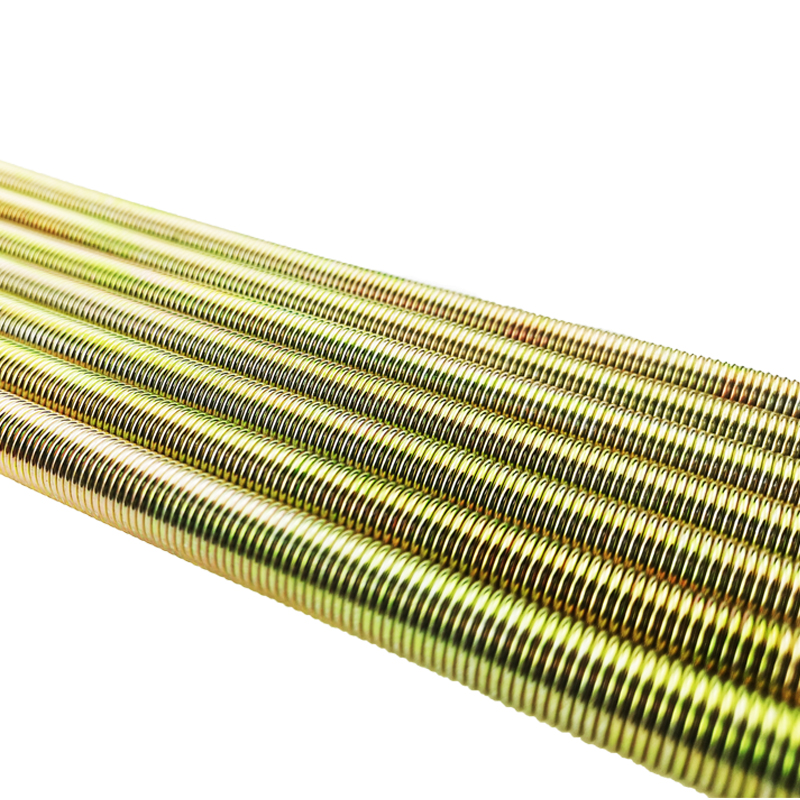
The photo shows long close-wound coil springs we make. We make compression springs and long close-wound coils in carbon and stainless wire with zinc or coated finishes, and our hydraulics industry page covers springs for hydraulic equipment. Brand names in this article identify the companies whose public documents we quote; NorenSpring is not affiliated with them.
How to fit a spring guard
The trade article notes that a metal spring guard needs to be fitted before the hose is assembled [1], because the fitting is larger than the guard’s bore. In practice:
- Cut the guard to length so it covers the abrasion zone and runs a short way past it at each end.
- Slide it onto the bare hose before crimping the fittings, or specify a pre-made guard with an end coil formed to grip the fitting.
- Keep the guard from migrating along the hose, for example with a reduced-diameter end coil, a clamp or the fitting socket itself.
- Inspect it at service intervals. A guard that has rusted through, opened up or slid away from the wear point no longer protects the hose.
What to specify for a hose spring guard
| Item | Example |
|---|---|
| Hose | -08 (1/2 in) EN 853 2SN, outside diameter 22.2 mm, minimum bend radius 180 mm |
| Inside diameter | 24.0 mm ± 0.3 mm |
| Wire | 2.0 mm hard-drawn carbon wire (ASTM A227), or 302 stainless |
| Pitch | Close-wound, or a stated gap such as 0.5 mm |
| Length | Cut lengths, for example 300 mm, or continuous coils |
| Ends | Square cut and deburred, or a reduced end coil to grip the fitting |
| Finish | Zinc plate with bake, yellow or clear passivate |
| Temperature and environment | For example, outdoor mobile equipment, −20 °C to 90 °C |
| Quantity and packing | Bundles of cut lengths or coils per carton |
Give the hose type and outside diameter, not only the dash size, because two hoses of the same dash size can differ by several millimetres outside. Send your drawing or sample through our contact page, and our engineers will review it and reply within 24 hours. You can read more about our company and its certifications. This guide was compiled by our editorial team with our spring engineers.
Frequently asked questions
What is a hose spring guard?
It is a coil of steel wire, usually plated, wound around a hydraulic hose to protect its cover from abrasion, cuts and kinking. Guards are sold by hose type and size, either as cut lengths or as long coils [3].
How do I size a spring guard for a hydraulic hose?
Start from the hose outside diameter and add a small diametral clearance. In our worked example, a 24.0 mm guard suits a 22.2 mm two-wire hose. Then choose the wire size for the crush and abrasion you expect, and the pitch for flexibility.
Does a spring guard protect against hose burst?
No. A spring guard protects the cover against abrasion, cuts and local kinking. It is not designed to contain a burst or a pin-hole leak, so it does not replace correct hose selection, routing and inspection.
Close-wound or open-pitch spring guard?
Close-wound guards give the most coverage and start to stiffen as soon as they bend, which helps near fittings. Open-pitch guards are lighter, more flexible and let dirt fall through, but in our example a 0.5 mm gap lets the hose bend down to 65 mm before the coils touch.
References
- Power & Motion, “Increase hose life and safety with proper protection”. https://www.powermotiontech.com/hydraulics/hose-tubing/article/21882981/increase-hose-life-and-safety-with-proper-protection
- Parker Hose Shield Spring Guard SG-084, distributor listing (Kundinger). https://shop.kundinger.com/spring-guard-sg-084.html
- Alfagomma steel protective coil springs SRS, R1S0033-0174 (Kuriyama of America). https://products.kuriyama.com/item/alfagomma-hydraulic-hose-fittings-hose-protectors/steel-protective-coil-springs-srs-1/r1s0033-0174
- Vincke, “Two wire braid hydraulic hose, DIN EN 853 2SN” datasheet (PDF). https://www.flowfitonline.com/uploads/PDFproducts/vincke-en-853-2sn.pdf
- Parker pre-made steel spring guards SSG, distributor listing (Kundinger). https://shop.kundinger.com/spec-spring-guards-55ssg-4.html
- Shigley’s Mechanical Engineering Design, Chapter 10 Mechanical Springs, lecture slides, Istanbul Technical University. https://web.itu.edu.tr/~halit/Makel/Ch_10_slides_m.pdf



