










In this article
- Key takeaways
- What is hard drawn spring wire (ASTM A227)?
- What is oil tempered spring wire (ASTM A229)?
- Oil tempered vs hard drawn: side-by-side comparison
- Tensile strength by wire diameter
- How much more load does oil tempered wire carry?
- When to choose hard drawn wire
- When to choose oil tempered wire
- How to specify the wire on your drawing
- Frequently asked questions
- About the authors
- Sources
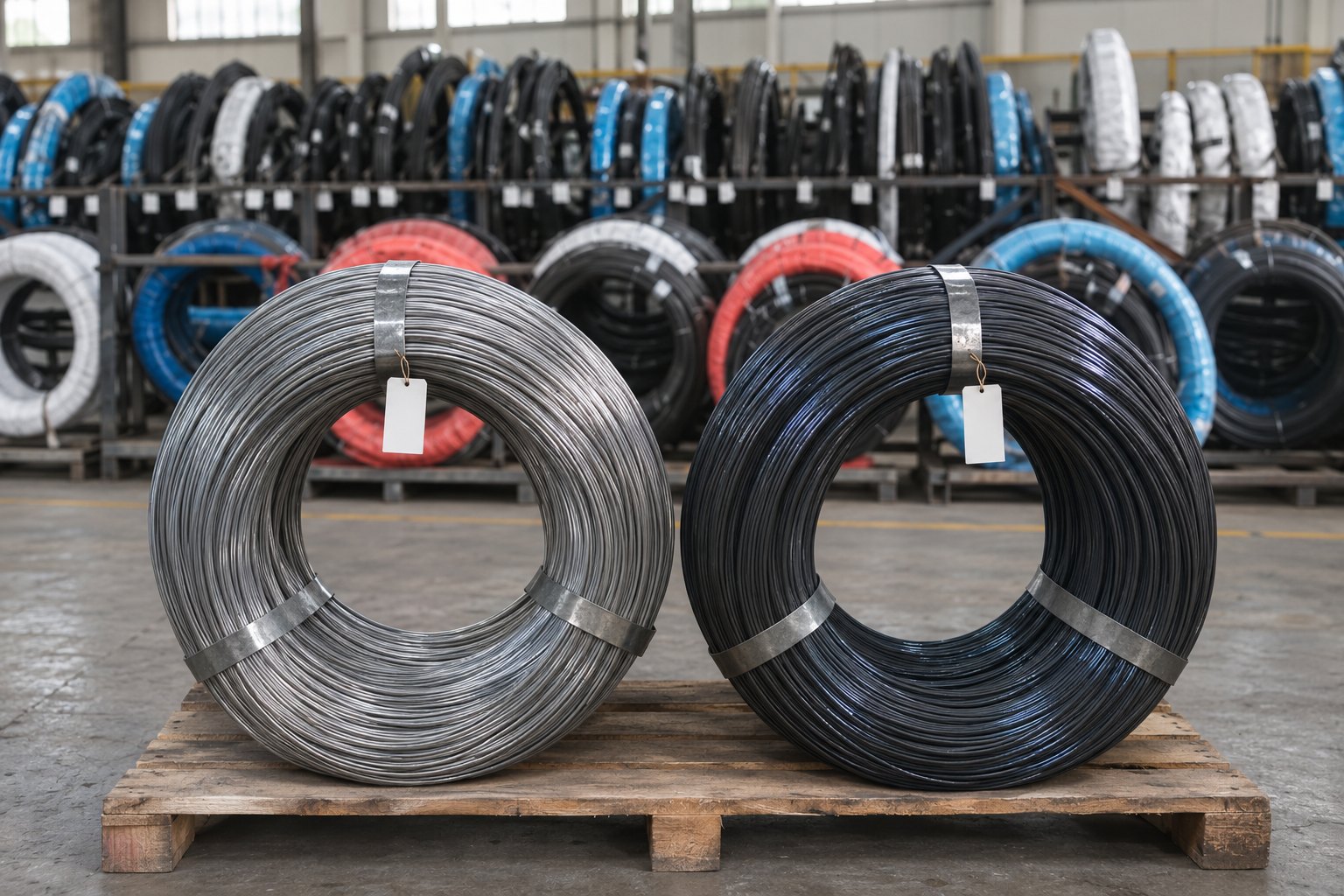
Cover image: an AI-generated illustration based on a photo of our wire store, not a photograph of a specific wire batch.
The choice between oil tempered and hard drawn spring wire comes down to how the strength is made. Hard drawn spring wire is carbon steel wire (ASTM A227) that gets its strength from cold drawing alone. Oil tempered spring wire is carbon steel wire (ASTM A229) that is quenched and tempered before coiling, which gives a slightly higher and more uniform strength [1]. Both are medium to high carbon steels, both are rated to about 121 °C (250 °F), and hard drawn is the cheaper of the two [2].
This guide compares the two grades side by side, shows how their strength changes with wire size, calculates how much load the same spring carries in each wire, and explains when each one is the right choice.
Key takeaways
- Process, not chemistry, is the main difference. A227 is cold drawn; A229 is oil quenched and tempered. Their carbon ranges overlap: 0.45–0.85% for A227 and 0.55–0.85% for A229 [2].
- A229 is a little stronger. At the same diameter, A229 Class I minimum tensile strength is about 2–12% higher than A227 Class I in the published tables [3] [4].
- It is also allowed a higher working stress. One spring maker’s design table allows 45% of minimum tensile for A229 against 40% for A227 [5]. Together, the same spring carries about 14–21% more static load in A229 in our worked example.
- Hard drawn is for low-cost, low-stress springs. Use it where life, accuracy and deflection are not critical [1].
- Oil tempered is the usual choice for larger wire. It is often used in sizes where music wire is not available [2].
What is hard drawn spring wire (ASTM A227)?
Hard drawn spring wire is a medium-carbon steel wire that is drawn cold through a series of dies until it reaches the required size and strength. Nothing is done to it after drawing except, later, a low-temperature stress relief once the spring is coiled. Lee Spring describes it as a general purpose wire “for low to average stress applications” [2], and course notes based on Shigley’s design textbook call it the “cheapest general-purpose” spring wire [1].
ASTM A227 has two strength classes. Class I is the common one; Class II has a higher tensile range. Typical chemistry is 0.45–0.85% carbon and 0.30–1.30% manganese, and Gibbs supplies it from 0.20 mm to 9.5 mm (0.008–0.375 in) [4]. In Japanese specifications the matching standard is JIS G3521: Gibbs cross-references A227 Class I to grade SW-B [6], and the standard also has a lower SW-A and a higher SW-C grade [8].
What is oil tempered spring wire (ASTM A229)?
Oil tempered wire is drawn to size first, then hardened by heating and quenching in oil, and tempered, all before it reaches the spring maker. Because it is already heat treated, the coiler only needs a stress relief after forming. Gibbs places it “between hard drawn spring wire and music wire” and notes that a low temperature stress relief is required after processing [3].
ASTM A229 also has Class I and Class II. Chemistry is 0.55–0.85% carbon and 0.30–1.20% manganese, and Gibbs supplies Class I from 0.58 mm to 15.9 mm (0.023–0.625 in) [3]. The Japanese equivalents are SWO-A (Class I) and SWO-B (Class II) to JIS G3560, and the European family is EN 10270-2 [6].
Oil tempered vs hard drawn: side-by-side comparison
| Property | Hard drawn, ASTM A227 | Oil tempered, ASTM A229 |
|---|---|---|
| How strength is made | Cold drawing only | Drawn, then oil quenched and tempered |
| Carbon (wt %) | 0.45–0.85 | 0.55–0.85 |
| Manganese (wt %) | 0.30–1.30 | 0.30–1.20 |
| Minimum tensile, Class I | 1,014–1,951 MPa | 1,138–2,020 MPa |
| Minimum tensile, Class II | 1,179–2,234 MPa | 1,317–2,234 MPa |
| Design stress, % of min tensile | 40% | 45% |
| Hardness | HRC 31–52 | HRC 42–55 |
| E / G | 207 / 79.3 GPa | 207 / 79.3 GPa |
| Max operating temperature | 121 °C (250 °F) | 121 °C (250 °F) |
| Japanese equivalent | JIS G3521 SW-B, SW-C | JIS G3560 SWO-A, SWO-B |
| Typical use | Low-cost, low to average stress springs | General purpose and larger wire springs |
Sources: Master Spring material table for tensile, design stress, hardness, moduli and temperature [5]; Lee Spring for chemistry [2]; Gibbs cross-reference for JIS grades [6]. Manganese ranges differ slightly between sources, so check the mill certificate.
Two rows in that table matter most. The stiffness, E and G, is the same, so a spring has the same rate in either wire. And both wires are limited to about 121 °C. If the spring runs hotter, neither is right; see our guide to high temperature springs.
Tensile strength by wire diameter
Both wires get weaker as they get thicker, because thin wire receives more cold work. We converted the Gibbs tables for A227 Class I and A229 Class I and II from inches and psi to millimetres and MPa [4] [3] [7]:
| Wire diameter | A227 Class I min | A229 Class I min | A229 Class II min |
|---|---|---|---|
| 0.81 mm (0.032 in) | 1,834 MPa | 1,931 MPa | 2,144 MPa |
| 1.57 mm (0.062 in) | 1,634 MPa | 1,703 MPa | 1,917 MPa |
| 3.05 mm (0.120 in) | 1,448 MPa | 1,517 MPa | 1,731 MPa |
| 6.35 mm (0.250 in) | 1,255 MPa | 1,276 MPa | 1,455 MPa |
| 9.52 mm (0.375 in) | 1,151 MPa | 1,241 MPa | 1,420 MPa |
| 15.88 mm (0.625 in) | 1,014 MPa | 1,138 MPa | 1,317 MPa |
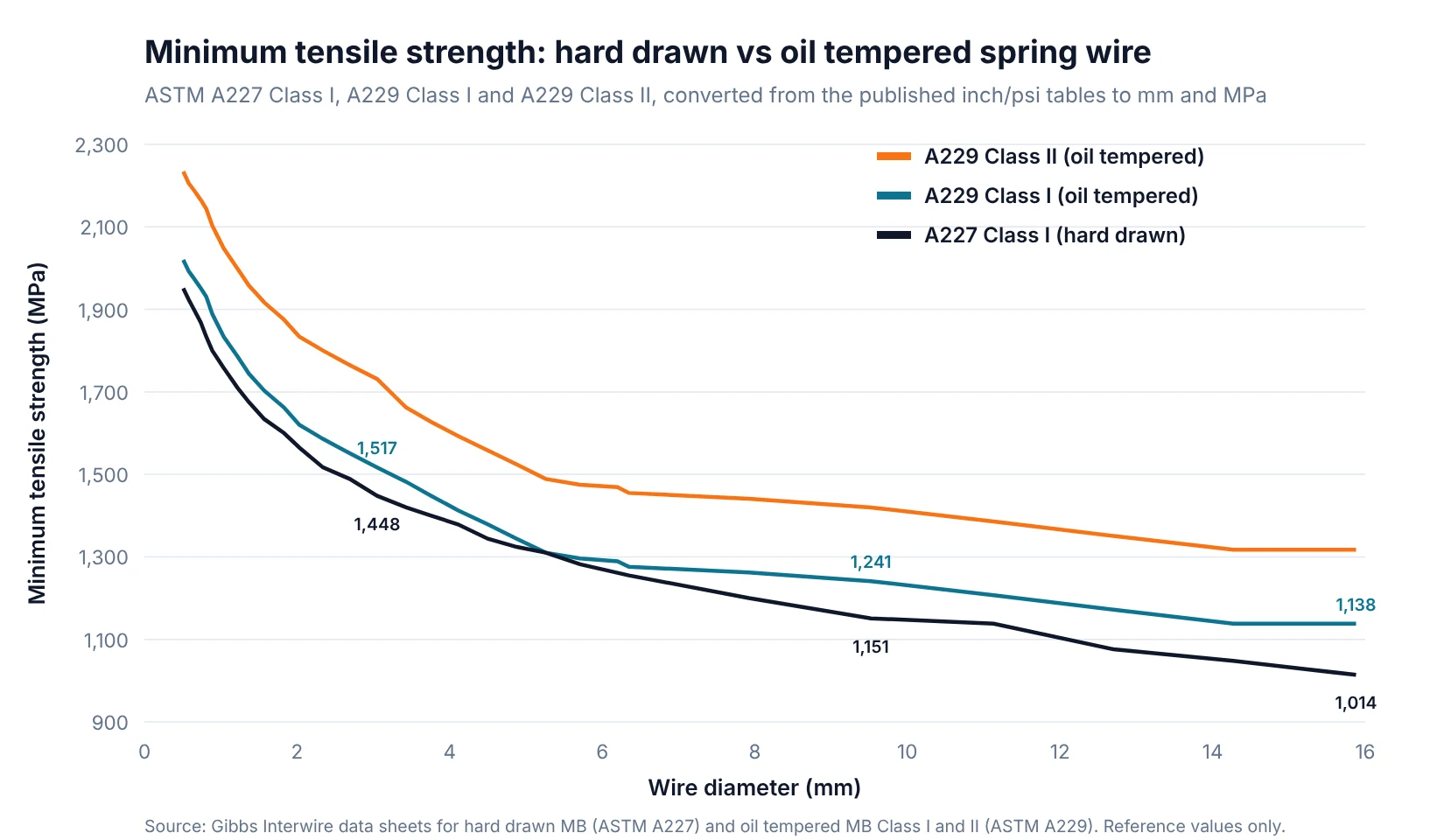
The chart shows a detail that the headline comparison hides. Between about 4 and 6 mm, the two Class I wires are almost equal, within about 3% in the Gibbs tables [4] [3]. Above 9 mm, oil tempered wire keeps more of its strength, which is one reason it is preferred for heavy springs.
How much more load does oil tempered wire carry?
Tensile strength alone understates the difference, because spring makers also allow a higher fraction of it for oil tempered wire. To put a number on it, we calculated the maximum static load of the same compression spring in both wires. We used a spring index C = D/d of 8, the minimum tensile strengths above, a design stress of 40% of minimum tensile for A227 and 45% for A229 [5], the Wahl correction factor and the standard formula F = τπd³ / (8DK).
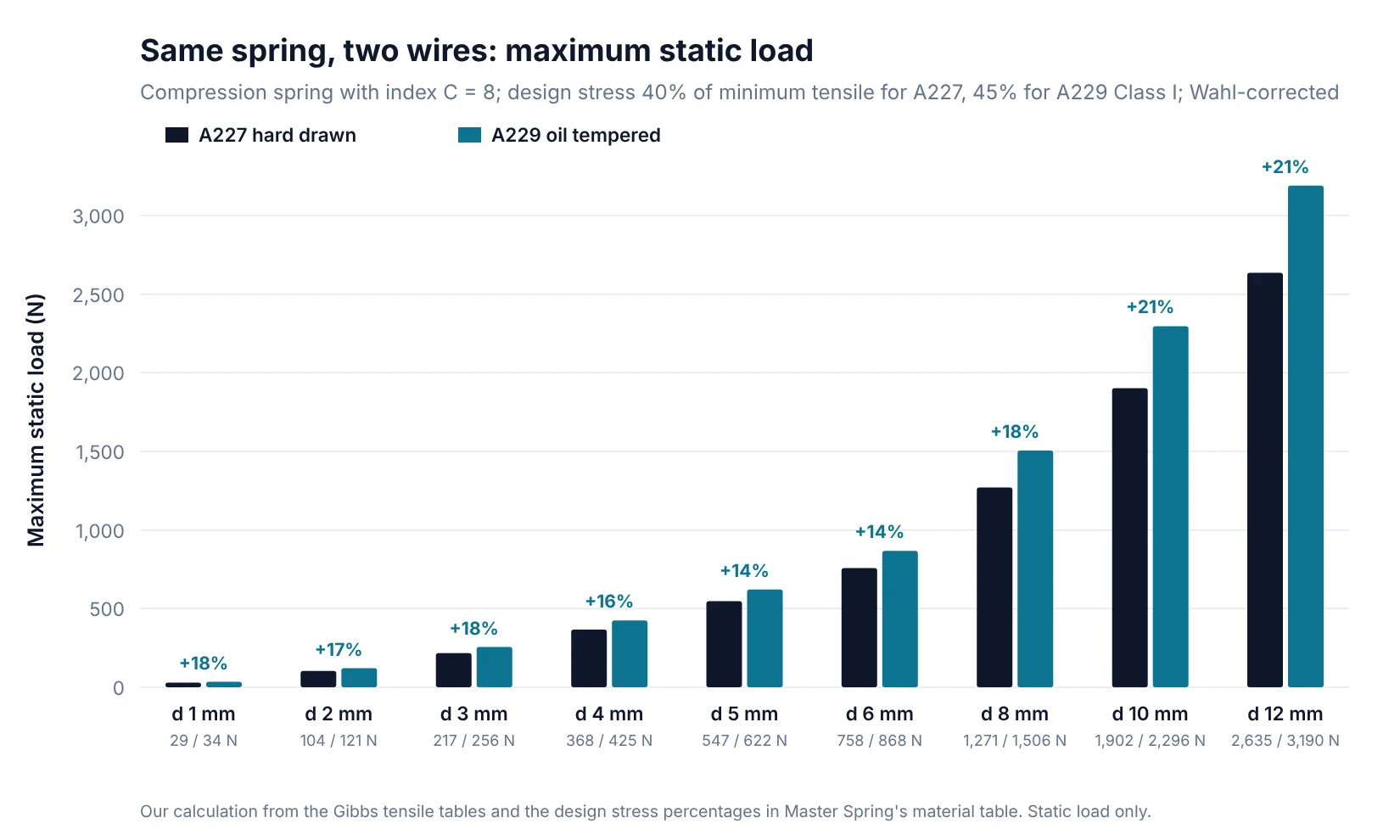
For example, a spring with 3 mm wire and a 24 mm mean diameter can carry about 217 N in hard drawn wire and 256 N in oil tempered wire, 18% more, using the Gibbs tensile tables and the Master Spring design stresses [5]. With 10 mm wire and an 80 mm mean diameter, the figures are about 1,900 N and 2,300 N, 21% more. The spring rate is identical in both cases, so the oil tempered spring can be compressed further before it reaches its stress limit.
These are static limits for a spring that is loaded occasionally. For springs that cycle many times, the allowable stress is lower for both wires, and the surface quality of the wire matters more than its tensile strength. Our compression spring design guide walks through the full calculation.
When to choose hard drawn wire
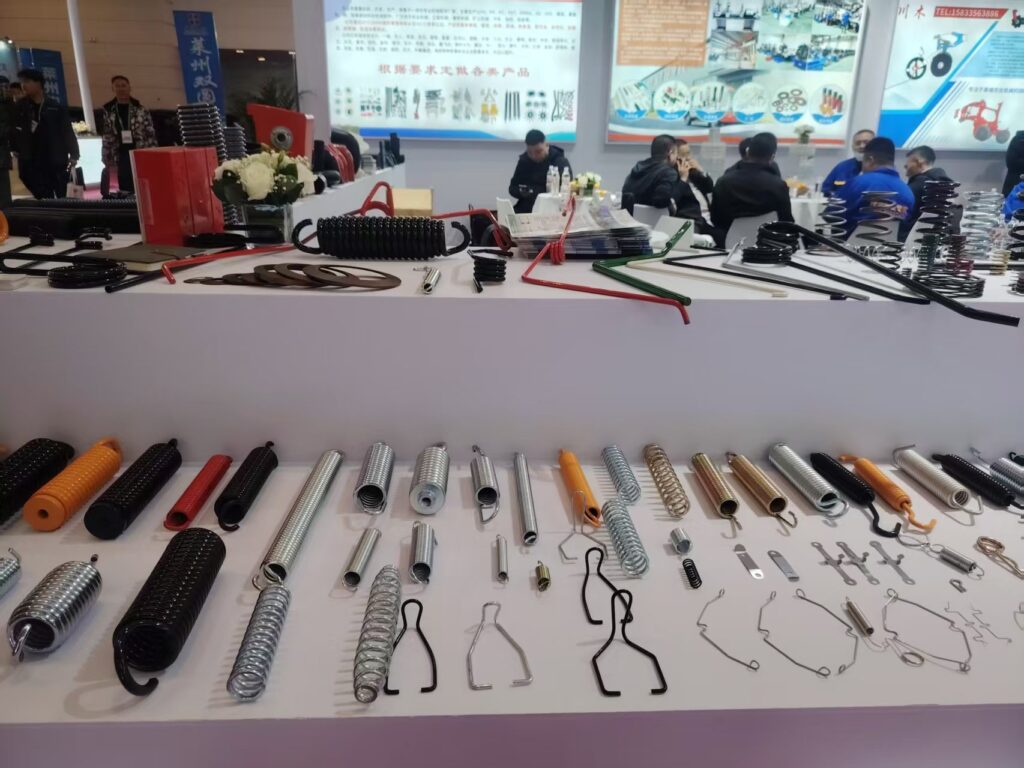
Hard drawn wire is the right buy when the spring is cheap, lightly stressed and not safety critical. The ITU course notes put it plainly: use it “only where life, accuracy, and deflection are not too important” [1]. Typical examples include:
- Extension springs for doors, gates, seats and light implements.
- Pedal and return springs with low cycle counts.
- Wire forms, clips and retaining springs where the shape matters more than the stress.
In our own production, hard drawn wire to JIS G3521 grade SW-C is listed on five of the 36 parts in our customer case list, mostly extension and pedal springs: agricultural extension springs, tractor brake and accelerator pedal springs, a motorcycle side stand spring and general metal extension springs. All of them are zinc plated (one also in nickel), and wire sizes range from 1 to 8 mm.
When to choose oil tempered wire
Oil tempered wire is the better choice when the spring is more highly stressed, uses wire above about 6 mm, or needs more consistent properties from batch to batch. The heat treatment at the wire mill gives “greater strength and uniformity of properties” [1], and Lee Spring notes that it is often used for larger wire sizes when music wire is not available [2].
Typical examples include heavier compression springs, machinery and agricultural springs with larger wire, and springs that must hold their load tolerance closely. For small, highly stressed springs, music wire is usually stronger still. For springs that run warm or take shock loads, an oil tempered alloy wire such as chrome silicon or chrome vanadium is the next step up.
Oil tempered wire has one practical drawback: because it is already hardened, it is less forgiving of tight bends. Gibbs describes it as “excellent for springs without severe bends” [3]. Hooks with very small radii and complex wire forms are often easier in hard drawn wire.
How to specify the wire on your drawing
A drawing that only says “spring steel” leaves the wire choice open. To get the spring you expect, state:
- Wire standard and class: for example ASTM A229 Class I, or JIS G3560 SWO-A, and whether an equivalent is acceptable.
- Wire diameter and tolerance.
- Loads: force at one or two working lengths, with tolerances.
- Duty: static or cyclic, and the target number of cycles.
- Temperature: if it can exceed about 100 °C, discuss an alloy wire instead.
- Finish: zinc plating, phosphate, black oxide or powder coating. Our spring finishes guide compares them.
Our spring wire material guide covers the alloy and stainless grades as well. We make compression, extension and torsion springs and wire forms in hard drawn, oil tempered and alloy wire to drawing, and can review a drawing and suggest the most economical wire for the load. Send it through our contact page.
Frequently asked questions
What is the difference between oil tempered and hard drawn spring wire?
Hard drawn wire (ASTM A227) gets its strength from cold drawing only. Oil tempered wire (ASTM A229) is drawn and then oil quenched and tempered at the mill. Oil tempered wire has a slightly higher tensile strength, more uniform properties and a higher allowable design stress, while hard drawn wire is cheaper.
Is oil tempered wire stronger than music wire?
No. Music wire (ASTM A228) has a higher minimum tensile range, 1,586–2,751 MPa, against 1,138–2,020 MPa for A229 Class I [5]. Oil tempered wire is mainly used in larger sizes, where music wire is less available.
What is the JIS equivalent of ASTM A227 and A229?
ASTM A227 hard drawn wire corresponds to JIS G3521, with Class I usually matched to grade SW-B; the standard also has SW-A and SW-C [8]. ASTM A229 oil tempered wire corresponds to JIS G3560 SWO-A for Class I and SWO-B for Class II [6].
Can hard drawn or oil tempered springs be used at high temperature?
Only up to about 121 °C (250 °F) for both [2]. Above that they lose load quickly. Chrome vanadium is rated to about 218 °C and chrome silicon to about 246 °C, and stainless or nickel alloys go higher.
Why do my oil tempered springs need a stress relief?
Coiling puts residual stress into the wire. A low-temperature stress relief after coiling removes much of it and stabilises the free length and load. Gibbs states that oil tempered wire requires a low temperature stress relief after processing [3]. Hard drawn springs are normally stress relieved too.
About the authors
This guide was prepared by the NorenSpring engineering team, which designs and manufactures custom compression, extension and torsion springs and wire forms in Xuzhou, China, since 2001. Technical content reviewed by Feng Yulin, General Manager and senior structural engineer, who has 15 years of spring R&D experience and more than 30 national patents. Our certificates are shown on our about page. Sources were last checked on November 7, 2026.
Sources
- Istanbul Technical University, Mechanical Springs lecture slides based on Shigley’s Mechanical Engineering Design, chapter 10 (spring wire materials). itu.edu.tr. Retrieved 2026-11-07.
- Lee Spring, Spring Materials table: chemistry, minimum tensile strength and maximum operating temperature of spring wires. leespring.com. Retrieved 2026-11-07.
- Gibbs Interwire, Oil Tempered MB Spring Wire Class I data sheet (ASTM A229). gibbswire.com. Retrieved 2026-11-07.
- Gibbs Interwire, Hard Drawn MB Spring Wire Class I data sheet (ASTM A227). gibbswire.com. Retrieved 2026-11-07.
- Master Spring and Wire Form Co., Properties of Materials (design stress, moduli, hardness and temperature by wire grade). masterspring.com. Retrieved 2026-11-07.
- Gibbs Interwire, Specification Cross Reference (ASTM, EN, JIS and DIN equivalents). gibbswire.com. Retrieved 2026-11-07.
- Gibbs Interwire, Oil Tempered MB Spring Wire Class II data sheet (ASTM A229). gibbswire.com. Retrieved 2026-11-07.
- Toho International, Hard Drawn Wire product page (JIS G3521 SW-A, SW-B and SW-C). toho-intl.co.jp. Retrieved 2026-11-07.



