










In this article
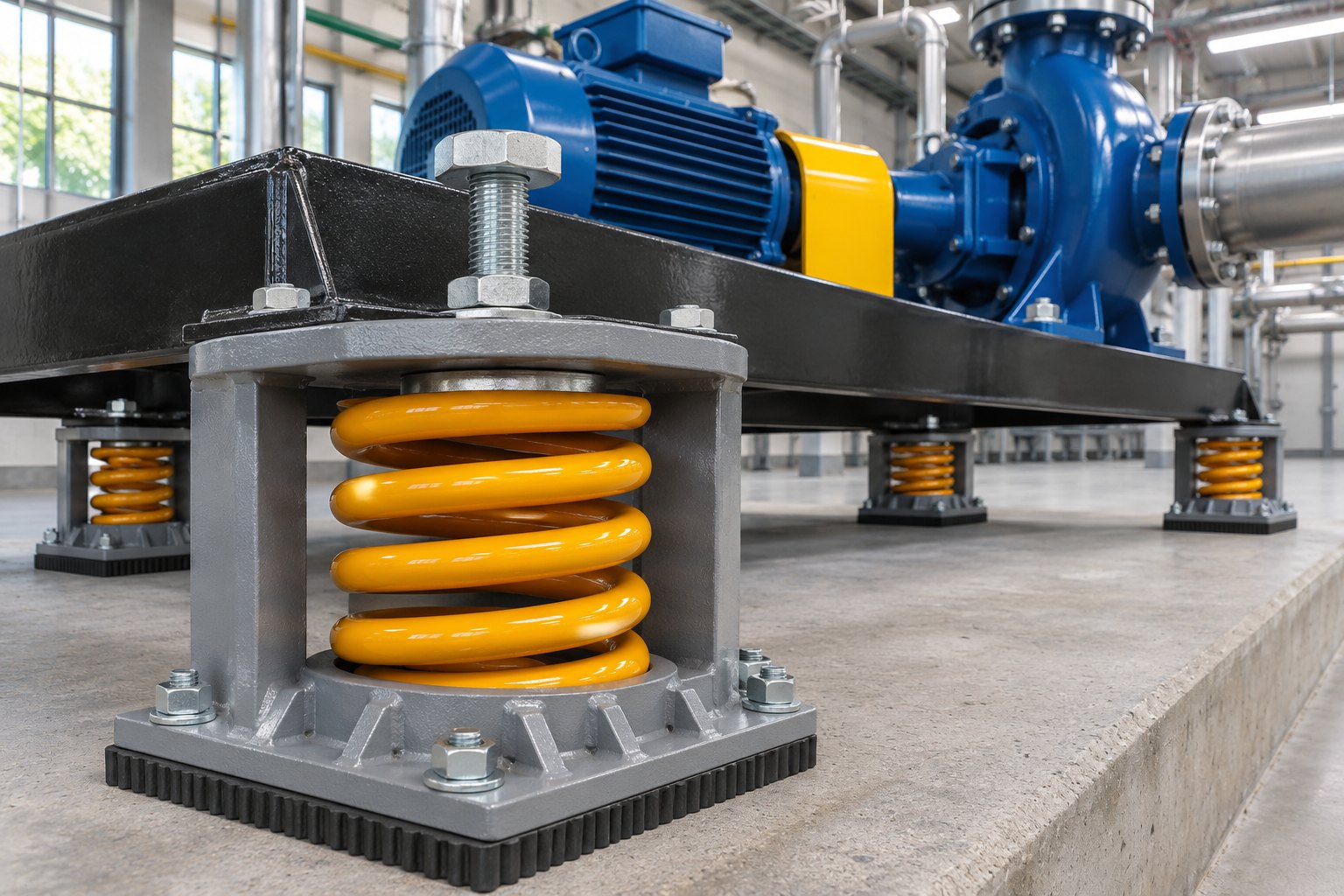
Cover image: an AI-generated illustration of a generic housed spring isolator, based on photos of compression springs we make; it does not show a specific product.
Spring isolators are vibration mounts that carry a machine on steel coil springs, so that the vibration of the machine does not pass into the floor, roof or structure below it. They sit under fans, pumps, chillers, compressors, generators and vibrating screens, or hang from the ceiling to carry ducts and pipes. Wikipedia describes mechanical springs and spring-dampers as heavy-duty isolators used for building systems and industry [1]. The housing, base plate and levelling bolt vary from one design to another, but the part that does the isolating is the coil spring inside.
This guide is for isolator manufacturers, HVAC equipment builders and machine makers who buy the springs for their mounts. It explains how a spring isolator works, why static deflection is the number that sets its performance, a worked design for a 25 mm (1 inch) deflection isolator spring, and the stability and travel-to-solid rules that building specifications put on the spring. For the frequency maths behind isolation, see our guide to spring natural frequency.
Key takeaways
- Static deflection sets the isolation. The natural frequency of a machine on steel springs is about 15.8 / √δ hertz, with the static deflection δ in millimetres. More deflection means a lower natural frequency and better isolation.
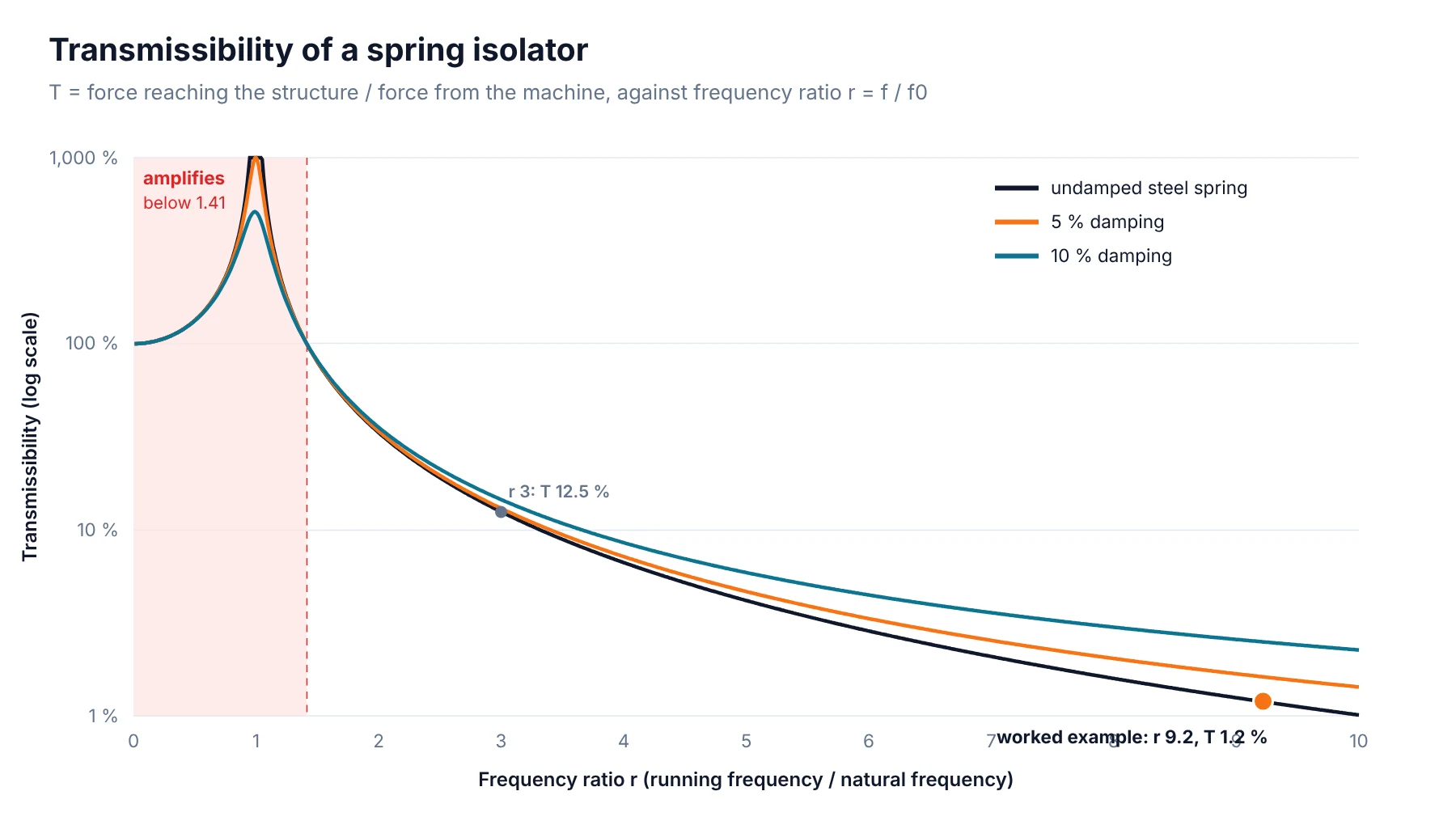
- Isolation only starts above 1.41 times the natural frequency. Below that ratio the springs amplify vibration instead of reducing it.
- In our worked example, a 25 mm spring gives 98.8 % isolation for a pump running at 1,750 rpm (29.2 Hz), because the natural frequency is only 3.17 Hz.
- Specifications control the shape of the spring, not only the rate. Typical rules are an outside diameter of at least 0.8 of the loaded height, lateral stiffness above 0.8 of vertical stiffness, and an extra 50 % of travel before the spring goes solid.
- The stress at solid is the check people forget. A spring with 50 % reserve travel must survive being pushed solid, so its stress at solid height decides the wire size.
How a spring isolator works
A machine sitting on springs behaves like a mass on a spring. Natural frequency is the frequency at which that mass bounces freely on the springs, f₀ = (1/2π)√(k/m). Wikipedia describes a passive isolator as a mechanical low-pass filter: below the natural frequency vibration passes straight through, at the natural frequency it is amplified, and above it little energy is transmitted [1]. For any frequency above the natural frequency, an isolator with a lower natural frequency gives more isolation [1].
Transmissibility is the ratio of the force that reaches the structure to the force the machine produces. For an undamped spring mount, T = 1 / (r² − 1), where r is the ratio of the forcing frequency to the natural frequency. When r is below √2 (about 1.41), T is greater than 1 and the mount makes things worse. When r is 3, T is 12.5 % and the isolation is 87.5 %. When r is 10, the isolation is 99 %.
The useful shortcut is static deflection. Because k = W/δ and m = W/g for a machine of weight W, the natural frequency depends only on how far the springs compress under the weight:
f₀ = (1/2π)√(g/δ) ≈ 15.76 / √δ (hertz, δ in millimetres)
| Static deflection | Natural frequency | Lowest speed for 90 % isolation |
|---|---|---|
| 6 mm (0.25 in) | 6.43 Hz | 1,280 rpm |
| 12 mm (0.5 in) | 4.55 Hz | 906 rpm |
| 25 mm (1 in) | 3.15 Hz | 627 rpm |
| 51 mm (2 in) | 2.21 Hz | 439 rpm |
| 76 mm (3 in) | 1.81 Hz | 360 rpm |
| 102 mm (4 in) | 1.56 Hz | 310 rpm |
Ninety percent isolation needs r = √11, about 3.32, so the lowest speed in the last column is 3.32 × f₀ × 60. That is why rubber pads, which give only a few millimetres of deflection, work for fast machines on solid ground floors, while slow fans and machines on long-span floors need springs with 25, 51 or even 102 mm of deflection.
We analyzed the isolation at common running speeds for each deflection class with the undamped formula. Isolation in percent (a dash means the mount amplifies):
| Running speed | 6 mm | 12 mm | 25 mm | 51 mm | 76 mm |
|---|---|---|---|---|---|
| 600 rpm (10 Hz) | 29.4 | 73.9 | 89.0 | 94.9 | 96.6 |
| 900 rpm (15 Hz) | 77.5 | 89.9 | 95.4 | 97.8 | 98.5 |
| 1,200 rpm (20 Hz) | 88.5 | 94.5 | 97.5 | 98.8 | 99.2 |
| 1,750 rpm (29.2 Hz) | 94.9 | 97.5 | 98.8 | 99.4 | 99.6 |
| 3,600 rpm (60 Hz) | 98.8 | 99.4 | 99.7 | 99.9 | 99.9 |
The numbers look close together at high speed, but every halving of transmissibility halves the force that reaches a light floor. On a stiff ground-floor slab, 95 % may be enough. On a roof or a long upper-floor span, the floor itself is springy and the isolator needs much more deflection than the floor. That choice belongs to the acoustic or structural engineer. A U.S. Department of Veterans Affairs specification, for example, tells designers to take the isolator type and minimum static deflection from the ASHRAE Handbook selection guide for each equipment application [2].
What specifications ask of the spring
Building specifications rarely give a spring rate. They give a deflection, and then rules on the spring’s proportions and reserve travel. Two published examples:
| Requirement | VA 23 05 41, open spring isolator (Type S) | Northwestern University 23 05 50 |
|---|---|---|
| Spring diameter | At least 1.0 × operating height (Type S); at least 0.8 × compressed height for restrained mounts and hangers | Outside diameter at least 80 % of compressed height at rated load |
| Lateral stiffness | Free-standing and laterally stable | More than 0.8 × rated vertical stiffness |
| Reserve travel | Additional travel to solid of 50 % of rated deflection | 50 % overload capacity before solid; spring safe at solid |
| Finish | Powder coated or electro-galvanized | Powder coated, salt spray tested to ASTM B117 |
| Identification | Colour coded by type and size | Colour coded or marked for load capacity |
Sources: VA specification section 23 05 41 [2] and Northwestern University design guideline 23 05 50 [3].
Each rule protects against a different failure:
- Diameter-to-height ratio keeps the spring short and wide, so it cannot buckle and the machine does not rock sideways on it. A tall, thin spring can carry the vertical load but will lean or buckle when the machine starts, stops or is pushed by wind.
- Lateral stiffness of at least 0.8 of the vertical stiffness keeps the natural frequency of rocking and sideways motion close to the vertical one, so the mount isolates in all directions.
- 50 % reserve travel means the spring will not go solid if the load is heavier than expected or the machine lifts and bounces at start-up.
- Safe at solid means the spring must not take a permanent set even when it is pushed all the way down.
Worked example: a 25 mm deflection isolator spring
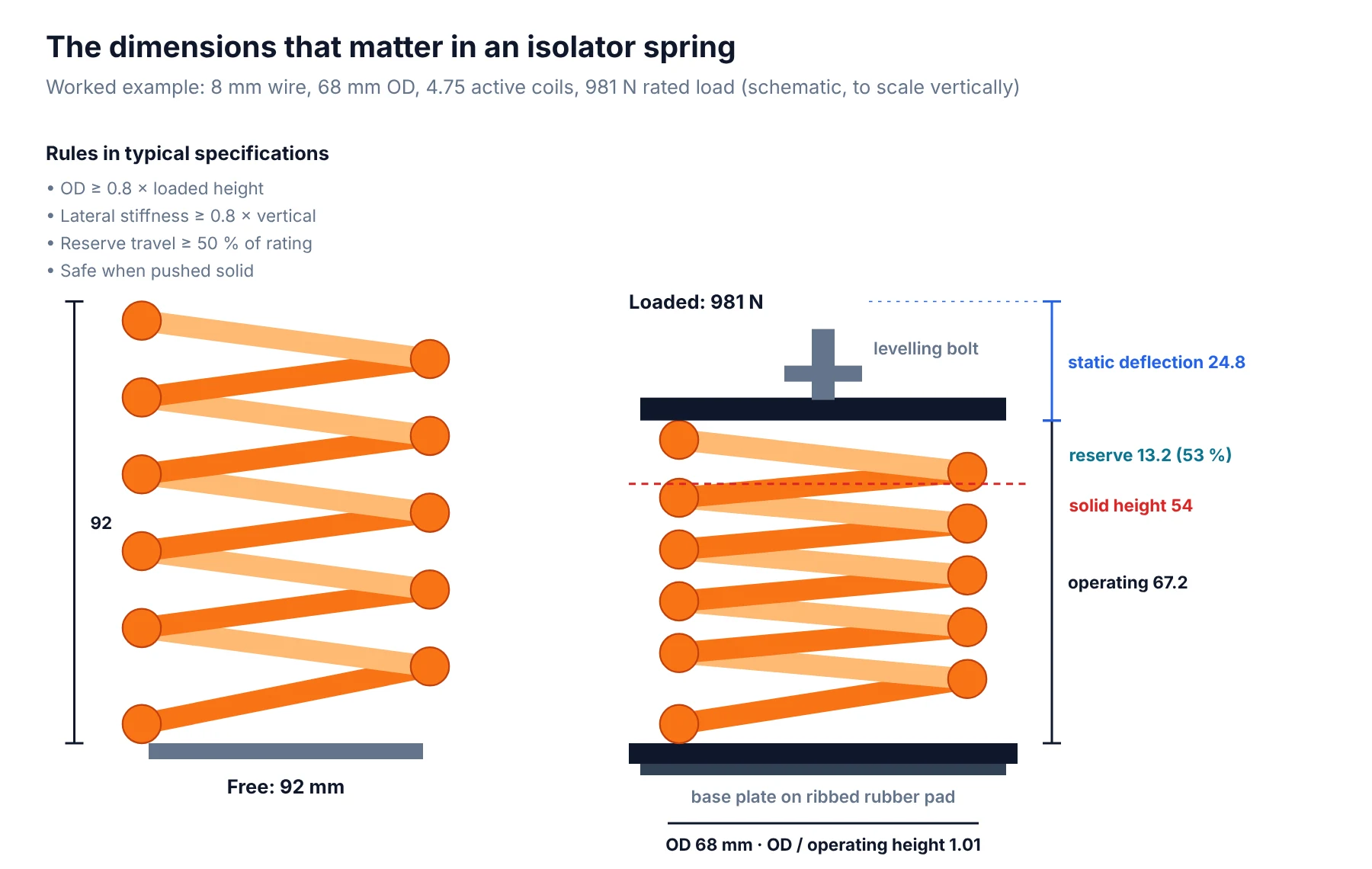
The example is a 400 kg pump set on four open spring isolators, running at 1,750 rpm. The load is assumed to be shared equally, which gives 981 N per mount. The target is a 25 mm (1 inch) static deflection. We designed the spring with the standard helical spring equations from Shigley, using G = 79.3 GPa for oil-tempered carbon spring wire [4]. These are our own example numbers, not a catalogue rating.
| Parameter | Value |
|---|---|
| Load per mount | 981 N (100 kg) |
| Wire | 8 mm oil-tempered carbon wire (ASTM A229) |
| Mean coil diameter | 60 mm (outside diameter 68 mm, spring index 7.5) |
| Active coils | 4.75, closed and ground ends, 6.75 total |
| Spring rate | 39.6 N/mm |
| Static deflection | 24.8 mm |
| Free height | 92 mm |
| Operating height | 67.2 mm |
| Solid height | 54 mm |
| Reserve travel to solid | 13.2 mm, 53 % of the static deflection |
| Natural frequency | 3.17 Hz (190 rpm) |
| Frequency ratio at 1,750 rpm | 9.2 |
| Transmissibility | 1.2 %, so 98.8 % isolation |
The spring rate comes from k = G·d⁴ / (8·D³·Nₐ) [4]. The outside diameter is 68 mm and the operating height is 67.2 mm, so the diameter-to-height ratio is 1.01. That meets the 0.8 rule for restrained mounts and hangers and, measured on the outside diameter, the 1.0 rule for a free-standing VA Type S mount. The free height is only 1.53 times the mean diameter, far below the slenderness at which a compression spring with parallel ends can buckle, as our compression spring buckling guide explains.
Stresses at load and at solid
At the 981 N working load, the Wahl-corrected shear stress is 351 MPa, which is 0.28 of the minimum tensile strength of 8 mm A229 wire (about 1,257 MPa from Shigley’s strength equation [4]). If the spring is pushed solid, the force is 1,504 N and the stress rises to 537 MPa, or 0.43 of tensile strength. A common textbook limit for oil-tempered carbon wire at solid is around 45 to 50 % of tensile strength without set removal, so this spring is safe at solid.
Comparing spring choices for the same mount
The same 981 N load and roughly 25 mm deflection can be met with different wire and coil sizes. We compared four options, each given the 50 % reserve travel:
| Option | Rate | Deflection | Free / operating height | OD / operating height | Stress at solid / tensile | Result |
|---|---|---|---|---|---|---|
| 8 mm wire, D 60 mm, 4.75 coils (example) | 39.6 N/mm | 24.8 mm | 92 / 67.2 mm | 1.01 | 0.43 | Passes both rules |
| 8 mm wire, D 64 mm, 3.9 coils | 39.7 N/mm | 24.7 mm | 85 / 60.3 mm | 1.19 | 0.45 | Passes, at the stress limit |
| 9 mm wire, D 70 mm, 4.5 coils | 42.1 N/mm | 23.3 mm | 94 / 70.7 mm | 1.12 | 0.35 | Passes, lowest stress, heavier |
| 7 mm wire, D 52 mm, 6 coils | 28.2 N/mm | 34.8 mm | 109 / 74.2 mm | 0.79 | 0.54 | Fails diameter and solid stress |
The last option is a useful warning. It gives more deflection and better isolation on paper, but it is too slender for the 0.8 diameter rule and too highly stressed to be safe at solid. In practice, isolator makers offer springs in deflection classes, such as 1, 2 and 3 inch, with several load ratings in each class. Both specifications ask for every spring to be colour coded or marked for its capacity [2][3].
Uneven loads, start-up and damping
Few machines put the same weight on every mount. If one corner of the pump set carries 30 % more than the others, the same spring would deflect 32 mm at that corner and the base would sit out of level. The VA specification asks for isolators selected and located to give uniform loading and deflection even when the weight is not evenly distributed [2]. That usually means a stiffer spring under the heavy corner, which is one reason isolator ranges have many load ratings in each deflection class.
Resonance at start-up is the other weak point. A pump that runs at 1,750 rpm passes through the 190 rpm natural frequency every time it starts and stops. Steel springs have very little damping, so the machine can rock briefly as it passes through. Restrained isolators with limit stops, snubbers and flexible pipe connectors keep that movement under control, and the specifications above list them for seismic areas and for wind on roofs [2]. Damping is also discussed in our spring natural frequency guide.
A steel spring transmits high-frequency noise along the wire better than it blocks it, so most open spring isolators stand on a ribbed rubber or neoprene pad. The VA specification calls these acoustical friction pads [2]. The spring handles the low-frequency vibration and the pad handles the high-frequency noise.
Spring surge in isolator springs
Spring surge is the natural frequency of the coils themselves, as opposed to the mass bouncing on the spring. If the running speed or a blade-pass frequency matches it, the coils vibrate between the ends and pass vibration straight through. Short, heavy isolator springs usually have surge frequencies of tens to hundreds of hertz, but fans with many blades and high-speed equipment can reach that range. Our spring natural frequency guide shows how to calculate the surge frequency and how much margin to leave.
Materials and finishes
Isolator springs are usually made from oil-tempered carbon or alloy spring wire, with closed and ground ends so they stand square on the base plate. Bigger isolators use thick wire, and hot-coiled springs take over at the largest sizes, as our guide to heavy duty compression springs explains. For outdoor and rooftop mounts, both specifications call for powder coating, and the VA specification also allows electro-galvanizing [2][3]. Plated high-strength springs need baking after plating to reduce the risk of hydrogen embrittlement, which our spring finishes guide covers.
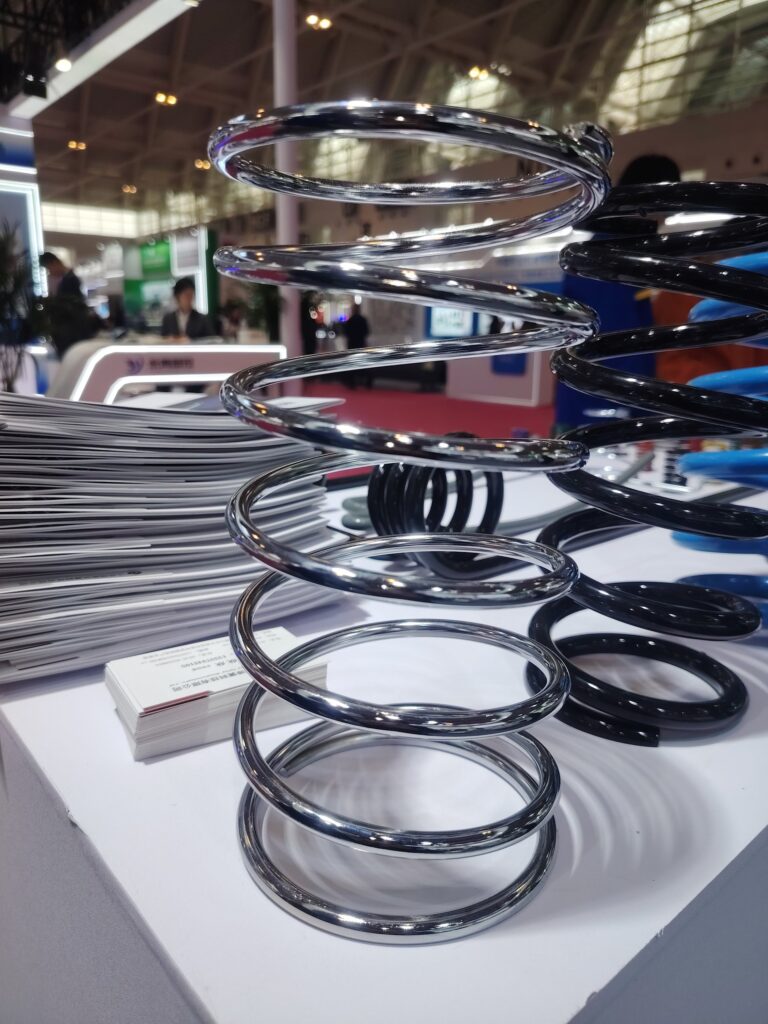
The photo shows large compression springs we make. We make compression springs from 0.1 mm to 80 mm wire and supply the spring element to the mount maker; we do not make the isolator housings. For vibrating screens, see our vibrator springs, which isolate the screen deck from its frame.
What to send for an isolator spring quote
| Item | Example |
|---|---|
| Rated load per spring | 981 N (100 kg) |
| Rated static deflection | 25 mm (1 in) |
| Reserve travel to solid | 50 % of rated deflection |
| Maximum outside diameter and free height | 68 mm OD, 92 mm free height |
| Minimum OD to operating height ratio | 0.8 or 1.0, as your specification requires |
| Lateral stiffness requirement | At least 0.8 × vertical stiffness |
| End type and squareness | Closed and ground, squareness to your drawing |
| Material | Oil-tempered carbon or alloy spring wire |
| Finish and colour code | Powder coat in your colour code, or zinc plating with baking |
| Load test | Force at operating height and at solid on each batch |
| Quantity and packing | Per isolator size and load rating |
A rated load, a rated deflection and a reserve travel to solid are enough for us to propose wire, coil diameter and coil count. Send your drawing or load table through our contact page, and our engineers will reply within 24 hours. You can read more about our company and its certifications. This guide was compiled by our editorial team with our spring engineers.
Frequently asked questions
What is a spring isolator used for?
A spring isolator carries a vibrating machine, such as a fan, pump, chiller, compressor or generator, on steel coil springs so that its vibration does not pass into the building structure. Spring hangers do the same job for suspended ducts, pipes and equipment.
How do I choose the static deflection of a spring isolator?
Choose the deflection that puts the natural frequency well below the lowest running speed, then check it against the floor. The natural frequency is about 15.76 / √δ hertz with δ in millimetres. Building projects usually take the minimum deflection from the ASHRAE selection guide that specifications such as VA 23 05 41 refer to.
Are spring isolators better than rubber mounts?
For slow machines and flexible floors, yes. Rubber mounts give only a few millimetres of deflection, so their natural frequency is too high to isolate low running speeds. Rubber is still useful under the spring, where it blocks high-frequency noise.
Why must an isolator spring have travel left before it goes solid?
The reserve travel, typically 50 % of the rated deflection, stops the spring bottoming out if the machine is heavier than expected or moves at start-up. A spring that goes solid passes shock straight into the structure and may take a permanent set.
References
- Wikipedia, “Vibration isolation”. https://en.wikipedia.org/wiki/Vibration_isolation
- U.S. Department of Veterans Affairs, Section 23 05 41, Noise and Vibration Control for HVAC Piping and Equipment (via WBDG). https://www.wbdg.org/FFC/VA/VAASC/VA%2023%2005%2041.pdf
- Northwestern University Facilities, Design Guideline 23 05 50, Vibration Isolation. https://northwestern.edu/facilities/docs/construction/design_guidelines/23_hvac/NU_23%200550%20-%20VIBRATION%20ISOLATION.pdf
- Shigley’s Mechanical Engineering Design, Chapter 10 Mechanical Springs, lecture slides, Istanbul Technical University. https://web.itu.edu.tr/~halit/Makel/Ch_10_slides_m.pdf



