










In this article
- Key takeaways
- What springs are inside a door latch?
- How does the latch bolt spring set the closing force?
- Why do lever handles sag, and how much return torque do they need?
- Worked example: a latch bolt spring for 1,000,000 cycles
- Signs that a door latch spring has failed
- What to specify for door latch springs
- FAQ
- Sources
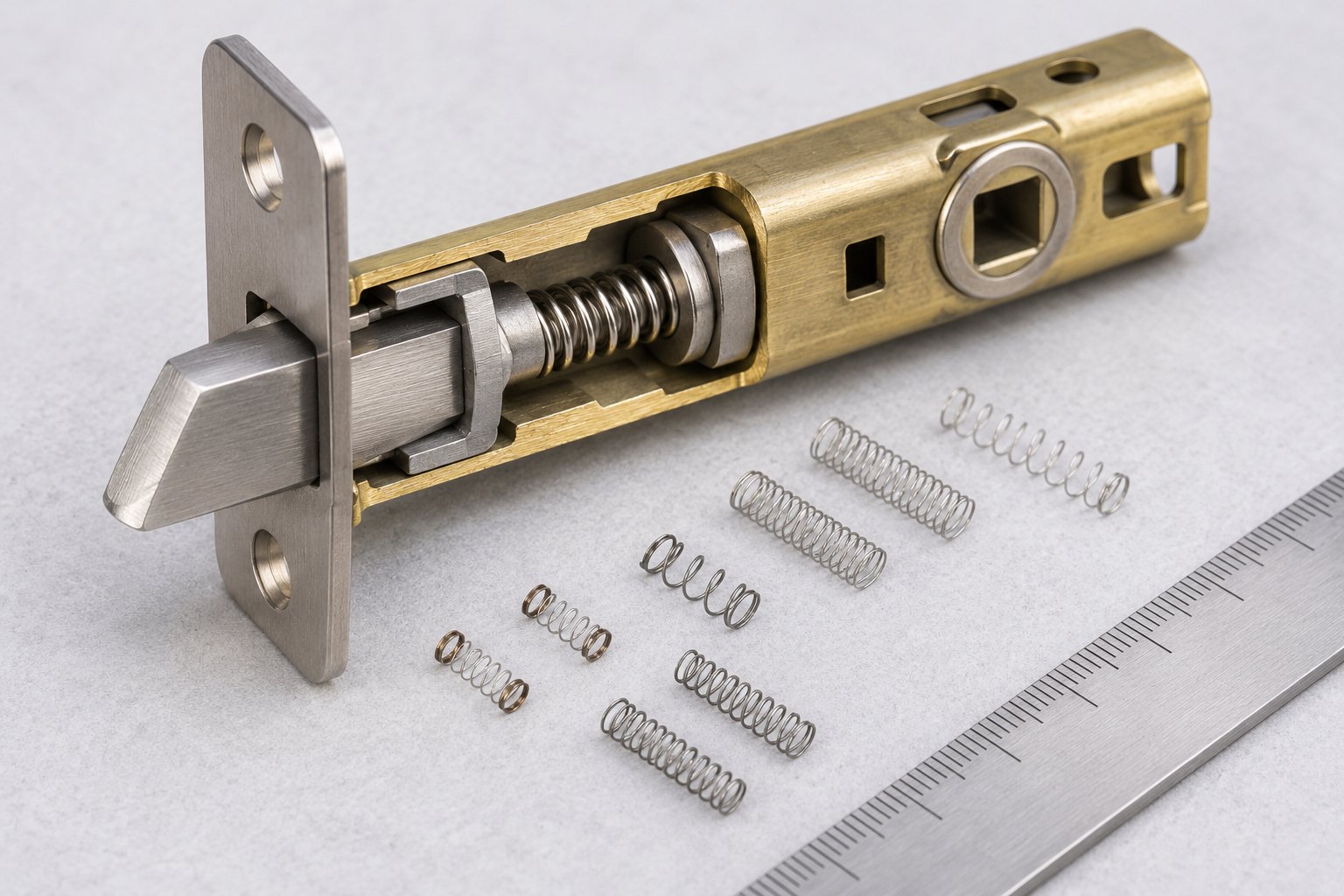
Cover image: an AI-generated illustration of a generic tubular latch, based on a photo of small compression springs we make; it does not show a specific brand or its exact internal layout.
Door latch springs are the small springs inside a door latch and its handle set: one spring pushes the angled latch bolt out so that the door catches in the strike plate, and others return the knob or lever to its rest position after each turn. Wikipedia describes the spring latch as “a spring-loaded bolt with an angled edge” and explains that “When the door is pushed closed, the angled edge of the latch bolt engages with the lip of the strike plate; a spring allows the bolt to retract” [1].
This guide is written for lock and hardware makers who source these springs, and for engineers who need to understand why a latch sticks or a lever droops. It covers residential and commercial door latches; for the spring that closes a gate, see our gate springs guide.
Key takeaways
- A door latch has two jobs for springs: the latch bolt spring pushes the bolt out, and return springs bring the knob or lever back to rest.
- The latch spring sets the closing force: in our model, a 45 degree bevel turns a 5 to 11 N latch spring into a 6.8 to 14.9 N push at the latch when the door closes.
- Levers need more return torque than knobs: a lever’s weight sits to one side of the spindle; in our model the latch spring alone leaves a 0.30 kg lever 0.03 N·m short of holding itself level.
- The operating limits are tight: BHMA allows a maximum of 28 in-lbf (3.16 N·m) to open a lever lock, and the ADA limits operating force to 5 lbf (22.2 N), so return springs cannot simply be made stiffer.
- Cycle life decides the wire: three latch bolt springs with the same 0.47 N/mm rate have fatigue safety factors of 0.71, 0.92 and 1.15, and the one that passes needs a 37 mm free length.
What springs are inside a door latch?
A typical bored or tubular lockset has two groups of springs.
- The latch bolt spring. This is a compression spring inside the latch housing that pushes the bolt out to its full throw. The residential latches we checked have a throw of 1/2 inch (12.7 mm): a Design House passage latch lists a “Latchbolt throw distance” of 0.5 inch and an ANSI Grade 3 rating [2], and a residential Ultra series lockset lists a 1/2 inch bolt throw [11].
- The return springs. These sit in the rose or chassis behind each knob or lever and turn the handle back after it has been rotated. They may be torsion springs or compression springs set in a curved cage around the spindle.
How much work the return springs do depends on the handle, and a US patent on lever return spring cages explains that with knobs, “the latch return springs will usually suffice for also returning the knob”, because a knob’s balanced mass only requires the springs “to overcome friction within the lock mechanism” [3]. Levers are different: “the springs also must overcome the lever overhang and the weight imbalance and may not be strong enough to prevent sagging and droop of the levers” [3].
Hardware makers handle this with different spring strengths for the same latch: one latchset catalogue offers its rose cassette with “Knob Strength, Lever Strength and Heavy Duty Lever Strength” springs [4].
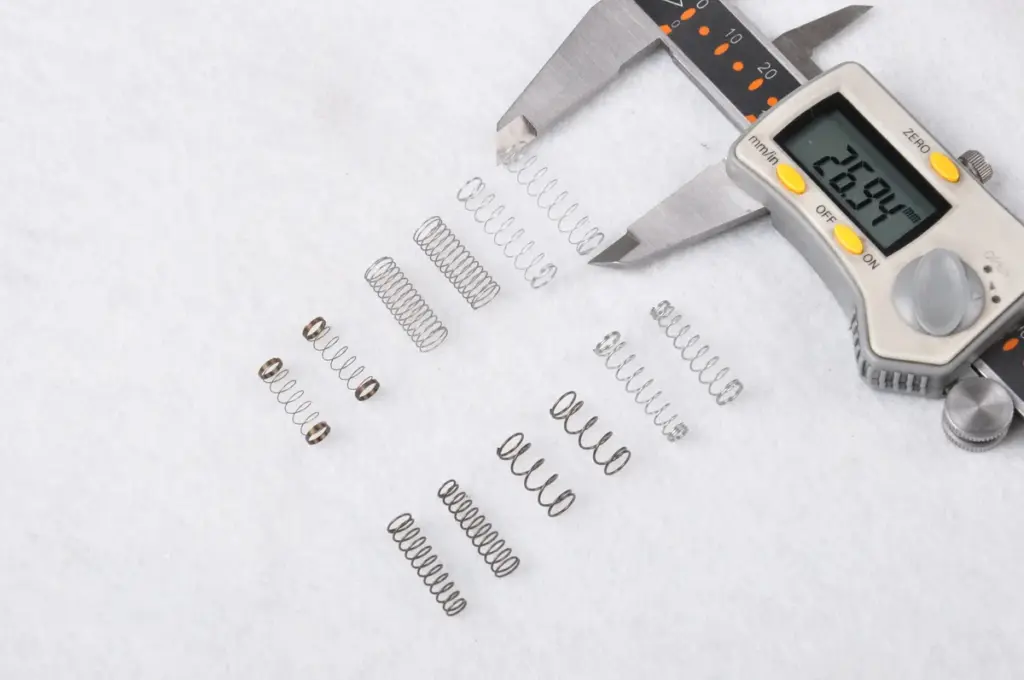
The term “spring loaded latch” also covers latches that are not inside a door handle, such as slide bolts, cabinet catches and slam latches. Wikipedia describes a slam latch as one that “uses a spring and is activated by the shutting or slamming of a door” [1], and the bevel and spring force calculation below applies to these designs as well.
How does the latch bolt spring set the closing force?
When a door swings shut, the lip of the strike plate meets the angled face of the latch bolt and pushes it back into the door. The steeper the bevel relative to the bolt, the less force the door needs. For a frictionless straight ramp at angle θ from the bolt axis, the push needed in the closing direction is the spring force divided by tan θ [5], and friction between the strike and the bolt adds to that push.
We modelled a latch bolt spring that pushes with 5 N with the bolt fully out and 11 N with the bolt pushed in by 12.7 mm, and assumed a friction coefficient of 0.15 at the strike; these are our design values, not data for a particular lock.
| Bevel angle from the bolt axis | Ratio, no friction | Ratio, friction 0.15 | Push at first contact | Push with bolt fully in |
|---|---|---|---|---|
| 35° | 1.43 | 2.01 | 10.0 N | 22.1 N |
| 45° | 1.00 | 1.35 | 6.8 N | 14.9 N |
| 55° | 0.70 | 0.95 | 4.7 N | 10.4 N |
Two results follow from this table: a latch spring that is twice as strong as needed doubles the push at the latch, which a door closer or the person closing the door has to supply, and the bevel angle matters as much as the spring, since at 35° the same spring needs almost 50 % more push than at 45°.
The standards measure these forces, and BHMA’s summary of ANSI/BHMA A156.2 for bored and preassembled locks says “the force to retract the latch and force to close the door are measured to ensure ease of egress and smooth closing” [6]. The ADA’s door opening force limit, by contrast, excludes the latch: the 5 lbf limit for interior doors does “not apply to the force required to retract latch bolts or disengage other devices that hold the door or gate in a closed position” [7].
Why do lever handles sag, and how much return torque do they need?
A lever handle hangs out to one side of its spindle, so its weight tries to rotate it downward all the time. The return springs must hold it level with some margin for friction and wear. The same patent describes what happens when they cannot: “a heavy lever will begin to sag after a relatively short service life, due to weakening of the springs” [3].
Return springs also cannot be made as stiff as the designer likes, and the patent states that “very stiff springs could prevent lever sag, they cannot be applied to door levers because of the necessity for operability of the levers by children and handicapped persons” [3]. Two limits apply:
- BHMA: “lever operated locks must open with a maximum torque of 28 in-lbf” [6], which is 3.16 N·m.
- ADA: operable parts “shall be operable with one hand” and “The force required to activate operable parts shall be 5 pounds (22.2 N) maximum” [7]; with the hand 100 mm from the spindle, that is 2.22 N·m.
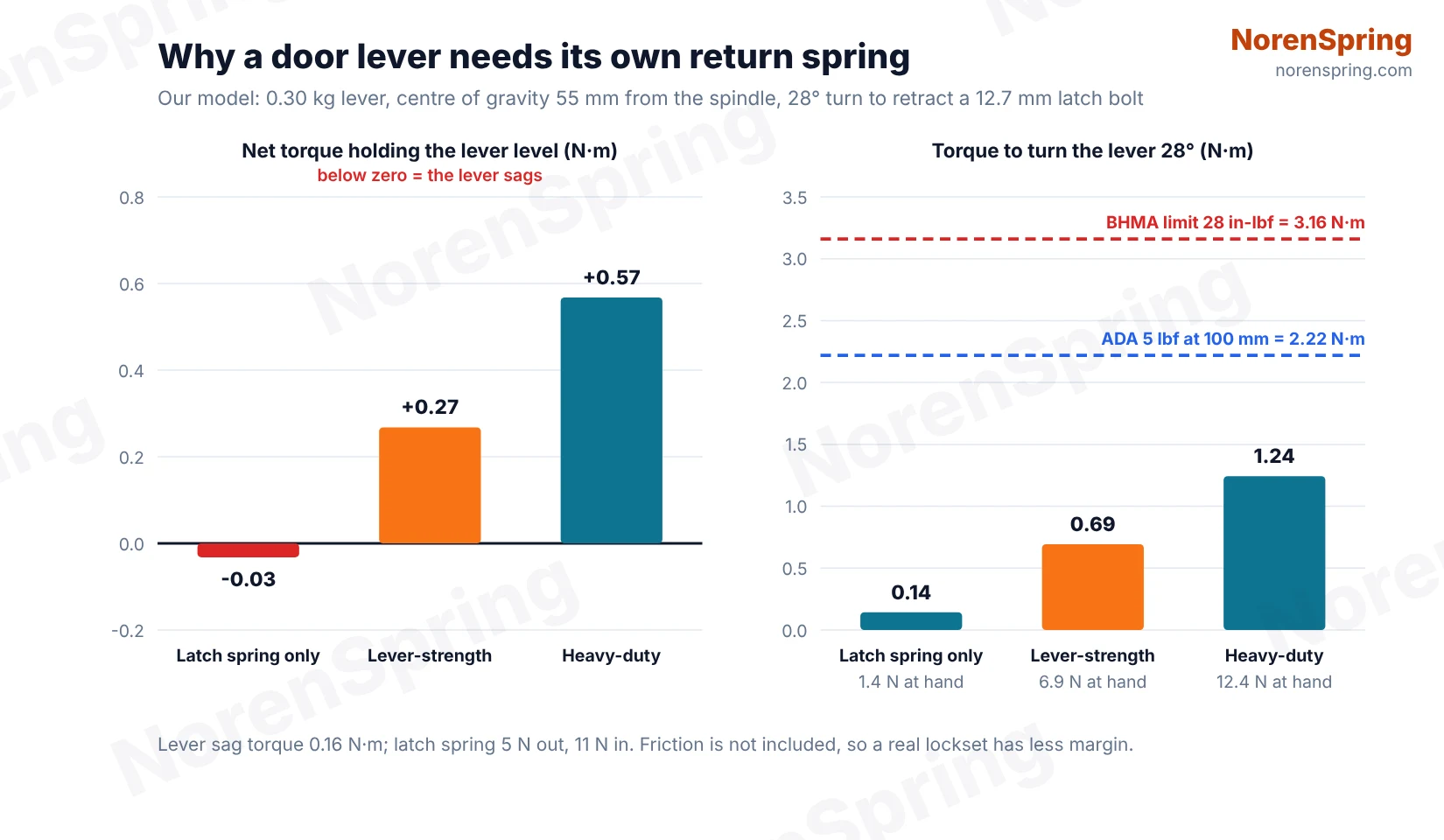
To show how these limits shape the spring, we modelled a 0.30 kg lever with its centre of gravity 55 mm from the spindle, which gives a sag torque of 0.16 N·m with the lever level. The lever turns 28 degrees to retract the latch; one latchset maker quotes “28° rotation to retract latch” for levers and 55° for knobs [8]. Pulling a 12.7 mm bolt back over 28 degrees means the latch spring acts on the spindle through an effective radius of 26 mm, so it contributes 0.13 N·m of return torque at rest and 0.29 N·m at full turn.
| Return spring case | Return spring torque, at rest → 28° | Net torque holding the lever level | Torque to turn 28° | Hand force at 100 mm |
|---|---|---|---|---|
| Latch spring only (as with a knob) | 0 | -0.03 N·m (lever sags) | 0.14 N·m | 1.4 N |
| Lever-strength return spring | 0.30 → 0.55 N·m | +0.27 N·m | 0.69 N·m | 6.9 N |
| Heavy-duty return spring | 0.60 → 1.10 N·m | +0.57 N·m | 1.24 N·m | 12.4 N |
The lever-strength spring holds the lever with 0.27 N·m to spare, about 1.7 times the lever’s own sag torque, and needs a 6.9 N push at the hand. The heavy-duty spring doubles the holding margin, which suits heavier levers, and still stays well below both limits. The model leaves out friction and the lock’s other moving parts, so a real lockset has less margin than these figures show. The patent design shares the return load between two compression springs; it notes that two springs double “the return force available to prevent sagging” and halve “the wear and tear” on each [3].
Worked example: a latch bolt spring for 1,000,000 cycles
Every time the handle is turned or the door is closed, the latch bolt spring goes through a full stroke, and the ANSI/BHMA grades set different cycle tests. Allegion’s summary of the grades lists the required cycle tests for bored locks (A156.2) as 1,000,000 for Grade 1, 400,000 for Grade 2 and 200,000 for Grade 3 [9]. BHMA adds that Grade 1 locks “must pass a rigorous test through one million cycles of opening and closing with a 10 pound axial load applied” [6].
We sized three music wire springs for the latch in our model: 5 N with the bolt out, 11 N with the bolt in, 12.7 mm stroke and 6.0 mm mean coil diameter, so that they fit the same bore in the bolt. We checked them with the methods in Shigley’s Mechanical Engineering Design, chapter 10 [10].
| Item | 0.55 mm wire | 0.60 mm wire | 0.65 mm wire (our choice) |
|---|---|---|---|
| Outside diameter | 6.55 mm | 6.60 mm | 6.65 mm |
| Active coils | 9.2 | 13.0 | 17.9 |
| Rate | 0.47 N/mm | 0.47 N/mm | 0.47 N/mm |
| Solid height | 6.2 mm | 9.0 mm | 12.9 mm |
| Free length | 30.4 mm | 33.3 mm | 37.2 mm |
| Shear stress with bolt fully in | 47 % of tensile | 37 % | 30 % |
| Fatigue safety factor (Gerber) | 0.71 | 0.92 | 1.15 |
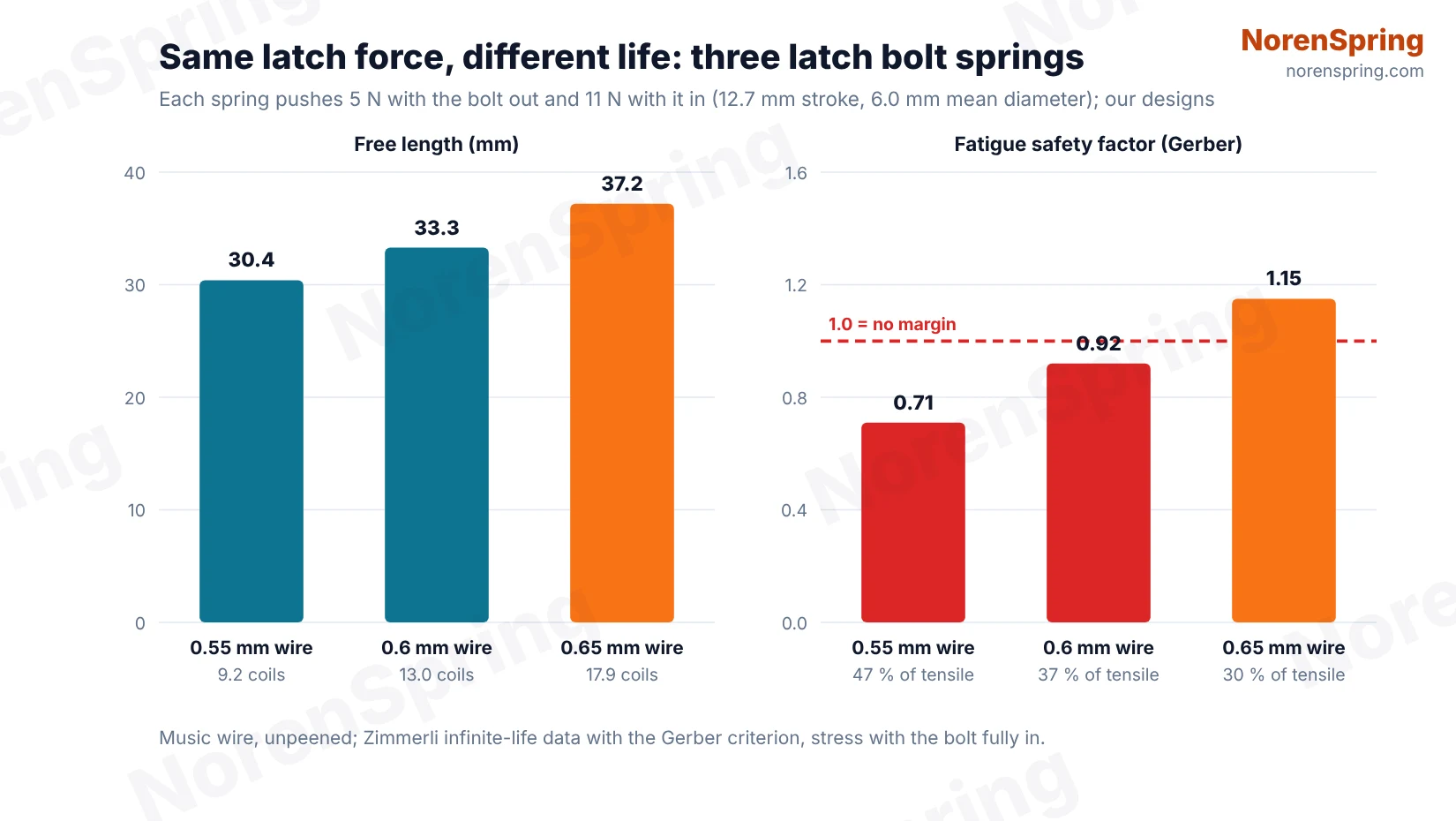
The 0.55 mm spring is the most compact, but with the bolt pushed in its stress reaches 47 % of tensile strength, above the 45 % that Shigley’s Table 10-6 allows for music wire compression springs before the set is removed [10]. Under repeated loading it has a fatigue safety factor of 0.71 against Zimmerli’s infinite-life data (241 MPa alternating, 379 MPa mean, unpeened), so we would not expect it to survive a Grade 1 cycle test.
The 0.65 mm spring stays at 30 % of tensile strength and has a fatigue safety factor of 1.15. Its cost is length: it needs a 37.2 mm free length and 12.9 mm solid height, so the bolt housing must give it that space with the bolt fully in. Zimmerli’s values are for infinite life, so this is a conservative check for 1,000,000 cycles; a cycle test on the assembled latch is still the final proof. For a Grade 3 latch at 200,000 cycles, a designer might accept the 0.60 mm spring after testing, but the space it saves is only 4 mm.
Signs that a door latch spring has failed
- The latch bolt does not spring fully out, so the door does not stay shut or rattles in the strike.
- The bolt sticks in when the handle is released: a weak or broken latch spring is one cause; dirt or paint in the latch housing is another.
- A lever droops below level and does not return fully after use, which is a sign the return springs have lost force.
For a lever that has started to sag, the fix is new return springs or a spring cage from the lockset maker, matched to the lever type. Fitting stronger springs than the original can push the operating torque above the BHMA and ADA limits.
What to specify for door latch springs
For a lock or hardware maker, a latch spring drawing should carry the items in our compression spring specification guide, with these points stated clearly:
- Force at two lengths: bolt fully out and bolt fully in, each with a tolerance, which in our example would read 5 N and 11 N.
- Maximum outside diameter and minimum inside diameter, to fit the bore in the bolt and any guide pin.
- Solid height, checked against the space with the bolt fully in.
- Cycle life and test method, tied to the grade, for example 1,000,000 cycles for a Grade 1 bored lock.
- Wire and finish. Music wire with zinc or nickel plating, or 302 stainless for damp or coastal doors; see our spring finishes guide.
- End type, usually closed and ground or closed and not ground for wire this size.
- Return spring torque or force at rest and at full turn, for the knob or lever spring, with the lever weight it is meant to hold.
For the 0.65 mm latch spring above, the key lines of the drawing would look like this, with tolerances as example values to agree with the lock maker.
| Drawing item | Example value |
|---|---|
| Wire | 0.65 mm music wire (ASTM A228), nickel plated |
| Mean diameter / outside diameter | 6.0 mm / 6.65 mm maximum |
| Active coils, ends | 17.9, closed and not ground |
| Free length | 37.2 mm |
| Load with bolt fully out (26.6 mm) | 5.0 N ± 10 % |
| Load with bolt fully in (13.9 mm) | 11.0 N ± 10 % |
| Solid height | 12.9 mm maximum |
| Cycle test | 1,000,000 strokes over the full travel, then load rechecked |
Lever return springs follow the same approach with torque in place of force. If the return spring is a torsion spring, our torsion spring specification guide lists what to put on the drawing. For the related ball-and-spring parts used in catches, see our detent springs guide, and for self-closing hinges, our hinge springs guide.
Send your latch geometry, throw and target cycle life through our contact page, and our engineers will review the spring forces and fatigue margin. Our compression springs and torsion springs pages show the sizes we make, and you can read more about our company and its certifications. This guide was compiled by our editorial team with our spring engineers.
FAQ
What does the spring in a door latch do?
It pushes the angled latch bolt out so that the door catches in the strike plate, and lets the bolt slide back when the door is pushed shut or the handle is turned, while separate return springs bring the knob or lever back to rest.
Why does my door lever droop?
The lever’s weight sits to one side of the spindle, so the return springs must hold it up all the time. When those springs are too weak for the lever, or have lost force with use, the lever sags. A lever return spring patent describes this as “sagging and droop of the levers” [3].
Can I fit a stronger latch spring?
It is possible, but a stronger latch spring raises the force to close the door and the torque to turn the handle. BHMA limits lever operating torque to 28 in-lbf [6], so the spring should be matched to the latch rather than simply made stronger.
How long should a door latch spring last?
That depends on the grade: bored locks are cycle tested to 1,000,000 cycles for Grade 1, 400,000 for Grade 2 and 200,000 for Grade 3 [9], and the latch spring has to survive the same test.
Is a spring loaded latch the same as a door latch?
A door latch is one type of spring loaded latch; slide bolts, cabinet catches and slam latches also use a spring to push a bolt or catch into place, and the bevel and force calculation in this guide applies to them in the same way.
Sources
- Wikipedia, “Latch (hardware)”. en.wikipedia.org
- Design House, 2-way square corner passage latch 779330, specification sheet. pdf.lowes.com
- US Patent 5,718,468, “Door handle modular return spring cage assembly”. patents.google.com
- OMNIA Industries, 2019 latchsets and locksets catalogue, sub-rose cassette features. afsupply.com
- Firgelli Automations, “Slam Latch: Mechanism, How It Works”. firgelliauto.com
- BHMA, “A156.2 – 2022 Locks and Latches”, Hardware Highlights. buildershardware.com
- US Access Board, 2010 ADA Standards for Accessible Design, sections 309.4 and 404.2.9. access-board.gov
- OMNIA Industries, knob and lever latchset product data. s3.amazonaws.com
- Allegion, “Understanding BHMA grading and testing”. allegion.com
- Shigley’s Mechanical Engineering Design, chapter 10 lecture slides (mechanical springs), Istanbul Technical University. web.itu.edu.tr
- Ultra Locksets specification sheets (Tulip series and others), distributor PDF. absupply.net



