











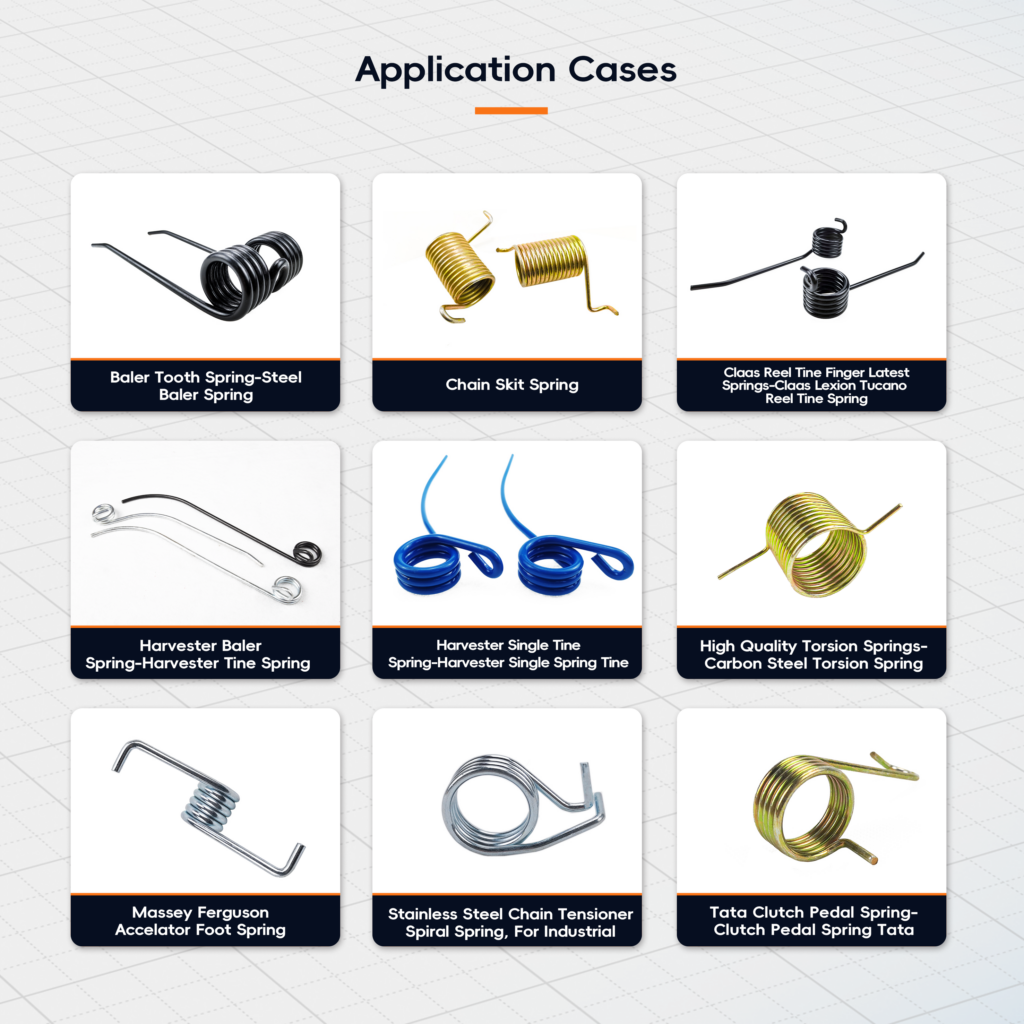
Harvester and baler tines, pedal return springs for tractors and other vehicles, and chain-related springs make up the nine torsion springs on this page, all from NorenSpring’s application cases. Each one works by twisting: load goes in through the legs and comes back as torque around the coil body. On most of them, leg geometry matters as much as the coil. The page is written for OEM buyers and for distributors of replacement tines and pedal springs. For what to send with an inquiry, see our guides to specifying a custom torsion spring and measuring replacement spring tines.
Key Takeaways
- Four of the nine parts are harvester and baler tines; the rest are pedal return, chain-related and general torsion springs.
- The portfolio includes single-body and double-body (double torsion) designs.
- An anonymized project below shows how reel tine springs for combine harvesters in Germany were reworked for longer service life.
- NorenSpring has an in-house testing laboratory and makes prototype samples for dimensional, load and application approval.
- NorenSpring works with wire from 0.1 mm to 80 mm across its product range, and accepts drawings in DWG, DXF, STEP, PDF, JPG or PNG.
The nine parts in this portfolio
| Part | Equipment | What the spring does |
|---|---|---|
| Baler tooth spring | Baler pickup | Double torsion tooth: two coils and two tines joined by a mounting section |
| Chain skit spring | Chain tensioner | Pair of torsion springs with bent, hooked legs that keep a chain under tension |
| Reel tine finger spring | Combine header reel | Replacement spring compatible with Claas Lexion and Tucano headers; a flexible finger that lifts and guides crop |
| Harvester baler tine spring | Baler or harvester pickup | Single coil with a long tine that flexes around obstacles and springs back |
| Harvester single tine spring | Harvester pickup | Coiled tine that gathers crop and absorbs impacts |
| Carbon steel torsion springs | General machinery | Straight-leg springs for general return duty |
| Accelerator foot spring | Tractor throttle pedal | Replacement spring suitable for Massey Ferguson tractors; returns the pedal to idle |
| Stainless steel chain tensioner spiral spring | Industrial chain drive | Keeps chain slack taken up as the chain wears and moves |
| Clutch pedal spring | Vehicle clutch pedal | Replacement spring compatible with Tata vehicle clutch pedals; returns the clutch pedal |
Where these springs work
Harvester reels and pickups
Reel and pickup tines rotate through the crop, deflect when they meet stones or ground, and must spring back to shape every time. The coil stores the deflection and the tine transfers it. Tines wear and break in service, so they are common replacement parts. See agricultural tine and spring applications and our wire forms portfolio for tines without coils.
Pedal return
Accelerator and clutch pedal springs pull the pedal back when the driver releases it. The torque at the released position must overcome friction in the linkage every time. More on automotive and pedal spring applications.
Chain tensioning and general machinery
Chain tensioner springs press a guide or sprocket against the chain to take up slack. Straight-leg carbon steel springs cover general industrial equipment duty such as lever and cover return.
Example project: reel tine springs for combine harvesters
A buyer in Germany needed replacement reel tine springs compatible with Claas combine harvesters.
- Problem. Harvester reels run in rough conditions, and the springs take high-frequency cycling and shock loads. Some of the original parts did not last long enough.
- What we changed. Our engineers analyzed the original spring’s structure and optimized the leg angle, changed the material selection and improved the surface treatment to improve fatigue resistance.
- Result. The springs meet the demands of continuous harvesting and last longer in service.
Customer details are kept confidential.
What we check before quoting a part like this
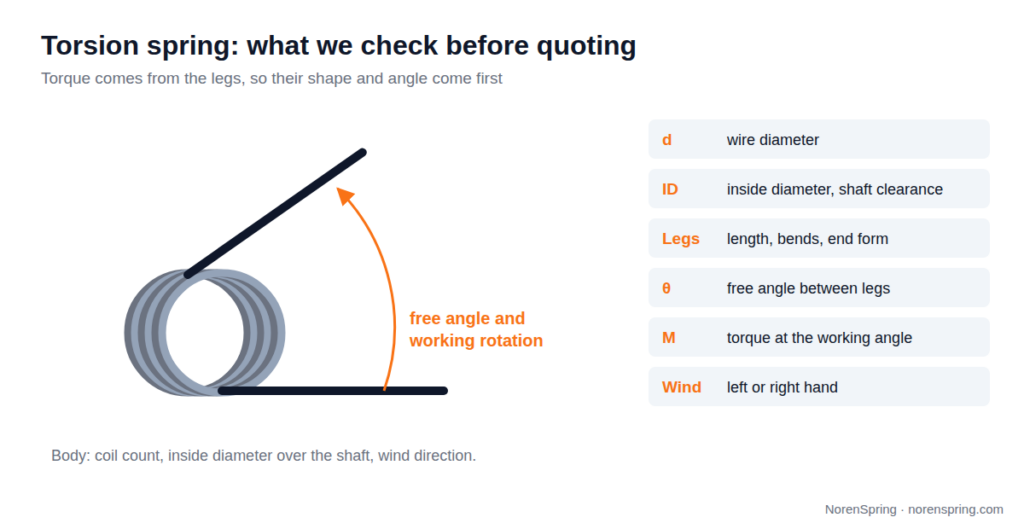
A torsion spring is specified mainly by leg angles and torque, where a compression or extension spring is specified by lengths and force. For a torsion quote we look at:
- Free leg angle. The angle between the legs with no load. Every working angle is measured from here.
- Torque at working angle. The torque needed at the installed position and at full rotation, usually in N·mm.
- Direction of wind. Left-hand or right-hand. A torsion spring should normally be loaded in the direction that winds the coils tighter.
- Body ID and arbor. As the spring winds up, its inside diameter shrinks and the body gets longer. The shaft or arbor needs clearance for both.
- Leg length and leg form. Bends, hooks and tine tips set where the load is applied. For tines, give tine length, tip shape and the mounting loop position.
- Double torsion geometry. Double torsion tines such as the baler tooth have two coil bodies wound in opposite directions, so both sides must match.
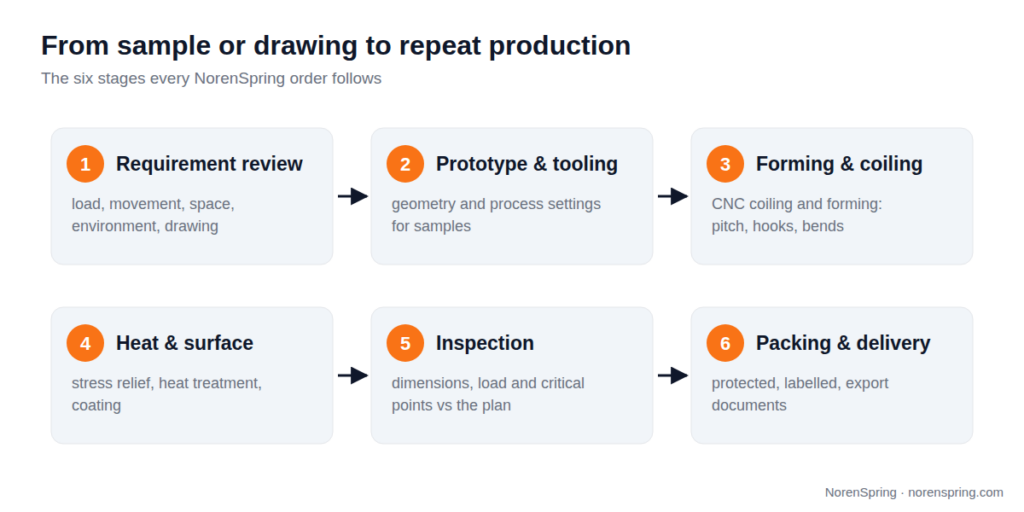
From sample or drawing to repeat production
Our team of 28+ engineers reviews each project, and we produce more than 4,000,000 springs a month for customers in 60+ countries.
- Requirement review. Torque, angles, mounting, environment and your drawing or sample are checked before quoting.
- Prototype and tooling. Forming tools for legs and tines are prepared and samples made for approval.
- Forming and coiling. CNC coiling and forming control body diameter, coil count and leg geometry.
- Heat and surface process. Stress relief to stabilize leg angles, then the agreed finish.
- Inspection and validation. Torque and angle are checked on JISC torsion testers and dimensions on an image measuring system, against the agreed control plan. Servo fatigue testers are available for cycle testing when a project needs it.
- Packing and delivery. Parts are protected, identified and shipped with export documentation.
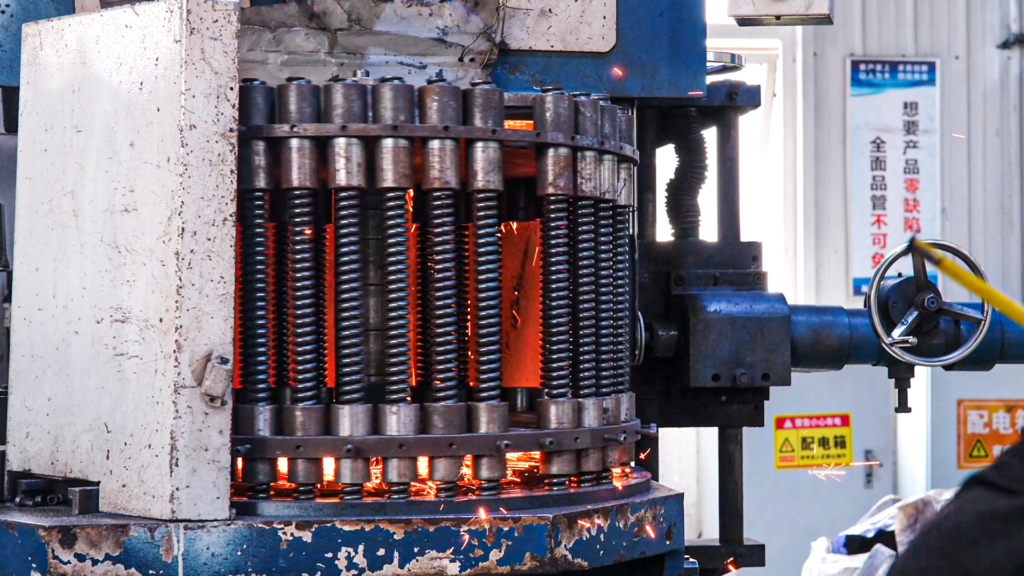
Samples typically take 7 to 15 working days and production 15 to 30 working days. The exact lead time is confirmed at quotation, since it depends on material, tooling, quantity and approvals. Our capabilities page lists the equipment.
Materials, wire sizes and finishes for these parts
The table gives the material, wire diameter range and usual finish for each part, as supplied by our production team, with the main markets each part ships to.
| Part | Material | Wire diameter | Usual finish | Main markets |
|---|---|---|---|---|
| Baler tooth spring | 50CrVA | 5–10 mm | Phosphate | Germany, USA |
| Chain skit spring | 60Si2Mn | 4–10 mm | Black oxide | USA |
| Reel tine finger spring | 50CrVA | 5–8 mm | Painting or phosphate | Germany, Europe |
| Harvester baler tine spring | 50CrVA | 6–12 mm | Phosphate | USA, Germany |
| Harvester single tine spring | 50CrVA | 5–10 mm | Powder coating | Europe |
| Carbon steel torsion springs | SWOSC-V | 1–8 mm | Zinc plating | USA, Japan |
| Accelerator foot spring | SWC | 2–5 mm | Zinc plating | India, Brazil |
| Stainless steel chain tensioner spiral spring | SUS304 | 1–5 mm | Passivation | Japan, USA |
| Clutch pedal spring | 65Mn | 2–6 mm | Zinc plating | India |
Grades are listed as our production team specifies them: 50CrVA (chromium-vanadium), 65Mn and 60Si2Mn are Chinese GB spring steels, SWOSC-V and SWC are Japanese JIS spring wires, and SUS304 is stainless steel. Photos may show a different finish from the usual one listed in the table.
Other materials and finishes
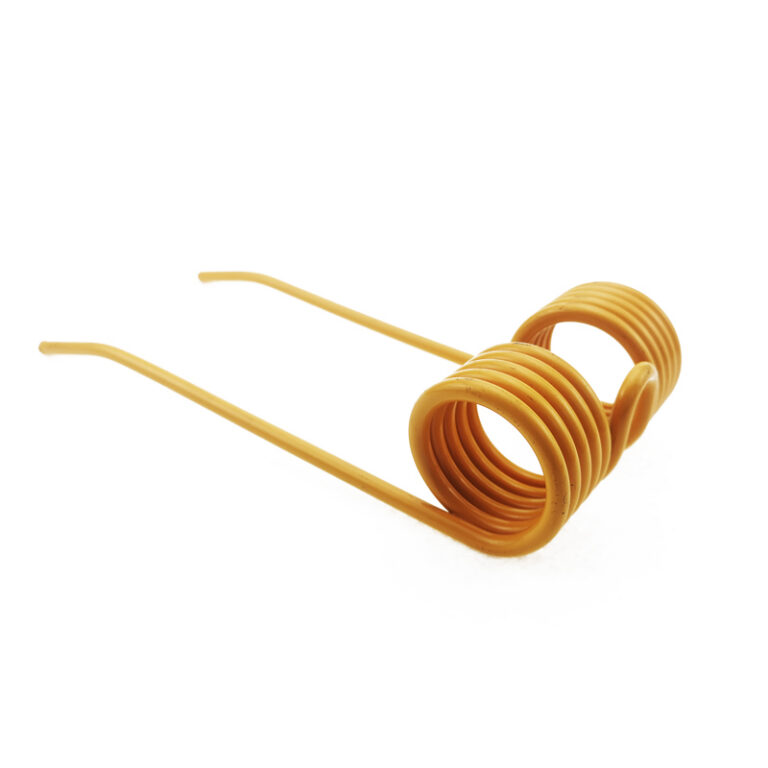
Color coatings make replacement tines easy to identify.
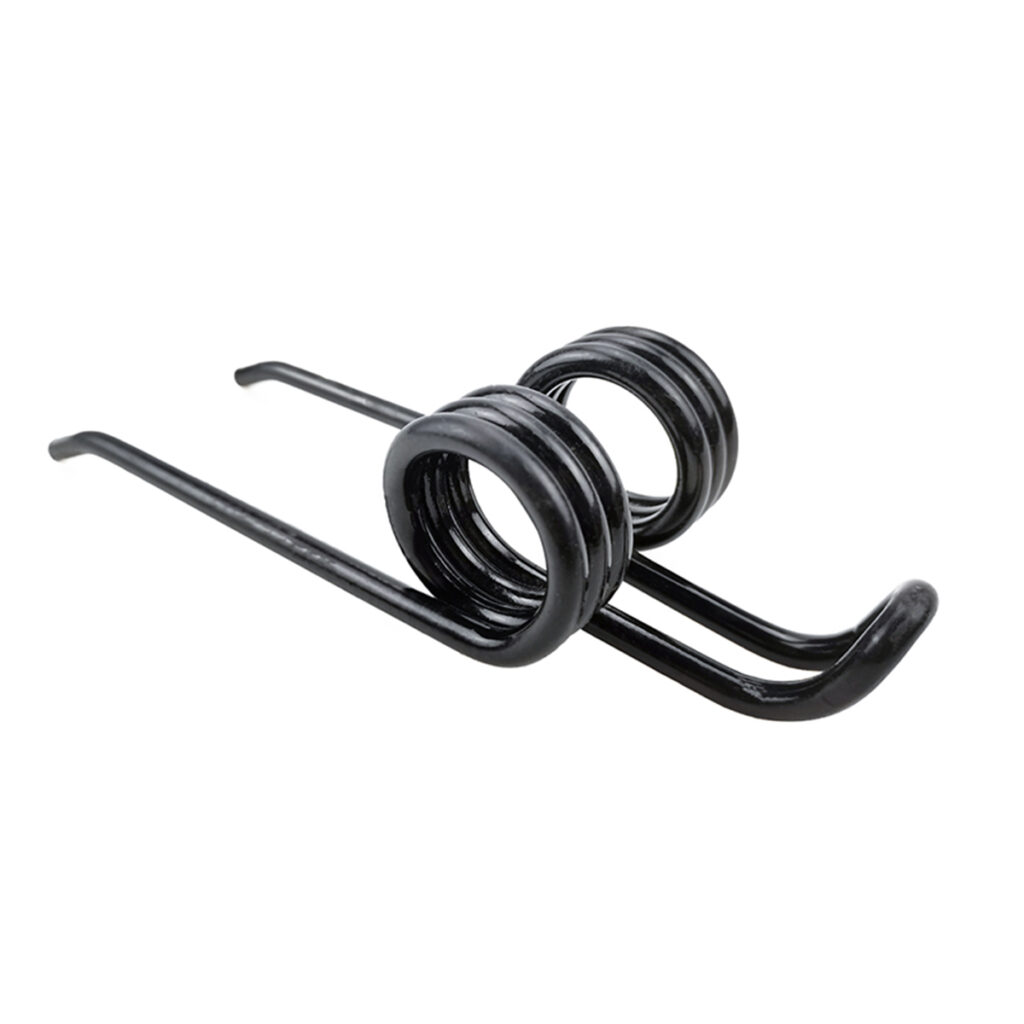
Wire options include carbon spring wire, music wire, oil-tempered wire, silicon-chrome and alloy spring steels, stainless 304 and 316, phosphor bronze, beryllium copper, and nickel and titanium alloys.
Frequently asked questions
Are these genuine Claas or Massey Ferguson parts?
No. They are replacement springs made to fit that equipment. The brand names only show which machines they fit.
Which drawing files can I send?
DWG, DXF, STEP, PDF, JPG and PNG. A sketch or a physical sample also works.
Can I test leg fit and torque before ordering in volume?
Yes. Prototype and pre-production samples are available for dimensional, load and application approval.
What size range can you make?
Across all spring types we work with wire from 0.1 mm to 80 mm. The practical wire size for a torsion spring or tine is confirmed at engineering review.
Send a drawing or a sample
Need a replacement tine or pedal spring, or a new torsion design? Send your drawing or sample with the leg angles and torque you need. Expect a reply from our engineering team within 24 hours. Or browse our torsion spring range.
