










In this article
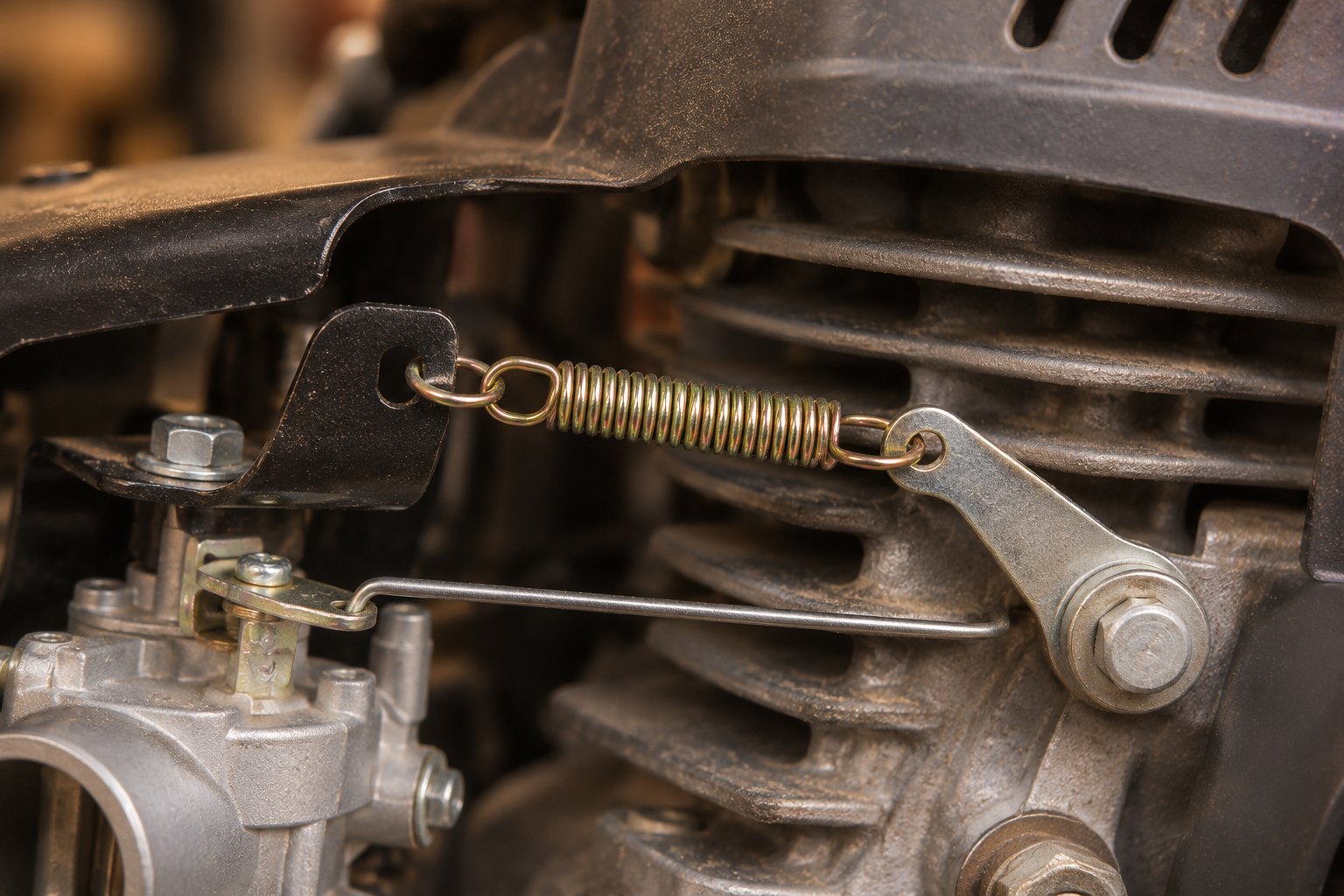
Cover image: an AI-generated illustration of a generic small engine governor linkage, based on photos of extension springs we make; it does not show a specific engine or part.
A governor spring is the small extension spring that sets the speed of a governed engine. It pulls the throttle open, while the engine’s governor pushes it closed as speed rises, and the engine settles at the speed where the two forces balance. Briggs & Stratton puts it simply: the governor spring wants to open the throttle and the governor tries to close it, and top engine speed is raised by increasing the spring force or lowered by decreasing it [1]. Lawn mowers, generators, pressure washers, pumps, tillers and small industrial engines all depend on it.
This guide is for small engine makers, equipment builders and aftermarket parts suppliers who buy governor springs. It explains how the spring and the flyweights balance, a worked governor spring design, how the spring rate decides how much the speed drops under load, why a stretched or wrong spring changes engine speed, and what to put on the drawing. For the springs that return the throttle at the pedal or carburettor, see our guide to pedal return springs.
Key takeaways
- The spring sets the speed; the flyweights hold it. Flyweight force rises with the square of engine speed, so the governed speed is roughly proportional to the square root of the spring force.
- Spring rate sets droop. In our worked example, a 0.43 N/mm spring lets speed fall 5.6 % from no load to full load, from 3,720 to 3,513 rpm. A 0.25 N/mm spring at the same no-load force drops only 3.2 %.
- Too little droop causes hunting. A very soft spring holds speed tightly in theory but can make the engine surge up and down.
- Small dimensional errors move the speed a lot. In our example, fitting 0.9 mm wire instead of 0.8 mm raises the speed from 3,720 to about 4,610 rpm. That is a 24 % overspeed from a 0.1 mm change.
- A stretched spring slows the engine. Losing a quarter of the initial tension drops the no-load speed in our example from 3,720 to 3,543 rpm.
How a mechanical governor uses the spring
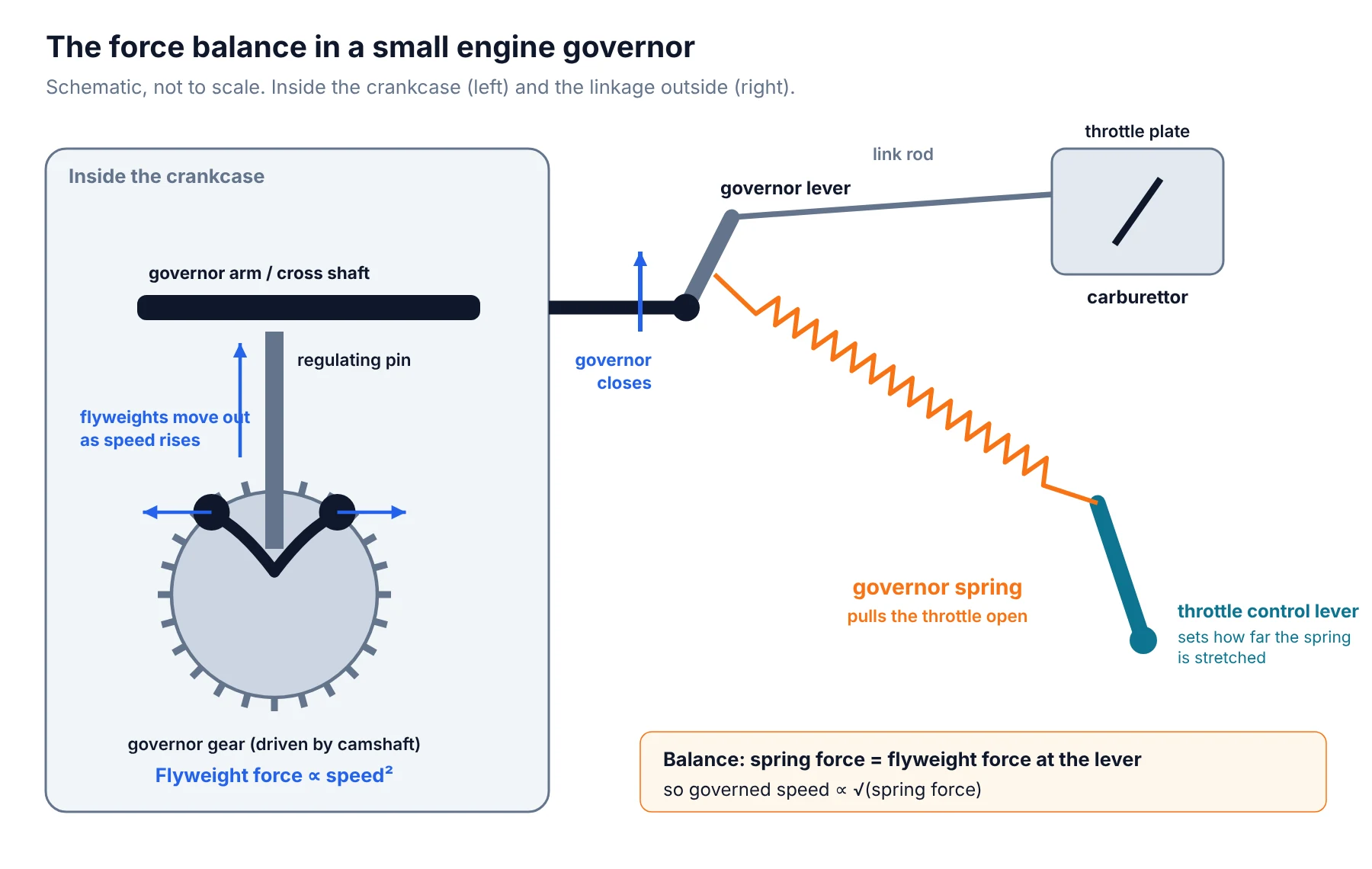
A mechanical governor is a speed regulator driven by the engine. In a typical small engine, a governor gear inside the crankcase carries flyweights. Briggs & Stratton explains that a mechanical governor uses flyweights to create a force based on crankshaft speed [1]. Kohler’s service manuals describe the same layout: the governor is driven off a gear on the camshaft, the flyweights move outward as speed rises and push a regulating pin against the governor arm, and the governor spring tension moves them back inward as speed falls [2][3].
Outside the crankcase, the governor arm connects to the carburettor throttle through a link rod, and the governor spring hooks between the governor lever and the throttle control. When the engine is stopped, the spring holds the throttle plate open [3]. When it runs, Kohler says, governor spring tension and the force applied by the regulating pin balance each other [2].
When a load is applied, the engine slows, the flyweight force drops and the spring tension moves the governor lever to open the throttle wider [2]. When the load is removed, the engine speeds up and the flyweights close the throttle. The governed speed is set by the position of the throttle control, which changes how far the spring is stretched [2].
| Part | What it does | Spring involved |
|---|---|---|
| Flyweights and regulating pin | Turn engine speed into a force on the governor arm | None |
| Governor lever and link rod | Move the throttle plate | Sometimes a small linkage spring to take up play |
| Governor spring | Pulls the throttle open; sets the governed speed | Extension spring, hooked to the throttle control |
| Throttle control lever | Sets how far the governor spring is stretched | Sometimes a friction or detent spring |
| Idle speed spring and screw | Set the idle stop on the carburettor | Small compression spring |
Kohler’s parts lists show a governor spring, a linkage spring and an idle spring as separate items, and some models also have a dampening spring [3][2]. Some small engines use an air vane in the cooling air from the flywheel instead of flyweights, but the job of the spring is the same: it sets the force that the governor must overcome.
Why the spring force sets the speed
The force from a spinning flyweight is m·r·ω², so it rises with the square of speed. If the lever geometry stays about the same, the engine settles where the flyweight force at the governor lever equals the spring force at the lever. That leads to a simple rule:
Governed speed ∝ √(spring force at the governor lever)
To run 10 % faster, the spring force must rise by about 21 %, because 1.1² = 1.21. To run 20 % slower, the force must fall by 36 %. | Speed change wanted | Speed ratio | Spring force ratio needed | Force change |
|—|—|—|—|
| 20 % slower | 0.80 | 0.64 | −36 % |
| 10 % slower | 0.90 | 0.81 | −19 % |
| 5 % slower | 0.95 | 0.90 | −10 % |
| No change | 1.00 | 1.00 | 0 % |
| 5 % faster | 1.05 | 1.10 | +10 % |
| 10 % faster | 1.10 | 1.21 | +21 % |
| 20 % faster | 1.20 | 1.44 | +44 % |
This is a simplification, because the flyweights move outward a little as the throttle closes, but it explains most of what a governor spring does. It is also why a spring that is only slightly too strong can push an engine well above its rated speed.
Speed droop and the spring rate
Speed droop is the drop in speed as a governed engine goes from no load to full load. Wikipedia defines it as the percentage change in design speed needed for 100 % governor action, and notes that increasing the spring pressure on a centrifugal governor raises the speed setting [4]. A simple centrifugal governor does not hold an exact speed but a speed range, because the throttle only opens further when the speed has fallen a little [5].
In a small engine, the droop comes from the governor spring. To open the throttle from closed to wide open, the governor lever moves, and the spring end moves with it. The spring shortens as the throttle opens, so its force drops by rate × travel. The flyweights then balance at a lower speed. A stiff spring loses more force over the same travel and gives more droop. A soft spring with more initial stretch loses less and gives less droop.
We analyzed this with a simple model: spring force at no load of 9.93 N, 2.5 mm of spring travel from closed to wide-open throttle, and speed proportional to the square root of the spring force. The no-load speed is set to 3,720 rpm, which is 62 Hz on a two-pole generator; a generator for 60 Hz power normally runs at 3,600 rpm, because 60 Hz needs a divisor of 3,600 rpm [6].
| Spring rate | Force at full load | Droop | Full-load speed | Generator frequency at full load |
|---|---|---|---|---|
| 0.15 N/mm | 9.55 N | 1.9 % | 3,649 rpm | 60.8 Hz |
| 0.25 N/mm | 9.30 N | 3.2 % | 3,601 rpm | 60.0 Hz |
| 0.43 N/mm (example) | 8.85 N | 5.6 % | 3,513 rpm | 58.5 Hz |
| 0.60 N/mm | 8.43 N | 7.9 % | 3,427 rpm | 57.1 Hz |
| 0.90 N/mm | 7.68 N | 12.1 % | 3,271 rpm | 54.5 Hz |
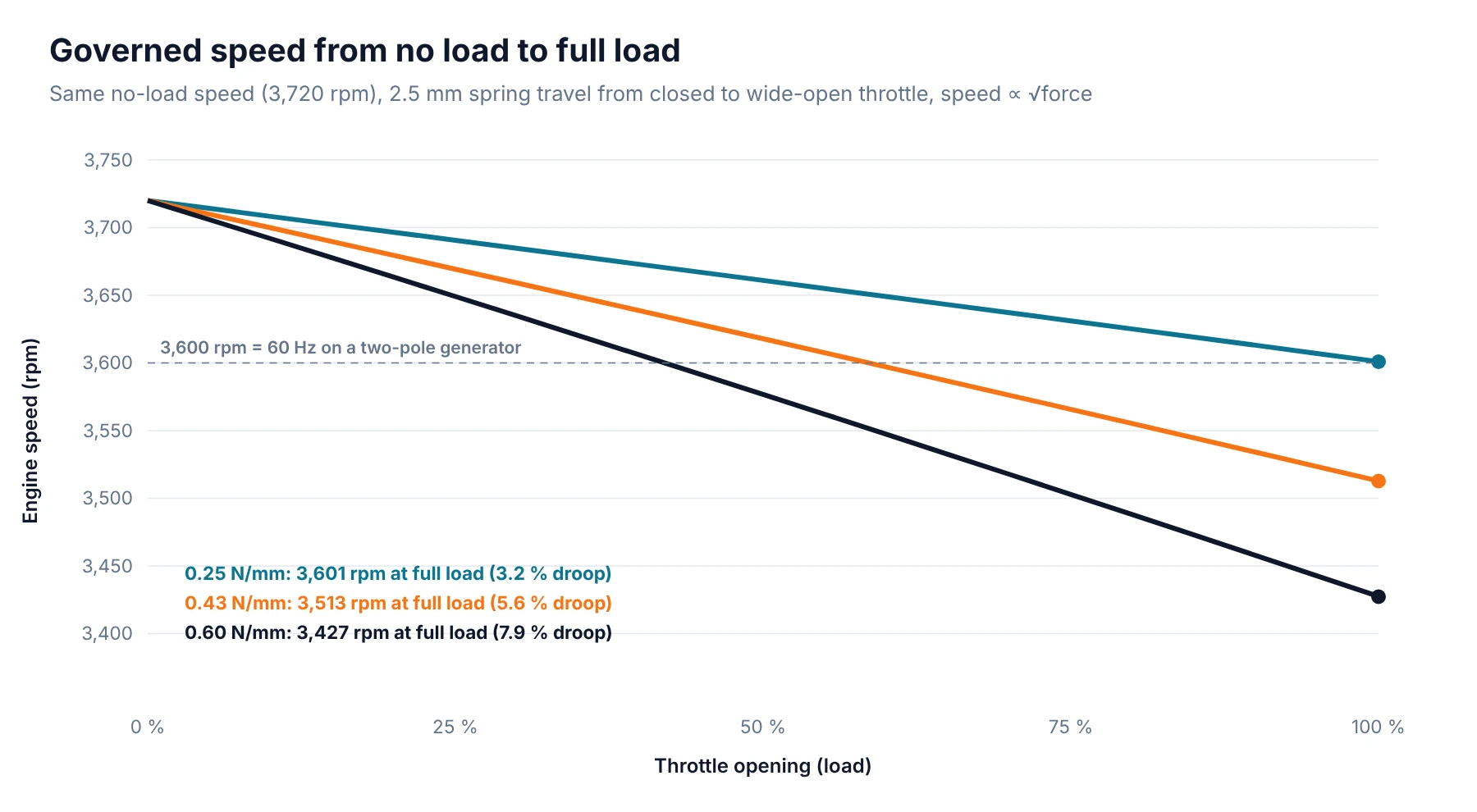
Data behind the chart (engine speed in rpm):
| Throttle opening | 0.25 N/mm | 0.43 N/mm | 0.60 N/mm |
|---|---|---|---|
| 0 % (no load) | 3,720 | 3,720 | 3,720 |
| 25 % | 3,691 | 3,669 | 3,649 |
| 50 % | 3,661 | 3,618 | 3,577 |
| 75 % | 3,631 | 3,566 | 3,503 |
| 100 % (full load) | 3,601 | 3,513 | 3,427 |
For a two-pole generator, the full-load speed should still give the rated frequency, which is 3,000 rpm for 50 Hz [6] and 3,600 rpm for 60 Hz. The more droop the governor has, the higher the no-load speed must be set:
| Droop | No-load speed for 50 Hz at full load | No-load speed for 60 Hz at full load |
|---|---|---|
| 2 % | 3,061 rpm (51.0 Hz) | 3,673 rpm (61.2 Hz) |
| 4 % | 3,125 rpm (52.1 Hz) | 3,750 rpm (62.5 Hz) |
| 6 % | 3,191 rpm (53.2 Hz) | 3,830 rpm (63.8 Hz) |
| 8 % | 3,261 rpm (54.3 Hz) | 3,913 rpm (65.2 Hz) |
A soft spring looks better on paper, but there is a limit. With very little droop, the governor reacts strongly to tiny speed changes, overshoots, and the engine surges or hunts. Engine designers choose the spring rate, the lever ratio and any damping spring together to get stable speed with an acceptable droop. For a spring buyer, this means the spring rate on the drawing matters as much as the force: two springs with the same force at one length but different rates will make the engine behave differently.
Worked example: a governor spring design
The example below is a governor spring for a small single-cylinder generator engine. The dimensions are our own example, not copied from a specific engine. We used the standard helical spring equations from Shigley, with G = 81.7 GPa for music wire [7].
| Parameter | Value |
|---|---|
| Wire | 0.8 mm music wire (ASTM A228) |
| Mean coil diameter | 6.0 mm (spring index C = 7.5) |
| Active coils | 45, close-wound body about 37 mm long |
| Spring rate | 0.430 N/mm |
| Initial tension | 3.69 N (about 110 MPa initial stress) |
| Extension at full-load position | 12.0 mm, giving 8.85 N |
| Extension at no-load position | 14.5 mm, giving 9.93 N |
| Coil stress at 9.93 N | 355 MPa, 0.16 of tensile strength |
| Hook bending stress at 9.93 N | 677 MPa, 0.30 of tensile strength |
The spring rate follows from k = G·d⁴ / (8·D³·Nₐ), and the hook stress from Shigley’s hook bending formula [7]. The minimum tensile strength of 0.8 mm music wire is about 2,284 MPa from Shigley’s strength equation [7]. The stresses are low on purpose. A governor spring is stretched for thousands of hours near a hot cylinder, and a low stress keeps relaxation small, so the speed stays where it was set.
How the throttle control changes the speed
Moving the throttle control lever changes how far the spring is stretched at no load. With the same spring:
| Target no-load speed | Spring force needed | Extension needed |
|---|---|---|
| 2,976 rpm (80 %) | 6.35 N | 6.2 mm |
| 3,348 rpm (90 %) | 8.04 N | 10.1 mm |
| 3,720 rpm (100 %) | 9.93 N | 14.5 mm |
| 4,092 rpm (110 %) | 12.01 N | 19.3 mm |
The last line is the reason engines have a fixed top speed stop. Only 4.8 mm of extra stretch takes the engine 10 % above its rated speed.
Small changes to the spring, big changes to the speed
The governed speed depends on the spring force at the installed length, so wire size and coil count both matter. Keeping the 6.0 mm mean diameter, 110 MPa initial stress and 14.5 mm installed extension:
| Variant | Rate | Initial tension | Force at 14.5 mm | No-load speed if fitted |
|---|---|---|---|---|
| 0.7 mm wire, 45 coils | 0.252 N/mm | 2.47 N | 6.13 N | 2,923 rpm |
| 0.8 mm wire, 45 coils (example) | 0.430 N/mm | 3.69 N | 9.93 N | 3,720 rpm |
| 0.9 mm wire, 45 coils | 0.689 N/mm | 5.25 N | 15.24 N | 4,610 rpm |
| 0.8 mm wire, 38 coils | 0.510 N/mm | 3.69 N | 11.08 N | 3,929 rpm |
| 0.8 mm wire, 52 coils | 0.372 N/mm | 3.69 N | 9.09 N | 3,559 rpm |
A 0.1 mm change in wire diameter changes the speed by about 24 %. Seven coils more or less changes it by about 5 %. A replacement spring that “looks about right” can therefore make an engine run too slow to carry its load or fast enough to overspeed. When we work from a sample, we measure the force at two lengths as well as the wire, coil diameter and coil count.
What a stretched spring does
A governor spring that has been stretched, overheated or bent loses initial tension first, and the engine slows down:
| Initial tension lost | No-load speed |
|---|---|
| 0 % | 3,720 rpm |
| 10 % | 3,650 rpm |
| 25 % | 3,543 rpm |
| 50 % | 3,357 rpm |
That is why bending or stretching a governor spring to “tune” an engine is a bad idea. The speed then depends on how far the hook was bent, not on a controlled force, and it keeps drifting. The right fix is the correct spring, with the speed checked by a tachometer against the engine maker’s specification.
Materials, hooks and finish
Most governor springs are small extension springs in fine music wire or stainless steel wire, often around a millimetre in diameter or less.
- Music wire gives the highest strength and a consistent initial tension. It needs a finish, usually zinc plating or oil, to resist rust. Our music wire springs guide gives its strength range.
- Stainless spring wire (302/304) is used where corrosion matters, such as marine engines and pressure washers. It has a lower strength and a lower shear modulus, so the same dimensions give a weaker spring.
- Hooks are usually small machine or extended hooks, sometimes with an offset end to fit a hole in the governor lever. The hook is the most stressed point, as the table above shows, and its shape should be on the drawing. Our extension spring specification guide shows the common end types.
- Zinc-plated high-strength springs need baking after plating to reduce the risk of hydrogen embrittlement, as our spring finishes guide explains.
Air-cooled engines run hot near the cylinder and muffler, and spring wire relaxes faster as temperature rises. If the spring sits close to hot parts, our guide to high temperature springs explains when to change material.
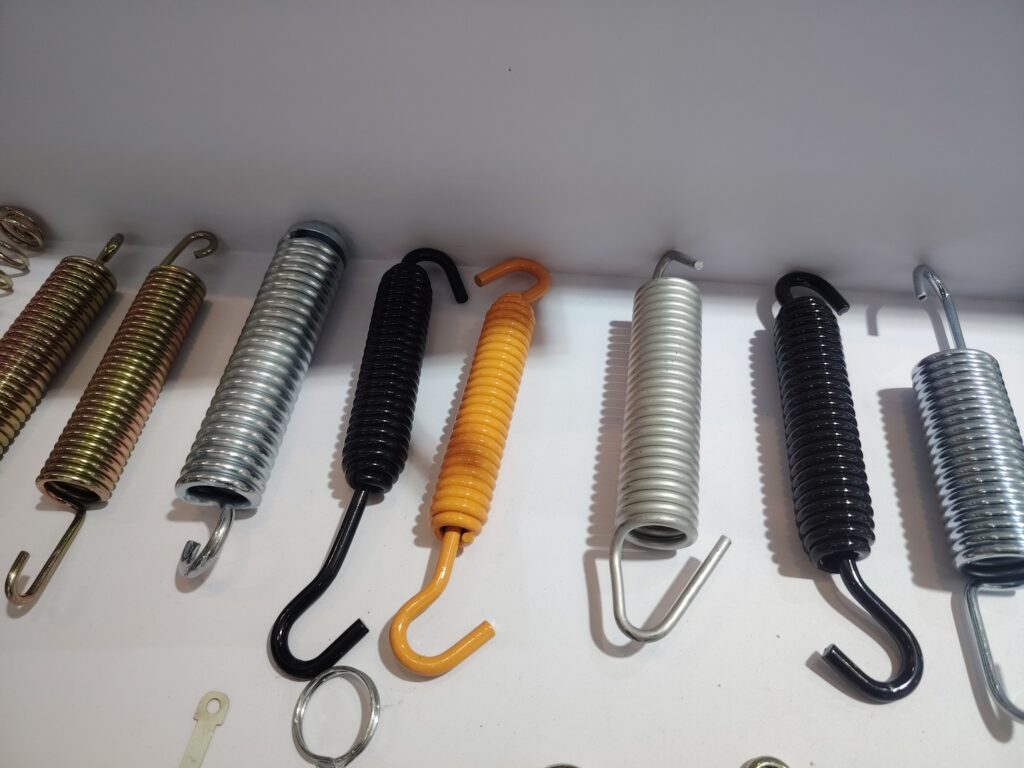
The photo shows extension springs we make. We make extension springs from fine wire upward, including small hook springs for engine and equipment linkages, and our extension spring application cases show parts we have supplied. Brand names in this article identify the engine makers whose public manuals we quote; NorenSpring is not affiliated with these manufacturers.
What to send for a governor spring quote
| Item | Example |
|---|---|
| Drawing or new sample | Drawing preferred; a used spring may already be stretched |
| Wire diameter and material | 0.8 mm music wire, or stainless 302 |
| Mean or outside diameter | 6.0 mm mean, 6.8 mm outside |
| Body length and coil count | About 37 mm body, 45 active coils |
| Hook type, length and orientation | Machine hooks both ends, in line, or an offset hook for the lever hole |
| Length inside hooks | At free length, with tolerance |
| Force at two lengths | 8.85 N at 12.0 mm and 9.93 N at 14.5 mm extension, ± 5 % |
| Minimum initial tension | 3.5 N minimum |
| Finish | Zinc plate with baking, or oiled |
| Engine and speed | Engine type and rated governed speed, for our engineers’ review |
| Quantity and packing | Per engine build or per service kit |
Two forces at two lengths are the most important lines on a governor spring drawing, because they fix both the speed setting and the droop. Send your drawing or sample through our contact page, and our engineers will review it and reply within 24 hours. You can read more about our company and its certifications. This guide was compiled by our editorial team with our spring engineers.
Frequently asked questions
What does a governor spring do on a small engine?
It pulls the throttle open against the governor flyweights. The engine runs at the speed where the flyweight force and the spring force balance, so the spring sets the governed speed and keeps it steady as the load changes.
What happens if the governor spring is too strong?
The engine runs faster than its rated speed. Because flyweight force rises with the square of speed, a spring that is 20 % too strong raises the speed by about 10 %. On a mower or generator this can overspeed the engine and the equipment it drives.
Why does my engine surge or hunt?
Surging often has a fuel cause, such as a partly blocked carburettor jet, but a wrong or weak governor spring, a sticking linkage or a spring with too little droop can also make the governor overshoot. Check the fuel system and the linkage first, then fit the correct spring.
Can I stretch a governor spring to change engine speed?
It is not a good idea. Stretching or bending the spring changes its initial tension in an uncontrolled way, so the speed keeps drifting. Use the correct spring and set the speed with the engine maker’s adjustment and a tachometer.
References
- Briggs & Stratton, “How does a small engine governor work?” https://www.briggsandstratton.com/us/en/support/faqs/governor-system
- Kohler RH255 engine service manual, governor system (ManualsLib). https://www.manualslib.com/manual/833943/Kohler-Rh255.html?page=24
- Kohler ECV940 engine service manual, mechanical governor (ManualsLib). https://www.manualslib.com/manual/612583/Kohler-Ecv940.html?page=53
- Wikipedia, “Droop speed control”. https://en.wikipedia.org/wiki/Droop_speed_control
- Wikipedia, “Centrifugal governor”. https://en.wikipedia.org/wiki/Centrifugal_governor
- Wikipedia, “Engine-generator”. https://en.wikipedia.org/wiki/Engine-generator
- Shigley’s Mechanical Engineering Design, Chapter 10 Mechanical Springs, lecture slides, Istanbul Technical University. https://web.itu.edu.tr/~halit/Makel/Ch_10_slides_m.pdf



