










In this article
- Key takeaways
- Where the springs are in a recliner
- How an over-centre recliner spring works
- Worked example: a recliner footrest spring
- What a stretched or wrong spring does
- Why recliner springs fail at the hook
- How to measure a recliner spring for replacement
- What to send for a recliner spring quote
- Frequently asked questions
- References
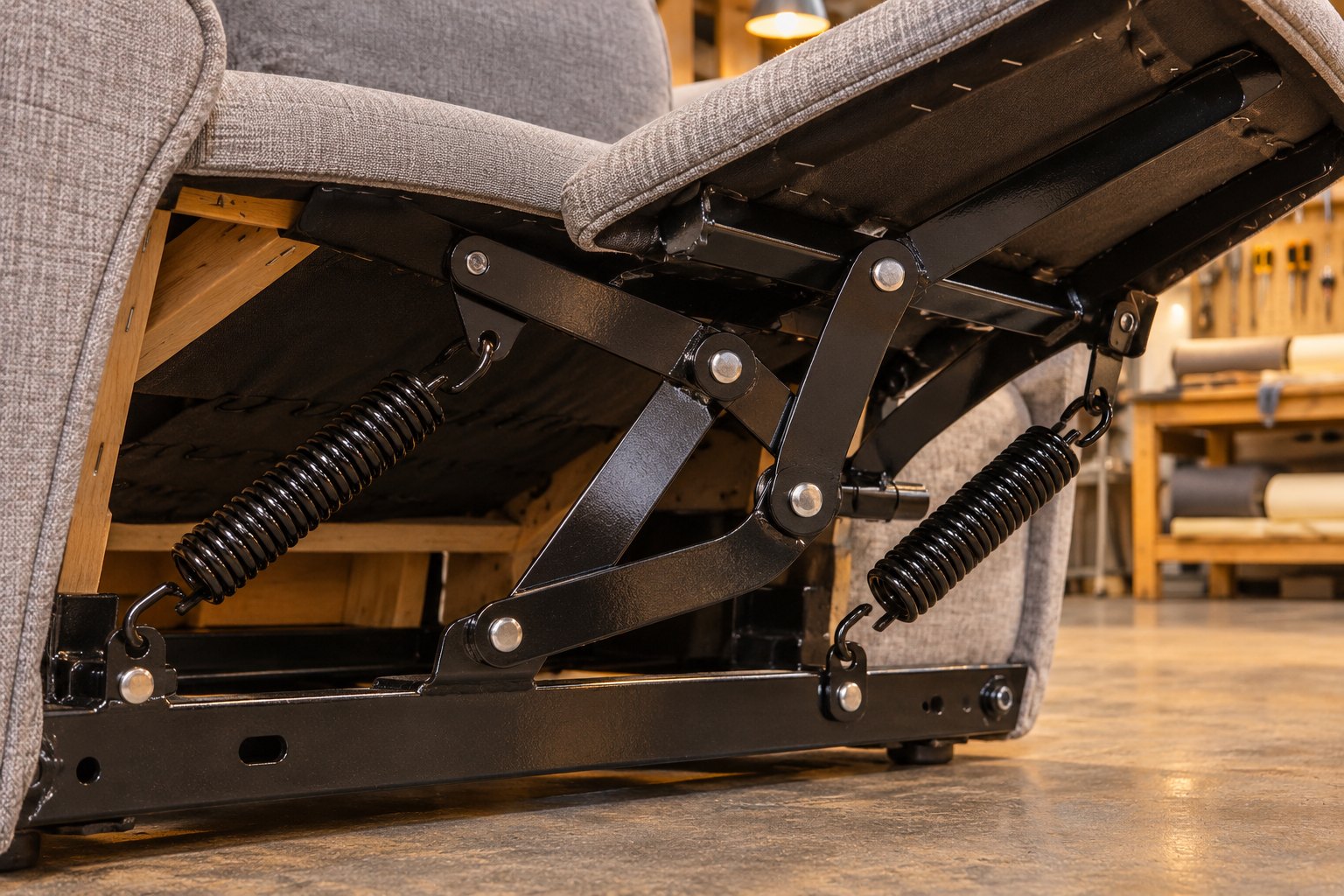
Cover image: an AI-generated illustration of a generic recliner footrest mechanism, based on a photo of an extension spring we make; it does not show a specific chair or mechanism.
Recliner springs are the extension springs inside a recliner’s metal mechanism. The largest ones, usually one on each side, connect the footrest linkage to the frame. They hold the footrest closed when the chair is upright, drive it out when the release handle is pulled, and help control the backrest as the chair reclines. In one patented wall-clearing recliner, a driving tension spring on each side of the mechanism is at maximum tension when the footrest is retracted, draws the drive arm rearward to extend it, and resists the recline of the backrest with substantial force [1].
This guide is for furniture mechanism makers, recliner manufacturers and replacement parts suppliers who buy recliner springs. It explains how an over-centre spring works, a worked recliner spring design, why a stretched or wrong replacement spring changes how the footrest behaves, and what to measure and specify. For the wave-shaped springs under the seat cushion, see our zig zag springs guide. For extension spring drawings in general, see our extension spring specification guide.
Key takeaways
- The spring works over centre. Its line of pull passes the link pivot as the footrest moves. On one side it holds the footrest shut; on the other it drives it out.
- Near centre, the torque is almost zero. That is why a light pull on the handle trips the footrest, and why a weak spring makes the footrest stop short.
- Stretched springs lose torque where it matters most. In our example, 6 mm of permanent set cuts the torque at the fully open position by 23 %, from 3.73 to 2.87 N·m.
- Hooks are the most stressed part. In our worked design the hook bending stress reaches 0.61 of the wire’s tensile strength, while the coils run at 0.32.
- “Close enough” replacements change the chair. A 3.2 mm wire spring in place of 3.0 mm gives 25 % more torque, but raises the hook stress.
Where the springs are in a recliner
A recliner mechanism is a set of steel links riveted together on each side of the chair. Different makers use different layouts, but the springs fall into a few groups.
| Spring | Typical form | What it does |
|---|---|---|
| Footrest drive spring | Large extension spring, one per side | Holds the footrest shut and drives it out once released |
| Over-centre or lock spring | Extension spring across a toggle link | Holds the linkage in a set position until pushed past centre |
| Handle or cable return spring | Small extension or torsion spring | Returns the release handle or cable |
| Back tension springs | Extension springs, sometimes with adjusters | Set how easily the backrest reclines |
Patents show how these springs are arranged. In US 6,231,120, a footrest spring connects a bracket to a stud on the footrest support bar, sits essentially on centre when the footrest is retracted, and moves over centre under the weight of the occupant’s legs, so the footrest floats in a spring-biased manner [2]. The same mechanism uses another extension spring that serves to lock the actuating structure in the upright position [2].
Lippert’s service sheet for its recliners covers the springs on the footrest mechanism and lists a standard spring and a heavy duty spring, which hook into an upper slot and a lower slot [3].
How an over-centre recliner spring works
A drive link is a short steel arm that pivots on the mechanism and carries the spring hook. The other end of the spring is anchored to the frame. The spring always pulls along the straight line between its two hooks. The torque it puts on the link is the spring force times the moment arm, the perpendicular distance from the pivot to that line.
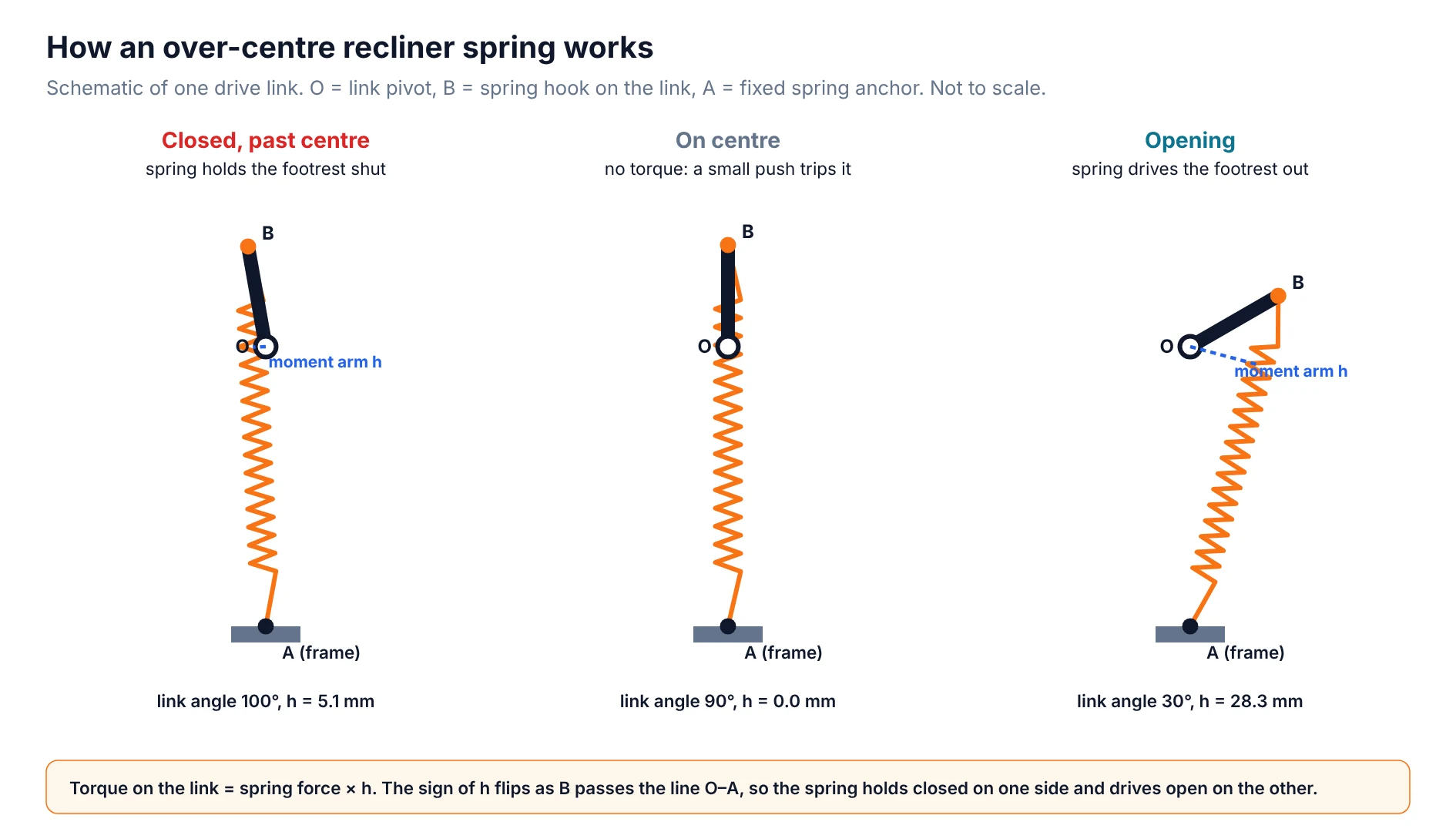
When the footrest is closed, the hook sits just past the line between pivot and anchor. The spring is at its longest and most stretched, but the moment arm is tiny, so it holds the footrest shut with a small torque. Pulling the handle pushes the link across the line. The moment arm then grows on the other side, and the spring drives the footrest out even as it shortens and its force falls.
The patent for the wall-clearing recliner describes the same balance in its own words: the spring anchoring pin on the drive arm is placed so as to offset the increase in the spring force [1]. The geometry, not just the spring, decides how the footrest feels.
Worked example: a recliner footrest spring
We analyzed one footrest drive spring in a simple over-centre layout: a 40 mm drive link and a spring anchor 110 mm from the link pivot. The link swings from 100° (closed, 10° past centre) to 20° (fully open). The dimensions are our own example, not copied from a specific mechanism. We used the standard extension spring equations and Shigley’s hook stress formulas, with G = 79.3 GPa and the minimum tensile strength of hard-drawn wire [4].
| Parameter | Value |
|---|---|
| Wire | 3.0 mm hard-drawn spring wire (ASTM A227) |
| Mean coil diameter | 19.0 mm (spring index C = 6.33); outside diameter 22.0 mm |
| Active coils | 26, close-wound body 81 mm long |
| Free length inside hooks | 117 mm, machine hooks both ends |
| Spring rate | 4.50 N/mm |
| Initial tension | 61.4 N (110 MPa initial stress) |
| Maximum force (on centre) | 210 N at 33.0 mm extension |
| Coil stress at maximum force | 0.32 of tensile strength (1,447 MPa) |
| Hook bending stress at maximum force | 0.61 of tensile strength |
Shigley describes hard-drawn wire as the cheapest general-purpose spring wire, to be used only where life, accuracy and deflection are not too important [4]. Furniture springs often use it for cost. That is one reason to keep the stresses moderate, as in this example. For a comparison with stronger wire, see our oil-tempered vs hard-drawn spring wire guide.
Force and torque through the stroke
| Link position | Spring length inside hooks | Extension | Spring force | Moment arm | Torque on the link |
|---|---|---|---|---|---|
| 100° (closed) | 149.6 mm | 32.6 mm | 208 N | 5.1 mm | 1.06 N·m holding closed |
| 90° (on centre) | 150.0 mm | 33.0 mm | 210 N | 0 mm | 0 N·m |
| 60° | 146.0 mm | 29.0 mm | 192 N | 15.1 mm | 2.89 N·m opening |
| 40° | 139.1 mm | 22.1 mm | 161 N | 24.2 mm | 3.90 N·m opening |
| 20° (fully open) | 129.3 mm | 12.3 mm | 117 N | 32.0 mm | 3.73 N·m opening |
The full stroke in 10° steps, with the hook bending stress as a fraction of tensile strength:
| Link angle | Length inside hooks (mm) | Extension (mm) | Force (N) | Moment arm (mm) | Hook stress ratio |
|---|---|---|---|---|---|
| 100° | 149.6 | 32.6 | 208 | 5.1 | 0.60 |
| 90° | 150.0 | 33.0 | 210 | 0.0 | 0.61 |
| 80° | 149.6 | 32.6 | 208 | 5.1 | 0.60 |
| 70° | 148.2 | 31.2 | 202 | 10.2 | 0.59 |
| 60° | 146.0 | 29.0 | 192 | 15.1 | 0.56 |
| 50° | 143.0 | 26.0 | 178 | 19.8 | 0.52 |
| 40° | 139.1 | 22.1 | 161 | 24.2 | 0.47 |
| 30° | 134.5 | 17.5 | 140 | 28.3 | 0.41 |
| 20° | 129.3 | 12.3 | 117 | 32.0 | 0.34 |
The spring force is highest when the footrest is closed, which matches the patent statement that the drive spring is at maximum tension when the footrest is retracted [1]. Yet the torque is highest near the open end, because the moment arm grows faster than the force falls. For example, between 60° and 20° the force drops by 39 %, while the moment arm more than doubles.
What a stretched or wrong spring does
The most common complaint about recliner springs is a footrest that no longer extends all the way. Lippert’s sheet gives a simple check: if the footrest fully extends, replacement is not necessary; if it does not fully extend, replacement of the spring may be necessary [3]. A home repair guide makes the same point more bluntly: like any other mechanism, eventually the spring in a recliner will fail [5].
We modelled the same mechanism with worn and substituted springs:
| Spring | Torque closed | Torque at 60° | Torque at 40° | Torque fully open | Change fully open | Peak hook stress |
|---|---|---|---|---|---|---|
| New spring (example) | 1.06 N·m | 2.89 N·m | 3.90 N·m | 3.73 N·m | 0 % | 0.61 |
| 3 mm permanent set | 0.99 N·m | 2.69 N·m | 3.57 N·m | 3.30 N·m | −12 % | 0.57 |
| 6 mm permanent set | 0.92 N·m | 2.49 N·m | 3.25 N·m | 2.87 N·m | −23 % | 0.53 |
| 30 % of initial tension lost | 0.97 N·m | 2.62 N·m | 3.45 N·m | 3.14 N·m | −16 % | 0.56 |
| 2.8 mm wire instead of 3.0 mm | 0.82 N·m | 2.25 N·m | 3.04 N·m | 2.94 N·m | −21 % | 0.57 |
| 3.2 mm wire instead of 3.0 mm | 1.35 N·m | 3.67 N·m | 4.93 N·m | 4.67 N·m | +25 % | 0.65 |
| 22 coils instead of 26 | 1.20 N·m | 3.25 N·m | 4.34 N·m | 4.05 N·m | +9 % | 0.69 |
| 30 coils instead of 26 | 0.96 N·m | 2.63 N·m | 3.58 N·m | 3.49 N·m | −6 % | 0.55 |
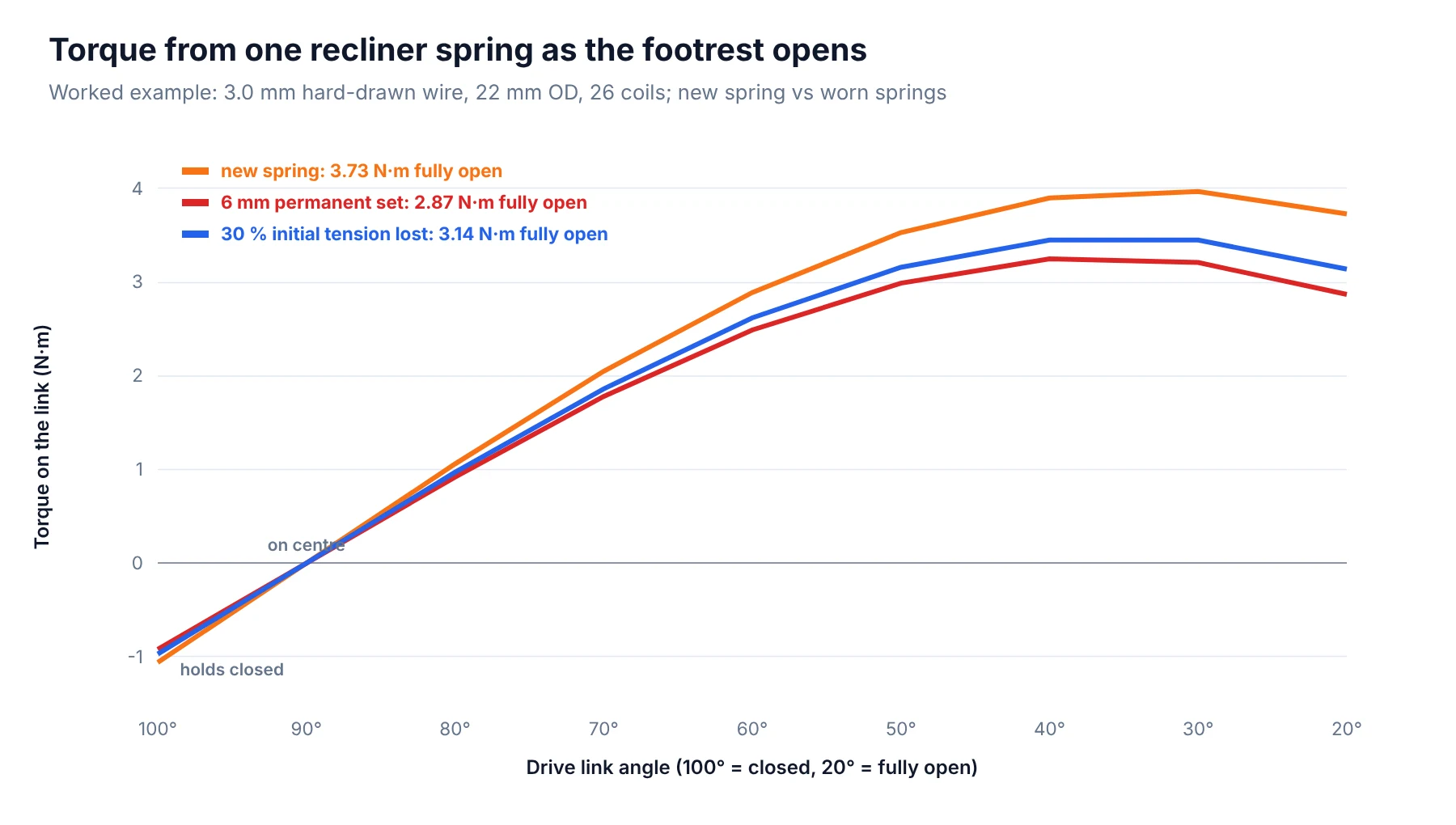
Data behind the chart (torque on the link in N·m; negative values hold the footrest closed):
| Link angle | New spring | 6 mm permanent set | 30 % initial tension lost |
|---|---|---|---|
| 100° | −1.06 | −0.92 | −0.97 |
| 90° | 0 | 0 | 0 |
| 80° | 1.06 | 0.92 | 0.97 |
| 70° | 2.05 | 1.78 | 1.86 |
| 60° | 2.89 | 2.49 | 2.62 |
| 50° | 3.53 | 2.99 | 3.16 |
| 40° | 3.90 | 3.25 | 3.45 |
| 30° | 3.97 | 3.21 | 3.45 |
| 20° | 3.73 | 2.87 | 3.14 |
So why does a chair with tired springs still open at all? Close to centre, every spring in the table gives almost the same small torque. Three lessons follow from the table:
- Wear shows up at the open end. A worn chair still opens, because the trip near centre needs little torque. The difference appears at the end of the stroke, where the footrest has to lift the occupant’s legs and lock out.
- A stronger spring is not free. The 3.2 mm spring gives more torque, but its higher force raises the hook stress and makes the footrest harder to close. Fewer coils do the same and push the hook stress to 0.69.
- Both sides must match. With one new and one worn spring, the two sides of the mechanism pull differently and the footrest can rack. Replace them in pairs.
Why recliner springs fail at the hook
Extension springs carry the highest bending stress where the hook leaves the body, not in the coils. The same check decides the hook in a wiper arm spring, where our worked example puts the hook at 55 % of tensile strength against 29 % in the coil body. Shigley’s equations apply separate stress-correction factors for bending at the hook and torsion at the hook bend [4]. In our example, the hook sees 0.61 of tensile strength at full stretch, nearly twice the coil stress.
Recliner springs also work at their highest force for most of their life, because the chair is usually closed. Over time that leads to permanent set, where the spring takes a longer free length and loses initial tension. Damage such as scratches from the mechanism, rust from spills and tight hook bends all shorten life. Our guide on why springs fail explains these failure modes in more detail, and our spring finishes guide covers coatings that protect against rust and wear.
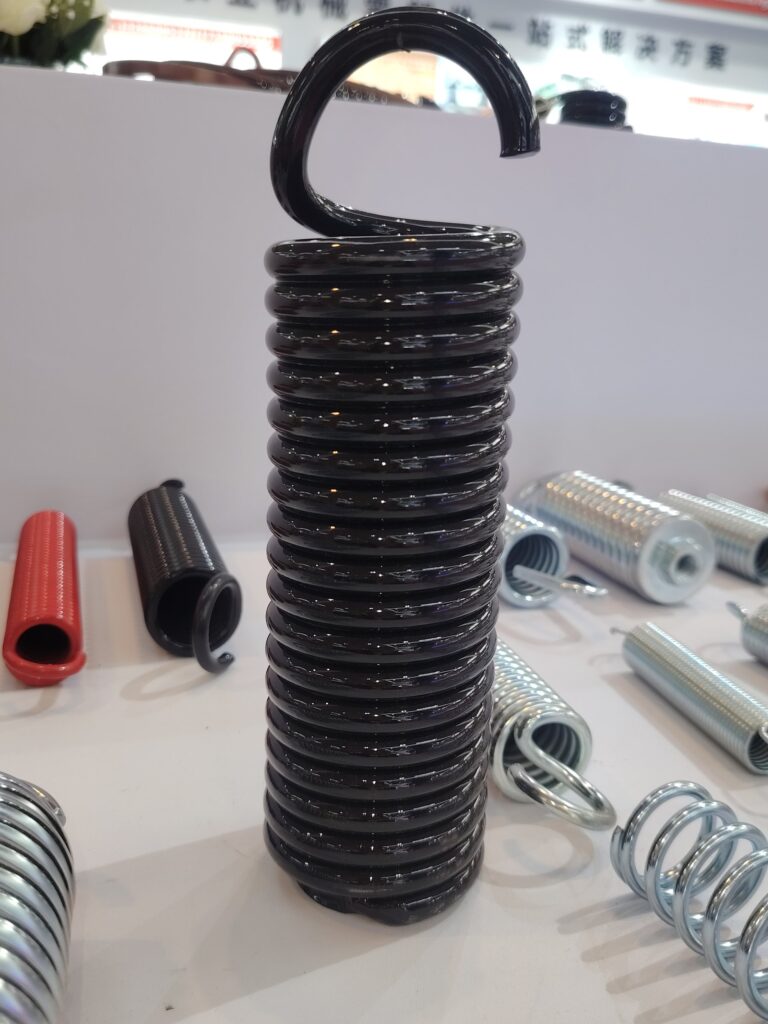
The photo shows an extension spring we make. We make extension springs with machine hooks, extended hooks and coated finishes, and our extension spring application cases show parts we have supplied. Brand names in this article identify the companies whose public documents we quote; NorenSpring is not affiliated with them.
How to measure a recliner spring for replacement
Recliner springs are under high tension even with the chair closed. Lippert advises relieving tension on the springs by extending the footrest before removing them, and warns that moving parts can pinch, crush or cut [3]. Once a spring is out, measure it as follows. Our guide on how to measure a spring shows each step with photos.
| Measurement | How to take it | Why it matters |
|---|---|---|
| Wire diameter | Calipers on a straight part of the coil | 0.2 mm changes the torque by about 20 % |
| Outside diameter | Calipers across the body | Must clear the mechanism links |
| Length inside hooks | Inside of one hook to inside of the other, unloaded | Sets the force at every position |
| Number of coils | Count the body coils | Changes the rate and the hook stress |
| Hook type and length | Note if one hook is longer | Lippert installs the longer end in the upper slot [3] |
| Hook orientation | Are the hooks in line or turned 90°? | Wrong orientation twists the hook |
| Finish | Black coat, zinc or plain | Affects corrosion and friction |
A used spring that has taken a permanent set is longer than it was new. If you are specifying a spring for production, ask the mechanism maker for the drawing, or send us a new, unused sample.
What to send for a recliner spring quote
| Item | Example |
|---|---|
| Drawing or new sample | Drawing preferred; a used spring may be stretched |
| Wire diameter and material | 3.0 mm hard-drawn or oil-tempered spring wire |
| Outside diameter | 22.0 mm |
| Length inside hooks | 117 mm free, with tolerance |
| Body length and coils | 81 mm close-wound, 26 coils |
| Hooks | Machine hooks both ends, in line, or one extended hook |
| Force at two lengths | 117 N at 129.3 mm and 210 N at 150.0 mm, ± 10 % |
| Minimum initial tension | 55 N minimum |
| Finish | Black coating, zinc plate with baking, or as specified |
| Quantity and packing | Per mechanism build, or in pairs for service kits |
Two forces at two lengths inside the hooks are the most important lines on a recliner spring drawing, because they fix both the closed and the open torque. Send your drawing or sample through our contact page, and our engineers will review it and reply within 24 hours. You can read more about our company and its certifications. This guide was compiled by our editorial team with our spring engineers.
Frequently asked questions
What do the springs on a recliner do?
The large springs in the footrest mechanism hold the footrest closed when the chair is upright and drive it out when you pull the handle. Other, smaller springs return the handle or cable, lock the linkage in position or set how easily the back reclines.
Why won’t my recliner footrest stay up or extend fully?
The most common cause is a footrest spring that has stretched or lost tension, so it no longer gives enough torque at the end of the stroke. A bent link or loose rivet can do the same. Check both springs; if they are stretched, replace them as a pair.
Can I use a stronger spring on my recliner?
You can, but it changes the chair. In our example, a 3.2 mm wire spring gives 25 % more torque than the 3.0 mm original, so the footrest opens harder and is harder to push closed, and the higher hook stress shortens spring life. Match the original spring unless the mechanism maker recommends otherwise.
Are all recliner springs the same size?
No. Recliner mechanisms differ in link lengths and anchor positions, so springs differ in wire size, diameter, length and hook type. Even one maker may offer a standard and a heavy duty spring [3]. Measure the old spring or use the maker’s part number.
References
- US Patent 4,226,468, “Wall-clearing recliner” (Google Patents). https://patents.google.com/patent/US4226468
- US Patent 6,231,120, “Reclining mechanism and furniture item” (Google Patents). https://patents.google.com/patent/US6231120
- Lippert, “Recliner footrest spring replacement”, technical information sheet. https://lci-support-doc.s3.amazonaws.com/technical-information-sheets/furniture/ccd-0006174.pdf
- Shigley’s Mechanical Engineering Design, Chapter 10 Mechanical Springs, lecture slides, Istanbul Technical University. https://web.itu.edu.tr/~halit/Makel/Ch_10_slides_m.pdf
- Hunker, “How to replace a recliner spring”. https://www.hunker.com/13403831/how-to-replace-a-recliner-spring/



