










In this article
- Key takeaways
- What is a tender spring?
- Tender spring vs helper spring: what is the difference?
- How do you calculate the combined rate of a tender and main spring?
- What does the crossover ring do?
- Worked example: a tender spring for a 2.5 in coilover
- How do tender springs change ride height and sag?
- What to specify when ordering tender springs
- FAQ
- Sources
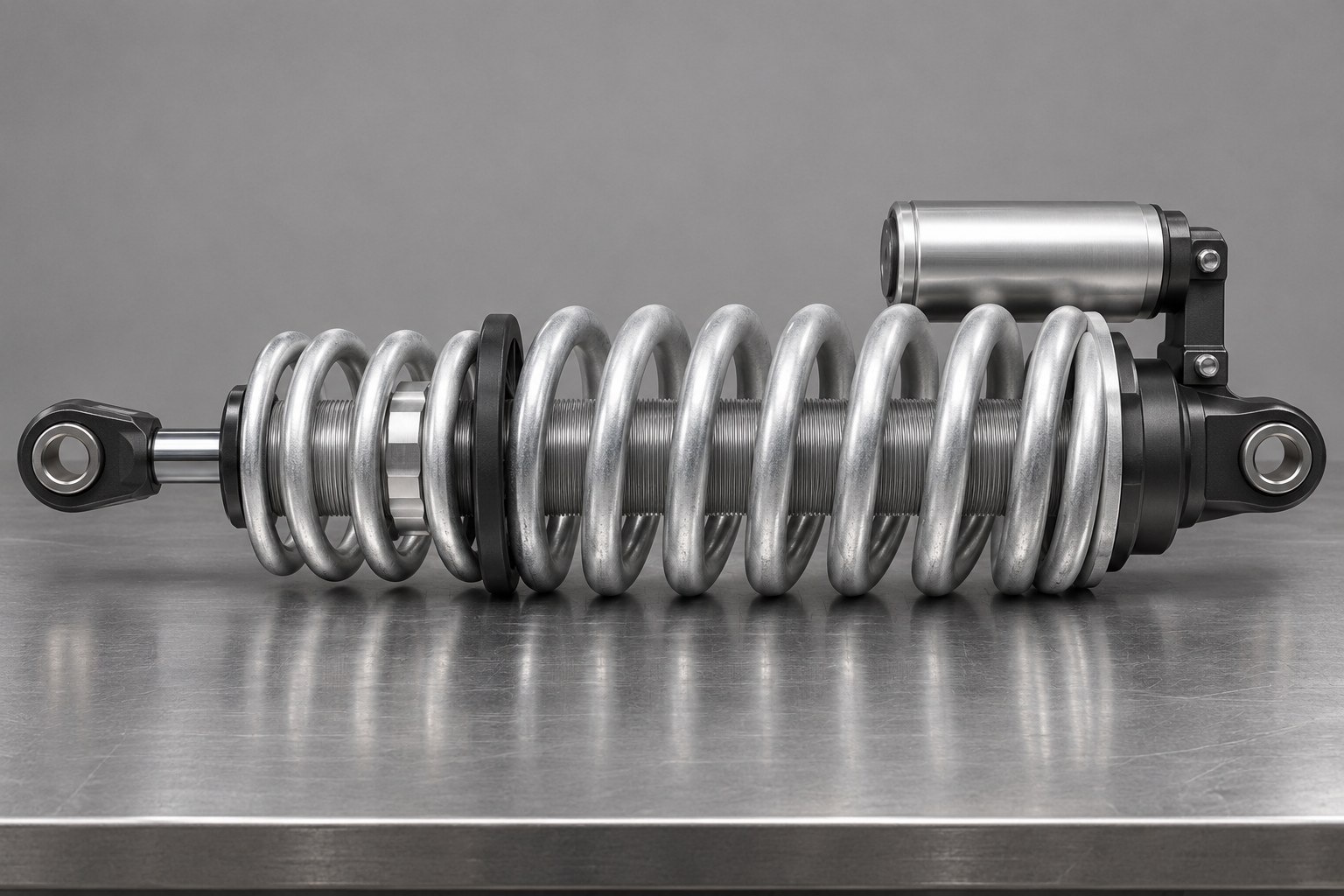
Cover image: an AI-generated illustration of a generic dual-spring coilover, based on a photo of a compression spring we make; it does not show a specific shock or spring brand.
Tender springs are short, soft coil springs fitted in series with the main spring on a coilover shock. While both springs compress together the suspension feels soft; once the tender spring stops compressing, the stiffer main spring carries the load alone. Eibach describes the arrangement this way: “The Eibach Main and Tender Spring concept provides a softer initial rate when both springs are compressed together, then delivers the desired firmer final rate once the tender spring closes completely” [1].
This guide, for shock builders and buyers of coilover tender springs, covers the combined rate, the difference from a helper spring, the crossover setting and the tender spring’s stress at solid height. For the general idea of springs that stiffen with travel, see our variable rate springs guide.
Key takeaways
- Two springs in series give a softer rate than either one: combined rate = (tender × main) / (tender + main), so a 200 lb/in tender on a 300 lb/in main gives 120 lb/in.
- A helper spring is not a tender spring. A helper has very little rate and only keeps the main spring seated at full droop; a tender sets the first-stage rate.
- The crossover point is set by the gap, not by the tender spring alone. In our example, 1.2 in of tender compression beyond preload gives a crossover after 2.0 in of shock travel, at 359 lbf.
- A tender spring that goes solid needs to be designed for it. Our 8 mm chrome silicon tender reaches 51 % of tensile strength at solid, just above the 50 % guide for springs used as wound, so it should be set removed or stopped short by a crossover ring.
- Specify rate, free length, solid height and the load at crossover, plus the inside diameter of the coilover, so the tender spring, main spring and divider fit together.
What is a tender spring?
A tender spring is the upper, softer spring of a dual-spring coilover. A patent on adjustable crossovers describes the layout in plain terms: “a dual coilover comprises an upper coil spring, or tender spring, and a lower coil spring, or main coil spring, separated by a spring divider, wherein the main coil spring is typically stiffer than the tender spring” [3].
The two springs sit one above the other on the same shock body, with a divider (also called a spring joiner) between them that slides along the body. BimmerWorld’s listing for an Eibach 2.25 in tender spring notes that “a spring joiner is required between the Tender and Main springs” [5].
Because the springs are stacked end to end, they carry the same force and their deflections add, which is a series arrangement, the same one we explain in our guide to springs in series and parallel.
Tender spring vs helper spring: what is the difference?
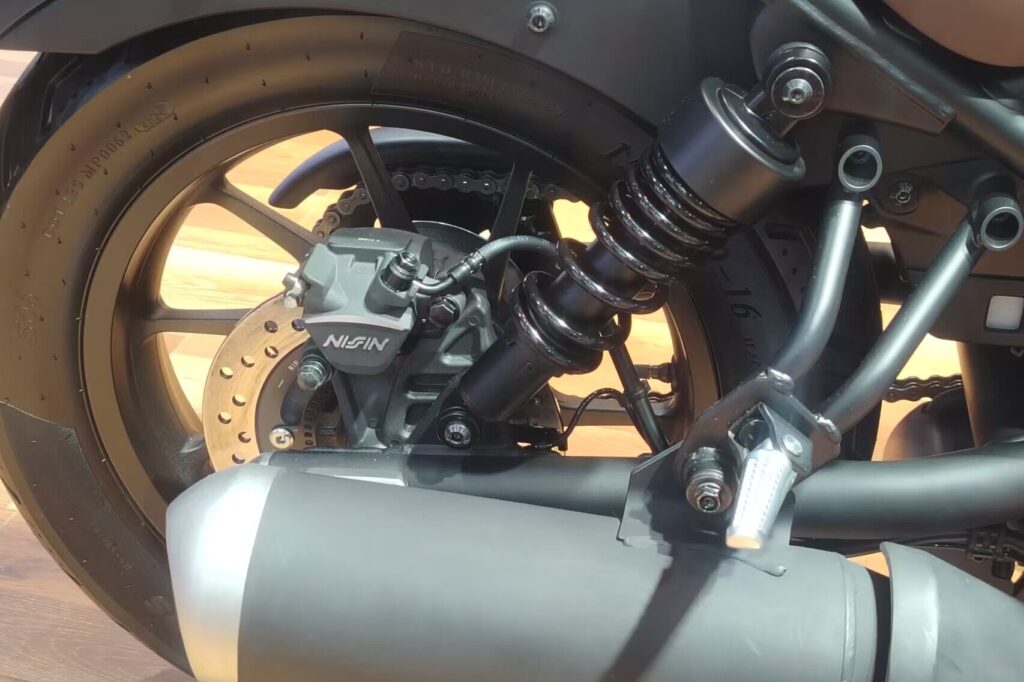
The two names are often mixed up, and some retailers use them as one. BimmerWorld writes that “Tender springs, also known as Helper springs, are fitted to a coil over to either correct the spring travel (helper) or create a progressive spring rate (tender)” [5]. Eibach separates them by what they do to the ride:
“A Helper Spring is used to prevent the Main Spring from becoming loose in the spring seat when the suspension is unloaded or at full droop. The Helper Spring, unlike the Tender Spring, has very little spring rate, and therefore has no effect on the suspension characteristics of the vehicle.” [1]
Eibach adds that “Up to 6” (150mm) of spring-to-perch gap can be covered with the use of a Helper Spring” [1].
| Helper spring | Tender spring | |
|---|---|---|
| Job | Keeps the main spring seated at full droop | Sets a softer first-stage rate |
| Rate | Very low; usually ignored in ride calculations | Real rate that changes the combined rate |
| Where it works | At full droop and near it | From ride height to the crossover point |
| Example figure | Covers up to 150 mm (6 in) of spring-to-perch gap (Eibach) | 199 lb/in with 30.5 mm (1.2 in) of travel to crossover (our example) |
Because a helper spring has so little rate, a small load closes it. So if a spring is already closed at ride height, it is acting as a helper; if it is still compressing at ride height, it is a tender and it changes the ride.
How do you calculate the combined rate of a tender and main spring?
Shock Therapy, a UTV suspension company, gives the rule for two springs stacked on one shock: the combined rate is “( TS x BS ) divided by ( TS + BS )”, where TS is the top spring and BS the bottom spring [2]. Their worked case uses two 250 lb springs: “(62,500) divided by (500) equals 125 lb combined spring rate” [2].
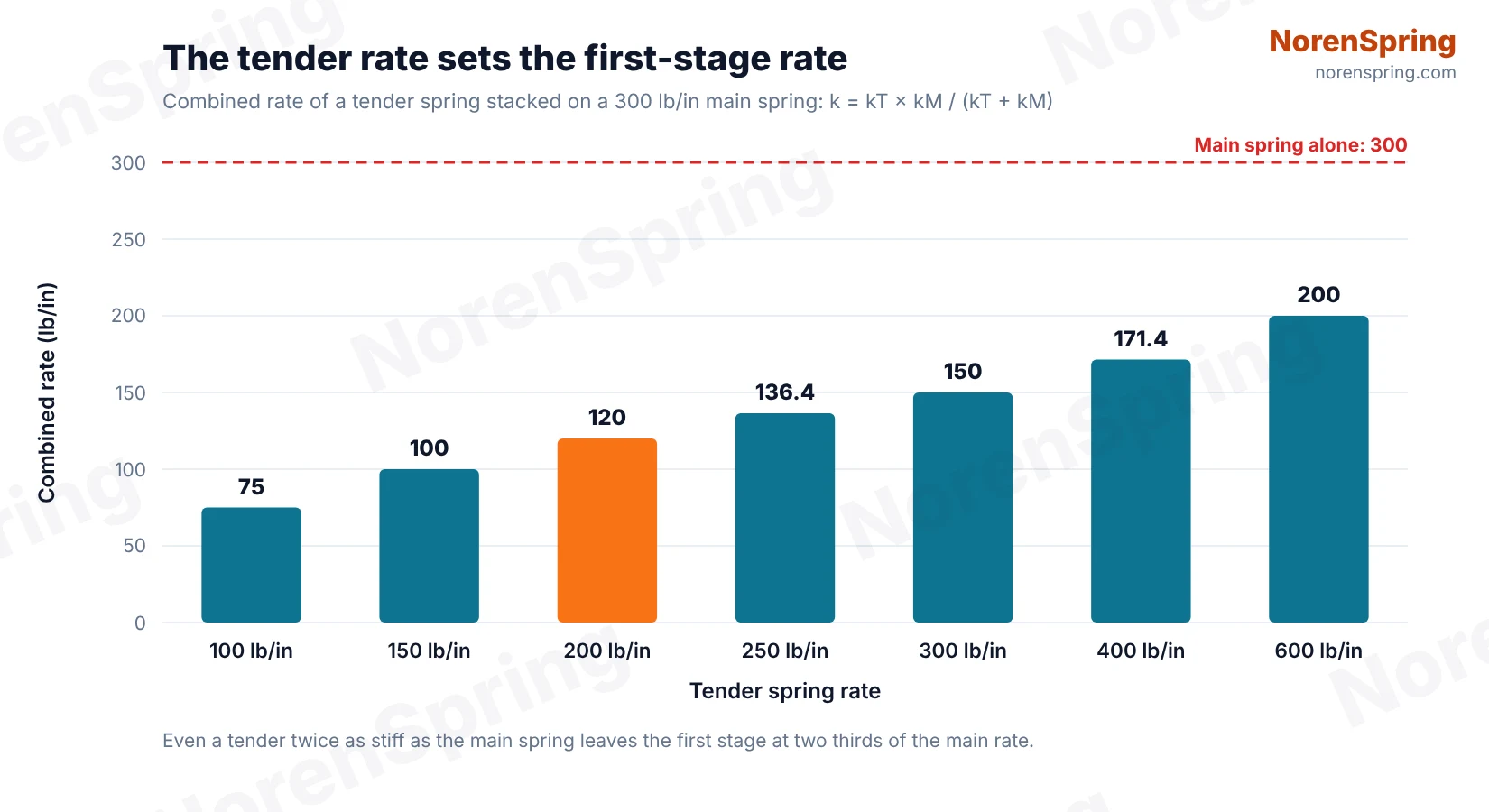
The result is always lower than the softer of the two springs, and the chart and table below run the formula for a 300 lb/in main spring and tender springs from 100 to 600 lb/in.
| Tender rate | Combined rate | Share of the 300 lb/in main rate | Combined rate in N/mm |
|---|---|---|---|
| 100 lb/in (17.5 N/mm) | 75 lb/in | 25 % | 13.1 |
| 150 lb/in (26.3 N/mm) | 100 lb/in | 33 % | 17.5 |
| 200 lb/in (35.0 N/mm) | 120 lb/in | 40 % | 21.0 |
| 250 lb/in (43.8 N/mm) | 136 lb/in | 45 % | 23.9 |
| 300 lb/in (52.5 N/mm) | 150 lb/in | 50 % | 26.3 |
| 400 lb/in (70.1 N/mm) | 171 lb/in | 57 % | 30.0 |
| 600 lb/in (105.1 N/mm) | 200 lb/in | 67 % | 35.0 |
Two points follow from the formula:
- The tender spring controls the first stage more than the main spring does. Doubling the tender rate from 100 to 200 lb/in raises the combined rate from 75 to 120 lb/in, a 60 % change.
- A stiff tender spring does little. At 600 lb/in, twice the main rate, the first stage is still 200 lb/in, only two thirds of the main rate, so a tender spring is a coarse tool if the goal is a small change in feel.
Shock Therapy also notes that the same stack with no crossover ring “is linear just like the single spring system is with one exception, it uses a COMBINED spring rate” [2]. That holds until one spring goes solid, as the worked example below shows. A true dual-rate setup needs a way to stop the tender spring at a chosen point.
What does the crossover ring do?
The crossover ring is a threaded collar on the shock body, inside the tender spring coils. The patent describes it as a ring that “moves closer to the spring divider until it engages the spring divider, at which point the tender spring can no longer be compressed, and the main coil spring then begins to compress” [3]. It defines the term this way: ““Crossover” refers to the point at which compression switches from the tender spring to the main coil spring” [3]. Shock Therapy lists other names for the same part: “cross over nut, rate nut or secondary rate nut” [2].
There are two ways to end the first stage:
- Let the tender spring go solid. This is the Eibach description quoted above, where the firmer rate starts “once the tender spring closes completely” [1].
- Stop the divider with a crossover ring before the tender is solid. The patent gives the reason: binding the tender spring “tends to wear out the spring” early, and the ring “prevents the tender spring from binding” [3].
Eibach’s UTV guide summarises the effect on the ride: “The tender and main springs work together early in the stroke, then transition as the crossover engages” [6].
Worked example: a tender spring for a 2.5 in coilover
To show the numbers behind a tender spring order, we sized one for a 2.5 in inside diameter coilover with a 300 lb/in main spring. The aim is a 120 lb/in first stage that lasts for the first 2.0 in of shock travel. The main spring is taken as a given rate; its own wire size and length depend on the full shock travel and are not covered here. Material constants are from Shigley’s Mechanical Engineering Design, chapter 10 [7].
| Item | Value |
|---|---|
| Wire | 8.0 mm oil-tempered chrome silicon (ASTM A401 class) |
| Inside diameter / mean coil diameter | 63.5 mm (2.50 in) / 71.5 mm, spring index 8.9 |
| Active coils / total coils | 3.1 / 5.1, ends closed and ground |
| Rate | 34.9 N/mm (199 lb/in), with G = 77.2 GPa |
| Free length / solid height | 96.6 mm (3.80 in) / 40.8 mm (1.61 in) |
| Combined rate with the 300 lb/in main | 120 lb/in |
| Preload | stack compressed 1.0 in at assembly: 120 lbf (532 N) |
| Tender compression from preload to crossover | 30.5 mm (1.20 in) |
| Crossover | after 2.0 in of shock travel, at 359 lbf (1,596 N) |
| Minimum tensile strength of 8.0 mm wire | about 1,577 MPa (Shigley Table 10-4: A = 1,974, m = 0.108) |
The rate comes from k = G·d⁴ / (8·D³·Na), using the shear modulus, wire diameter, mean coil diameter and active coils listed above. The crossover setting comes from the series rule: during the first stage the tender spring takes 120/200 = 0.6 of the stack travel, so 2.0 in of shock travel compresses the tender 1.2 in. That 1.2 in (30.5 mm) is the gap between the crossover ring and the divider once the preload is set; at 359 lbf the ring meets the divider and the rate steps from 120 to 300 lb/in.
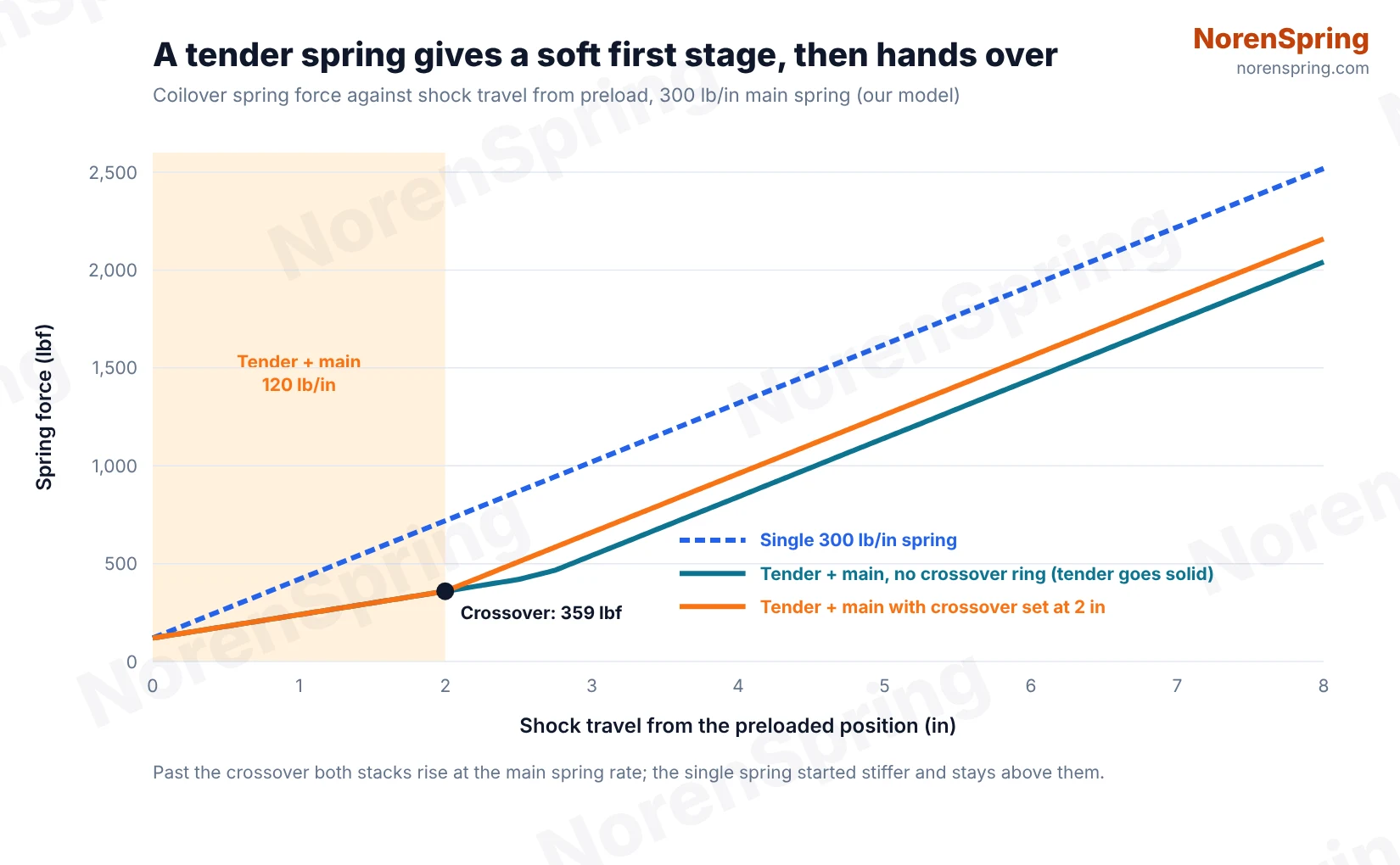
The chart shows what the rider feels: all three setups start at the same 120 lbf preload, and the single 300 lb/in spring is firm from the start. With the tender spring, the first 2.0 in are at 120 lb/in, then the line turns up at the main spring rate. Without a crossover ring, the tender keeps compressing until it is solid, here after 2.65 in of shock travel, and the switch comes later.
Stress in the tender spring
The tender spring sees its highest stress at the crossover load, or at solid height if it is allowed to close. Using the Bergsträsser factor (Kb = 1.153 at index 8.9):
| Condition | Force | Shear stress | Share of tensile strength | Shigley Table 10-6 guide |
|---|---|---|---|---|
| At crossover (ring set as above) | 1,596 N | 654 MPa | 41 % | 50 % as wound |
| At solid height (no ring) | 1,945 N | 797 MPa | 51 % | 50 % as wound; 65 to 75 % set removed |
Shigley’s Table 10-6 puts the limit for hardened and tempered low-alloy steel at 50 % of tensile strength before set is removed and 65 to 75 % after set is removed [7]. Our tender spring is comfortable at the crossover, but if it is allowed to go solid, it sits just above the as-wound guide, so it should be pre-set (compressed solid during manufacture to remove set) or stopped short by the ring. Using the Ks factor that the set-removed column calls for, the solid stress is 46 % of tensile strength, well inside 65 %.
In our example only three active coils carry the full crossover load, so each coil deflects a long way and the 8 mm wire is heavy for a 200 lb/in rate.
How do tender springs change ride height and sag?
Preload on a dual-spring stack compresses both springs, but the tender takes most of it. In our example, 120 lbf of preload compresses the tender 15.3 mm and the main spring 10.1 mm, 25.4 mm (1.0 in) in total. When the vehicle sits on its wheels, the static load compresses the stack further at the combined rate.
This has two effects on setup. First, with a soft first stage the shock sags more for the same corner weight, so ride height may need resetting with the spring perch. Wikipedia’s coilover article notes that “In coilovers with adjustable spring seats, linear-rate springs and no helper or tender springs, ride height must be adjusted through preload” [4]. With a tender stack, the crossover position gives the builder a second setting to work with.
Second, added load uses up part of the first stage, and Eibach’s UTV guide puts it this way: “Added weight increases sag and reduces available compression travel” [6]. If the vehicle already sits past the crossover at ride height, the tender spring does nothing on the trail. Check that ride height falls before the crossover with the normal load on board.
What to specify when ordering tender springs
A coilover tender spring is a short compression spring, so the drawing items are those in our compression spring design guide, plus the items that tie it to the stack:
- Inside diameter to match the coilover (for example 2.25, 2.5 or 3.0 in) and the divider.
- Rate in lb/in or N/mm, with a tolerance, measured between two stated heights.
- Free length and maximum solid height, for example 96.6 mm and 40.8 mm in our design, so the crossover gap and the tender travel fit the shock.
- Load at the crossover height, such as 1,596 N (359 lbf) in our example, if a crossover ring is used.
- Whether the spring may go solid in service. If yes, ask for set removal and a solid-height load test.
- Material and finish: chrome silicon or chrome vanadium wire, shot peening, and coating such as powder coat or zinc plating, and our chrome silicon springs guide compares the two wire grades.
- End type: closed and ground ends sit square against the divider and the top hat.
- Matching main spring rate, so the combined rate can be checked on the drawing.
- Batch load testing at two heights, with the report sent with each shipment.
If you are designing a full dual-rate or triple-rate kit, send the shock travel, the corner weights and the target first-stage rate through our contact page, and our engineers will size the tender spring with the main spring. Our compression springs page shows the wire sizes and finishes we produce, and you can read more about our company and its certifications. This guide was compiled by our editorial team with our spring engineers.
FAQ
What does a tender spring do on a coilover?
It adds a soft first stage: while the tender and main springs compress together, the rate is (tender × main) / (tender + main). Once the tender closes or the crossover ring stops it, the main spring works alone and the rate rises to the main spring rate.
Is a helper spring the same as a tender spring?
No. Eibach describes a helper spring as having “very little spring rate” and “no effect on the suspension characteristics”, while a tender spring sets the “softer initial rate” [1].
How do I calculate the combined spring rate?
Multiply the two rates and divide the product by their sum. Shock Therapy’s example of two 250 lb/in springs gives 125 lb/in [2]. A 200 lb/in tender with a 300 lb/in main gives 120 lb/in.
Where should the crossover ring be set?
Set it so the gap between the ring and the divider equals the tender compression you want after preload. In the first stage the tender takes the fraction (main rate) / (tender + main) of the shock travel. With 200 and 300 lb/in springs that is 0.6, so a 2.0 in first stage needs a 1.2 in gap.
Can a tender spring be allowed to go solid?
Yes, if it is designed for it: check the stress at solid height against the set-removed limits in Shigley Table 10-6 and ask the spring maker to pre-set the spring. Otherwise, use a crossover ring to stop the divider before the tender reaches solid height.
Sources
- Eibach, “Race Spring Systems” (main and tender, main and helper systems). eibach.com
- Shock Therapy, “The Truth about Dual Rate Springs”. shocktherapy.com
- US Patent 12,077,028 B2, “Coilover shock with adjustable crossover”, Google Patents. patents.google.com
- Wikipedia, “Coilover”. en.wikipedia.org/wiki/Coilover
- BimmerWorld, Eibach 2.25″ coil over tender spring, product listing. bimmerworld.com
- Eibach, “How to Choose UTV Spring Rates” technical guide. eibach.com
- Shigley’s Mechanical Engineering Design, chapter 10 lecture slides (mechanical springs), Istanbul Technical University. web.itu.edu.tr



