










In this article
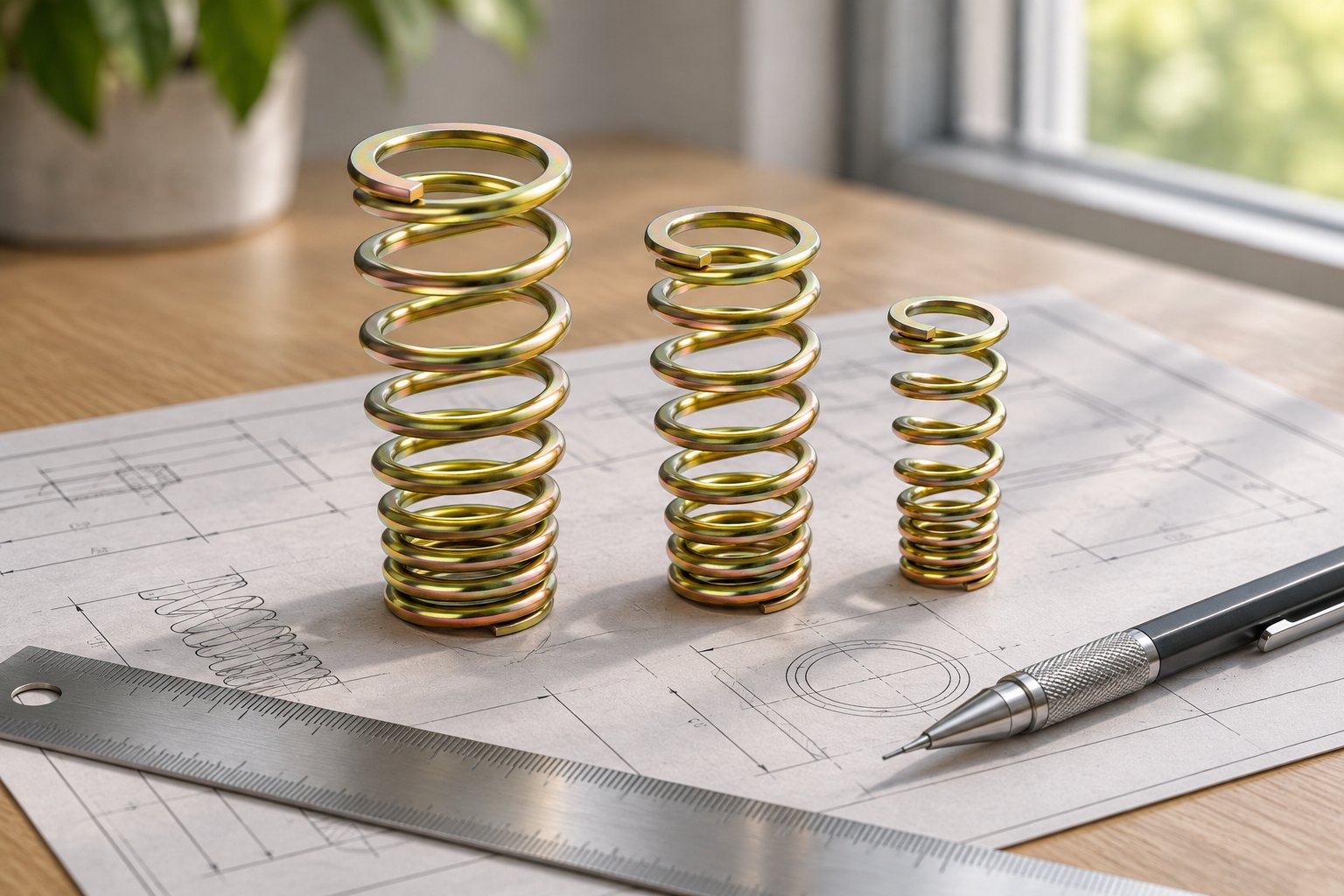
Cover image: an AI-generated illustration of variable pitch springs, based on a photo of our zinc plated springs, not a photograph of a specific order.
A variable rate spring is a spring whose rate changes with deflection, instead of staying constant like an ordinary coil spring. In almost every industrial case the rate rises, so the spring is also called a progressive spring: soft at the start of its travel and stiffer towards the end. The rise comes from coils that touch and stop working one after another. Variable pitch, conical, dual-rate and stepped nested springs all use this effect in different ways.
This guide explains how each type works, works through a variable pitch compression spring with its load table and chart, and lists what to put on the drawing so the spring you receive behaves as designed.
Key takeaways
- The rate rises because active coils drop out. A coil spring’s rate is k = G·d⁴ / (8·D³·Na) [2]. When a coil closes, Na falls and the rate goes up.
- Four common designs. Variable pitch, conical, dual-rate (two springs in series) and stepped nested springs (an inner spring that engages later).
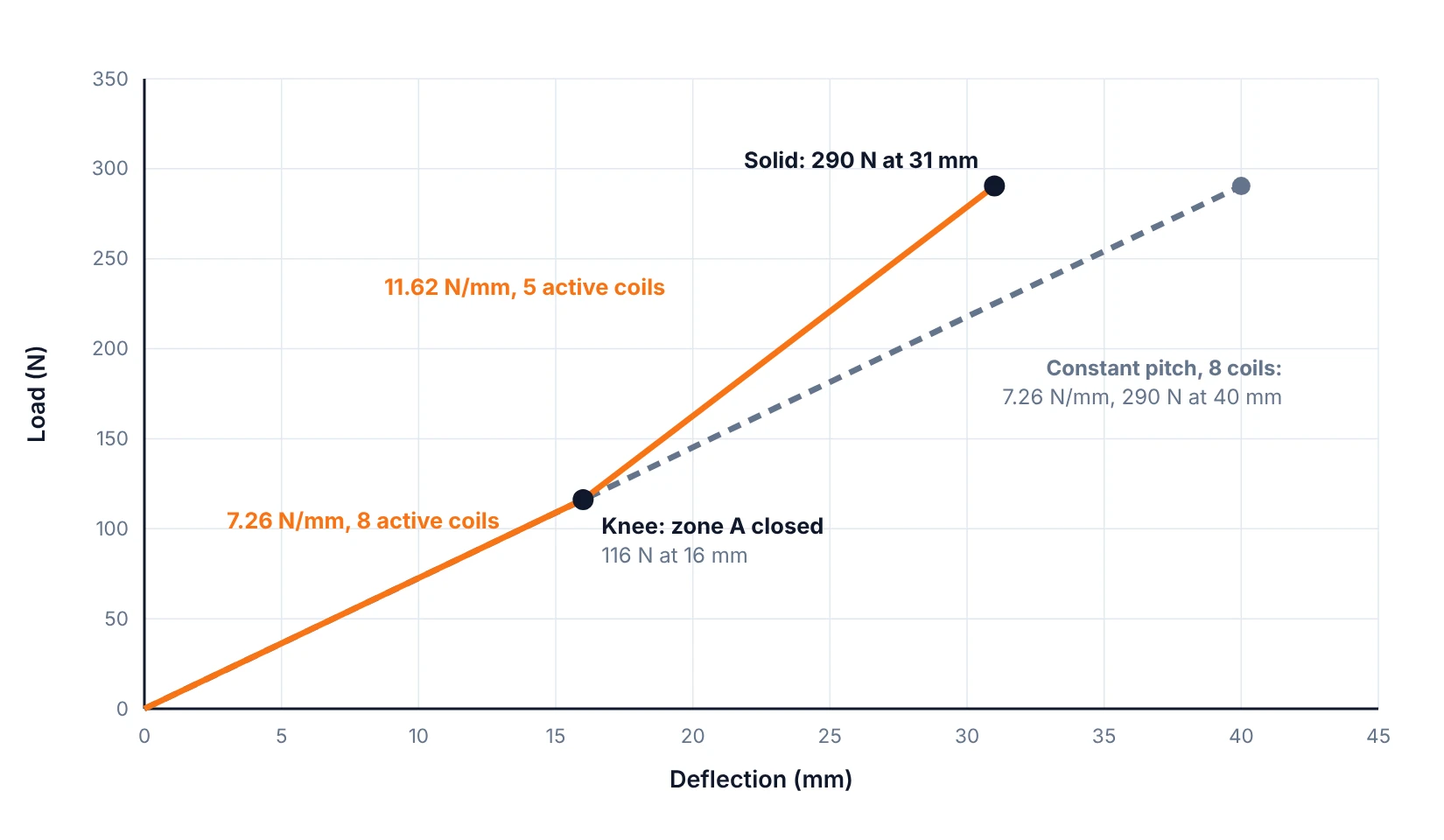
- The knee is predictable. In a variable pitch spring, the closely spaced coils close first, at a load set by their gap. Our worked example rises from 7.26 N/mm to 11.62 N/mm at 116 N.
- Why use one? A soft start with a firm end, a shorter spring for the same end load, and less resonance. Progressive load-deflection curves help limit vibration near resonance [1].
- Specify loads at heights, not a rate. A progressive spring needs a load-height table with at least one point below and one above the knee.
How a variable rate spring works
A cylindrical coil spring with a constant pitch has one rate from free length almost to solid. Every active coil carries the same force and deflects by the same amount, so all the gaps close together. The rate is linear.
Now make the gaps unequal, for example three close coils at one end and five open coils at the other. Under any load, each active coil still deflects by the same amount, because the same force passes through every coil and each coil has the same diameter and wire. The coils with the smallest gap therefore close first. Once a coil touches its neighbour, it stops deflecting and drops out of the active count. With fewer active coils, the remaining spring is stiffer. A modern research paper on nonlinear springs describes this as changing the spring’s geometry, by variable pitch and/or diameter, to give a nonlinear load-deflection curve [1].
Two consequences follow:
- The rate only changes when a coil closes. Between closures, the spring is linear. A spring with two pitch zones has two rates, a spring with a continuously changing pitch has a smooth curve.
- Coils that have closed are in contact. That contact makes noise and wear if the spring vibrates across the knee, and it is why the closing load must be set with care.
Four ways to build a variable rate spring
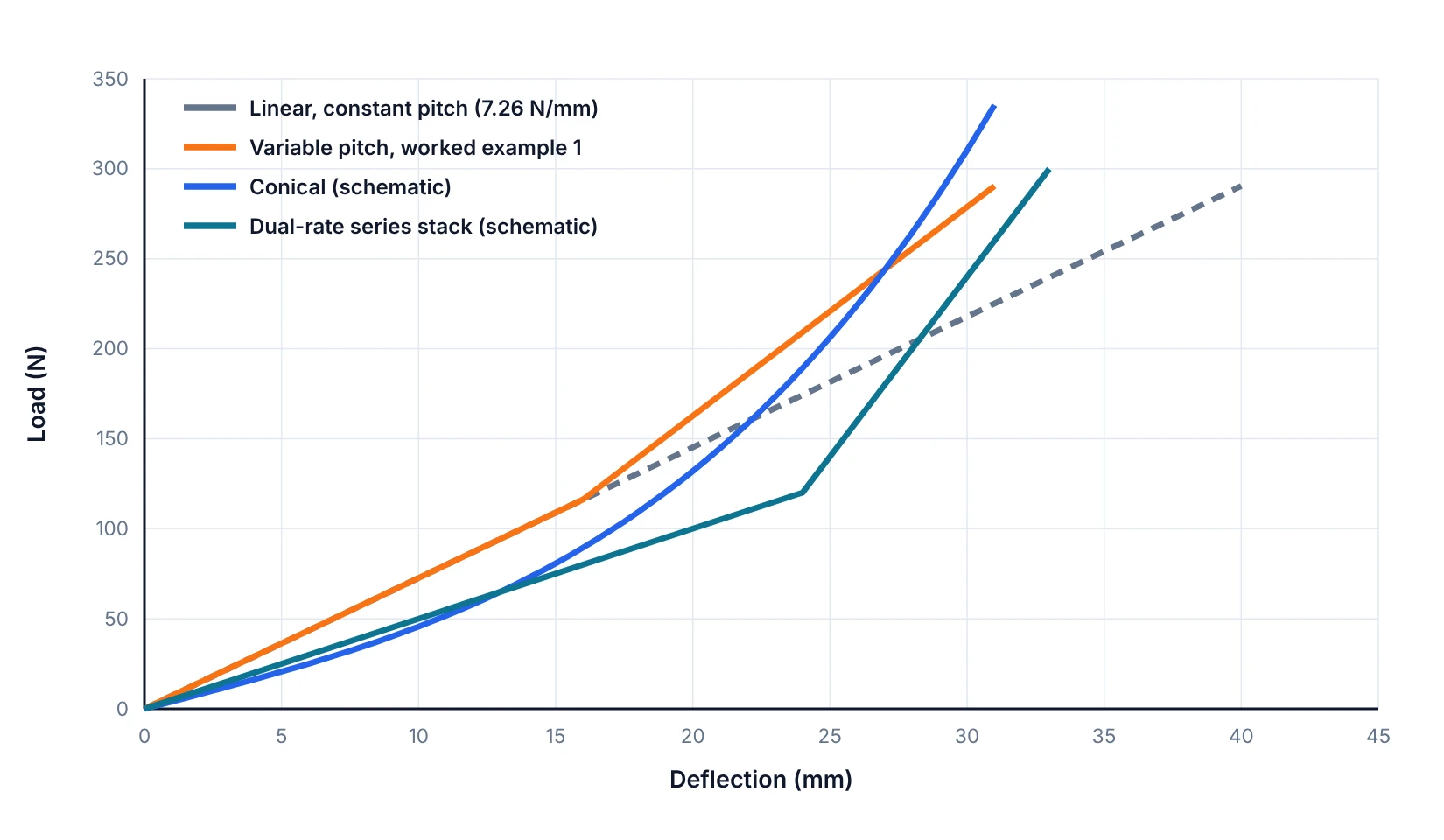
| Type | How the rate rises | Typical shape of the curve | Main design control |
|---|---|---|---|
| Variable pitch | Closely spaced coils close first | Steps, or a smooth curve if the pitch changes gradually | Gap of each coil zone |
| Conical | Large-diameter coils are softer, deflect more and bottom first | Smooth rising curve | Diameter change per coil and pitch |
| Dual-rate (series) | A soft spring goes solid, then the stiff spring works alone | Two straight lines with a sharp knee | Travel to solid of the soft spring |
| Stepped nested | An inner spring is shorter and only engages after some travel | Two straight lines, the second steeper | Free length difference |
Variable pitch springs are the most common progressive compression springs. The coil diameter is constant and only the pitch changes, which CNC coiling machines control coil by coil. The pitch can change in steps or continuously. The research above uses a constant transition radius between sections of different pitch, which it describes as the most advantageous choice for fatigue strength [1].
Conical springs combine a changing diameter with a changing rate. Each coil’s stiffness depends on D³, so the largest coils are the softest and bottom out first. A conical spring can also be designed so that the coils nest inside each other, giving a very low solid height. Our conical spring guide covers telescoping designs and their rate curves.
Dual-rate springs use two springs in series, usually a soft tender spring and a stiff main spring separated by a guided plate. The soft spring takes up the first part of the travel and then goes solid. Our article on springs in series and parallel works through a dual-rate stack from 7.14 N/mm to 25 N/mm. For the coilover version, our guide to tender and helper springs sizes the soft spring and checks its stress when it goes solid.
Stepped nested springs are two concentric springs in parallel with different free lengths. The outer spring works alone until the plate reaches the shorter inner spring, and from then on the two rates add. This gives a clean knee without any coil contact at the transition.
Worked example 1: a two-zone variable pitch spring
We take a music wire compression spring with closed and ground ends and two pitch zones. Shear modulus G = 79.3 GPa, and stress uses the Wahl factor [2].
| Parameter | Value |
|---|---|
| Wire diameter d | 3.0 mm |
| Mean diameter D | 24.0 mm (spring index C = 8, Wahl factor 1.184) |
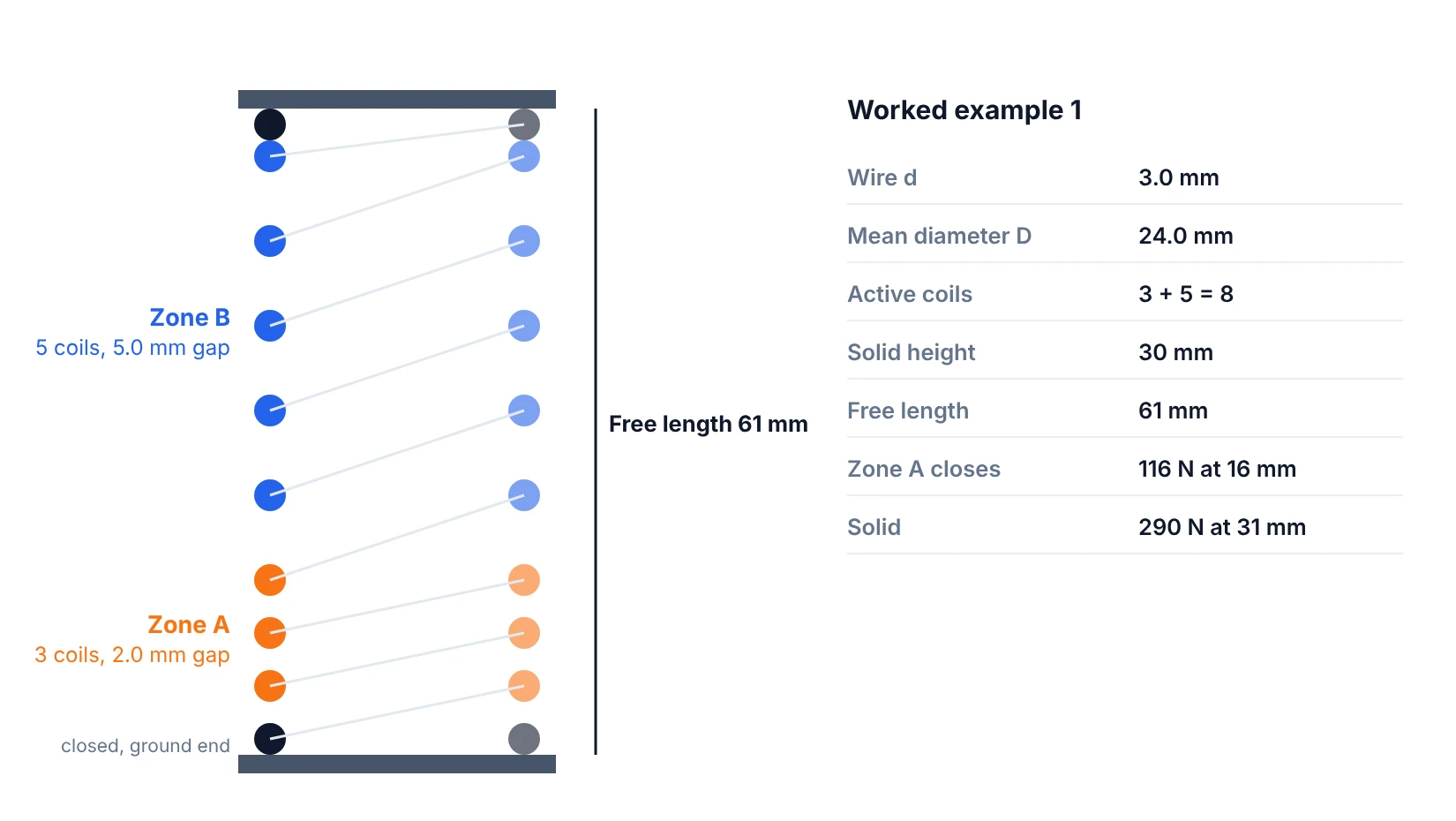
| Zone A (close pitch) | 3 active coils, 2.0 mm gap between coils |
| Zone B (open pitch) | 5 active coils, 5.0 mm gap between coils |
| Rate of one active coil | G·d⁴ / (8·D³) = 58.08 N/mm |
| Solid height | (8 + 2) × 3.0 = 30 mm |
| Free length | 30 mm + (3 × 2.0 + 5 × 5.0) = 61 mm |
Every active coil carries the same force, so each one deflects by F / 58.08 mm. The spring works in two stages.
- Stage 1, all 8 coils active. Rate = 58.08 / 8 = 7.26 N/mm. Zone A closes when each coil has moved its 2.0 mm gap: at 58.08 × 2.0 = 116 N and a total deflection of 8 × 2.0 = 16 mm.
- Stage 2, only zone B active. Rate = 58.08 / 5 = 11.62 N/mm. Zone B closes when its coils have moved 5.0 mm in total: at 58.08 × 5.0 = 290 N and a total deflection of 16 + 5 × 3.0 = 31 mm, which is solid.
| Deflection | Spring height | Load | Active coils | Rate |
|---|---|---|---|---|
| 0 mm | 61 mm | 0 N | 8 | 7.26 N/mm |
| 10 mm | 51 mm | 73 N | 8 | 7.26 N/mm |
| 16 mm (knee) | 45 mm | 116 N | 8 → 5 | 7.26 → 11.62 N/mm |
| 20 mm | 41 mm | 163 N | 5 | 11.62 N/mm |
| 25 mm | 36 mm | 221 N | 5 | 11.62 N/mm |
| 31 mm (solid) | 30 mm | 290 N | 0 | — |
Quick reference: rate of one active coil. With d fixed, k for one coil is G·d / (8·C³), so the table below covers any steel spring with G = 79.3 GPa. Divide by the number of active coils for the spring rate; multiply by a coil’s gap for the load at which that coil closes.
| Wire diameter d | One coil, C = 6 | One coil, C = 8 | One coil, C = 10 |
|---|---|---|---|
| 1.0 mm | 45.9 N/mm | 19.4 N/mm | 9.9 N/mm |
| 2.0 mm | 91.8 N/mm | 38.7 N/mm | 19.8 N/mm |
| 3.0 mm | 137.7 N/mm | 58.1 N/mm | 29.7 N/mm |
| 4.0 mm | 183.6 N/mm | 77.4 N/mm | 39.6 N/mm |
| 5.0 mm | 229.5 N/mm | 96.8 N/mm | 49.6 N/mm |
| 6.0 mm | 275.3 N/mm | 116.2 N/mm | 59.5 N/mm |
| 8.0 mm | 367.1 N/mm | 154.9 N/mm | 79.3 N/mm |
Stress check. At solid, the corrected shear stress is 1.184 × 8 × 290 × 24 / (π × 3³) = 778 MPa. The Shigley tensile strength constants give music wire of 3.0 mm a minimum tensile strength of about 1,885 MPa, and a common static limit before presetting, 0.45 times that figure, is 848 MPa [2]. The spring can be compressed solid without taking a set.
What the variable pitch bought. A constant-pitch spring with the same wire, diameter and 8 active coils that also reaches 290 N at solid needs a 5.0 mm gap on every coil. It has a constant 7.26 N/mm rate, 40 mm of travel and a 70 mm free length. The variable pitch version gives the same end load in 31 mm of travel and a 9 mm shorter free length, while keeping the same soft rate over the first 16 mm.
The knee is never as sharp as the calculation
The worked example assumes all three zone A coils close at exactly 116 N. Real springs round the corner for three reasons:
- Transition coils. The pitch cannot jump from one value to another within a fraction of a turn. The coil between the two zones has an intermediate gap and closes on its own, between the two stages.
- Gap tolerance. Each gap varies a little from coil to coil. The tightest coil closes first, the others follow over a few newtons.
- End coils. The last active coil next to a closed end touches the end coil gradually, which adds a small rise in rate at the very start of travel.
So we never set a working position at the calculated knee. Put working points at least a few millimetres either side, where the load is predictable, and use the knee only as the boundary between the two working ranges.
Where variable rate springs are used
- Engine valve springs. Dual springs and progressive-sprung valves are among the ways used to fight valve float without simply fitting a stiffer spring [3].
- Vehicle suspension. Progressive and dual-rate coil springs let a vehicle ride softly when empty and still carry a load. Our custom suspension springs article covers linear, progressive and dual-rate choices.
- Seats, handles and pedals. A soft initial feel with a firm end stop, for example a pedal that must feel light at first touch but stop firmly.
- Machinery under dynamic load. Progressive curves help limit vibration amplitudes near resonance, both of the mass on the spring and of the spring’s own coils [1]. Our article on spring natural frequency explains surge and resonance.
- Tight packages. As in the worked example, a progressive spring can reach a given end load in less length than a linear spring.
How to specify a variable rate spring
A single rate value means nothing on a progressive spring. Use this checklist instead:
- A load-height table with at least three points: one in the soft range, one in the stiff range and the maximum working height. Give a tolerance on each load.
- Solid height and the load at solid if the spring can be driven solid in service, so the stress at solid can be checked.
- The pitch layout if you have one: the number of coils in each zone and the gap or pitch of each. If you only know the curve you need, give the table and let the spring maker design the pitch.
- Which end goes where if the zones are not symmetrical. A variable pitch spring with its close coils at one end can be fitted upside down; mark it or make it symmetrical.
- Ends, wire and finish as for any compression spring. Our compression spring design guide covers the rest of the drawing.
We coil variable pitch and conical springs on CNC coilers that set the pitch coil by coil, and we test load at several heights on our spring testers so the whole curve, not one point, is checked. Our compression spring and conical spring lines both include progressive designs. Send the load-height table you need, or the space and loads, through our contact page, and we will propose the pitch layout. You can read more about us and our test lab. This guide was compiled by our editorial team with our spring engineers.
Frequently asked questions
What is a variable rate spring?
A variable rate spring is a spring whose rate changes as it is compressed. Usually the rate rises, because coils close and stop working one after another. Variable pitch, conical, dual-rate and stepped nested springs are the common types.
What is the difference between a progressive spring and a dual-rate spring?
A progressive spring has a rate that rises gradually or in several small steps, usually from a variable pitch or conical shape in one spring. A dual-rate spring has two distinct rates with a clear knee, usually from two springs in series where the soft one goes solid first. Our fork springs guide compares a linear and a dual-rate fork spring for the same motorcycle.
How do you calculate the rate of a variable pitch spring?
Work out the rate of one active coil, G·d⁴ / (8·D³). Divide it by the number of active coils to get the starting rate. A coil zone closes when each coil has deflected by its own gap, so the load at that point is the single-coil rate times the gap. After that, divide the single-coil rate by the coils that are still active.
Are variable rate springs better than linear springs?
Not in general. A linear spring is more predictable and easier to specify and test. Use a variable rate spring only when you need a soft start and a firm end, a shorter spring for the same end load, or better behaviour near resonance.
Can a conical spring be linear?
Yes, if the pitch is varied to compensate for the change in diameter, so that the coils do not touch over the working range. Without that compensation, a conical spring is progressive.
References
- K. Michalczyk, M. Warzecha, R. Baran, “A New Method for Generating Virtual Models of Nonlinear Helical Springs Based on a Rigorous Mathematical Model”, Applied Computer Science 19(2), 2023, AGH University of Science and Technology. https://ph.pollub.pl/index.php/acs/article/download/3656/3160/18123
- Shigley’s Mechanical Engineering Design, Chapter 10 Mechanical Springs, lecture slides, Istanbul Technical University. https://web.itu.edu.tr/~halit/Makel/Ch_10_slides_m.pdf
- Wikipedia, “Valve float”. https://en.wikipedia.org/wiki/Valve_float



