










In this article
- Key takeaways
- What does a fork spring do?
- How much sag should a motorcycle fork have?
- How to calculate the fork spring rate
- Linear vs progressive fork springs
- Wire, finish and fatigue
- Installed length, preload and room to solid height
- What to put on the drawing for a fork spring
- Custom fork springs from NorenSpring
- FAQ
- Sources
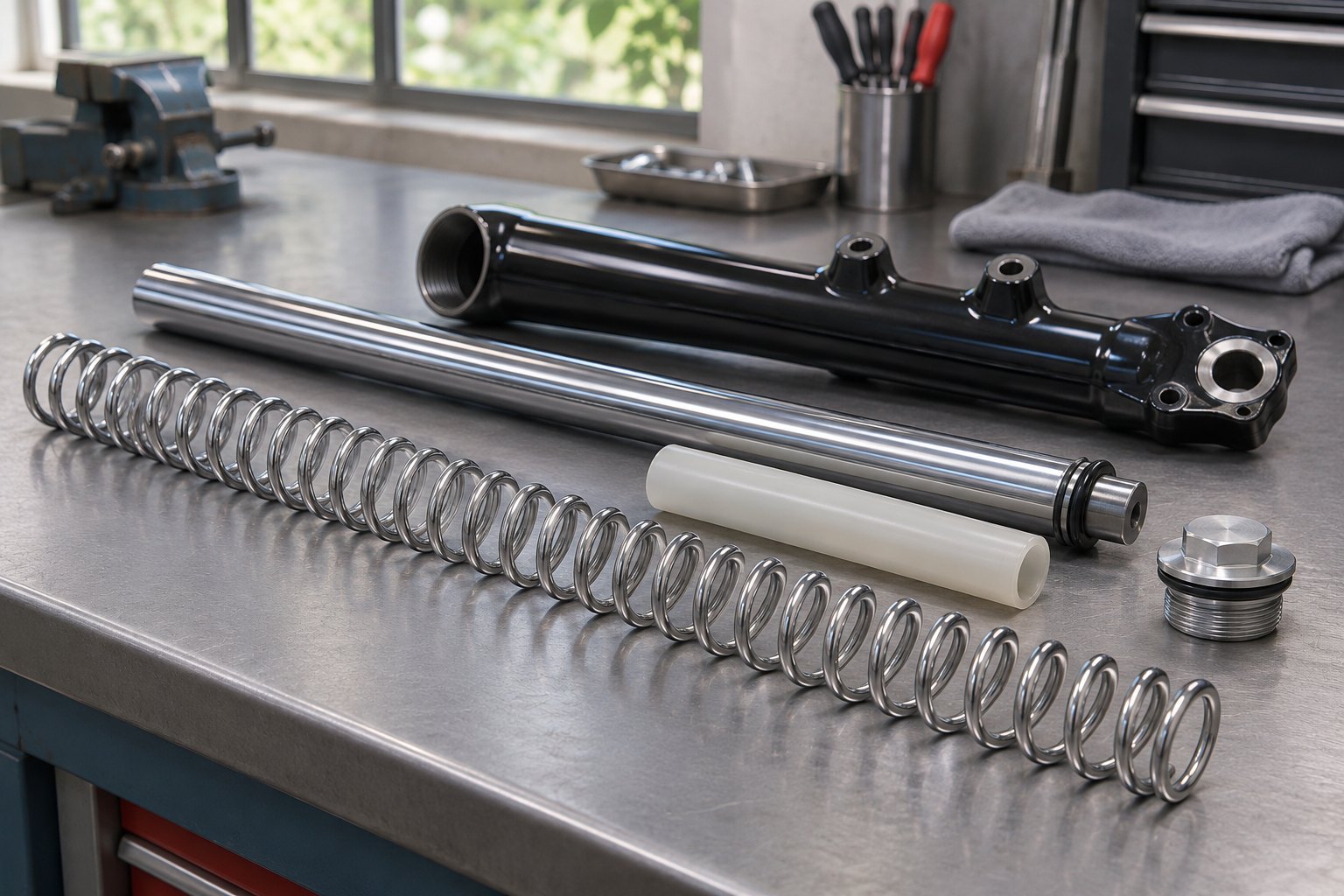
Cover image: an AI-generated illustration of a generic fork rebuild, based on a photo of compression springs we make; it does not show a specific brand’s fork or spring.
Fork springs are the long coil compression springs inside the tubes of a motorcycle’s telescopic front fork. They carry the front of the bike and the rider, and their rate and preload decide how far the fork sinks when the rider gets on (the sag) and how much travel is left for bumps and hard braking. Race Tech’s founder put the street target this way: “Street bikes run between 25 and 33 percent of their total travel, which equates to 30 to 35mm” [1].
This guide is for suspension brands and workshops who source fork springs, and for riders deciding between a linear and a progressive set. We work through the rate for an example bike, then compare a linear and a progressive spring that give the same sag. For the general idea of preload, see our spring preload guide.
Key takeaways
- The rate is calculated from the sprung load and the sag target. For our example motorcycle, an 80 kg rider requires approximately 10.3 N/mm (1.05 kg/mm) in each fork leg to settle at 32 mm of sag with 20 mm of preload.
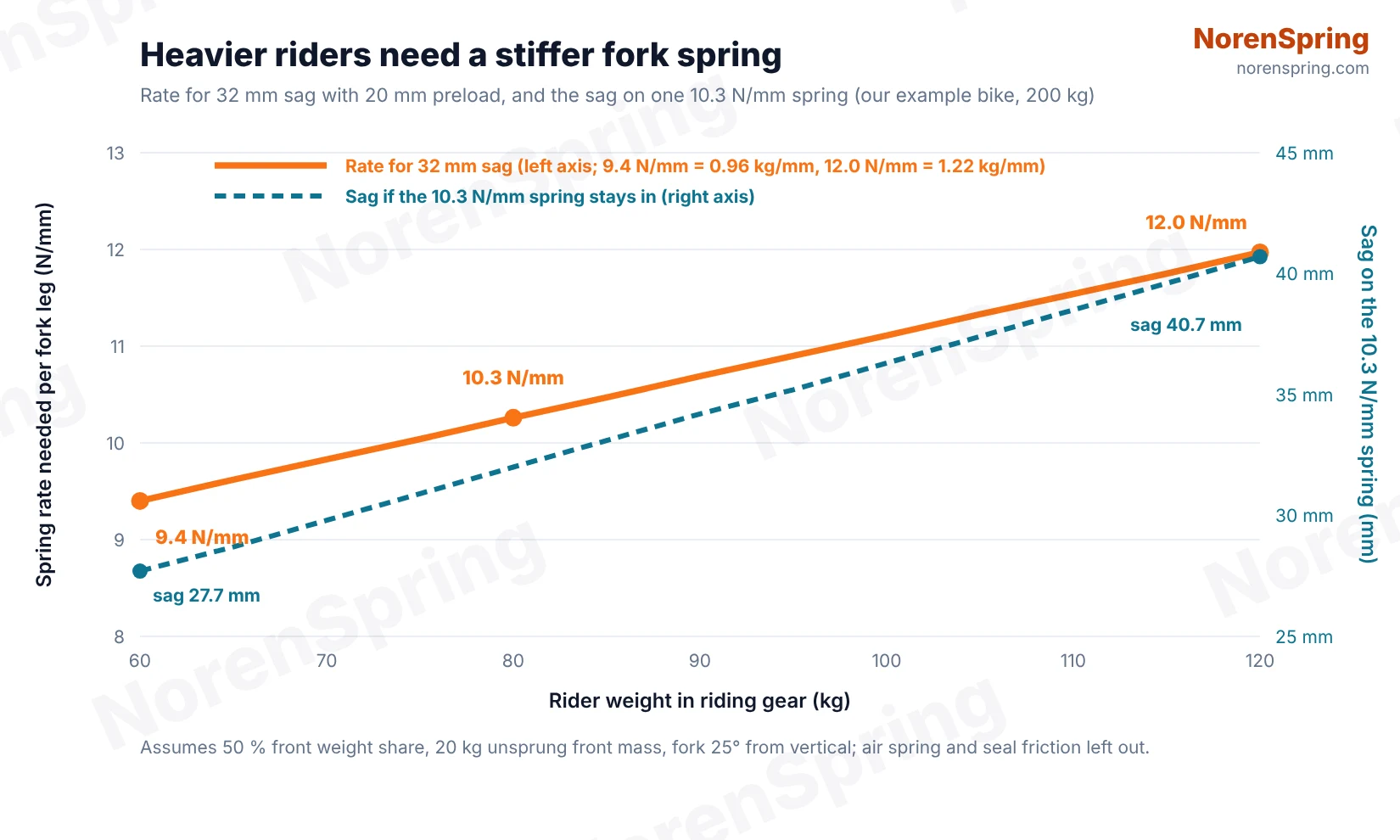
- Rider weight changes the required rate considerably. With an identical spring, sag increases from 27.7 mm for a 60 kg rider to 40.7 mm for a 120 kg rider, and maintaining 32 mm requires between 9.4 and 12.0 N/mm.
- Preload does not modify the spring rate. It only relocates the operating range within the stroke, so a spring that requires considerable preload to reach the sag target is probably too soft for the rider.
- A progressive spring behaves like two springs in series. In our example, the close-wound section becomes solid after 16 mm of fork travel, and the effective rate then increases from 8.7 to 13.9 N/mm.
- Stress at full travel determines the wire specification. Our linear 6.0 mm chrome silicon spring reaches 46 % of its tensile strength with the fork completely compressed, while the progressive alternative reaches 56 % and therefore requires presetting.
What does a fork spring do?
A telescopic fork has two jobs: the springs hold the bike up, and the damper controls how fast the fork moves. The spring rate is the force needed for each additional millimetre of compression, while preload is the compression already in the spring when the fork is fully extended. RevZilla’s suspension glossary defines it: “Spring preload is how much the spring is compressed from its free length while the suspension component is fully extended” [3].
Preload does not change stiffness at all. Bennetts BikeSocial puts it plainly: “Preload doesn’t alter the spring rate though” and “You can only alter spring rate by changing the springs” [2]. RevZilla says the same: preload “does not change the spring rate” [3].
Spring rate units: N/mm and kg/mm
Fork springs are specified either in N/mm or in kg/mm, where 1 kg/mm is equivalent to 9.81 N/mm. Teknik Motorsport lists a genuine Showa spring as “41.5mm outer diameter and 480mm length” with “5mm wire diameter” and a rate of 4.0 N/mm [7]. The same shop lists a KYB spring of 41 mm outside diameter and 460 mm free length in rates from 3.6 to 4.7 N/mm [8].
Those published numbers are enough to estimate the rest of the spring. For example, the rate of a helical compression spring is k = G·d⁴ / (8·D³·Na), where d is the wire size, D the mean coil diameter and Na the number of active coils [10]. If the Showa spring were chrome silicon wire (G = 77.2 GPa), 4.0 N/mm with 5 mm wire on a 36.5 mm mean diameter works out to about 31 active coils and a solid height near 165 mm. We use this kind of back-check when a customer sends only the outside diameter, length and rate of an existing spring.
How much sag should a motorcycle fork have?
Sag is how far the fork compresses from full extension with the rider on board. The Race Tech article above gives 30 to 35 mm for street bikes and says “Roadrace bikes usually run between 25 and 30mm” [1]. Penske’s guide is softer for the road: “For the street, 35-45 millimeters is ideal” [5]. Race Tech also adds that “there is no magic number” [1].
Preload has its own recommended range, and Race Tech’s fork instructions say “Street bike preload ranges from 5 to as much as 35mm” and “Dirt bike preload ranges from 4-6mm” [4]. The same page warns: “Fork preload is NOT a tuning variable. Too much preload will make the ride harsh particularly on acceleration bumps.”
Those figures provide a practical diagnostic for the spring rate: if the fork reaches its sag target only with preload near the upper limit of the range, the spring is too soft for the rider, and if it reaches the target with almost no preload, the spring is too stiff.
How to calculate the fork spring rate
The rate per fork leg comes from the load the spring carries at sag, divided by its compression at sag:
k = F_leg / (preload + sag)
F_leg is the sprung front load, along the fork axis, shared between two legs. The table lists the assumptions for our example; they are round numbers for a mid-size road bike, not the data of a specific model.
| Input (our example) | Value |
|---|---|
| Bike, wet | 200 kg |
| Rider in gear | 80 kg |
| Front share of bike plus rider | 50 % |
| Unsprung mass at the front (wheel, brakes, lower fork) | 20 kg |
| Fork angle from vertical | 25° |
| Target sag / preload / fork travel | 32 mm / 20 mm / 120 mm |
The sprung front load is (280 × 0.50 − 20) × 9.81 = 1,177 N. Resolved along a fork inclined at 25°, each leg therefore carries 1,177 × cos 25° ÷ 2 = 533 N, and at the sag position the spring is compressed by 20 + 32 = 52 mm, so:
k = 533 / 52 = 10.3 N/mm, equivalent to 1.05 kg/mm for each leg.
Seal friction also holds the fork up a little, and the calculation leaves it out; Race Tech notes that stiction is “particularly high for telescopic front ends”, which is why it measures sag twice, pushing down and lifting up, and averages the two readings [1].
What happens when rider weight changes
The chart illustrates why a single spring cannot suit every rider: with the 10.3 N/mm spring and 20 mm of preload, a 60 kg rider settles at 27.7 mm of sag, whereas a 120 kg rider settles at 40.7 mm. Maintaining 32 mm across that weight range requires rates from 9.4 to 12.0 N/mm (0.96 to 1.22 kg/mm). A heavier rider can recover several millimetres with additional preload, although every additional millimetre also increases the stress at full travel, as the section on installed length below demonstrates.
Linear vs progressive fork springs
A linear spring has the same pitch along its length and the same rate through the stroke. webBikeWorld describes the other kind: “A progressive or dual-rate spring is wound closer at one end and further apart at the other” [6]. Bennetts explains what happens in the fork: “As the spring compresses, the most densely packed windings eventually come together into a solid lump, effectively increasing the spring rate” [2].
The article quotes suspension specialists on both sides: race-focused tuners mostly choose linear springs, while Ikon Suspension’s director says a “well-chosen progressive-rate spring will do a better job than a linear rate spring” where riding conditions vary [6].
How a progressive spring works, in numbers
A dual-pitch spring behaves like two springs in series: before the close-wound section closes, both sections deflect and the combined rate is the series rate, and once it closes, only the open section works and the rate jumps. Our guide to springs in series and parallel covers the formula.
We designed a progressive spring for the same bike and rider, with the same 6.0 mm wire and 41.5 mm outside diameter as the linear one, and the same 533 N at the sag point:
| Linear (our design) | Progressive (our design) | |
|---|---|---|
| Rate | 10.3 N/mm throughout | 8.7 N/mm, then 13.9 N/mm |
| Rate change point | none | after 16.4 mm of fork travel |
| Active coils | 27.2 | 32.1 in total: 11.9 close-wound, 20.2 open |
| Total gap in the close-wound section | n/a | 13.5 mm |
| Force at sag (32 mm) | 533 N | 533 N |
| Force with the fork bottomed (120 mm) | 1,436 N | 1,752 N |
| Shear stress at bottom, % of tensile strength | 46 % | 56 % |
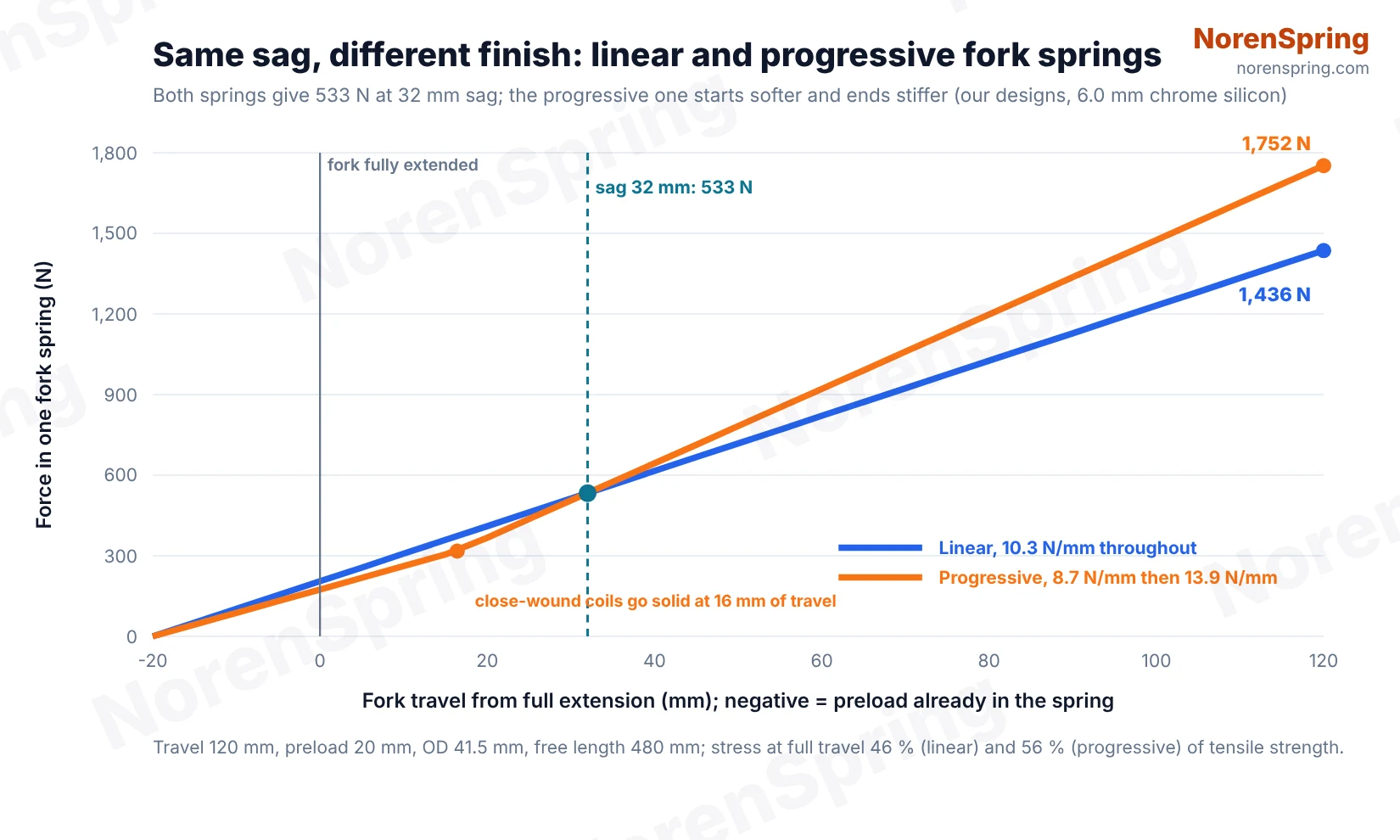
The progressive spring is softer over the first 16 mm, which takes the edge off small bumps, and carries 22 % more force than the linear spring at full travel (1,752 against 1,436 N), which resists bottoming under hard braking. The cost is a higher peak stress. At 56 % of tensile strength it is above the 50 % that Shigley’s Table 10-6 gives for hardened and tempered alloy steel springs without set removal, so we would preset it (compress it solid before final inspection) rather than run it as wound [10].
The close-wound section also has to be manufactured to an accurate pitch, because 13.5 mm of total gap distributed over 11.9 coils is approximately 1.1 mm for each coil. A pitch variation of a few tenths of a millimetre per coil relocates the transition point by several millimetres of fork travel, so the drawing should specify the transition as a force at a defined length, not only as a coil count.
Wire, finish and fatigue
Fork springs see high stress on every bump and every stop, so they are wound from high-strength alloy spring wire. Race Tech’s spring instructions describe its springs as made from “suspension quality” chrome silicon wire, “shot-peened, heat-treated and powder-coated” [9]. Our chrome silicon springs guide compares the wire grades.
Shot peening matters here, because it raises the fatigue strength at the wire surface. For our linear spring cycling between the sag point and 80 % of fork travel (533 to 1,256 N), the Gerber fatigue safety factor, using Zimmerli’s data for spring steel, is 1.55 for a peened spring and 1.11 for an unpeened one [10]. Our shot peening guide explains why the peened figure is higher.
Rate tolerance is worth agreeing before production, since Race Tech notes that “Standard production tolerances for the industry are +/- 5%” and that, as a result, springs marked with nearby rates can overlap [9]. For a matched pair, the two legs should come from the same batch and be checked against each other.
A fork spring is also a long, slender compression spring, with a free length more than ten times its diameter. Inside the fork tube it is guided, so it does not buckle in service, but it can bow on a load tester. See our buckling guide for the test fixtures that avoid false readings.
Installed length, preload and room to solid height
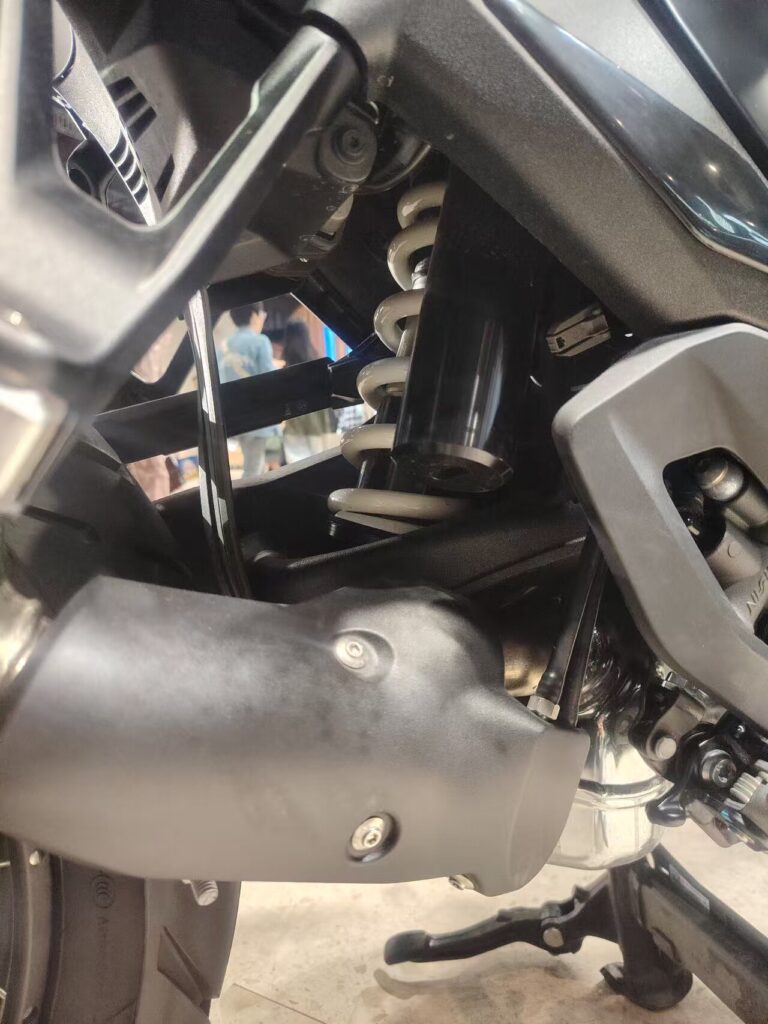
In our linear example, the fork spring uses less than half of the deflection it could physically provide. The free length is 480 mm and the solid height is 175 mm, so the coils could theoretically compress by 305 mm. Installed with 20 mm of preload, the spring sits at 460 mm, and with the fork completely compressed at 120 mm of travel it sits at 340 mm, which still leaves 165 mm of clearance before adjacent coils touch.
Because the fork tube is long and narrow, the designer can distribute the deflection over many active coils, which keeps the stress for every millimetre of travel moderate and allows a relatively small wire diameter.
Additional preload has a measurable consequence, however. Every extra millimetre of preload adds 10.3 N to the force at full travel, and the shear stress increases in proportion to that force:
| Preload (our linear design) | Force with the fork bottomed | Shear stress | % of tensile strength |
|---|---|---|---|
| 20 mm (design value) | 1,436 N | 755 MPa | 46 % |
| 30 mm | 1,539 N | 809 MPa | 49 % |
| 40 mm | 1,641 N | 863 MPa | 52 % |
At approximately 33 mm of preload, the linear spring passes the 50 % limit that Shigley’s Table 10-6 gives for springs without set removal [10]. Race Tech’s street range extends to 35 mm [4], so a workshop that later installs a longer spacer could realistically push an unpreset spring beyond that limit. Specifying presetting on the drawing protects against that situation, which is why the drawing table below lists the spring as preset.
What to put on the drawing for a fork spring
These are the values for our linear example. The tolerances are example values to agree with the customer.
| Item | Linear example |
|---|---|
| Wire | 6.0 mm chrome silicon (ASTM A401 class), shot peened, preset |
| Outside diameter | 41.5 mm maximum, for free movement inside the fork tube |
| Free length | 480 mm |
| Rate | 10.3 N/mm ± 3 %, measured between 20 and 140 mm of compression |
| Force at installed length (460 mm) | 205 N |
| Force at sag (428 mm) | 533 N |
| Ends | closed and ground, square within 2° |
| Solid height | 175 mm max |
| Finish | powder coating or black oxide, as agreed with the customer |
| Matched pair | rates of the two legs within 2 % of each other |
For a progressive spring, additionally specify both rates and the force at the length where the rate changes. For a damping rod fork, specify the length of the preload spacer the spring is designed around, since Race Tech sets fork preload by cutting spacer tube to length [4].
Custom fork springs from NorenSpring
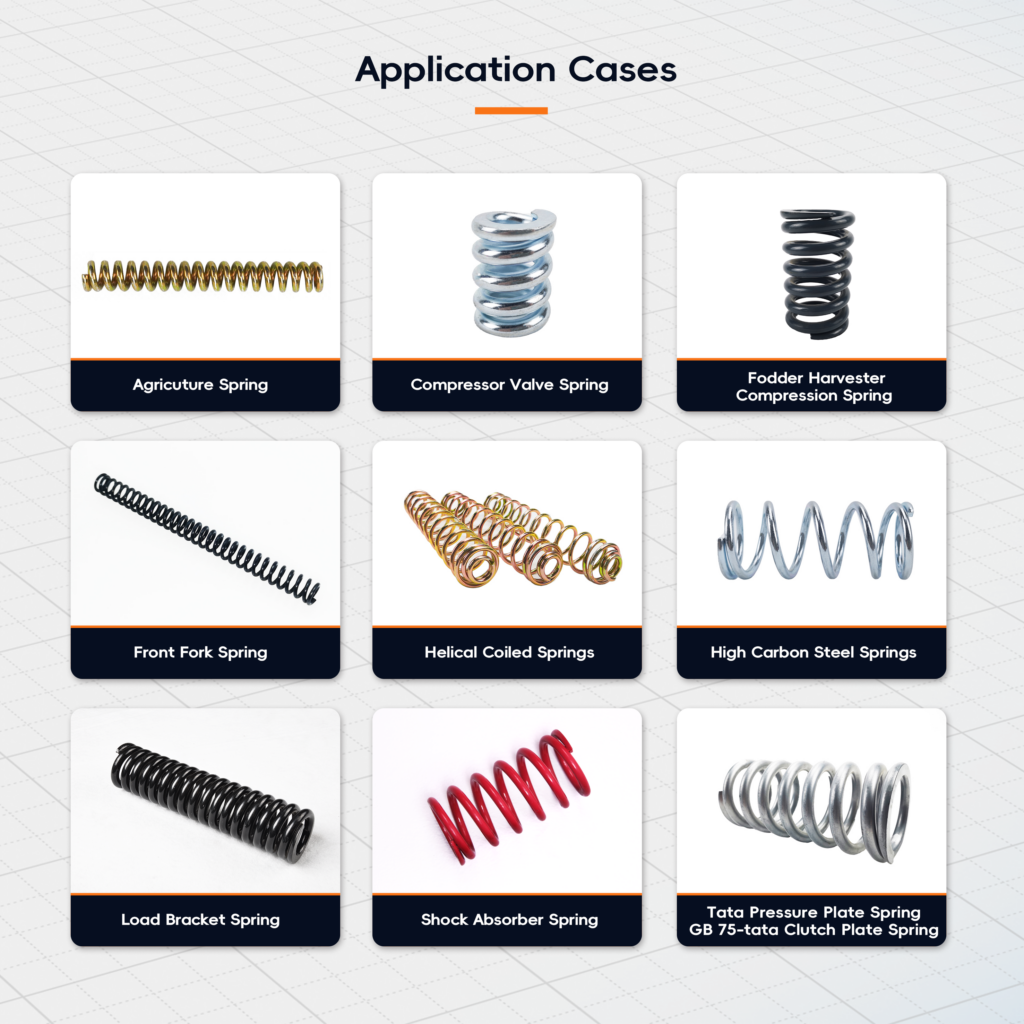
Front fork springs and shock absorber springs are among the compression spring parts in our application cases. We make compression springs from wire 0.1 mm to 80 mm, and our quality system is certified to IATF 16949 for automotive parts. Read more about our company.
Send the fork model or tube inside diameter, the current spring’s free length, outside diameter and rate, your target sag and rider weight range, and the travel, through our contact page. Our engineers will check the rate, the stress at full travel and the room left to solid height. This guide was compiled by our editorial team with our spring engineers.
FAQ
Are progressive fork springs better than linear?
Neither type is better in every case: progressive springs are softer at first and stiffer deep in the travel, which suits mixed road riding, while linear springs give the same rate throughout, which suspension tuners usually prefer for racing [6].
How do I know if my fork springs are too soft?
Measure the sag with the rider seated in riding position. For example, if the fork compresses considerably beyond 30 to 35 mm on a street bike, or reaches the target only with a lot of preload, the springs are too soft for that rider [1].
What does 0.95 kg/mm mean on a fork spring?
It is the spring rate, meaning the spring requires 0.95 kg of additional load for every additional millimetre of compression, which is equivalent to 0.95 × 9.81 = 9.3 N/mm in SI units.
Can I cut a fork spring to change it?
Cutting removes active coils, which increases the rate and leaves an unground, irregular end, so it is preferable to adjust preload with the spacer and to replace the spring if the rate is incorrect.
Does preload make the fork stiffer?
No. Preload changes the position within the stroke where the spring operates, and consequently the ride height, while the spring rate itself remains exactly the same [2].
Sources
- Paul Thede, Race Tech, “Suspension and Springs – Sag” (Sport Rider, August 1995). old.racetech.com
- Bennetts BikeSocial, “How do motorcycle forks work?”. bennetts.co.uk
- RevZilla Common Tread, “Motorcycle suspension vocabulary explained”. revzilla.com
- Race Tech, fork spring preload instructions (damping rod and external top-out forks). racetech.com
- Penske Racing Shocks, “How to Properly Set Your Motorcycle Front Suspension Sag & Why it Matters”. penskeshocks.com
- webBikeWorld, “Progressive or linear suspension springs?”. webbikeworld.com
- Teknik Motorsport, Showa front fork spring 41.5 mm OD × 480 mm, 4.0 N/mm. teknikmotorsport.com
- Teknik Motorsport, KYB linear rate fork spring 41 mm OD × 460 mm. teknikmotorsport.com
- Race Tech, RT Hi-Performance spring instructions (PDF). racetech.com
- Shigley’s Mechanical Engineering Design, chapter 10 lecture slides (mechanical springs), Istanbul Technical University. web.itu.edu.tr



