In this article
- Key takeaways
- What kind of spring is in a mouse trap?
- How much torque does a mouse trap spring give?
- What do tests show about mouse trap spring performance?
- Worked example: a double torsion spring for a 180 degree wooden trap
- Mouse trap springs vs rat trap springs
- What to specify for mouse trap springs
- FAQ
- Sources
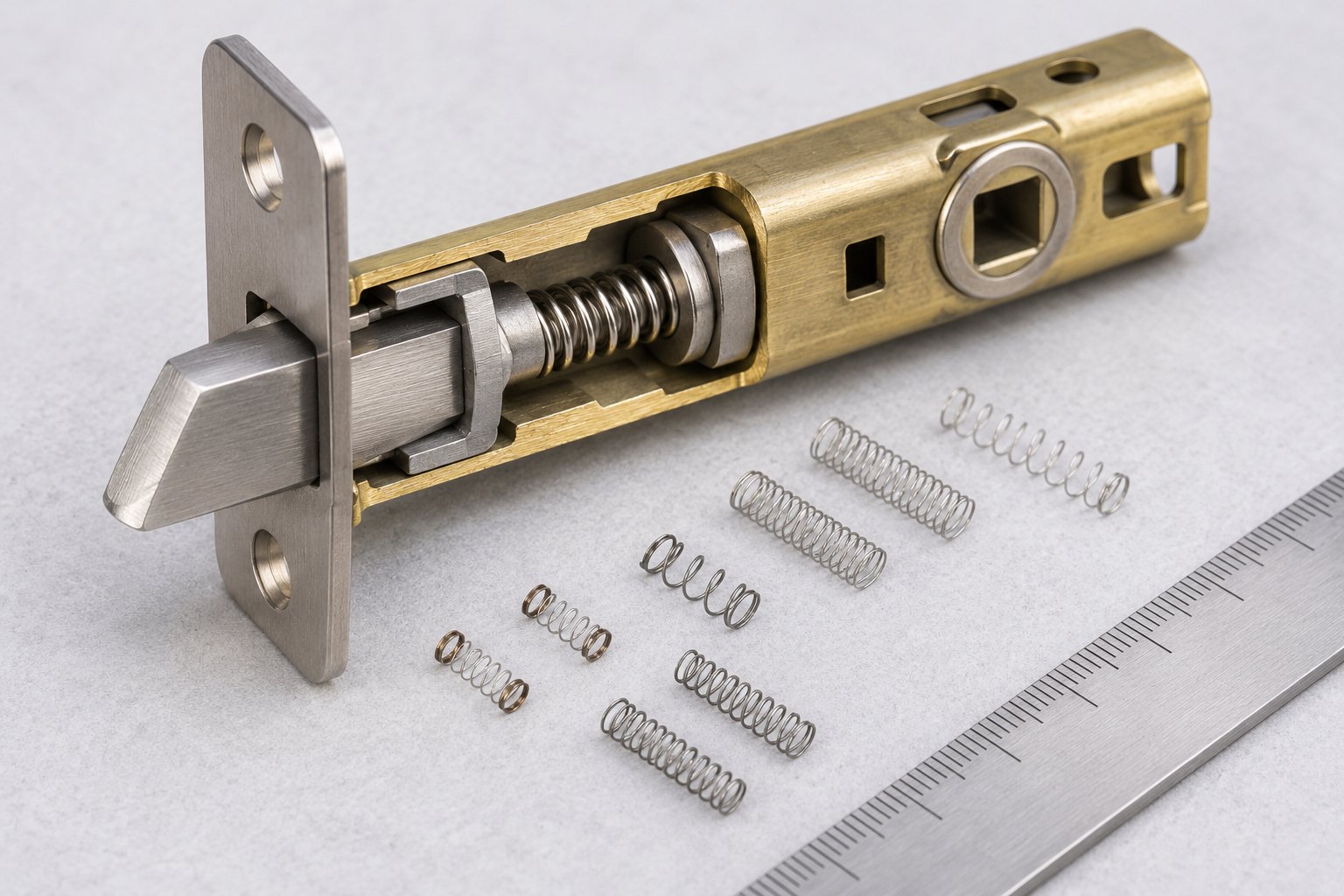
Cover image: an AI-generated illustration of a generic wooden snap trap, based on a photo of torsion springs we make; it does not show a specific brand.
Mouse trap springs are the torsion springs that drive the striker bar of a snap trap: setting the trap winds the spring up, and when the trip releases the bar, the spring swings it down onto the mouse and then holds it there. Wikipedia describes the spring-loaded bar mousetrap as “a simple device with a heavily spring-loaded bar and a trip to release it”, where the bar “swings down rapidly and with great force when anything, usually a mouse, touches the trip” [1].
This guide is for trap makers and pest control brands that source these springs, and for engineers curious about how much a small torsion spring can do; the numbers come from two published sources and our own spring calculations.
Key takeaways
- The spring is a torsion spring, wound through a large angle: on a wooden trap the bar swings about 180 degrees from set to closed, so the spring must stay elastic over that whole swing.
- Measured torque is small but useful: in a University of South Florida test, one trap’s spring gave 0.19 N·m at 40 degrees and 0.31 N·m at 110 degrees; extrapolated to the set position, our fit gives about 0.42 N·m and 0.84 J stored.
- Clamping force varies more than five-fold between traps: Baker and colleagues measured 1.69 to 9.36 N across 23 mouse traps, with a mean of 4.64 N [2].
- Coil count decides whether the spring survives being set: our 1.4 mm spring with 12.2 turns per side sits at 71 % of tensile strength when set; with 6 turns per side and the same clamping force it would reach 122 % and take a permanent set.
- Specify torque at two angles, plus leg form, wire, finish and a set-and-hold test, so that every batch clamps the same.
What kind of spring is in a mouse trap?
The classic wooden snap trap uses a helical torsion spring whose coils sit around the pivot of the striker bar, with one leg bearing on the base and the other driving the bar. Wikipedia credits William C. Hooker of Abingdon, Illinois with the first patent for the spring-loaded bar mousetrap, US patent 528671 of 1894, and notes that James Henry Atkinson patented a similar trap, the “Little Nipper”, in 1898 [1].
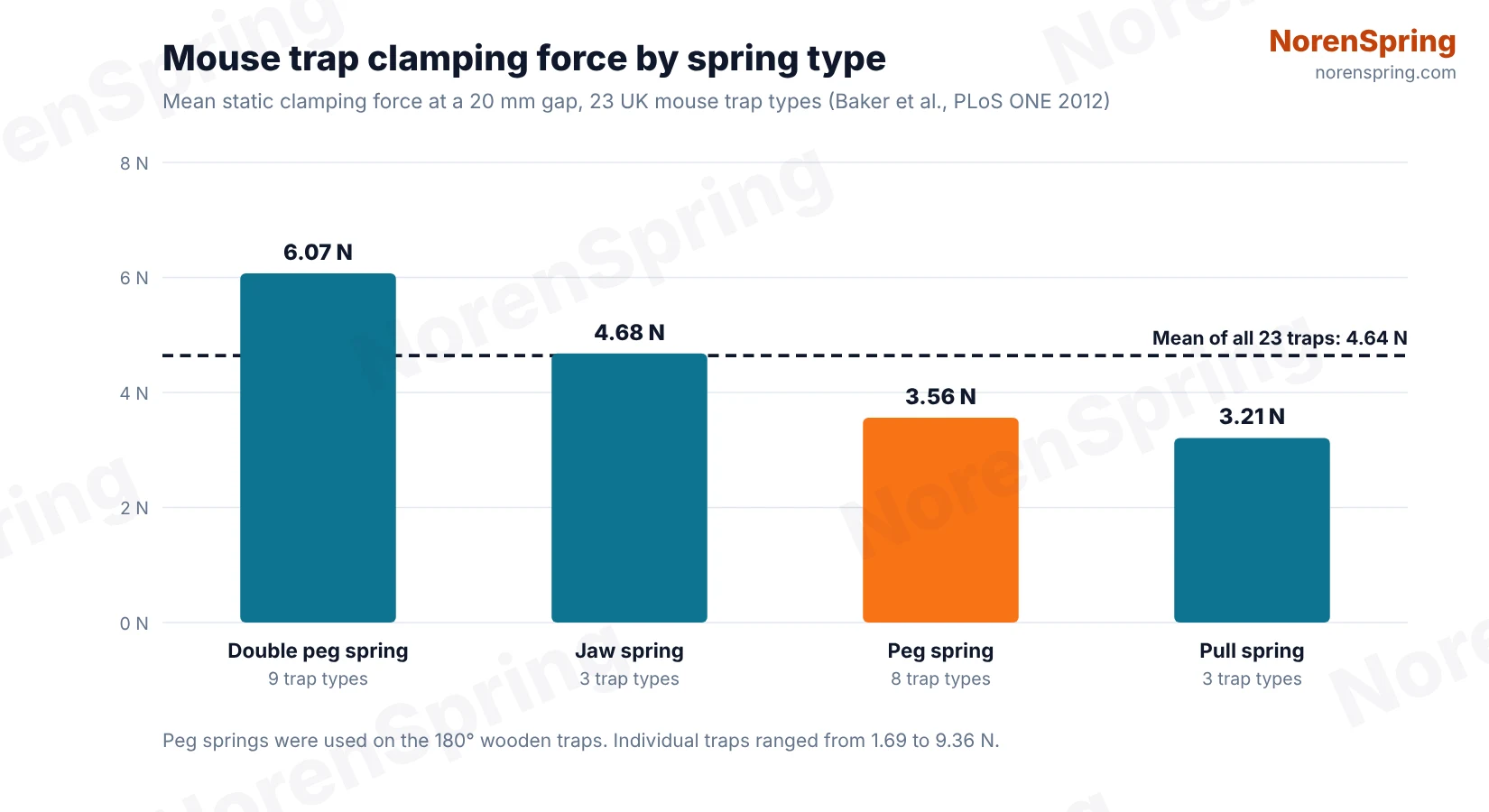
Not every snap trap uses the same spring layout: in a study of break-back traps sold in the UK, Baker and colleagues classed the springs as “peg (PEG), double peg (DPEG), jaw (JAW), or pull (PULL) type” [2]. The two wooden-bodied mouse traps in their replicated test set both opened to 180 degrees and both used peg springs, while the plastic-bodied mouse traps in that set opened between 45 and 80 degrees and used double peg, pull or jaw springs [2].
How much torque does a mouse trap spring give?
A University of South Florida engineering problem set by Autar Kaw reports a simple test: the authors pulled the bar of a mousetrap at right angles with a force probe and read the angle with a protractor, using a measured lever arm of 47 mm [3]. For their trap number 1, the force rose from 0.9 lb at 40 degrees to 1.5 lb at 110 degrees.
| Bar angle from closed | Measured force [3] | Torque at 47 mm |
|---|---|---|
| 40° | 0.9 lb | 0.188 N·m |
| 55° | 1.0 lb | 0.209 N·m |
| 65° | 1.1 lb | 0.230 N·m |
| 90° | 1.2 lb | 0.251 N·m |
| 110° | 1.5 lb | 0.314 N·m |
The source models the spring as a straight line of torque against angle [3], and our least-squares fit to these five points gives 0.118 N·m at zero degrees plus 0.096 N·m per radian, or 1.68 N·mm per degree. Extrapolated to the set position at 180 degrees, the spring would hold 0.42 N·m, which is 8.9 N at the end of a 47 mm bar, and the energy stored between closed and set would be 0.84 J, both figures being our extrapolation beyond the measured range.
The same fit also estimates the clamping force, which Baker and colleagues measured at a 20 mm gap, their estimate of a mouse’s diameter just behind the forelegs [2]. On a 47 mm bar, a 20 mm gap means the bar stops 25 degrees short of closed, where the fitted torque is 0.16 N·m and the force at the bar is 3.4 N. That sits close to the 3.56 N mean that Baker and colleagues measured for traps with peg springs [2], although the two measurements come from different traps.
What do tests show about mouse trap spring performance?
Baker and colleagues tested 23 types of mouse trap and 18 types of rat trap bought in the UK, measuring static clamping force with a load cell and impact momentum from the force history at the strike, and found that “Trap-opening angle and spring type were related to impact momentum and clamping force” [2].
Their main findings for mouse traps were these:
- Wide spread: “Clamping force varied between 1.69 and 9.36 N (mean = 4.64…)” for mouse traps, and impact momentum between 0.01 and 0.06 N·s [2].
- Spring type mattered: clamping forces were “greatest for those with DPEG springs followed by those with JAW, PEG and then PULL springs” [2].
- Smaller opening angles clamped harder: the clamping force “was greater for traps with a smaller opening angle” [2].
- Price did not predict performance: the authors found “no evidence of a simple linear relationship between price and trap performance” for mouse traps [2].
From a spring designer’s point of view, the opening angle result makes sense, because a 180 degree trap’s spring has to swing about 155 degrees between set and clamped, and its stress when set limits how much torque it can have when clamped. A trap that opens to 60 degrees swings its spring only about 35 degrees, so the same wire can carry much more preload at the clamped position; this is our reading of the mechanics, not a conclusion stated by the study.
Worked example: a double torsion spring for a 180 degree wooden trap
We sized a double torsion spring, two coils of the same wire joined by the leg that drives the bar, for a wooden trap with a 47 mm bar that opens to 180 degrees, with the two coils sharing the torque. Our target was a clamping force of 4.6 N at a 20 mm gap, close to the mean that Baker and colleagues measured across all 23 mouse traps [2].
We used music wire and the torsion spring methods in Shigley’s Mechanical Engineering Design, chapter 10: the rate per turn with the 10.8 constant that allows for coil friction, and the bending stress correction factor for the inside of the coil [4], and for static strength the same slides say to divide the torsion values in Table 10-6 by 0.577 [4], which gives 78 % of tensile strength for music wire; because a trap can stay set for days or weeks, we held the stress when set to about 70 % of tensile strength to leave margin against slow loss of force.
| Item | 1.2 mm wire | 1.4 mm wire (our choice) | 1.4 mm wire, fewer turns |
|---|---|---|---|
| Mean coil diameter | 9.0 mm | 10.0 mm | 10.0 mm |
| Body turns per side | 14.7 | 12.2 | 6.0 |
| Rate, both coils | 1.61 N·mm per degree | 3.24 N·mm per degree | 6.59 N·mm per degree |
| Torque clamped at 20 mm gap | 0.216 N·m | 0.216 N·m | 0.216 N·m |
| Torque when set (180°) | 0.47 N·m | 0.72 N·m | 1.24 N·m |
| Force to set, at the bar end | 9.9 N | 15.3 N | 26.3 N |
| Bending stress when set | 71 % of tensile | 71 % | 122 % |
| Energy released down to the clamp | 0.92 J | 1.26 J | 1.96 J |
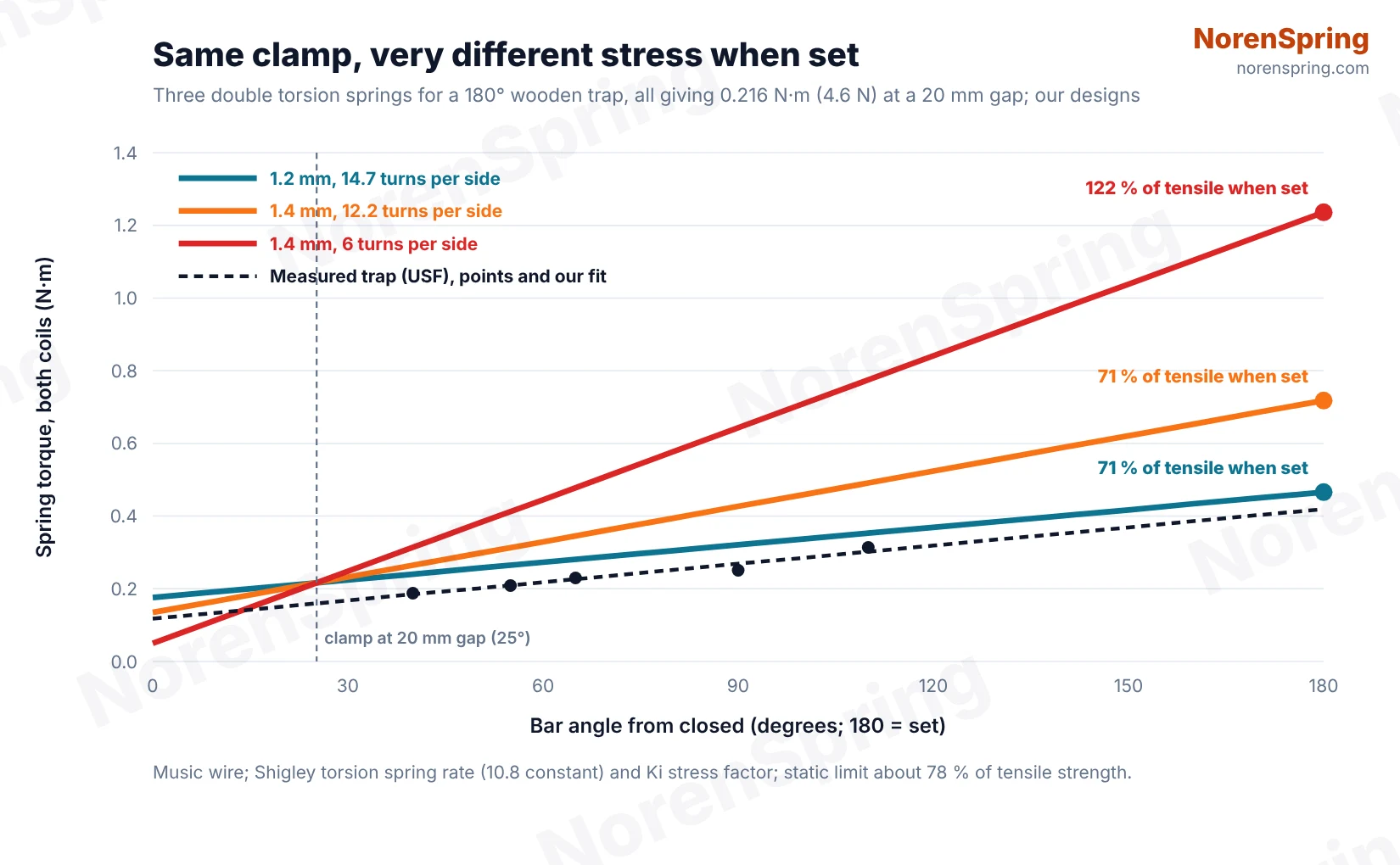
All three springs clamp with the same 4.6 N, so the difference lies at the set position. Because the 6-turn spring has twice the rate of the 12.2-turn spring, winding it through the same 155 degrees takes it to 122 % of tensile strength, and it would take a permanent set the first time the trap is cocked, losing much of its clamping force.
The 1.2 mm spring is the gentlest to set, at 9.9 N on the bar, and its rate of 1.61 N·mm per degree is close to the 1.68 N·mm per degree of the University of South Florida trap. The 1.4 mm spring needs 15.3 N to set but releases 1.26 J instead of 0.92 J between set and clamp, and that extra energy goes into the strike, which Baker and colleagues measured as impact momentum and found to vary six-fold across mouse traps [2]. Choosing between the two is a trade-off between ease of setting and striking energy that we would settle with the trap maker after testing samples.
Mouse trap springs vs rat trap springs
Baker and colleagues measured clamping forces of 5.03 to 23.10 N for rat traps (mean 11.32 N) and impact momentum of 0.03 to 0.25 N·s, against 1.69 to 9.36 N and 0.01 to 0.06 N·s for mouse traps [2]. They also found “considerable overlap” between the two, and pointed out that “the average weight of a brown rat Rattus norvegicus is more than 20 times that of a house mouse” [2].
For the spring this means a heavier wire, a longer bar and a 40 mm test gap in place of 20 mm, which Baker and colleagues used for rats [2]; the same stress check at the set position applies, and with heavier wire it again decides how many turns the spring needs.
What to specify for mouse trap springs
For a trap maker, a mouse trap spring drawing should carry the items in our torsion spring specification guide, with these points made explicit:
- Torque at two angles: at the clamped position, for example at a 20 mm gap, and at the set position, each with a tolerance.
- Body turns and coil diameter, with the inside diameter checked against the pivot pin when the spring is wound up.
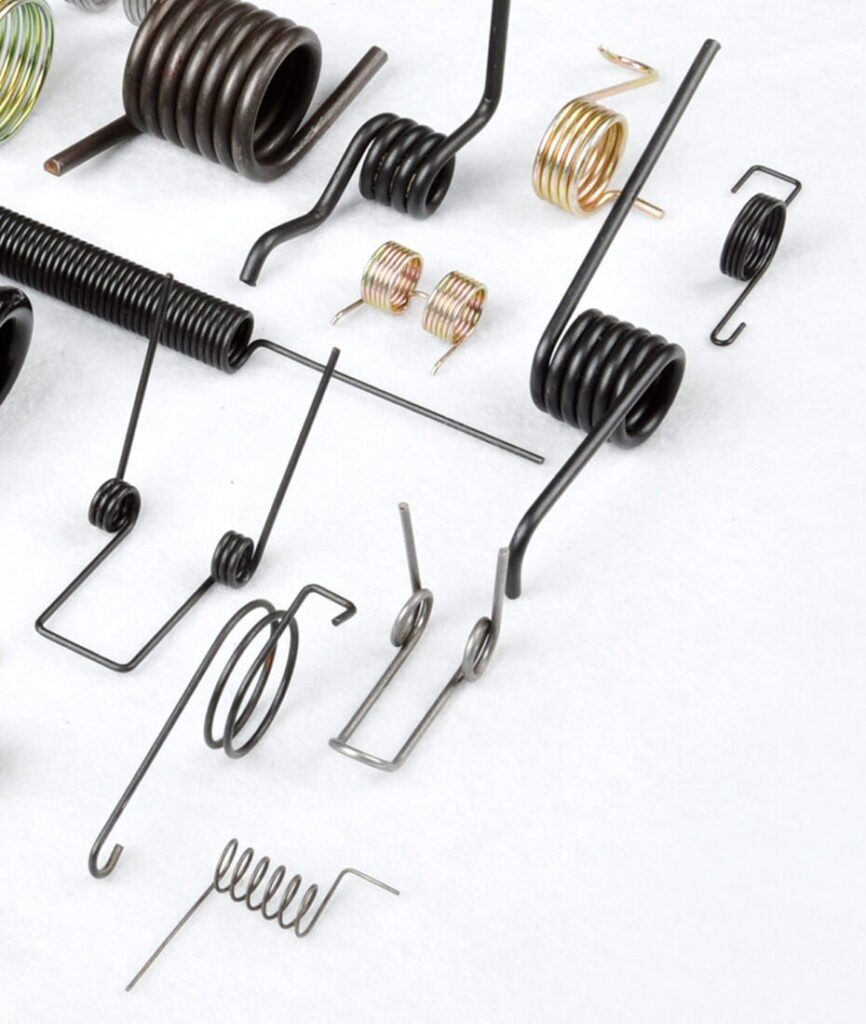
- Leg forms and lengths, including the leg that bears on the base and the leg or loop that drives the bar.
- Wire and material. Our example uses music wire for its strength in small sizes; see our music wire springs guide.
- Finish. Zinc plating or galvanised wire for traps used in damp places; our spring finishes guide compares the options.
- Set-and-hold test: for example, hold the spring at the set angle for 7 days and recheck torque at the clamped angle, with an agreed maximum loss.
- Hand of wind for each coil of a double torsion spring, so the legs sit the right way round on the trap.
For the 1.4 mm design above, the key lines of the drawing would look like this, with tolerances as example values to agree with the trap maker.
| Drawing item | Example value |
|---|---|
| Wire | 1.4 mm music wire (ASTM A228), zinc plated |
| Form | Double torsion spring, one left-hand and one right-hand coil |
| Mean coil diameter | 10.0 mm |
| Body turns | 12.2 per side |
| Torque at 25° from closed (20 mm gap) | 0.216 N·m ± 10 % |
| Torque at 180° (set) | 0.72 N·m ± 10 % |
| Set-and-hold test | 7 days at 180°, torque at 25° within 5 % of the initial value |
Send your trap geometry, target clamping force and gap through our contact page, and our engineers will review the spring and its stress when set. Our torsion springs page shows the leg forms we make, our double torsion spring guide explains how the two coils share the load, and our small torsion springs guide covers springs of this size, and you can read more about our company and its certifications. This guide was compiled by our editorial team with our spring engineers.
FAQ
What type of spring does a snap trap use?
It is a helical torsion spring: on a wooden snap trap its coils sit around the pivot of the striker bar, with one leg on the base and the other driving the bar. Some plastic traps use other layouts, which Baker and colleagues classed as double peg, jaw or pull springs [2].
How strong is a mouse trap spring?
The trap measured in the University of South Florida problem set needed 0.9 to 1.5 lb at the end of its bar between 40 and 110 degrees [3], and across 23 UK mouse traps clamping force at a 20 mm gap ranged from 1.69 to 9.36 N [2].
Why does a mouse eat the bait without springing the trap?
That is a trigger problem rather than a spring problem: the spring only acts once the trip releases the bar, so a stronger spring does not make the trap fire more easily.
Can a weak mouse trap spring be made stronger?
Only by changing the spring: adding turns lowers the rate and heavier wire raises it, but either way the stress at the set position has to stay within the wire’s limit, and our worked example shows that halving the turns on a 1.4 mm spring takes it from 71 % to 122 % of tensile strength when set.
Is a mousetrap car spring the same as a mouse trap spring?
Yes, mousetrap cars use the spring from an ordinary snap trap, and the University of South Florida test above was made to estimate the energy available to such a car [3].
Sources
- Wikipedia, “Mousetrap”. en.wikipedia.org
- Sandra Baker and colleagues (2012), “Mechanical Performance of Rat, Mouse and Mole Spring Traps, and Possible Implications for Welfare Performance”, PLoS ONE 7(6): e39334. pmc.ncbi.nlm.nih.gov
- Autar Kaw (2009), “Physical Problem for Regression: General Engineering” (mousetrap spring), Holistic Numerical Methods, University of South Florida. mathforcollege.com
- Shigley’s Mechanical Engineering Design, chapter 10 lecture slides (mechanical springs), Philadelphia University. philadelphia.edu.jo