In this article
GB/T 1222-2025 Spring steels is China’s revised national standard for the hot-rolled bars and wire rod that springs are made from. It was issued on October 31, 2025 and took effect on May 1, 2026, replacing GB/T 1222-2016 and the two-part automotive suspension spring steel standard GB/T 33164.1/.2-2016. The foreword lists 14 technical changes, covering chemistry, hardenability, inclusions, decarburisation, grain size and surface quality.
Key takeaways
- GB/T 1222-2025 was issued on October 31, 2025 and has applied since May 1, 2026. GB/T 1222-2016 is now withdrawn.
- It merges the general spring steel standard with GB/T 33164.1-2016 (hot-rolled flat bar) and GB/T 33164.2-2016 (hot-rolled round bar and wire rod) for automotive suspension springs.
- The 14 changes include new phosphorus and sulphur content groups, revised copper and oxygen limits, a new grain size requirement, a new hardenability requirement for 60CrMnB and the removal of grade 40SiMnVBE.
- Buyers should update drawing references, check any part specified in 40SiMnVBE or 60Si2Mn, and agree which steel grade and group the material certificate will show.
What GB/T 1222-2025 is and when it took effect
GB/T 1222 is the Chinese national standard for spring steels. It sets the ordering information, manufacturing route, technical requirements, test methods, inspection rules, packaging, marking and quality certificate for spring steel supplied by steel mills. The 2025 edition was published by China’s State Administration for Market Regulation (SAMR) and the Standardization Administration of China in national standard announcement No. 29 of 2025 (SAMR full-text notice). It’s a recommended standard (GB/T), maintained by the National Technical Committee on Steel (SAC/TC 183) and proposed by the China Iron and Steel Association.
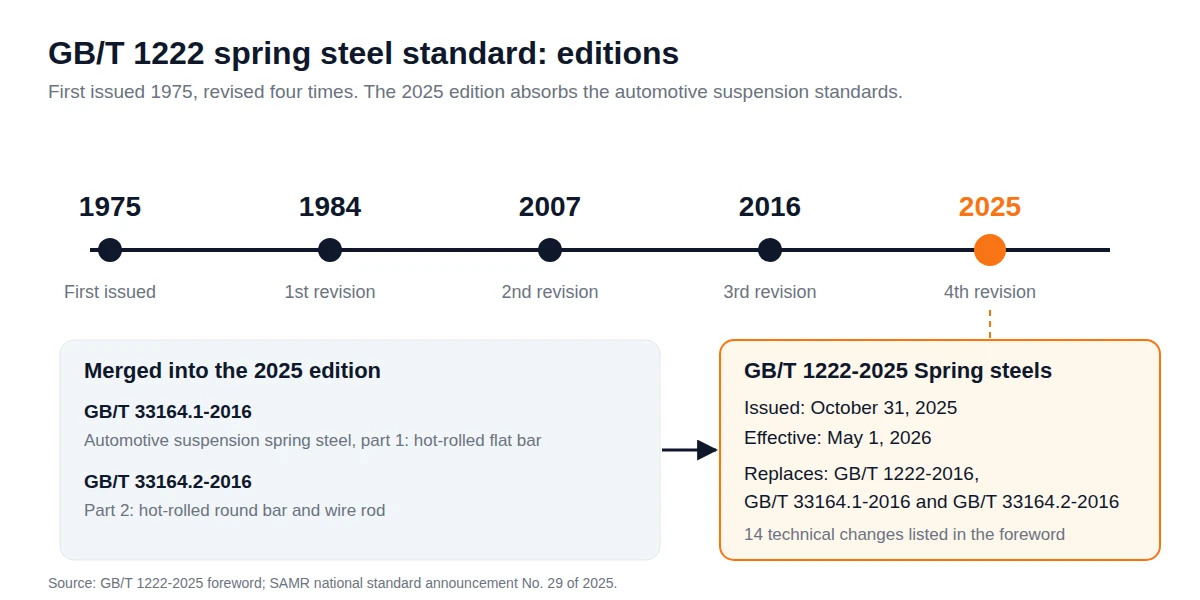
According to the foreword, this is the fourth revision since the standard was first issued in 1975, after the 1984, 2007 and 2016 editions. The drafting group of 15 organisations includes major special-steel mills such as Jiangyin Xingcheng, Daye and Qingdao Special Steel, plus a heavy truck maker (Sinotruk) and a suspension manufacturer, which reflects the merger with the automotive suspension standards (GB/T 1222-2025 foreword preview).
Which products the standard covers
The 2025 edition applies to three hot-rolled product forms:
| Product form | Size limit in GB/T 1222-2025 |
|---|---|
| Round and square bar | Nominal diameter or side up to 180 mm |
| Flat bar | Nominal width up to 180 mm and thickness up to 70 mm |
| Wire rod | Nominal diameter up to 40 mm |
Size limits are from the scope clause of GB/T 1222-2025 (standard record; chinesestandard.net listing). Ingots, billets and products made from them follow the grades and chemical compositions by reference. In practice, this is the steel behind hot-coiled suspension springs, leaf springs, heavy-duty compression springs and the wire rod that is later drawn into spring wire. Finished cold-drawn and oil-tempered spring wires are covered by their own standards, but many of them start from wire rod made to this one.
The 14 technical changes, grouped
The foreword lists the changes from GB/T 1222-2016 as items a) to n). The standard says what was changed or added. It doesn’t say by how much, so check the full text for the actual limits before changing a specification.
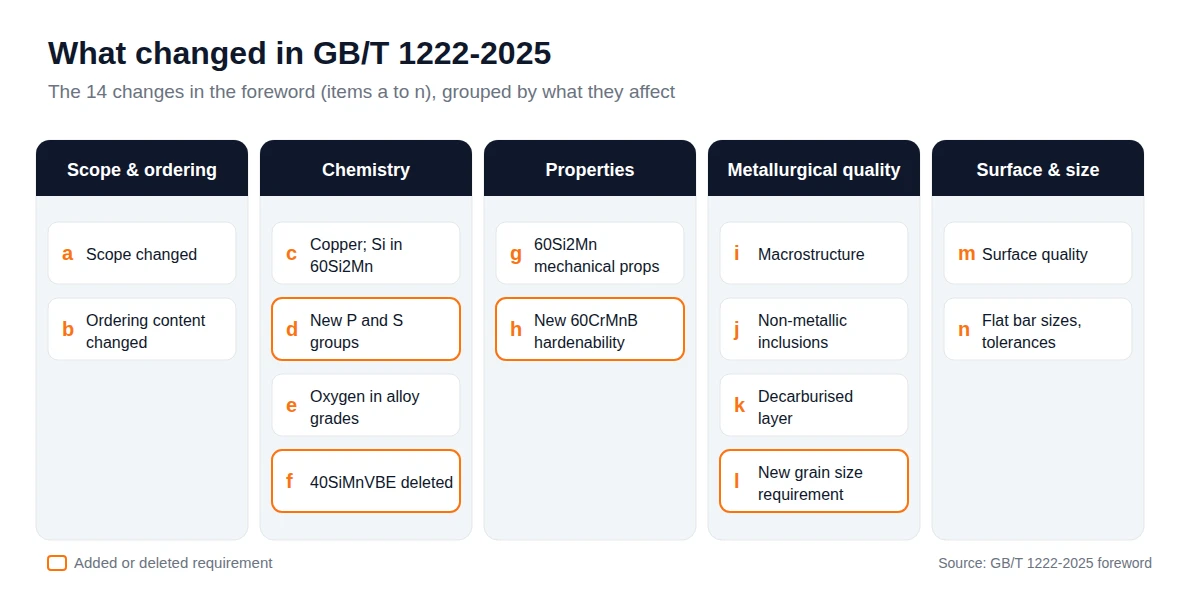
| Area | Changes in GB/T 1222-2025 (foreword item) |
|---|---|
| Scope and ordering | Scope changed (a); ordering content changed (b) |
| Chemistry | Copper limit and the silicon range for 60Si2Mn changed (c); grouping by phosphorus and sulphur content added (d); oxygen limit for alloy spring steel changed (e); grade 40SiMnVBE deleted (f) |
| Properties | Mechanical property requirements for 60Si2Mn changed (g); hardenability requirement for 60CrMnB added (h) |
| Metallurgical quality | Macrostructure (i), non-metallic inclusion (j) and decarburised layer (k) requirements changed; grain size requirement added (l) |
| Surface and dimensions | Surface quality requirements changed (m); nominal dimensions, tolerances and lengths of hot-rolled flat bar changed (n) |
Several of these changes deal with the cleanliness and microstructure of the steel: residual copper, oxygen, inclusions, decarburisation and grain size. Those are the properties that most affect a spring’s fatigue life, because fatigue cracks can start at an inclusion or at a decarburised surface. The standard itself doesn’t make claims about fatigue life, and nor should a supplier based on the standard alone. For the wider materials picture, see our spring industry trends for 2026. For how Chinese grades compare with JIS, ASTM and EN wire, see our spring wire material guide.
What changes for buyers who specify Chinese spring steel
Most buyers don’t order spring steel directly. They order springs, and the spring maker buys the steel. The new edition still affects what should be on your drawing and what you should expect on the paperwork.
- Update drawing and specification references. Drawings that cite GB/T 1222-2016 or GB/T 33164.1/.2-2016 now point to withdrawn standards. Change the reference to GB/T 1222-2025, or agree with your supplier in writing which edition applies to existing parts.
- Check parts made from 40SiMnVBE. This grade is no longer in the standard. If a drawing calls for it, ask your spring maker to propose an alternative and confirm it with a sample or test before production.
- Re-check 60Si2Mn parts. Silicon content and mechanical property requirements for 60Si2Mn were changed, so if you rely on specific values from the 2016 edition, compare them against the 2025 text.
- Ask about the phosphorus and sulphur group. The new edition groups steels by phosphorus and sulphur content. For fatigue-critical springs, it’s reasonable to ask which group the material is ordered to and have it shown on the mill certificate.
- Expect grain size and hardenability data where required. Grain size is a new requirement, and 60CrMnB now has a hardenability requirement. Mill certificates for these materials may show new test items.
How we handle spring steel material records
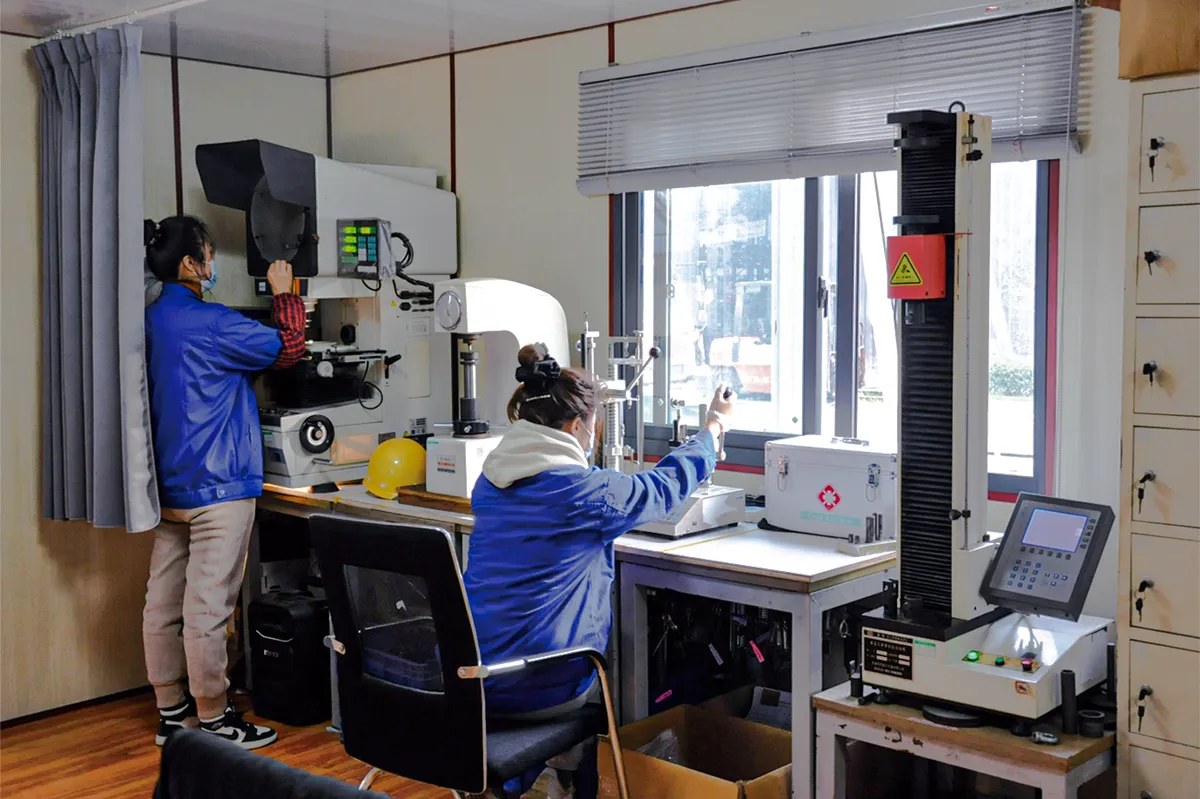
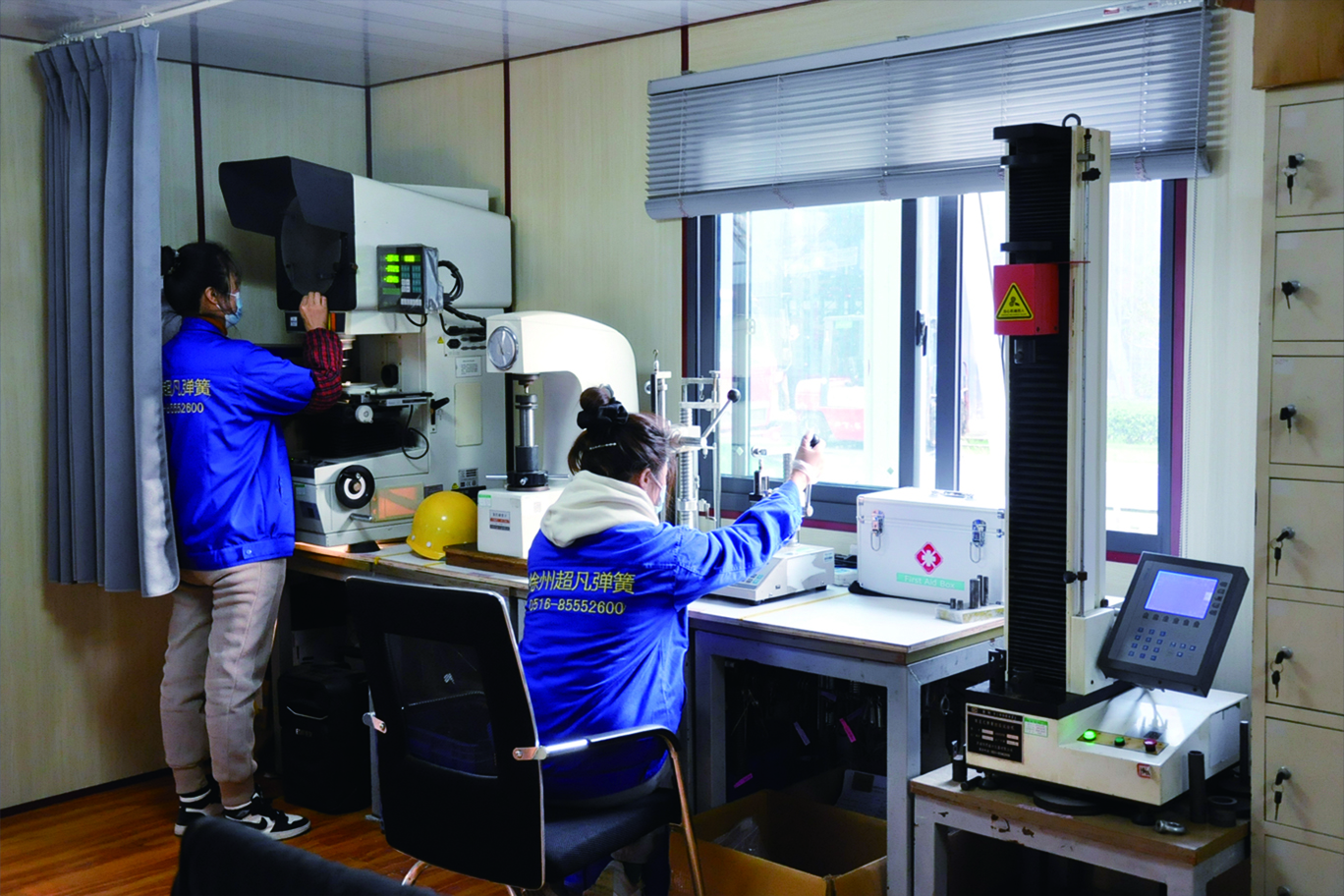
At NorenSpring, material certificates, inspection reports and traceability records are agreed with each customer at project setup, and our in-house testing laboratory checks dimensions, load and the characteristics named in the control plan. If your drawing still cites an older spring steel standard, or specifies a grade that’s been removed, send it to us for engineering review and we’ll confirm the material route before quoting. For automotive parts, our IATF 16949 certification applies; see our automotive springs page.
GB/T 1222-2025 FAQ
When did GB/T 1222-2025 take effect?
It took effect on May 1, 2026. It was issued on October 31, 2025. GB/T 1222-2016 was withdrawn on the same date the new edition took effect.
Which standards does GB/T 1222-2025 replace?
It replaces GB/T 1222-2016 Spring steels, GB/T 33164.1-2016 (automotive suspension spring steel, part 1: hot-rolled flat bar) and GB/T 33164.2-2016 (part 2: hot-rolled round bar and wire rod).
Does GB/T 1222-2025 apply to finished springs?
No. It covers the spring steel bar, flat and wire rod supplied by steel mills. Finished springs are specified by the customer’s drawing and by separate spring standards, although the material shown on the certificate will usually refer to a steel standard such as this one.
About the authors
Prepared by the NorenSpring engineering team, which designs and manufactures custom compression, extension and torsion springs and wire forms in Xuzhou, China. Technical review by Feng Yulin, General Manager and senior structural engineer, with 15 years of spring R&D experience and more than 30 national patents. More about NorenSpring.
Sources
- State Administration for Market Regulation, notice publishing the full text of national standard announcement No. 29 of 2025 (lists GB/T 1222-2025, issued 2025-10-31, effective 2026-05-01).
- National Public Service Platform for Standards Information, GB/T 1222-2016 record (withdrawn, fully replaced by GB/T 1222-2025).
- GB/T 1222-2025 foreword and scope preview (bzchaxun.com, third-party standards library) (list of 14 technical changes, drafting organisations, scope and edition history).
- National Public Service Platform for Standards Information, GB/T 33164.1-2016 record (automotive suspension spring steel, hot-rolled flat bar).