










In this article
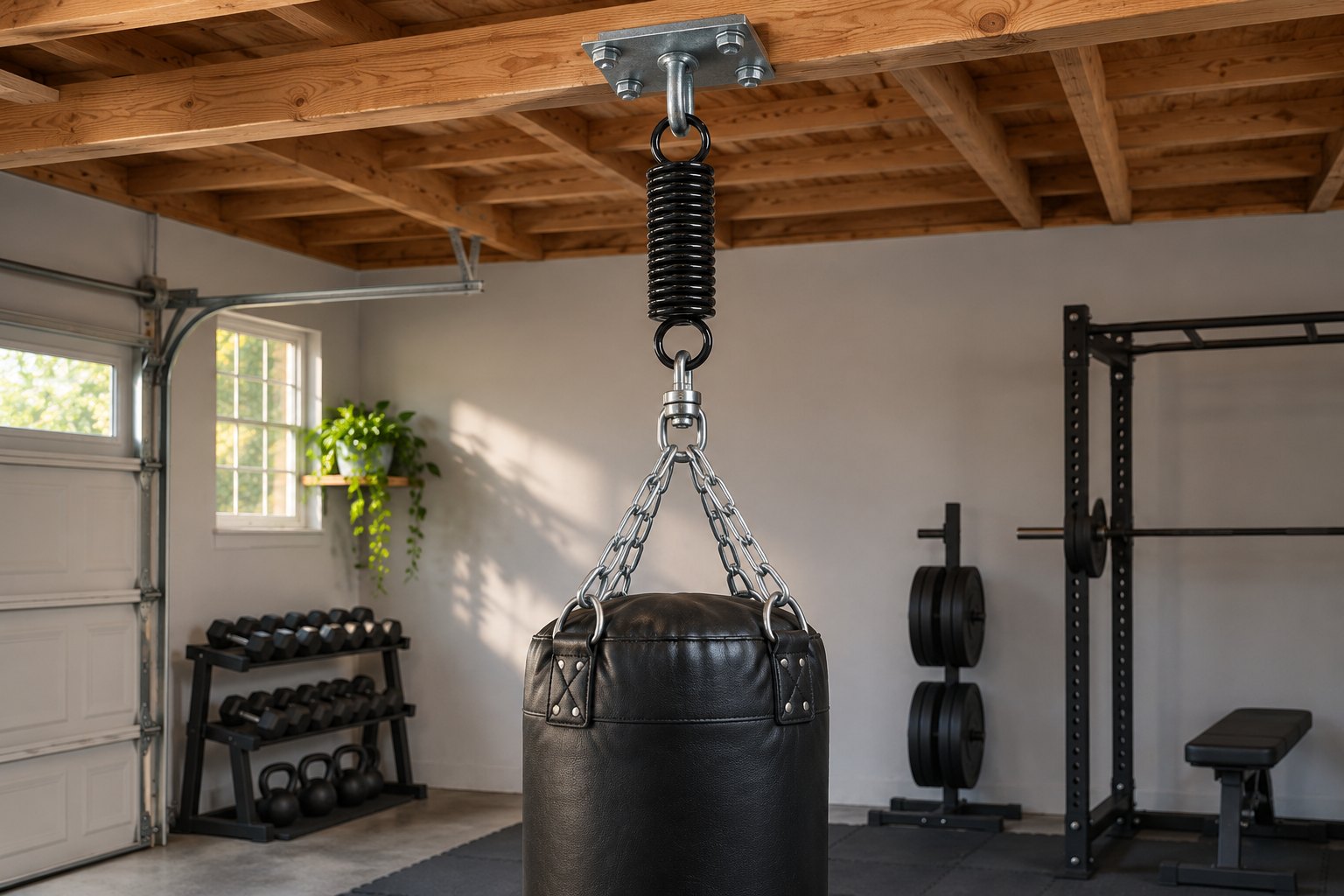
Cover image: an AI-generated illustration of a generic heavy bag setup, based on a photo of an extension spring we make; it does not show a specific brand’s spring or mount.
A heavy bag spring is a short, heavy extension spring fitted between a ceiling mount and the chains of a hanging punching bag. It stretches a little under the bag’s weight and a little more with every punch, so the jolts and noise that reach the joist are smaller. Hunker’s installation guide puts it this way: “The spring absorbs some of the force of the blows the bag receives, protecting your house structurally” [1].
This guide is for fitness equipment brands who source these springs, and for anyone choosing one for a home gym. For a spring doing a similar job under a bouncing load, see our trampoline springs guide.
Key takeaways
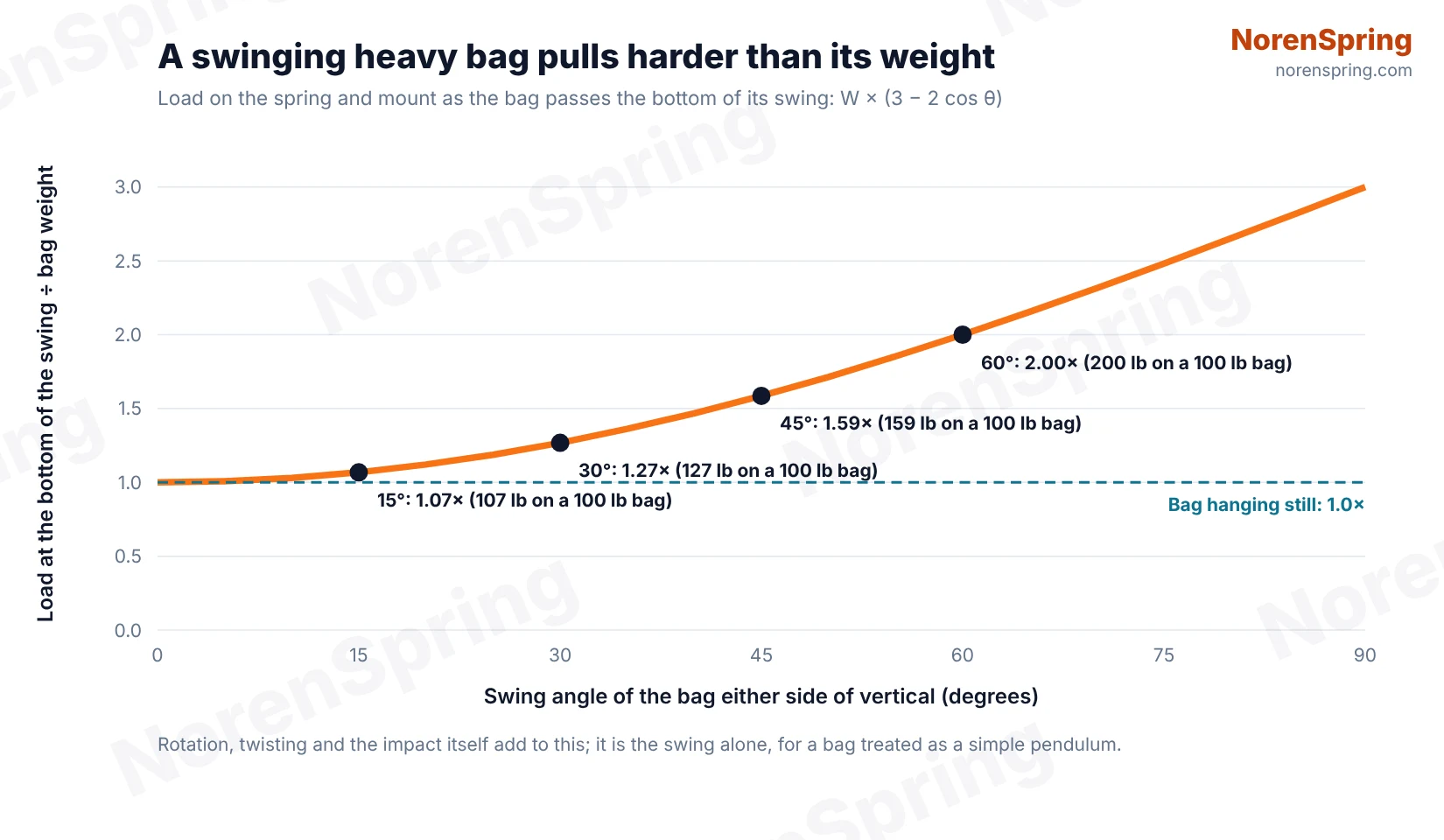
- A swinging bag pulls harder than its weight. At the bottom of a 45 degree swing, the load on the spring is 1.59 times the bag weight: 159 lb for a 100 lb bag.
- A drop back after an uppercut is the bigger jolt. In our model, a 100 lb bag lifted 15 mm and dropped peaks at 967 N on a 5 in spring and 754 N on a 7 in spring of the same wire.
- The loops limit the spring. On the 5 in spring the loop bend reaches 73 % of tensile strength at that peak, against a 75 % static guide; the 7 in spring stays at 57 %.
- Weight ratings are static numbers. Retail springs are rated by bag weight, such as Revgear’s 150 lb spring [2] and TITLE’s spring for bags “up to 250 lbs” [3], but the spring sees swing and impact on top.
- Specify force at two lengths, loop type and a cycle test, not just a bag weight, and keep a slack safety chain past the spring.
What does a heavy bag spring do?
A hanging bag is joined to the building by a chain of parts: ceiling mount, swivel, spring, chains and the bag’s straps. Without a spring, every punch that moves the bag sends a sharp load straight into the mount. With a spring in the line, the bag can move a few millimetres up and down, so the same change in momentum is spread over a longer time and the peak force falls.
Spring makers market the part for three separate effects: Revgear lists that it “Absorbs shock and vibration to shield the bag mount from excess strain”, “Dampens impact noise for a quieter home training environment” and “Helps extend the lifespan of both heavy bag and mounting hardware” [2]. TITLE Boxing says its spring “Helps eliminate noise and stress on mounts, and increases longevity of hanging chains and swivel” [3].
Some ceiling mounts replace the coil spring with a gas spring; Everlast’s CM-1000GS ceiling mount is “Equipped with Gas Springs to dampen vibration”, for bags of 70 to 130 lb, and “Every Ceiling Mount is assembled to a specific bag weight +/- 10lbs” [4].
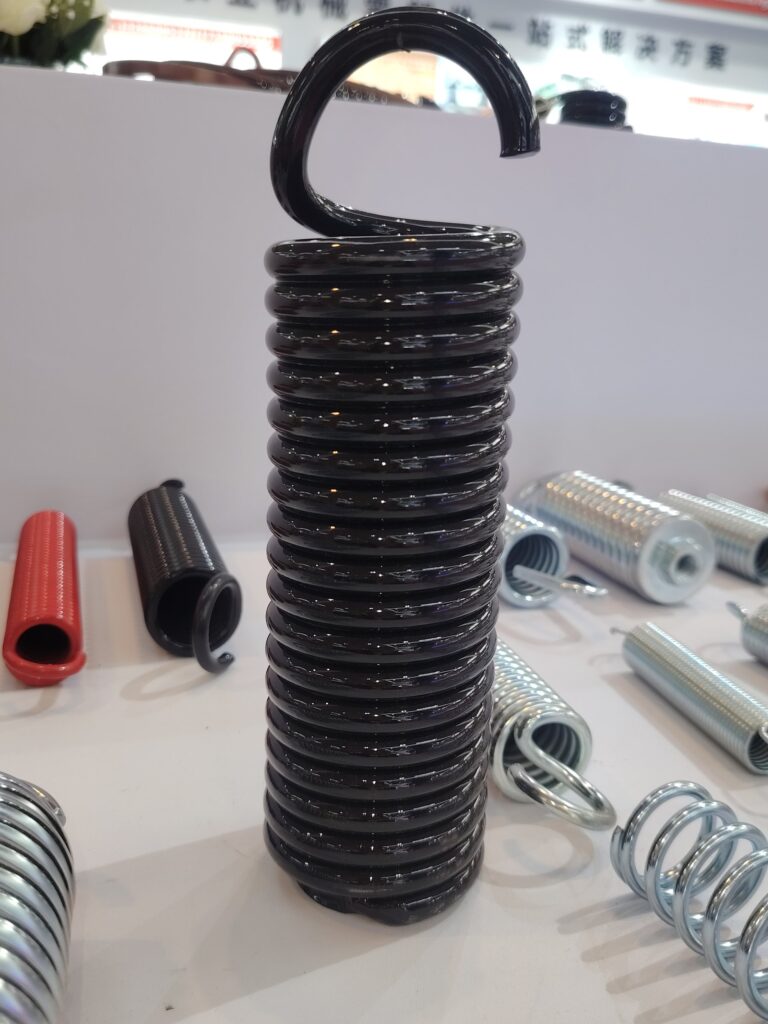
Where the spring goes in the hanging chain
Hunker’s step-by-step guide has the installer “Attach a swivel and a spring, in that order, to one end of the single chain that will hang from the eye bolt” [1]. The City University of New York (CUNY) home fitness textbook adds a warning about adding parts: “Do not stack several unapproved springs, straps, and rotating connectors to reduce noise. Each added part creates another connection that must remain secure” [5].
Because an extension spring that breaks lets the bag drop, we recommend a safety chain or cable from the mount to the bag hardware, hung with enough slack that it never carries load while the spring is intact, and rated to hold the bag on its own.
How much load does a swinging heavy bag put on the spring?
Considerably more than its weight, and the CUNY textbook is direct about it: “The printed bag weight describes the bag while it is still”, and the system also sees swing, rotation, impact and vibration, so “do not choose a mounting point or connector merely because its static label appears to equal the bag’s weight” [5].
For the swing alone, the bag behaves approximately as a pendulum, so at the bottom of a swing of amplitude θ the tension in the support is W × (3 − 2 cos θ), which gives the following multipliers:
| Swing either side of vertical | Load ÷ bag weight | Load for a 100 lb (445 N) bag |
|---|---|---|
| 15° | 1.07 | 107 lb (475 N) |
| 30° | 1.27 | 127 lb (565 N) |
| 45° | 1.59 | 159 lb (705 N) |
| 60° | 2.00 | 200 lb (890 N) |
What happens when the bag drops back?
An uppercut or a hard hook can lift the bag, and when it falls back the spring has to stop it. For a bag lifted a height h above its rest position, the spring force rises to the bag weight plus spring rate × h while the spring stays open. If the bag is lifted further than the spring’s stretch at rest, the coils close up and the bag falls freely before the spring catches it, which raises the peak sharply.
The spring rate therefore decides how hard that catch is. We designed three springs from the same 6.0 mm hard-drawn wire with a 34 mm mean coil diameter (40 mm outside), differing only in overall length, and modelled a 100 lb bag lifted up to 40 mm. The bag is treated as a rigid mass, so these are upper-end figures.
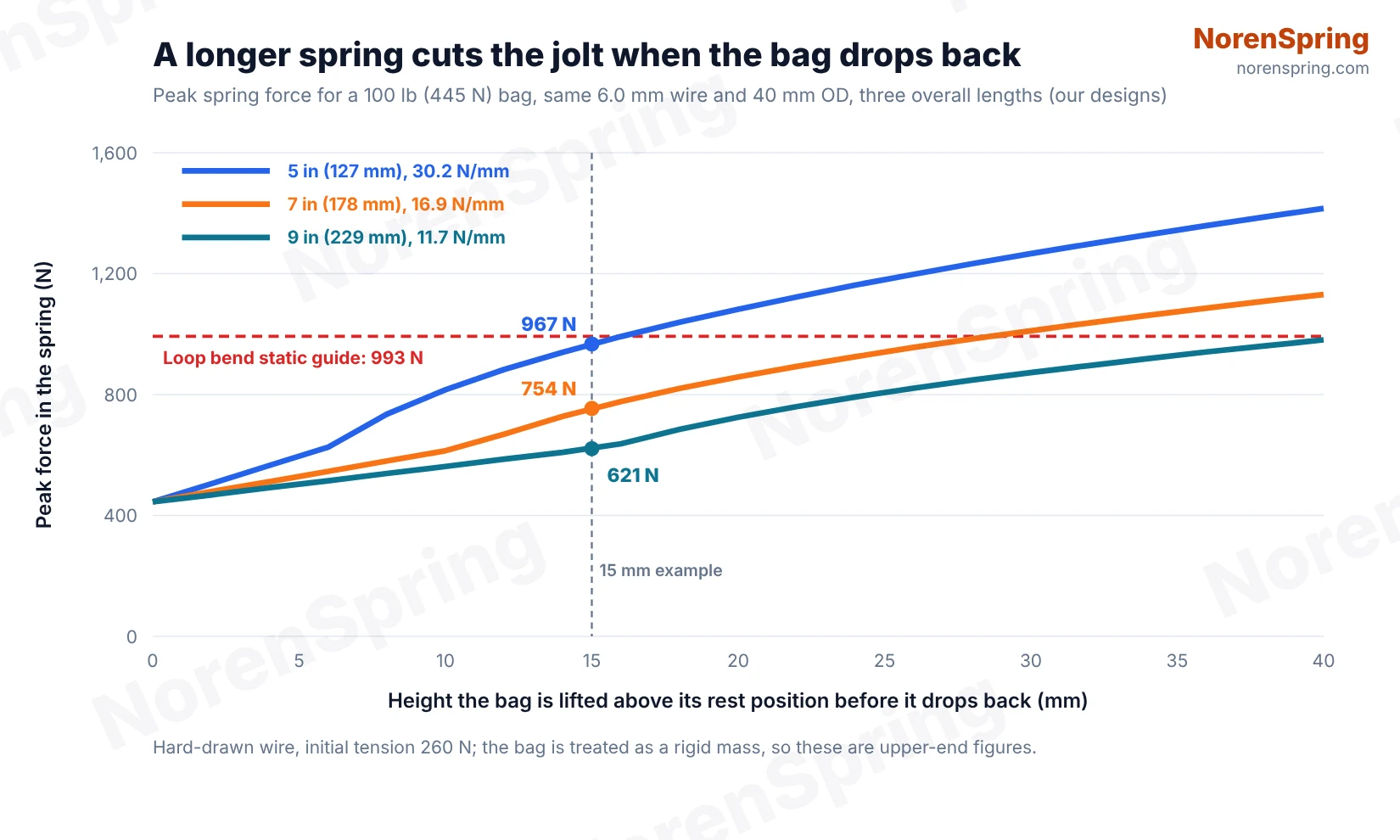
At a 15 mm lift, the 5 in spring peaks at 967 N, the 7 in spring at 754 N and the 9 in spring at 621 N. The longer springs are softer, so they stretch more under the bag’s weight (10.9 and 15.7 mm, against 6.1 mm for the 5 in spring) so a small lift closes the coils later, or on the 9 in spring not at all.
Worked example: springs for a 100 lb heavy bag
The three designs use material data and stress limits from Shigley’s Mechanical Engineering Design, chapter 10 [6]. The design force for each spring is the larger of the 45 degree swing (705 N) and the 15 mm drop; both are our example cases, not a published standard.
| Item | 5 in (127 mm) | 7 in (178 mm), our choice | 9 in (229 mm) |
|---|---|---|---|
| Wire, mean coil / outside diameter | 6.0 mm, 34 / 40 mm | 6.0 mm, 34 / 40 mm | 6.0 mm, 34 / 40 mm |
| Active coils | 10.8 | 19.3 | 27.8 |
| Rate | 30.2 N/mm (172 lb/in) | 16.9 N/mm (97 lb/in) | 11.7 N/mm (67 lb/in) |
| Initial tension | 260 N | 260 N | 260 N |
| Stretch with the bag hanging still | 6.1 mm | 10.9 mm | 15.7 mm |
| Design force | 967 N (drop) | 754 N (drop) | 705 N (swing) |
| Coil body stress at design force | 39 % of tensile | 30 % | 28 % |
| Loop bend stress at design force | 73 % | 57 % | 53 % |
| Coil body fatigue safety factor (Gerber) | 1.43 | 1.95 | 2.12 |
The wire’s minimum tensile strength at 6.0 mm is about 1,269 MPa (Shigley Table 10-4, hard-drawn: A = 1,783, m = 0.190). The 260 N initial tension works out to 104 MPa, inside the range Shigley’s Fig. 10-7c marks as preferred for this spring index. Shigley’s Table 10-7 limits for static use are 45 % of tensile strength in the body and 75 % in bending at the loop [6]. For this wire, those limits put the largest force the loop can carry at 993 N, and the body at 1,122 N.
The 5 in spring passes the static check at 73 %, but a heavy bag spring is not a static part, because it cycles with every punch for years. We checked the coil body for fatigue with Zimmerli’s endurance data for unpeened springs and the Gerber criterion, cycling between the bag at rest (445 N) and the design force. All three bodies pass, but the loop is the weak point, and Shigley’s static table does not cover it under cycling. A loop at 73 % of tensile strength under repeated load leaves little margin, so we would choose the 7 in spring at 57 % and prove the loops with a cycle test on finished parts.
What a longer spring costs
A softer spring has its own costs. Under a 100 lb bag the 7 in spring opens 10.9 mm and bounces at about 3.1 Hz, against 6.1 mm and 4.1 Hz for the 5 in spring. It is also 51 mm longer, so the bag hangs lower and the hanging height has to allow for it. The CUNY textbook asks for swing clearance to be measured from the bag’s outer surface, not its centerline [5].
Why are heavy bag springs sold by bag weight?
Bag weight is the one number every buyer already knows. Revgear’s spring is “designed to work with setups intended for heavy bags up to 150lbs” [2]. TITLE’s professional spring is “Recommended for all hanging professional heavy bags up to 250 lbs”, is “5” long” and is “Available in three strengths” [3].
Our table shows why the strength has to suit the bag: a spring that suits one bag weight is too stiff or too soft for another. A spring that is too soft for its bag hangs with its coils well open and may hit its stretch limit on a big swing. A spring that is too stiff for a light bag barely opens, so it adds little cushioning. Revgear makes the same point about its own spring, saying its “effectiveness is optimized for bags within its specified weight range” [2].
Signs that a heavy bag spring needs replacing
- The coils stay open with the bag hanging still, when they used to close up, which means the spring has taken a permanent set.
- A loop is opening, cracked or worn, especially where it bears on the shackle or swivel.
- The bag sits lower than it did, or bounces more after each punch.
- There is rust or flaking finish on the coils or loops.
- The spring has been used above its rated bag weight.
The CUNY textbook lists inspection points for all hanging parts, including “Bent links”, “Rust”, “Cracks”, “Elongated holes” and “Unusual noise” [5]. A spring with a cracked or opening loop should be replaced before the next session, not watched. Our guide to why springs fail shows what a fatigue crack at a loop looks like.
What to specify when ordering heavy bag springs
For a fitness brand ordering heavy bag springs, the drawing should carry the items in our extension spring specification guide, with these made explicit:
- Bag weight range the spring is sold for, for example 70 to 130 lb.
- Force at two lengths: at the rest stretch for the middle bag weight, and at the largest stretch allowed.
- Rate, since it sets the stretch under the bag and the peak force on a drop.
- Wire diameter and material, such as hard-drawn or oil-tempered carbon steel.
- Overall length, outside of loops, because that is how springs are sold and how hanging height is planned.
- Loop type, size and orientation, sized for the shackle or swivel pin it hangs on.
- Initial tension with a range, since it sets the force at which the coils start to open.
- Finish: black powder coat, zinc plating or black oxide. See our spring finishes guide.
- Cycle test: for example, cycling between the rest force and the design force, then checking free length and loops for cracks.
For the 7 in spring in our example, the key drawing lines would read:
| Drawing item | Example value |
|---|---|
| Wire | 6.0 mm hard-drawn carbon steel (ASTM A227 class), black powder coat |
| Outside diameter | 40 mm |
| Overall length, outside of loops | 178 mm (7 in), two full machine loops |
| Rate | 16.9 N/mm ± 10 % |
| Initial tension | 260 N ± 40 N |
| Force at 10.9 mm stretch | 445 N (100 lb bag at rest) |
| Force at 29 mm stretch | 754 N (design force) |
The tolerances are our example values, to agree with the brand. Send your bag weight range, hanging hardware and target length through our contact page, and our engineers will review the spring and its loops. Our extension springs page shows the loops and finishes we make, and you can read more about our company and its certifications. This guide was compiled by our editorial team with our spring engineers.
FAQ
What is the purpose of a heavy bag spring?
It cushions the jolt each punch sends into the ceiling mount and reduces noise. Revgear says its spring “Absorbs shock and vibration to shield the bag mount from excess strain” [2].
Do I need a spring for my heavy bag?
It is not required, but it reduces the peak loads and noise reaching the joist. Hunker’s guide includes a spring in the hanging chain, between the swivel and the single chain from the eye bolt [1]. Whatever you fit, the mount and structure must be rated for the bag.
What size heavy bag spring do I need?
Choose a spring rated for your bag’s weight from the bag or mount maker, since springs are made in different strengths. TITLE says its springs are “Available in three strengths”, and its 5 in professional spring is for bags up to 250 lb [3].
Can a heavy bag spring break?
Yes, like any spring under repeated load, it can crack, usually at a loop. Inspect it with the rest of the hanging hardware, and fit a slack safety chain so the bag cannot fall if the spring fails.
Should a heavy bag spring stretch when the bag hangs still?
It should open slightly. In our 100 lb example, the 7 in spring opens 10.9 mm with the bag at rest, which lets it cushion small lifts without the coils closing up. A spring that does not open at all under the bag is too stiff for it.
Sources
- Hunker, “How To Hang A Heavy Bag Without Damaging The Ceiling”. hunker.com
- Revgear, 150lb Heavy Bag Spring product page. revgear.com
- TITLE Boxing, Professional Heavy Bag Spring (Up To 250 lbs). titleboxing.com
- Everlast, CM-1000GS ceiling mount data sheet. cdn.shopify.com
- City University of New York, Home Fitness, “Heavy Bags for Home Boxing”. pressbooks.cuny.edu
- Shigley’s Mechanical Engineering Design, chapter 10 lecture slides (mechanical springs), Istanbul Technical University. web.itu.edu.tr



