










In this article
- Key takeaways
- How trampoline springs work
- How many springs, and how long?
- Worked example: a 7 inch spring for a 14 ft frame
- Why tapered trampoline springs last longer
- Wire, galvanizing and rust
- Example product: a polished gym spring
- Safety standards that touch trampoline springs
- Signs a trampoline spring needs replacing
- What to send for a trampoline spring quote
- Frequently asked questions
- References
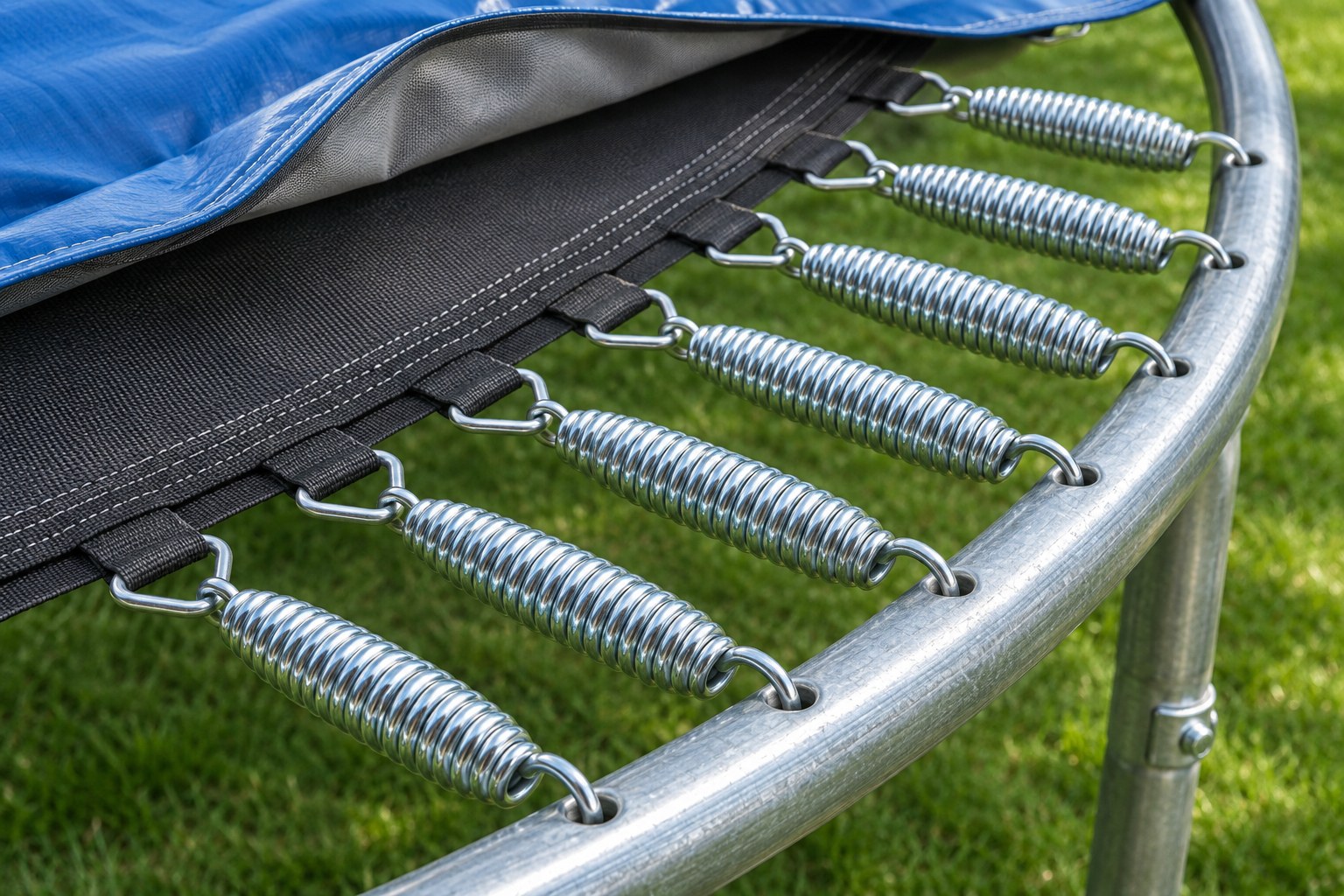
Cover image: an AI-generated illustration based on a photo of a polished extension spring we make for gym equipment; the trampoline is generic and not a specific product.
Trampoline springs are the coiled extension springs that join the jumping mat to the steel frame. The mat itself barely stretches, so almost all of the bounce comes from these springs. When a jumper lands, the mat is pulled down into a shallow cone, every spring around the edge stretches, and the stored energy throws the jumper back up [1]. A good spring set gives a smooth, even bounce for years; a weak, rusty or badly hooked set gives a harsh bounce, tears mats and breaks at the hooks.
This guide is written for trampoline brands, trampoline park builders and replacement-parts sellers who buy springs by the thousand. It explains how the jumper’s load is shared between the springs and what spring count and length really change. It then works through a spring design for a 14 ft round frame, shows why tapered ends last longer, compares galvanizing methods and lists what to put on the drawing. If you are new to extension spring drawings, our guide on how to specify a custom extension spring covers the basics.
Key takeaways
- The springs carry the jumper, not the mat. The vertical force on the bed is the number of springs × the force in each spring × the slope of the mat at the edge.
- More springs give a firmer bed, not just more bounce. In our 14 ft model, going from 72 to 108 springs cuts the centre deflection under a 3,900 N landing from 422 mm to 341 mm and the force in each spring from 248 N to 205 N.
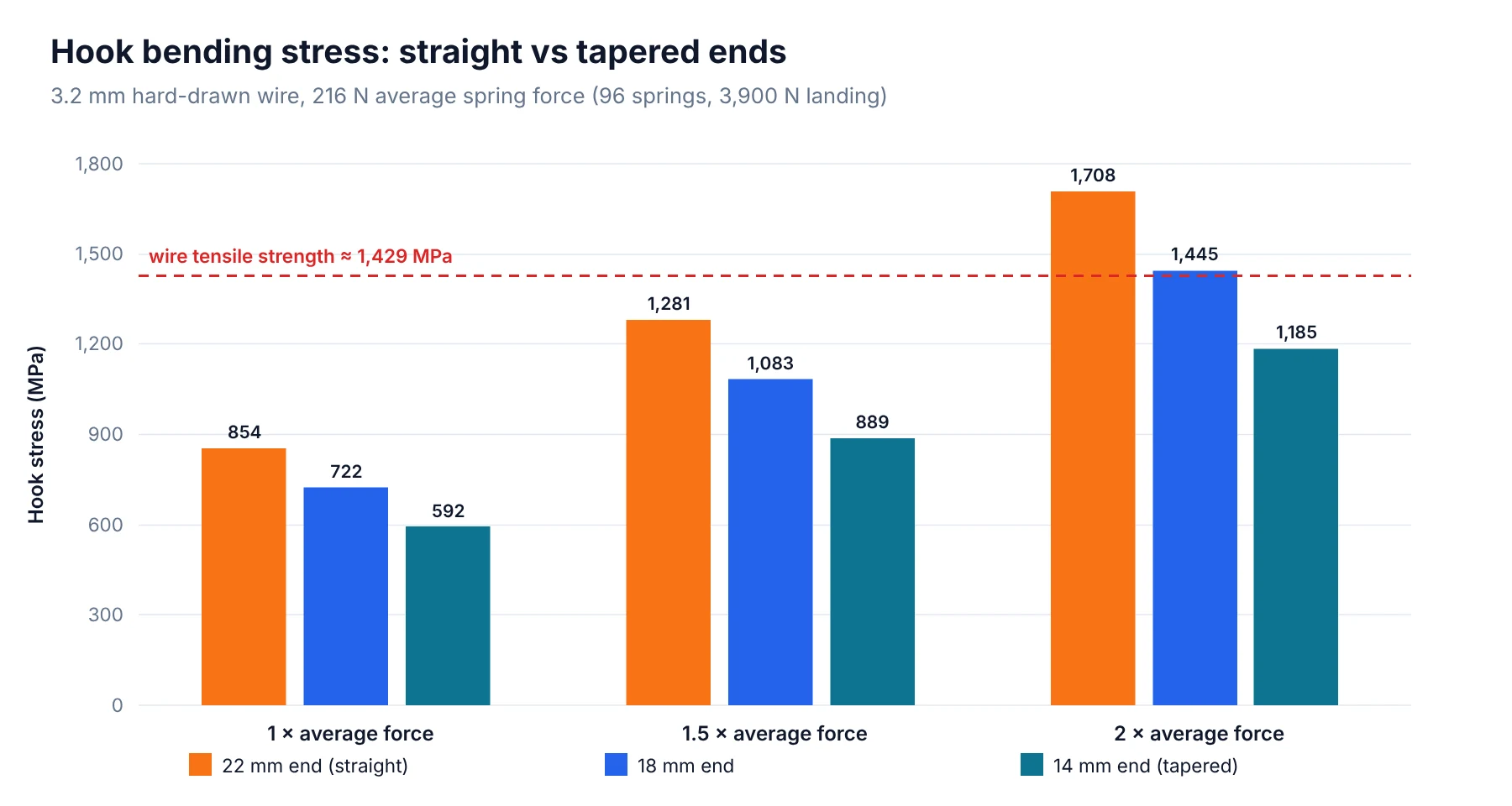
- The hooks fail first. In the same example the hook bending stress is 854 MPa, almost twice the 449 MPa in the coils.
- Tapered ends cut hook stress by about 31 %. Reducing the end coil diameter from 22 mm to 14 mm drops the hook stress from 854 MPa to 592 MPa at the same load.
- Rust is a strength problem, not just a looks problem. Losing 10 % of the wire diameter to corrosion raises the stress by 37 %.
How trampoline springs work
A trampoline bed is a woven mat stretched inside a round, oval or rectangular frame by dozens of coiled steel springs. Wikipedia’s description of the device makes the point clearly: the fabric is not elastic itself, and the elasticity is provided by the springs that connect it to the frame [1]. Recreational trampolines for home use are built less sturdily than competition trampolines and have weaker springs, while a competition bed of 4.28 × 2.14 m is held by around 110 steel springs [1].
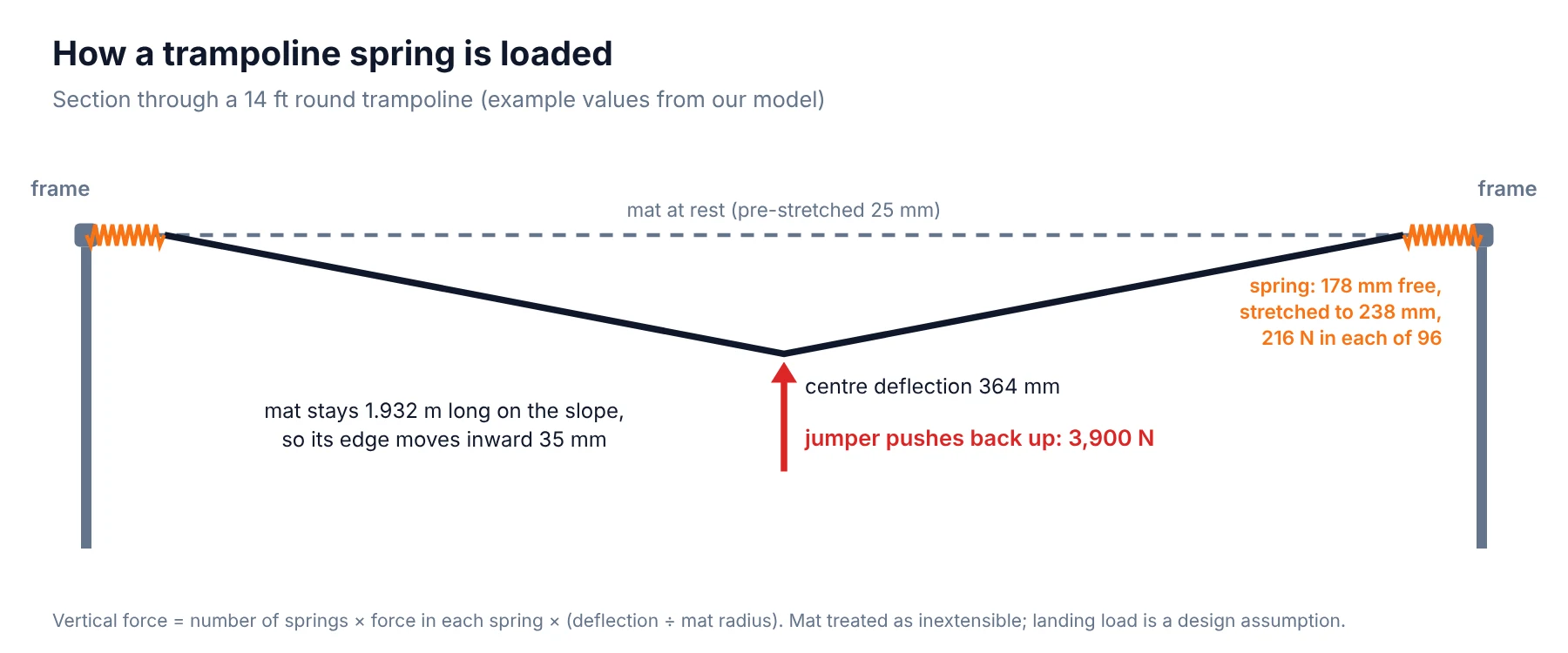
Because the mat hardly stretches, its edge has to move inward when the centre is pushed down. That inward movement is the extra stretch in each spring. At the same time, the spring force turns from horizontal towards the slope of the mat, so a growing share of it pushes the jumper back up. Two things follow from this geometry, and both matter when you specify springs:
- The bed is soft at first and becomes stiffer as it goes down, because both the spring force and the slope grow with the deflection.
- The installed pre-stretch sets the firmness of the first few centimetres, which is why a trampoline with tired springs feels “dead” even before any spring breaks.
How many springs, and how long?
Replacement springs are usually sold by their hook-to-hook length, and the common lengths offered for domestic trampolines are 5.5, 7 and 8.25 inches [5]. A trampoline retailer’s buying guide gives the usual rule of thumb: the more springs and the longer the spring, the more bounce, and longer springs give a smoother bounce than short ones [4].
That rule is half right. Spring length and rate set how far the bed goes down before it pushes back, but the number of springs works the other way. To see this, we analyzed a 14 ft (4.27 m) round frame with 178 mm (7 inch) springs, each pre-stretched by 25 mm at assembly, and a centre landing load of 3,900 N. That load is our design assumption for a 100 kg adult landing at about four times body weight, not a measured value. The mat was treated as inextensible, so the numbers show what the springs alone do.
| Springs on the frame | Centre deflection at 3,900 N | Force in each spring | Spring extension from free length |
|---|---|---|---|
| 72 | 422 mm | 248 N | 72 mm |
| 88 | 381 mm | 225 N | 63 mm |
| 96 | 364 mm | 216 N | 60 mm |
| 108 | 341 mm | 205 N | 55 mm |
The table shows the trade-off. Adding springs spreads the load, so each spring works at a lower force and lasts longer, but the bed also becomes firmer. A softer bed with fewer springs needs each spring to stretch further and carry more, which puts the hooks closer to their limit. When a buyer asks for “more bounce”, the right answer is usually a longer spring with a lower rate, not simply more springs. The same trade-off between bounce and hook stress decides the size of porch swing springs.
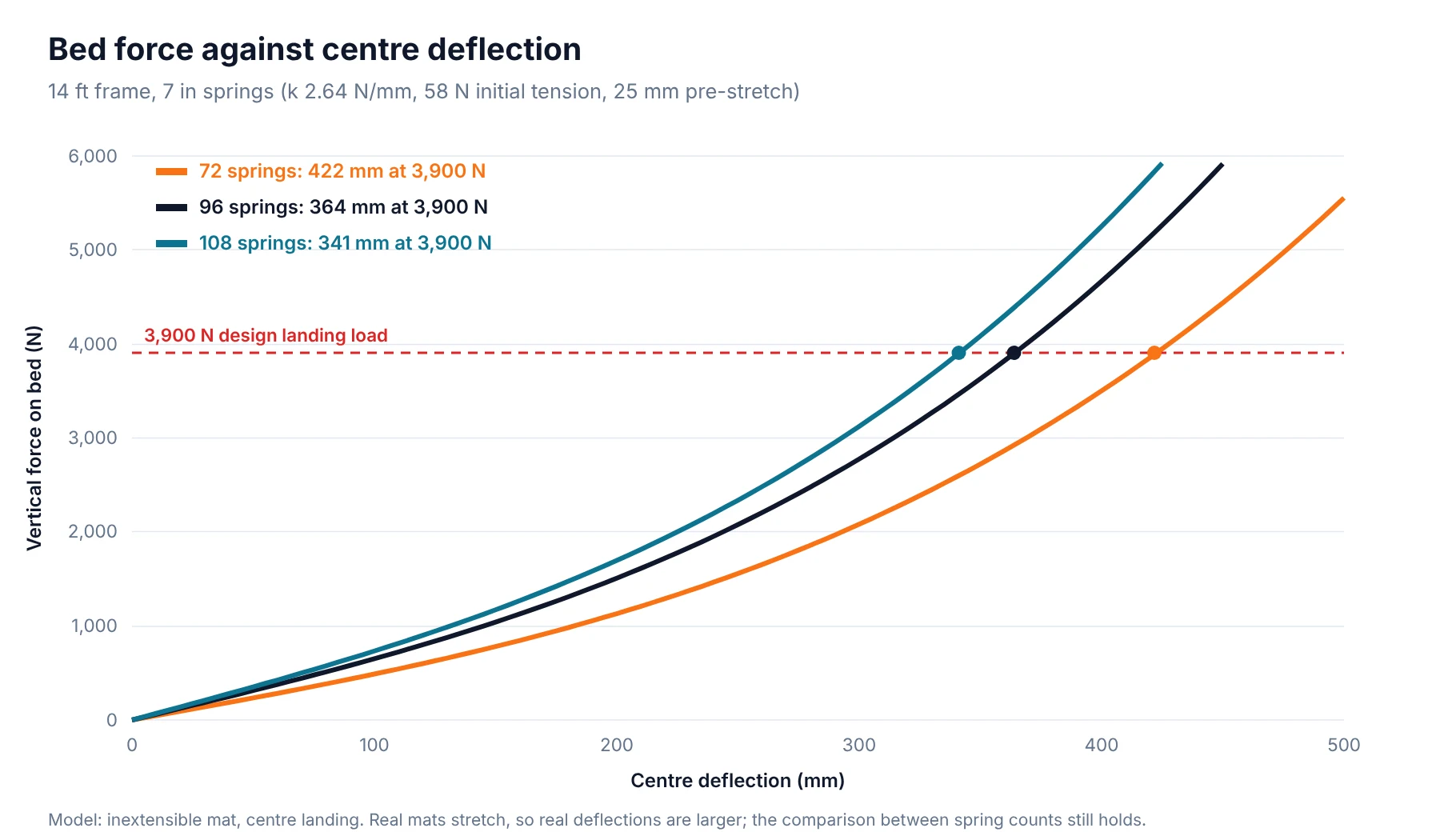
Data behind the chart:
| Centre deflection (mm) | Spring extension (mm) | Force per spring (N) | Bed force, 72 springs (N) | Bed force, 96 springs (N) | Bed force, 108 springs (N) |
|---|---|---|---|---|---|
| 50 | 26 | 126 | 235 | 313 | 353 |
| 100 | 28 | 131 | 489 | 652 | 734 |
| 150 | 31 | 140 | 782 | 1,042 | 1,173 |
| 200 | 35 | 152 | 1,132 | 1,509 | 1,697 |
| 250 | 41 | 167 | 1,559 | 2,078 | 2,338 |
| 300 | 48 | 186 | 2,083 | 2,777 | 3,124 |
| 350 | 57 | 209 | 2,723 | 3,631 | 4,085 |
| 400 | 67 | 235 | 3,501 | 4,669 | 5,252 |
Worked example: a 7 inch spring for a 14 ft frame
The example spring in our model is a close-wound extension spring. Its dimensions are listed below.
| Parameter | Value |
|---|---|
| Wire | Galvanized carbon spring wire, 3.2 mm |
| Mean coil diameter | 22 mm (spring index C = 6.9) |
| Active coils | 37, body length about 122 mm |
| Spring rate | 2.64 N/mm |
| Initial tension | 58 N (about 100 MPa initial stress) |
| Free length, hook to hook | 178 mm |
| Installed pre-stretch | 25 mm, giving 124 N at rest |
| Force at 3,900 N centre landing (96 springs) | 216 N at 60 mm extension |
Spring rate is the force needed to stretch the spring by one millimetre, and for a helical spring it follows the familiar formula k = G·d⁴ / (8·D³·Nₐ), where G is the shear modulus of the wire [6]. Our spring rate guide explains each term. With G = 79.3 GPa for carbon spring wire, the numbers above give 2.64 N/mm.
Stress in the coils
At 216 N, the corrected shear stress in the coils is 449 MPa, using the Wahl factor for C = 6.9. Hard-drawn carbon spring wire of 3.2 mm has a minimum tensile strength of about 1,429 MPa from Shigley’s strength equation [6], so the coils run at 31 % of tensile strength. That is comfortable for the static case and leaves room for the fatigue that comes from thousands of jumps a week.
Stress at the hooks
The hook is the weak point of every extension spring. Shigley gives the bending stress at the inside of the hook as σ = F·[(K)ᴬ·16D / (πd³) + 4 / (πd²)], where (K)ᴬ is a curvature factor for the hook bend [6]. For our spring with a full-diameter hook, that gives 854 MPa at 216 N, or 60 % of tensile strength: almost twice the stress in the coils. The same hook limit sets the listed safe load of the four springs on a spring horse, as our article on rocking horse springs shows.
Now look at what happens when the jumper lands off-centre. The springs nearest the landing point take more than their share. If those springs see 1.5 or 2 times the average force, the hook stress climbs to 1,281 MPa and 1,708 MPa. The second figure is above the wire’s tensile strength, which is exactly the failure trampoline owners report: a hook that opens or snaps near the frame. More detail on hook failures is in our article on why springs fail.
Why tapered trampoline springs last longer
A tapered trampoline spring is an extension spring whose last few coils get smaller towards each hook. Buying guides recommend them for a better bounce and more stability [4], but the engineering reason is the hook stress. The bending moment on the hook is the spring force times the hook radius. A smaller end coil means a smaller hook, a shorter lever arm and less bending at the weakest point.
| End coil (hook) diameter | Hook stress at 216 N | Share of tensile strength | Hook stress at 2 × 216 N |
|---|---|---|---|
| 22 mm (straight spring) | 854 MPa | 60 % | 1,708 MPa |
| 18 mm | 722 MPa | 51 % | 1,444 MPa |
| 14 mm (tapered end) | 592 MPa | 41 % | 1,185 MPa |
In our example the tapered end keeps the hook below the wire’s tensile strength even at twice the average force, while the straight spring does not. The same idea is used in conical springs, where reducing coil diameter changes both stiffness and stress. A tapered end costs a little more to coil because the diameter changes along the spring, but for a product that sees years of outdoor use it is usually worth it.
Wire, galvanizing and rust
Almost all trampoline springs are made of carbon spring wire with a zinc coating. Buying guides advise checking that springs are galvanized and avoiding springs that do not say so [4], and the reason is simple arithmetic. For a given force, the stress in a spring rises with the inverse cube of the remaining wire diameter, as the table shows.
| Wire diameter lost to corrosion | Stress at the same force |
|---|---|
| 0 % | 1.00 × |
| 10 % | 1.37 × |
| 20 % | 1.95 × |
For example, a spring that has lost a tenth of its wire diameter to rust runs at 37 % more stress. That takes our straight-hook example from 854 MPa to about 1,170 MPa at the hook, before any off-centre landing is counted.
How the zinc is applied matters as much as whether it is there. Each route has a known trap:
- Pre-galvanized wire. Galvanized spring wire is drawn or coated with zinc before the spring is coiled. The coating covers the wire well, but the cut ends at the hooks are bare steel and need attention.
- Hot-dip galvanizing after coiling. Hot-dip galvanizing immerses steel in molten zinc at around 450 °C [7]. That is hot enough to relax a cold-drawn spring and change its force, so finished springs are not normally hot-dipped.
- Electro-galvanizing after coiling. Zinc plating covers the whole part, including the hooks, but poorly controlled electroplating is one of the most common causes of hydrogen embrittlement in steel, and baking after plating is used to drive the hydrogen out [8].
Our spring finishes guide compares zinc with other coatings in more detail. For outdoor trampolines, ask your supplier which route they use and, for plated springs, how they control hydrogen embrittlement.
Example product: a polished gym spring
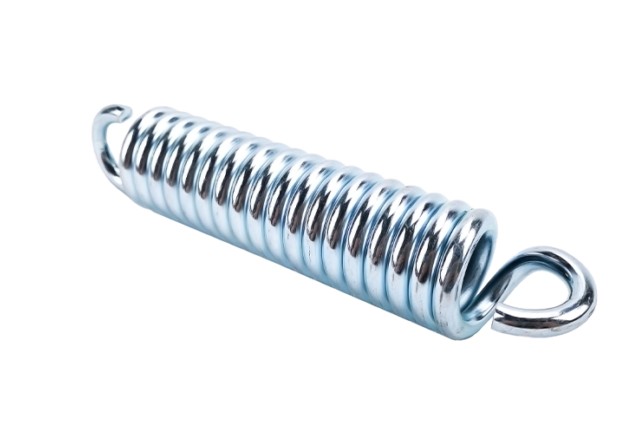
The spring above is one of the gym equipment springs shown in our extension spring application cases. It has the same features a good trampoline spring needs: a long close-wound body with initial tension, end coils that reduce towards the hooks, and full round eyes. We have not supplied springs for a named trampoline brand, so treat this as an example of what we can make rather than a trampoline reference. Fitness is one of the industries we supply; see our sport and fitness spring solutions for the range. For a spring that carries a hanging punching bag instead of a jumper, see our heavy bag springs guide.
Safety standards that touch trampoline springs
In the United States, ASTM F381 covers the components, assembly and use of consumer trampolines. The current edition, F381-24, applies to trampolines with a bed of at least 3,300 in² (21,300 cm²) and a height of at least 20 in (51 cm). It requires frame padding and a shock attenuation test on that padding, and it includes static load tests on the bed and frame and an ultraviolet resistance test [2]. In Europe, EN 71-14 covers trampolines for domestic use. Its 2025 revision gives clearer guidance on pinching and crushing risks for bystanders, with a focus on minimizing access to springs. SGS notes that the revision had not yet been harmonized under the Toy Safety Directive when it was published [3].
These standards test the whole trampoline, not the spring alone. For a spring supplier, the practical consequences are:
- The springs must survive the static bed and frame load tests with the mat fitted, so the hooks need the margin discussed above.
- The frame pad has to cover the springs, so spring length and hook shape must suit the pad width.
- Spring-covering designs and enclosure nets change how the springs are accessed and replaced, which affects the hook style.
Signs a trampoline spring needs replacing
A retailer’s guidance is to replace a spring as soon as it is stretched and no longer closes, broken, or strongly rusted. It also advises replacing even one bad spring, because the others and the mat then take extra load [4]. Our model supports that advice: when one spring stops working, its neighbours carry its share at the point where off-centre landings already load them most.
For a parts seller, the useful checks on a returned or field spring are:
- Gaps between coils at rest, which mean the spring has lost initial tension or taken a set.
- Hooks that have opened, twisted or cracked at the bend.
- Rust pits on the coils, or bare steel at the hook ends.
- A free length longer than a new spring from the same batch, for instance 185 mm against 178 mm.
What to send for a trampoline spring quote
To quote a new or replacement trampoline spring, we need:
| Item | Example |
|---|---|
| Free length, hook to hook | 178 mm (7 in) |
| Wire diameter and material | 3.2 mm galvanized carbon spring wire |
| Body outer diameter and end shape | 25 mm OD, tapered to 17 mm OD at the hooks |
| Hook type and orientation | Full round eye, both ends in line |
| Force at installed length and at maximum stretch | 124 N at 203 mm, 216 N at 238 mm |
| Initial tension, if specified | 58 N minimum |
| Finish | Zinc, with hydrogen embrittlement relief if plated after coiling |
| Frame size and spring count | 14 ft round, 96 springs |
| Quantity and packing | Per frame set or bulk, with carton marking |
If you only have a sample, such as a spring taken from an existing frame, we can measure it and propose a drawing. A drawing with the force at two lengths is better than a wire size alone, because two springs of the same wire can feel very different on a bed. Send your drawing or sample details through our contact page and our engineers will review it within 24 hours. Our extension springs page lists the wire range and hook styles we make, and you can read more about our company and its certifications. This guide was compiled by our editorial team with our spring engineers.
Frequently asked questions
What size springs does my trampoline need?
Measure the hook-to-hook length of an old spring with no load on it and count the springs on the frame. Common replacement lengths are 5.5, 7 and 8.25 inches, but frames differ, so match the old spring and the gap between frame and mat rather than the frame diameter alone.
Do more springs make a trampoline bounce higher?
More springs make the bed firmer and share the load, so each spring lasts longer. In our 14 ft model, 108 springs gave 341 mm of deflection under a 3,900 N landing against 422 mm with 72 springs. Longer springs with a lower rate are what make the bounce softer and deeper.
Why are trampoline springs tapered?
The smaller end coils reduce the bending stress at the hooks, which is where trampoline springs usually break. In our example a 14 mm end coil cut the hook stress by about 31 % compared with a full 22 mm end.
Should I replace all trampoline springs at once?
Replace any spring that is stretched, broken or rusty straight away. If several springs have gaps between the coils at rest, the set has lost initial tension and a full replacement gives a more even bed.
Are galvanized trampoline springs rust-proof?
No, but zinc slows corrosion considerably. The cut ends at the hooks and any damage to the coating rust first, and once the wire starts to thin, the stress rises quickly.
References
- Wikipedia, “Trampoline”. https://en.wikipedia.org/wiki/Trampoline
- ASTM International, ASTM F381-24 Standard Safety Specification for Components, Assembly, Use, and Labeling of Consumer Trampolines, scope page. https://store.astm.org/f0381-24.html
- SGS, “Revised EN 71-14:2025 Standards Updates Requirements for Toy Trampolines”, SafeGuardS 150/25, October 2025. https://www.sgs.com/en/news/2025/10/safeguards-15025-revised-en-71-14-2025-standards-updates-requirements-for-toy-trampolines
- Trampolines.com, “Trampoline Spring Tips”, March 2016. https://www.trampolines.com/blogs/trampoline-news/131067975-trampoline-spring-tips
- YescomUSA, galvanized steel trampoline spring product page (5.5, 7 and 8.25 in lengths). https://yescomusa.com/products/85-in-galvanized-steel-wire-trampoline-spring-20pcs
- Shigley’s Mechanical Engineering Design, Chapter 10 Mechanical Springs, lecture slides, Istanbul Technical University. https://web.itu.edu.tr/~halit/Makel/Ch_10_slides_m.pdf
- Wikipedia, “Hot-dip galvanization”. https://en.wikipedia.org/wiki/Hot-dip_galvanization
- Wikipedia, “Hydrogen embrittlement”. https://en.wikipedia.org/wiki/Hydrogen_embrittlement



