











In this article
- Key takeaways
- What loads does a porch swing spring carry?
- Worked example: a heavy duty porch swing spring
- Why wire size and hooks decide the rating
- Safety cable, hooks and other design choices
- How to check and replace porch swing springs
- What to send for a porch swing spring quote
- Frequently asked questions
- References
Cover image: an AI-generated illustration of a generic porch swing with comfort springs, based on a photo of extension springs we make; it does not show a specific product.
Porch swing springs are heavy extension springs fitted between the ceiling hanger and the top of each swing chain. Often sold as comfort springs, they let the swing bounce a little when someone sits down and soften the jerk at each end of the swing. The Porch Swing Company describes the usual layout: one end of the spring attaches to the hook in your ceiling or stand and the other end attaches to the top link of the hanging chains [1].
This guide is for swing and outdoor furniture makers, hanging kit suppliers and hardware brands who buy porch swing and hanging chair springs. It explains the loads a swing spring really sees, a worked heavy duty spring design, why wire size and hook shape set the safe rating, and what to put on a drawing. For extension spring drawings in general, see our extension spring specification guide.
Key takeaways
- Each spring carries half the swing, and more while it moves. At a 30° swing, the chain force at the bottom of the arc is 1.27 times the static load.
- The hook is the limit, not the coils. In our worked 8 mm design, hook bending stress reaches 0.69 of tensile strength at full swinging load, while the coil body is at 0.37.
- Thin wire cannot carry a heavy rating. A 6 mm wire spring of the same size would see hook stresses above the wire’s tensile strength at a 285 kg total load.
- Initial tension works against comfort. High initial tension stops the spring from moving at all under a light load.
- Always fit a safety cable. One swing maker says that when using the comfort spring, the spring safety cable must be installed [2].
What loads does a porch swing spring carry?
A porch swing usually hangs from two ceiling points, with one spring at each. Each spring carries half the weight of the swing plus its occupants. Published capacities give a sense of scale. Polywood puts the average porch swing’s weight capacity at 550 pounds [3]. This Old House suggests adding the weight of the swing to the maximum you expect it to hold, with 600 pounds as a reasonable estimate for the people [4].
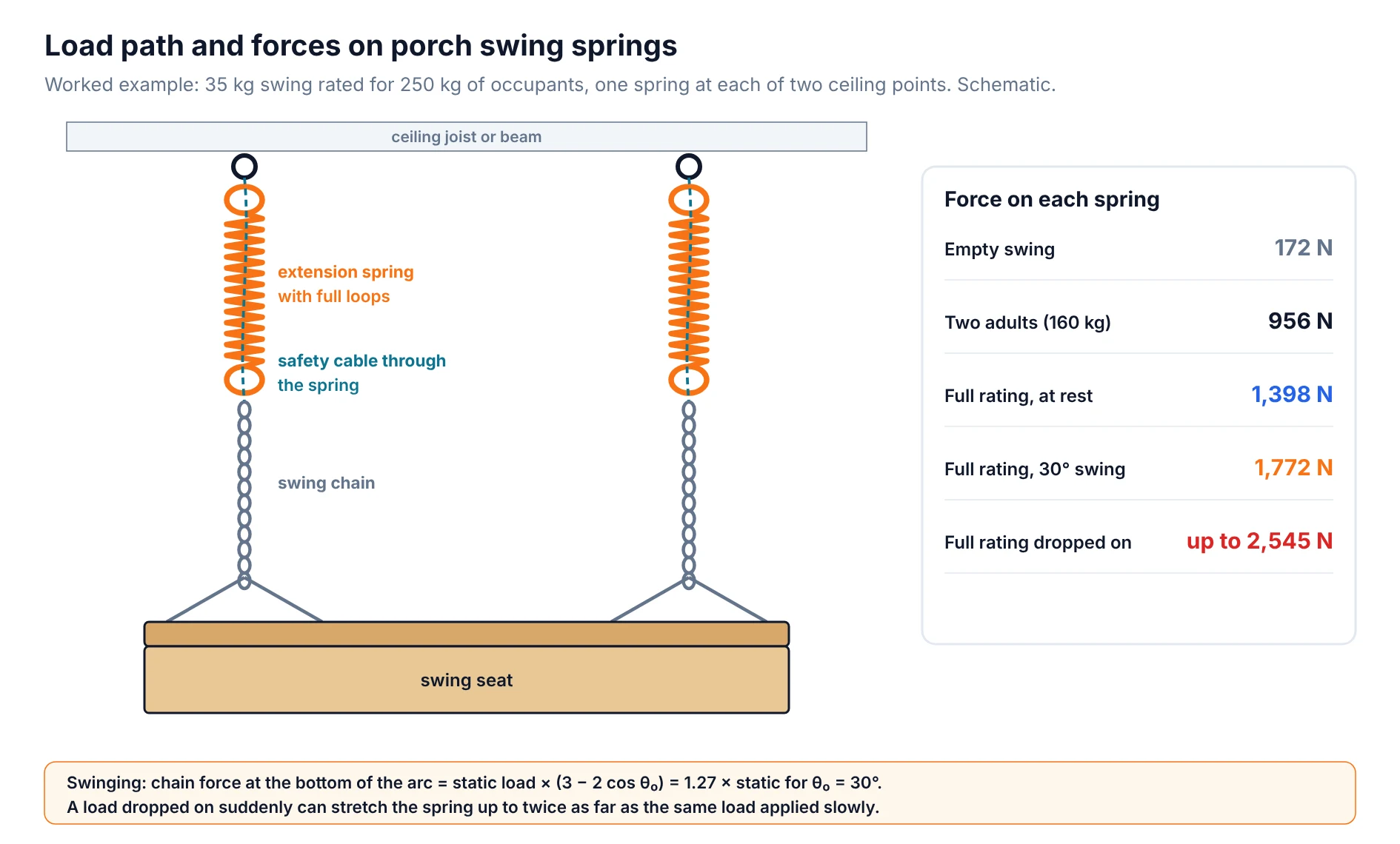
Swinging adds to that. For example, at the bottom of each arc, the chains must also pull the swing round its curved path. For a swing released from an angle θ₀, the chain force at the bottom is the static load times (3 − 2 cos θ₀). That is 1.27 times static for a 30° swing. A person dropping into the seat adds a short peak too: a load applied suddenly can stretch a spring up to twice as far as the same load applied slowly.
That is why ceiling hardware is sized with a margin. Woodsmith says the support beam should hold at least two times the weight of the fully loaded porch swing [5]. The spring sits in that same load path, so it needs the same thinking.
Worked example: a heavy duty porch swing spring
We sized a spring for a two to three seat swing weighing 35 kg, rated for 250 kg of occupants, so 285 kg in total (about 630 lb). With one spring per side, that is 1,398 N per spring at rest and 1,772 N at the bottom of a 30° swing. The typical case we used for comfort is two adults, 160 kg, or 956 N per spring. These are our own design assumptions, not figures from a standard. We used the standard extension spring equations and Shigley’s hook stress formulas, with G = 79.3 GPa and the minimum tensile strength of oil-tempered wire [6].
| Parameter | Value |
|---|---|
| Wire | 8.0 mm oil-tempered spring wire (ASTM A229), tensile strength 1,257 MPa |
| Mean coil diameter | 40.0 mm (spring index C = 5.0); outside diameter 48.0 mm |
| Active coils | 30, close-wound body 248 mm long |
| Length inside loops | About 312 mm, full loops both ends |
| Spring rate | 21.1 N/mm |
| Initial tension | 251 N (50 MPa initial stress, deliberately low) |
| Stretch, two adults (956 N) | 33 mm |
| Stretch, full rating at rest (1,398 N) | 54 mm |
| Stretch, full rating swinging (1,772 N) | 72 mm |
| Coil body stress, swinging at full rating | 0.37 of tensile strength |
| Hook bending stress, swinging at full rating | 0.69 of tensile strength |
| Hook bend torsion, swinging at full rating | 0.35 of tensile strength |
How the spring feels at different loads
| Occupants | Force per spring | Stretch | Bounce frequency |
|---|---|---|---|
| Empty swing (35 kg) | 172 N | 0 mm (below initial tension) | No bounce |
| One adult (80 kg) | 564 N | 15 mm | 3.05 Hz |
| Two adults (160 kg) | 956 N | 33 mm | 2.34 Hz |
| Full rating (250 kg) | 1,398 N | 54 mm | 1.94 Hz |
The bounce is quicker with fewer people, because the same spring carries less mass. Compare it with the swing itself: on 2.4 m chains, the swing moves at about 0.32 Hz, so the chain force peaks about 0.64 times per second. The spring’s bounce stays well above that, so the swinging does not pump it into resonance. Our guide to spring natural frequency explains the formula.
The full load range for the same spring, per spring, with stresses as fractions of tensile strength:
| Occupants | Force at rest | Stretch at rest | Force, 30° swing | Stretch, 30° swing | Hook stress, swinging | Coil stress, swinging |
|---|---|---|---|---|---|---|
| 0 kg | 172 N | 0 mm | 218 N | 0 mm | 0.08 | 0.05 |
| 40 kg | 368 N | 6 mm | 466 N | 10 mm | 0.18 | 0.10 |
| 80 kg | 564 N | 15 mm | 715 N | 22 mm | 0.28 | 0.15 |
| 120 kg | 760 N | 24 mm | 964 N | 34 mm | 0.37 | 0.20 |
| 160 kg | 956 N | 33 mm | 1,213 N | 45 mm | 0.47 | 0.25 |
| 200 kg | 1,153 N | 43 mm | 1,462 N | 57 mm | 0.57 | 0.30 |
| 250 kg | 1,398 N | 54 mm | 1,772 N | 72 mm | 0.69 | 0.37 |
Why wire size and hooks decide the rating
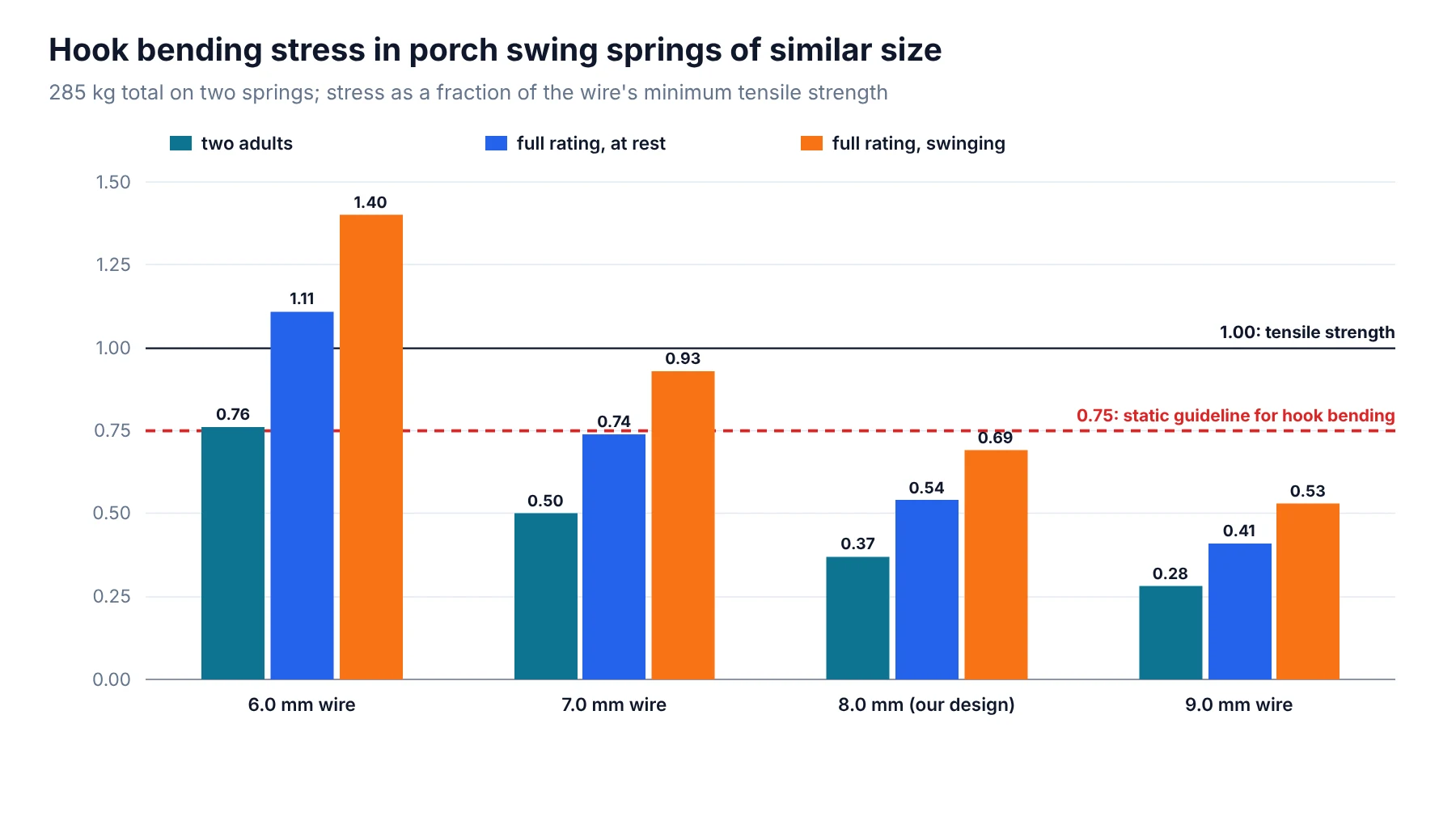
Many swing springs look alike, such as springs roughly 40–50 mm across and 200–300 mm long. The wire size inside that envelope makes a large difference. We compared four springs of similar size at the same 285 kg total load:
| Wire | OD | Rate | Bounce (two adults) | Coil body stress, swinging | Hook bending stress, at rest | Hook bending stress, swinging |
|---|---|---|---|---|---|---|
| 6.0 mm | 44 mm | 9.4 N/mm | 1.56 Hz | 0.74 | 1.11 | 1.40 |
| 7.0 mm | 45 mm | 19.7 N/mm | 2.26 Hz | 0.50 | 0.74 | 0.93 |
| 8.0 mm (our design) | 48 mm | 21.1 N/mm | 2.34 Hz | 0.37 | 0.54 | 0.69 |
| 9.0 mm | 51 mm | 39.9 N/mm | 3.22 Hz | 0.28 | 0.41 | 0.53 |
Stress values are fractions of the wire’s minimum tensile strength.
Shigley’s lecture slides point to Table 10–7 for the recommended maximum stresses in extension springs under static loads; for bending at the hook of common carbon spring steels it is about 75 % of tensile strength [6]. A swing is not a static load, so a good design stays below that line even while swinging.
So what does a rating of “600 lb per spring” actually mean? It may be a working load, a proof load or a breaking load. One kit maker lists comfort springs measuring 1.75 by 8.5 inches with a 600 lb weight capacity each [1]. A buyer should ask which kind of rating it is and what it was tested to. Three lessons follow from the table:
- The hook fails first. Shigley gives separate stress-correction factors for bending at point A of the hook and torsion at the hook bend, because these are the critical locations [6]. The coils of every spring in the table are below the hook stress.
- A thicker wire makes a harder ride. Going from 8 to 9 mm wire cuts hook stress by a quarter, but nearly doubles the rate. To keep the bounce, the stronger spring needs more coils and a longer body.
- Dropping into the seat is the worst case. If the full 250 kg drops onto the seat at once, our 8 mm spring briefly sees about 2,545 N and its hook reaches 0.99 of tensile strength. A rating should leave room for that, and the safety cable covers what is left.
Keep initial tension low
Close-wound extension springs are made with initial tension, a force that holds the coils together before the spring starts to stretch. Shigley shows that initial tension is created by twisting the wire as it is wound onto a mandrel, and that it is locked in because the spring cannot get any shorter [6]. That is useful in a mechanism, but in a swing it is wasted. With a standard 110 MPa initial stress, our spring would carry 553 N before moving at all, so one adult would feel no bounce. We specified 50 MPa, or 251 N, so the spring starts working under one person.
| Initial stress | Initial tension | Stretch, one adult (564 N) | Stretch, two adults (956 N) | Stretch, full rating (1,398 N) |
|---|---|---|---|---|
| 110 MPa (typical) | 553 N | 0.5 mm | 19 mm | 40 mm |
| 50 MPa (our design) | 251 N | 15 mm | 33 mm | 54 mm |
Safety cable, hooks and other design choices
The most important safety feature is not the spring. One swing maker’s user guide says plainly: when using the comfort spring, the spring safety cable must be installed [2]. The cable runs through the middle of the spring from the ceiling hook to the chain, a little longer than the stretched spring. If a hook breaks, the cable holds the swing.
Other choices that matter for makers:
- Full loops with generous bends. A tight bend at the hook raises the torsion stress at point B. Shigley also shows an alternate hook design that reduces the coil diameter at point A to lower the bending stress there [6].
- A drawbar spring for a fail-safe design. A drawbar spring is a compression spring pulled by two wire loops through its middle. Overload closes the coils instead of stretching them, and a broken spring still holds. Our drawbar springs article explains how it works.
- Outdoor finish. The Porch Swing Company’s springs are zinc-plated and clear-coated for all-weather protection [1]. Zinc plating on high-strength wire must be followed by baking to avoid hydrogen embrittlement; our spring finishes guide covers the options.
- Matched pairs. Two springs with different rates make the swing hang crooked and twist as it moves. Supply and replace them in pairs.
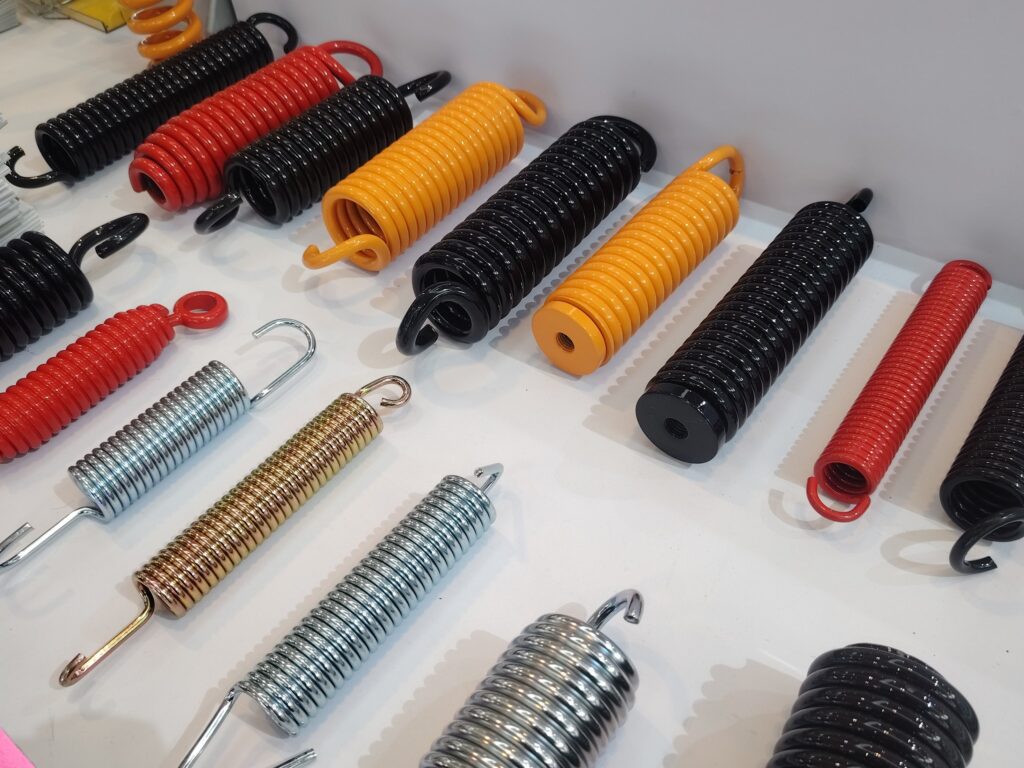
The photo shows extension springs we make. We make heavy extension springs with full loops, extended hooks and coated or plated finishes, and parts such as gym equipment springs. Other springs that carry people work the same way; for example, see our articles on trampoline springs and rocking horse springs. Brand names in this article identify the companies whose public documents we quote; NorenSpring is not affiliated with them.
How to check and replace porch swing springs
Springs and hooks wear at the contact points, and outdoor springs rust. Check them at the start of each season:
| Check | What to look for | Action |
|---|---|---|
| Hook and loop bends | Cracks, flat spots or deep wear where the hook meets the eye bolt | Replace both springs |
| Free length | The spring no longer closes fully when unloaded | It has taken a set; replace both |
| Rust | Pitting, flaking zinc or red rust on the coils | Replace; pitting starts fatigue cracks |
| Safety cable | Missing, frayed or shorter than the stretched spring | Fit a new cable before use |
| Matching | One side hangs lower than the other | Replace as a pair |
To measure a spring for a replacement, take the wire diameter, the outside diameter, the length inside the loops and the number of coils. Our guide on how to measure a spring shows each step, and our article on why springs fail explains fatigue, set and corrosion.
What to send for a porch swing spring quote
| Item | Example |
|---|---|
| Use and rating | Two to three seat porch swing, 250 kg occupants, two springs |
| Drawing or new sample | Drawing preferred; a used spring may have taken a set |
| Wire and material | 8.0 mm oil-tempered (ASTM A229) or as specified |
| Outside diameter | 48.0 mm |
| Length inside loops | About 312 mm, with tolerance |
| Ends | Full loops, in line, with inside bend radius at least equal to the wire size |
| Force at two lengths | 956 N at 345 mm and 1,398 N at 366 mm, ± 10 % |
| Maximum initial tension | 300 N maximum |
| Finish | Zinc plate with baking and clear coat, or powder coat |
| Safety cable | Through the spring, supplied by us or by you |
| Quantity and packing | In matched pairs |
Two forces at two lengths inside the loops are the most important lines on the drawing. Send your drawing or sample through our contact page, and our engineers will review it and reply within 24 hours. You can read more about our company and its certifications. This guide was compiled by our editorial team with our spring engineers.
Frequently asked questions
Do porch swing springs need a safety cable?
Yes. A safety cable through the spring holds the swing if a hook or the spring breaks. One swing maker’s guide says the spring safety cable must be installed whenever the comfort spring is used [2].
How much weight can porch swing springs hold?
It depends on the wire size, the hook design and how the rating is defined. In our worked example, an 8 mm wire spring with a 48 mm outside diameter is sized for a 285 kg swing and occupants on two springs, including swinging. A 6 mm spring of similar size would be overloaded at the hook at that load.
Should a porch swing spring be stiff or soft?
Soft enough to bounce, strong enough at the hook. In our example, a 21 N/mm spring stretches 33 mm with two adults and bounces at about 2.3 Hz. A spring twice as stiff gives a harder ride with little gain in safety, unless it also has a thicker wire.
Can I use porch swing springs on a hanging chair?
Yes, the same type of spring is used on hanging egg chairs and hammock chairs, usually one spring at a single ceiling point. With one spring, it carries the whole load, so it needs roughly twice the capacity of each spring on a two-point porch swing.
References
- The Porch Swing Company, “Black snap hook hangers and springs porch swing hanging kit”. https://theporchswingcompany.com/pages/black-snap-hook-hangers-and-springs-porch-swing-hanging-kit
- Organic Swings, “User guide” (PDF). https://cdn.shopify.com/s/files/1/0183/1445/files/Organic_Swings_User_Guide.pdf
- Polywood, “How to hang a porch swing”. https://polywood.com/blog/outdoor-living/diy/how-to-hang-a-porch-swing
- This Old House, “How to hang a porch swing”. https://www.thisoldhouse.com/porches/how-to-hang-a-porch-swing
- Woodsmith, “How to hang a porch swing”. https://www.woodsmith.com/review/how-to-hang-a-porch-swing/
- Shigley’s Mechanical Engineering Design, Chapter 10 Mechanical Springs, lecture slides, Istanbul Technical University. https://web.itu.edu.tr/~halit/Makel/Ch_10_slides_m.pdf



