










In this article
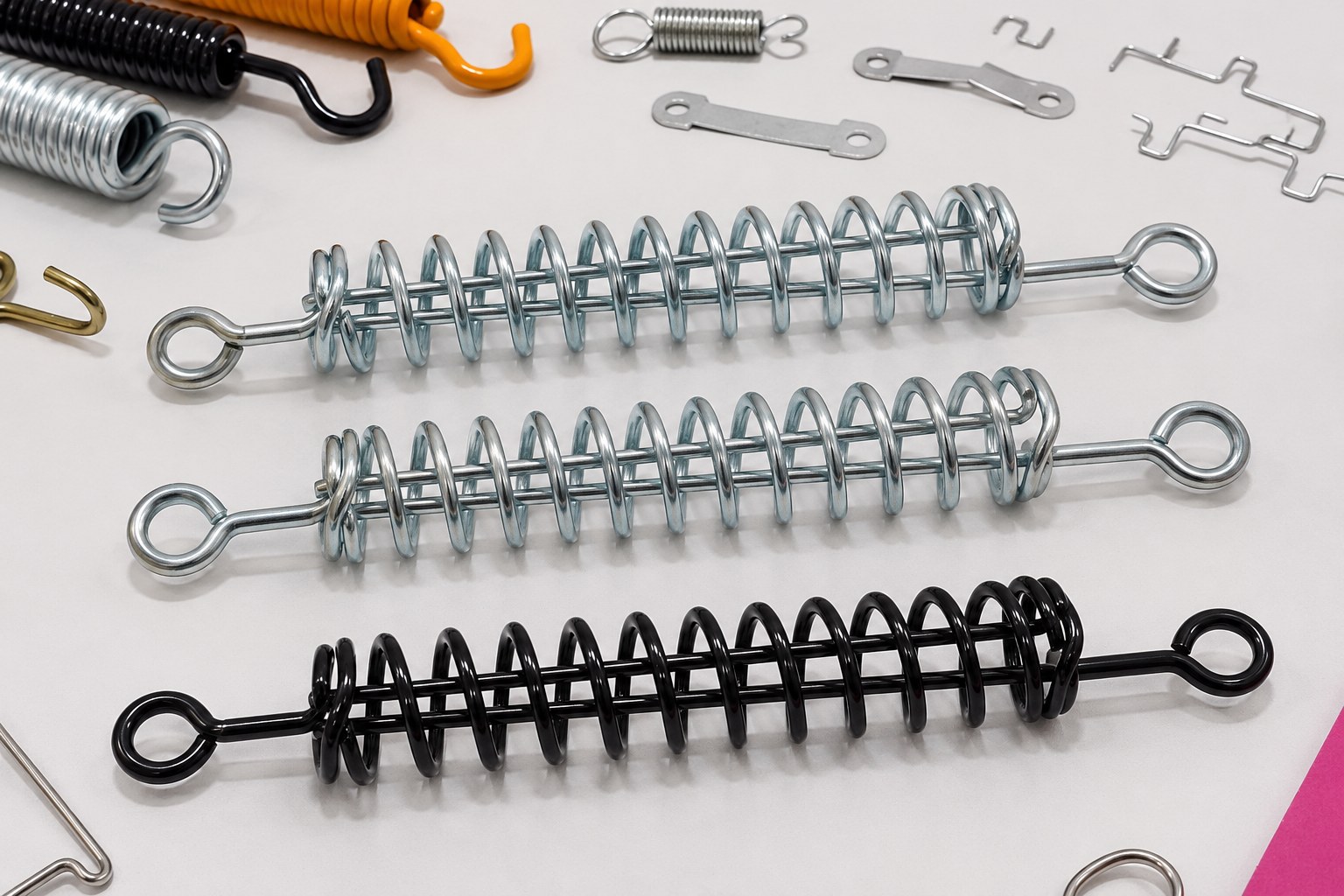
Cover image: an AI-generated illustration based on a photo of springs from our stand, not a photograph of a specific drawbar order.
Drawbar springs are assemblies that combine a compression spring with two formed wire loops, called drawbars, that pass through the centre of the coils and hook around the opposite ends [1]. When you pull on the drawbars, they squeeze the spring between them, so a tension load at the ends becomes a compression load in the coils. The assembly behaves like an extension spring, but it has a fail-safe feature: if the spring breaks, the drawbars stay hooked together and keep holding the load [2].
Below: how it works, when to choose it over an extension spring, and a worked sizing example with 4 data tables.
Key takeaways
- A compression spring that works in tension. The loops “convert tension loads at the ends of the drawbar spring into a load that compresses the helical coils” [1].
- Fail-safe. A drawbar spring will continue to carry a static load after the spring fractures [4], which is why it is used for swing seats and other loads over people [3].
- Built-in stop. Travel ends when the compression spring reaches solid height, so the assembly cannot be overstretched [2].
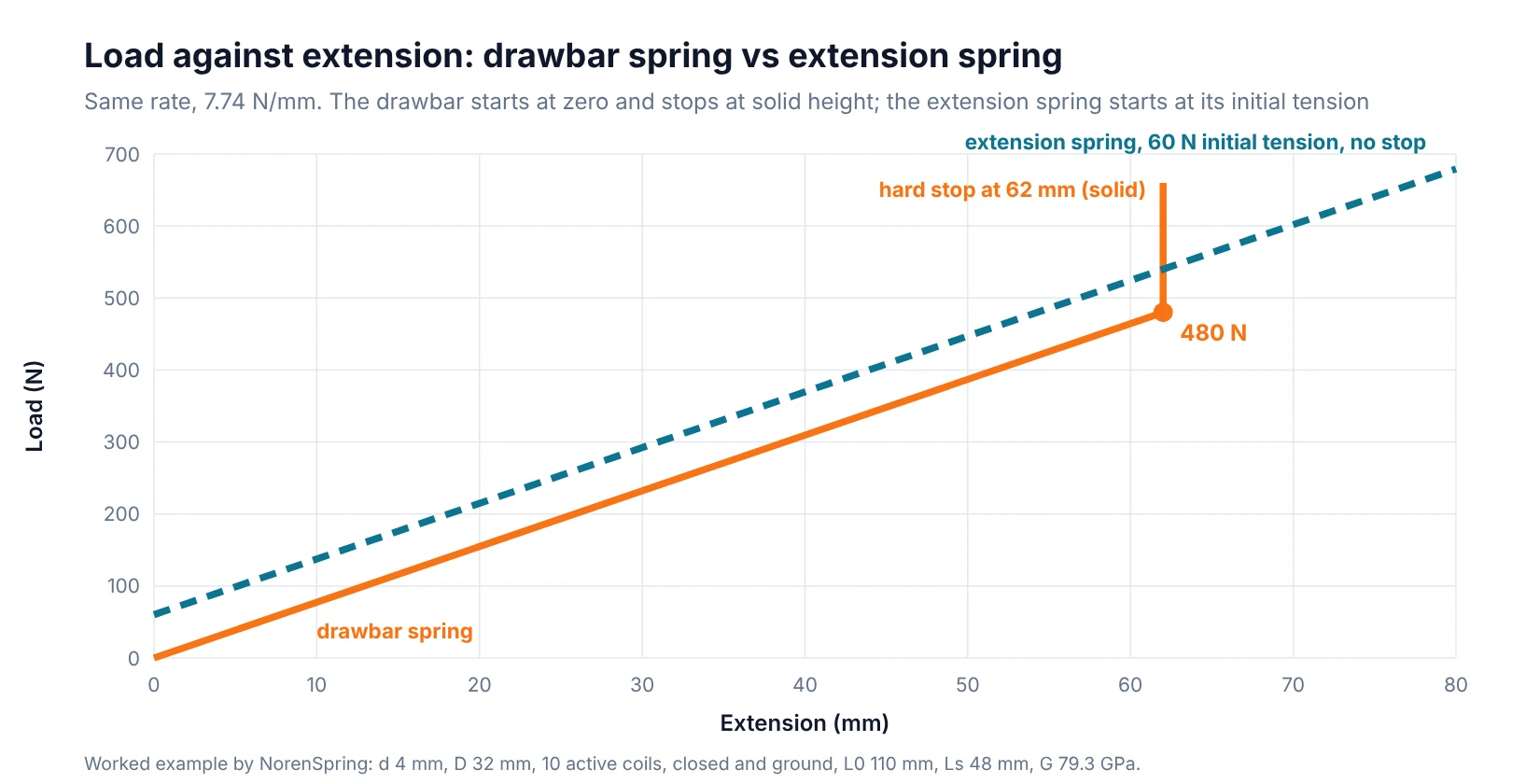
- No initial tension. The assembly starts to extend from zero load, unlike a close-wound extension spring.
- Size it as a compression spring. Rate, travel and stress come from the compression spring formulas. The stress at solid height must be safe, because overloads always drive the spring solid.
How does a drawbar spring work?
A drawbar spring has three parts: one helical compression spring and two drawbars. Each drawbar is a length of wire bent into a long loop. One drawbar enters the spring from the left, runs through the centre and hooks over the right-hand end coil. The other enters from the right and hooks over the left-hand end coil. The ends are then bent to capture the spring between them [1].
When the eyes are pulled apart, each drawbar pushes on the far end of the spring, so every 1 mm of extension at the eyes is 1 mm of compression in the coils.
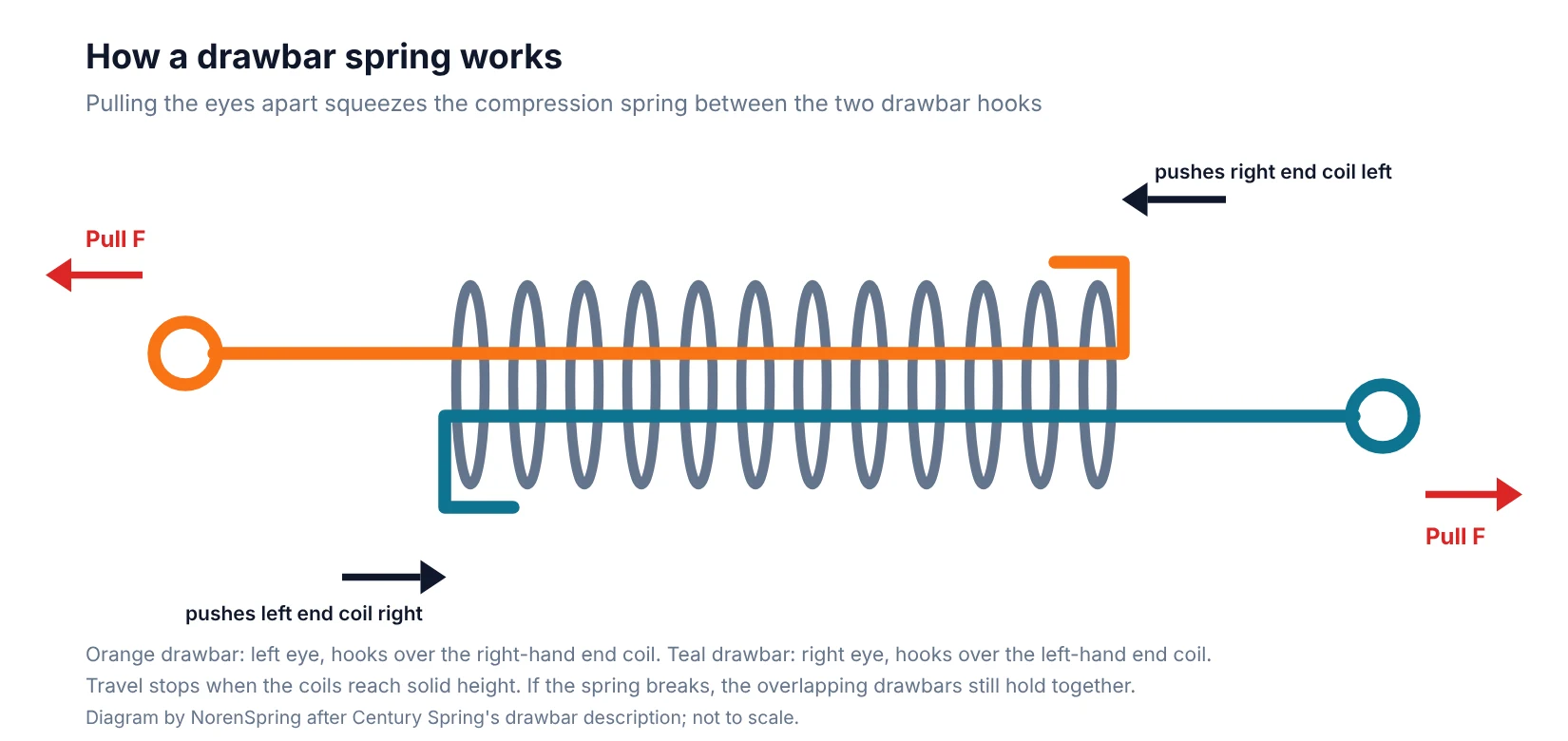
Three consequences follow from this layout:
- The spring rate is the compression spring rate. Century Spring notes the rate is a function of the wire diameter, the number of coils and the coil diameter [1], exactly as for any compression spring.
- The travel is limited by solid height. Once the coils touch, the drawbars cannot move further apart. Lee Spring calls this “an extension spring with a fixed stop” that eliminates potential overstretching [2].
- The load path survives a broken spring. The drawbar loops overlap inside the coils, so if the spring fractures, the two loops hook on each other and the assembly does not come apart. Century Spring describes drawbar springs as designed to “maintain load and structural cohesion, even when the spring has fractured” [1].
Drawbar spring vs extension spring
An extension spring takes the load through hooks formed from the spring wire itself. The hook is usually the most highly stressed part, and our guide to compression vs extension springs shows that hook bends can run above the coil stress. If an extension spring hook breaks, the two ends separate. A drawbar spring moves the load into separate drawbars and keeps the spring wire in compression, which Century Spring describes as stronger than the hook ends of a traditional extension spring [1].
| Feature | Extension spring | Drawbar spring |
|---|---|---|
| Load in the coils | Tension (torsion of the wire) | Compression |
| Initial tension | Yes, wound in during coiling | None, unless the drawbars preload the spring |
| End fittings | Hooks or loops formed from the spring wire | Separate drawbars of a chosen wire size |
| Maximum extension | No built-in stop, can be overstretched | Positive stop at solid height |
| If the spring breaks | Ends separate and the load drops | Drawbars stay hooked and hold the load |
| Length for the same travel | Shorter at rest | Longer, because travel is limited to free length minus solid height |
| Parts and cost | One part | Three parts, assembled |
Choose an extension spring when space is tight and a failure does no harm. Choose a drawbar spring when a sudden separation would be dangerous or hooks keep breaking. Lee Spring adds that drawbar springs can often withstand loads far in excess of the compression spring’s own closing force [2], because the solid spring and the drawbars carry the overload together.
Where drawbar springs are used
Typical applications named by spring makers:
- Porch and garden swings, and hammocks. The best-known use: the spring supports the weight of the occupants [1], and a catastrophic failure would be completely unacceptable [3]. Our porch swing springs guide works through the loads and hook stresses for a conventional extension spring on a swing.
- Covers and tarpaulins. Swimming pool covers and tarpaulins, where the spring holds a steady tension [2].
- Marine. Tethering or mooring a boat, where shock loads are common [2].
- Fences and gates. Tensioning fence wires or closing gates [2]. For heavy folding gates on trailers, where springs act through a crank on the hinge, see our trailer ramp springs sizing guide. Plow blades use a related design: long preloaded extension springs that let the blade trip over a curb. Our snow plow trip springs guide explains how they are set.
- Vehicles, aircraft and medical equipment. Trunk and door latches, aircraft personnel and cargo bay doors, wheelchairs and hospital beds [1].
How to size a drawbar spring
Sizing is mostly a compression spring calculation in six steps:
- Set the load and travel. State the load at the working extension, the maximum extension the mechanism needs, and any overload the assembly must survive.
- Choose the spring so that free length minus solid height exceeds the travel. The usable travel can never be more than L0 − Ls. Our compression spring design guide explains how much of that travel to use in service.
- Calculate the rate. Use k = G·d⁴ / (8·D³·Na) [5]. The load at any extension x is simply k·x, starting from zero.
- Check the stress at solid height. Because any overload drives the spring solid, the corrected shear stress at solid must be within the allowable stress for the wire. This is the key difference from a normal compression spring, which may never reach solid in service.
- Leave room inside the coils for the drawbars. Two drawbar wires pass side by side through the centre, so the spring inside diameter must be larger than twice the drawbar wire diameter plus clearance.
- Size the drawbars and their bends. The drawbars carry the full load and the fail-safe load. Their wire size and bend radius, not the spring, set the ultimate strength of the assembly. Our wire forms design guide covers minimum bend radii.
Step 4 is where most problems start. A drawbar spring will be pulled to its stop every time someone overloads it, for example when a child swings hard. A “solid safe” spring turns the stop into a real safety feature rather than the point where the spring takes a permanent set.
Worked example
We sized one drawbar spring to show the numbers. The spring uses 4 mm wire, a 32 mm mean diameter (spring index 8), 10 active coils and closed, ground ends, so it has 12 total coils.
| Quantity | Formula | Value |
|---|---|---|
| Spring rate k | G·d⁴ / (8·D³·Na), G = 79.3 GPa [6] | 7.74 N/mm |
| Solid height Ls | d·Nt for closed and ground ends [5] | 48 mm |
| Maximum travel, L0 = 110 mm | L0 − Ls | 62 mm |
| Load at the stop | k × 62 mm | 480 N |
| Wahl factor at index 8 | (4C − 1)/(4C − 4) + 0.615/C | 1.184 |
| Corrected stress at solid | 8·F·D·Kw / (π·d³) | 724 MPa |
| Inside diameter | D − d | 28 mm |
Because there is no initial tension, load and stress rise in direct proportion to the extension:
| Share of travel | Extension | Load | Corrected stress |
|---|---|---|---|
| One quarter | 15.5 mm | 120 N | 181 MPa |
| Half | 31 mm | 240 N | 362 MPa |
| Three quarters | 46.5 mm | 360 N | 543 MPa |
| Full travel (stop) | 62 mm | 480 N | 724 MPa |
The assembly starts from zero load and reaches 480 N at its 62 mm stop. A 724 MPa corrected stress at solid is acceptable for a good oil tempered or music wire of this size; compare it with the allowable stress for your wire, as explained in our oil tempered vs hard drawn wire guide. If the free length is raised to 120 mm, the travel grows to 72 mm, but the load at solid rises to 558 N and the stress to 841 MPa, which is too high for many wires. The 28 mm inside diameter leaves plenty of room for two drawbars of 5 or 6 mm wire.
The table shows how the free length trades travel against stress for the same spring (d 4 mm, D 32 mm, 10 active coils, Ls 48 mm, k 7.74 N/mm):
| Free length L0 | Travel to the stop | Load at the stop | Corrected stress at solid |
|---|---|---|---|
| 90 mm | 42 mm | 325 N | 490 MPa |
| 100 mm | 52 mm | 403 N | 607 MPa |
| 110 mm | 62 mm | 480 N | 724 MPa |
| 120 mm | 72 mm | 558 N | 841 MPa |
| 130 mm | 82 mm | 635 N | 957 MPa |
Every extra 10 mm of free length adds 10 mm of travel, 77 N at the stop and about 117 MPa of stress at solid. If you need more travel without more stress, add active coils or use a larger coil diameter instead of simply lengthening the spring.
The same layout scales neatly. Keep the spring index at 8, 10 active coils, closed and ground ends and a free length of 27.5 wire diameters, and the stress at solid stays at 724 MPa for every wire size, while the rate grows with d and the load at the stop grows with d²:
| Wire d | Mean diameter D | Free length L0 | Rate k | Solid height Ls | Travel | Load at the stop | Stress at solid |
|---|---|---|---|---|---|---|---|
| 2 mm | 16 mm | 55 mm | 3.87 N/mm | 24 mm | 31 mm | 120 N | 724 MPa |
| 3 mm | 24 mm | 82.5 mm | 5.81 N/mm | 36 mm | 46.5 mm | 270 N | 724 MPa |
| 4 mm | 32 mm | 110 mm | 7.74 N/mm | 48 mm | 62 mm | 480 N | 724 MPa |
| 5 mm | 40 mm | 137.5 mm | 9.68 N/mm | 60 mm | 77.5 mm | 750 N | 724 MPa |
| 6 mm | 48 mm | 165 mm | 11.62 N/mm | 72 mm | 93 mm | 1,080 N | 724 MPa |
This is a quick way to pick a starting size: find the row whose load at the stop covers your overload case, then adjust coils and free length for the exact travel.
For step 5, the room left for the drawbars depends on the spring index. With index 8 springs and 2 mm of total clearance (our working assumption), the largest drawbar wire that fits twice through the centre is:
| Spring wire d | Mean diameter D | Inside diameter | Largest drawbar wire, two side by side |
|---|---|---|---|
| 2 mm | 16 mm | 14 mm | 6.0 mm |
| 3 mm | 24 mm | 21 mm | 9.5 mm |
| 4 mm | 32 mm | 28 mm | 13.0 mm |
| 5 mm | 40 mm | 35 mm | 16.5 mm |
| 6 mm | 48 mm | 42 mm | 20.0 mm |
At index 8 there is always room; the limit bites with small-index springs (C of 4 to 5), where the inside diameter shrinks quickly.
Materials and finishes
Spring and drawbars are usually high carbon or stainless steel [1]. Lee Spring lists carbon and alloy steels, stainless 17-7, 301, 302 and 316, phosphor bronze, Hastelloy, Inconel, beryllium copper and Elgiloy as possible materials [2]. Outdoors, corrosion often decides:
- Zinc plating gives basic corrosion resistance at low cost [2]. On high-strength spring steel it must be followed by a hydrogen relief bake.
- Powder coating adds corrosion resistance and colour coding [2].
- Shot peening can be used to reduce stress and improve fatigue life [2].
Our spring finishes guide compares these coatings, including the colour passivates we use on zinc-plated springs.
What to send for a drawbar spring quote
For a quote, send:
- The load at working extension and at the stop, and the required travel.
- Eye-to-eye length at rest and the maximum installed length.
- Eye or hook shape at each end, and the pin or chain it hooks onto.
- Maximum outside diameter, if the assembly runs in a tube or near other parts.
- Material and finish, and the operating environment (outdoor, pool, marine).
- Whether the drawbars should preload the spring, giving an initial load like an extension spring.
Century Spring suggests measuring the outside diameter, the free length without compressing the spring, and the drawbar wire size when replacing an existing part [1].
A drawbar assembly is a compression spring plus two wire forms. We make both compression springs and wire forms, so we can review a drawbar design from a drawing, a sketch or a sample. Send the details through our contact page, and if you are still deciding between a drawbar and a standard extension spring, our custom extension spring guide lists what to specify for the hook version.
Frequently asked questions
Is a drawbar spring stronger than an extension spring?
Usually, in ultimate load: overloads go into the solid spring and the drawbars, not into hooks bent from the spring wire. Its working rate is simply that of the compression spring inside.
What happens if a drawbar spring breaks?
The drawbar loops overlap inside the coils, so they hook on each other and the assembly keeps holding a static load [4]. The broken spring should be replaced, but the load does not drop suddenly.
How far can a drawbar spring stretch?
Only as far as the compression spring can be compressed: free length minus solid height. In our worked example that is 62 mm for a 110 mm free length. Beyond that point the coils are solid and the assembly stops.
Do drawbar springs have initial tension?
Not usually: the spring rests at its free length, so the assembly extends at any load. For an initial load, make the drawbars slightly shorter than the free length to preload the spring.
About the authors
This guide was prepared by the NorenSpring engineering team, which designs and manufactures custom compression, extension and torsion springs and wire forms in Xuzhou, China, since 2001. Technical content reviewed by Feng Yulin, General Manager and senior structural engineer, who has 15 years of spring R&D experience and more than 30 national patents. Our certificates are shown on our about page. The worked example is our own calculation. Sources were last checked on November 8, 2026.
Sources
- Century Spring, Drawbar springs: construction, load path, applications and measurement. centuryspring.com. Retrieved 2026-11-08.
- Lee Spring, Drawbar springs from Lee Spring: fail-safe stop, applications, materials and finishes. leespring.com. Retrieved 2026-11-08.
- Engineer Live (Setform), Drawbar springs with inbuilt safety feature (2 April 2020). engineerlive.com. Retrieved 2026-11-08.
- MW Components, Drawbar springs. mwcomponents.com. Retrieved 2026-11-08.
- AMES, Compression spring formulas: spring rate, solid height and end types. amesweb.info. Retrieved 2026-11-08.
- Istanbul Technical University, Mechanical Springs lecture slides based on Shigley’s Mechanical Engineering Design, chapter 10 (spring wire properties and Wahl factor). itu.edu.tr. Retrieved 2026-11-08.



