










In this article
- Key takeaways
- Compression vs extension spring at a glance
- How does a compression spring work?
- How does an extension spring work?
- Worked example: one 120 N spring, both ways
- Which is safer when it breaks?
- Stress limits compared
- Space, guiding and buckling
- Overload, fatigue and life
- Real springs: compression and extension side by side
- Which should you choose?
- What to send for a quote
- Frequently asked questions
- About the authors
- Sources
The difference between a compression vs extension spring is the direction of the load. A compression spring is pushed: it gets shorter under load and pushes back. An extension spring, also called a tension spring, is pulled: it gets longer and pulls back through hooks or loops at its ends. Choose a compression spring when the mechanism can squeeze something, and an extension spring when it has to pull two parts together.
That sounds simple, but the choice also changes where the spring is most stressed, how it fails, how much space it needs, and whether it carries force before it moves. This guide compares the two side by side and works one 120 N spring through both designs. For the wider family of spring types, see our types of springs guide.
Key takeaways
- Compression springs push, extension springs pull. Both use the same helical coil body and the same rate formula, so the same wire and coil give the same stiffness.
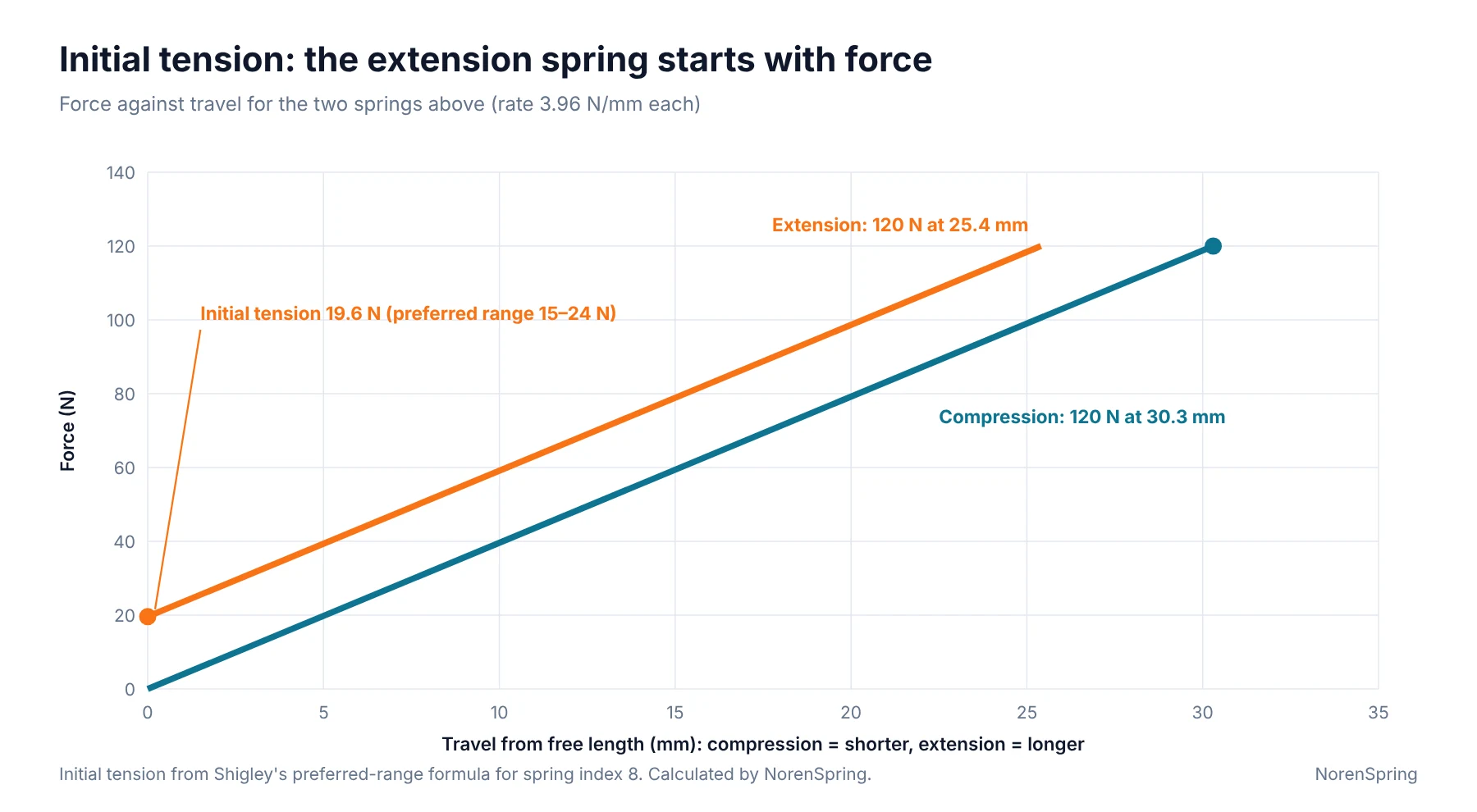
- Extension springs can start with force. Initial tension wound into the coils holds them shut until the load passes it. In our example it is about 19.6 N.
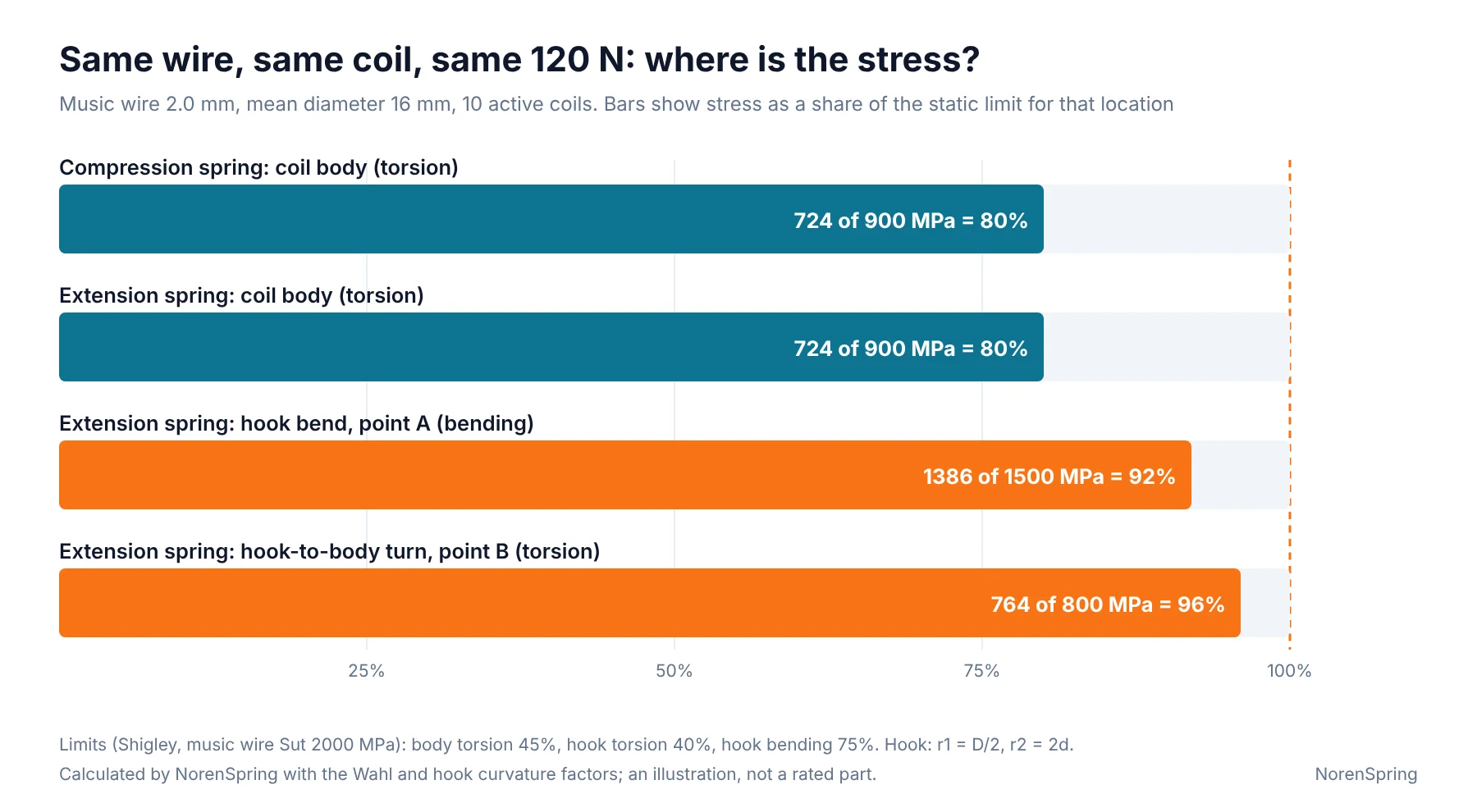
- The hooks are the weak point. In our worked example, the coil body runs at 80% of its static limit, but the hook runs at 92–96%.
- Compression springs fail safer. A broken compression spring usually still holds the parts apart. A broken extension spring lets go of the load.
- Compression springs need guiding; extension springs do not buckle. In Shigley’s stability limits, a steel compression spring stays straight up to a free length of about 2.6 to 5.3 times its mean diameter, depending on how the ends are held; longer ones need a rod or bore.
Compression vs extension spring at a glance
| Feature | Compression spring | Extension spring |
|---|---|---|
| Load direction | Push, gets shorter | Pull, gets longer |
| Coils at rest | Spaced apart (open pitch) | Usually tight together (close wound) |
| Force at zero travel | Zero | Initial tension, if wound in |
| Ends | Closed, closed and ground, or open | Hooks, loops, or threaded inserts |
| Most stressed point | Inside of the coil body | The hook bend and the turn into the body |
| Stops at | Solid height (coils touch) | No hard stop: over-stretching yields the coils |
| Buckling | Possible when long and slender | No: tension keeps it straight |
| Needs a guide | Often, a rod or a bore | No, the hooks locate it |
| If it breaks | Parts usually stay apart | The load is released |
| Typical uses | Valves, buttons, suspensions, seats | Doors, trampolines, levers, agricultural linkages |
How does a compression spring work?
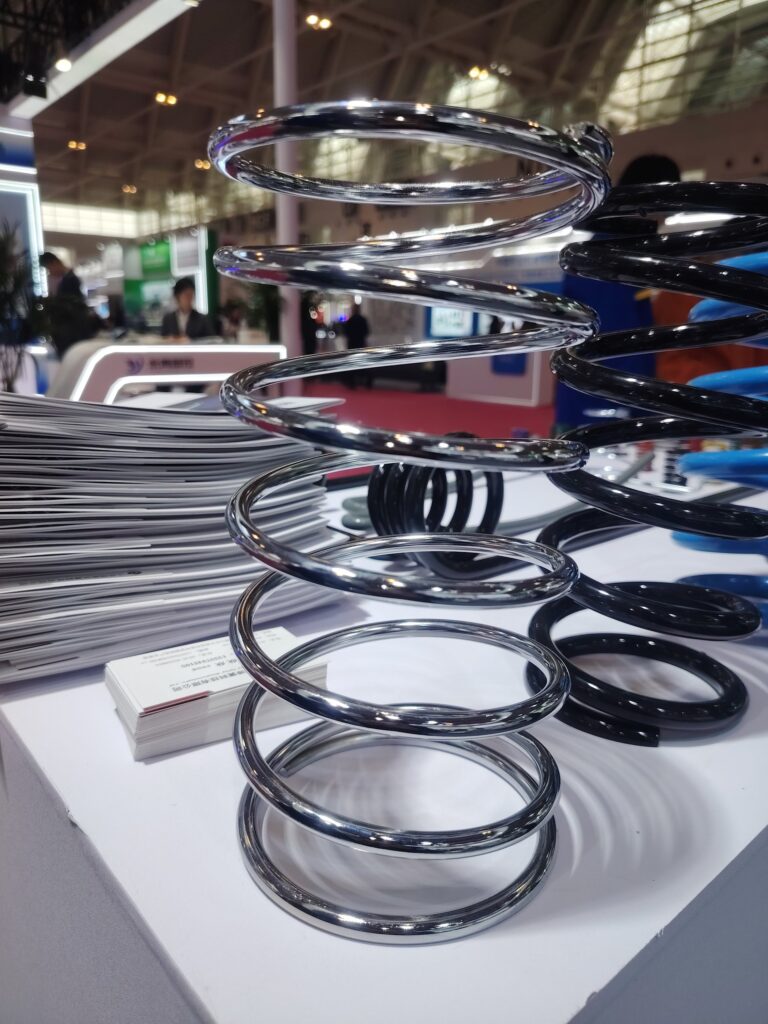
A compression spring is an open-coiled helical spring that resists being pushed. Load it and the gaps between coils close. Its force rises in a straight line with travel until the coils touch, at solid height. Solid height is a built-in stop: the spring cannot be crushed further, so it is hard to overload by accident.
The ends are usually closed, and often ground flat so the spring stands square. Long, slender compression springs can bow sideways, or buckle, so designs with a free length beyond about 2.6 times the coil diameter (pivoted ends) or 5.3 times (flat, parallel ends) often run over a rod or inside a bore. Our compression spring design guide covers solid height, ends and buckling in detail.
How does an extension spring work?
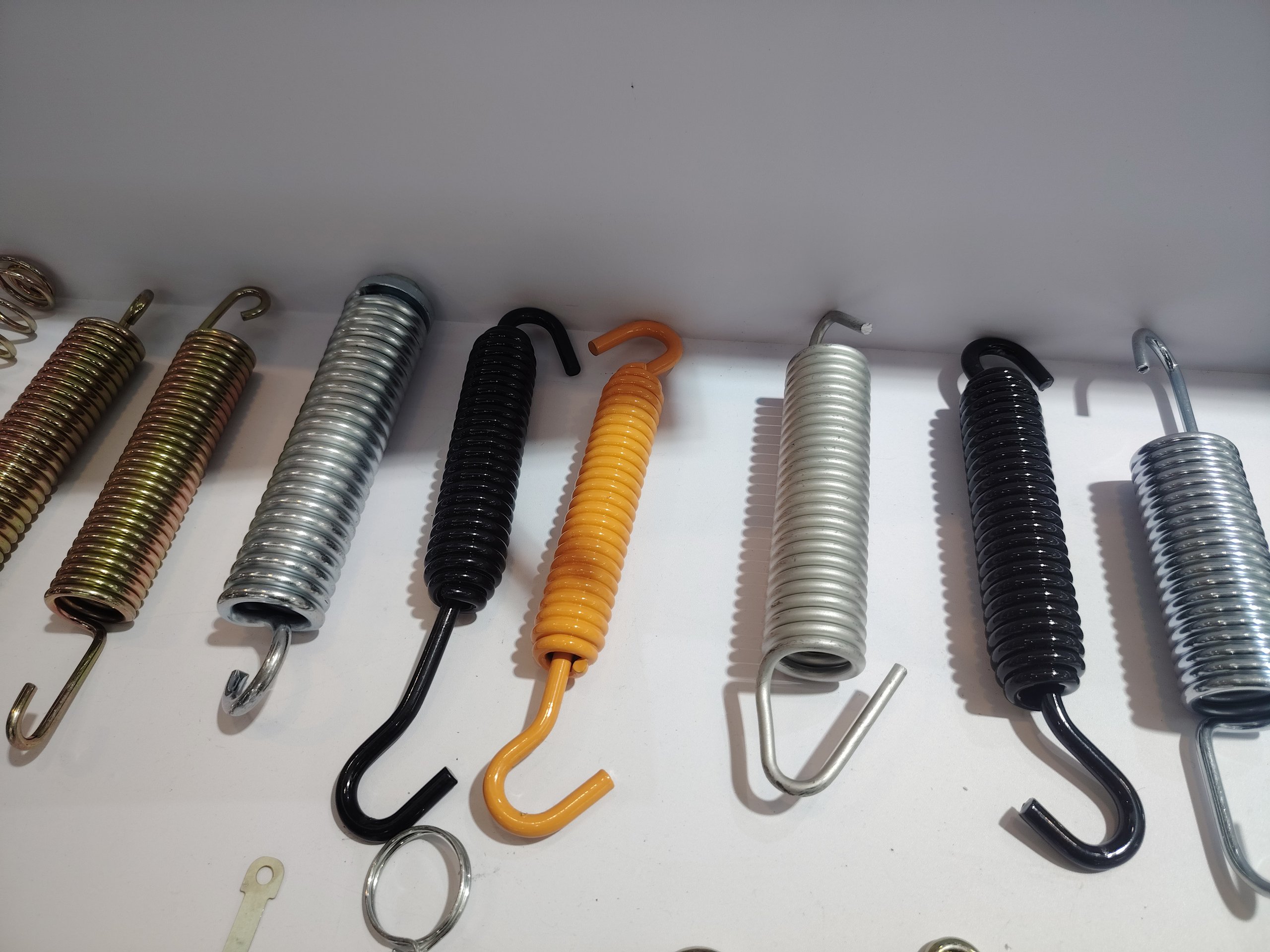
An extension spring is a close-wound helical spring with hooks or loops at each end. Pull the hooks apart and the coils separate. Many extension springs are wound with initial tension: the coils press against each other, so the spring holds a load before it starts to stretch. Once that initial tension is overcome, the spring behaves linearly, like a compression spring (eFunda extension spring notes). Shigley’s Mechanical Engineering Design explains it like this: initial tension is made by twisting the wire as it is wound, and it is locked in because the spring cannot get any shorter (Shigley Chapter 10 lecture notes, Philadelphia University).
Initial tension is useful. For example, it holds a lever or a gate firmly closed with no slack, and it shortens the travel needed to reach a given force. The trade-off is that the hooks carry the full load through a tight bend. That makes them the usual failure point. For hook styles and how to specify them, see our guide on how to specify a custom extension spring.
How much initial tension can be wound in depends on the spring index. Shigley gives a preferred range of uncorrected shear stress, τᵢ = 231 / e^(0.105C) ± 6.9 (4 − (C − 3) / 6.5) MPa. We worked it out for common indexes:
| Spring index C | Preferred initial tension stress | Notes |
|---|---|---|
| 4 | 125–178 MPa | Tight coil, high initial tension possible, harder to wind |
| 6 | 99–147 MPa | Common for compact springs |
| 8 | 77–122 MPa | Our worked example below |
| 10 | 61–101 MPa | Common general-purpose index |
| 12 | 47–84 MPa | Initial tension becomes harder to hold |
| 16 | 29–57 MPa | Little initial tension; tolerance widens |
To turn stress into force, use Fᵢ = τᵢ·π·d³ / (8·D). Ask for initial tension as a force with a tolerance on the drawing, not as a stress.
Worked example: one 120 N spring, both ways
Example scenario (an illustration, not a customer record). A mechanism needs 120 N at its working position. We try the same wire and coil both ways: music wire to ASTM A228, 2.0 mm wire diameter, 16 mm mean coil diameter, 10 active coils. The spring index C = D/d is 8.
How we calculated it:
- Spring rate k = G·d⁴ / (8·D³·n), with G = 81.0 GPa for music wire of this size. The result is 3.96 N/mm for both springs. Our spring rate guide explains the formula.
- Minimum tensile strength of 2.0 mm music wire, from Shigley’s formula S = A/dᵐ with A = 2211 MPa·mmᵐ and m = 0.145: about 2000 MPa.
- Static stress limits (set not removed), from Shigley: 45% of tensile strength for torsion in the body, 40% for torsion at the hook, and 75% for bending at the hook (AMES extension spring stress table).
- Hook stress at the bend (point A) follows Shigley’s hook analysis (lecture notes) and uses the curvature factor K = (4C₁² − C₁ − 1) / (4C₁(C₁ − 1)), with the bend radius equal to half the coil diameter, so C₁ = 8. At the turn into the body (point B) we assume a bend radius of 2d, so C₂ = 4.
- Initial tension uses Shigley’s preferred range for C = 8: 77–122 MPa of uncorrected shear stress, which is 15–24 N. We take the middle, 19.6 N.
| Result at 120 N | Compression spring | Extension spring |
|---|---|---|
| Spring rate | 3.96 N/mm | 3.96 N/mm |
| Force before any travel | 0 N | 19.6 N (initial tension) |
| Travel to reach 120 N | 30.3 mm | 25.4 mm |
| Body shear stress / limit | 724 / 900 MPa (80%) | 724 / 900 MPa (80%) |
| Hook bending stress / limit | — | 1386 / 1500 MPa (92%) |
| Hook torsion stress / limit | — | 764 / 800 MPa (96%) |
| Free length | About 59 mm (12 total coils, closed and ground) | 50 mm inside hooks (22 mm body + 2 × 14 mm hooks) |
| Length at 120 N | About 29 mm | About 75 mm |
What the numbers show:
- Same coil, same rate, same body stress. The body does not know whether it is pushed or pulled. Up to the ends, the two springs are the same part.
- The hooks run close to their limit. At 96%, point B leaves almost no margin. In a real design we would raise the bend radius, reduce the hook coil diameter, or use a heavier wire. A compression spring has no such weak spot.
- Initial tension buys travel. The tension spring reaches 120 N about 5 mm sooner because it starts at 19.6 N.
- The space is different. The compression spring shrinks from about 59 to 29 mm and needs room to the side if it bows. The pulled spring grows from 50 to 75 mm and needs clear space along its length.
Which is safer when it breaks?
A compression spring that breaks usually leaves two shorter pieces between the same two parts. The mechanism loses some force but does not fly apart. That is why springs in safety-related parts, such as valves, seats and suspension, are almost always compression springs.
An extension spring that breaks releases its load at once, often at the hook, and the broken ends can whip. Doors, gates and lifting levers that use tension springs therefore often run a safety cable through the coils, or add a guard. If a failure could hurt someone, prefer a compression spring, or use a drawbar spring: a compression spring loaded through two wire loops so that it pulls like an extension spring but squeezes like a compression spring. If the coils break, the drawbars still hold the load.
Stress limits compared
The table shows the static stress limits from Shigley that we used, as a share of the wire’s minimum tensile strength (set not removed):
| Location | Carbon and low-alloy steel wire | Stainless and nonferrous wire |
|---|---|---|
| Compression spring body, torsion | 45% | 35% |
| Extension spring body, torsion | 45–50% | 35% |
| Extension spring hook, torsion (point B) | 40% | 30% |
| Extension spring hook, bending (point A) | 75% | 55% |
On music wire of 2.0 mm (about 2000 MPa), that is 900 MPa in the body, 800 MPa at the hook turn and 1500 MPa in hook bending. Stainless springs have lower limits, so the hook problem is sharper in 302 or 316 stainless.
The same spring in 302 stainless
Now make the same coil from 302 stainless wire. With Shigley’s constants for ASTM A313 type 302 (A = 1867 MPa·mmᵐ, m = 0.146), 2.0 mm wire has a minimum tensile strength of about 1687 MPa. The shear modulus drops to about 69 GPa, so the rate falls to 3.37 N/mm.
| Location (302 stainless, 2.0 mm) | Static limit | Stress at 120 N | Highest safe static load |
|---|---|---|---|
| Body, torsion (both types) | 591 MPa (35%) | 724 MPa | About 98 N |
| Hook turn, point B | 506 MPa (30%) | 764 MPa | About 80 N |
| Hook bend, point A | 928 MPa (55%) | 1386 MPa | About 80 N |
So in stainless, the compression spring can carry about 98 N but the tension spring only about 80 N, because the hooks limit it. To reach 120 N in stainless, both need a heavier wire, and the hooked version needs it most. Our stainless steel springs guide covers the grades.
Space, guiding and buckling
- Compression springs need room for their free length plus the parts around them. They need a rod or a bore when slender. Their solid height also has to fit: in our example, 24 mm of solid coil. The example spring has an 18 mm outside and 14 mm inside diameter, and the outside grows slightly as it is compressed, so it would run in a bore of about 19–20 mm or over a rod of about 12–13 mm.
- Extension springs need room for the stretched length, plus the hook openings, along a straight line. They never buckle, and the hooks locate them, so no guide is needed.
- Side loads, for instance from a lever that swings in an arc, suit neither type well, but a guided compression spring handles them better than a hooked spring, whose hooks will twist.
Overload, fatigue and life
Overload. A compression spring stops at solid height. If the solid stress is within the limit, it cannot be overloaded by squeezing. A tension spring has no stop: pull it too far and the coils take a permanent set. Many designs add a mechanical stop to protect it.
Fatigue. In cycling use, the hook is usually what breaks first, because of the stress concentration we saw at points A and B. Compression springs can be shot peened inside the coil body, which raises fatigue life; see our shot peening guide. The inside of a tight hook bend gains less from peening, which is another reason hooks limit life.
Corrosion. Close-wound coils trap moisture and plating chemicals between touching coils. Coatings and plating need care on both types, but more on extension springs.
Real springs: compression and extension side by side
This short video from our display table shows both types: extension springs with different hook ends, compression springs, and wire forms.
Which should you choose?
| If your mechanism needs… | Choose | Why |
|---|---|---|
| To push parts apart or cushion a load | Compression spring | It works by being squeezed |
| To pull two parts together | Extension spring | Hooks attach straight to the parts |
| A hard stop against overload | Compression spring | Solid height limits travel |
| Holding force with no slack at rest | Extension spring | Initial tension |
| Safe behaviour if the spring breaks | Compression spring, or a drawbar spring | Load is not released |
| No guide rod or bore | Extension spring | It cannot buckle |
| Highest cycle life in a small space | Usually compression spring | No hooks; body can be peened |
| Low cost at high volume | Either; often compression | Simpler ends, no hook forming |
If the mechanism could use either, our engineers start with a compression spring and switch only when pulling suits the layout better.
What to send for a quote
- Spring type and drawing, or a sketch with free length, outside diameter and wire diameter.
- Loads and lengths: for a compression spring, force at one or two working lengths; for an extension spring, force at one or two extended lengths, and the initial tension if it matters.
- Ends: ground or unground for compression springs; hook type, orientation and opening for extension springs.
- Travel and cycles, and whether the spring must survive being pushed to solid or stretched past the working length.
- Material and finish: music wire, oil-tempered, stainless or other; zinc, coating or plain.
- Quantity and documents you need.
We make both types from 0.1 mm to 80 mm wire. See our compression springs and extension springs, or send the details through our contact page.
Frequently asked questions
What is the main difference between a compression spring and an extension spring?
A compression spring is pushed and gets shorter; an extension spring is pulled and gets longer. Compression springs have open coils and flat ends. Tension springs have tight coils, hooks or loops, and often initial tension, so they carry force before they stretch.
Can I use a compression spring instead of an extension spring?
Yes, with a drawbar assembly. Two wire loops pass through the coils and hook onto the parts, so pulling the loops squeezes the spring. It takes more space but has a solid stop and still holds the load if the spring breaks.
Why do extension springs break at the hook?
The hook bends the wire through a tight radius, which adds bending stress and a stress concentration. In our worked example, the hook ran at 92–96% of its static limit while the coil body ran at 80%. Larger bend radii, smaller hook diameters and reduced-diameter hooks help. At the same body stress, compression springs usually last longer in cycling use.
About the authors
This guide was prepared by the NorenSpring engineering team, which designs and manufactures custom compression, extension and torsion springs and wire forms in Xuzhou, China, since 2001. Technical content reviewed by Feng Yulin, General Manager and senior structural engineer, who has 15 years of spring R&D experience and more than 30 national patents. Our certificates are shown on our about page. The worked example is a calculation to show the method, not a rated part. Sources were last checked on November 3, 2026.
Sources
- R. Budynas and K. Nisbett, Shigley’s Mechanical Engineering Design, 10th ed., McGraw-Hill, 2014, Chapter 10 (spring rate, Wahl factor, music wire strength, extension spring hook stresses, initial tension and allowable stresses).
- AMES, Maximum Allowable Stresses for Helical Extension Springs in Static Applications, from Shigley and the Standard Handbook of Machine Design. amesweb.info. Retrieved 2026-11-03.
- AMES, Maximum Allowable Torsional Stress for Helical Compression Springs in Static Applications. amesweb.info. Retrieved 2026-11-03.
- Philadelphia University, Mechanical Springs lecture slides based on Shigley Chapter 10 (extension spring hooks and initial tension). philadelphia.edu.jo. Retrieved 2026-11-03.
- eFunda, Extension Springs. efunda.com. Retrieved 2026-11-03.
- ASTM International, ASTM A228/A228M Standard Specification for Steel Wire, Music Spring Quality. astm.org. Retrieved 2026-11-03.



