In this article
- Key takeaways
- Types of springs at a glance
- How springs are classified: by load, by shape, by wire and by process
- Compression springs
- Extension springs (tension springs)
- Torsion springs: single, double and other torsion types
- Compression vs extension vs torsion springs: how to choose
- Wire forms and special-shaped springs
- Other spring types: conical, die, vibrator, disc, wave, constant force and leaf
- Which spring type fits your application?
- What to send when you are not sure which type you need
- Frequently asked questions
- Summary
- About the authors
- Sources
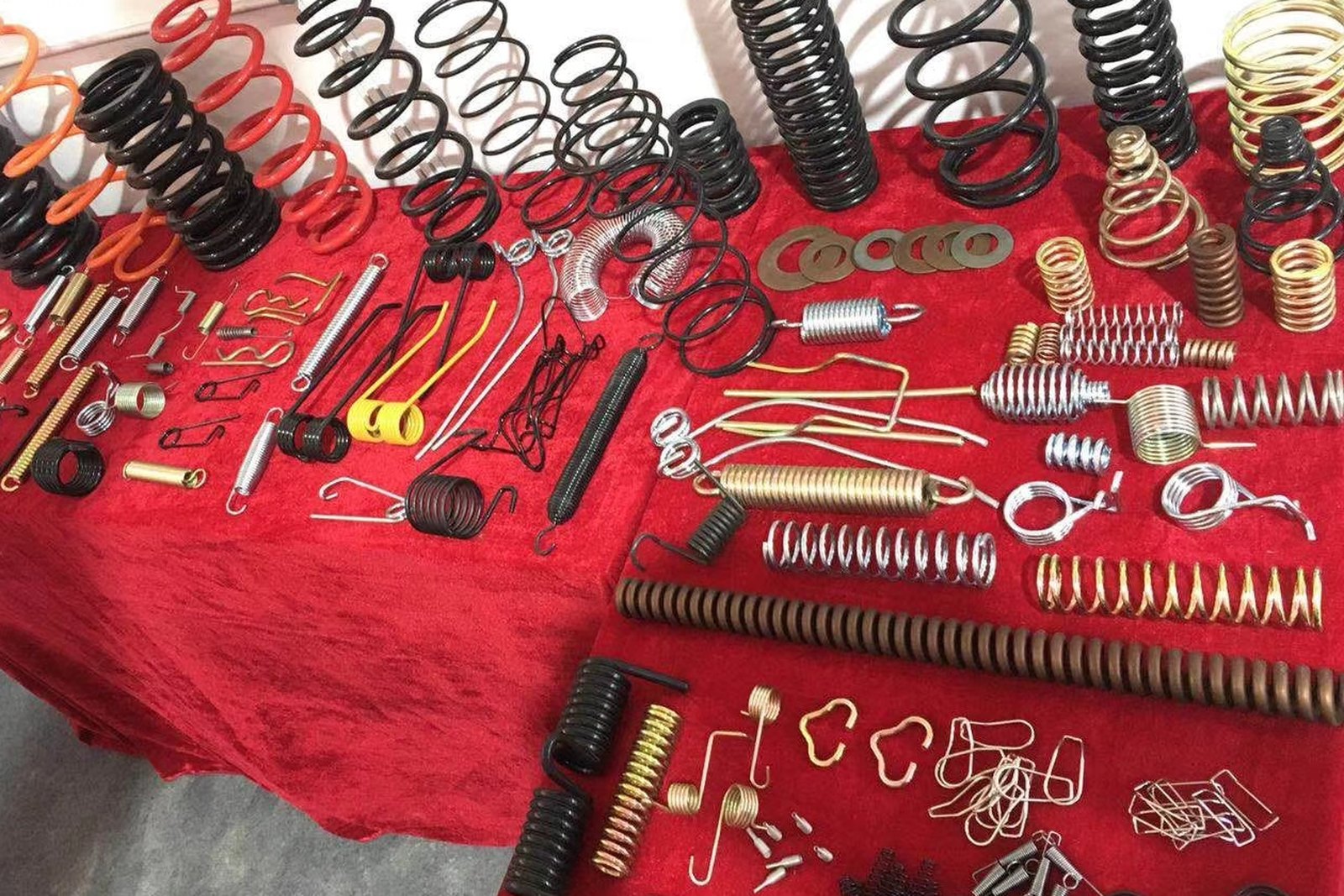
There are three main types of springs, sorted by how the load is applied. Compression springs are pushed shorter, extension (tension) springs are pulled longer, and torsion springs are twisted through an angle. Most springs in machinery are one of these three, wound as a helical coil from round wire. Two more groups cover almost everything else. Wire forms are bent into a fixed shape such as a clip, pin or tine. Special springs include conical, die, disc and wave springs.
This guide covers 12 types of springs: compression, extension, torsion, wire forms, double torsion, conical, die, vibrator, disc, wave, constant force and leaf springs. For each one it explains how it carries load, where it is used and when to choose it. It also compares compression vs extension vs torsion springs and lists what to send a manufacturer if you are not sure which type you need.
Key takeaways
- Classify by load first. Push, pull or twist decides between a compression, extension or torsion spring. Shape, wire section and process come second.
- Compression springs are the most common type. They have a built-in stop at solid height, and if one breaks it usually stays on its seat.
- Extension springs give force from zero travel thanks to initial tension. They have no natural stop, and their hooks are often the most highly stressed point.
- Torsion springs work in bending, not torsion. Load them so the coils wind tighter, and leave room on the arbor for the inside diameter to shrink.
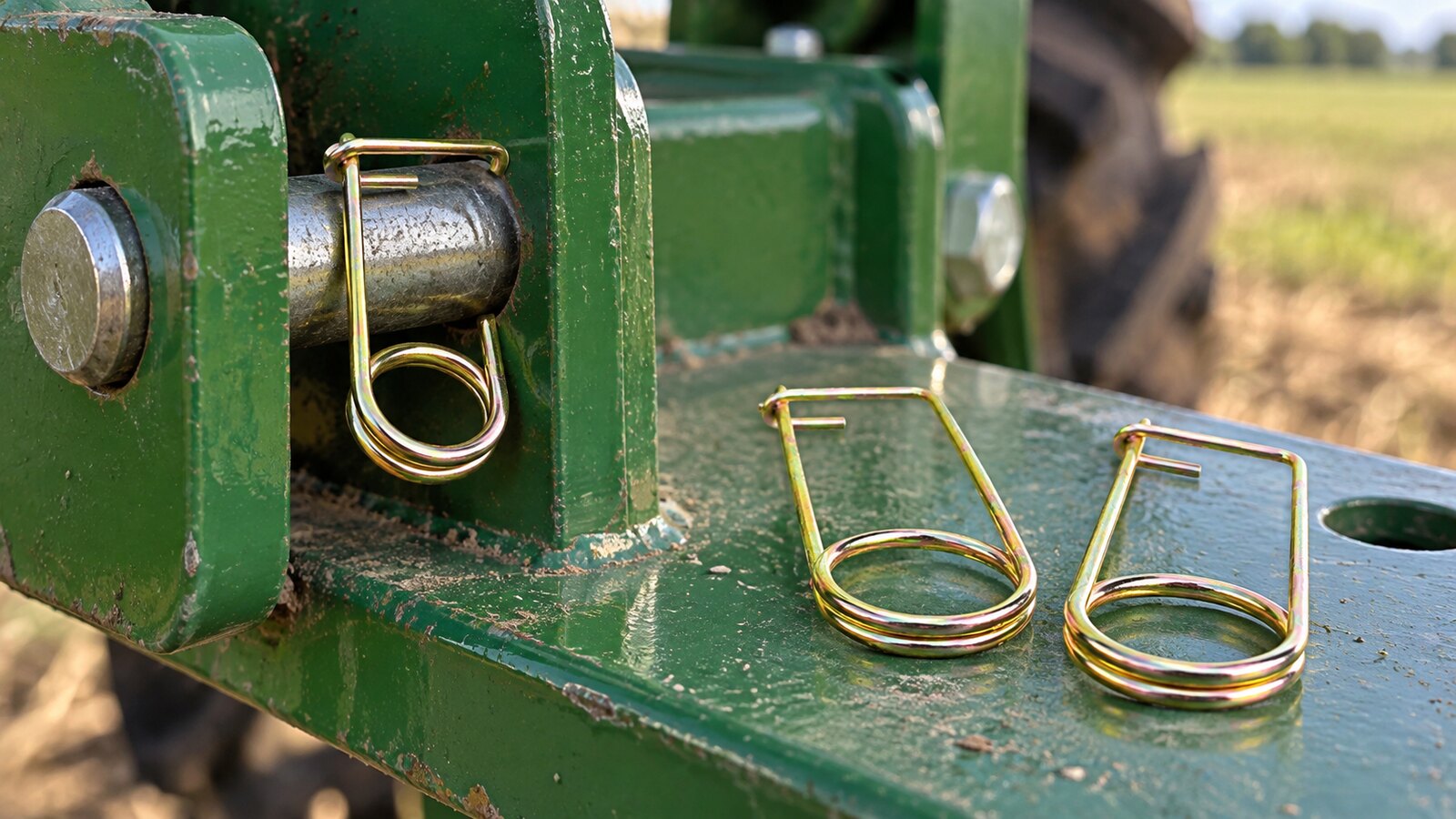
- Wire forms are not coils. A clip, R-pin or tine works through its bends and leg lengths, so the drawing has to fix the shape.
- Special types solve space problems. Conical, wave and disc springs give force in less height. Die springs give more force in the same bore.
Types of springs at a glance
The table lists the 12 spring types covered in this guide, how each one is loaded, and where to read more. The first four rows are the main groups: the three load types and wire forms. The rest are variants and special springs.
| Spring type | How it is loaded | How it stores energy | Typical uses | Read more |
|---|---|---|---|---|
| Compression | Pushed along its axis; gets shorter | Wire twisted (torsional shear) as coils close | Valves, suspensions, clutches, machinery return springs | Compression spring guide |
| Extension (tension) | Pulled along its axis; gets longer | Wire twisted as coils open; initial tension holds coils closed | Pedal and lever returns, belt tensioners, implements | Extension spring guide |
| Torsion | Legs rotated about the coil axis | Wire bent as the coil winds up | Hinges, levers, tines, pedal returns | Torsion spring guide |
| Wire form | Depends on the shape | Bending of legs and loops | Clips, R-pins, retaining rings, hooks | Wire forms guide |
| Double torsion | Two bodies, legs rotated | Bending in two opposite-wound bodies | Spring tines, latches, more torque in a balanced part | Double torsion guide |
| Conical | Pushed; coils can nest | Torsional shear; rate often rises with travel | Short solid height, battery contacts, controls | Conical spring guide |
| Die | Pushed; rectangular wire | Torsional shear, high load in a small bore | Stamping dies and press tools | Die springs |
| Vibrator | Pushed; carries a vibrating mass | Torsional shear under constant cycling | Vibrating screens and feeders | Vibrator springs |
| Disc (Belleville) | Pushed across a coned disc | Disc flattens | Bolted joints, clutches, high loads in short travel | Disc spring guide |
| Wave | Pushed; flat-wire waves flatten | Bending of the waves | Bearing preload, seals, short axial space | Wave spring guide |
| Constant force | Strip unrolled from a coil | Strip straightened | Counterbalances, retractors | General type, described below |
| Leaf | Bent as a beam | Bending of one or more leaves | Vehicle suspension | General type, described below |
How springs are classified: by load, by shape, by wire and by process
Springs are most often classified by how the force is applied. Engineering texts and the European design standards use the same three load classes: compression, extension and torsion [1][2]. EN 13906, the European calculation standard for helical springs, is split along those lines. Part 1 covers compression springs, Part 2 extension springs and Part 3 torsion springs [2]. The same spring can then be described in three other ways.
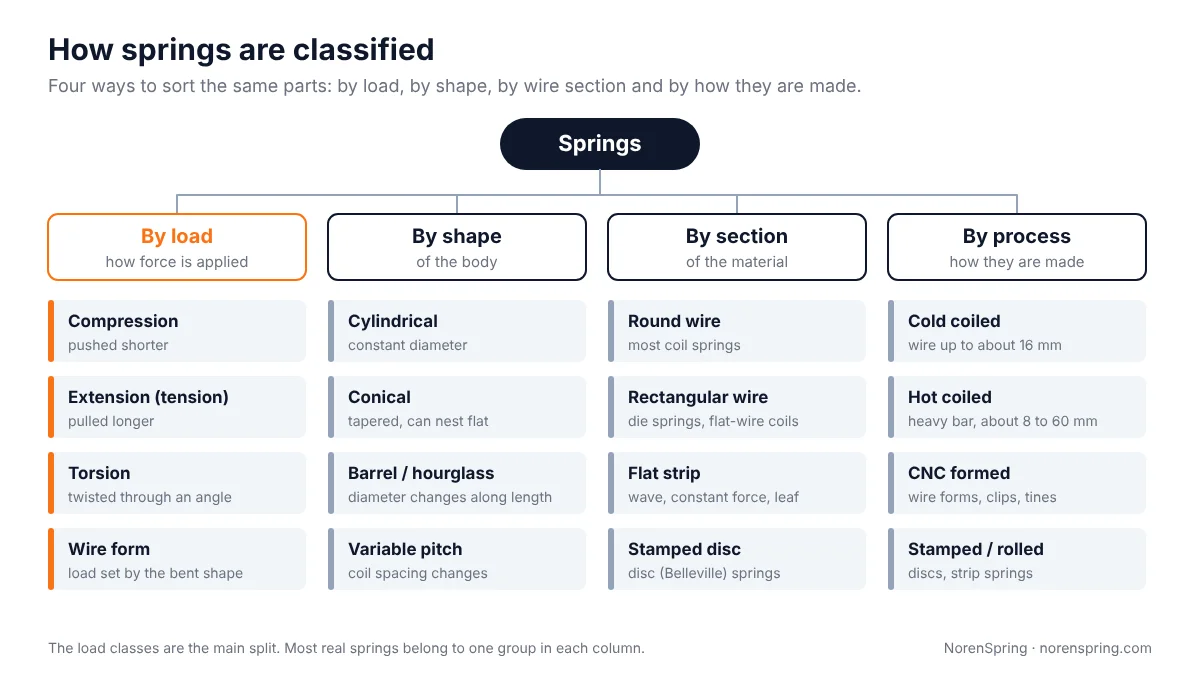
By load. Compression, extension and torsion springs make up most coil springs. Wire forms sit beside them, because their load depends on the bent shape, not on a coil.
By shape. Cylindrical springs have the same diameter along their length. Conical (tapered) springs reduce in diameter from one end to the other, so the coils can nest inside each other. Barrel and hourglass springs change diameter in the middle. A variable-pitch spring changes the spacing between coils to give a rising rate. All of these are types of coil springs; only the outline changes.
By wire section. Most springs use round wire. Die springs and some heavy springs use rectangular wire, which packs more steel into the same diameter. Wave springs, constant force springs and leaf springs use flat strip. Disc springs are stamped or machined from plate.
By process. Wire up to about 16 mm (0.63 in) is normally coiled cold, usually from pre-hardened wire. EN 15800, the European quality standard for cold-coiled compression springs, covers wire from 0.07 to 16 mm (0.003–0.63 in) [3]. Heavier bar is heated, coiled hot, then quenched and tempered. ISO 11891 covers hot-formed compression springs from 8 to 60 mm (0.31–2.36 in) bar [4]. Wire forms are bent on CNC forming machines. We make both cold-coiled springs and hot-coiled large springs, with wire from 0.1 to 80 mm (0.004–3.15 in). Our spring manufacturing process guide walks through both coiling routes.
Compression springs
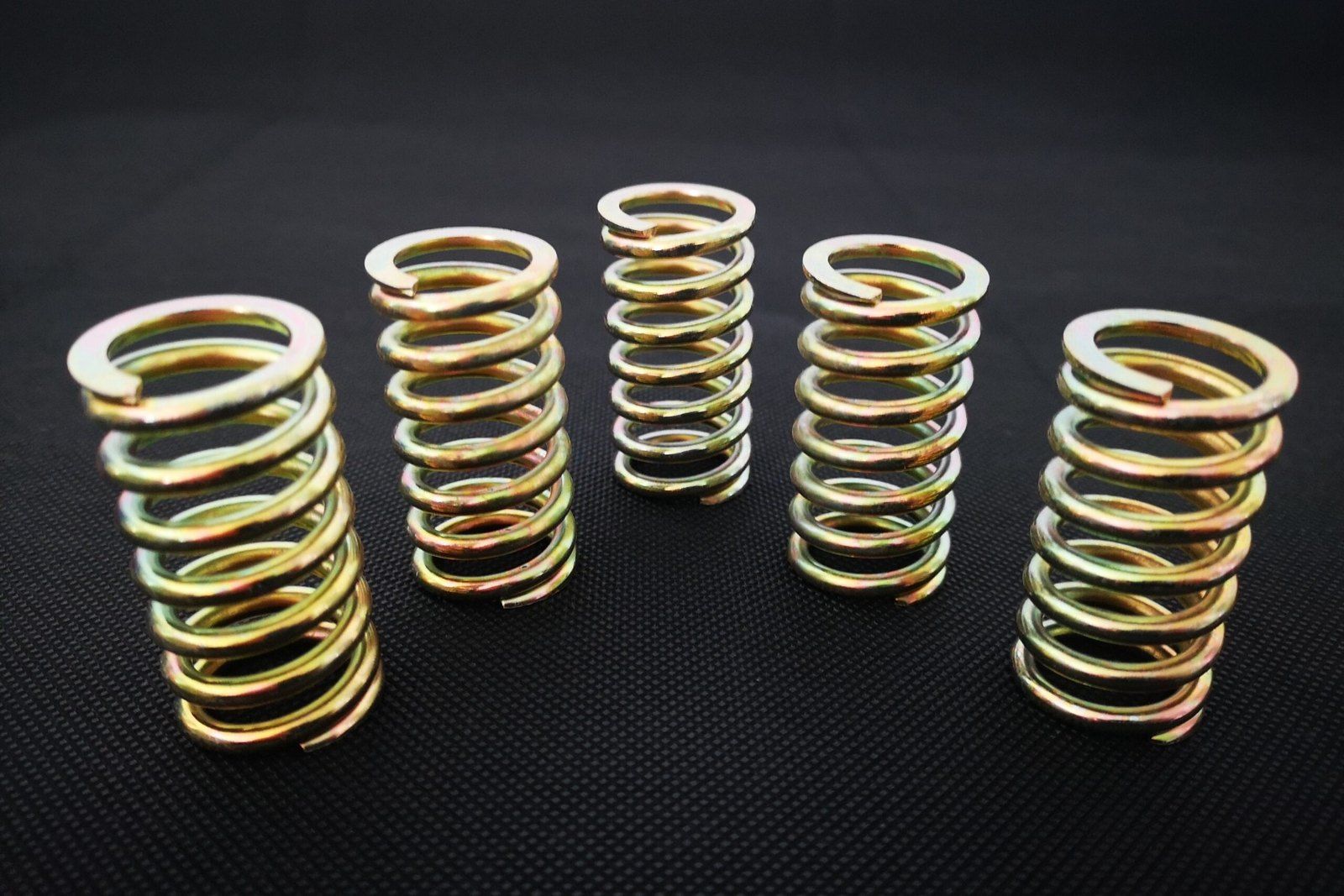
A compression spring is an open-coil helical spring that resists a pushing force [1]. When it is loaded along its axis, the coils move closer together and the spring gets shorter. The wire itself is twisted as the coils close, so the stress in a compression spring is torsional shear. It is the most common of all the kinds of springs because it is simple and compact. It is also naturally stable when it sits in a bore or over a rod.
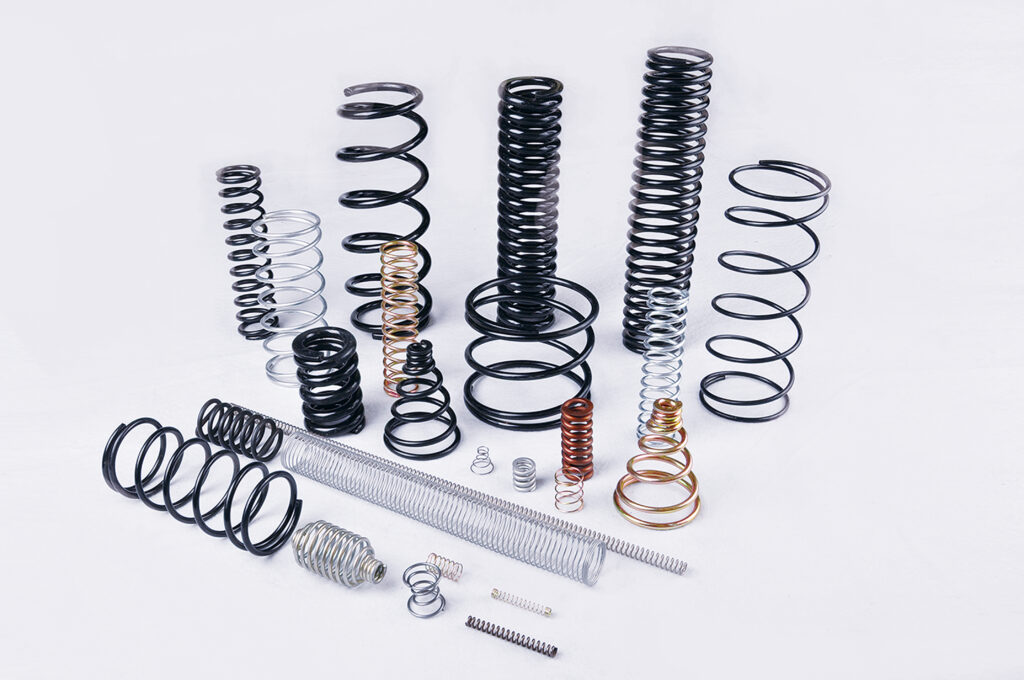
The force a compression spring gives is set by its rate, the force per millimeter of travel. For a round-wire coil the rate is k = Gd⁴ / (8D³Na) [1]. Here G is the shear modulus of the material, d the wire diameter, D the mean coil diameter and Na the number of active coils. Two things follow. Wire size has the largest effect, because it is raised to the fourth power. And more active coils make a softer spring. Our spring rate guide shows how to calculate and measure it. The spring index guide explains why the ratio D/d is best kept between about 4 and 12.
Compression springs have a natural stop: solid height, the length at which every coil touches. The end type changes it. Open ends are the cheapest. Closed ends, and closed and ground ends, sit square on their seats and are the usual choice where the spring must load evenly.
Typical uses: valve springs, clutch and brake springs, shock absorber and suspension springs, machine return springs, and many springs in agricultural implements. Parts from our compression spring cases include a compressor valve spring, a shock absorber spring, a clutch pressure plate spring and fodder harvester springs.
Choose a compression spring when the mechanism pushes, when you want a safe stop at solid height, and when there is a bore or rod to guide it. For long, slender springs, check for buckling and add a guide rod or bore where needed. See our compression spring manufacturing page for the range we make.
Extension springs (tension springs)
An extension spring, also called a tension spring, is a close-coiled helical spring that resists a pulling force [1]. It is attached at each end by a hook or loop, and it stretches as the load is applied. Like a compression spring, its wire is in torsional shear.
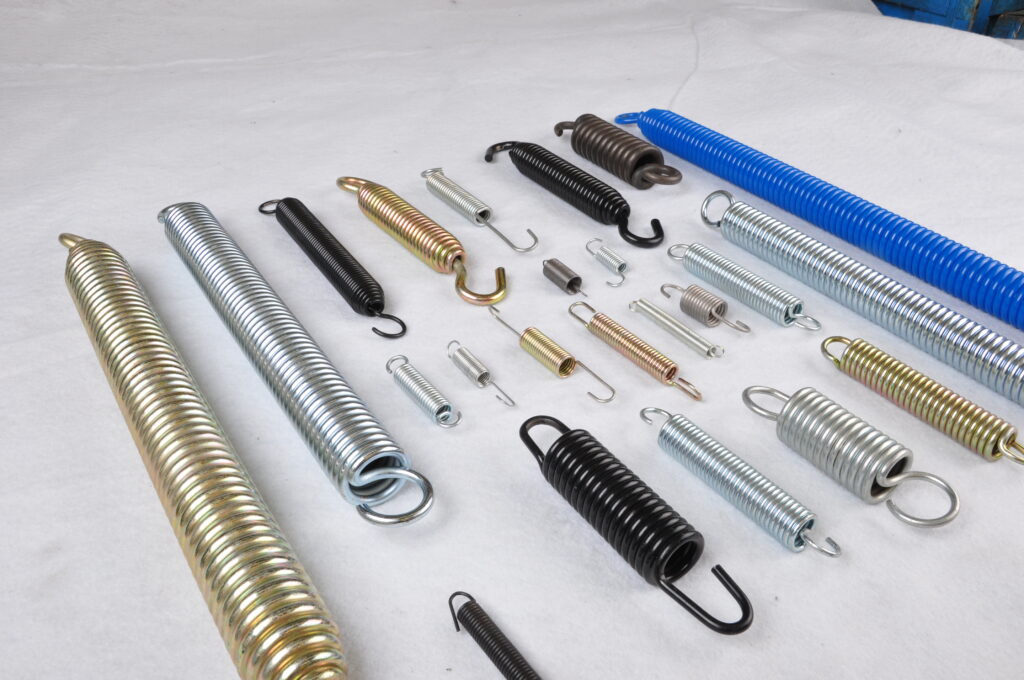
Two features set extension springs apart.
- Initial tension. Extension springs are usually wound so the coils press against each other. That built-in preload, called initial tension, must be overcome before the coils start to separate. It lets a short spring hold a load from the first millimeter of travel, which a compression spring cannot do [1].
- Hooks. The hook is where the wire is bent most sharply, and the stress at the hook bend is often higher than in the body [1]. Common end types are machine hooks, crossover hooks, side hooks, extended hooks and full loops. The choice affects stress, length and how the spring is fitted.
Extension springs have no natural stop. If the mechanism can pull the spring past its design length, the spring will take a permanent set or break. A drawbar arrangement, a cable or a hard stop in the mechanism prevents that.
Typical uses: lever and door return springs, belt tensioners, counterweights and implement springs. Parts from our extension spring cases include tractor brake pedal springs, a cable reel spring and an exhaust pipe spring. Others are a motorcycle side stand spring, cultivator springs and a gym equipment spring.
Choose an extension spring when the mechanism pulls, when there is no room to guide a compression spring, or when you need a preload with no travel. The extension springs page shows what we make.
Torsion springs: single, double and other torsion types
A torsion spring is a helical coil with two legs that resists a rotating force, or torque. One leg is held and the other is turned, and the spring pushes back with a torque proportional to the angle. The name is misleading: in a helical torsion spring the wire is in bending, not torsion [1][2][8].
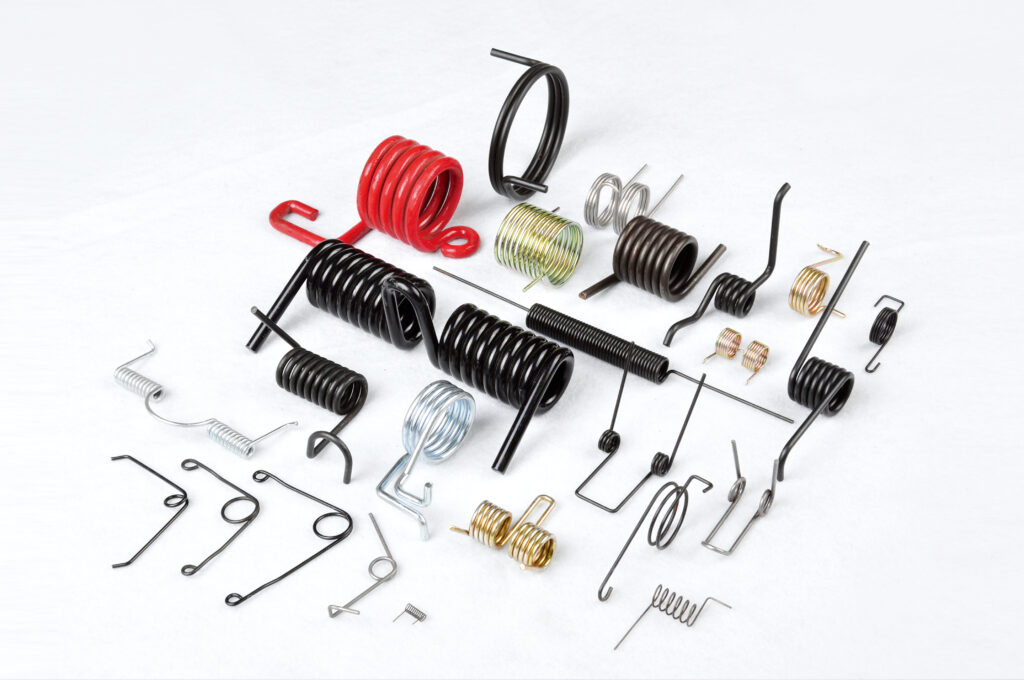
The main torsion spring types are:
- Single torsion springs. One coil body with two legs. The legs can be straight, bent, hooked or offset, and the free angle between them is set to suit the mechanism.
- Double torsion springs. Two coil bodies wound in opposite directions and joined by a loop in the middle. The two halves work in parallel, so the spring gives more torque and the load is balanced.
- Spring tines. Many agricultural tines for balers, rakes, tedders and harvester reels are double torsion springs with long tine legs; some are single torsion springs. One tine we make uses 10 mm (0.39 in) 65Mn wire hardened to 42–47 HRC. It has two 45 mm (1.77 in) coils and a black RAL 9005 polymer coating. See our spring tines guide.
- Other torsion-loaded springs. Spiral (clock) springs and torsion bars are also torsion springs in the broad sense [8]. A spiral spring is flat strip wound in a flat spiral; a torsion bar is a straight bar twisted about its axis. They are different products from helical torsion springs.
Three rules matter for every helical torsion spring. State the wind direction, left hand or right hand. Load the spring so its coils close, which makes the body diameter smaller; loading it the other way raises the stress [1]. And leave room on the arbor. As the spring winds up, its inside diameter shrinks and its body gets longer, so a pin that fits the free spring can bind at full rotation.
Typical uses: hinges and lids, pedal and lever returns, chain tensioners, latches and spring tines. Parts from our torsion spring cases include accelerator and clutch pedal springs, a chain tensioner spring and reel tine springs.
Choose a torsion spring when the part must rotate or a lever must return to position. The torsion springs page shows our range.
Compression vs extension vs torsion springs: how to choose
Start from the motion. If the part is pushed, use a compression spring. If it is pulled, use an extension spring. If it rotates, use a torsion spring. Then check three things the motion alone does not decide: whether the spring has a stop, what happens if it breaks, and how much space it takes.
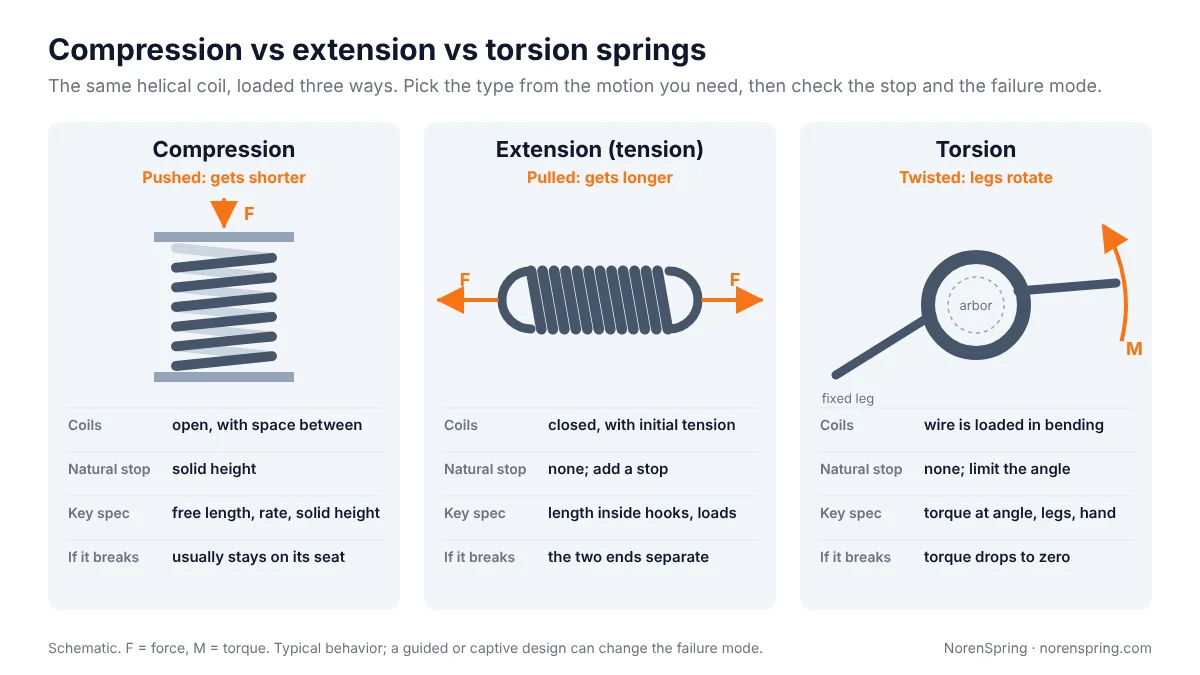
| Question | Compression | Extension (tension) | Torsion |
|---|---|---|---|
| Load direction | Push along the axis | Pull along the axis | Rotation about the axis |
| Coils at rest | Open, with gaps | Closed, often with initial tension | Usually closed |
| Stress in the wire | Torsional shear | Torsional shear (highest at the hooks) | Bending |
| Built-in stop | Yes, solid height | No; add a stop | No; limit the angle |
| Force at zero travel | Zero | Equal to initial tension | Zero (unless preloaded on assembly) |
| Typical failure behavior | Broken spring usually stays on its seat | Ends separate and the load is released | Torque drops; legs may move freely |
| Needs guiding | Bore or rod for long springs | Mounted by hooks | Arbor or pin inside the body |
| What to specify | Free length, loads at lengths, solid height | Length inside hooks, loads at lengths, hook type | Free angle, torque at angle, legs, wind direction |
Compression vs extension spring: which is safer?
The tension spring vs compression spring choice often comes down to failure behavior. A compression spring that breaks is still trapped between its seats and usually keeps some force. The mechanism degrades instead of letting go. An extension spring that breaks separates, the load is released at once, and the broken ends can move. That is why designers often prefer a compression spring for safety-related functions when they have the choice. Another option is to put a compression spring inside a drawbar, so that a pull on the assembly compresses the spring. Where an extension spring is the right choice, add a stop or containment if a failure would be dangerous.
When space decides
An extension spring needs room for its hooks, but no guide. A compression spring needs room for its solid height plus clearance, and a guide if it is long. A torsion spring needs room for its legs to swing and for the body to grow in length as it winds up. If none of them fits, look at the special types below. A conical spring or a wave spring can do the same job as a compression spring in far less height.
Wire forms and special-shaped springs
A wire form is a part bent from spring wire into a fixed two- or three-dimensional shape: a clip, R-pin, retaining ring, hook, bracket or tine. Unlike a coil spring, it works mainly through its bend angles and leg lengths. It locates, holds or springs back against a mating part, so the drawing has to fix that shape precisely.
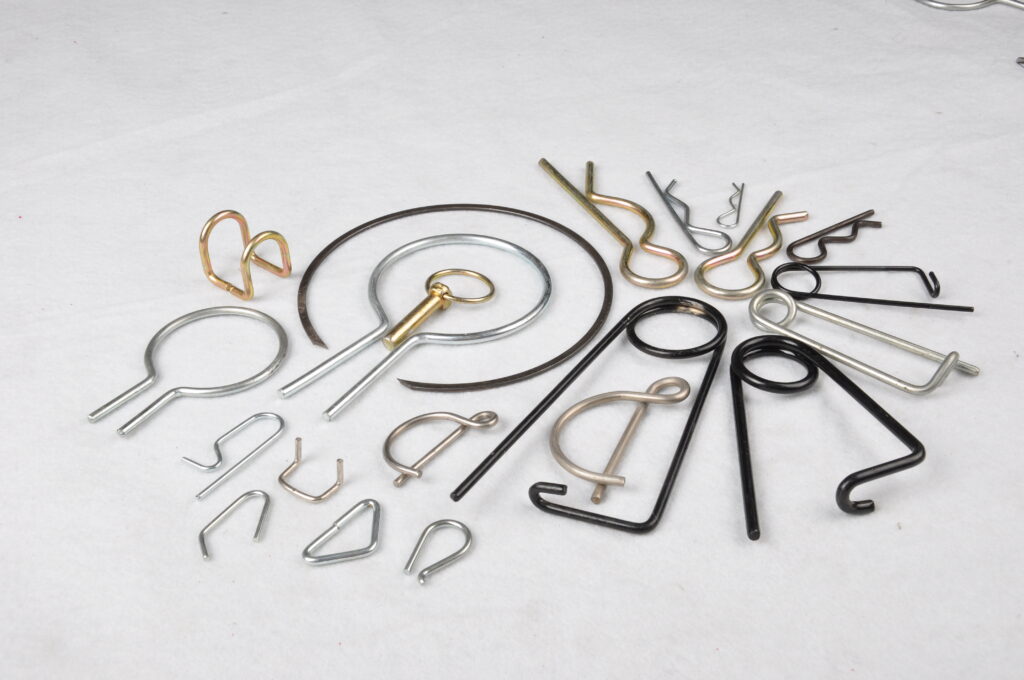
Many parts sit between the two groups. A spring tine is usually a double torsion spring with long formed legs, and a clip may have one torsion coil in its middle. These special-shaped springs are made on CNC forming machines that bend, loop and cut the wire in one sequence.
Three design points matter most. Tight bends raise the local stress, so give each bend an inside radius of at least about one wire diameter where you can. Spring wire springs back after every bend, so put tight tolerances only on the angles and positions that affect fit. And plating adds thickness to every surface, so allow for it on clips that must grip a pin. Parts from our wire form cases include harrow and reel tines, spring steel circlips, retaining springs and spring clips. The wire forms page shows the full range.
Other spring types: conical, die, vibrator, disc, wave, constant force and leaf
These spring types solve specific problems: too little height, too much load, vibration, or a need for steady force over a long travel. The first five are in our product range. Constant force and leaf springs are described here as general types.
Conical springs. A conical (tapered) compression spring gets smaller in diameter from one end to the other. When the coils are sized to nest, the spring can compress to a solid height of only one or two wire diameters. Its rate usually rises as the large coils bottom out first. A volute spring is a related cone-shaped type, often wound from strip, whose turns slide over each other [1][9]. See our conical springs page.
Die springs. Die springs are heavy-duty compression springs, usually made from rectangular wire. They are used in stamping dies, press tools and molds. ISO 10243 standardizes their housing dimensions. It sorts them into four rate classes (light, medium, strong and extra strong), each identified by a color code [5].
Vibrator springs. Vibrator springs are compression springs that support vibrating screens and other vibration equipment. They are often wound with reduced-diameter end coils that grip the stud or seat, so the spring does not walk off while the machine shakes. Fatigue resistance matters more than for a static spring.
Disc springs (Belleville washers). A disc spring is a coned disc that flattens under load. It carries very high loads in a short travel [1]. Discs can be stacked: nested in parallel for more force, or face to face in series for more travel [6][10]. EN 16983 sets the standard dimensions and quality [6]. See our disc springs page.
Wave springs. A wave spring is flat wire formed into waves. It can be a single ring, several turns stacked crest to crest, or nested layers [11]. It does the work of a compression spring in a fraction of the axial space, which suits bearing preload and seals. See our wave springs page.
Constant force springs. A constant force spring is a tightly rolled strip of spring steel that exerts a nearly constant force as it is unrolled [1][7]. It is used where a steady pull is needed over a long travel, such as counterbalances and retracting mechanisms.
Leaf springs. A leaf spring is one or more narrow, curved steel plates that bend as a beam. Multi-leaf springs stack progressively shorter leaves for heavier loads. They are still used in heavy commercial vehicles such as vans and trucks, and in railway carriages [12].
You may also meet garter springs: a coil spring joined end to end to form a ring. A common use is holding the lip of a rotary shaft seal against the shaft. Flat springs are stamped from strip and loaded as small cantilevers. Gas springs use compressed gas rather than metal. These are outside the scope of this guide.
Which spring type fits your application?
The table matches common applications to the spring types usually used there. These are typical uses; your design may call for a different type.
| Application | Common spring types | Typical parts |
|---|---|---|
| Agricultural machinery | Torsion (tines), extension, compression, wire forms | Baler and reel tines, cultivator springs, belt tension springs, R-pin clips, shock springs |
| Automotive | Compression, extension, torsion, wire forms | Shock absorber springs, clutch and brake springs, pedal return springs, seat springs |
| Industrial equipment | Compression, die, vibrator, extension | Press return springs, fixture clamp springs, packaging machine springs, vibrating screen springs |
| Medical and precision devices | Precision compression, torsion, wire forms | Small springs for insulin pens and lancet devices |
A single agricultural machine can use torsion tines, extension and compression springs and wire forms together. Impact, vibration and corrosion in the field make material, heat treatment and coating as important as the geometry. Automotive work needs consistent dimensions and load from lot to lot, with traceable documentation; we work under IATF 16949. Industrial equipment springs are usually chosen for cycle life. Medical and precision devices use small compression springs, often in stainless steel, where cleanliness and tight load tolerance matter. We hold ISO 13485 certification, and the springs we have supplied in this field include insulin pen springs and lancet device springs.
Material choice cuts across all of these. Our spring wire material guide compares the common grades, and the spring finishes guide explains how to choose a coating.
What to send when you are not sure which type you need
You do not need to know the spring type before you ask. Describe the job, and the type usually follows. Send what you have:
- A drawing, a sketch or a sample. Most projects start from a drawing or sketch, but a physical sample or a photo with a scale beside it also works. We accept DWG, DXF, STEP, PDF, JPG and PNG files.
- The motion. Is the spring pushed, pulled or twisted? Give the travel in millimeters or inches, or the rotation in degrees.
- The force. Give the force or torque you need at one or two working positions. If you have no figures, say what the spring has to move or hold.
- The space. The bore, shaft or pin it fits, and the length or height available.
- The environment. Temperature, moisture or chemicals, and whether the load is steady or cycles many times.
- Quantity. Prototypes, a first batch, or a yearly volume.
If you have only an old spring, three measurements are enough to start: the wire diameter, the outside diameter and the free length. Our guide on how to measure a spring shows how to take each one with a caliper. Our engineers give quotation and engineering feedback within 24 hours, and there is no fixed minimum order quantity. Prototype samples can be made for dimensional, load and fit approval before production. Send your drawing or sample through the contact page, or browse all spring products and our manufacturing capabilities.
Frequently asked questions
What are the three main types of springs?
The three main types are compression springs, which are pushed shorter; extension (tension) springs, which are pulled longer; and torsion springs, which are twisted through an angle. They are classified by how the load is applied, and between them they cover most helical coil springs.
What is the difference between a compression spring and an extension spring?
A compression spring has open coils and resists a push; it stops at solid height. An extension spring has closed coils, usually with initial tension, and resists a pull through hooks or loops at its ends. It has no natural stop. If a compression spring breaks it usually stays on its seat, while a broken extension spring releases its load.
Is a coil spring the same as a helical spring?
In most engineering use, yes. A helical spring is wire wound in a helix, and “coil spring” is the everyday name for the same thing. Compression, extension and torsion springs are all helical coil springs. A spiral spring, wound flat like a clock spring, is coiled but not helical.
Which type of spring is strongest?
It depends on what “strongest” means. For the most force in the least travel and space, disc springs carry the highest loads. In a fixed bore, a die spring made from rectangular wire carries more load than a round-wire spring of the same size. For any type, a larger wire diameter and a high-strength material raise the load the spring can carry.
What type of spring is used in agricultural machinery?
All the main types. Balers, rakes, tedders and harvester reels use spring tines, most often double torsion and some single torsion. Cultivators, harrows and mowers use heavy extension and compression springs. Implements use wire forms such as R-pin clips.
Summary
The types of springs are easiest to sort by load: compression springs push back, extension springs pull back and torsion springs twist back. Wire forms cover parts whose shape, not a coil, does the work. Conical, die, disc, wave and vibrator springs solve particular problems of space, load or vibration. Choose the type from the motion first, then check the stop, the failure behavior and the space. When you are not sure, describe the job and send a drawing or sample; the right type usually becomes clear in the first engineering review.
About the authors
This guide was prepared by the NorenSpring engineering team, which designs and manufactures custom springs and wire forms in Xuzhou, China. We work with wire diameters from 0.1 to 80 mm (0.004–3.15 in). Technical review by Feng Yulin, General Manager and senior structural engineer, who has 15 years of spring R&D experience and more than 30 national patents. NorenSpring holds IATF 16949, ISO 9001, ISO 13485, ISO 14001 and ISO 45001 certifications. More about NorenSpring. Photos show parts from our own range. Last checked on October 14, 2026.
Sources
The numbers in square brackets in the text refer to this list.
- R. G. Budynas and J. K. Nisbett, Shigley’s Mechanical Engineering Design, 11th edition, McGraw-Hill, 2020, chapter 10 (Mechanical Springs). Source for the compression, extension and torsion spring definitions, the spring rate formula, initial tension, hook stress, bending stress and loading direction in torsion springs, and the constant-force, conical, volute and Belleville springs.
- CEN, EN 13906 series, Cylindrical helical springs made from round wire and bar — Calculation and design: Part 1, compression springs (iTeh Standards); Part 2, extension springs (BSI); Part 3, torsion springs (BSI). Retrieved 2026-10-14.
- CEN, EN 15800:2008, Cylindrical helical springs made of round wire — Quality specifications for cold coiled compression springs, scope at Genorma. Source for the 0.07 to 16 mm wire range. Retrieved 2026-10-14.
- ISO, ISO 11891:2012, Hot formed helical compression springs — Technical specifications. Source for the 8 to 60 mm bar range. Retrieved 2026-10-14.
- ISO, ISO 10243:2019, Tools for pressing — Compression springs with rectangular section — Housing dimensions and colour coding, summary at Genorma. Source for the four rate classes and color code. Retrieved 2026-10-14.
- DIN, DIN EN 16983, Disc springs: quality specifications and dimensions. Retrieved 2026-10-14.
- Wikipedia, Spring (device). Secondary source for the classification by load and shape and the constant-force spring definition. Retrieved 2026-10-14.
- Wikipedia, Torsion spring. Secondary source for bending stress in helical torsion springs, torsion bars and spiral springs. Retrieved 2026-10-14.
- Wikipedia, Volute spring. Retrieved 2026-10-14.
- Wikipedia, Belleville washer. Secondary source for stacking in series and parallel. Retrieved 2026-10-14.
- Wikipedia, Wave spring. Retrieved 2026-10-14.
- Wikipedia, Leaf spring. Source for the definition, multi-leaf construction and current uses. Retrieved 2026-10-14.