










In this article
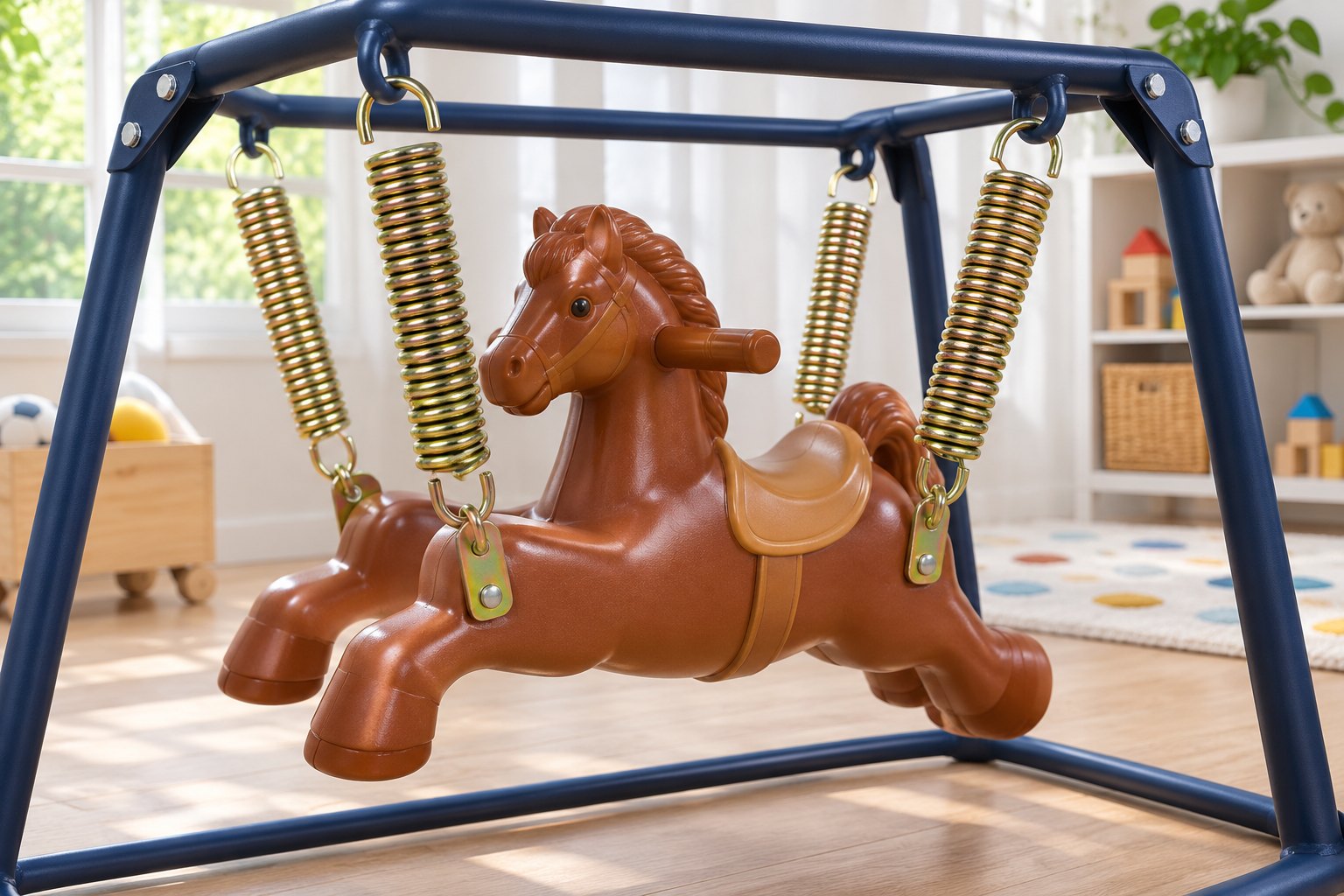
Cover image: an AI-generated illustration of a generic spring rocking horse, based on a photo of extension springs we make; it does not show a specific product.
Rocking horse springs are the heavy close-wound extension springs that hang the body of a spring horse from its tubular steel frame, usually one at each corner. When a child rocks or bounces, the springs stretch and pull the horse back, which gives the ride its bounce. A product recall notice from the U.S. Consumer Product Safety Commission describes the classic design exactly: the horse body “is suspended by four springs from a tubular” metal frame [1].
This guide is written for toy and playroom furniture brands, ride-on toy manufacturers and replacement part suppliers who buy these springs in volume. It calculates the load on each spring for a common replacement size, checks the gaps between the coils against the toy-safety rule on finger pinching, explains why the hooks rather than the coils set the safe load and lists what belongs on a drawing. For extension spring drawings in general, see our extension spring specification guide.
Key takeaways
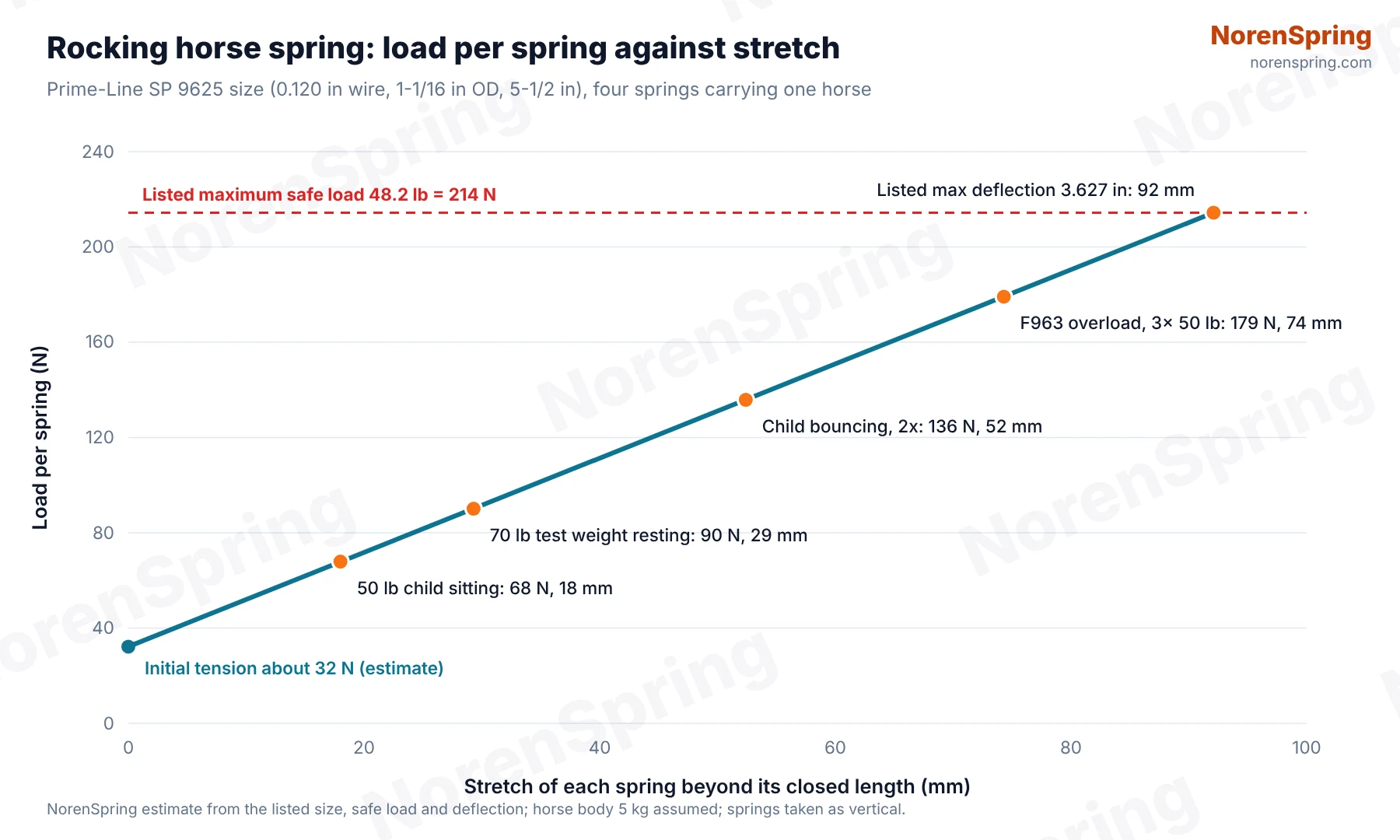
- Four springs share the load. With a 50 lb (22.7 kg) child on a 5 kg horse, each spring in our example carries about 68 N and stretches about 18 mm.
- The hooks set the safe load. At the listed 48.2 lb safe load of a common replacement spring, our estimate puts the loop end at 0.73 of the wire’s tensile strength but the coil body at only 0.38.
- Four springs pass the toy-standard overload. A load of three times a 50 lb child puts 179 N on each spring, which is 84 % of the listed safe load.
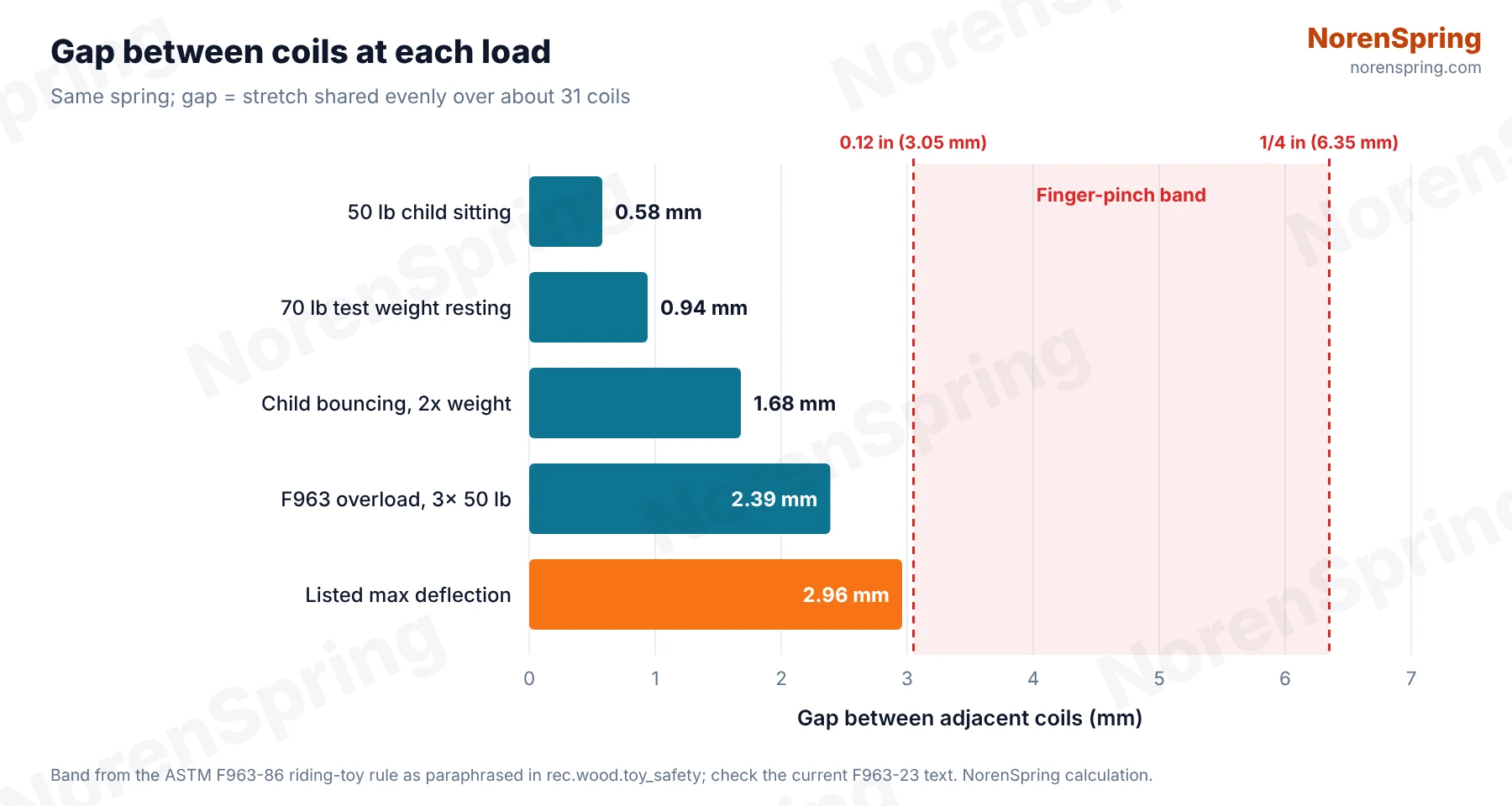
- Coil gaps decide finger safety. At its listed maximum stretch, the example spring opens to about 2.96 mm between coils, just under the 0.12 in (3.05 mm) pinch threshold.
- Check the published numbers. The listed load, deflection and wire size only agree with each other for one of the two wire sizes the same listing gives.
How does a spring rocking horse work?
A spring horse has three parts: a moulded or wooden horse body, a floor-standing tubular frame, and the springs that join them. Each spring hooks onto a bracket or eye at one corner of the frame at one end and onto a bracket on the horse at the other. Because the springs carry the whole body, the horse can rock forwards and back, bounce up and down and sway, all at once.
The springs are extension springs with initial tension, which means the coils are wound pressed together and the spring does not start to stretch until the pull exceeds a built-in preload. On an empty horse this preload keeps the springs closed and the horse steady; once a child sits on it, the springs open and the bounce begins. Our article on porch swing springs uses the same physics for a hanging seat for adults.
The playground spring rider is a different product. A typical one sits on a single large coil spring bolted between a floor plate and the seat; one replacement spring for playground riders, for example, is listed at 13-5/8 in long and 5-5/8 in in diameter, with 3/4 in coil wire [2]. These fall under playground equipment standards rather than toy standards, so this guide covers only the four-spring toy horse.
| Type | Spring | Typical setting | Governing standard (U.S.) |
|---|---|---|---|
| Spring rocking horse | Four close-wound extension springs with loop ends | Home, playroom | ASTM F963 toy standard |
| Bouncing or hobby horse on a stand | Two to four extension springs | Home | ASTM F963 toy standard |
| Playground spring rider | One large coil spring bolted top and bottom | Public playgrounds | Playground equipment standards |
| Wooden bow rocker | No spring | Home | ASTM F963 toy standard |
Worked example: what can one rocking horse spring carry?
We modelled a common replacement spring sold for children’s hobby horses, Prime-Line SP 9625. Its listing gives a 1-1/16 in outside diameter, a 5-1/2 in length, single open loop ends, nickel-plated heat-tempered spring steel, a maximum safe load of 48.2 lb and a maximum deflection of 3.627 in [3]. The same page gives the wire as 0.120 in in its title and as 0.125 in in its description [3]. We calculated the rate and initial tension from the standard extension spring equations [4], so they are our estimates, not published figures.
| Parameter | 0.120 in wire | 0.125 in wire |
|---|---|---|
| Wire diameter | 3.05 mm | 3.18 mm |
| Mean coil diameter | 23.9 mm; spring index C = 7.85 | 23.8 mm; C = 7.50 |
| Body coils (estimated) | About 31 | About 30 |
| Spring rate (estimated) | 1.98 N/mm (11.3 lb/in) | 2.45 N/mm (14.0 lb/in) |
| Initial tension implied by the listed 48.2 lb at 3.627 in | +32 N (7.2 lb) | −12 N, which is impossible |
| Coil body stress at 48.2 lb | 0.38 of tensile strength | 0.34 of tensile strength |
| Loop end bending stress at 48.2 lb | 0.73 of tensile strength | 0.65 of tensile strength |
The 0.120 in wire is the only size that fits the listed load and deflection, because the 0.125 in wire would need a negative initial tension, which a close-wound spring cannot have. In other words, a datasheet can hold internal contradictions, so a buyer should check that load, rate and deflection agree before copying them onto a drawing. We use the 0.120 in values from here on.
The stress rows explain the 48.2 lb rating. The coil body sits at about 38 % of the wire’s tensile strength, well inside the usual limit, while the bending stress at the loop end reaches 0.73 of tensile strength, close to the 0.75 limit that Shigley’s text gives for extension spring ends [4]. Consequently, the safe load of this spring is set by its hooks, and a stronger hook or a larger bend radius raises it more than heavier coils would. Our guide to spring end types compares the hook designs.
Load on each spring
We assumed a 5 kg horse body and four springs hanging close to vertical. The rider weights come from the age-weight table and test loads that a hobbyist summary attributes to ASTM F963: a five-year-old counts as 50 lb, seats must bear three times the child’s weight, and the spring-gap check uses a 70 lb weight bouncing on the toy [5]. The “child bouncing” case assumes the springs see twice the static weight at the bottom of each bounce, which is our assumption.
| Case | Load per spring | Stretch | Share of listed safe load | Coil gap |
|---|---|---|---|---|
| Empty horse | 12 N | 0 mm (below initial tension) | 6 % | 0 mm |
| 50 lb child sitting | 68 N | 18 mm | 32 % | 0.58 mm |
| 70 lb test weight resting | 90 N | 29 mm | 42 % | 0.94 mm |
| 50 lb child bouncing, 2× weight | 136 N | 52 mm | 63 % | 1.68 mm |
| Overload, 3× a 50 lb child | 179 N | 74 mm | 84 % | 2.39 mm |
| Listed maximum deflection | 214 N | 92 mm | 100 % | 2.96 mm |
With a 50 lb child on board, the horse in our model bounces at about 2.7 Hz, which is a lively but controllable ride. A heavier spring would make the ride stiffer and faster, and a lighter one would let the horse sink further and risk reaching full stretch on hard bounces.
Why do the gaps between the coils matter?
When a spring stretches, its coils open, and when the load comes off they snap shut again. If a child’s finger is between two coils at that moment, it is pinched. Toy standards deal with this directly. The hobbyist summary of ASTM F963 says that on riding toys the gaps between spring coils should be less than 0.12 in or more than 1/4 in, even with a 70 lb weight bouncing on the toy [5]. That summary is based on an old edition, and in the United States toys must now comply with ASTM F963-23 under 16 CFR part 1250 [6], so designers should check the current clause rather than rely on these figures.
In our example, the gap between coils is the stretch divided by about 31 coils. Even at the listed maximum deflection, the gap is 2.96 mm (0.117 in), just under the 0.12 in (3.05 mm) threshold. This suggests the spring was proportioned with that limit in mind: enough coils that, before the hooks reach their safe load, no gap opens wide enough to trap a fingertip.
That leads to three practical design rules:
- Count coils, not just load. A shorter spring with the same rate needs fewer, wider-opening coils, and its gaps can enter the pinch band at loads it can easily carry.
- Do not substitute a “stronger” spring blindly. A spring with heavier wire and fewer coils may hold the load but open wider per coil under the same stretch.
- Use covers where the numbers do not work. A fabric or plastic sleeve over each spring keeps fingers out of the coils whatever the gap.
Material, finish and the hooks
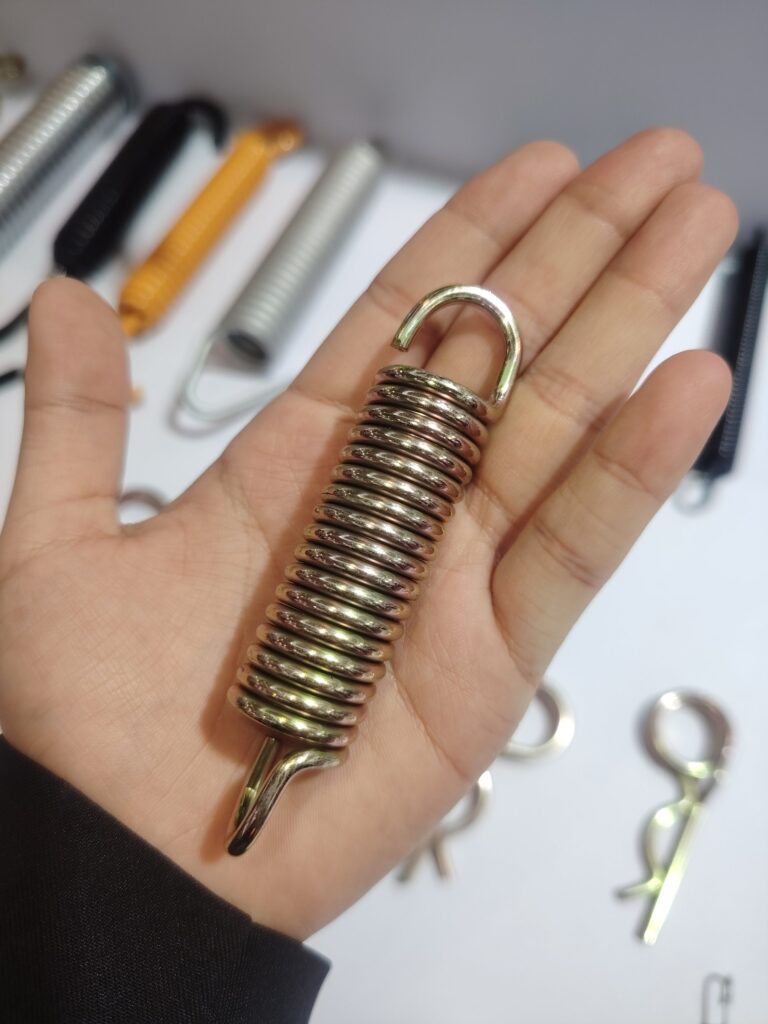
Rocking horse springs are usually hard-drawn or oil-tempered carbon spring steel, plated for appearance and rust resistance. The listing in our example is nickel-plated heat-tempered spring steel [3]; zinc plating and powder coating are common alternatives. If the springs are plated, hydrogen embrittlement relief after plating matters, because a brittle hook fails suddenly. Our spring finishes guide compares the options.
The body of the toy can fail too. In the 1987 recall, about 114,000 spring horses were withdrawn after 105 complaints that the plastic body broke while being ridden, with 40 incidents causing cuts, scrapes and bruises [1]. The springs were not the reported failure, but the case shows why the bracket on the horse, the hook and the spring have to be designed as one load path. Brand names in this article are used only to identify products and public records; NorenSpring is not affiliated with these manufacturers.
Practical points for the hooks:
- Specify the loop type and opening. Single open loops, as in our example, are easy to hook on but can work off a bracket; closed loops or a captive bolt stop that.
- Give the bend radius. A tight bend at the base of the loop raises the stress that limits the safe load.
- Match the bracket wire size. The bracket should fill the loop so it does not wear a groove or lever the loop open.
Replacing springs on an old rocking horse
Owners of vintage and antique spring horses often need to replace one tired or broken spring. Replace all four springs at once, because a new spring next to three older ones of a different length tilts the horse. Measure the old spring before ordering: outside diameter, wire diameter, length inside the loops, and the loop type. Our article on how to measure a spring shows each measurement. If the original springs were longer than standard replacement springs, use an adjustable link rather than stretching the new spring to reach the bracket, which would use up stretch before anyone sits on the horse.
What to specify for a rocking horse spring
| Item | Example |
|---|---|
| Application | Ride-on spring horse, four springs, rider up to 50 lb (22.7 kg), age group stated |
| Wire | 3.05 mm (0.120 in) oil-tempered or hard-drawn spring steel |
| Outside diameter | 27.0 mm (1-1/16 in) ± 0.4 mm |
| Length inside loops | Stated with tolerance, for example 140 mm ± 1.5 mm |
| Initial tension | For example 32 N ± 15 % |
| Rate | For example 2.0 N/mm ± 10 % |
| Maximum working load and stretch | 179 N at about 74 mm (three-times overload case) |
| Coil gap limit | Less than 3.0 mm between coils at maximum stretch, or springs covered |
| Ends | Single open loops in line with the body, minimum bend radius stated |
| Finish | Nickel or zinc plate with embrittlement relief, or powder coat |
| Testing | Load at two lengths, overload hold, and the gap check at maximum stretch |
Send your drawing, a sample spring or the toy’s load case through our contact page, and our engineers will review it and reply within 24 hours. Our extension springs page shows the end types and finishes we make, and you can read more about our company and its certifications. This guide was compiled by our editorial team with our spring engineers.
Frequently asked questions
What size springs does a rocking horse use?
There is no single standard size. One common replacement spring for hobby horses is 1-1/16 in in outside diameter and 5-1/2 in long, with single open loops, a 48.2 lb maximum safe load and 3.627 in maximum deflection [3]. Measure the original springs before you order.
How much weight can a spring rocking horse hold?
It depends on the springs, the brackets and the horse body. With four springs of the size in our example, each spring reaches its listed safe load at 214 N, so the four together carry about 857 N, including the weight of the horse. The maker’s stated rider limit always takes priority.
Why should all four springs be replaced together?
Springs relax and lengthen with use. A single new spring will be shorter and stiffer than the other three, so the horse sits tilted and the new spring carries more than its share of every bounce.
Are rocking horse springs a pinch hazard?
They can be. When coils open and close, a gap that admits a fingertip can pinch it. The rule summarised from ASTM F963 is to keep gaps under 0.12 in or over 1/4 in under the bouncing test load [5]; otherwise, cover the springs. For a similar check on a trampoline frame, see our trampoline springs article.
References
- U.S. Consumer Product Safety Commission, “CBS Wonder Spring Ride-On Horses Recalled”, recall 87-061, 1987. https://www.cpsc.gov/Recalls/1987/CBS-Wonder-Spring-Ride-On-Horses-Recalled
- Discount Playground Supply, spring rider replacement spring (Jensen SP205s). https://discountplaygroundsupply.com/spring-rider-replacement-spring
- Prime-Line, hobby horse extension spring SP 9625. https://www.primelineparts.com/hobby-horse-ext-spring-1-1-16-inches-x-5-1-2-inches-12-gage-steel-single-loop-open-pack-of-1
- Shigley’s Mechanical Engineering Design, Chapter 10 Mechanical Springs, lecture slides, Istanbul Technical University. https://web.itu.edu.tr/~halit/Makel/Ch_10_slides_m.pdf
- rec.woodworking toy safety summary of ASTM F963-86 (hobbyist paraphrase). https://www.cs.rochester.edu/u/roche/rec.wood.misc/rec.wood.toy_safety
- Electronic Code of Federal Regulations, 16 CFR Part 1250, Safety Standard Mandating ASTM F963 for Toys. https://www.ecfr.gov/current/title-16/chapter-II/subchapter-B/part-1250



