










In this article
Cover image: an AI-generated illustration of a generic custom motorcycle, based on a photo of chrome-plated compression springs we make; it does not show a specific product.
Motorcycle seat springs are the short compression or torsion springs that hold up a solo seat, usually two of them under the rear of a seat pan that pivots at the front. On a rigid or “hardtail” frame they are the only rear suspension the rider has. They are sold by height, typically 2, 3, 4 or 5 in. One maker states that its 3 in barrel springs give “approximately 2″ of suspension travel for rider weights up to 240 lbs” [1].
This guide is written for custom motorcycle parts brands, seat makers and distributors who buy seat springs in volume. It works out the load on each spring for different rider weights and models a 3 in barrel spring to show where it starts to bottom out. It then compares 3, 4 and 5 in springs against the frequencies the seated human body is most sensitive to and lists what to put on a drawing. For compression spring drawings in general, see our compression spring specification guide.
Key takeaways
- Each spring carries about a quarter of the rider. With a front pivot, a 240 lb rider puts about 58 lb on each of two rear springs in our model.
- Short springs run out of travel. Our 3 in barrel spring is linear to about 1.3 in and usable to about 2 in, which matches the “about 2 in of travel” a seller quotes.
- Bounce frequency follows sag, not spring length alone. A 3 in spring sized for a 240 lb rider gives a bounce of about 4.4 to 5.8 Hz, inside the 4 to 6 Hz band where the seated body resonates.
- Longer springs ride softer. Sized for the same rider, 5 in springs bring the bounce down to about 3.3 to 4.4 Hz.
- Chrome plating needs baking. Plated springs that are not baked to relieve hydrogen can crack suddenly under load.
What do solo seat springs do?
A solo seat is a single-rider seat bolted to the frame at its nose through a pivot, with the springs under its rear corners. When the rear wheel hits a bump on a rigid frame, the frame rises and the springs compress, so the rider’s body moves less than the frame. The springs do the job that a shock absorber does on a swingarm bike, but with no damping.
Seat springs come in three common styles:
| Style | Spring type | How it carries the load | Typical heights sold |
|---|---|---|---|
| Barrel (beehive) | Compression spring, wider in the middle than at the ends | Coils compress; large coils nest inside each other near the end of travel | 2, 3, 4 and 5 in [2] |
| Hairpin or scissor | Torsion spring with two long legs | Legs close like a hinge, twisting the coil | 3 in [2] |
| Seat post springs | Compression springs inside a sprung seat post | Upper and lower springs in the frame tube | Sold as upper and lower sets for older rigid and swingarm big twins [2] |
A barrel spring is a compression spring whose coil diameter is largest in the middle and smaller at both ends, so it looks like a barrel or beehive. The shape lets the large middle coils slide over the smaller ones near the end of travel, which gives a shorter solid height than a straight spring of the same wire. Our conical spring guide covers the related single-taper shape and how coils telescope.
A hairpin seat spring is a torsion spring, so its rate is set by the coil and leg length rather than by compression. One catalogue lists a 3 in chrome “torsion seat spring” sold as a pair for bolt-on fitting [3]; our guide to double torsion springs shows how such springs are specified.
How much load does each seat spring carry?
The load depends on the rider’s weight, how much of it goes through the seat and where the rider sits between the pivot and the springs. We assumed that 75 % of the rider’s weight goes through the seat, with the rest carried by the footpegs or forward controls. We also assumed that the rider’s weight acts at 0.65 of the distance from the pivot to the springs. Both are our assumptions for a typical solo seat; measure your own seat if the geometry differs.
| Rider weight | Load through the seat | Load on each of two springs |
|---|---|---|
| 160 lb (73 kg) | 120 lb | 39 lb (173 N) |
| 200 lb (91 kg) | 150 lb | 49 lb (217 N) |
| 240 lb (109 kg) | 180 lb | 58.5 lb (260 N) |
| 280 lb (127 kg) | 210 lb | 68 lb (304 N) |
| 300 lb (136 kg) | 225 lb | 73 lb (325 N) |
In other words, each spring carries roughly a quarter of the rider’s weight. The springs then see much more on every bump. On a rigid frame, a pothole can briefly multiply the load several times, and the spring has to absorb that without going solid.
Why do 2 and 3 in seat springs bottom out?
Bottoming out happens when a spring compresses until its coils touch, so the seat hits a hard stop. On a short spring there is little room to absorb a bump. Riders report this in product reviews. One 245 lb rider wrote of their old springs, “I was bottomed out pretty much completely”, and another said their 3 in springs “snapped” because they were too heavy for them [4]. One seller points riders of 250 lb or more to 5 in springs, which it says give about 2.5 in of travel [1].
To see what limits a 3 in spring, we modelled one barrel design with 5.5 mm (0.217 in) wire and 6 active coils. Its outside diameter is 61.5 mm in the middle and 39.5 mm at the ends, and its free height is 3 in. We used the standard helical spring equations [5], let each coil stop when it closes its gap, and assumed chrome-silicon wire with a tensile strength of about 1,668 MPa at this size. These are our design estimates, not data for any product on sale.
| Compression | Load on the spring | Peak stress / tensile strength | What is happening |
|---|---|---|---|
| 0.44 in | 39 lb | 0.10 | 160 lb rider sitting |
| 0.65 in | 58 lb | 0.15 | 240 lb rider sitting |
| 1.0 in | 89 lb | 0.23 | Linear range, about 90 lb/in |
| 1.32 in | 118 lb | 0.31 | Largest middle coils start to close |
| 1.5 in | 137 lb | 0.34 | Rate rising |
| 2.0 in | 227 lb | 0.48 | Near the static limit for oil-tempered wire |
| 2.2 in | 305 lb | 0.59 | Past the limit; set or fracture risk |
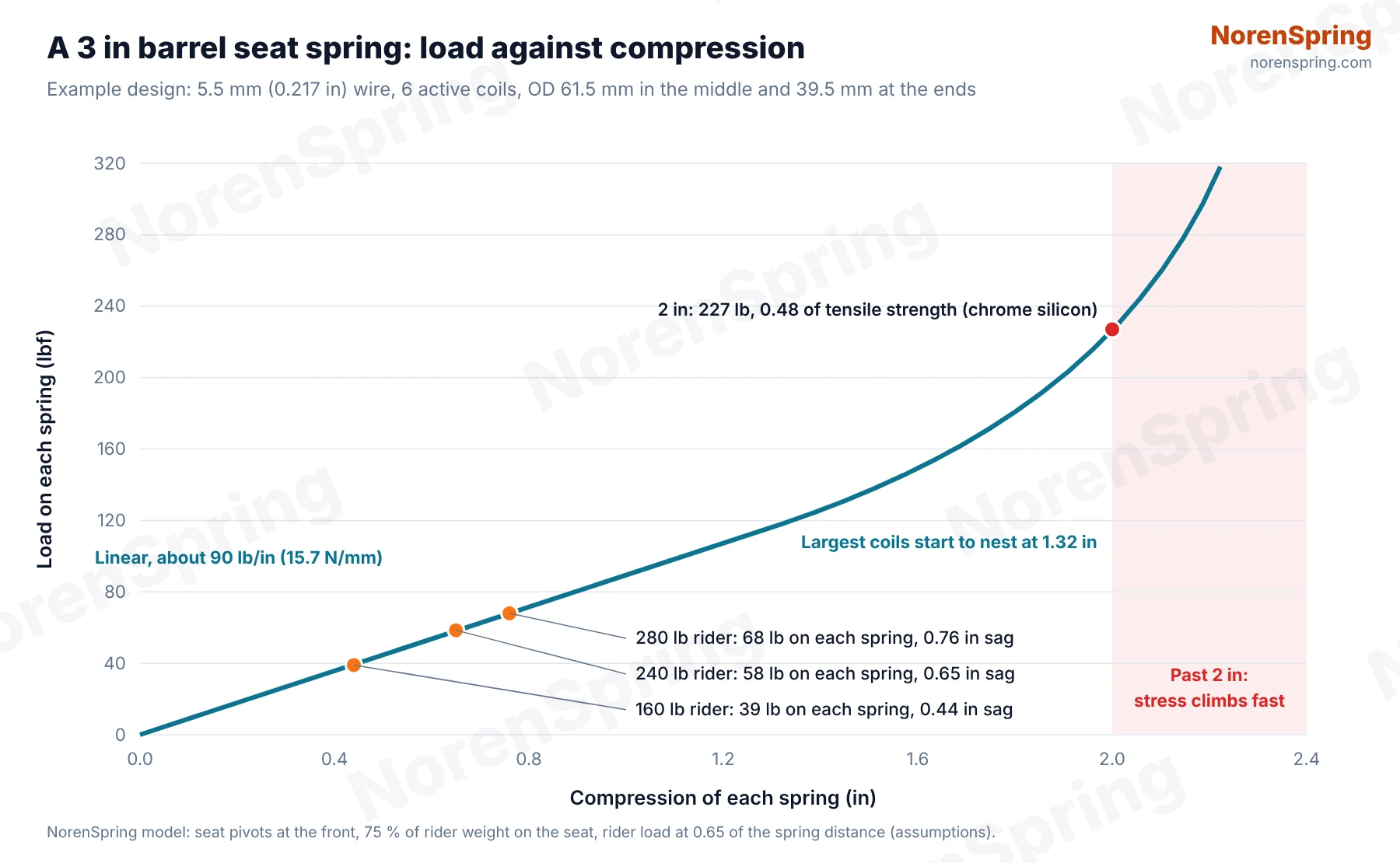
The model agrees with the seller’s “about 2 in of travel” figure. Up to about 1.3 in, the spring is linear. After that, the large middle coils close one after another and the rate climbs, which cushions the end of travel. By 2 in, the most highly stressed coil reaches 0.48 of tensile strength, close to the usual 50 % static limit for oil-tempered wire at solid in Shigley’s design tables [5]. Beyond about 2.1 in, stress climbs quickly, so a heavy rider who regularly bottoms a 3 in spring will see it take set or break, as the review above describes.
The progressive end of the curve is the reason the barrel shape exists. A straight spring with the same rate and wire needs about 4.6 active coils at a 50 mm mean diameter. With closed ends, that is roughly 36 mm (1.4 in) of solid height, against about 16 mm for the nested barrel. That leaves too little travel in a 3 in package. Progressive rates like this are also used deliberately in variable rate springs.
How does spring length change ride comfort?
Bounce frequency is how many times per second the rider and seat would bounce on the springs if disturbed and left alone. For a simple spring and mass, it depends only on how far the rider sinks under their own weight: f = (1/2π) × √(g / sag), with the sag measured at the rider. Our guide to spring natural frequency derives the formula.
The human body has its own resonance. In a 2010 study in Industrial Health, M-Pranesh and colleagues note that biodynamic responses of the seated body show “a peak gain between 4 and 6 Hz” under vertical vibration, generally considered the primary resonance [6]. Qiu and Griffin add that the resonance frequency falls, from about 6 Hz to 4 Hz in one cited study, as the vibration gets stronger [7]. A seat that bounces in that band amplifies the shaking the rider feels instead of filtering it out.
We compared 3, 4 and 5 in springs, choosing each rate so that a 240 lb rider uses the full travel at three times body weight, and then calculated the bounce frequency for three rider weights.
| Spring height and travel | Rate per spring | 160 lb rider | 240 lb rider | 280 lb rider |
|---|---|---|---|---|
| 3 in, 2.0 in travel | 88 lb/in (15.4 N/mm) | 5.8 Hz | 4.8 Hz | 4.4 Hz |
| 4 in, 2.75 in travel | 64 lb/in (11.2 N/mm) | 5.0 Hz | 4.0 Hz | 3.8 Hz |
| 5 in, 3.5 in travel | 50 lb/in (8.8 N/mm) | 4.4 Hz | 3.6 Hz | 3.3 Hz |
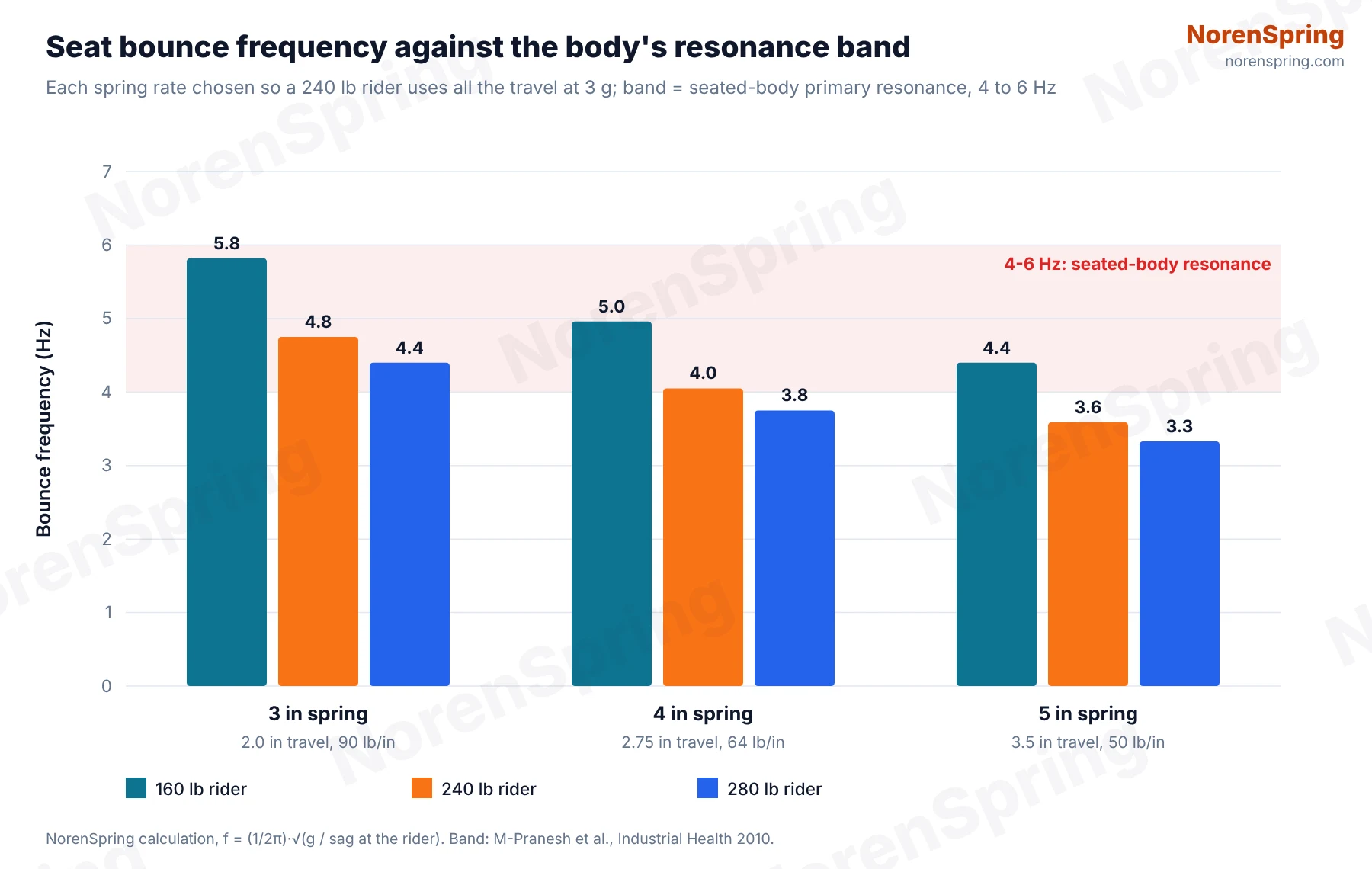
All three 3 in cases fall inside the 4 to 6 Hz band. Because short springs have little travel, they must be stiff to avoid bottoming, and stiff springs give small sag and a high bounce frequency. Longer springs can be softer for the same bottoming margin, which moves the bounce below the band for most riders. Therefore, a longer spring is not only for heavy riders; it is the only way to make a solo seat ride noticeably softer without bottoming more often. Light riders on springs sized for heavy riders get the opposite: little sag, a harsh 5 to 6 Hz bounce and plenty of unused travel. A tractor suspension seat goes further, with a long spring tuned below 2 Hz; see our tractor seat springs guide.
Materials and chrome plating
Most seat springs are carbon or chrome-silicon spring steel, finished in chrome for looks or black powder coat. Chrome-silicon wire has a higher tensile strength than oil-tempered carbon wire, which our model shows matters near the end of travel; our chrome silicon springs article compares the grades.
Electroplating chrome puts hydrogen into high-strength steel, and that hydrogen can make a loaded spring crack without warning. A U.S. National Bureau of Standards investigation of chromium-plated steel loaded notched specimens at 70 % of the notched tensile strength of unplated ones. Unbaked plated specimens failed after half an hour, while baked specimens lasted 200 hours under the same load, and the report recommended baking at 400 °F for 4 hours [8]. For seat springs, the practical rule is that every chrome-plated batch should be baked promptly after plating, and the drawing should say so. Our spring finishes guide covers embrittlement relief for other platings too.
What to specify for a motorcycle seat spring
| Item | Example |
|---|---|
| Application | Solo seat, two springs, front pivot, rider weight range stated (for example 160 to 280 lb) |
| Style | Barrel compression spring, or hairpin torsion spring with leg lengths and angle |
| Free height | 76.2 mm (3 in) ± 1.5 mm |
| Wire | 5.5 mm chrome-silicon spring wire (ASTM A401 or EN 10270-2 equivalent) |
| Coil form | OD 61.5 mm at the middle, 39.5 mm at both ends, 6 active coils, ends closed |
| Load points | For example 260 N ± 10 % at 16.6 mm, and a second load at 1.5 in |
| Usable travel | Maximum working compression stated, for example 50.8 mm (2 in) |
| Mounting | Stud or bolt size, end coil inside diameter and cup or plate seat |
| Finish | Bright chrome over nickel, baked for hydrogen relief, or black powder coat |
| Testing | Load at two heights on samples from every lot; compress to maximum travel three times, then recheck free height for set |
Send your drawing, a sample spring or your seat geometry through our contact page, and our engineers will review it and reply within 24 hours. Our compression springs and torsion springs pages show the shapes and finishes we make, and you can read more about our company and its certifications. For a full rear suspension rather than a seat, see our guide to custom suspension springs. This guide was compiled by our editorial team with our spring engineers.
Frequently asked questions
What size seat springs do I need for my weight?
Use the seller’s rider-weight guidance first. One seller quotes 3 in barrel springs for riders up to 240 lb and recommends 5 in springs at 250 lb or more [1]. In our model, a 240 lb rider puts about 58 lb on each spring, and a 3 in barrel spring sized for that weight is usable to about 2 in.
Why do my seat springs bottom out?
The springs are too short or too soft for your weight and the roads you ride. Each spring carries about a quarter of your weight, and bumps on a rigid frame multiply it. Move to taller springs, or to a stiffer spring of the same height if you accept a firmer ride.
Are 2 in or 3 in seat springs more comfortable?
Taller springs are usually more comfortable, because they have room for a softer rate before bottoming. In our comparison, 3 in springs gave a bounce of 4.4 to 5.8 Hz. That is inside the 4 to 6 Hz band where the seated body resonates [6], while 5 in springs brought it down to 3.3 to 4.4 Hz.
What is the difference between barrel and hairpin seat springs?
Barrel springs are compression springs that get stiffer as their large coils nest near the end of travel. Hairpin or scissor springs are torsion springs whose legs close like a hinge, so their rate depends on coil and leg length and their travel is set by the leg angle.
References
- DK Custom Products, “Outlaw Barrel Springs for Your Solo Seat Pan, Pair of 2” (listed as discontinued). https://www.dkcustomproducts.com/outlaw-barrel-springs-for-your-solo-seat-pan-pair-of-2-dk-brl-spr.htm
- Lowbrow Customs, motorcycle seat springs collection. https://lowbrowcustoms.com/collections/motorcycle-seat-springs
- J&J Motorsports, Drag Specialties chrome torsion seat spring, 3 in. https://jj-motorsports.com/drag-specialties-chrome-torsion-seat-spring-3-098013
- TJBC, “Seat Springs – For Solo Seat”, product page and customer reviews. https://shoptjbc.com/products/barrel-seat-springs
- Shigley’s Mechanical Engineering Design, Chapter 10 Mechanical Springs, lecture slides, Istanbul Technical University. https://web.itu.edu.tr/~halit/Makel/Ch_10_slides_m.pdf
- M-Pranesh A., Rakheja S., Demont R., “Influence of Support Conditions on Vertical Whole-body Vibration of the Seated Human Body”, Industrial Health 48 (2010) 682-697. https://www.jniosh.johas.go.jp/en/indu_hel/doc/IH_48_5_682.pdf
- Qiu Y., Griffin M. J., “Biodynamic Responses of the Seated Human Body to Single-axis and Dual-axis Vibration”, Industrial Health 48 (2010) 615-627. https://www.jniosh.johas.go.jp/en/indu_hel/doc/IH_48_5_615.pdf
- Feinberg I. J., “Hydrogen Embrittlement of Chromium Plated Printing Plates”, National Bureau of Standards Report 9942. https://nvlpubs.nist.gov/nistpubs/Legacy/RPT/nbsreport9942.pdf



