










In this article
- Key takeaways
- How the idler and spring tension the deck belt
- How much belt tension does the deck need?
- Why spring rate matters as the belt stretches
- Worked example: sizing a deck belt tension spring
- Hooks: where deck springs break
- Example project: a deck belt spring for mowing equipment
- Materials and finishes for deck springs
- Signs a deck belt tension spring is worn
- What to send for a deck spring quote
- Frequently asked questions
- References
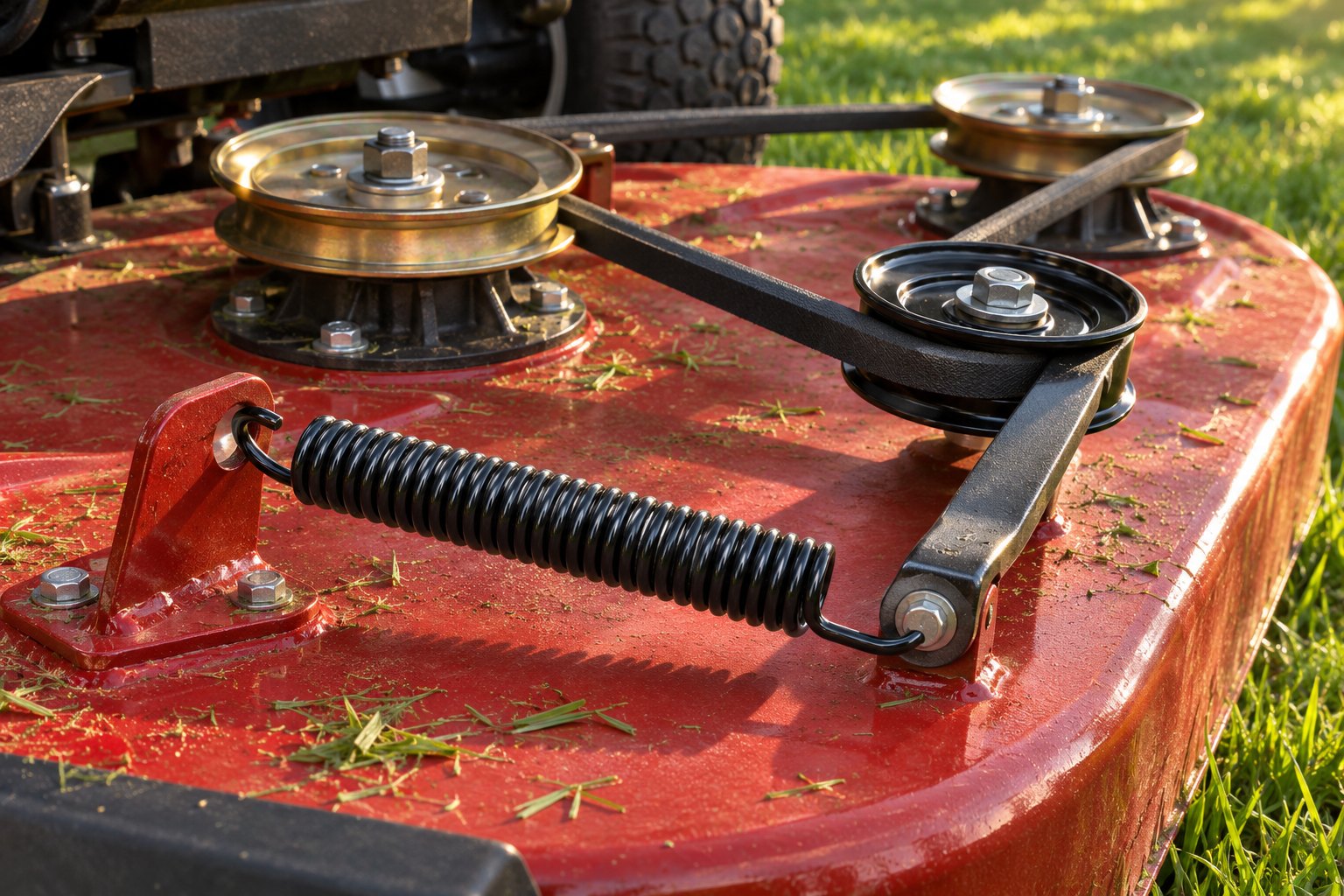
Cover image: an AI-generated illustration based on a photo of an extension spring we make; the mower deck is generic and not a specific model.
A mower deck belt tension spring is the spring, usually an extension spring, that pulls the idler arm so the idler pulley presses on the deck belt and keeps it tight. On riding mowers, lawn tractors and zero-turn mowers the blades are driven by a belt and pulley system rather than directly from the engine crankshaft [2], and this spring keeps that belt tight. When the spring weakens or a hook opens, the belt slips, squeals, cuts unevenly or jumps off the pulleys, and although some decks use a torsion spring at the idler pivot instead, the force questions are the same.
This guide is for mower and garden equipment makers, deck rebuilders and aftermarket parts brands that source deck springs. It covers the idler geometry, the force the spring needs, why the spring rate decides how fast tension falls as the belt stretches, a worked spring design with hook stresses and what to put on the drawing. For extension spring terms in general, see our guide on how to specify a custom extension spring.
Key takeaways
- The idler arm is a lever. With the spring attached 60 mm and the idler pulley 100 mm from the pivot, the spring must pull with 267 N to maintain 160 N of tension in the belt span.
- Wet belts slip first. Under the assumptions below, a dry belt transmits full blade power down to very low tension, but a wet belt begins slipping once span tension falls below approximately 81 N.
- Specify a low rate with high initial tension. As the belt stretches by 12 mm, an 8 N/mm spring loses 22 % of belt tension, whereas a 20 N/mm spring with the same installed force loses 54 %. Roller chain drives follow the same rule; see our guide to spring-loaded chain tensioner springs.
- Hooks fail before coils. In the worked design, the bending stress at the hook reaches 881 MPa, almost double the 458 MPa in the coil body.
- Field failures are usually fatigue failures. Deck vibration loads the spring many times per second, so hook geometry and initial tension matter more than a slightly higher installed force.
How the idler and spring tension the deck belt
A belt drive transmits power by friction between the belt and the pulley grooves. The capstan equation is the belt friction formula, also called the Euler–Eytelwein formula, that sets the limit: a belt slips when the ratio of the tight-side to slack-side tension exceeds eμφ, where μ is the friction coefficient and φ the wrap angle in radians [1]. A V-belt wedges into its groove, which increases friction [3]; in calculations the effective friction coefficient becomes μ / sin(β/2) for a groove angle β. The slack-side tension therefore sets how much torque the drive can carry, and on many decks the idler sits on that slack side.
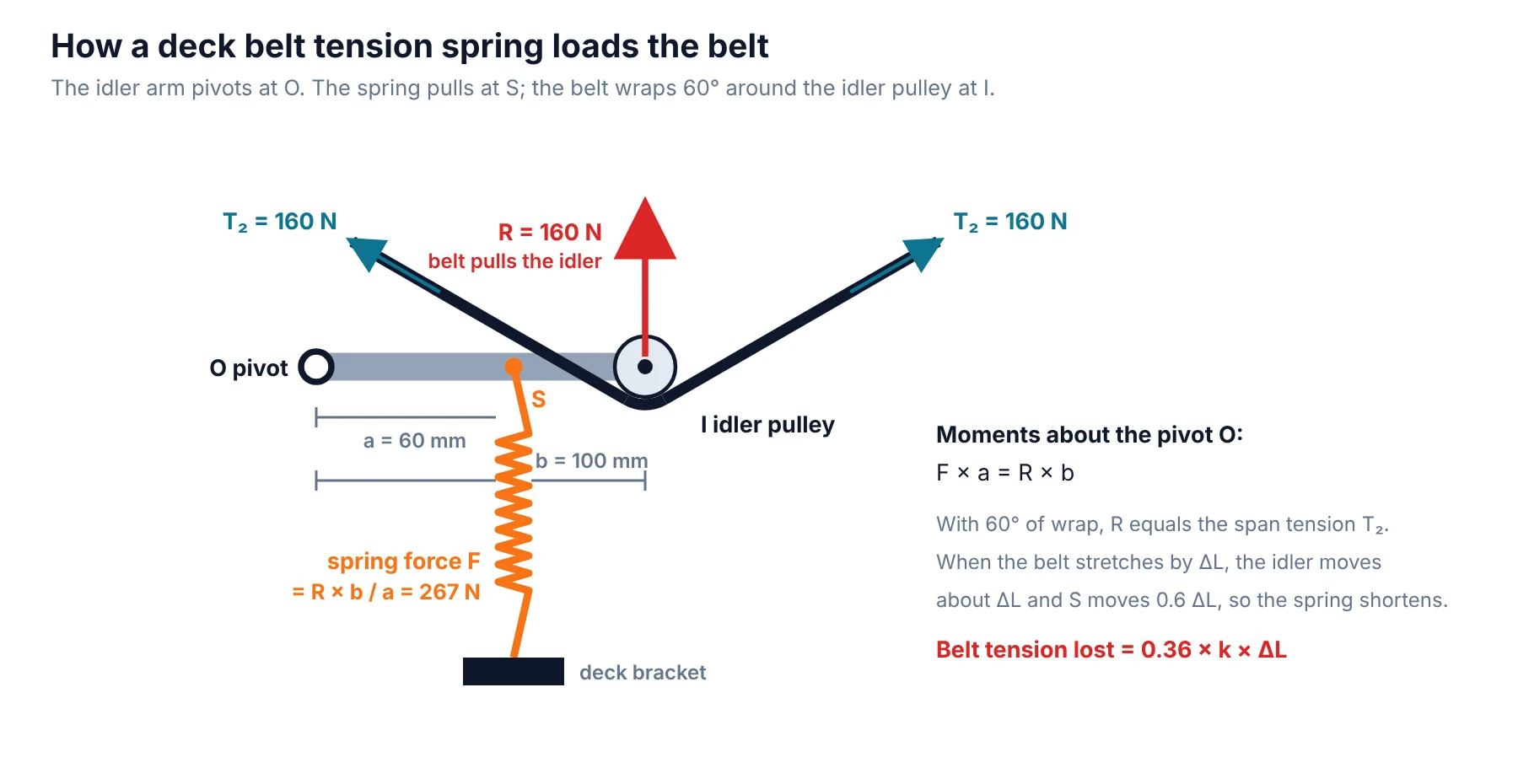
The idler arm pivots on the deck, the belt pulls the idler pulley one way and the spring pulls the arm the other way, so taking moments about the pivot O gives:
Fspring × a = R × b
where a is the spring’s lever arm, b the idler’s lever arm and R the belt load on the idler. With the belt wrapping 60° around the idler, R equals the tension in one span.
For our worked example we drew an arm with a = 60 mm and b = 100 mm and a target span tension of 160 N. The spring must pull F = 160 × 100 / 60 = 267 N. The lever cuts both ways: the spring moves only 0.6 times as far as the idler, so a long belt stretch becomes a short spring movement.
The same moment balance gives the spring force for other arm layouts. The table assumes 60° of wrap on the idler, so the belt load on the idler equals the span tension, and lists the spring force for four ratios of idler arm b to spring arm a:
| Span tension | b/a = 1.25 | b/a = 1.67 | b/a = 2.0 | b/a = 2.5 |
|---|---|---|---|---|
| 100 N | 125 N | 167 N | 200 N | 250 N |
| 120 N | 150 N | 200 N | 240 N | 300 N |
| 140 N | 175 N | 233 N | 280 N | 350 N |
| 160 N | 200 N | 267 N | 320 N | 400 N |
| 180 N | 225 N | 300 N | 360 N | 450 N |
| 200 N | 250 N | 333 N | 400 N | 500 N |
A longer idler arm relative to the spring arm multiplies the force the spring must supply, but it also reduces how far the spring moves as the belt stretches, which helps the spring hold tension.
How much belt tension does the deck need?
The answer depends on blade power and on operating conditions, particularly moisture on the belt. As an illustration, take a deck that absorbs 6 kW, driven by a 127 mm engine pulley at 3,400 rpm. The belt speed is 22.6 m/s. Power equals the difference between tight-side and slack-side tension times belt speed [3], so that difference must be 6,000 / 22.6 = 265 N. We assumed a 38° groove, 180° of wrap on the drive pulley and friction coefficients of 0.25 for a dry belt and 0.15 for a wet one; real values depend on belt and pulley condition.
| Slack-side tension | Capacity, dry belt (μ 0.25) | Capacity, wet belt (μ 0.15) | Margin over 265 N, wet |
|---|---|---|---|
| 160 N | 1,626 N | 520 N | 1.96 |
| 120 N | 1,219 N | 390 N | 1.47 |
| 100 N | 1,016 N | 325 N | 1.23 |
| 80 N | 813 N | 260 N | 0.98 |
A dry belt has plenty of margin, which is why a weak spring often goes unnoticed until the operator mows wet grass, where the belt slips once tension drops below about 81 N. Slip also glazes the belt surface and lowers friction further, so a deck that has started slipping tends to deteriorate quickly.
Why spring rate matters as the belt stretches
V-belts stretch and wear in service, and as the belt rides deeper in worn pulley grooves its effective length increases, so the spring has to take up that slack continuously. With 60° of wrap on the idler, each millimetre of additional belt length moves the idler approximately one millimetre, which moves the spring attachment 0.6 mm and shortens the spring accordingly. The belt tension lost is:
ΔT ≈ 0.36 × k × ΔL
where k is the spring rate and ΔL the belt stretch.
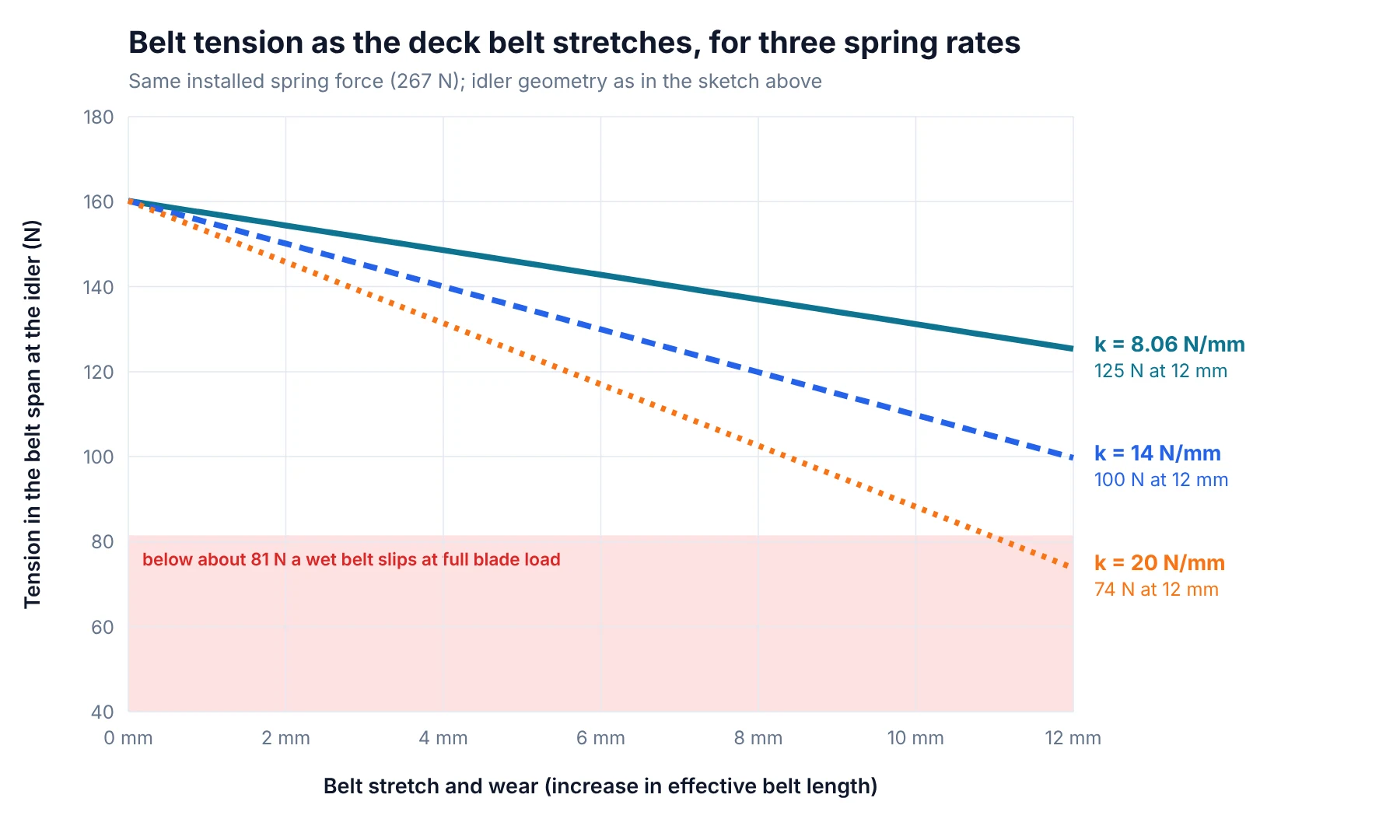
| Belt stretch | Tension, k = 8.06 N/mm | Tension, k = 14 N/mm | Tension, k = 20 N/mm |
|---|---|---|---|
| 0 mm | 160 N | 160 N | 160 N |
| 3 mm | 151 N | 145 N | 138 N |
| 6 mm | 143 N | 130 N | 117 N |
| 9 mm | 134 N | 115 N | 95 N |
| 12 mm | 125 N | 100 N | 74 N |
All three springs pull 267 N when new; the difference is how that force is built. A short, stiff spring generates most of its force from stretch, so it loses force quickly as the idler moves to take up belt slack. Initial tension is the force wound into a close-coiled extension spring that must be overcome before its coils separate. A longer spring with more coils and more initial tension gets much of its force before it stretches at all, so its force stays nearly constant as the idler moves. For example, the 8.06 N/mm spring below gets 80 N of its 267 N from initial tension.
Worked example: sizing a deck belt tension spring
We sized the spring with the standard helical spring equations [4]: rate k = G d⁴ / (8 D³ Na), body stress τ = KB × 8 F D / (π d³), hook stresses at the bending point A and the torsion point B, and initial tension from the index-based range in the same source. We chose music wire to ASTM A228, with a shear modulus of 81.7 GPa and a minimum tensile strength of about 1,844 MPa at 3.5 mm.
| Parameter | Value | How it was found |
|---|---|---|
| Wire diameter d | 3.5 mm | Keeps hook stress under half the tensile strength |
| Mean coil diameter D | 24 mm (outside diameter 27.5 mm) | Spring index C = 6.86 |
| Active coils Na | 13.75 | For a rate of about 8 N/mm |
| Rate k | 8.06 N/mm | From the coil count |
| Initial tension | 80 N | Inside the achievable range of 62 to 95 N for C = 6.86 |
| Close-wound body length | 51.6 mm | d × (Na + 1) |
| Stretch at installed length | 23.2 mm | (267 − 80) / 8.06 |
| Force at installed length | 267 N | Matches the idler geometry |
| Body stress at 267 N | 458 MPa | 25 % of tensile strength |
| Hook bending stress, point A | 881 MPa | 48 % of tensile strength |
| Hook torsion stress, point B | 451 MPa | Bend radius 2.5 × d |
Same rate, different wire
The table keeps the 267 N installed force and a rate of about 8 N/mm and changes the wire and coil diameter. Initial tension is the middle of the achievable range for each index.
| Wire d | Mean diameter D | Active coils | Initial tension | Body stress | Hook bending stress | Close-wound body |
|---|---|---|---|---|---|---|
| 3.2 mm | 22 mm | 12.5 | 65 N | 549 MPa | 1,056 MPa | 43.2 mm |
| 3.5 mm | 22 mm | 18 | 90 N | 427 MPa | 818 MPa | 66.5 mm |
| 3.5 mm | 24 mm | 13.75 | 80 N | 458 MPa | 881 MPa | 51.6 mm |
| 3.8 mm | 26 mm | 15.25 | 95 N | 388 MPa | 746 MPa | 61.8 mm |
| 4.0 mm | 26 mm | 18.5 | 115 N | 336 MPa | 644 MPa | 78.0 mm |
The 3.2 mm wire is compact but puts more than 1,000 MPa into the hooks, while the 4.0 mm wire is the most robust but needs a body 78 mm long, which may not fit between the bracket and the arm. The 3.5 × 24 mm design is therefore the balance for this particular deck.
Spring surge and vibration
Shigley’s guidance is that a spring’s fundamental critical frequency should be 15 to 20 times the frequency of the force or motion acting on it [4]. The active coils of our worked spring weigh 78 g, giving a fundamental frequency of about 160 Hz with both ends held. The engine at 3,400 rpm turns at 57 Hz, so a deck spring cannot meet that ratio. The practical aim is to keep the spring’s frequency away from the engine and blade orders. The wire options above compare as follows, with the engine turning at 3,400 rpm (57 Hz):
| Wire d × mean diameter D | Active coils | Active coil mass | Fundamental frequency | Ratio to 57 Hz |
|---|---|---|---|---|
| 3.2 × 22 mm | 12.5 | 55 g | 192 Hz | 3.4 |
| 3.5 × 22 mm | 18 | 94 g | 146 Hz | 2.6 |
| 3.5 × 24 mm | 13.75 | 78 g | 160 Hz | 2.8 |
| 3.8 × 26 mm | 15.25 | 111 g | 134 Hz | 2.4 |
| 4.0 × 26 mm | 18.5 | 149 g | 116 Hz | 2.0 |
Heavier springs with more coils run at lower frequencies, closer to the second engine order at 113 Hz. Our guide to spring natural frequency shows how to calculate it. The engine speed itself is held by a much smaller spring at the governor lever, covered in our guide to governor springs.
Hooks: where deck springs break
The hook ends carry the highest stress in an extension spring. At point A, where the hook leaves the body, bending stress combines with the axial load, while at point B, where the wire turns from the last coil into the hook, the stress is predominantly torsion, amplified by the tightness of the bend [4]. The table shows the torsion stress at point B for the worked spring at 267 N:
| Bend radius at point B | Stress factor | Hook torsion stress | Share of tensile strength |
|---|---|---|---|
| 1.0 × d | 1.75 | 666 MPa | 0.36 |
| 1.5 × d | 1.38 | 523 MPa | 0.28 |
| 2.0 × d | 1.25 | 476 MPa | 0.26 |
| 2.5 × d | 1.19 | 452 MPa | 0.25 |
| 3.0 × d | 1.15 | 438 MPa | 0.24 |
A tight bend at B adds almost 50 % to the hook stress compared with a 2.5 × d bend. Hooks that twist against the bracket or arm also introduce side bending that the standard formulas do not include, so hook orientation belongs on the drawing together with the bend radius. Our article on why springs fail shows typical hook fractures.
Example project: a deck belt spring for mowing equipment
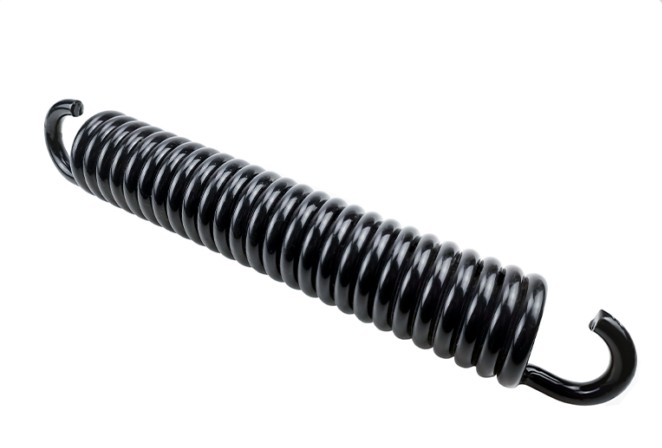
A buyer in the USA needed a deck belt extension spring, a replacement part compatible with John Deere mowing equipment. The replacement spring they had been using lost tension under high-frequency operation, so the deck belt was no longer held tight enough.
Working from the original part’s dimensions, our engineers redesigned the hook form, optimized the initial tension and improved fatigue performance. The spring is made from high-strength spring steel. It passed installation testing on the equipment, and we now supply it as a replacement on a steady basis. Customer details are kept confidential, and the full project is on our extension spring case page. Brand names are used only to identify compatible equipment; NorenSpring is not affiliated with these manufacturers.
The project follows the pattern in the numbers above: the failure showed up as lost tension, and the fix was in the hooks and the initial tension rather than a stiffer spring.
Materials and finishes for deck springs
Deck springs work outdoors in wet grass, fertiliser and washing water, so the finish matters as much as the wire.
| Material or finish | Why it is used | Points to check |
|---|---|---|
| Music wire (ASTM A228) | Highest strength for small diameters; good fatigue life | Needs a protective finish |
| Oil-tempered carbon wire | Economical for larger deck springs | Slightly lower strength than music wire |
| Stainless steel 302/304 | Corrosion resistance without plating | Lower strength, so the spring gets larger for the same force |
| Zinc plating | Common OEM finish with good rust protection | Plated high-strength springs need baking after plating |
| Black coating or paint | Matches the deck; good outdoor protection | Coating thickness changes hook fit on pins |
All of our zinc-plated springs are baked after plating to relieve hydrogen and reduce the risk of embrittlement. Hydrogen embrittlement is the loss of ductility caused by hydrogen absorbed into high-strength steel, often during plating, which can crack a spring under load [5]. See our spring finishes guide for coating choices and how to write them on a drawing.
Signs a deck belt tension spring is worn
- Belt squeal or slipping, especially in wet grass or at the moment the blades engage, which shows the slack-side tension has fallen close to the slip limit.
- Uneven cut or clumping, because blade speed drops under load when the belt creeps on the pulleys.
- Belt jumping off the pulleys, often together with an idler arm that moves freely by hand.
- A spring that is longer at rest than a new one, or coils that stay open with no load, which shows the spring has lost its initial tension.
- Rust pits or a cracked hook, since pits start fatigue cracks; replace a rusted spring even if it still pulls.
To check a spring, measure the length inside the hooks at rest and compare it with a new part, then pull it to its installed length with a spring scale and compare the force. A worn belt also needs replacing, because a new spring cannot make up for a belt that has stretched beyond the idler’s travel.
What to send for a deck spring quote
To quote a new or replacement deck belt tension spring, we need:
- A sample, or a drawing with wire diameter, outside diameter, body length and length inside the hooks.
- Hook form and orientation: machine, crossover or extended hook, and the angle between the two hooks.
- Force at the installed length, and the installed length itself. If you only have a sample, we can measure it.
- Pin and bracket hole sizes the hooks fit on.
- Material and finish, such as zinc, black coating or stainless steel.
- Quantity, with samples first for a fitting and running trial.
We make extension springs with machine, crossover, extended and custom hooks from drawing or sample, and load check them against the agreed control plan. Material certificates and inspection reports are available as agreed at project setup. See our extension springs range and our work for agricultural machinery, read more about us, or send your sample details through our contact page. This guide was compiled by our editorial team with our spring engineers.
Frequently asked questions
What does the spring on a mower deck do?
It pulls the idler arm so that the idler pulley presses on the deck belt and keeps it tight; without that force the belt slips on the pulleys and the blades slow down or stop.
How do I know if my mower deck spring is bad?
Typical signs are belt squeal, slipping in wet grass, an uneven cut, a belt that jumps off, or a spring that is longer at rest than a new one, and you should also check the hooks for cracks and the coils for rust pits.
Can I use a stronger spring on my mower deck?
A stronger spring raises belt tension, but it also increases the load on the spindle bearings, the idler bearing and the belt itself. If the original specification worked when the deck was new, fitting a replacement spring of the same force together with a new belt is usually the better repair.
Why does my new deck belt still slip?
The spring may have lost initial tension, the idler arm may have reached the end of its travel, or the belt and pulley grooves may be worn or glazed. Remember that a wet belt slips at a considerably higher tension than a dry one.
Are mower deck springs extension or torsion springs?
Most are extension springs with hooks, although some decks use a torsion spring at the idler pivot; both do the same job, and both need the force at the working position specified.
References
- Wikipedia, “Capstan equation”. https://en.wikipedia.org/wiki/Capstan_equation
- Wikipedia, “Lawn mower”. https://en.wikipedia.org/wiki/Lawn_mower
- Wikipedia, “Belt (mechanical)”. https://en.wikipedia.org/wiki/Belt_(mechanical)
- Shigley’s Mechanical Engineering Design, Chapter 10 Mechanical Springs, lecture slides, Istanbul Technical University. https://web.itu.edu.tr/~halit/Makel/Ch_10_slides_m.pdf
- Wikipedia, “Hydrogen embrittlement”. https://en.wikipedia.org/wiki/Hydrogen_embrittlement



