










In this article
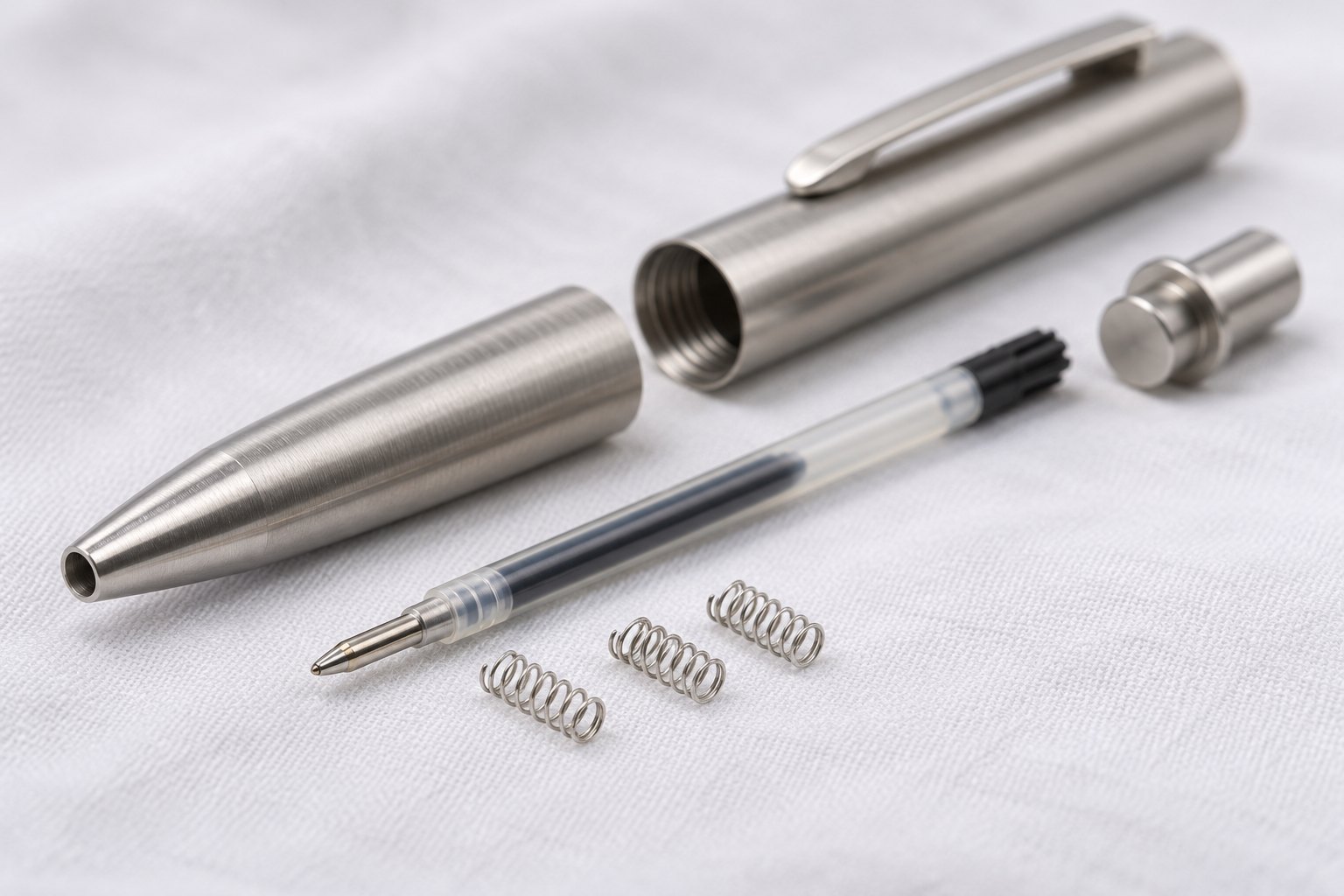
Cover image: an AI-generated illustration of a generic disassembled click pen, based on a photo of small compression springs we make; it does not show a specific product.
A pen spring is the small compression spring that sits around the tip end of the refill in a retractable ballpoint pen and pushes the refill back into the barrel when the pen is clicked off. Wikipedia lists the parts of a click pen as the frame, a thruster, two cams, a guide pin, a spring and the ink cartridge, and notes that the spring provides the tension that retracts the cartridge while the cams hold it in either the retracted or the writing position [1].
This guide is written for pen brands, promotional pen makers, refill producers and stationery part suppliers who buy pen springs by the hundred thousand. It explains what the spring does, works through a sizing example for a spring that fits over a standard G2 refill, shows how sensitive the click force is to wire size and free length, and lists the details that belong on a drawing. For compression spring drawings in general, see our compression spring specification guide.
Key takeaways
- The spring only retracts the refill. The cams carry the writing force; the spring pushes the refill back when the cams release it.
- Fit comes first. The spring’s inside diameter must clear the refill tip, which is up to 2.5 mm wide on a G2 refill, and its outside diameter must clear the barrel bore.
- Wire size controls the force. With the same coil diameter and coil count, going from 0.25 mm to 0.35 mm wire raises the writing-position force in our example from 0.57 N to 2.01 N.
- Free length sets the preload. A ±0.5 mm change in free length moves the retracted force in our example by about ±17 %.
- Stress is not the limit. At full click, our example spring runs at only 0.18 of the wire’s tensile strength, so consistency and fit matter more than strength.
What does a pen spring do?
In a retractable pen, pressing the button pushes the refill forward until the cams lock it with the point out. Pressing again releases the cams, and the spring pushes the refill back inside. Wikipedia describes the cams as a bistable system, with one position for the retracted cartridge and one for the extended cartridge [1]. Because the cams lock the refill in the writing position, the writing pressure goes into the cam and the barrel, not into the spring.
The spring is usually seated between a shoulder on the refill and the inside of the pen’s front section. A refill guide notes, for example, that on one compatible refill the “shoulder that holds the spring” matches the G2 specification [2]. So the refill shoulder, the front section and the spring form one stack, and a change in any one of them changes the force.
| Pen type | Spring role | Typical refill |
|---|---|---|
| Click (push-button) ballpoint | Retracts the refill after each click | G2 (Parker-style), or a proprietary refill |
| Twist-action ballpoint | Holds the refill against the twist mechanism | G2 or D1 |
| Multi-colour pen | One small spring per refill returns the unused refills | D1 mini refills |
| Capped ballpoint | Often no spring | Various |
Refill sizes that set the spring
Ballpoint refills are standardised in ISO 12757; Part 1 covers pens for general use and Part 2 those for documentary use [3]. The ISO 12757-1 abstract states that it sets minimum quality requirements for ball point pens and refills for general use [4]. The two refills most pen springs are built around are:
| Refill | Length | Diameter | Notes |
|---|---|---|---|
| G2, “Parker-style” | 98.1 mm | 6.00 mm (5.8 mm in some sources) | Up to 2.5 mm wide at the tip [2]; front section 23.2 mm long [5] |
| D1, mini | 67.0 mm | 2.35 mm (2.1 mm on some Japanese refills) | Used in multi-pens and compact pens [2] |
Sources differ by a few tenths of a millimetre, so measure the actual refill you design around. The G2 traces back to the Parker Jotter, which was introduced in 1954 [6]. Brand names in this article are used only to identify compatible refills and products; NorenSpring is not affiliated with these manufacturers.
Worked example: sizing a spring for a G2 click pen
We sized a spring to slide over the tip of a G2 refill. The 3.0 mm inside diameter leaves 0.5 mm of diametral clearance over the 2.5 mm maximum tip width. We assumed the pen holds the spring at 15 mm when retracted and that the click moves the refill 4 mm forward. Those two lengths are our modelling choices, not published pen dimensions. We used 302 stainless steel (ASTM A313) and the standard compression spring equations [7].
| Parameter | Value |
|---|---|
| Wire | 0.30 mm 302 stainless, tensile strength about 2,230 MPa |
| Inside / outside diameter | 3.0 mm / 3.6 mm; spring index C = 11.0 |
| Active coils | 12, plus one closed coil at each end |
| Free length | 18.0 mm |
| Spring rate | 0.162 N/mm |
| Retracted length and force | 15.0 mm, 0.49 N preload |
| Writing-position length and force | 11.0 mm, 1.13 N |
| Solid length | 4.2 mm, never reached in the pen |
| Stress at the writing position | 396 MPa, 0.18 of tensile strength |
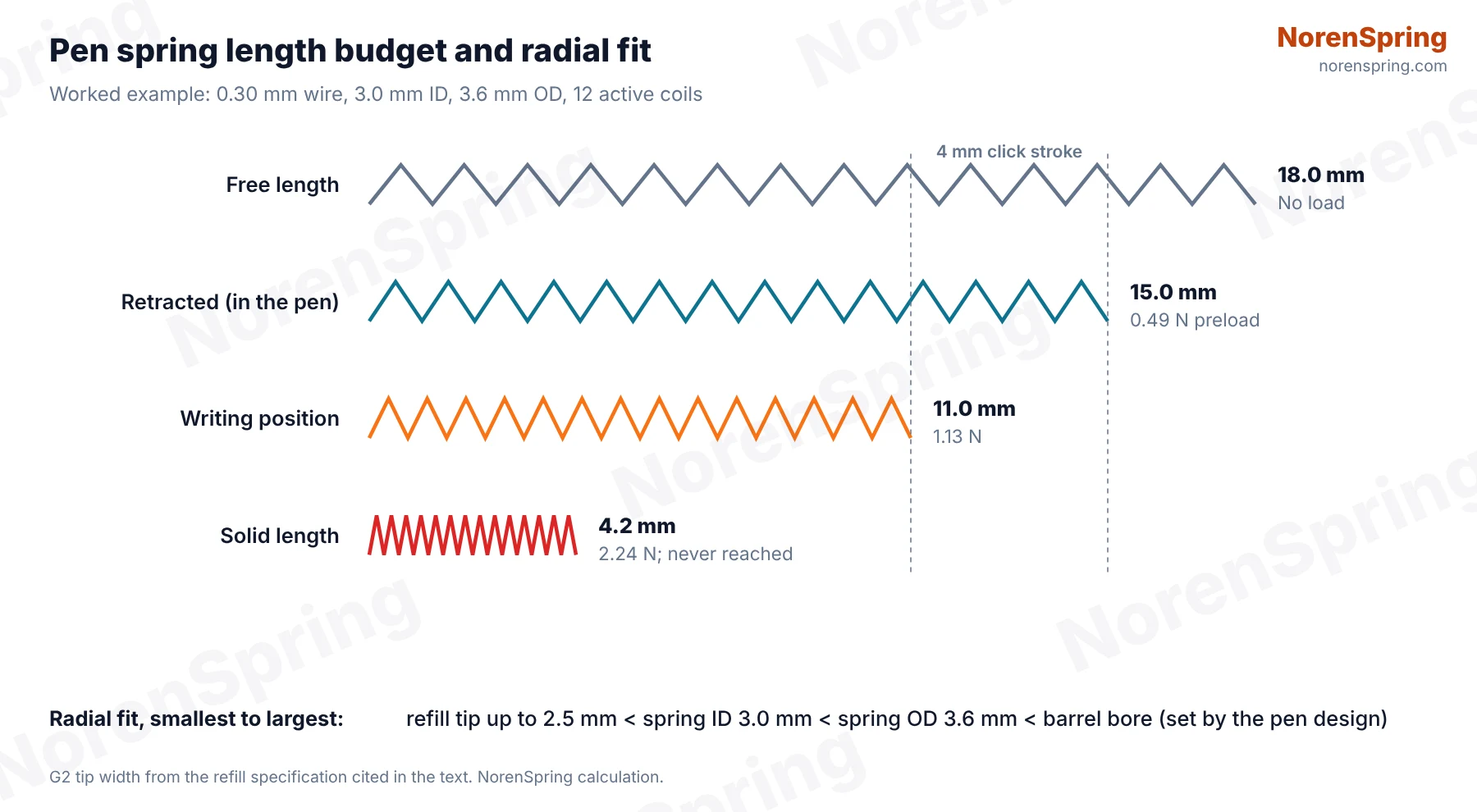
At the writing position, the stress is less than a fifth of the wire strength, so a pen spring like this one is far from any fatigue limit even after a very large number of clicks. The design questions are fit, force and consistency, not strength.
How wire size changes the click force
Spring rate rises with the fourth power of wire diameter [7], so small changes in wire make large changes in force. Keeping the 3.0 mm inside diameter, 12 active coils and 18 mm free length, we compared three wire sizes:
| Wire | Outside diameter | Spring index | Rate | Retracted force | Writing force | Stress / tensile strength |
|---|---|---|---|---|---|---|
| 0.25 mm | 3.50 mm | 13.0 | 0.082 N/mm | 0.25 N | 0.57 N | 0.15 |
| 0.30 mm | 3.60 mm | 11.0 | 0.162 N/mm | 0.49 N | 1.13 N | 0.18 |
| 0.35 mm | 3.70 mm | 9.6 | 0.287 N/mm | 0.86 N | 2.01 N | 0.21 |
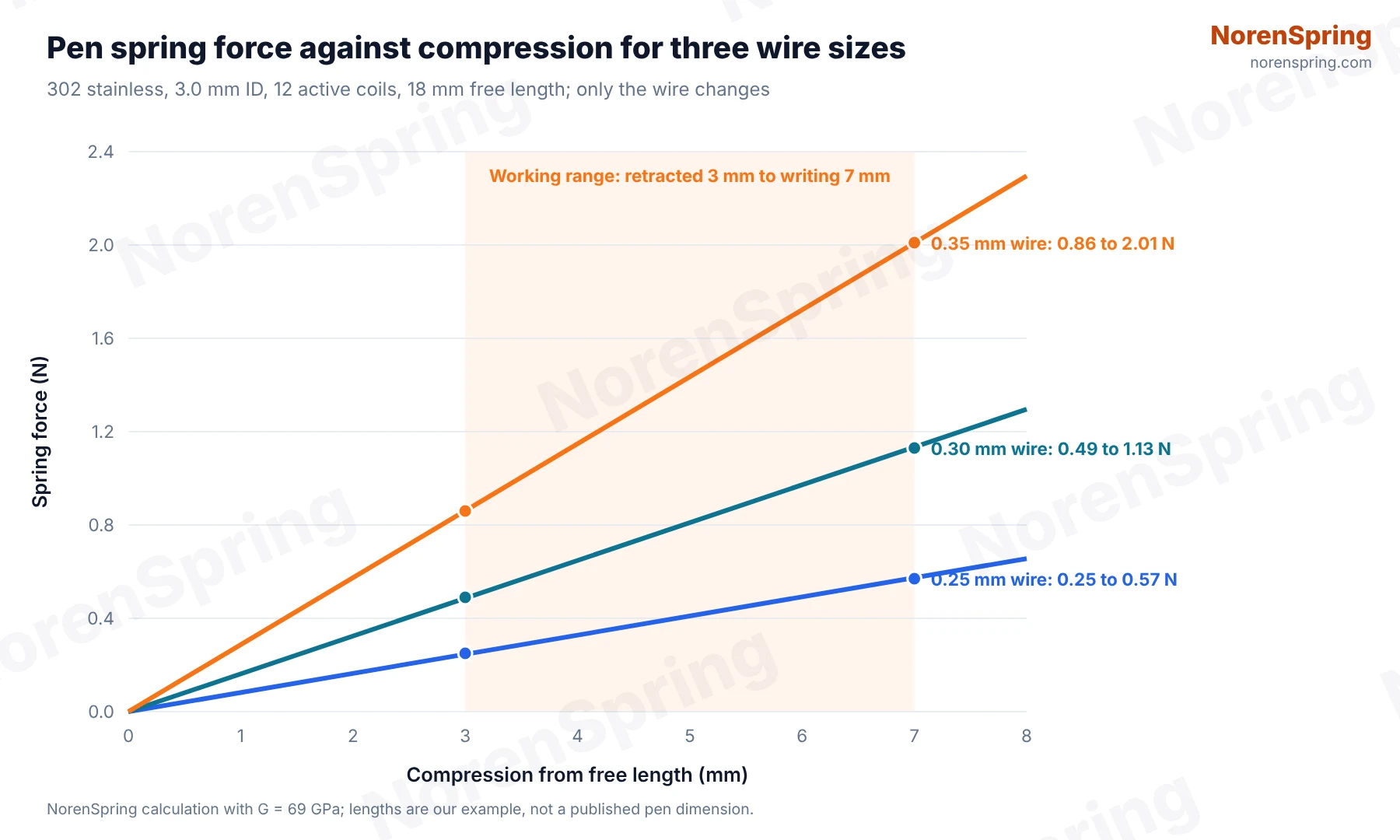
Consequently, a 0.05 mm change in wire roughly doubles or halves the force. The force at the button also includes cam friction, so the spring is only part of what the user feels, but it is the part that varies most from one spring batch to the next.
Tolerances that matter
We varied one dimension at a time from the worked example and recalculated the retracted force at 15 mm (nominal 0.49 N):
| Variation | Rate | Retracted force | Change |
|---|---|---|---|
| Free length 17.5 mm / 18.5 mm | 0.162 N/mm | 0.41 N / 0.57 N | −17 % / +17 % |
| Wire 0.295 mm / 0.305 mm | 0.152 / 0.172 N/mm | 0.46 N / 0.52 N | −6 % / +6 % |
| Mean diameter 3.35 mm / 3.25 mm | 0.155 / 0.170 N/mm | 0.47 N / 0.51 N | −4 % / +5 % |
| Active coils 12.5 / 11.5 | 0.156 / 0.169 N/mm | 0.47 N / 0.51 N | −4 % / +4 % |
| All four at their low / high limits | 0.140 / 0.188 N/mm | 0.35 N / 0.66 N | −28 % / +36 % |
Free length dominates, because a 0.5 mm error is a sixth of the 3 mm preload deflection. Therefore, a drawing that controls force at a stated length, rather than free length alone, gives a more consistent pen. A common approach is to specify the force at the retracted length with a tolerance and give the free length for reference.
Why does a pen spring not buckle?
Our example spring is 18 mm long and 3.3 mm in mean diameter, a slenderness ratio of about 5.5. Shigley’s text puts the stability limit for a spring with both ends fixed at about 5.26 [7], so on its own the spring could bow sideways. In the pen it does not, because the refill tip runs through its middle and acts as a guide rod. That is why the inside-diameter clearance matters: too tight and the spring drags on the tip, too loose and it can bow and rub the barrel. Our article on compression spring buckling explains the check in detail.
Material, finish and spring index
For pen springs, 302 or 304 stainless steel wire is a sound default, because the spring sits near the tip where it meets ink and moisture from the hand; plated music wire is the lower-cost alternative. Our guides to stainless steel springs and music wire springs compare the two.
The spring index also matters in production. Shigley’s text gives a preferred range of about 4 to 12 [7], and our 0.25 mm option at 13.0 sits above it. Springs with a high index are harder to coil to a tight diameter tolerance, and open-ended springs of this size can tangle in bulk packing. Closed ends help with both. Our spring index guide explains the range.
Replacing a lost pen spring
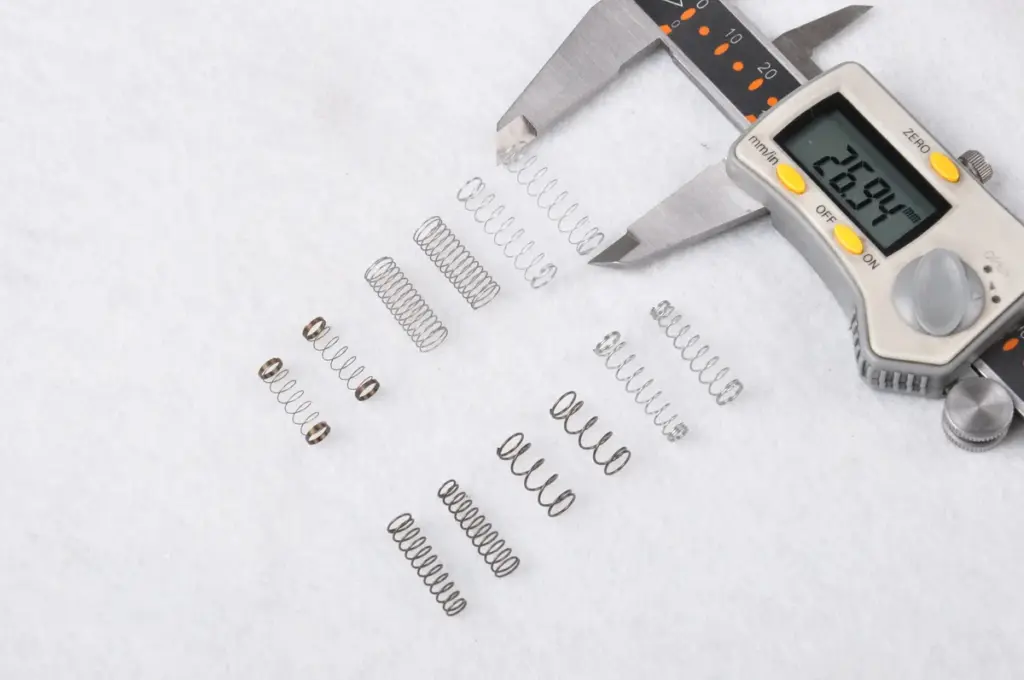
If a pen has lost its spring, measure a matching pen’s spring if one is available: outside diameter, wire diameter, free length and the number of coils. Our guide on how to measure a spring shows each step. The new spring must slide freely over the refill tip and inside the barrel. A spring that is too long can stop the pen from latching, while one that is too short or too weak lets the refill rattle or fail to retract fully. Pen refill guides add that when you measure the refill, you should measure its body, not the spring [8].
What to specify for a pen spring
| Item | Example |
|---|---|
| Refill and pen | G2 refill, tip up to 2.5 mm wide; barrel bore stated |
| Wire | 0.30 mm 302 stainless (ASTM A313), or plated music wire |
| Inside diameter | 3.0 mm, minimum stated so it clears the refill tip |
| Outside diameter | 3.6 mm, maximum stated so it clears the barrel |
| Active coils and ends | 12 active coils, closed (not ground) ends |
| Force at a length | 0.49 N ± 15 % at 15.0 mm |
| Free length | 18.0 mm, for reference |
| Finish | Passivated stainless, or nickel-plated music wire |
| Packing | Bulk with anti-tangle packing, or in trays for automatic assembly |
| Quantity | Annual volume and release size |
Send your drawing, a sample pen or the refill and barrel dimensions through our contact page, and our engineers will review it and reply within 24 hours. Our compression springs page shows the sizes and finishes we make, and you can read more about our company and its certifications. This guide was compiled by our editorial team with our spring engineers.
Frequently asked questions
What size is a pen spring?
There is no single size. The spring has to fit over the refill tip and inside the barrel, so it follows the refill and the pen. For a G2 refill, whose tip is up to 2.5 mm wide [2], our worked example uses a spring with a 3.0 mm inside diameter, a 3.6 mm outside diameter, 0.30 mm wire and an 18 mm free length.
Can I use any small spring in a click pen?
Only if it fits and has a similar force. A spring that is too strong makes the click heavy and can stop the cams from latching; one that is too weak lets the refill rattle. Match the outside diameter, the wire size and the free length of the original spring as closely as you can.
What material are pen springs made of?
Stainless steel such as 302 or 304, or plated music wire, in diameters of a few tenths of a millimetre suits the job. Stainless resists rust from ink and from sweat on the hand.
Does the spring take the writing pressure?
No. In a click pen, the cams lock the refill in the writing position, so the writing pressure goes through the cam and the barrel [1]. The spring only pushes the refill back when the cams release it.
References
- Wikipedia, “Retractable pen”. https://en.wikipedia.org/wiki/Retractable_pen
- Unsharpen, guide to ballpoint refill sizes and specifications. https://unsharpen.com/?p=3248
- Bleistift, “Everything You Always Wanted to Know About Refills”. https://bleistift.blog/2018/02/refills/
- ISO 12757-1:2017, Ball point pens and refills, Part 1: General use (iTeh catalogue page). https://standards.iteh.ai/catalog/standards/iso/a65f0cd4-73e7-4465-86b0-aa8b2e2a0a0c/iso-12757-1-2017
- Stationery Wiki, “G2”. https://stationery.wiki/G2
- Wikipedia, “Parker Jotter”. https://en.wikipedia.org/wiki/Parker_Jotter
- Shigley’s Mechanical Engineering Design, Chapter 10 Mechanical Springs, lecture slides, Istanbul Technical University. https://web.itu.edu.tr/~halit/Makel/Ch_10_slides_m.pdf
- Niche Tools Program, “Pen Refill Compatibility Finder”. https://tools.incoherency.co.uk/pen-refill-compatibility-finder



