










In this article
- Key takeaways
- What is a spring door stop?
- How does a spring door stop work?
- What sets how stiff a door stop spring feels?
- How far can a door stop spring bend and still spring back?
- Why does a spring door stop go “boing”?
- How do wire size, material and finish change a door stop spring?
- What should you specify when sourcing door stop springs?
- FAQ
- Sources
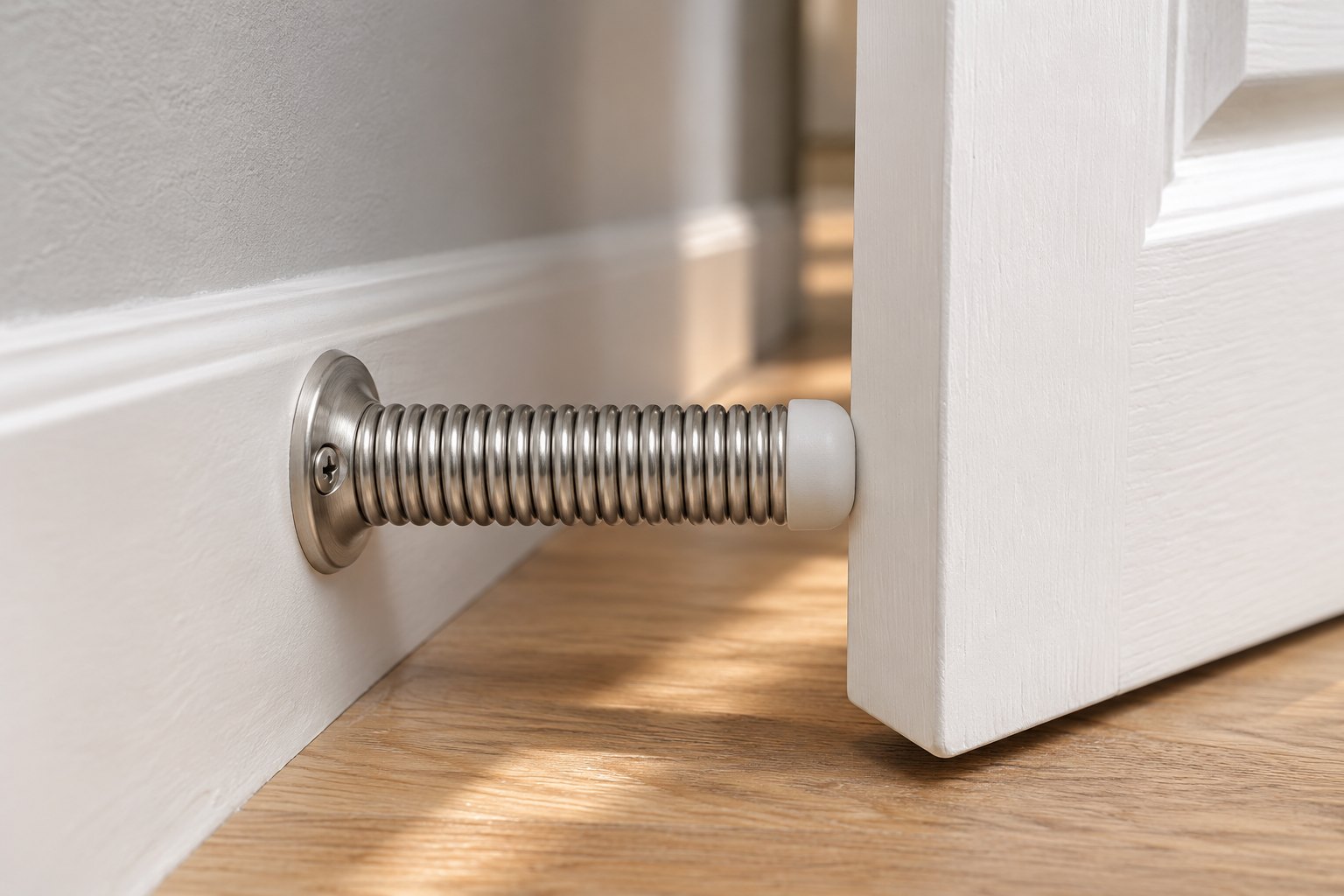
Cover image: an AI-generated illustration of a generic spring door stop, based on a photo of close-wound springs we make; it does not show a specific door stop brand.
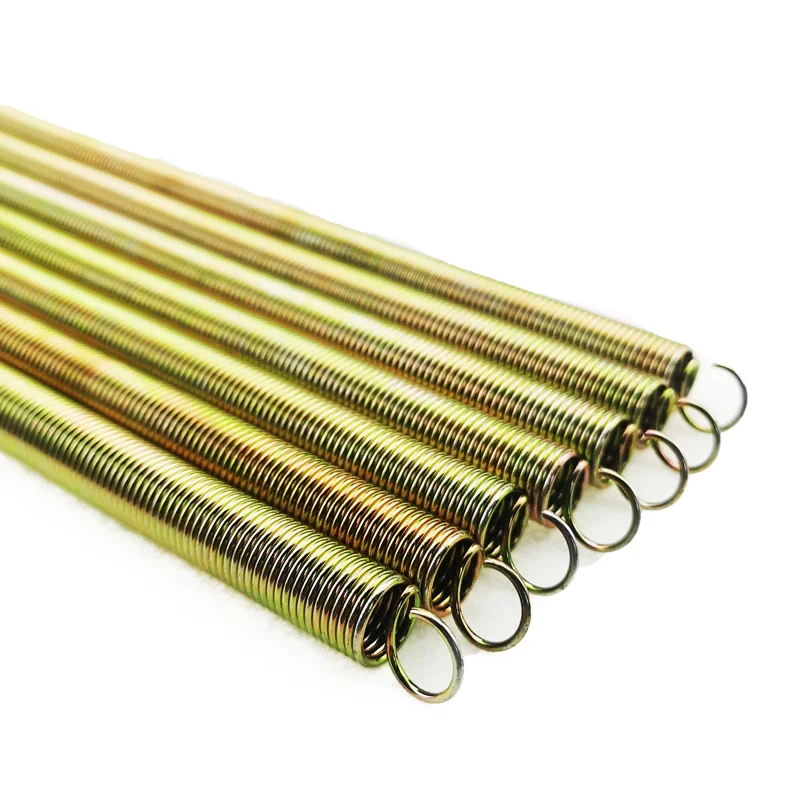
A door stop spring is the short, close-wound coil spring inside a spring door stop: one end is fixed to a metal base that screws into the baseboard, and the other end carries the rubber or plastic tip that the door contacts. One maker’s specification sheet lists stops 3 in, 3-1/8 in and 3-3/4 in long from the wall [2]. The spring is what allows the stop to deflect out of the way of a foot or a vacuum cleaner and subsequently return to its upright position.
This guide is intended for door hardware brands, importers and purchasing engineers who source door stop springs or complete stops. It explains what happens to the spring when a door strikes it, works through the calculations for an example spring and lists the information a drawing should contain. For close-wound springs in general, see our extension spring specification guide.
Key takeaways
- A square hit goes through the coils, not round them. Because the coils of a door stop spring already touch, a door arriving straight onto the tip compresses a solid column of wire, and the rubber tip provides most of the cushioning.
- The spring earns its place on glancing hits. An accidental kick, a vacuum cleaner or a door meeting the tip at an angle deflects the spring sideways, after which it recovers its original position.
- Initial tension sets the feel. In our example spring, initial tension accounts for about two thirds of the side force at 10 mm of tip movement, so two springs coiled from identical wire can behave quite differently.
- A good spring survives being bent flat. In our example, music wire remains elastic down to a centreline bend radius of about 8 mm, whereas laying the 65 mm coil over through 90 degrees requires a radius of only about 41 mm.
- Specify the tension, the wire and the joint. Projection, coil diameter, wire grade, initial tension, finish and the attachment between spring and base all influence how the finished stop performs.
What is a spring door stop?
Wikipedia describes this category of hardware briefly: “Rigid metal springs (also tipped with rubber or plastic) are used to absorb and more widely distribute the kinetic energy of the door swinging” [1]. A typical stop consists of three components.
| Part | What it does | Examples from published specs |
|---|---|---|
| Base and screw | Holds the spring in the baseboard or wall | One spec sheet lists a “#8×3/4″” mounting screw [3]; another stop has a “Screw is fixed to base for one-piece installation” [5] |
| Coil spring | Bends sideways and returns straight | Described as “STEEL SPRING WIRE” [2] or “Steel wire spring with wide base for better support” [6] |
| Tip | Meets the door and protects its face | White or black tips [2]; one retailer notes the “Rubber tip is replaceable” [4] |
The same retailer states that spring door stops “are traditionally used on the baseboards of walls” [4], positioned where the door would otherwise swing into the wall, so the handle never reaches the plaster.
How does a spring door stop work?
It helps to separate two different kinds of contact.
A square hit. When a door swings open, its face approaches the wall almost head-on and meets the tip approximately along the spring’s axis. A close-wound spring has no gaps between its coils and therefore cannot get any shorter, so the force travels through the touching coils into the base and the screw, leaving the rubber tip as the only compliant component. Retail copy says that “The tip and spring of the door stop will help absorb shock upon opening” [4], and for a square hit our reading is that the tip does most of that work.
A glancing hit. If the door meets the tip at an angle, or a foot or vacuum cleaner catches the stop from the side, the spring deflects: the coils separate on the outside of the bend, remain in contact on the inside, and close again once the load is removed. A solid rod stop of identical dimensions would either transmit the entire load into the screw or bend permanently.
How much energy can the spring itself absorb? We compared a typical door with the example spring analysed below, assuming a 15 kg interior door, 0.8 m wide, with the stop positioned so the door meets it 0.7 m from the hinge. Treating the door as a uniform panel, its effective mass at that point is about 6.5 kg, so a door arriving at 1 m/s carries about 3.3 J, whereas deflecting our example spring sideways by 20 mm stores less than 0.05 J, under 2 % of that energy. A spring door stop is therefore a flexible mounting for a tip rather than a shock absorber in the sense of a damper or buffer.
What sets how stiff a door stop spring feels?
The answer is mostly initial tension. When a close-wound spring is coiled, the coils are pressed together with a locked-in force. Shigley’s design notes describe how “Initial tension is created by twisting the wire as it is wound onto a mandrel” and add that “Including some initial tension in close-wound springs helps hold the free length more accurately” [7]. In a door stop, this locked-in force performs two functions simultaneously: it keeps the coil straight, and it determines the side force required before the coils begin to separate.
Because retail specification sheets do not publish wire sizes, we modelled an example spring using assumed dimensions chosen to match a typical 3-1/8 in stop:
| Example spring (assumed) | Value |
|---|---|
| Free coil length from base to tip | 65 mm |
| Coil OD | 10.0 mm |
| Wire | 1.6 mm music wire (ASTM A228) |
| Mean diameter and spring index | 8.4 mm, index 5.25 |
| Initial tension, middle of Shigley’s preferred range | 25.5 N (range 20.7 to 30.3 N) |
Our calculation method treats the coils as pivoting on their contact points on the inside of the bend, so each opening gap is resisted by the spring’s axial rate plus its initial tension. That approach gives a bending stiffness of G·d⁵/(32·D) and a threshold moment of initial tension × D/2 before any coil separates. As a cross-check, Wahl’s open-coil formula for a helical spring treated as a beam gives a bending stiffness approximately 13 % higher, so the two approaches agree reasonably closely.
With a side load at the tip, the results for the example spring are:
- No visible deflection occurs until the tip load reaches about 1.65 N, at which point the coils nearest the base begin to separate.
- At 10 mm of tip movement the side force is approximately 2.4 N, rising to approximately 2.9 N at 20 mm.
- Of the 2.4 N required at 10 mm, approximately 1.65 N (two thirds) originates from initial tension rather than from the wire’s stiffness.
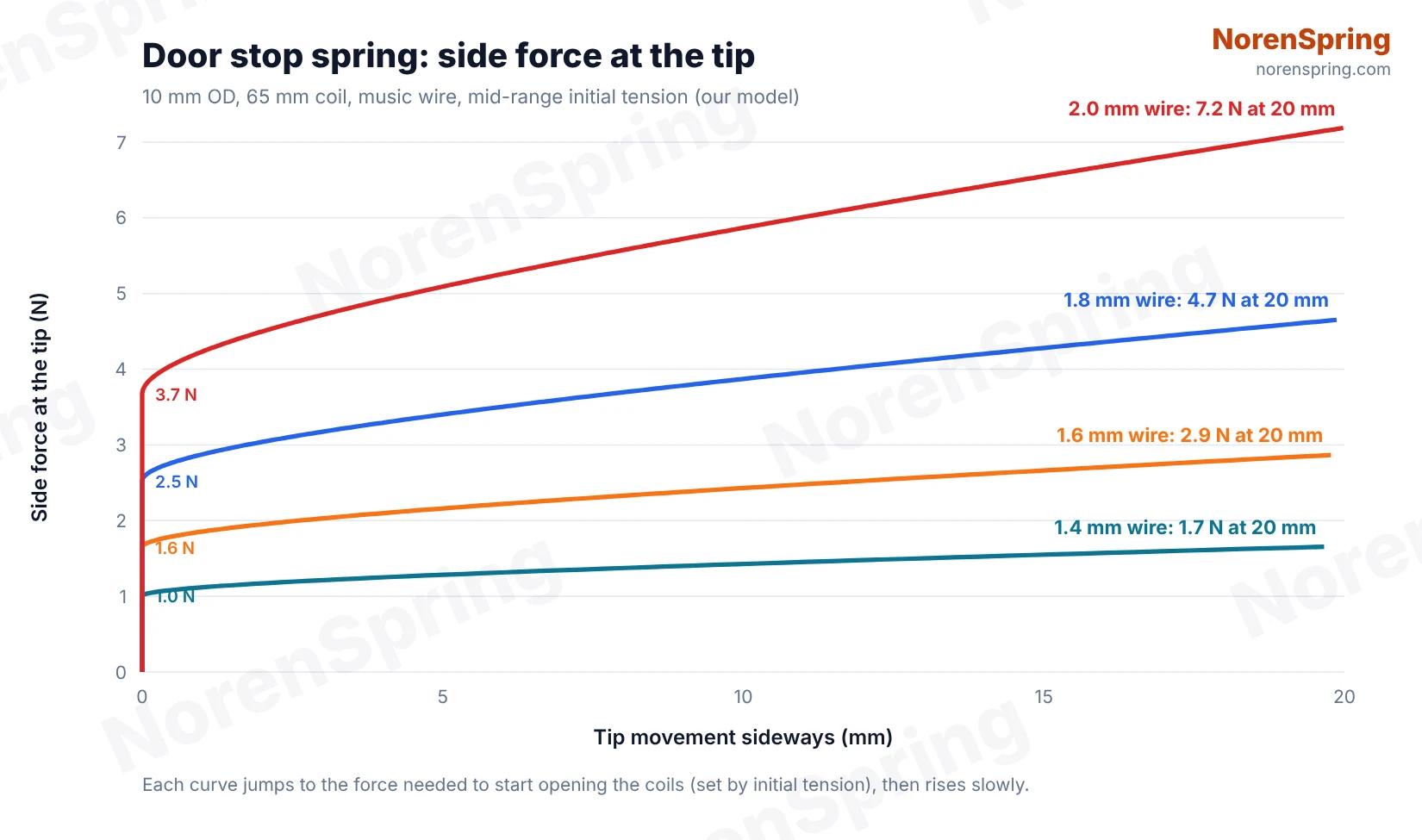
Two conclusions follow for anyone preparing a specification. First, wire diameter has a strong influence: moving from 1.6 to 1.8 mm wire on the same outside diameter raises the side force at 10 mm from 2.4 to 3.9 N. Second, initial tension matters even when the wire is fixed, because across Shigley’s preferred range for our example (20.7 to 30.3 N), the force at 10 mm varies from 2.1 to 2.8 N, approximately ±15 %. If a buyer expects every production batch to feel identical, the drawing needs an initial tension value with a tolerance, not only a wire size.
How far can a door stop spring bend and still spring back?
Considerably further than most people expect. When the coil bends, the wire in each coil is twisted, so the practical limit is the wire’s allowable torsional stress. Shigley’s Table 10-7 gives static limits of 45 to 50 % of tensile strength for the body of carbon steel springs and 35 % for austenitic stainless, but adds: “For springs that require high initial tension, use the same percent of tensile strength as for end” [7]. A door stop depends on its initial tension, so we used the end values, 40 % for music wire and hard drawn wire and 30 % for 302 stainless, with the Wahl correction. Tensile strengths come from the standard minimum curves for each wire at 1.6 mm.
The result is the tightest radius the coil’s centreline can be bent to before the wire starts to yield:
| Wire, 1.6 mm (example spring) | Minimum tensile strength | Tightest elastic bend radius |
|---|---|---|
| Music wire, ASTM A228 | 2,065 MPa | 7.6 mm |
| Hard drawn, ASTM A227 | 1,631 MPa | 10.4 mm |
| 302 stainless, ASTM A313 | 1,743 MPa | 14.2 mm |
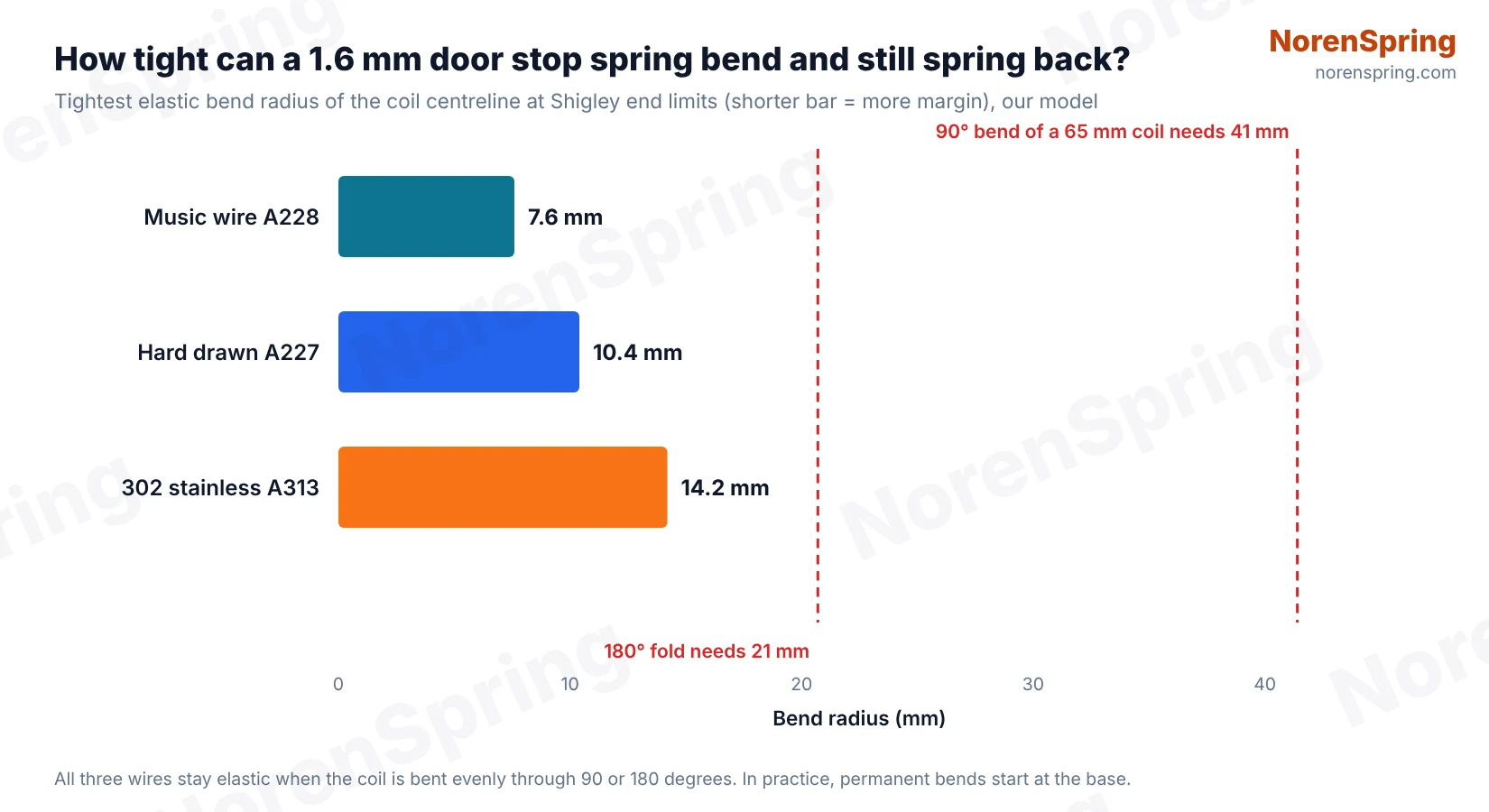
Bending the 65 mm coil evenly through 90 degrees requires a centreline radius of about 41 mm, and folding it completely back through 180 degrees requires about 21 mm. All three materials remain within their elastic limit in both situations, which explains why a well-made door stop can be stepped on and still recover its upright position.
In practice, the vulnerable location is the base. Because the end coils are restrained by the base, the coil cannot bend uniformly there, and the curvature concentrates in the first unsupported coils, which is where a stop that has taken a permanent set is usually bent. Two design details help: a base that supports the bottom coils over a short distance rather than gripping them at a sharp edge, and a wire with high strength for its diameter, where music wire provides the greatest margin in our example.
The mounting screw experiences less load than many people assume. At 20 mm of tip movement, the bending moment at the base of our example spring is only about 0.21 N·m; a door striking the tip squarely loads the screw in compression through the coils, and only a heavy sideways kick generates significant pull on the screw.
Why does a spring door stop go “boing”?
Flick the tip and the spring vibrates. For our example spring, with an assumed 1.5 g tip, the first bending mode is approximately 12 Hz, a visible oscillation that remains inaudible because it falls below the usual lower limit of human hearing, about 20 Hz [8]. The audible note therefore originates elsewhere, most likely from the coils colliding each time the gaps close on the inside of the swing. A thicker wire raises the vibration frequency (approximately 21 Hz for 2.0 mm wire in the table below) and reduces the amplitude.
If a stop is intended to be quiet, the available adjustments are a softer tip, a higher initial tension that keeps the coils closed for longer, and a finish that does not rattle. For the theory behind the frequency, see our spring natural frequency guide.
How do wire size, material and finish change a door stop spring?
Here is the same 10 mm OD, 65 mm coil in four wire sizes, music wire, mid-range initial tension:
| Wire | Spring index | Initial tension | Side force to start bending | Side force at 10 mm | Tightest elastic bend radius | First wobble frequency |
|---|---|---|---|---|---|---|
| 1.4 mm | 6.1 | 15 N | 1.0 N | 1.4 N | 5.2 mm | 9 Hz |
| 1.6 mm | 5.3 | 26 N | 1.7 N | 2.4 N | 7.6 mm | 12 Hz |
| 1.8 mm | 4.6 | 40 N | 2.5 N | 3.9 N | 10.8 mm | 16 Hz |
| 2.0 mm | 4.0 | 60 N | 3.7 N | 5.9 N | 15.1 mm | 21 Hz |
A thicker wire produces a stiffer, quieter stop that still recovers from a 90 degree bend in every case shown, although the resulting lower spring index makes consistent initial tension more difficult to achieve during coiling.
Material. Shigley’s notes describe music wire as “Best, toughest, and most widely used for small springs” [7], and it has the highest tensile strength of the carbon spring wires at a given diameter; see our music wire springs guide. Stainless steel suits bathrooms and humid locations, but in our comparison it needs approximately 1.9 times the bend radius of music wire before yielding, which leaves less margin when the stop is kicked flat. Our stainless steel springs guide covers the grades.
Finish. Door stops are sold as decorative hardware, and one spec sheet lists oil rubbed bronze (10B), satin nickel (15), nickel, black, polished chrome and satin chrome finishes [2]. Electroplating high-strength spring wire introduces a risk of hydrogen embrittlement, so the drawing should specify baking after plating. Our spring finishes guide explains the options.
What should you specify when sourcing door stop springs?
For a door stop spring, or a complete stop manufactured to your design, these are the items we would expect on the drawing or purchase specification:
- Projection and coil length. The overall projection from the wall (for example 3-1/8 in), together with the free coil length between base and tip.
- Coil OD and wire diameter. These dimensions determine stiffness and must correspond to the base and tip bores.
- Wire grade. For example ASTM A228 music wire or ASTM A313 302 stainless.
- Initial tension with a tolerance, or alternatively a side-force check such as the tip force at 10 mm of sideways movement, which is what keeps successive batches consistent.
- Straightness. How far the tip may sit off the base axis with no load.
- The joint to the base and the tip. The method of fixing the end coils, with a minimum pull-off force for both the base and the tip.
- Finish and baking. The finish code to match your hardware range, plating thickness, baking after plating and any salt spray requirement.
- A bend-back test. For example: bend the tip through 90 degrees in four directions, release, and check that it returns within the straightness limit.
- Packing. Published specs show case quantities such as 50 per case [2] and 75 per box [3].
The same Design House specification sheet lists “ANSI/BHMA N/A” [3], so for that product the buyer’s own specification is the only applicable standard, which makes a written side-force and bend-back requirement particularly important.
Related door hardware springs are covered in our guides to hinge springs and screen door springs.
Send your drawing, a sample stop or your target dimensions through our contact page, and our engineers will review it. Our extension springs page shows the close-wound springs and finishes we make, and you can read more about our company and its certifications. This guide was compiled by our editorial team with our spring engineers.
FAQ
What is a door stop spring made of?
Usually steel spring wire. Published specs describe it as “STEEL SPRING WIRE” [2], plated to match the door hardware. Music wire gives the most strength for its size; 302 stainless resists corrosion but is weaker at the same size.
How long is a spring door stop?
Published projections include 3 in, 3-1/8 in and 3-3/4 in [2]; choose a projection long enough that the door stops before its handle reaches the wall.
Does the spring absorb the shock of the door?
Only partially. On a square hit the close-wound coils behave as a solid column and the rubber tip provides most of the cushioning, while the spring’s function is to deflect during glancing hits and kicks before returning straight. In our example it can store under 2 % of the energy of a door arriving at 1 m/s.
Why did my spring door stop bend and stay bent?
The coil can bend a considerable distance elastically, but the curvature concentrates immediately above the base, where the end coils are restrained, and a heavy kick or a weaker wire can take a permanent set there. A stop combining stronger wire with a base that supports the bottom coils gradually is less likely to remain bent.
Can a door stop spring be made stiffer without changing its size?
Yes, within limits. Raising the initial tension stiffens the beginning of the bend, and a slightly thicker wire on the same outside diameter increases stiffness throughout; in our example, changing from 1.6 to 1.8 mm wire raises the side force at 10 mm from about 2.4 to 3.9 N.
Sources
- Wikipedia, “Doorstop”. en.wikipedia.org/wiki/Doorstop
- Taymor, “Steel Spring Door Stop” specification sheet (US). taymor.com
- Design House, “Door Hardware Spring Door Stop” specification sheet. homedepot-static.com
- Lowe’s, RELIABILT 3-3/4 in spring door stop product page. lowes.com
- Zoro, Hardware Resources 3 in nickel spring door stop DS05-NI. zoro.com
- Zoro, National Hardware N184-291 spring door stop. zoro.com
- Shigley’s Mechanical Engineering Design, chapter 10 lecture slides (mechanical springs), Istanbul Technical University. web.itu.edu.tr
- Wikipedia, “Hearing range”. en.wikipedia.org/wiki/Hearing_range



