










In this article
Cover image: an AI-generated illustration of a generic screen door with a door spring, based on a photo of extension springs we make; it does not show a specific product.
A screen door spring is a long, close-wound extension spring fitted across the hinge side of a door, with one end hooked onto the door frame and the other onto the door itself. When the door opens, the spring stretches, and its tension then swings the door shut again. At the other end of the swing, a spring door stop keeps the door off the wall. Hardware maker Prime-Line describes its wood screen door springs this way: tempered spring wire with closed loops at each end, plus two anchor hooks to attach the spring to the door and the jamb [1].
This guide is written for door hardware brands, screen and storm door manufacturers and replacement part suppliers who purchase door closer springs. It calculates the closing torque of a typical door spring, demonstrates why the mounting position matters more than the spring itself, explains the function of the spring in a storm door chain, and lists the specifications that belong on a drawing. For the springs that hold up a sliding window sash, see our window balance springs guide. For extension spring drawings in general, see our extension spring specification guide.
Key takeaways
- The lever arm does most of the work. In our worked example, moving the frame end of the spring from 60 to 120 mm deep doubles the closing torque at the latch, from 1.32 to 2.64 N·m, with the same spring.
- The pull is weakest where the door needs it most. The spring force rises as the door opens, but the lever arm falls faster, so the torque at 90° is lower than at 40°.
- Past a certain angle, the spring holds the door open. Our two layouts reach zero torque at 109.4° and 102.5°.
- A plain spring slams the door. Released from 90°, our example door reaches the latch at 1.5 to 2.1 m/s if nothing slows it.
- The spring in a storm door chain is a shock absorber. It can cut the peak chain force by a factor of ten in a gust.
What is a screen door spring?
Most screen door springs are long close-wound extension springs with a loop at each end, and the loops hook onto screw eyes or anchor hooks, one on the door and one on the frame. Prime-Line, for example, lists five wood screen door springs in its replacement range. All are 16-3/8 in long, with wire from 0.050 in to 0.065 in and diameters from 5/16 in to 15/32 in [2]. The same listing includes an adjustable storm or screen door spring that adjusts from 13-1/2 in to 16-1/2 in [2].
Storm doors, however, usually use a cylinder closer instead. A home repair guide explains that a spring inside the closer does the actual closing, and that air or oil controls how fast it moves; without that control the door would swing shut wildly, as the old-time springs still used on some wooden doors and gates do [3]. Consequently, the exposed screen door spring and the spring concealed inside a storm door closer perform the same job, except that the closer adds controlled damping and the plain spring does not. A garden gate does the same job with an extension spring, and our gate spring sizing guide works out how much pull a self-closing gate needs.
| Type | Spring | Where it is used | Damping |
|---|---|---|---|
| Screen door spring | Long close-wound extension spring with loops | Wood screen doors, gates, sheds | None |
| Adjustable door spring | Extension spring with an adjustable hook or rod | Screen and storm doors | None |
| Pneumatic or hydraulic closer | Spring inside a cylinder | Storm doors, lighter entry doors | Air or oil, adjustable |
| Spring hinge | Torsion spring inside the hinge | Self-closing doors and gates | None, or a separate damper |
| Chain and spring | Short extension spring in the stop chain | Storm doors | Absorbs the shock at full opening |
Spring hinges work on a different principle, using a torsion spring wound around the hinge pin; our article on hinge springs covers their design in detail.
Worked example: how much torque does a screen door spring give?
We modelled a common size of door spring: 0.060 in (1.52 mm) wire, 13/32 in (10.3 mm) outside diameter and 16-3/8 in (416 mm) long, close-wound. Those are the published dimensions of one retail screen door spring, which lists a maximum safe load of 19.60 lb [1]. The rate and initial tension are our own estimates, from the standard extension spring equations [4] with music wire and a typical initial stress. They are not published figures.
| Parameter | Value |
|---|---|
| Wire | 1.52 mm (0.060 in) music wire, tensile strength about 2,080 MPa |
| Outside diameter | 10.3 mm (13/32 in); spring index C = 5.8 |
| Body | 416 mm long, about 271 active coils, close-wound |
| Spring rate (estimated) | 0.29 N/mm (1.7 lb/in) |
| Initial tension (estimated) | 19 N, from a 120 MPa initial stress |
| Stretch at the listed maximum safe load (87 N) | About 235 mm |
| Stress at 87 N | Coil body 0.34 and hook 0.63 of tensile strength |
Therefore, the listed safe load sits comfortably inside the wire’s strength, even at the hook, and in normal operation the spring stretches far less than 235 mm.
Door and mounting
The door in our model is 813 mm (32 in) wide and 30 mm thick, weighs 7 kg and swings outward, with the spring running across the hinge side on the inside face. Its door end sits about 480 mm from the hinge, so the spring is already stretched 10 mm when the door is closed. We compared two positions for the frame end, 60 mm and 120 mm deep on the hinge jamb measured from the hinge axis, and in both cases the frame end stands 15 mm off the jamb. These dimensions are modelling choices, not a published installation standard.
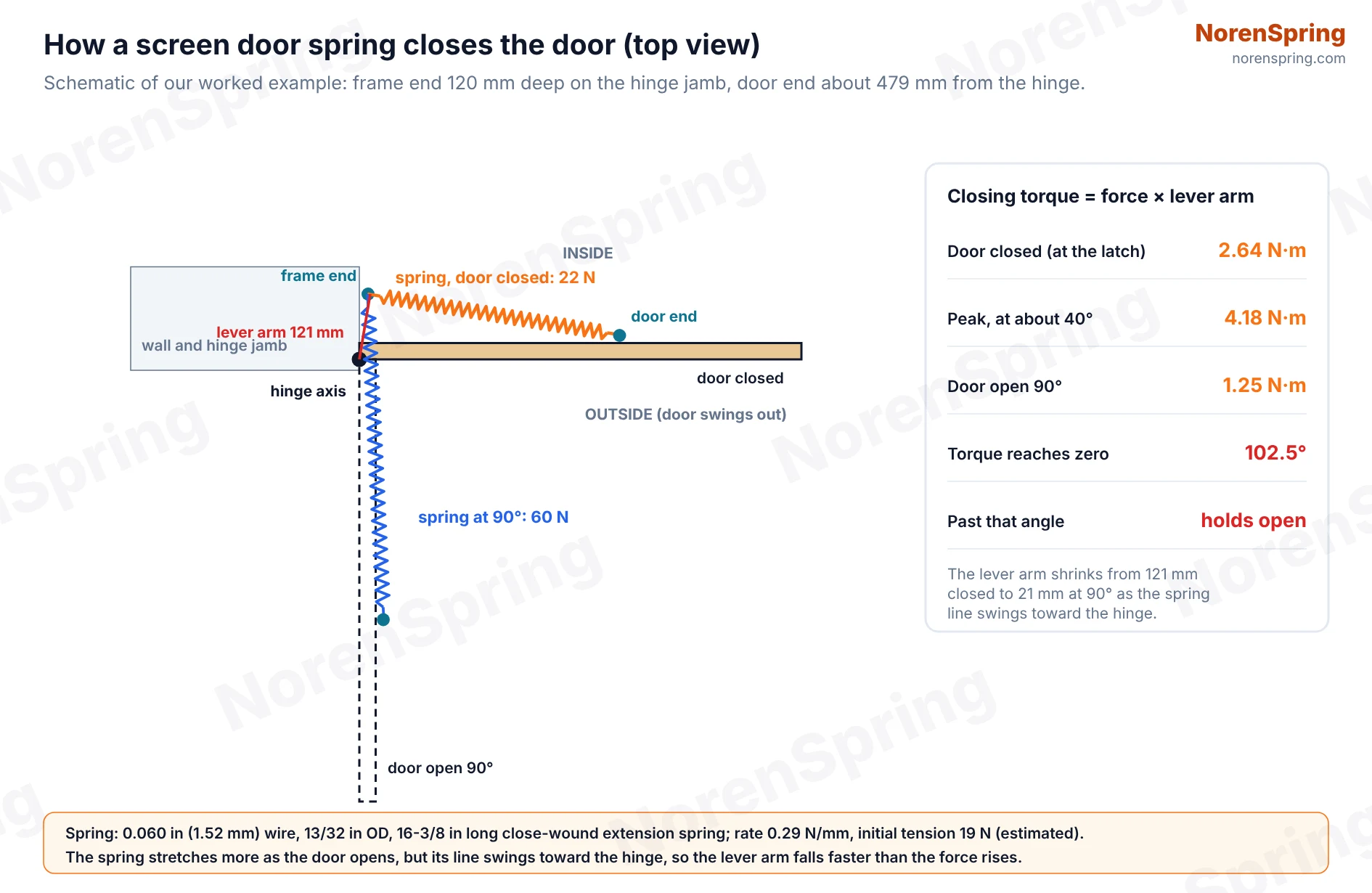
The closing torque equals the spring force multiplied by its lever arm, which is the perpendicular distance from the hinge axis to the line of the spring. The calculation gives the following results for both mounting positions:
| Opening angle | Spring force, 60 mm frame end | Torque, 60 mm frame end | Spring force, 120 mm frame end | Torque, 120 mm frame end |
|---|---|---|---|---|
| 0° (latch) | 21.9 N | 1.32 N·m | 21.9 N | 2.64 N·m |
| 20° | 28.1 N | 1.72 N·m | 33.8 N | 3.81 N·m |
| 40° | 34.0 N | 1.87 N·m | 44.4 N | 4.18 N·m |
| 60° | 39.0 N | 1.69 N·m | 52.6 N | 3.59 N·m |
| 90° | 43.8 N | 0.80 N·m | 59.5 N | 1.25 N·m |
| 100° | 44.5 N | 0.40 N·m | 60.1 N | 0.25 N·m |
| Torque reaches zero | 109.4° | 102.5° |
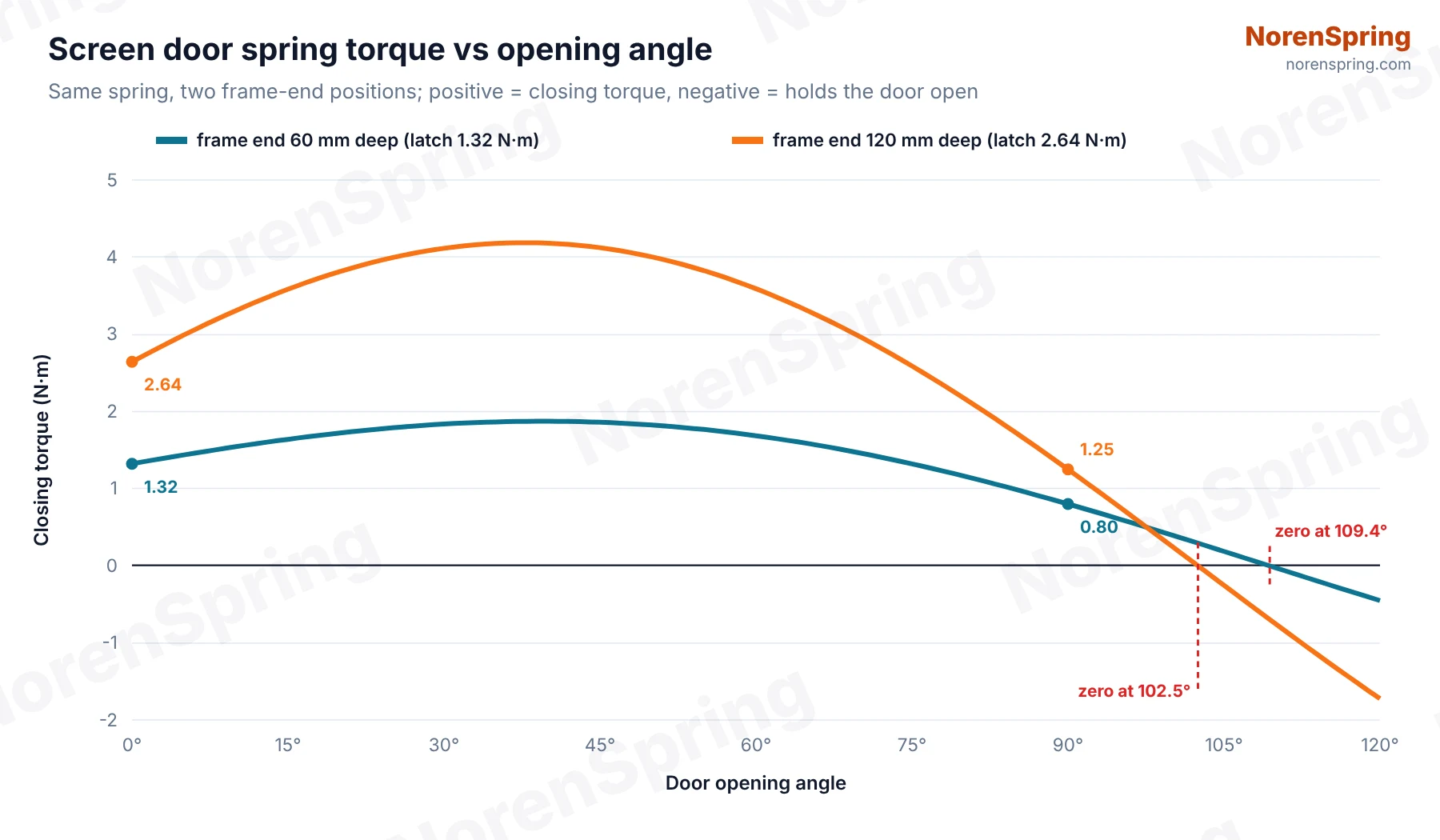
Three lessons follow from the table:
- Mounting position beats spring strength. The deeper frame end doubles the lever arm at the latch, from 60 mm to 121 mm, so the same spring delivers twice the latching torque. In contrast, a stronger spring in the shallow position would add force, but it would also add stretch and stress for the same result.
- The spring line swings toward the hinge. As the door opens, the line of the spring moves progressively closer to the hinge axis; at 90° the lever arm in the deeper layout is only 21 mm, so the torque falls to 1.25 N·m even though the force has risen to 60 N.
- There is an over-centre angle. When the spring line passes through the hinge axis, the torque becomes zero, and beyond that position the spring actually pulls the door further open. In our layouts this happens at 109.4° and 102.5°, so a door stop or chain positioned before that angle prevents the door from staying open.
Why a plain door spring slams the door
All the energy stored in the spring returns to the door as it closes. From 90°, our spring releases 2.48 J in the shallow layout and 5.28 J in the deep one, so with no friction and no damper the 7 kg door would reach the latch at 1.46 m/s and 2.13 m/s respectively at its outer edge. Hinge friction absorbs some of that energy, but the spring alone has nothing to slow the final few degrees of travel.
This is the fundamental trade-off for a door spring: more latching torque means more stored energy and a harder slam. For a quiet door, therefore, specify the spring for the latching torque you actually need and no more, and add a damper or use a pneumatic closer wherever the door must close softly. The cylinder closer described above exists for exactly this reason [3].
The spring in a storm door chain
A storm door chain prevents the door from blowing past its full opening position. The home repair guide puts it bluntly: the chain stops the door from over-opening, and enough force can even rip the jamb bracket right out of the door jamb [3]. For that reason, many chains include a short extension spring.
We estimated the effect of that spring for a typical case. Consider an 18 kg storm door, 914 mm (36 in) wide, caught by a gust so that it is rotating at 2 rad/s when the chain becomes tight; this speed is our assumption, not a measured gust. The door then carries 10 J of kinetic energy, which the chain assembly must absorb.
| Chain | Stiffness along the chain | Peak force | Stretch |
|---|---|---|---|
| With our chain spring | 3.04 N/mm | 247 N | 81 mm |
| Plain chain, brackets and screws (assumed) | 300 N/mm | 2,453 N | 8 mm |
Peak force increases with the square root of stiffness, so a connection one hundred times softer produces one tenth of the force. The spring we sized for this duty uses 3.0 mm music wire with a 23 mm outside diameter, 33 active coils and a 102 mm body, and at 247 N it operates at 0.30 of tensile strength in the coils and 0.57 at the hooks. A stronger gust raises those numbers, so the spring also needs a positive stop, usually the chain itself, before it overstretches.
What to specify for a screen door spring
Extension springs for doors fail in predictable ways: hooks crack at the bend, the spring takes a permanent set and no longer closes the door, or the plating deteriorates outdoors. A drawing that controls those characteristics prevents most warranty returns. The same hook check decides the life of the pair of springs on a folding loft stair, which our attic ladder springs guide works through.
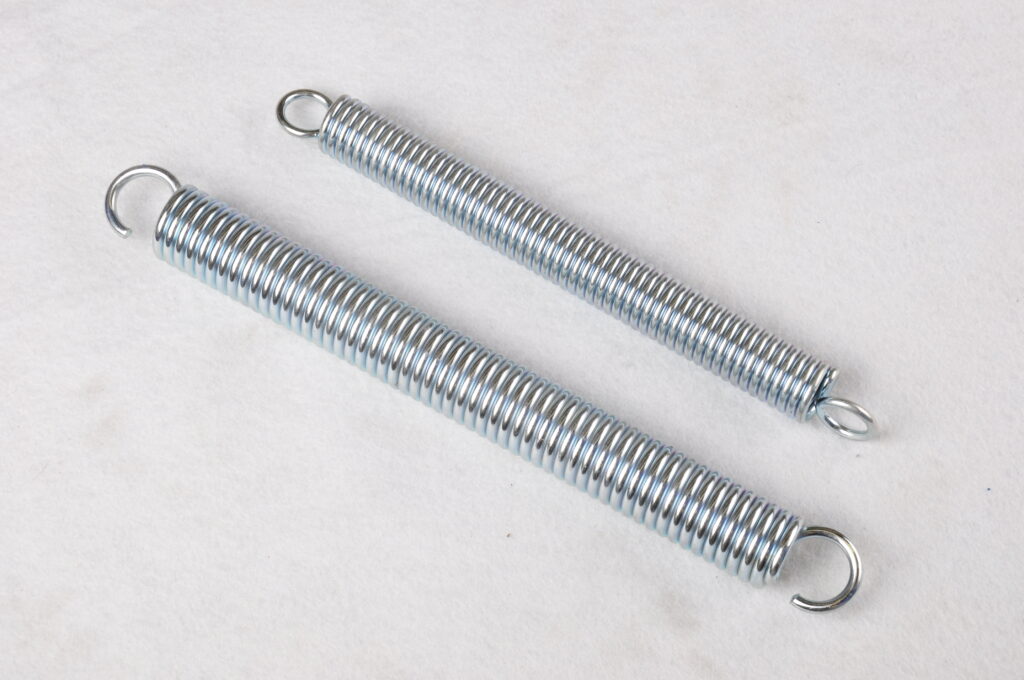
The photo shows extension springs we make. We make extension springs with full loops, extended hooks and plated or coated finishes, from fine wire upward. Brand names in this article identify the companies whose public documents we quote; NorenSpring is not affiliated with them.
| Item | Example |
|---|---|
| Use | Wood screen door, outward swing, 813 mm wide, about 7 kg |
| Mounting | Frame end 120 mm deep on the hinge jamb, door end about 480 mm from the hinge |
| Wire and material | 1.52 mm (0.060 in) music wire, or stainless for coastal use |
| Outside diameter | 10.3 mm (13/32 in) |
| Length inside loops | 416 mm (16-3/8 in), with tolerance |
| Ends | Closed loops, in line, with anchor hooks or screw eyes |
| Initial tension | 19 N ± 20 %, or as specified |
| Force at a length | For example, 22 N at the closed length and 60 N at the 90° length |
| Finish | Zinc or nickel plate, baked after plating, or black coating |
| Packing | With or without anchor hooks and screws |
Two forces at two lengths matter more than the nominal rate, so specify the spring length with the door closed and fully open, together with the force required at each position. If you have a sample instead of a drawing, our guide on how to measure a spring shows how to take its dimensions.
Initial tension and finish
Close-wound door springs are manufactured with initial tension, a force that holds the coils together before they start to separate. Shigley shows that it is created by twisting the wire as it is wound onto a mandrel [4]. In a door spring it provides latching force with very little stretch, which is useful; however, it also varies more from spring to spring than the rate does, so it deserves its own tolerance on the drawing. Our article on spring preload explains how initial tension and preload differ.
Outdoor door springs also need corrosion protection. Zinc plating is common, and plating on high-strength wire must be followed by baking to avoid hydrogen embrittlement; our spring finishes guide compares the available options, and all our zinc-plated springs are baked after plating.
Frequently asked questions
How do I choose a screen door spring?
Start from the force you need at the latch and the mounting points you have. For a light wood screen door, a 16-3/8 in spring with 0.050 to 0.065 in wire is a typical retail size [2]. Measure the distance between the screw eyes with the door closed and fully open; the spring must reach the first and survive the second.
Why won’t my screen door latch?
Usually the closing torque at the latch is too low. In our worked example, moving the frame end of the spring from 60 to 120 mm deep doubled the latching torque without changing the spring. A worn spring that has taken a set will also lose force; check whether its coils still close fully when it is unloaded. The latch bolt spring adds its own resistance at that point, and our door latch springs guide calculates it for three bevel angles.
Why does my screen door slam?
A plain door spring has no damping, so all its stored energy goes back into the door. In our example a 7 kg door reaches the latch at 1.5 to 2.1 m/s. Use the lightest spring that still latches the door, or add a pneumatic closer.
What is the spring in a storm door chain for?
It absorbs the shock when wind or a push swings the door to the end of its chain. In our estimate, a 3 N/mm spring cuts the peak force on the chain and jamb bracket from about 2,450 N to about 250 N.
Send us your door spring drawing
Whether you need a replacement door spring, a chain spring or a closer spring, the essential inputs are identical: the forces at two lengths, the wire and finish, and the end configuration. Send your drawing or sample through our contact page, and our engineers will review it and reply within 24 hours. You can read more about our company and its certifications. This guide was compiled by our editorial team with our spring engineers.
References
- Prime-Line, “Wood screen door closer extension spring, 0.060 GA x 13/32 in. x 16-3/8 in., SP 9642”. https://www.primelineparts.com/wood-screen-door-closer-spring-13-32-inches-in-diameter-pack-of-1-c0gl
- Prime-Line, “Swinging screen door hardware: spring” (product listing). https://primelineparts.com/categories/repair-replacement-parts/swinging-screen-door-hardware/spring
- The Natural Handyman, “Storm door installation, repair and adjustment”. https://www.naturalhandyman.com/iip/infxtra/infsto.html
- Shigley’s Mechanical Engineering Design, Chapter 10 Mechanical Springs, lecture slides, Istanbul Technical University. https://web.itu.edu.tr/~halit/Makel/Ch_10_slides_m.pdf



