










In this article
- Key takeaways
- What do attic ladder springs do?
- How much force does an attic ladder spring carry?
- Why are attic ladder replacement springs sold by length?
- Worked example: a 9-1/4 in attic ladder spring
- Signs that attic ladder springs need replacing
- What to specify when ordering attic ladder springs
- FAQ
- Sources
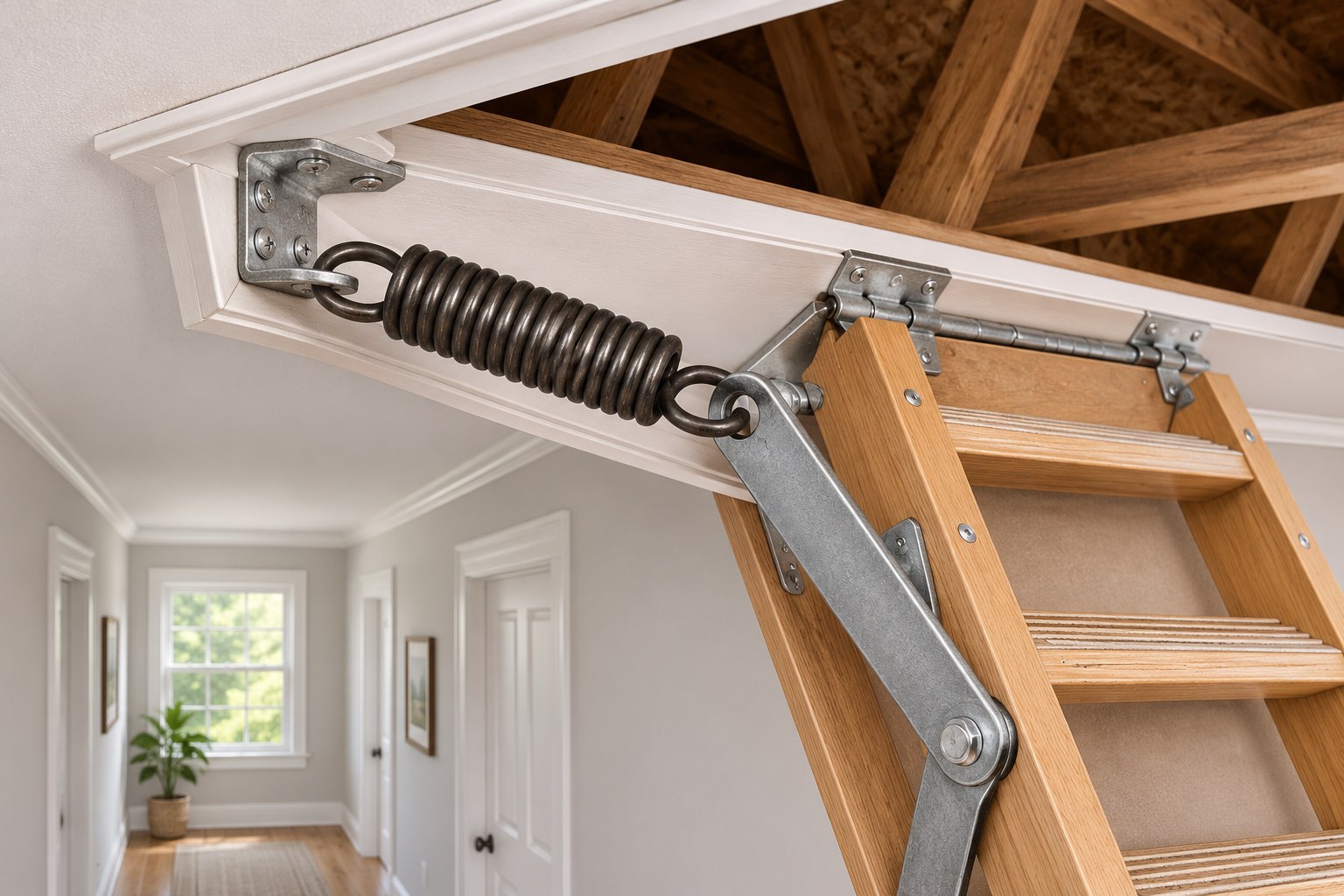
Cover image: an AI-generated illustration of a generic folding attic ladder, based on a photo of an extension spring we make; it does not show a specific ladder brand or its exact spring layout.
Attic ladder springs are the pair of heavy extension springs, one on each side of a folding attic ladder, that hold the ceiling door shut and support the door and the folded ladder sections as they swing down. They work with the folding arms that link the door to the frame. Louisville Ladder’s instructions call these the “folding arm mechanism (power arm assembly)” and warn that “The springs / gas cylinders on this folding attic ladder are under pressure” [1].
This guide is written for attic ladder and loft hatch makers who source these springs, and for buyers matching a replacement pair. It explains the load the springs carry, why matching the length of an old spring is not enough, works through a 9-1/4 in spring with a stress check on its loops, and lists what a spring drawing should carry. For the same type of spring on a lighter door, see our screen door spring guide.
Key takeaways
- The springs carry the door and the folded ladder, not the climber. In our illustrative case of a 20 kg assembly, each spring has to supply about 54 N·m about the hinge, or about 675 N at an 80 mm lever arm.
- Length alone does not define a replacement. Three springs we designed at the same 235 mm (9-1/4 in) overall length pull 499, 645 and 844 N at the same stretch.
- The loops limit the load, not the coils. In our 5.0 mm example the loop bend reaches 67 % of tensile strength at the working force, against a 75 % guide, while the coil body sits at 36 %.
- Replace springs as a pair and follow the ladder maker’s instructions, because the springs are under tension even with the door shut.
- Specify force at two installed lengths, plus wire size, outside diameter, loop type and finish, so a replacement pulls like the original.
What do attic ladder springs do?
A folding attic ladder is a hinged ceiling door with the ladder sections folded on its back. When the door is closed, the springs pull it up against the frame. When someone pulls the cord, the door swings down about its hinge while the springs resist its weight, so the door and ladder can come down under control. Once the ladder sections are unfolded and the feet rest on the floor, the climber’s weight goes through the ladder legs to the floor, not through the springs.
Because the springs are always loaded, the instructions treat them with care. The installation guide for the W2200, W2500, WH2200, WH2500 and WH3000 series wood access ladders warns: “Do not push the access ladder open from within the overhead space. The spring tension changes suddenly” [2]. A second guide for the same series explains that bowing of the ladder parts in the box “is normal since wood parts are subjected to strong spring tension for some time before purchase and installation” [3].
How much force does an attic ladder spring carry?
The springs have to balance the weight of the door and folded ladder about the hinge. The weight acts at the centre of gravity, so the moment is mass × g × distance from the hinge. With two springs, each one supplies half.
As an illustration, take a door and folded ladder of 20 kg with its centre of gravity 550 mm from the hinge (our assumption, not a published figure for any model). The moment is 20 × 9.81 × 0.55 = 108 N·m, or 54 N·m per side. If each spring acts on the door linkage at a lever arm of 80 mm about the hinge, it has to pull about 675 N, roughly 150 lbf.
Forces of this size call for heavy spring wire, and they are why a broken spring matters. This Old House describes a reader who “was halfway up a folding attic stair when a loose screw let go, a spring popped, and the stair swung out from under him” [4]. Its advice for broken springs is short: “Replace the springs following the manufacturer’s instructions” [4].
The exact lever arm and how it changes as the door opens depend on each maker’s arm and bracket layout. For a similar spring-and-lever problem worked through in full, see our trailer ramp springs guide. Our dishwasher door springs guide works through the same balance on a smaller door, where a cable and crank arm change the lever as the door opens.
Why are attic ladder replacement springs sold by length?
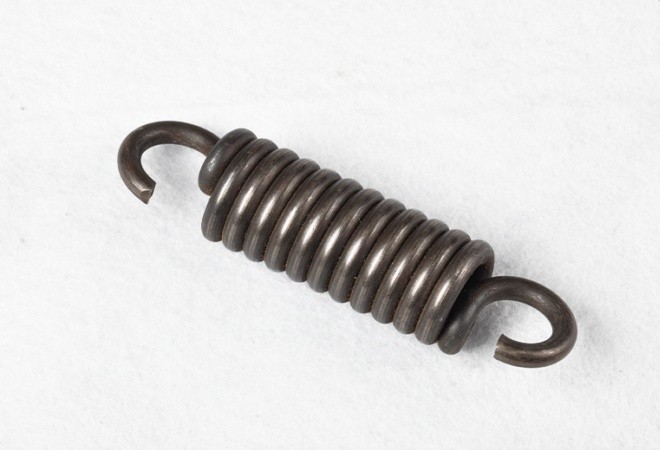
Replacement springs are listed by ladder model and overall length. The Werner Parts online store (wernerparts.com) sells a Spring Kit for Wood Attic Ladders (56-1) as a pair and states: “This spring is approximately 9-1/4″ long outside of loop to outside of loop. (Overall length)” [5]. The listing names the models it fits, from W2208 to WH2510 [5]. The wood ladder instructions list spring replacement kits by part number and model, such as P/N 53465-01 for the W2200, W2500, WH2200 and WH2500 [2].
A part number from the ladder maker carries the right spring. A generic spring bought by length does not, because overall length says nothing about how hard the spring pulls. The pull depends on the wire diameter, the coil diameter, the number of coils and the initial tension wound into the coils.
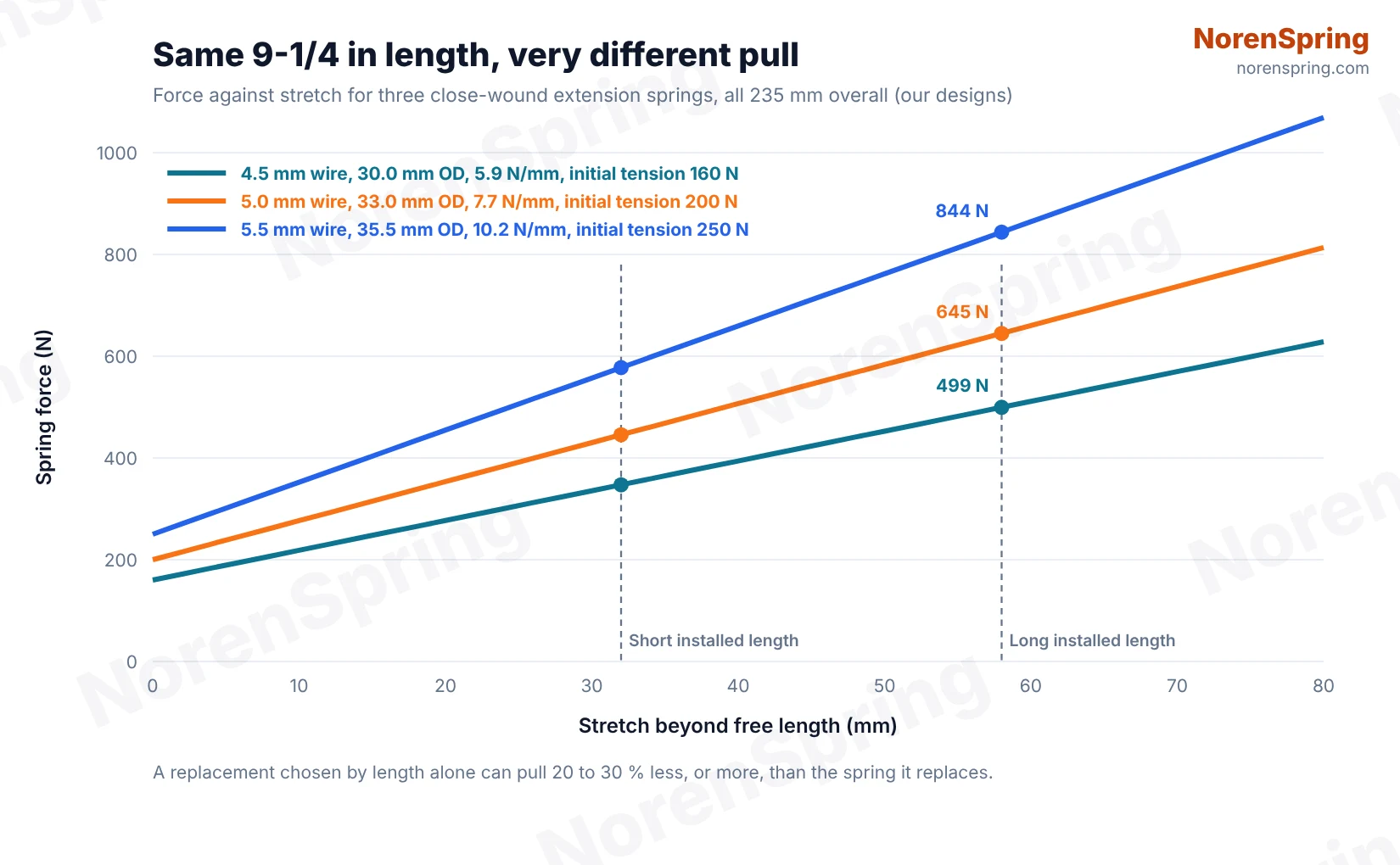
The chart shows three close-wound springs of the same overall length, each with initial tension inside the range Shigley’s Fig. 10-7c marks as preferred. A 4.5 mm wire spring pulls 23 % less than the 5.0 mm spring at the same stretch, and a 5.5 mm spring pulls 31 % more. Too little pull lets the door sag or drop; too much makes it hard to pull down.
Worked example: a 9-1/4 in attic ladder spring
To show what a spring maker checks, we designed a spring for the 645 N working force above. Material constants and stress limits come from Shigley’s Mechanical Engineering Design, chapter 10 [6]. The two installed stretches (32 mm and 58 mm beyond free length) are our example; on a real ladder they are measured with the spring fitted.
| Item | Value |
|---|---|
| Wire | 5.0 mm hard-drawn carbon steel (ASTM A227 class) |
| Mean coil diameter / outside diameter | 28.0 mm / 33.0 mm, spring index 5.6 |
| Overall length, outside of loops | 235 mm (9-1/4 in), two full machine loops |
| Active coils | 36.8, close wound |
| Rate | 7.67 N/mm (43.8 lb/in), with G = 79.3 GPa |
| Initial tension | 200 N (114 MPa, inside the 103 to 153 MPa preferred range at index 5.6) |
| Force at 32 mm stretch | 445 N (100 lbf) |
| Force at 58 mm stretch | 645 N (145 lbf) |
| Minimum tensile strength of 5.0 mm wire | about 1,313 MPa (Shigley Table 10-4: A = 1,783, m = 0.190) |
Force is initial tension plus rate × stretch, so F = 200 + 7.67 × 58 = 645 N. The rate comes from k = G·d⁴ / (8·D³·Na), with the active coils taken from the body length: 235 mm overall, less two loops of one inside diameter (23 mm) each, leaves 189 mm of close-wound body.
Where an attic ladder spring is highest stressed
An extension spring has three places to check: the coil body in torsion, the loop where it bends away from the body, and the corner where the loop turns. Shigley’s Table 10-7 gives static limits for patented, cold-drawn or hardened carbon steel of 45 to 50 % of tensile strength in the body, 40 % in torsion at the end and 75 % in bending at the end [6].
| Location | Stress at 645 N | Share of tensile strength | Table 10-7 guide | Largest force at the guide |
|---|---|---|---|---|
| Coil body (torsion, Wahl factor 1.273) | 468 MPa | 36 % | 45 % | 814 N |
| Loop bend (bending, factor 1.153) | 881 MPa | 67 % | 75 % | 721 N |
| Loop corner (torsion, bend index 4) | 460 MPa | 35 % | 40 % | 737 N |
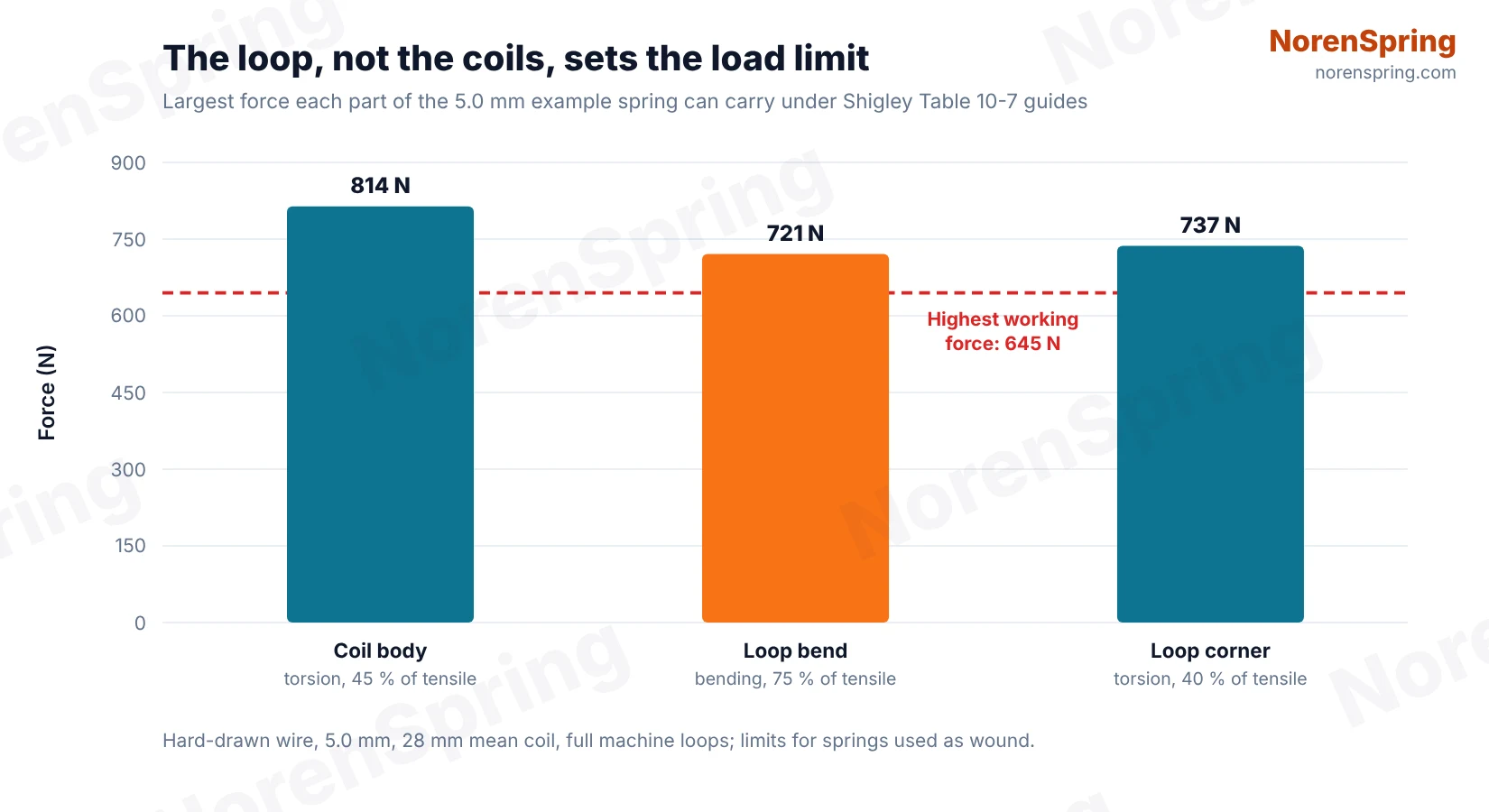
The loop bend sets the limit at 721 N, only 12 % above the working force. If a replacement spring is stretched further than the original, or has a tighter loop, the loop is the first place to take a set or crack. In our example the loop is the most highly stressed point, so check the loops first on an old spring; our guide to why springs fail shows how to read a broken end.
Signs that attic ladder springs need replacing
- The door will not stay shut or hangs open a little at one side. A spring that has taken a set has lost force at its installed length.
- The door drops quickly when the cord is pulled, instead of coming down under control.
- A spring is cracked, broken or badly rusted, especially at the loops.
- One side pulls differently from the other. Springs work as a pair; a new spring on one side and an old one on the other leaves the door twisting.
The Louisville instructions also ask owners to “Annually lubricate (spray silicon recommended) pivot points of right and left folding arm mechanism” [1]. A stiff pivot can feel like a weak spring, so check the arms before blaming the springs.
Replacing the springs is a job for the ladder maker’s instructions and parts. The same Louisville guide says the springs “are under pressure” and should not be removed or replaced before installation [1].
What to specify when ordering attic ladder springs
For a ladder maker or a parts brand, an attic ladder spring drawing should carry the items in our extension spring specification guide, with these points made explicit:
- Force at two installed lengths, for example door closed and door fully open, with a tolerance on each.
- Free length, stated as inside of loops or outside of loops, since overall length is how replacements are sold.
- Wire diameter and material, such as hard-drawn or oil-tempered carbon steel.
- Outside diameter, so the spring clears the frame and the arm.
- Initial tension with a range, because it sets the force at the shorter length.
- Loop type and orientation: full machine loops, crossover loops or extended hooks, and the angle between the two loops.
- Maximum installed length, with the loop bend stress checked at that length.
- Finish: black oxide, zinc plating or powder coat. The spring sits in an attic space that may be damp.
- Pair matching: both springs in a pair from the same batch, with load test records at both lengths.
Send your arm geometry, door and ladder weight, and the two installed lengths through our contact page, and our engineers will review the spring pair. Our extension springs page shows the loops and finishes we make, and you can read more about our company and its certifications. This guide was compiled by our editorial team with our spring engineers.
FAQ
What do the springs on an attic ladder do?
They hold the ceiling door shut and support the door and folded ladder sections as they swing down, so the ladder opens under control. They do not carry the person climbing; once unfolded, the ladder legs rest on the floor.
Can I replace attic ladder springs with any spring of the same length?
Not safely. Springs of the same overall length can pull very differently. In our example, three 235 mm springs pull 499, 645 and 844 N at the same stretch. Use the ladder maker’s spring kit for your model, such as Werner’s 56-1 kit for the models it lists [5].
How long are attic ladder springs?
It depends on the ladder. Werner’s 56-1 replacement spring is about 9-1/4 in from the outside of one loop to the outside of the other [5]. Check the parts list in your ladder’s instructions for the right kit.
Why does my attic ladder door not stay closed?
A spring that has lost force, a broken spring, a stiff arm pivot or a frame that is out of square can all cause it. The Louisville guide has the installer check that the frame is square by measuring its diagonals, and asks for annual lubrication of the arm pivots [1].
Should both attic ladder springs be replaced together?
Yes. The two springs share the load, so a new spring next to a weakened one pulls the door unevenly. Replacement kits such as Werner’s 56-1 are sold as a pair [5].
Sources
- Louisville Ladder, attic ladder installation instructions, models AA2210, AA2510, WA2210 (Home Depot product document). images.homedepot-static.com
- Wood overhead access ladder installation instructions, W2200, W2500, WH2200, WH2500 and WH3000 series (Lowe’s product document). pdf.lowes.com
- WH2200/WH2500/WH3000 series wood attic ladder installation instructions (Lowe’s installation guide). pdf.lowes.com
- This Old House, “How To Size and Choose Pull Down Attic Stairs”. thisoldhouse.com
- Werner Parts, Spring Kit for Wood Attic Ladders (Pair) 56-1. wernerparts.com
- Shigley’s Mechanical Engineering Design, chapter 10 lecture slides (mechanical springs), Istanbul Technical University. web.itu.edu.tr



