










In this article
- Key takeaways
- How do window balance springs work?
- How do you size a window balance? Start with the sash weight
- Block and tackle balances: the stamp, the pulleys and the spring
- Spiral balances: tube length, tip colour and wind-up
- Constant force balances
- Troubleshooting a sash that will not hold
- What to specify for a balance spring
- Frequently asked questions
- References
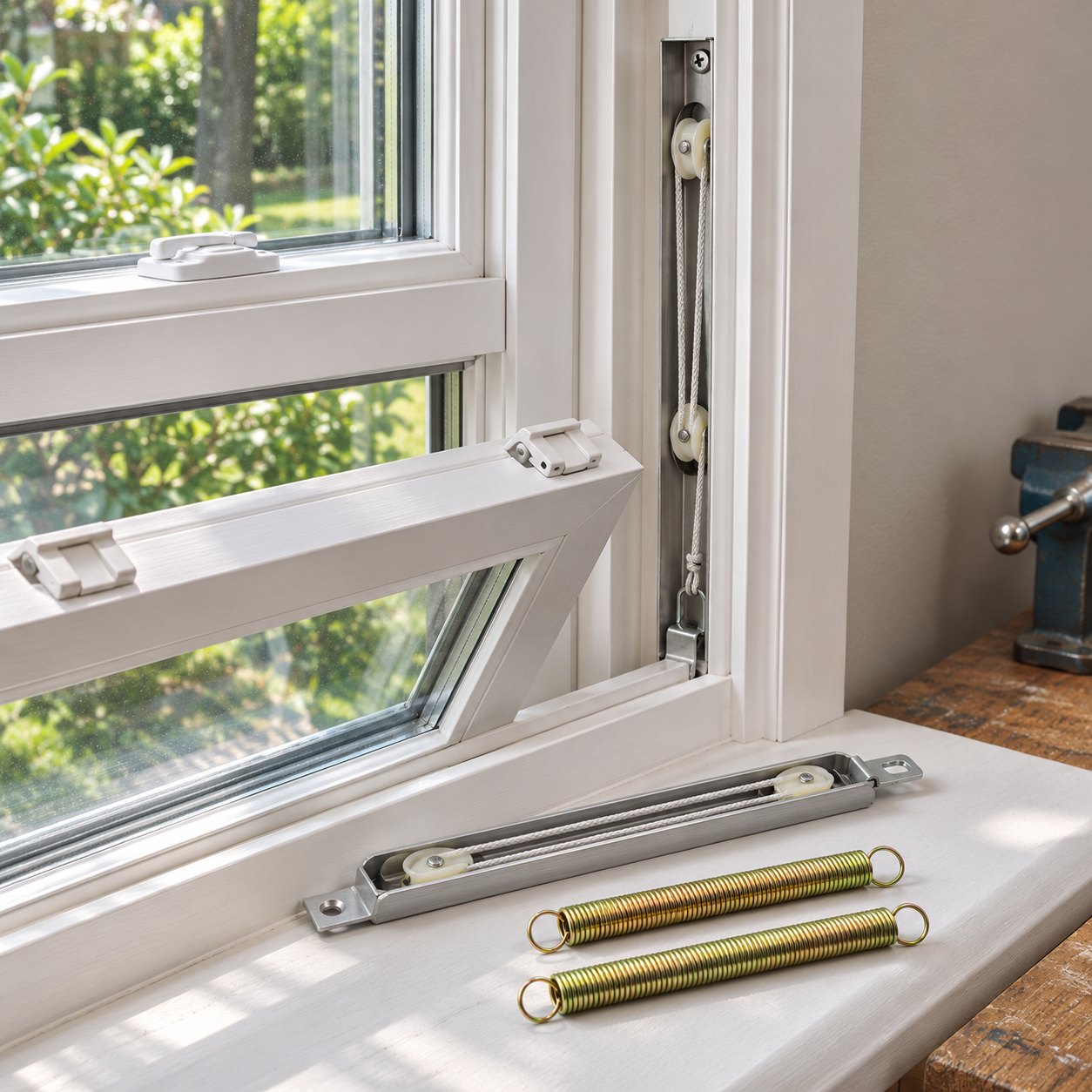
Cover image: an AI-generated illustration of a generic double-hung window, based on a photo of extension springs we make; it does not show a specific window or balance brand.
Window balance springs are the springs inside a sliding window’s jambs that carry the weight of the sash, so it stays open where you leave it instead of dropping shut or creeping up. Older sash windows did this with cast iron counterweights on cords; modern vinyl and aluminium windows use block and tackle, spiral or constant force balances instead. When a window “won’t stay open, slams shut, or becomes difficult to lift”, a worn or wrongly sized balance is a likely cause [4].
This guide is written for window manufacturers, balance and hardware makers and replacement-part buyers who need to understand what the spring inside a balance has to do. It explains the three balance types, decodes the stamps and colour codes used to identify them and works through the sizing maths with a worked example. For extension spring drawings in general, see our extension spring specification guide.
Key takeaways
- Each balance carries about half the sash. As one balance supplier puts it, “each balance will hold half the total weight of the sash” [1].
- Glazing changes the load a lot. In our example, the same sash weighs about 14 lb single glazed, 23 lb double glazed and 31 lb triple glazed, so an upgrade to heavier glass needs heavier balances.
- A stamp is a code, not a weight. On block and tackle balances, the first number is a length code and the second is a spring code; one supplier warns that “just because the stamp says 40, this doesn’t mean it is 40 lbs” [2].
- Coil spring balances always vary. The pull of a block and tackle balance changes across the travel by the spring rate times the sash travel, whatever the pulley ratio. Friction in the jamb covers the difference.
- A tight force band costs spring length. In our worked example, holding the force within ±2 lb needs about 22 in of spring space; ±1 lb needs about 41 in.
How do window balance springs work?
A sash is balanced when the upward pull of its balances roughly equals its weight. Any difference has to be taken by friction between the sash and the jamb, which is why a well-balanced sash stays put and a poorly balanced one drifts. One supplier sums up the failure mode: “Spring fatigue causes sash drift or slamming” [4].
There are three main types of spring balance, each using a different kind of spring:
| Balance type | Spring inside | How the force behaves | How it is identified |
|---|---|---|---|
| Block and tackle | Close-wound extension spring in a U-channel, with pulleys and a cord | Rises as the sash moves and the spring stretches | Stamp: length code and spring code [3] |
| Spiral (tube) | Spring in a tube, wound by a twisted rod | Changes as the spring is wound or let off | Tube diameter, length and tip colour [7] |
| Constant force | Flat coiled strip of spring steel | Nearly constant over the travel | Number stamped on the coil for its weight range [4] |
How do you size a window balance? Start with the sash weight
Most of the load on a balance comes from the glass. Flat soda-lime glass has a density of about 2.53 g/cm³ [10], so a 1/8 in (3.2 mm) pane weighs about 1.65 lb per square foot.
We worked out the sash weight for an example lower sash, 36 × 28 in overall, with 32 × 24 in of glass and an assumed 5 lb vinyl frame, carried by two balances:
| Glazing | Glass weight | Sash weight | Per balance |
|---|---|---|---|
| Single, 1/8 in | 8.8 lb | 13.8 lb | 6.9 lb |
| Double, 2 × 1/8 in | 17.6 lb | 22.6 lb | 11.3 lb |
| Double, 2 × 5/32 in (4 mm) | 22.1 lb | 27.1 lb | 13.6 lb |
| Triple, 3 × 1/8 in | 26.3 lb | 31.3 lb | 15.7 lb |
| Laminated 6.38 mm + 1/8 in | 26.4 lb | 31.4 lb | 15.7 lb |
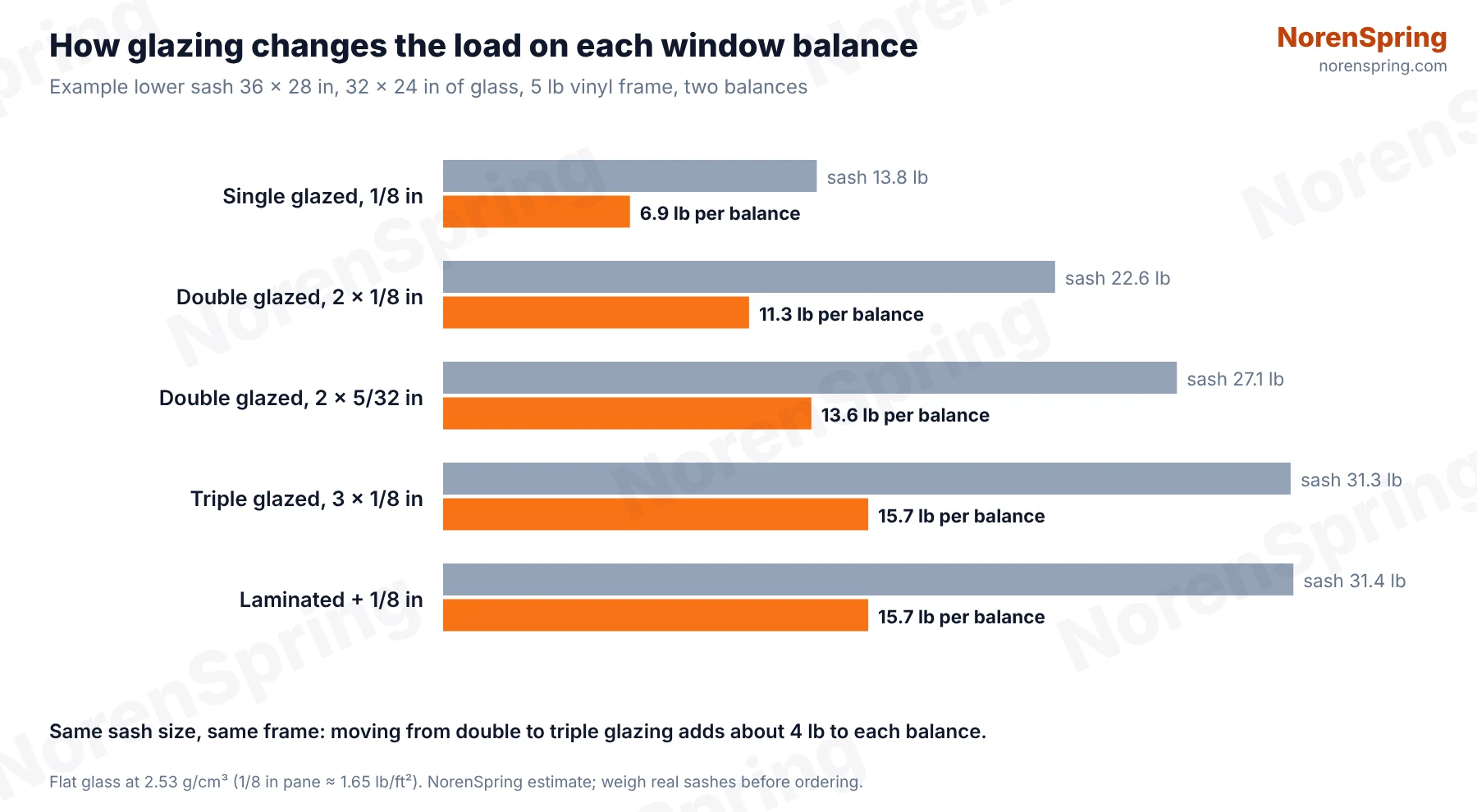
In the double-glazed example, the glass is 17.6 lb of the 22.6 lb sash. Moving the same sash from double to triple glazing adds about 4.4 lb to each balance, roughly 40 % more load. A balance chosen for the original glass will let the heavier sash drop. Weighing the sash is still the best check; a supplier of balances lists “sash weight (or approximate)” among the details it needs before matching a replacement [4].
Block and tackle balances: the stamp, the pulleys and the spring
A block and tackle balance is a metal U-channel holding an extension spring, two pulley blocks and a cord that runs to the sash. Caldwell’s 1994 patent describes the idea as combining “a system of pulleys with an extension spring” to turn a high spring force over a short stretch into a lower force over the longer sash travel [5]. In that design each pulley block carries two pulleys, and the balance is “sized so that a desired lifting force is applied to the window sash throughout the entire range of sash travel” [5]. A later Caldwell patent mounts the balance upside down to give the sash more travel [6].
What does the stamp on a block and tackle balance mean?
The stamp takes the form XX-X or XXXX, for example 14-4 or 1440 [3]:
- The first two digits are a length code. They are one inch less than the balance length, so 13 means a 14 in balance [2]. A 32 in Caldwell Series 300 balance for a 5/8 in channel, for example, is stamped 31-9 [8].
- The last digits are a spring code. They identify the spring, not a weight in pounds. One supplier gives the example of a Series 400 stamp 1340 that measures 14 in and holds a sash weight of 12 to 13 lb [2].
The two supplier pages differ slightly on whether the length is measured on the metal channel alone or overall, so measure the old balance and compare it with the stamp before ordering.
Why does a block and tackle balance never match the sash exactly?
With a pulley ratio of r:1, the spring carries 1/r of the force at the sash and stretches 1/r of the sash travel. Our derivation from those two facts gives a useful result: the change in pull at the sash across the travel equals the spring rate times the sash travel, whatever the ratio. The pulleys let a short spring serve a tall sash, but they do not flatten the force curve.
For our double-glazed example, each balance carries about 11 lb. With 24 in of sash travel and 4:1 reeving, the spring needs a mean force of 2.75 lb (12.2 N) and stretches 6 in over the full travel. If the jamb friction can hide ±2 lb, the spring rate can be no more than 0.17 lb/in.
We then sized a music wire spring that fits a balance channel (OD 9 mm) and runs below 45 % of its tensile strength, using the standard spring equations and the preferred range of initial tension [9]. A soft spring has little initial tension, so it must be pre-stretched before it delivers the required force. That pre-stretch, not the coils themselves, takes most of the room:
| Force band at the sash | Spring rate | Spring body | Pre-stretch | Travel stretch | Total spring space |
|---|---|---|---|---|---|
| ±1 lb | 0.083 lb/in | 7.9 in | 27.1 in | 6.0 in | 41.0 in |
| ±1.5 lb | 0.125 lb/in | 5.3 in | 17.1 in | 6.0 in | 28.3 in |
| ±2 lb | 0.167 lb/in | 4.0 in | 12.0 in | 6.0 in | 22.0 in |
| ±3 lb | 0.250 lb/in | 3.8 in | 6.7 in | 6.0 in | 16.5 in |
| ±4 lb | 0.333 lb/in | 2.9 in | 4.3 in | 6.0 in | 13.1 in |
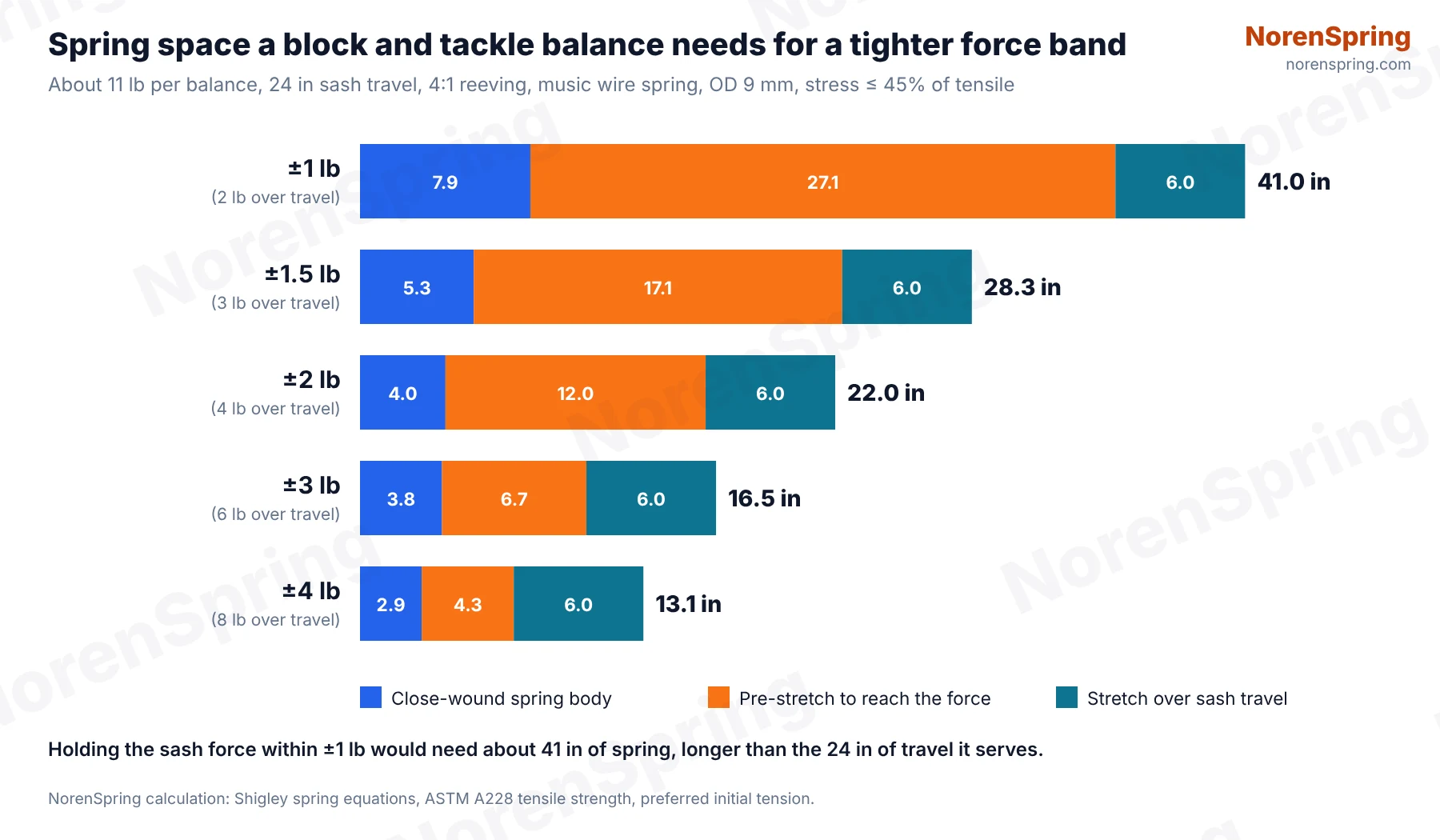
A balance that holds the sash within ±1 lb over 24 in of travel would need a spring space longer than the 28 in sash itself. In our model, friction has to cover whatever band the spring cannot hold, and a spring code that is wrong for the sash shifts the whole band away from the sash weight. Our article on spring preload explains initial tension and pre-stretch in more detail.
Spiral balances: tube length, tip colour and wind-up
A spiral balance is a slim tube containing a spring and a twisted rod; one supplier says the rod “acts like a torsion spring” [4]. The lifting force equals 2π times the spring torque divided by the rod’s lead, the length of rod per full twist, so the force changes as the spring is wound further or let off over the sash travel.
Spiral balances are sized by tube diameter and length, and the coloured bushing or coupling on the rod shows the spring strength. Prime-Line’s colour code for its spiral tilt balances is [7]:
| Tip colour | Prime-Line grade | Safe weight |
|---|---|---|
| White | Standard | 12 lb |
| Red | Medium | 25 lb |
| Blue | Heavy | 35 lb |
| Black | Heavy-duty | 50 lb |
Colour codes are brand-specific, so do not assume another maker’s red tip carries the same rating. Spiral balances are adjusted by winding the rod with a tension tool before the sash is fitted; without correct adjustment, “the sash will drift or be hard to move” [4].
Constant force balances
A constant force balance uses “a flat, coiled strip of spring steel” that unrolls as the sash moves and pulls with nearly the same force over the whole travel [4]. The coils are stamped with a number for their weight range. They avoid the force spread described above, at the cost of a different, strip-wound spring and a matching shoe.
Troubleshooting a sash that will not hold
| Symptom | Likely cause | What to check |
|---|---|---|
| Sash drops shut | Weak or broken spring, snapped cord, code too light | Weigh the sash: each balance must carry half, about 11 lb in our 22.6 lb example |
| Sash creeps upward | Code too strong, e.g. after swapping 4 mm for 3 mm glass | Step down one spring code or tip colour |
| Holds near the top, rises when lowered | Force band too wide for 24 in or more of travel | Balance length code against sash height |
| Noisy, jerky movement | Spring rubbing the channel walls, worn pulleys or dirt | Caldwell’s patent links an off-centre spring to “noise and additional friction” [5] |
| Tilt sash stiff after refitting | Spiral rod over- or under-wound | Re-wind with a tension tool such as Prime-Line H 3787 [7] |
What to specify for a balance spring
For balance makers buying the wire springs in volume:
| Item | Block and tackle spring (example) | Spiral balance spring (example) |
|---|---|---|
| Application | Balance length, sash weight range per spring code, sash travel, pulley ratio | Tube ID, rod lead, sash weight range, number of pre-wind turns |
| Wire | Music wire (ASTM A228), or 302 stainless for coastal use | Music wire or oil-tempered wire, size stated |
| Size | Maximum OD to clear the channel, for example 9 mm | OD to clear the tube, ID to clear the nut |
| Ends | Hook or loop type, orientation and length inside hooks | End anchors at the tube cap and the nut |
| Force | Initial tension with tolerance; load at two extensions, for example ±10 % | Torque at two angles of wind, with tolerance |
| Life | Cycle test over the full travel; load loss after testing | Cycle test over full wind; torque loss after testing |
| Finish | Plain, oiled or zinc plated, matched to the channel | Plain or oiled |
Two forces on the drawing, not just one, are what keep a production batch in the same force band; our spring rate guide explains how rate and tolerance interact. For the same reason, spring codes should be checked at goods-in with a force test, not only by size.
Send your drawing, a sample spring or your balance dimensions through our contact page, and our engineers will review it and reply within 24 hours. Our extension springs and torsion springs pages show the shapes and finishes we make, and you can read more about our company and its certifications. For other door and window hardware springs, see our guide to screen door springs. This guide was compiled by our editorial team with our spring engineers.
Frequently asked questions
How do I know which window balance spring I need?
Identify the balance type first: a U-channel with a cord is block and tackle, a slim tube is spiral, and a coiled flat strip is constant force. Then read the stamp or tip colour, measure the length and weigh the sash. Each balance carries about half the sash weight.
Why won’t my window stay up?
The balances are pulling less than half the sash weight, usually because the springs have weakened, a cord has broken, or the balances are too light for the glass. Heavier replacement glazing can be the cause, since triple glazing can add about 40 % to the load.
What do the numbers on a block and tackle balance mean?
The first two digits are the length code, one inch less than the balance length. The digits after them are the spring code for the sash weight range [3]. For example, 1440 or 14-4 means a 15 in balance with spring code 40, which is not 40 lb.
References
- Window Hardware Direct, “How to Weigh a Window to get Sash Weight”. https://windowhardwaredirect.com/blogs/news/how-to-weigh-a-window-to-get-sash-weight
- Window Hardware Direct, “Block & Tackle Window Balances: Understanding the Meaning of Stamps” (2024). https://windowhardwaredirect.com/blogs/news/block-tackle-window-balances-understanding-the-meaning-of-stamps
- Window Hardware Direct, “What Does the Stamp on a Block and Tackle Window Balance Mean?” (2020). https://windowhardwaredirect.com/blogs/news/what-does-the-stamp-on-a-block-and-tackle-window-balance-mean
- Window Hardware Direct, “Window Balance Parts Explained: Block & Tackle, Spiral and Constant Force Balances” (2026). https://windowhardwaredirect.com/blogs/news/window-balance-parts-explained-block-tackle-spiral-and-constant-force-balances
- deNormand R. S., Martini J. A., Westfall N. R. (Caldwell Manufacturing), “Block and tackle window balance”, US Patent 5,530,991 (filed 1994, granted 1996). https://patents.google.com/patent/US5530991
- deNormand R. S. (Caldwell Manufacturing), “Inverted block and tackle window balance”, US Patent 6,041,476 (filed 1997, granted 2000). https://patents.google.com/patent/US6041476
- Tractor Supply, Prime-Line 9/16 in × 23 in spiral tilt balance, red tip, FH 2220. https://www.tractorsupply.com/tsc/product/prime-line-9-16-in-x-23-in-spiral-tilt-balance-red-tip-fh-2220
- Walmart, 32 in Caldwell Series 300 5/8 in channel block and tackle window balance, stamp 31-9. https://www.walmart.com/ip/313301536
- Shigley’s Mechanical Engineering Design, Chapter 10 Mechanical Springs, lecture slides, Istanbul Technical University. https://web.itu.edu.tr/~halit/Makel/Ch_10_slides_m.pdf
- Wikipedia, “Soda-lime glass”, physical properties table. https://en.wikipedia.org/wiki/Soda-lime_glass



