










In this article
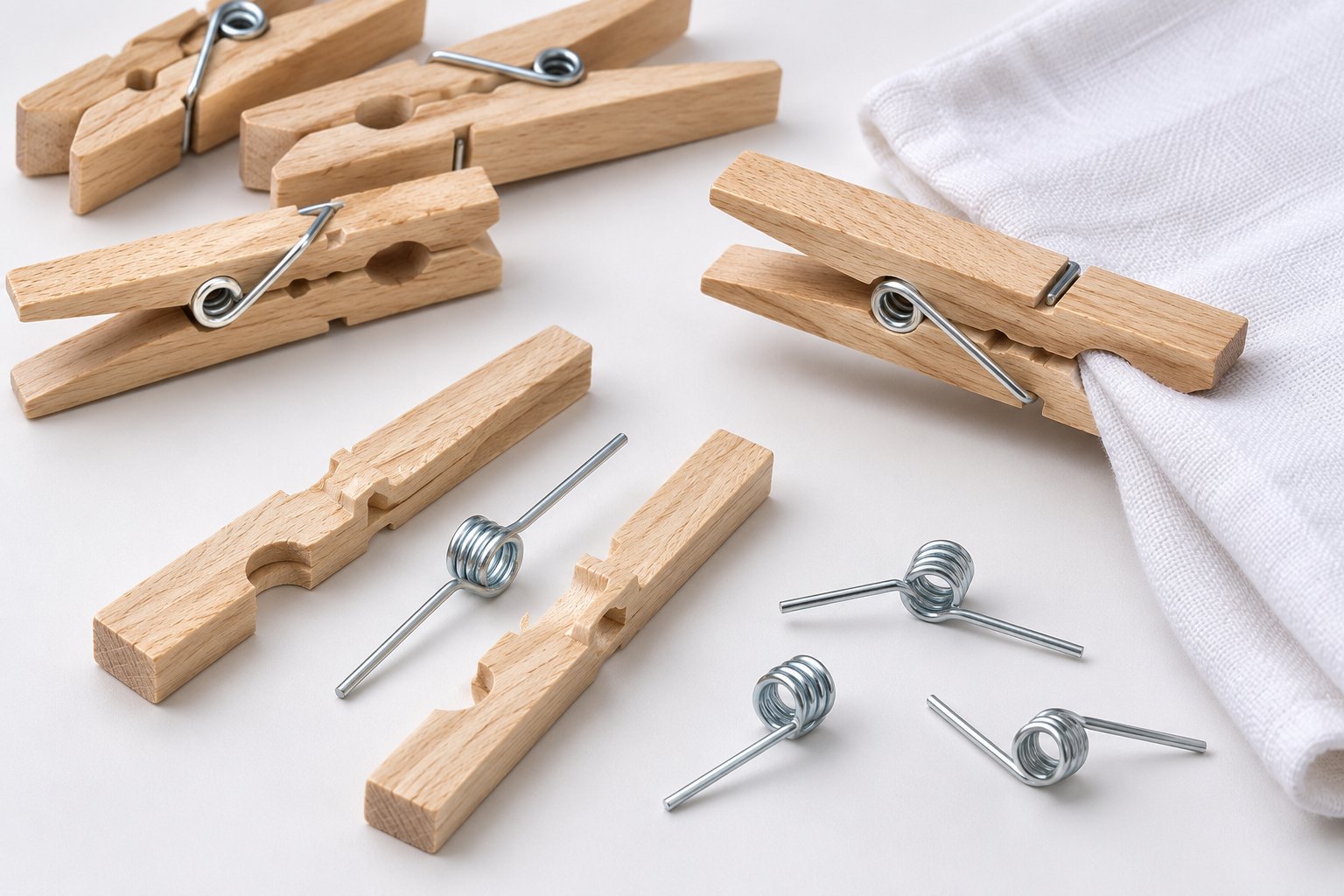
Cover image: an AI-generated illustration of generic wooden clothespins, based on a photo of torsion springs we make; it does not show a specific clothespin brand.
A clothespin spring is the small wire torsion spring that holds the two wooden or plastic halves of a spring clothespin together. Its coiled middle sits in a notch between the halves and acts as the pivot, while its two straight arms press the gripping ends shut, so a single piece of wire does the work of a hinge, a clamp and a fastener. Retail listings describe pins of 2-7/8 in (73 mm) [5] and 3-1/3 in (85 mm) [4] long, so the spring has to deliver its entire gripping force within a component measuring only about 73 to 85 mm.
This guide is intended for clothespin and clip manufacturers, housewares importers and purchasing teams who source clothespin springs or complete pins, and it explains how the spring operates, calculates the grip of an example spring and lists what a drawing for clothespin springs should contain. For small torsion springs in general, see our small torsion springs guide.
Key takeaways
- The spring is the hinge as well as the clamp, because its coil sits in recesses in both halves and its arms press the jaws together, a design patented in 1887.
- Grip comes from preload: in our example, a 1.0 mm hard drawn wire spring twisted 20° at assembly grips 3 mm of cloth with about 2.6 N.
- Preload has a ceiling, because for the same spring a preload above about 22° pushes the coil past its yield limit when the pin is opened fully, so the spring takes a set and loses grip.
- Fewer coils means less usable grip: removing one coil from our example raises the rate by 43 % and cuts the most grip the spring can give without yielding from 2.8 to 2.3 N.
- Specify the free angle, not just wire and coils, because a 5° error in free angle changes the grip of our example by about 19 %.
How does a clothespin spring work?
The modern spring clothespin dates from the 1850s, and Wikipedia records that in 1853 David Smith of Springfield, Vermont “invented a clothespin with two prongs connected by a fulcrum, plus a spring” [1], patented as a “Spring-clamp for clothes-lines” [2]. Wikipedia records that Solon Moore improved Smith’s design in 1887 and that his version “became the first successful spring-actuated clothespin” [1]. Moore’s patent describes a spring “composed of a single piece of wire, and may be brass or galvanized to prevent the same from rusting” [3].
Moore’s patent also explains how the spring is arranged: the wire is coiled in the middle “so as to form a movable coiled fulcrum” that bears in recesses in the two wooden halves, and from each end of the coil run “tangential arms” that are “so arranged as to normally compress the clamping end of the pin” [3]. The bent ends of the arms sit in grooves on the outside of the halves, which stops the spring from sliding sideways.
Consequently, the spring performs three separate functions simultaneously:
- Pivot: the coil is the fulcrum, so its outside diameter and the shape of the recesses set where the halves rock.
- Clamp: the twist locked into the coil at assembly presses the jaws together, and that torque divided by the distance to the gripping point gives the grip force.
- Fastener: the arms in their grooves hold the two halves together, so if an arm slips out of its groove the pin falls apart.
Wikipedia notes that stainless steel clothespins use a different layout: “Rather than using a torsion spring that often twists, causing the clothespin to fall apart, they rely on a strong, trapped, compression spring that results in a stronger grip” [1]. The remainder of this guide concentrates on the torsion spring used in wooden and most plastic pins.
How much grip does a clothespin spring give?
A torsion spring’s coil works in bending, and Shigley’s lecture notes put it plainly: “The coil of a torsion spring experiences bending stress (despite the name of the spring)” [6]. The torque in the coil equals the spring rate multiplied by the twist from the spring’s free position, and the grip on whatever sits in the jaws equals that torque divided by the distance from the coil to the gripping point.
Because the clothespin listings we checked do not publish spring dimensions, we modelled an example spring with assumed dimensions that would fit a pin of approximately 75 mm:
| Example spring and pin (assumed) | Value |
|---|---|
| Wire | 1.0 mm hard drawn carbon spring wire (ASTM A227 strength) |
| Coil | 5.0 mm mean diameter (6.0 mm OD), 2.5 body turns |
| Arms | 20 mm each from the coil to the grooves |
| Gripping point | 30 mm from the coil centre, on 3 mm of cloth |
| Jaw tip and finger pad | 35 mm and 22 mm from the coil centre |
| Fully open | 10 mm gap at the jaw tip |
| Preload at assembly | 20° of twist with the jaws closed |
| Wire per spring | About 95 mm: coil 39 mm, arms 2 × 20 mm, end bends about 2 × 8 mm |
| Mass per spring | About 0.59 g, or roughly 1,700 springs per kg of 1.0 mm wire |
Using the torsion spring rate with Shigley’s 10.8 constant and an allowance for the arms’ own bending [6], the spring has 3.35 equivalent active turns and a rate of approximately 3.0 N·mm per degree, which produces the following values through one complete cycle of use:
| Position | Coil twist | Torque | Force |
|---|---|---|---|
| Closed, empty | 20.0° | 61 N·mm | 1.7 N at the jaw tip |
| Gripping 3 mm of cloth | 25.7° | 78 N·mm | 2.6 N grip |
| Fully open (10 mm at the tip) | 36.4° | 111 N·mm | 5.0 N at the finger pad |
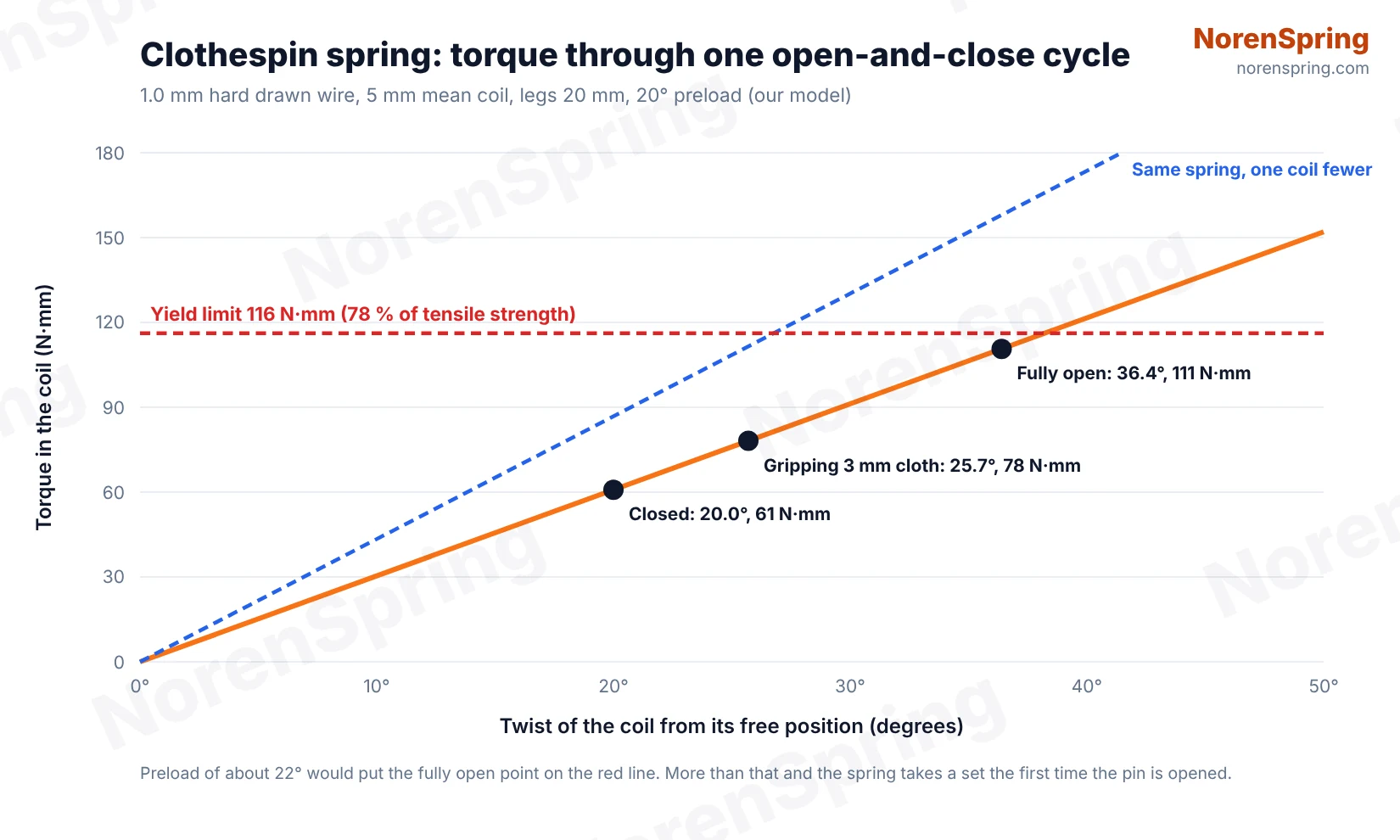
The fully open point matters most, because at 111 N·mm the peak bending stress in the coil, corrected for curvature, reaches 1,324 MPa, which is 74 % of the wire’s minimum tensile strength of 1,783 MPa at 1.0 mm. Shigley’s notes obtain the static bending limit by dividing the torsion values of Table 10-6 by 0.577, which for music wire and hard drawn wire gives 78 % of tensile strength [6], so the example spring is close to its limit every time someone opens the pin wide.
Why do clothespin springs lose their grip?
The model identifies three causes that are set at the design or assembly stage.
Too much preload: in our example, a preload of about 22° puts the fully open point exactly on the yield limit, whereas a spring assembled with 25° of preload would grip a little harder at first, but the first full opening would overstress the coil, which would then take a permanent set and come back with less preload than before. Assembling with additional twist therefore does not produce a permanently stronger clothespin. A snap trap spring meets the same limit when the trap is set, as our mouse trap springs guide shows.
Too few coils: Wikipedia records that in 1909 a clothespin maker found a way to make pins “more cheaply, by eliminating one of the coils in the ‘spring fulcrum'” [1]. In our model, going from 2.5 to 1.5 body turns raises the rate by 43 %, so the same 20° preload and full opening would reach about 1,890 MPa, well beyond the 1,391 MPa limit, so to remain elastic the shorter spring could only carry about 10° of preload, which cuts its grip on 3 mm of cloth from a maximum of 2.8 N to 2.3 N.
Arms that leave their grooves: the arms are what hold the halves together, so a spring whose arms are too short, or bent at the wrong angle at the ends, lets the halves twist on the coil. Wikipedia describes the torsion spring in these pins as one that “often twists, causing the clothespin to fall apart” [1]; on the spring side, the arm length and end bends are what keep the arms seated in the grooves.
How do wire size and material change a clothespin spring?
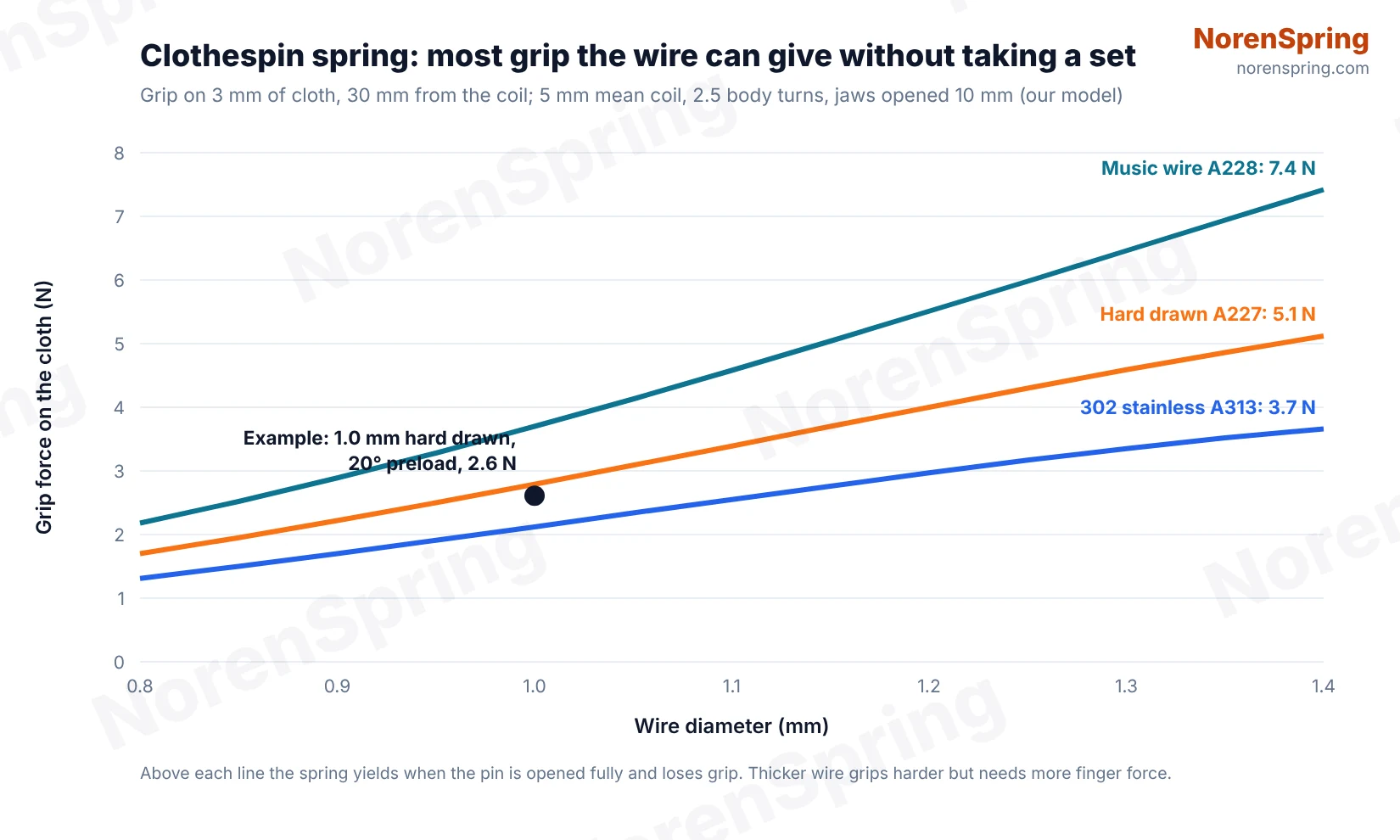
We ran the same pin geometry for wire from 0.8 to 1.4 mm in three materials, each time setting the preload to the highest value that keeps the fully open stress at the static limit, which gives the maximum grip each spring can deliver without taking a permanent set:
| Wire (5 mm mean coil, 2.5 body turns) | Rate | Highest preload without set | Grip on 3 mm cloth | Finger force fully open |
|---|---|---|---|---|
| 0.9 mm hard drawn | 2.0 N·mm/° | 27.7° | 2.2 N | 4.0 N |
| 1.0 mm hard drawn | 3.0 N·mm/° | 21.8° | 2.8 N | 5.3 N |
| 1.1 mm hard drawn | 4.5 N·mm/° | 17.1° | 3.4 N | 6.8 N |
| 1.2 mm hard drawn | 6.3 N·mm/° | 13.3° | 4.0 N | 8.5 N |
| 1.0 mm music wire | 3.1 N·mm/° | 29.8° | 3.7 N | 6.6 N |
| 1.0 mm 302 stainless | 3.0 N·mm/° | 15.7° | 2.1 N | 4.3 N |
Three practical conclusions follow for anyone specifying the spring:
- Thicker wire grips harder but is heavier to open: going from 1.0 to 1.2 mm hard drawn wire raises the available grip from 2.8 to 4.0 N, but the finger force to open the pin rises from 5.3 to 8.5 N, which matters for children’s craft pins and for people with weak hands.
- Thicker wire makes the grip more sensitive to the free angle: since the stiffer spring operates on less preload, a 5° error in the free angle changes the grip by about 0.5 N (19 %) at 1.0 mm but about 1.05 N (26 %) at 1.2 mm, so the coiling tolerance has to tighten as the wire gets thicker.
- Material sets the ceiling, since music wire allows the most preload and grip for a given size, while 302 stainless resists rust without plating but gives about a quarter less grip than hard drawn wire at 1.0 mm in our model. Our music wire springs guide and stainless steel springs guide compare these wires in more detail.
Finish: clothespins hang outdoors in damp conditions, so corrosion protection is an essential part of the spring specification, and Moore’s 1887 patent already called for brass or galvanized wire [3], and current listings describe “Galvanized no-rust wire springs” [4]. Galvanized wire, zinc plating with baking, or stainless wire are the options we would compare, and our spring finishes guide explains the trade-offs between them.
What should you specify when sourcing clothespin springs?
For clothespin springs, or a complete pin made to your design, these are the items we would expect to see on the drawing or purchase specification:
- Wire diameter and material, for example 1.0 mm hard drawn galvanized carbon spring wire or 1.0 mm 302 stainless, together with the wire standard.
- Coil outside diameter and body turns, matched to the recesses in the halves, since the coil is the pivot.
- Arm length and end bends, including the angle and length of the bent ends that sit in the grooves.
- Free angle between the arms with a tolerance, because the free angle and the closed position together set the preload and therefore the grip.
- A functional check, such as the force to open the jaws to a given gap measured on an assembled pin, or a torque at a given angle on the loose spring.
- A set test, for example opening the assembled pin fully ten times and checking that the closing force has not dropped by more than an agreed amount.
- Finish and salt spray hours, particularly if the pins are intended for outdoor use throughout the year.
- Packing, for example bulk bags for automatic assembly lines or counted packs for hand assembly.
Our guides on how to specify a custom torsion spring and the torsion spring calculator show how rate, free angle and stress relate to each other, and you can send your drawing, a sample pin or your target grip through our contact page for review by our engineers. Our torsion springs page shows the leg forms and finishes we make, and you can read more about our company and its certifications. This guide was compiled by our editorial team with our spring engineers.
FAQ
What kind of spring is in a clothespin?
It is a small torsion spring made from a single piece of wire, coiled in the middle with two straight arms, and Moore’s 1887 patent describes the coil as a “movable coiled fulcrum” and the arms as compressing “the clamping end of the pin” [3]. Stainless steel pins may use a trapped compression spring instead [1].
How strong is a clothespin spring?
It depends on the wire and the preload: in our model of a 75 mm wooden pin, a 1.0 mm hard drawn spring with 20° of preload grips 3 mm of cloth with about 2.6 N and needs about 5 N at the finger pad to open fully.
Why does a clothespin lose its grip?
In our model, the main mechanism is a spring that is overstressed whenever the pin is opened wide, so the coil takes a permanent set and loses preload, and excessive preload at assembly, too few coils or insufficiently strong wire can all produce that result. Separately, arms that slip out of their grooves let the halves twist apart.
Can you replace the spring in a clothespin?
Yes, if the replacement has the same coil diameter, arm length and end bends, because the coil must seat in the recesses and the arms in the grooves, while a spring with a different free angle will grip noticeably harder or softer than the original.
What wire size is a clothespin spring?
Clothespin listings we checked do not publish it, so our model uses 1.0 mm for a pin about 75 mm long, and shows that sizes from 0.9 to 1.2 mm give grips of roughly 2 to 4 N in hard drawn wire; the right size depends on the pin’s length, the recess size and the grip you want.
Sources
- Wikipedia, “Clothespin”. en.wikipedia.org/wiki/Clothespin
- David Smith, US Patent 10,163, “Spring-clamp for clothes-lines”, 1853. patents.google.com
- Solon Moore, US Patent 365,755, “Clothes-pin”, 1887. patents.google.com
- Vermont Country Store, Wooden Spring Clothespins, Set of 100, product page. vermontcountrystore.com
- WebstaurantStore, Household Essentials wood clothespins 96 pack, product page. webstaurantstore.com
- Shigley’s Mechanical Engineering Design, chapter 10 lecture slides (mechanical springs, torsion springs), Philadelphia University. philadelphia.edu.jo



