










In this article
- Key takeaways
- How do dishwasher door springs work?
- How much force does a dishwasher door spring carry?
- Why do dishwasher door springs have tension settings?
- Worked example: a dishwasher door spring for 100,000 cycles
- Dishwasher door spring or detergent lid spring?
- Signs that dishwasher door springs need replacing
- What to specify when ordering dishwasher door springs
- FAQ
- Sources
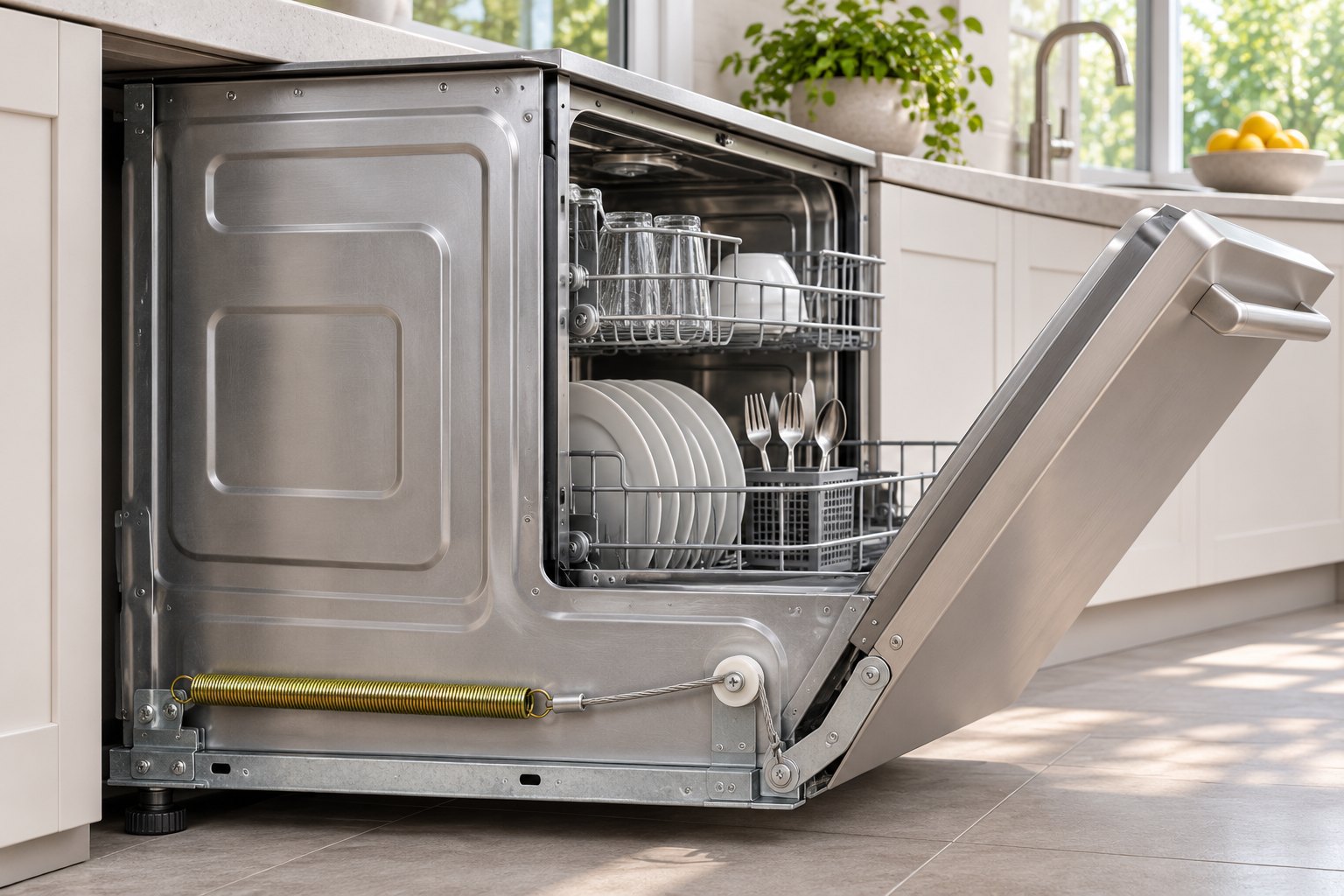
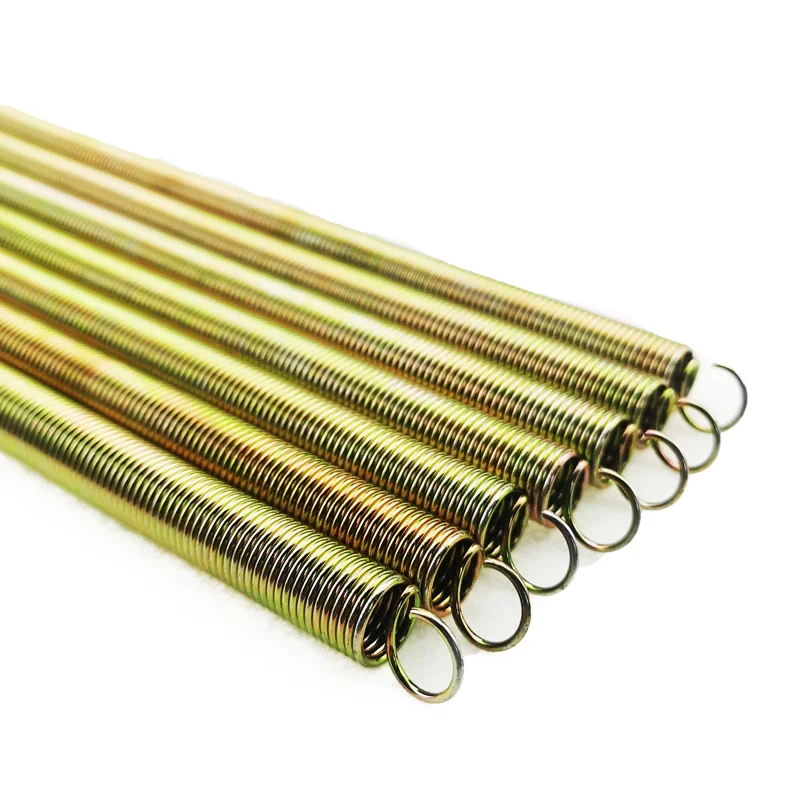
Cover image: an AI-generated illustration of a generic dishwasher, based on a photo of extension springs we make; it does not show a specific brand or its exact spring layout.
Dishwasher door springs are the two extension springs, one on each side of the tub, that counterbalance the weight of the dishwasher door. Each spring pulls on a cable or link that runs to the door hinge, so the door opens under control and stays open where you leave it. AppliancePartsPros puts it simply for a Frigidaire model: the door cable “helps balance the door’s movement with the help of a spring” [1].
This guide is for appliance makers and parts brands who source these springs, and for anyone matching a replacement. For the same job on a heavier door, see our attic ladder springs guide.
Key takeaways
- The springs balance the door’s weight about the hinge. In our 9 kg door model, gravity pulls with 24.7 N·m at fully open, and the two springs follow that curve to within 1.1 N·m between 5 and 85 degrees.
- A door that drops open has too little spring torque; a door that creeps shut has too much. GE’s instructions say exactly that and have both springs set to the same notch [2].
- Custom panels change the spring. GE requires its heavy-duty kit for panels over 4 lb [3]; in our model a 2 kg panel needs about three notches more tension.
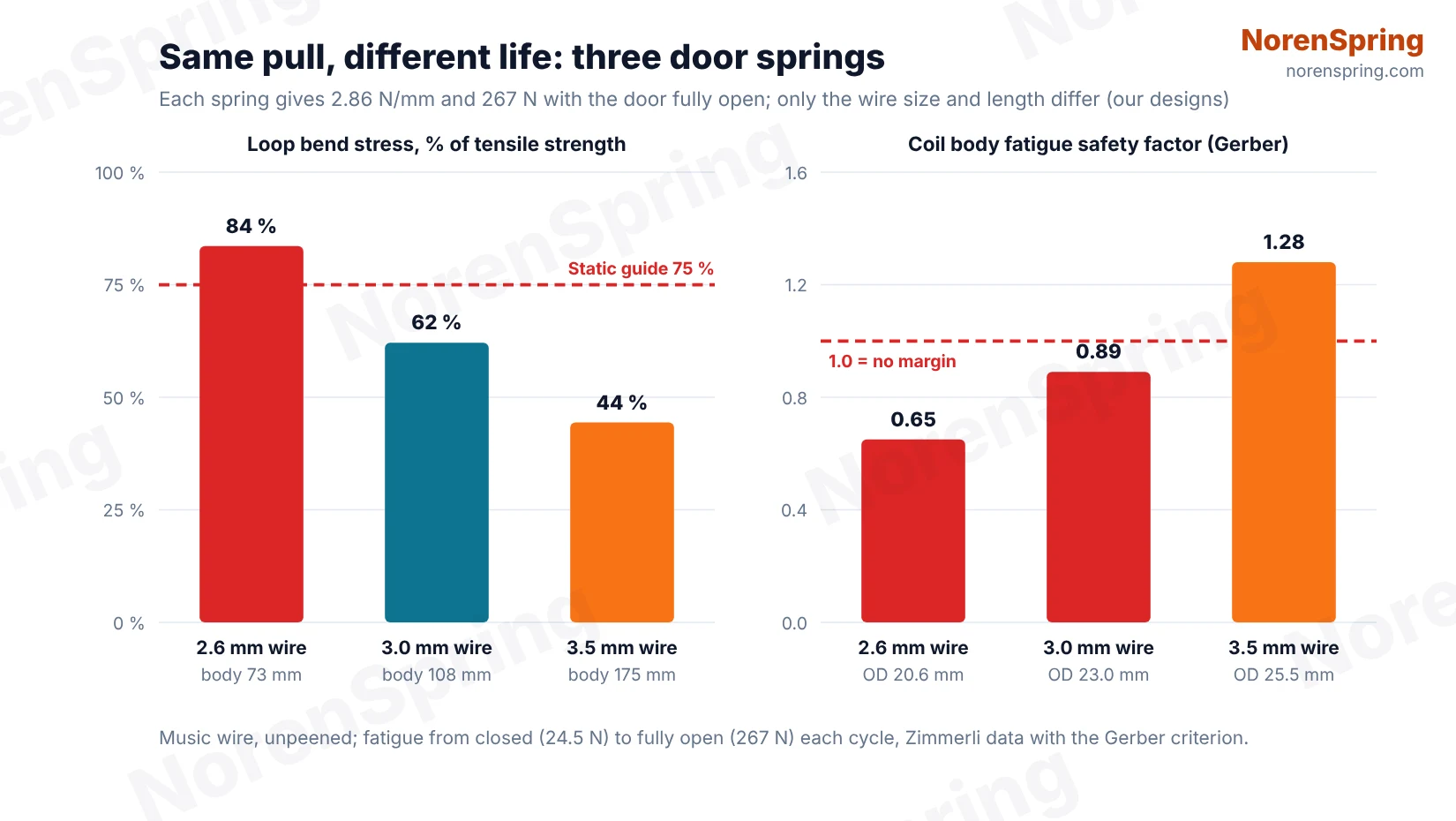
- Matching the pull is not enough. Three springs we designed with the same rate and force have fatigue safety factors of 0.65, 0.89 and 1.28, because the wire size and length differ.
- Specify force at door closed and fully open, plus cycle life, wire, loop shape and finish, so a replacement behaves like the original.
How do dishwasher door springs work?
A dishwasher door is hinged at the bottom. As it opens, its weight acts further and further from the hinge, so the turning moment from gravity rises from zero with the door closed to a maximum with the door flat. The springs must supply a matching moment, or the door falls open or springs shut.
On the GE, Bosch and Frigidaire models cited here, the springs sit low on the sides of the tub. AppliancePartsPros describes the Bosch layout: “The door cable on a Bosch dishwasher connects the door spring to the door hinge, allowing the dishwasher door to open and close properly” [4]. On GE models, the long hook of the spring goes into a notch on a frame bracket, the short hook goes into the cable end, and the cable runs over a pulley to the hinge [2]. GE moved to this side-mounted arrangement for dishwashers “manufactured since March 3rd, 1997”, replacing a front-mounted spring assembly [3].
What happens when a door spring or cable breaks?
With one spring or cable gone, the other side carries the whole door and the door twists as well as drops. AppliancePartsPros puts the symptom plainly: “If your Frigidaire dishwasher door drops open like a trapdoor or feels way too heavy, chances are the door cable snapped” [1]. In the repair guides cited here, the dishwasher is pulled out of its cabinet to reach the springs and cables. For Bosch, the same source recommends replacing both cables “since the kit usually includes both cables for even wearing” [4].
How much force does a dishwasher door spring carry?
To show the numbers, we modelled a door assembly of 9 kg with its centre of gravity 280 mm above the hinge pin. These two figures are our assumptions, not published data for any model. Fully open, gravity pulls the door down with 9 × 9.81 × 0.28 = 24.7 N·m. Each of the two springs supplies half the balancing moment.
In our model each cable is pulled by a crank on the hinge arm, 60 mm from the hinge pin. Its lever arm about the hinge is 42 mm with the door closed, 60 mm at 45 degrees and 42 mm again fully open, and it draws 85 mm of cable out as the door opens. The best fit to the gravity curve is a spring of 2.86 N/mm pulling 24.5 N with the door closed and 267 N (60 lbf) fully open.
The table gives the model at 15 degree steps.
| Door angle (degrees) | Gravity torque (N·m) | Cable pulled out (mm) | Force per spring (N) | Lever arm (mm) | Spring torque, both sides (N·m) |
|---|---|---|---|---|---|
| 0 | 0.0 | 0 | 24 | 42 | 2.1 |
| 15 | 6.4 | 12 | 60 | 52 | 6.2 |
| 30 | 12.4 | 27 | 101 | 58 | 11.7 |
| 45 | 17.5 | 42 | 146 | 60 | 17.5 |
| 60 | 21.4 | 58 | 190 | 58 | 22.0 |
| 75 | 23.9 | 72 | 231 | 52 | 24.0 |
| 90 | 24.7 | 85 | 267 | 42 | 22.6 |
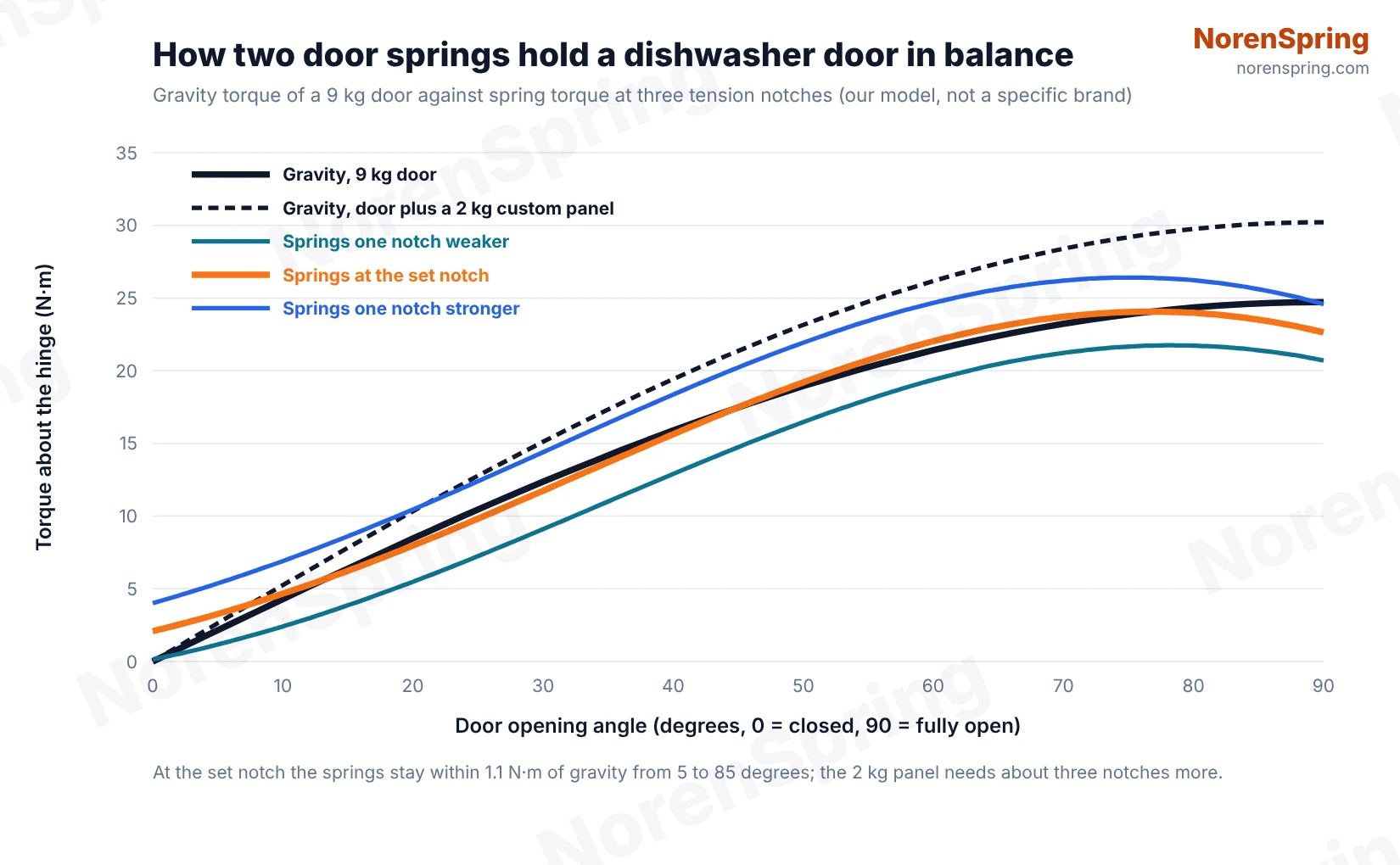
The chart shows what the balance looks like. At the set notch, the spring torque is 2.1 N·m above gravity with the door closed, which pulls the last few degrees shut, and 2.1 N·m below gravity at fully open, so the door rests on its stop. In between, the spring and gravity curves stay within 0.6 N·m at every 10 degree step; whether the door holds still in that band depends on hinge friction, which our model does not include. Samsung’s adjustment guide asks for the same behaviour: the door “should remain stable” when opened to 20 to 30 degrees and when fully open [5].
Why do dishwasher door springs have tension settings?
Spring tension is set by moving the spring’s fixed end. In our model each notch moves the anchor 8 mm, which changes each spring’s pull by 23 N and the door torque fully open by 1.9 N·m. That is enough to turn a door that drops into one that creeps shut.
GE’s trim kit instructions give the test: “If the door tends to drop when released, increase spring tension. If the door tends to close, decrease spring tension.” They also say “both springs must be set to the same position on the side brackets” [2]. Samsung uses two tension screws and asks for both to be turned “simultaneously in the same direction” [5].
Custom panels and heavier doors
Panel-ready dishwashers carry a cabinet-matching front, and the springs have to carry its weight as well. Makers handle this in different ways:
| Maker and document | What it says about panel weight and springs |
|---|---|
| GE, side mounted door springs | Four adjustable positions; panels of 4 lb or less by adjustment, over 4 lb need the GPF100 Heavy Duty Spring Kit [3] |
| Bosch, custom panel installation template | Accepts panels “ranging from 7 to 24 lbs”, but comes from the factory “ready for custom panel door weights from 11 to 18 lbs” [6] |
| Cove (Sub-Zero Group) | Door tension adjusted with a nut after the panel is fitted; “Panel weight cannot exceed 16 lb (7 kg)” [7] |
In our model a 2 kg (4.4 lb) panel adds 5.5 N·m at fully open, about three notches. For panels over 4 lb, GE specifies its separate heavy-duty spring kit instead of more adjustment.
Worked example: a dishwasher door spring for 100,000 cycles
GE says its side-mounted springs are “Life tested for over 20 years at 14 openings per day or over 100,000 full open and close cycles” [3]. Every opening takes the spring from its closed force to its fully open force and back, so the spring is a fatigue part, not a static one. We designed three springs that all give the 2.86 N/mm rate and 267 N fully open force from our model, then checked them with the methods in Shigley’s Mechanical Engineering Design, chapter 10 [8].
| Item | 2.6 mm spring | 3.0 mm spring | 3.5 mm spring (our choice) |
|---|---|---|---|
| Mean coil diameter / outside diameter | 18.0 / 20.6 mm | 20.0 / 23.0 mm | 22.0 / 25.5 mm |
| Active coils, body length | 27.2, 73 mm | 35.1, 108 mm | 48.9, 175 mm |
| Stretch fully open ÷ body length | 1.18 | 0.80 | 0.49 |
| Coil body stress fully open | 44 % of tensile | 33 % | 23 % |
| Loop bend stress fully open | 84 % | 62 % | 44 % |
| Body fatigue safety factor (Gerber) | 0.65 | 0.89 | 1.28 |
All three springs pull the same, so a load test at two lengths would pass all three. The difference is stress. The 2.6 mm spring has to stretch 86 mm on a 73 mm body, and its loop bend reaches 84 % of tensile strength, above the 75 % static guide in Shigley’s Table 10-7 [8]. Under repeated loading its coil body has a fatigue safety factor of 0.65 against Zimmerli’s infinite-life data, and we would not release a door spring below 1.0 on that check.
The 3.5 mm spring spreads the same stretch over a 175 mm body. We used music wire (about 1,844 MPa minimum tensile strength at 3.5 mm, from Shigley’s Table 10-4), Zimmerli’s endurance data for unpeened springs (241 MPa alternating, 379 MPa mean) and the Gerber criterion. The coil body swings between 40 and 432 MPa each cycle and the fatigue safety factor is 1.28. Zimmerli’s values are for infinite life, so this is a conservative check against 100,000 cycles. The loop bend at 44 % of tensile strength is the next place to watch. We would prove the loops with a cycle test on finished springs; GE’s 100,000 cycle figure also comes from a life test.
The initial tension is kept light, 20 N, so the coils are already open with the door closed. That is below the range Shigley’s Fig. 10-7c marks as preferred for this index, and it is a choice the spring maker and the appliance designer agree on.
Dishwasher door spring or detergent lid spring?
Searches for “dishwasher spring” also cover a much smaller part: the spring in the detergent dispenser. AppliancePartsPros describes Whirlpool’s detergent lid spring (WP8066018) as “responsible for providing the necessary tension to open and close the detergent dispenser lid during the wash cycle” [9]. It lists the symptoms of a bad one as a lid “not opening during the cycle” and “Inconsistent or incomplete release of detergent” [9].
Dispenser springs are small parts that sit in hot water and detergent, so corrosion resistance matters as much as force. For that kind of part, see our small torsion springs guide and stainless steel springs guide.
Signs that dishwasher door springs need replacing
- The door drops open as soon as the latch releases, or feels much heavier than before.
- The door springs back up or will not stay open at about 20 to 30 degrees.
- The door sits crooked or rubs on one side, because one spring or cable is broken or set to a different notch.
- You hear a snap when opening the door, or see a loose cable or a spring hanging from one hook.
- A cable has jumped off its pulley. GE warns to check that the cable “has not slipped over the pulley shoulder and onto the axle” before adjusting tension [2].
Replacing the springs means pulling the dishwasher out of its cabinet, so water and power must be turned off first. AppliancePartsPros starts with “Always power off and unplug your appliance or switch off the circuit breaker” [10]. GE adds that the dishwasher “will tip forward when the door is opened” once it is out of the cabinet, so hold it at the top [2]. Use the spring kit listed for your model number.
What to specify when ordering dishwasher door springs
For an appliance maker or a parts brand, a dishwasher door spring drawing should carry the items in our extension spring specification guide, with these points made explicit:
- Force at two installed lengths: door closed and door fully open, each with a tolerance. Our example would read 24.5 N and 267 N.
- Rate, because it sets how the force changes between the two lengths.
- Cycle life and test method, for example 100,000 full open and close cycles on a fixture that copies the hinge stroke.
- Wire diameter and material. Music wire with plating, oil-tempered wire or 302 stainless, depending on how wet the base area gets.
- Outside diameter and body length, so the spring clears the tub, hoses and wiring. GE asks installers to check that the springs “do not contact water line, fill hose, wiring or other components” [2].
- Loop types and lengths at each end, such as a long hook for the frame notch and a short hook for the cable end, with their orientation.
- Initial tension with a range, since it sets the force near the closed position.
- Finish: zinc plating, black oxide or passivated stainless. See our spring finishes guide.
- Pair matching: both springs in a kit from the same batch, with load test records at both lengths.
For the 3.5 mm spring above, the key lines of the drawing would look like this. The tolerances are our example values, to agree with the appliance maker.
| Drawing item | Example value |
|---|---|
| Wire | 3.5 mm music wire (ASTM A228), zinc plated |
| Outside diameter | 25.5 mm maximum |
| Active coils, body | 48.9, close wound, 175 mm body |
| Rate | 2.86 N/mm ± 10 % |
| Initial tension | 20 N ± 5 N |
| Force, door closed (1.6 mm extension) | 24.5 N |
| Force, door fully open (86.4 mm extension) | 267 N ± 8 % |
| Cycle test | 100,000 cycles over the full stroke, then force at both lengths rechecked |
Send your hinge geometry, door weight range and the two installed lengths through our contact page, and our engineers will review the spring and its cycle life. Our extension springs page shows the loops and finishes we make, and you can read more about our company and its certifications. If a spring has already failed, our guide to why springs fail shows how to read a broken end. This guide was compiled by our editorial team with our spring engineers.
FAQ
What do the springs on a dishwasher door do?
They counterbalance the door’s weight about its bottom hinge, through a cable or link on each side. The door then opens under control, stays at partly open positions and rests fully open without slamming down.
Why does my dishwasher door fall open?
Usually a spring or cable has broken, a cable has come off its pulley, or the springs are set too weak. GE’s instructions say to increase spring tension if the door “tends to drop when released” [2].
Should I replace both dishwasher door springs?
Yes. The two springs share the door’s weight, so a new spring beside an old one pulls unevenly and can twist the door. Kits are usually sold for both sides; the Bosch cable kit described by AppliancePartsPros includes both cables [4].
Do custom panel dishwashers need different springs?
Often, yes. GE requires its GPF100 heavy-duty spring kit for panels over 4 lb [3], and Bosch ships its panel-ready model set for panels of 11 to 18 lb [6]. Weigh the panel before fitting it.
Can I use any extension spring of the same length?
Not safely. Springs of the same length can pull very differently, and even springs that pull the same can differ in fatigue life, as our three designs show. Use the kit listed for your model, or for production parts, specify force at two lengths and the cycle life.
Sources
- AppliancePartsPros, “How to Install Door Cable 154756401 on a Frigidaire Dishwasher”. appliancepartspros.com
- GE Appliances, GPF825 series trim kit installation instructions (custom panel and door springs). canadianappliance.ca
- GE Appliances, “Dishwasher – Side Mounted Door Springs”. products.geappliances.com
- AppliancePartsPros, “How to replace the door cable on a Bosch dishwasher”. appliancepartspros.com
- Samsung, “Adjust the door on your Samsung dishwasher”. samsung.com
- Bosch, custom panel installation template, document 9001568307 B. media3.bosch-home.com
- Sub-Zero, Wolf and Cove, “Cove Dishwasher Door Tension Adjustment”. subzero-wolf.com
- Shigley’s Mechanical Engineering Design, chapter 10 lecture slides (mechanical springs), Istanbul Technical University. web.itu.edu.tr
- AppliancePartsPros, Whirlpool WP8066018 detergent lid spring. appliancepartspros.com
- AppliancePartsPros, “How to replace door cable and spring kit on a GE dishwasher”. appliancepartspros.com



