










In this article
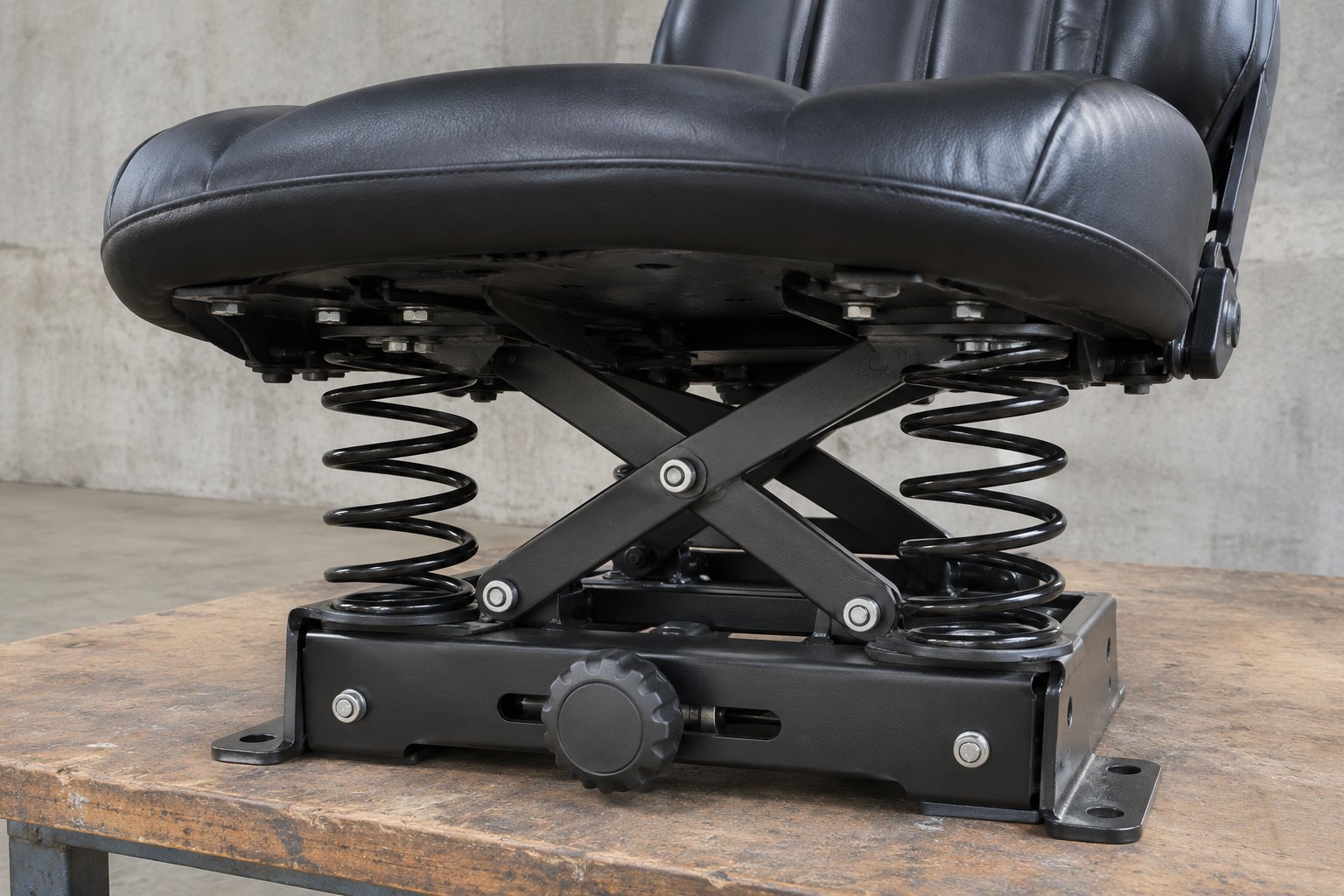
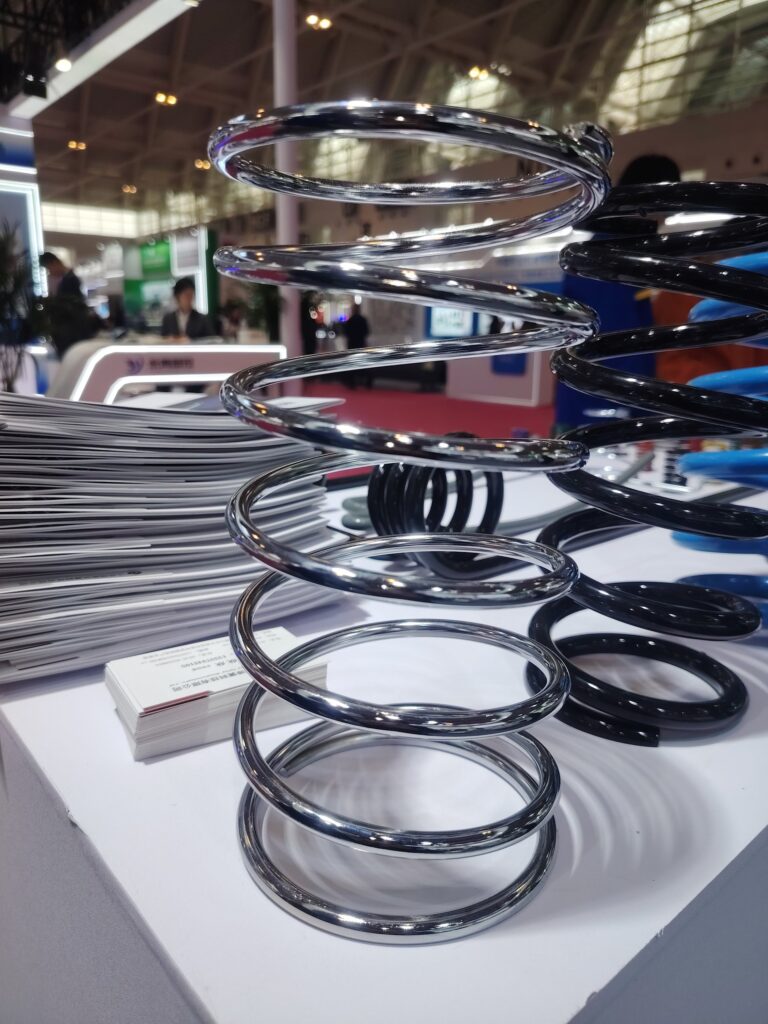
Cover image: an AI-generated illustration of a generic mechanical suspension seat, based on a photo of compression springs we make; it does not show a specific brand’s seat.
A tractor seat spring is the coil spring that carries the driver’s weight in a tractor’s suspension seat. Together with a damper and a linkage, it decides how much of the cab floor’s vibration reaches the driver’s back. Field measurements on a tractor seat found that vertical vibration peaked “between 2 and 5 Hz” and again “around 12.5 Hz” [1], so the spring has to make the seat soft at frequencies that low.
This guide is for seat and tractor makers who source seat springs, and for owners whose seat spring has broken and is not sold on its own. It covers how the spring sets the seat’s natural frequency, why that frequency forces a long spring and a weight adjuster, and a worked design for operators from 55 to 98 kg. For a similar problem on a motorcycle, see our motorcycle seat springs guide.
Key takeaways
- A seat only isolates vibration above about 1.4 times its natural frequency. Below that, the spring passes the vibration through or amplifies it.
- Low frequency means a big static deflection. A seat tuned to 2 Hz sinks 62 mm under the driver’s weight; at 1.5 Hz it sinks 110 mm. The deflection is set by the frequency alone: δ = g / (2πf)².
- One spring does not suit every driver. In our example, the same spring gives 2.03 Hz for a 55 kg operator and 1.62 Hz for a 98 kg operator. At 2.5 Hz the light operator gets 1.37 times the floor vibration, the heavy one 0.81 times.
- The weight adjuster sets ride height, not frequency. It changes preload, so the seat sits mid-stroke for every driver, but the rate and the frequency stay the same.
- A replacement can be made from measurements. Free length, outside diameter, wire size, coil count, end type and the force at a known length are enough to quote a seat spring.
Why tractor seat vibration matters
European law sets limits for whole-body vibration at work. Directive 2002/44/EC sets a daily whole-body vibration exposure limit value of “1,15 m/s2” and an action value of “0,5 m/s2”, both standardised to an eight-hour day [3]. In Great Britain the Control of Vibration at Work Regulations 2005 apply the same figures, and HSE notes a “further transitional period to 2014 for Agriculture and Forestry sectors” [4].
The seat is the last part between the floor and the driver, and its spring sets how soft it is. Seat maker GRAMMER states the design aim: “The lower the natural frequency of the seat suspension, the greater the comfort for you as the driver” [5]. A 1983 review of tractor seat testing put a number on it: “it is highly evaluated that the natural frequency is less than 2 Hz” [2].
Types of tractor seat suspension
- Spring seats on a single coil or pivot. Some older tractors hang the seat pan on one large spring. A replacement spring for Farmall tractors, for example, is listed with a “13-1/4″ free length”, “3/8″ wire diameter” and an “8-5/8″ big end outside diameter”, described as a “Heavy spring for heavyweight operator” [6].
- Mechanical suspension seats. A scissor or parallel linkage guides the seat up and down, coil springs carry the load, a damper controls rebound, and a knob changes spring preload for the driver’s weight.
- Air suspension seats. An air spring replaces the coil spring and a valve sets the ride height automatically. This guide covers the coil spring seats.
Why a seat spring must be soft: natural frequency
A seat on a spring is a mass on a spring. Its natural frequency is f = (1/2π)·√(k/m), where k is the vertical stiffness and m the mass it carries. When the floor shakes faster than about 1.41 times f, the seat moves less than the floor. When it shakes near f, the seat moves more. The Torino field study states the limit for real seats: their effectiveness “is limited to circumstances when the input acceleration (cab floor) frequency is greater than the natural frequency of the seat suspension system” [1].
Low frequency means a long static deflection
The catch is that natural frequency and static deflection are tied together. Under its own load a spring compresses δ = m·g / k, and putting that into the frequency formula gives δ = g / (2πf)². The driver’s mass drops out: any spring that gives the seat a 2 Hz natural frequency sinks 62 mm under the load, whoever sits on it.
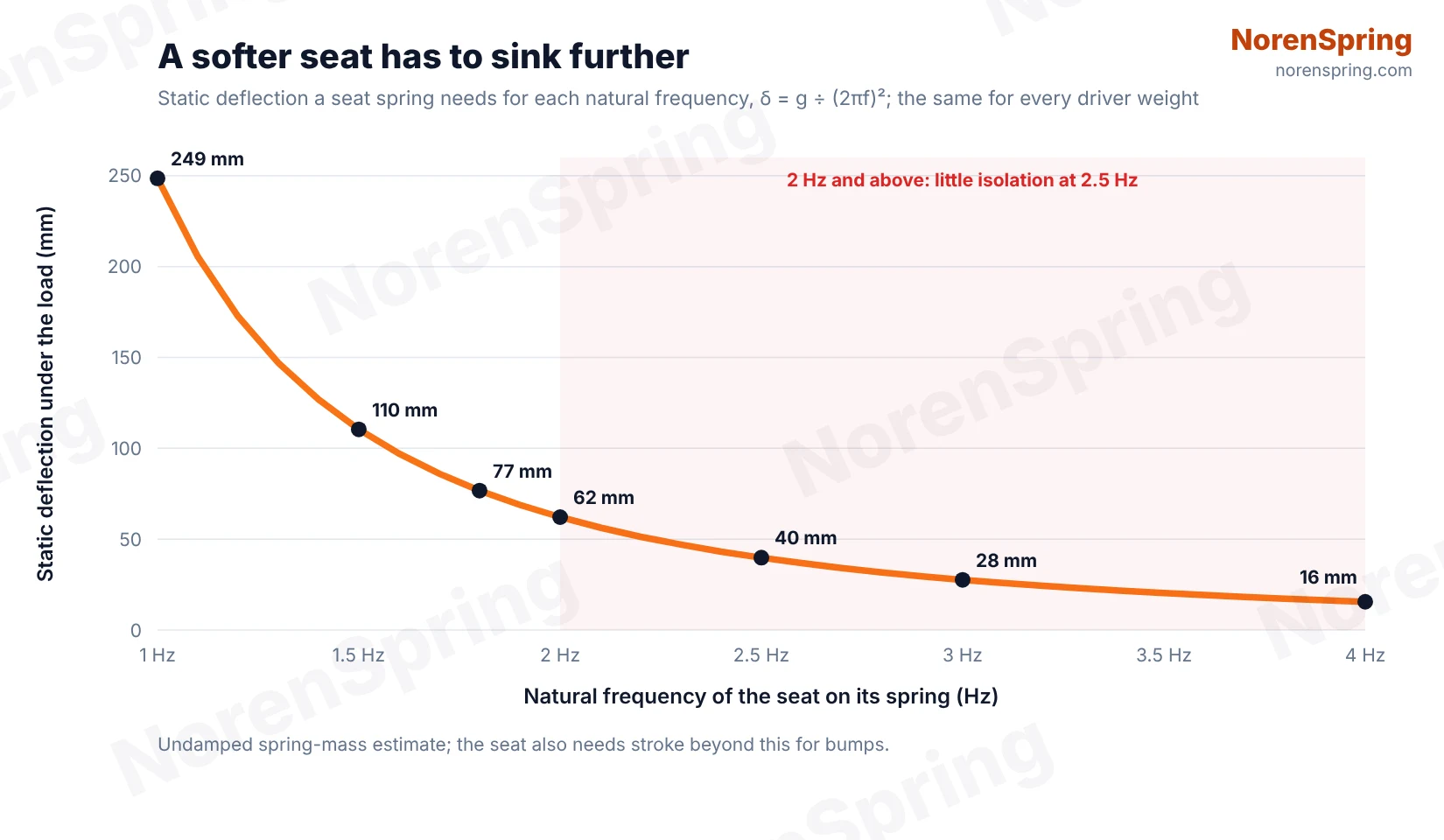
That is why seat springs are long and why the seat needs a weight adjuster. To reach 1.5 Hz the seat must settle 110 mm under the driver and still have travel left for bumps. A short, stiff spring cannot do it: at 4 Hz the seat would settle only 16 mm, and it would pass most of the 2 to 5 Hz vibration straight through.
Worked example: a seat spring for 55 to 98 kg operators
Seat tests use more than one driver weight. The JIRCAS review notes that ISO 5008 “recommends 55 kg and 98 kg ( ± 10%)” test operators [2]. We designed a direct-acting seat with two compression springs, tuned to 1.8 Hz for a 75 kg operator. The table lists our assumptions.
| Input (our example) | Value |
|---|---|
| Suspended seat parts (cushion, pan, upper frame) | 15 kg |
| Share of the operator’s mass carried by the seat | 75 % |
| Design point | 1.8 Hz with a 75 kg operator |
| Damping ratio of the seat damper | 0.30 |
| Working stroke about the ride position | ±40 mm |
The suspended mass at the design point is 15 + 0.75 × 75 = 71.3 kg. For 1.8 Hz the total vertical stiffness is k = m·(2πf)² = 71.3 × (2π × 1.8)² = 9.11 N/mm, or 4.56 N/mm for each of the two springs.
One spring, three drivers
| Operator | Natural frequency | Static deflection | Seat vibration ÷ floor vibration at 2.5 Hz | at 12.5 Hz |
|---|---|---|---|---|
| 55 kg | 2.03 Hz | 60.5 mm | 1.37 | 0.10 |
| 75 kg | 1.80 Hz | 76.7 mm | 1.04 | 0.09 |
| 98 kg | 1.62 Hz | 95.3 mm | 0.81 | 0.08 |
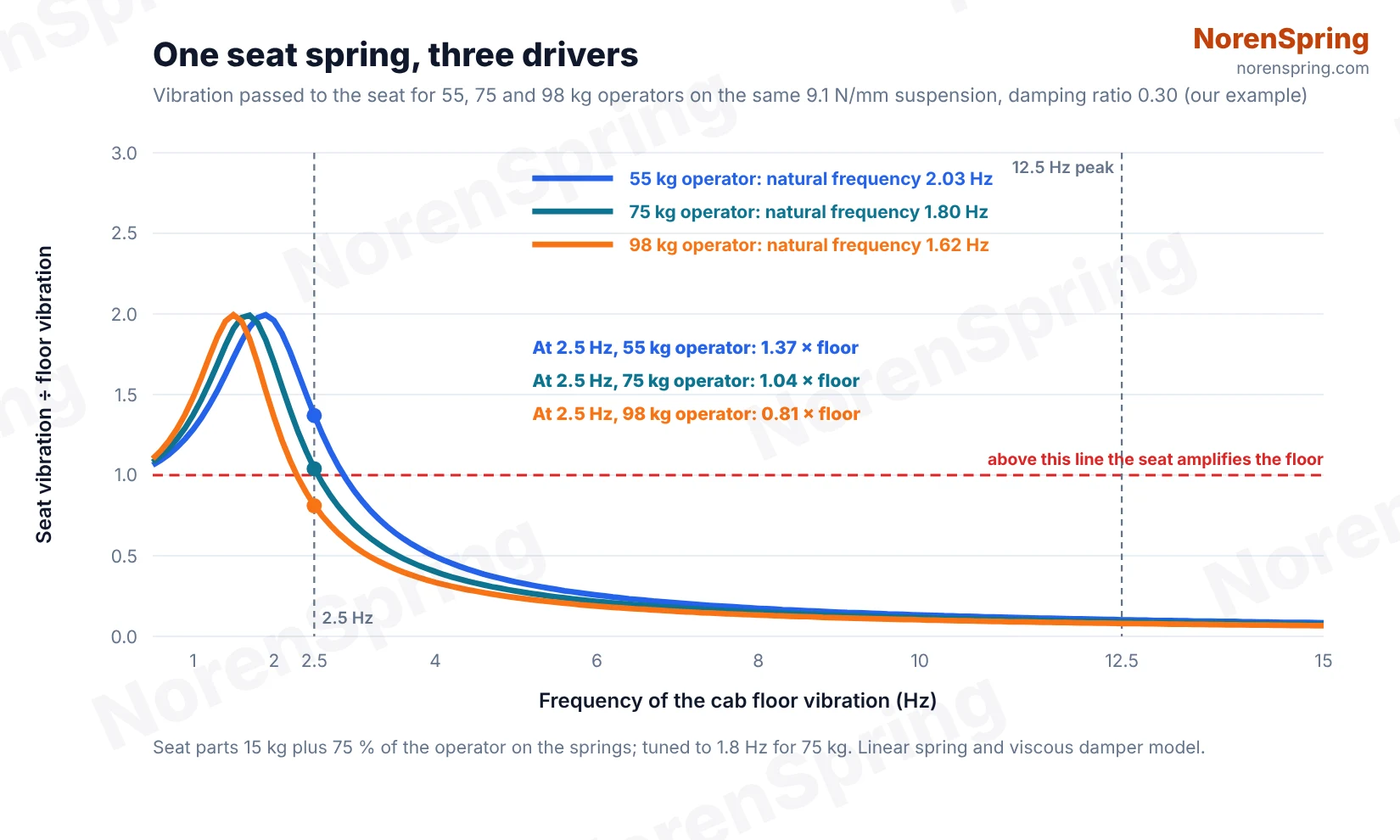
The 12.5 Hz vibration is cut to a tenth for all three drivers. The 2.5 Hz vibration is the problem. The Torino study describes it as “the oscillating main frequency of category A class 2 wheeled tractor (ISO 5007: 2003)” [1]. With our springs, the 98 kg driver gets some isolation at 2.5 Hz, the 75 kg driver almost none, and the 55 kg driver 37 % more vibration than the floor. A spring soft enough for the light driver would let the heavy driver sink 95 mm or more and use up the stroke.
What the weight adjuster does
The static deflection runs from 60.5 mm for the light driver to 95.3 mm for the heavy one, a 35 mm difference. Without an adjuster, the heavy driver would ride near the bottom stop and the light driver near the top. The adjuster changes the spring preload so that every driver sits at mid-stroke. It does not change the spring rate, so it does not change the natural frequency in the table. Our spring preload guide covers the idea.
Sizing the spring
| Property (our design, each of two springs) | Value |
|---|---|
| Wire | 6.0 mm oil-tempered (ASTM A229 class) |
| Outside diameter / mean diameter | 60 mm / 54 mm (spring index 9.0) |
| Active coils | 17.4, plus one closed end coil each end |
| Rate | 4.56 N/mm |
| Force at the ride position | 276 N (55 kg), 349 N (75 kg), 434 N (98 kg) |
| Solid height | 117 mm |
| Free length | 272 mm |
| Force at full bump stroke, 98 kg operator | 616 N, at 135 mm compression |
| Shear stress at full stroke | 456 MPa, 34 % of tensile strength |
| Fatigue safety factor, ±25 mm about ride position, 98 kg | 1.88 unpeened, 2.30 shot peened |
The stress and fatigue checks use the Wahl factor, Shigley’s tensile strength constants for oil-tempered wire and Zimmerli’s fatigue data with the Gerber criterion [9]. The stress is low; the limit on this spring is geometry. Its free length is 5.0 times its mean diameter, close to the 5.26 at which a spring with ground ends on parallel plates starts to buckle, so it needs a guide tube, a centre rod or the seat’s linkage to keep it straight. Our buckling guide explains the limit.
A 272 mm free length takes a lot of height under a seat, and a scissor linkage is one way to shorten the spring. If the linkage makes the spring move 1/i as far as the seat, the spring needs i² times the rate and carries i times the force. With i = 2.5, each spring would need about 28.5 N/mm and 1,085 N at the heavy operator’s ride position, over a much shorter stroke. Our spring rate guide explains the rate formula.
Replacing a tractor seat spring
Some seat springs are not sold separately. One TractorByNet member with a New Holland compact tractor wrote after a seat spring broke: “You have to buy the entire $800 seat!” [8]. The same post lists the measurements: “length: 9-5/8″, spring diam = 1.365″, spring wire diameter = .265″”. That is a good start, and a spring maker needs a few more values:
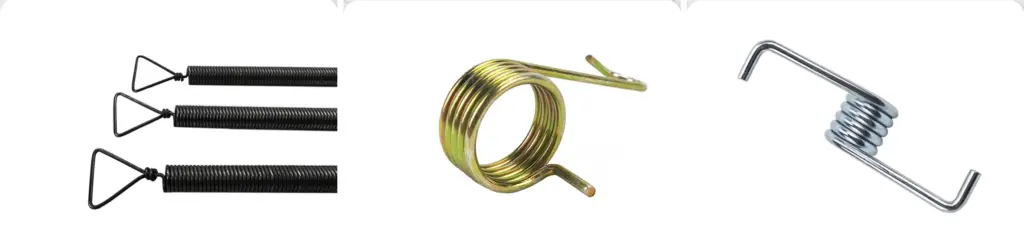
- Free length with the spring removed and unloaded, or the length inside the hooks for an extension spring.
- Outside diameter and wire diameter, measured with calipers on several coils.
- Total coils and the end type: closed and ground, closed only, or hooks and their orientation.
- Force at a known length, if you can measure it. Without it, the rate has to be calculated.
- Material and finish, if known, and whether the old spring took a set (is it shorter than the good one on the other side?).
Check the rate from the dimensions
Published dimensions let you calculate the rate and see whether a substitute is close. John Deere lists its M163357 seat suspension compression spring with a 4.877 mm wire, 39.5 mm outside diameter, 89 mm free length, 46 mm solid length, 8.5 total coils, stainless steel, and a spring rate of 20.78 [7]. With closed ends, 8.5 total coils leaves about 6.5 active, and the rate formula with G = 69 GPa for stainless gives about 18.1 N/mm. That is 13 % below the listed figure, which shows how much the active coil count and the material modulus matter. For a replacement, the force at a measured length on the old spring or a drawing beats any calculation.
Our how to measure a spring guide shows how to take each of these readings.
What to specify for a seat spring
| Item | What to give |
|---|---|
| Operator weight range | for example 55 to 98 kg, or the seat’s weight scale |
| Seat type | direct-acting, scissor (with lever ratio) or pivot |
| Target natural frequency or rate | for example 1.8 Hz at 75 kg, or 4.56 N/mm |
| Forces at two lengths | ride position and full bump stroke |
| Envelope | maximum outside diameter, guide rod or tube size, installed length |
| Ends | closed and ground, or hook type and orientation |
| Material and finish | oil-tempered or chrome silicon wire; powder coat or zinc |
| Fatigue | cycle count and test stroke to agree with the seat maker |
Seat springs from NorenSpring
Agricultural machinery is one of the markets we serve, and we make compression springs and extension springs from wire 0.1 mm to 80 mm, from a drawing or from a sample. Send the seat model, the spring dimensions from the list above or the old spring, and the operator weight range, through our contact page, and our engineers will check the rate, stress and buckling before quoting. Read more about our company and its certifications. This guide was compiled by our editorial team with our spring engineers.
FAQ
How does a tractor seat spring work?
It carries the driver’s weight so the seat can move up and down while the cab floor shakes. Soft enough, it gives the seat a low natural frequency, and vibration above about 1.4 times that frequency is reduced before it reaches the driver.
What is the weight adjustment on a tractor seat?
It changes the preload on the seat spring so the seat sits in the middle of its travel for a light or heavy driver. It does not change the spring rate.
Why does my tractor seat bottom out?
The spring is too soft for the driver, the weight adjuster is set too low, or the spring has lost length. Compare its free length with a new one or the drawing.
Can I replace just the spring in a suspension seat?
Often yes, if you can measure the old spring. A spring maker can make a replacement from its free length, diameters, wire size, coil count, ends and, ideally, its force at a known length.
What natural frequency should a tractor seat have?
Lower is better for comfort. A 1983 review of tractor seat testing rated seats with a natural frequency below 2 Hz highly [2].
Sources
- Calvo, A. et al., “Whole-body vibration: Measurement of horizontal and vertical transmissibility of an agricultural tractor seat”, International Journal of Industrial Ergonomics (2017), preprint, University of Turin. iris.unito.it
- Ishikawa, F. and Kobayashi, K., “Vibration Measurement and Evaluation of Tractor Seats”, JARQ Vol. 16 No. 4 (1983). jircas.go.jp
- Directive 2002/44/EC on exposure of workers to vibration, as adopted. legislation.gov.uk
- HSE, “The Control of Vibration at Work Regulations 2005”. hse.gov.uk
- GRAMMER, MAXIMO Professional tractor seat. grammer.com
- Reliable Aftermarket Parts, 354670R2 seat spring. reliableaftermarketparts.com
- John Deere, M163357 seat suspension compression spring. shop.deere.com
- TractorByNet forum, “Broken seat suspension spring” (2019). tractorbynet.com
- Shigley’s Mechanical Engineering Design, chapter 10 lecture slides (mechanical springs), Istanbul Technical University. web.itu.edu.tr



