










In this article
- Key takeaways
- What are medical springs used for?
- Why are small medical springs hard to hold to a force window?
- Which materials do medical springs use?
- Biocompatibility: does the spring need testing?
- Sterilization and cleaning: what happens to the spring?
- Passivation: how to call it out on a spring drawing
- Where does the spring sit in your quality system?
- How we make and check medical springs
- What to send for a medical spring quote
- Frequently asked questions
- About the authors
- Sources
Cover image: an AI illustration based on a photograph of small compression springs we make, placed in a new setting. The device shown is generic, not a customer product.
Medical springs are the small springs inside medical and drug-delivery devices: the compression spring that drives an insulin pen dose, the spring that fires a lancet, the torsion spring on a hinged cap, the return spring under a button. Most are coiled from fine stainless wire, and many weigh less than a gram. Their job is simple, but the force window is narrow, and every device has to behave the same.
This guide is for device engineers and buyers writing a spring drawing. It covers spring types, materials, fine-wire tolerances, sterilization, passivation and the quality system. If you are looking for a supplier rather than a design guide, see our page on our work as an ISO 13485 medical spring manufacturer.
Key takeaways
- The force window drives the design. On a 0.30 mm stainless spring, a wire just 0.005 mm thicker raises the force by 6.8% in our worked example. Wire diameter is usually the largest single source of force variation.
- Specify force, not only dimensions. Give the load at one or two working lengths with a tolerance, and let the free length or coil count adjust to hit it.
- Stainless 302/304 is the default; 316 and 17-7 PH have their places. ASTM A313 covers stainless spring wire, including austenitic and age-hardenable grades (ASTM A313).
- Your quality system now points straight at ISO 13485. Since February 2, 2026, the FDA’s Quality Management System Regulation incorporates ISO 13485:2016 by reference (FDA QMSR page).
What are medical springs used for?
A medical device spring stores energy and gives it back in a controlled way. The table shows the common jobs and the spring that usually does each one.
| Device function | Typical spring | What matters most |
|---|---|---|
| Dose drive in an injection pen | Precision compression spring | Force at two lengths, consistent from pen to pen |
| Lancet firing | Compression spring | Force at the cocked and fired positions, clearance to solid height |
| Button and trigger return | Small compression or conical spring | Return force, feel, solid height |
| Hinged caps, covers and latches | Torsion spring | Torque at the open and closed angles, leg shape |
| Retraction and tensioning | Extension spring | Initial tension, hook strength |
| Retaining and contacts | Wire forms, clips, battery contact springs | Fit, contact force, plating |
Many small devices also use a detent spring, for example in a dose knob that clicks. Hinged covers on instruments often use the parts in our small torsion springs guide.
The springs in a handheld device are mostly hidden inside a housing. That matters later for biocompatibility and cleaning, so note on the drawing whether the spring touches the patient, the drug path or neither.
Why are small medical springs hard to hold to a force window?
Spring rate is the force needed per millimetre of deflection. It depends on wire diameter to the fourth power and on coil diameter to the third power. The rate formula is k = G·d⁴ / (8·D³·n), where G is the shear modulus of the wire, d the wire diameter, D the mean coil diameter and n the number of active coils. Our spring rate guide explains the formula. On fine wire, a change of a few microns is a large share of the diameter, so force moves more than most drawings expect.
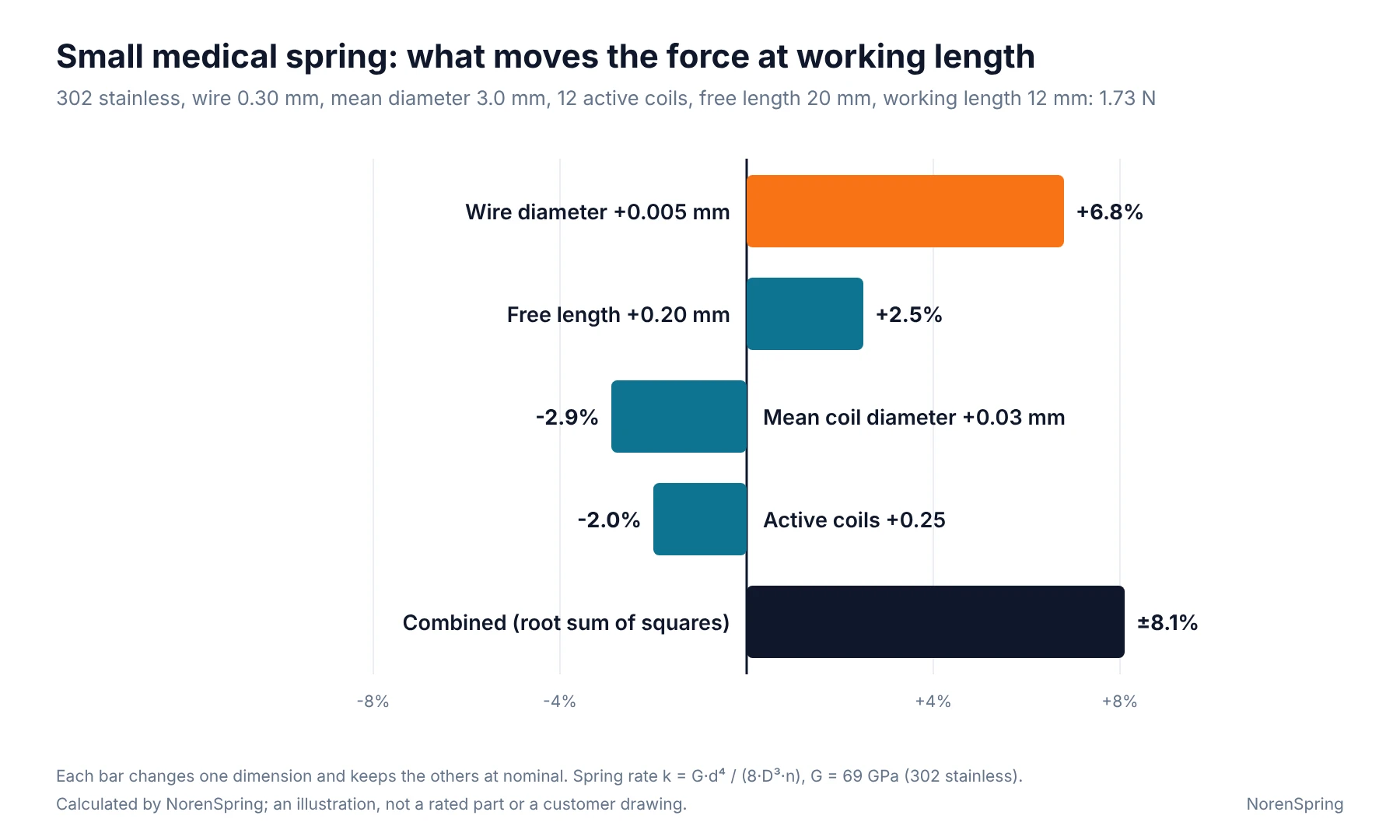
Example scenario (an illustration, not a customer record). A dose spring is coiled from 302 stainless wire, 0.30 mm diameter, with a 3.0 mm mean diameter and 12 active coils. It has a 20 mm free length and works at 12 mm. With G = 69 GPa for 302 stainless, as listed in Shigley’s spring tables and our stainless steel springs guide, the rate is 0.216 N/mm and the force at 12 mm is 1.73 N.
How we calculated it: we changed one dimension at a time, kept the others at nominal, and recalculated the force at 12 mm. Figure 1 shows the result.
| Case | Dimension changed | Force at 12.0 mm | Change from nominal |
|---|---|---|---|
| Nominal | d 0.300 mm, D 3.00 mm, n 12, L0 20.0 mm | 1.73 N | — |
| Thicker wire | d 0.305 mm | 1.84 N | +6.8% |
| Longer free length | L0 20.2 mm | 1.77 N | +2.5% |
| Larger coil | D 3.03 mm | 1.68 N | −2.9% |
| More active coils | n 12.25 | 1.69 N | −2.0% |
Three lessons follow from the numbers:
- Wire diameter dominates. A 0.005 mm change is less than 2% of the wire, but it moves the force by 6.8%. Wire lots vary, so a spring maker has to adjust each lot to hold force.
- Dimensional tolerances alone add up fast. Even these small changes combine to about ±8% by root sum of squares. Tight tolerances on every dimension cost money and still do not guarantee the force.
- Force tolerances work better. Write the load at the working length with a tolerance, for example “1.73 N ±5% at 12.0 mm”, and mark the free length and active coils as reference. That lets the maker tune free length or coils for each wire lot, which is how most precision springs are held to a force window.
Here is how the example spring could be written on a drawing:
| Drawing note | Example value |
|---|---|
| Material | 302 stainless spring wire, ASTM A313; wire 0.30 mm (reference) |
| Load (critical) | 1.73 N ±5% at 12.0 mm |
| Second load, if needed | 2.59 N ±8% at 8.0 mm, the end of the stroke (calculated) |
| Free length | 20.0 mm (reference) |
| Active / total coils | 12 / 14 (reference), ends closed |
| Outside diameter | 3.30 mm ±0.05 mm, to clear a 3.6 mm bore |
| Solid height | 4.2 mm max |
| Finish | Passivate per ASTM A967, citric acid, verify by high humidity test |
| Records | Material certificate per wire lot; load and dimension report per lot |
Also check stress, and check it at the end of the stroke. Our example spring runs at about 559 MPa corrected shear stress at 12 mm, using the Wahl factor of 1.145 for an index of 10. Pushed to 8.0 mm, it gives 2.59 N and reaches about 838 MPa, 50% more. Compare the higher figure with the allowed stress for the wire grade and size, and keep 8.0 mm well clear of the 4.2 mm solid height. Leave margin if the spring is compressed many times, such as in a reusable pen.
Which materials do medical springs use?
Most medical springs are stainless steel, because it needs no plating and resists body fluids, cleaning agents and humidity. The table lists the usual grades. Shear modulus values are from Shigley’s spring tables, the same values used in our stainless guide.
| Grade | Common designations | Shear modulus G | Where it fits |
|---|---|---|---|
| 302 / 304 stainless | UNS S30200 / S30400, EN 1.4310 / 1.4301, ASTM A313 | about 69 GPa | The default for small device springs |
| 316 stainless | UNS S31600, EN 1.4401, ASTM A313 | about 69 GPa | Chlorides or harsh cleaning agents; slightly lower strength than 302/304 |
| 17-7 PH stainless | UNS S17700, EN 1.4568, ASTM A313 | 75.8 GPa | More load in the same space; magnetic after aging |
| Music wire | ASTM A228 | about 81 GPa | Only inside dry, sealed housings with an oil film |
| Titanium alloys | By request | Lower than steel | Lighter or non-ferrous springs; fine sizes confirmed at review |
ASTM A313 is the common specification for stainless spring wire and covers austenitic and age-hardenable grades (ASTM A313). A spring converted from music wire to stainless loses about 15% of its rate at the same size, because G drops from about 81 to 69 GPa, so the design has to be checked again.
Our stainless steel springs guide compares strength, temperature limits and magnetism in detail. Implantable springs are a different category, with implant-grade material specifications of their own, and are outside the scope of this guide.
Biocompatibility: does the spring need testing?
That depends on how the spring contacts the body, and the decision belongs to the device maker. The FDA guidance on ISO 10993-1 applies to devices that come into direct or indirect contact with the human body. It describes a risk-based approach to deciding whether biocompatibility testing is needed (FDA ISO 10993-1 guidance).
For the spring maker, the practical points are:
- Tell us the contact category on the drawing or purchase order, even when it is “no patient contact”.
- Fix the material and process. A biocompatibility assessment is valid for a defined material, finish and cleaning process. Changing any of them can reopen it.
- Ask for lubricant and residue rules. Coiling oil, cleaning agents and packaging all leave residues. If they matter, write the cleaning or residue limit on the drawing.
Sterilization and cleaning: what happens to the spring?
The FDA lists moist heat (steam), dry heat, radiation, ethylene oxide (EtO) gas and vaporized hydrogen peroxide among the ways medical devices are sterilized. It notes that about fifty percent of sterile devices in the U.S. are sterilized with EtO (FDA sterilization page).
A stainless spring itself is rarely the weak point in sterilization. The things to check are around it:
- Moisture and steam. Music wire and plated carbon steel rust. Use stainless if the spring sees steam or repeated cleaning.
- Coatings and lubricants. Some coatings, dry films or greases do not survive steam, radiation or chemical sterilants. Name the sterilization method on the drawing so the finish can be checked.
- Plastic around the spring. Radiation and heat can change the plastic housing that the spring presses on. That changes the installed length and the force, so test the spring in the assembly after sterilization.
Passivation: how to call it out on a spring drawing
Passivation is a chemical treatment that removes free iron and other surface contamination from stainless steel so its protective oxide film forms evenly. Stainless springs are usually passivated after coiling. ASTM A967 covers chemical passivation of stainless steel parts by nitric acid immersion, citric acid immersion or electrochemical treatment. It also lists tests to confirm the result, including water immersion, high humidity, salt spray, copper sulfate and potassium ferricyanide-nitric acid tests (ASTM A967).
A complete callout names three things: the specification, the treatment type and the test. For example, “Passivate per ASTM A967, citric acid treatment, verify by high humidity test.” Passivation does not change the size or color of the wire, so it does not affect the force. Electropolishing does remove metal, so say whether dimensions and loads apply before or after polishing. Our spring finishes guide compares other surface options.
Where does the spring sit in your quality system?
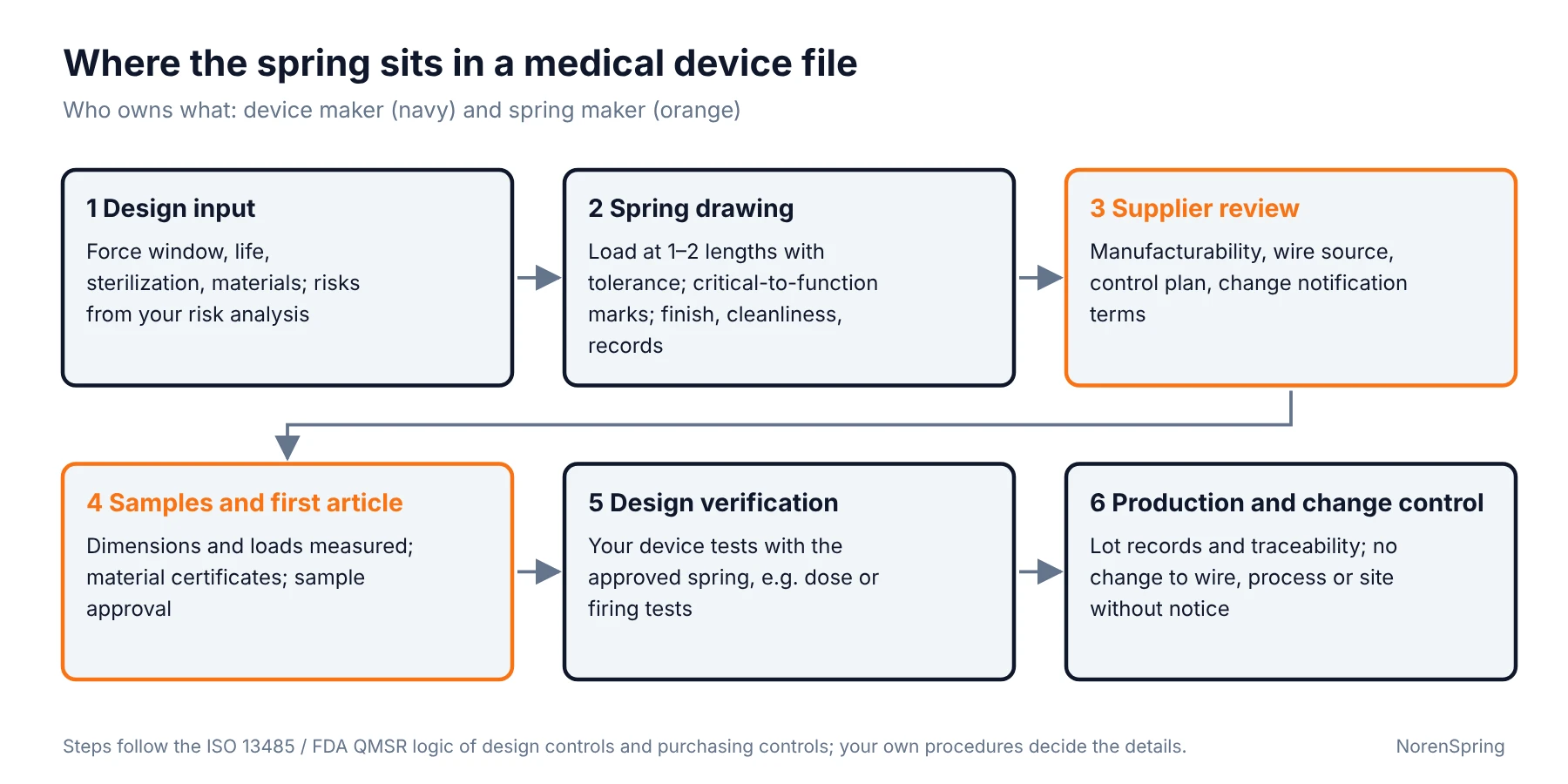
Since February 2, 2026, the FDA’s Quality Management System Regulation has amended 21 CFR Part 820 and incorporates ISO 13485:2016 by reference. The FDA says this harmonizes its device CGMP framework with the one used by other regulators (FDA QMSR page). For a device maker, the spring is a purchased component under ISO 13485-style design and purchasing controls. Figure 2 shows who usually owns each step.
Two items are easy to miss:
- Change notification. Write into the supply agreement that the spring maker must tell you before changing the wire source, process or production site.
- Acceptance plan. Agree which characteristics are checked on every lot, by what method and with what sampling. Our compression spring acceptance plan is a starting template.
How we make and check medical springs
NorenSpring has supplied precision compression springs for insulin pens, where the spring drives the dose mechanism, and for lancet devices, where it fires the lancet. Founded in 2001 in Xuzhou, we have 120+ employees and 28+ engineers, make 4,000,000+ springs a month and export to 60+ countries. Our quality system is certified to ISO 13485:2016, with a certificate scope of design and manufacture of springs for medical devices, valid to March 26, 2028. What we offer for medical springs:
- Wire from 0.1 mm, in stainless 304 and 316 among other materials, coiled on CNC machines.
- Small-part measurement with a Keyence IM-8000 image measuring system for wire diameter, outside diameter, free length and coil count.
- Load testing with JISC and Aikoh spring testers, and an ALGOL automatic tester for production lots.
- Hardness on tiny springs with a Mitutoyo HM-200 micro-Vickers tester, and material confirmation of 304 or 316 with a Thermo Scientific Niton XL2 analyzer.
- Records as agreed at setup: material certificates, sample approval records, inspection reports, dimensional records and traceability.
Prototype and pre-production samples are available, with no fixed MOQ. Lead time is confirmed at quotation. Device design verification, biocompatibility and regulatory submissions remain with the device maker.
What to send for a medical spring quote
- Drawing with revision, critical-to-function characteristics marked, and the spring type.
- Loads: force at one or two working lengths with tolerance, and which dimensions are reference.
- Space: bore and rod diameters, solid height available, and the travel.
- Material and finish: grade, wire standard, passivation callout, cleanliness or residue limits.
- Use conditions: contact category, sterilization method, cleaning, number of cycles.
- Records: certificates, first article or sample approval, inspection data, traceability and retention time.
- Quantities: prototype, pilot and annual volumes.
Send it through our contact page, and our engineers will reply with feedback within 24 hours.
Frequently asked questions
What are medical springs made of?
Most are 302, 304 or 316 stainless steel spring wire, often to ASTM A313. 17-7 PH stainless is used when more strength is needed. Music wire is only suitable inside dry, sealed housings. Titanium alloys are used where a non-ferrous spring is requested.
Are medical springs biocompatible?
A spring is not biocompatible on its own; the device is assessed. Under the FDA’s ISO 10993-1 guidance, the assessment depends on whether and how the device contacts the body, as explained above. Keep the spring’s material, finish and cleaning fixed once the assessment is done.
Can stainless springs be sterilized?
Yes. Stainless steel springs handle steam, radiation and EtO well. Check any coating, lubricant or plastic part around the spring, and test the assembled force after sterilization.
What is the smallest wire you can coil for medical springs?
We coil wire from 0.1 mm. Whether a specific small spring can be made depends on its index, coil count and tolerances, which we confirm at review.
About the authors
This guide was prepared by the NorenSpring engineering team, which designs and manufactures custom springs and wire forms in Xuzhou, China, since 2001. Technical content reviewed by Feng Yulin, General Manager and senior structural engineer, who has 15 years of spring R&D experience and more than 30 national patents. Our ISO 13485 and other certificates are shown on our about page. The product photo is our own; the cover is an AI illustration based on our own product photo. The worked example is a calculation to show the method, not a customer part. Sources were last checked on November 2, 2026.
Sources
- U.S. Food and Drug Administration, Quality Management System Regulation (QMSR). fda.gov. Source for the February 2, 2026 effective date and the incorporation of ISO 13485:2016 into 21 CFR Part 820. Retrieved 2026-11-02.
- U.S. Food and Drug Administration, Use of International Standard ISO 10993-1, guidance. fda.gov. Retrieved 2026-11-02.
- U.S. Food and Drug Administration, Sterilization for Medical Devices. fda.gov. Source for sterilization methods and the share of devices sterilized with EtO. Retrieved 2026-11-02.
- ASTM International, ASTM A313/A313M, Standard Specification for Stainless Steel Spring Wire, scope. astm.org. Retrieved 2026-11-02.
- ASTM International, ASTM A967/A967M, Standard Specification for Chemical Passivation Treatments for Stainless Steel Parts, abstract and scope. astm.org. Retrieved 2026-11-02.
- R. G. Budynas and J. K. Nisbett, Shigley’s Mechanical Engineering Design, 9th edition, McGraw-Hill, 2011, chapter 10 (Mechanical Springs). Source for the spring rate formula, the Wahl factor and the shear modulus of 302 stainless.



