In this article
- Key takeaways for specifying spring tines
- What is a spring tine?
- Where spring tines work
- How to measure a worn or sample tine
- Why small dimension changes matter
- Why spring tines break, and what a replacement should keep
- Replacement spring tines compatible with your machine
- From sample to batch production
- Spring tine RFQ checklist
- Have a worn tine or a drawing?
- Frequently asked questions
- About the authors
- Sources
A replacement spring tine has to do three things: fit the tine bar or rotor arm without modification, flex back and return like the original, and survive a season of stones and heavy swaths. To quote one accurately, a spring manufacturer needs the wire diameter, the coil outside diameter and number of coils on each side, the hand of wind, the leg length and shape, the mounting loop, and the coating colour. A drawing is ideal. A clean sample tine works just as well.
Most baler pickup tines (also sold as baler teeth), hay rake tines (often called rake teeth) and tedder tines are double torsion springs. They look simple, but in our worked example a 0.5 mm change in wire diameter makes a tine a third softer or more than 40% stiffer. This guide explains how a spring tine works, where it fails, how to measure one, and what to put in your inquiry. It follows our guides to custom torsion springs and spring wire materials.
Key takeaways for specifying spring tines
- A tine is a torsion spring. Each tooth flexes on its own coil. Wire size, coil count and coil diameter set how hard it pushes back.
- Measure, don’t estimate. In our worked example, 0.5 mm less wire (5.5 to 5.0 mm, coil OD unchanged) makes the tine about 33% softer. One coil fewer per side makes it about 25% stiffer.
- Hand of wind matters. A tine wound the wrong way opens its coils under load instead of closing them. Record the wind direction of each coil on every sample.
- The coil-to-leg bend is a common crack site. Copy the bend shape there exactly and keep the coating intact.
- A sample is enough to start. We can work from a worn tine, a drawing or a photo with key dimensions.
What is a spring tine?
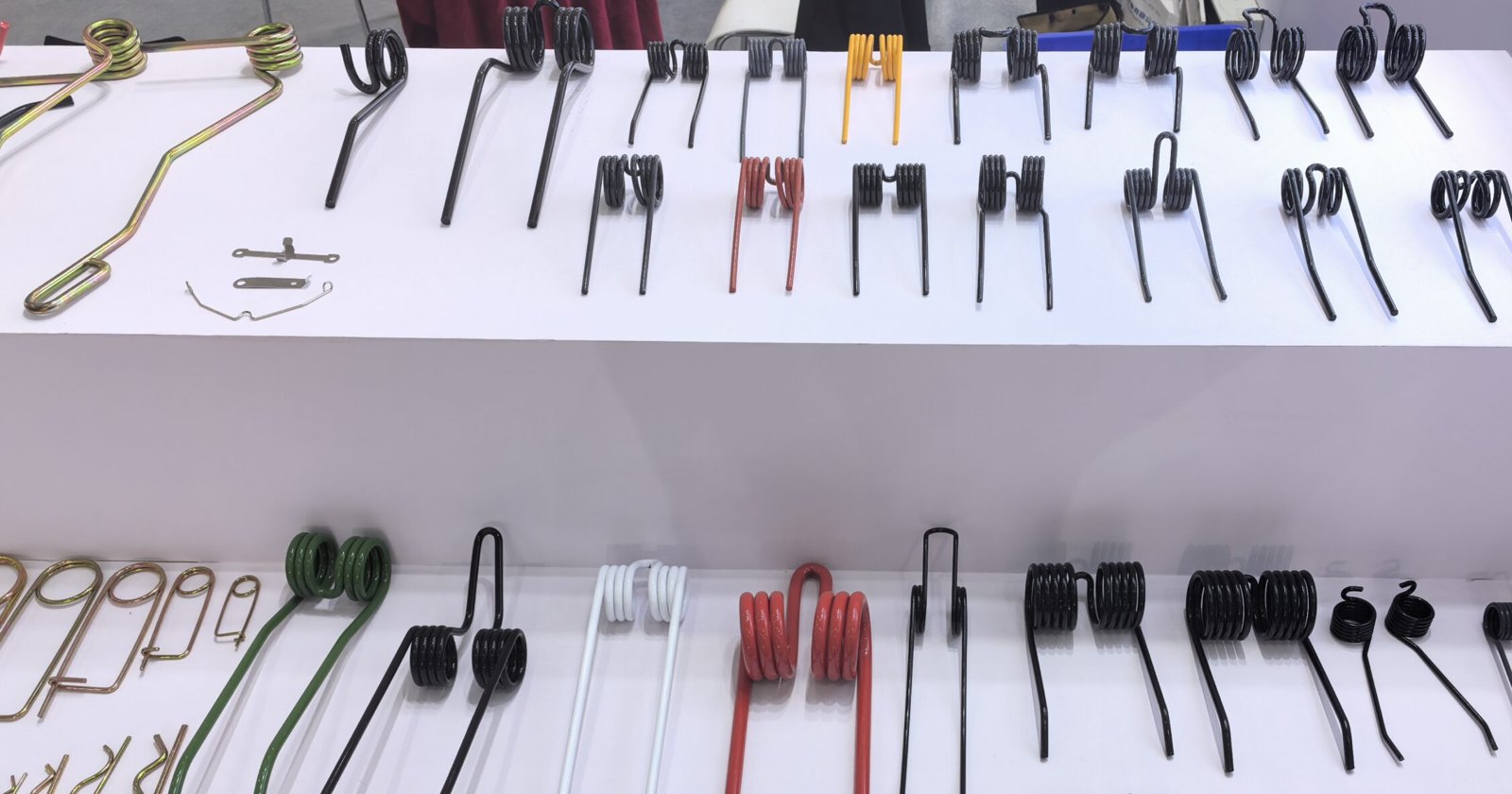
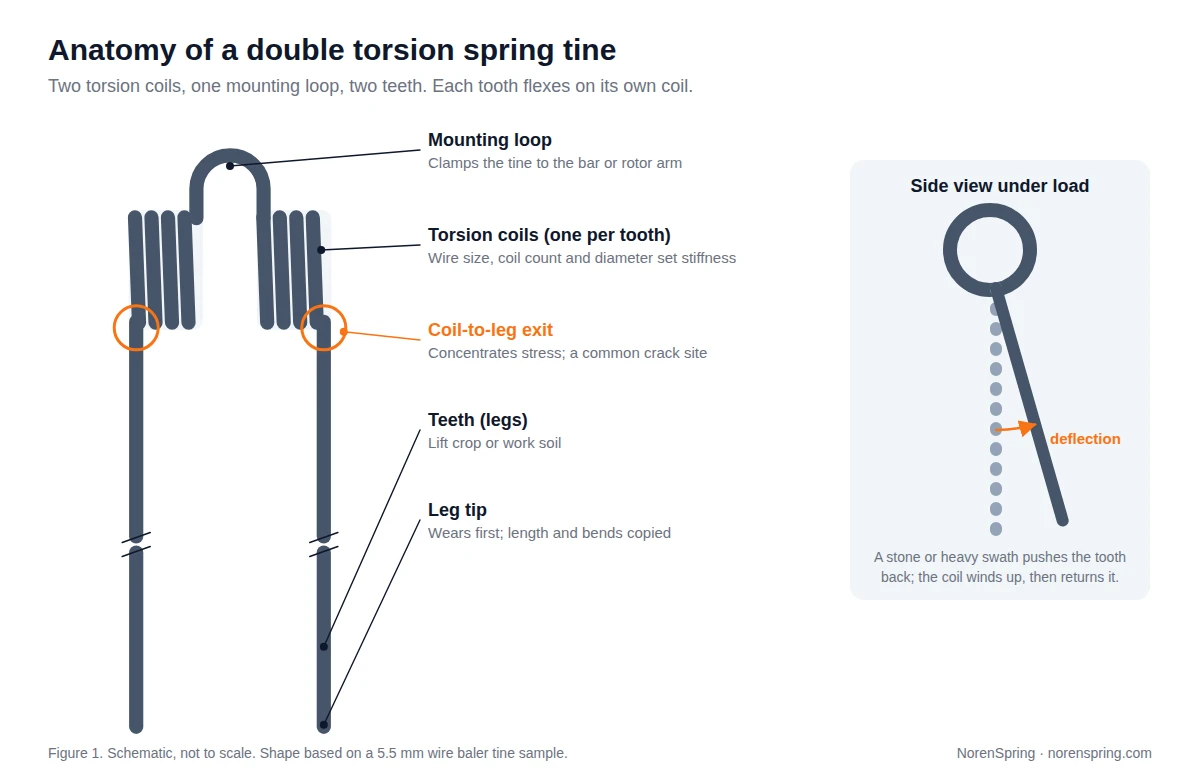
A spring tine is a wire tooth with a torsion coil built into it. The coil lets the tooth swing back when it hits the ground, a stone or a lump of crop, then returns it to its working position. On balers, rakes and tedders, the most common form is the double torsion spring tine: two coils, one per tooth, joined by a mounting loop that clamps to the tine bar or rotor arm.
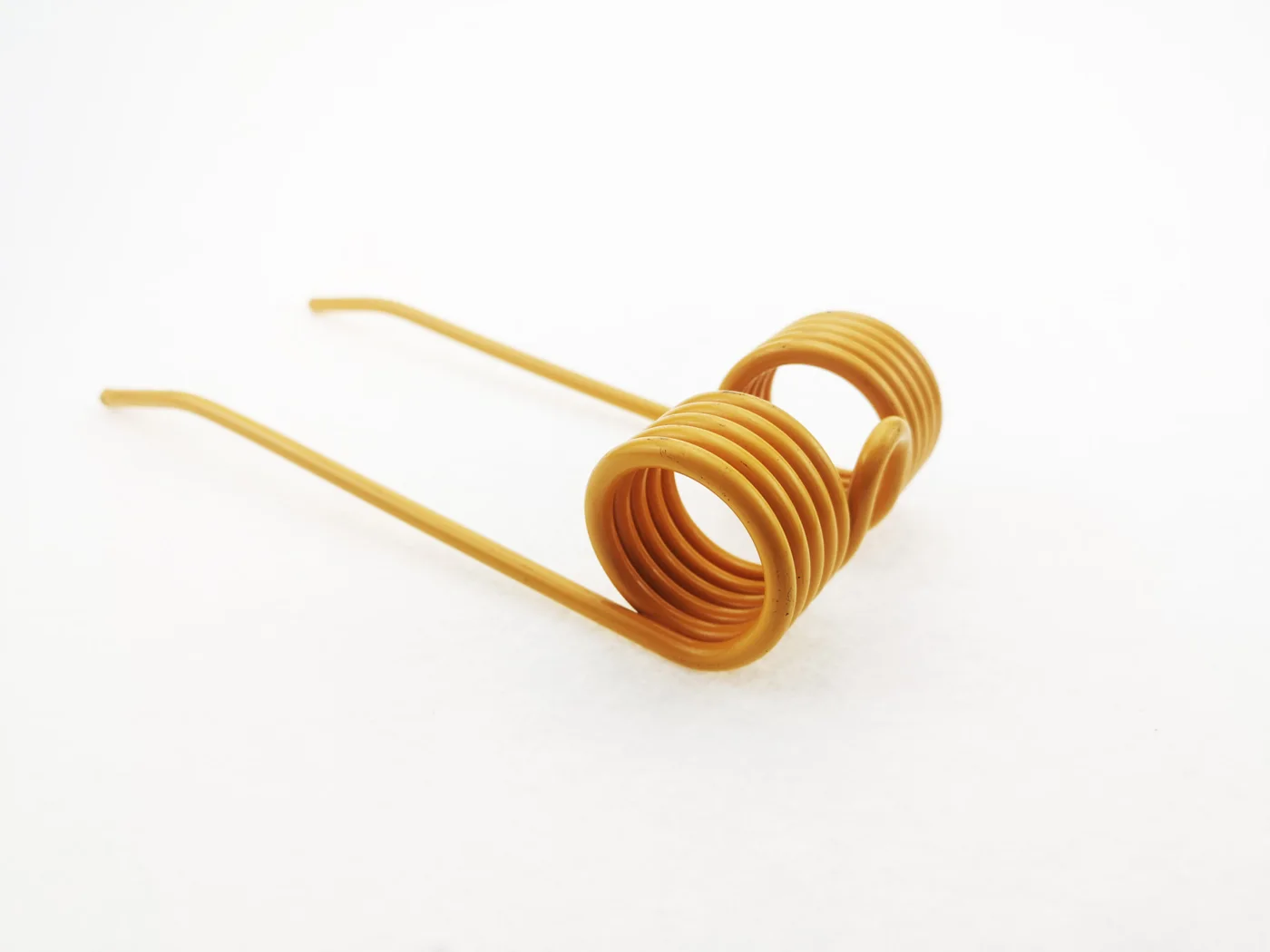
Because each tooth works on its own coil, the two halves behave as two torsion springs that share a mounting point. The stiffness of each half depends on the wire diameter, the mean coil diameter and the number of active coils, as the torsion spring formulas in Shigley’s Mechanical Engineering Design and EN 13906-3 describe. The leg length then sets how much force the tooth tip delivers for a given deflection.
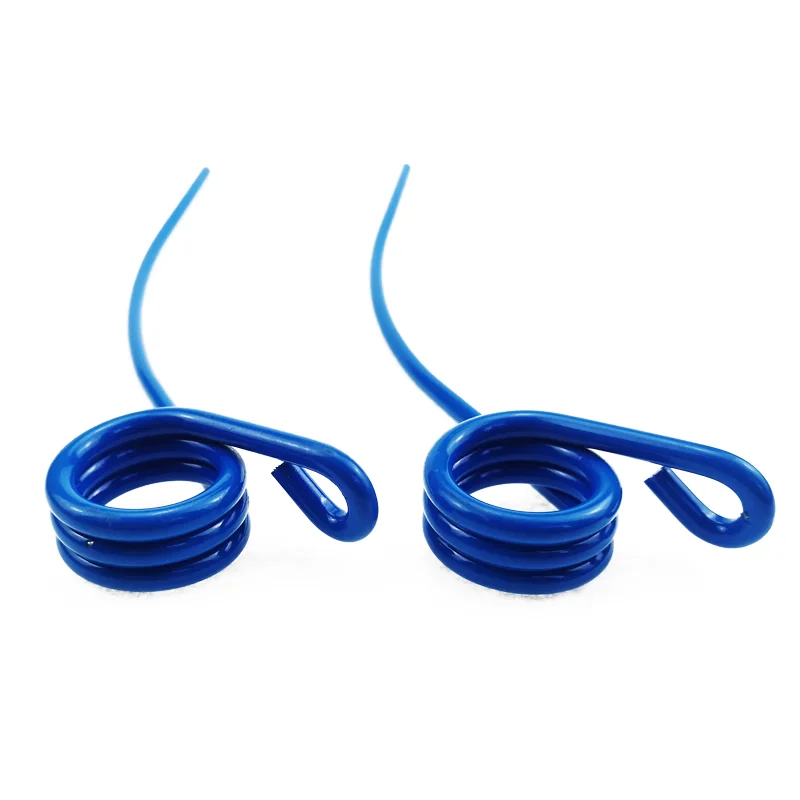
Some machines use single-coil tines instead, with one tooth and a mounting eye, or straight fingers with no coil at all. The measuring method below works for all of them; single-coil parts simply have one coil and one leg to record.
For more background on how torsion coils carry load, see our torsion springs product page.
Where spring tines work
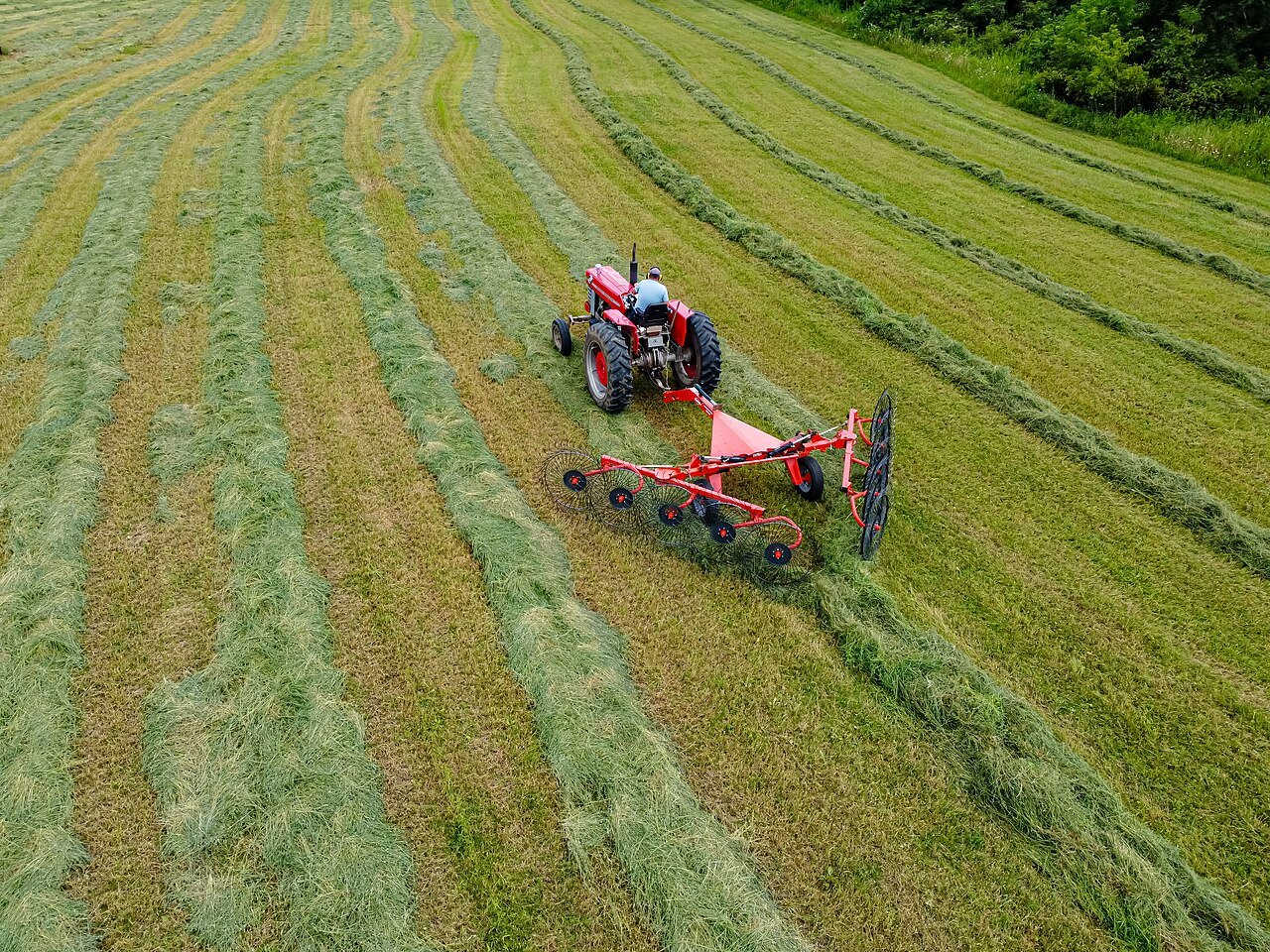
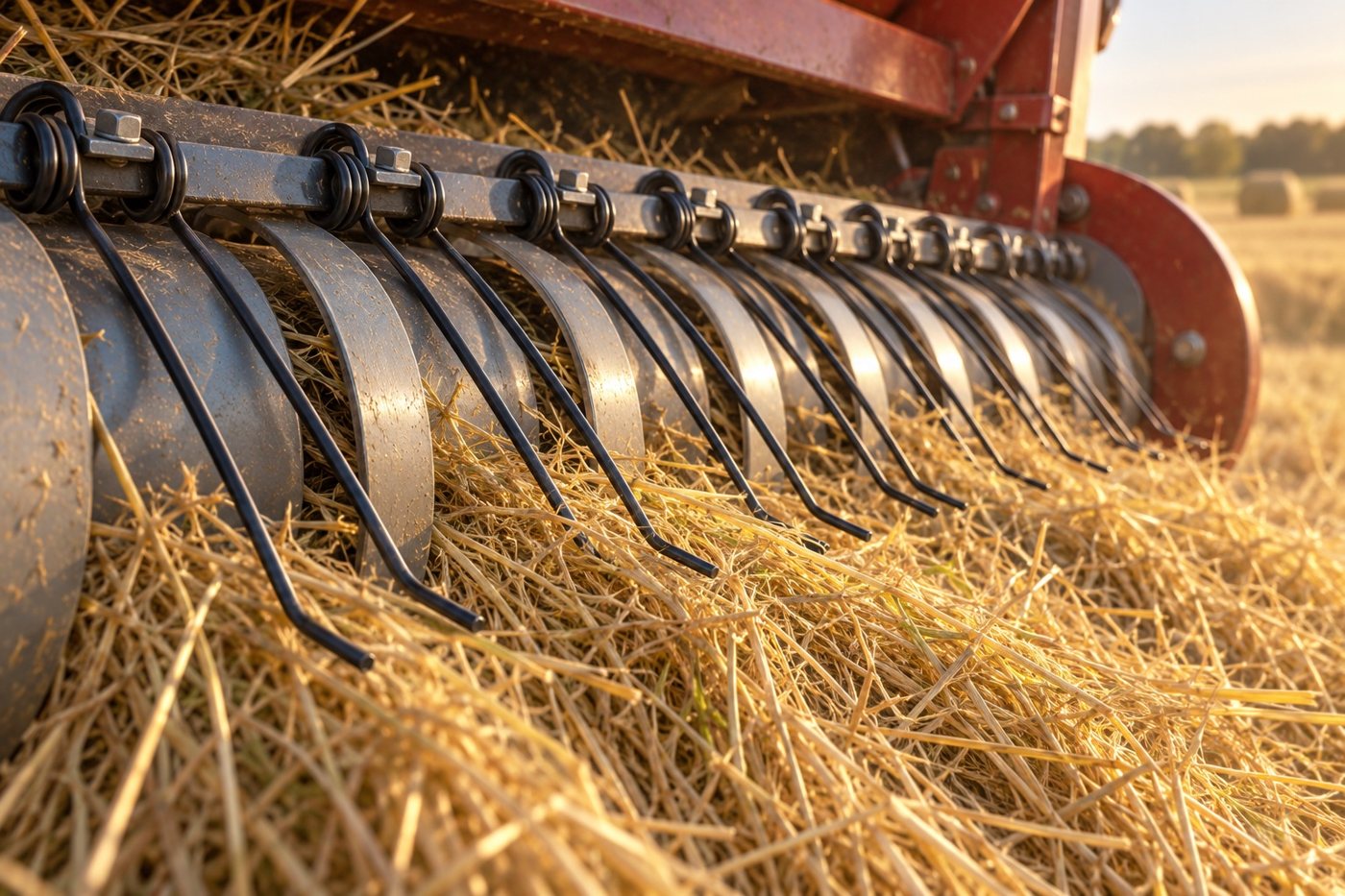
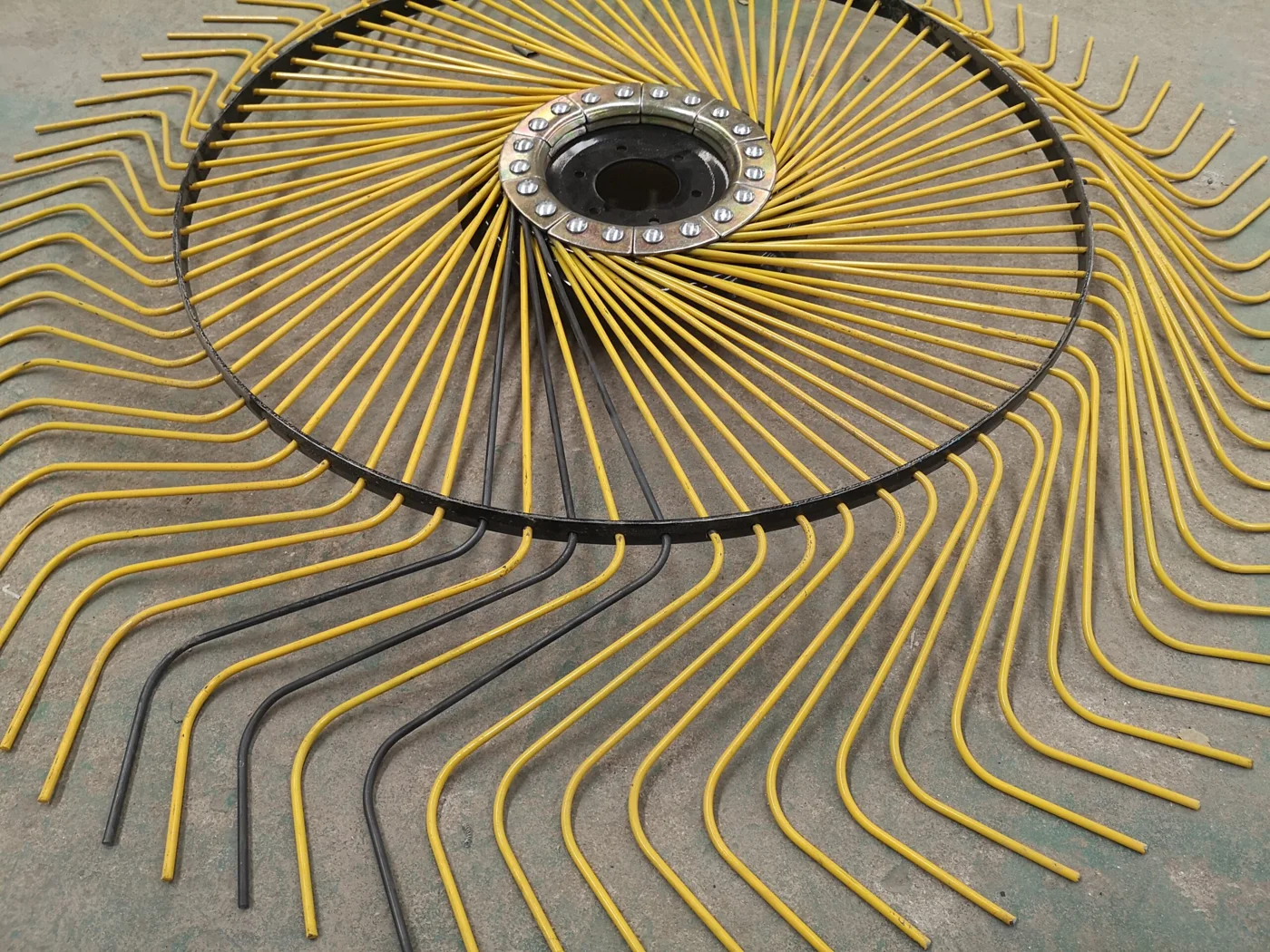
Spring tines appear wherever a machine has to lift, move or comb crop or soil without breaking when it meets an obstacle. The tine shape changes with the job.
| Machine | Typical tine | What the tine does | What to check on a sample |
|---|---|---|---|
| Baler pickup (round, small square, large square) | Double torsion tine, short to medium legs | Lifts the windrow into the baler | Loop size to fit the tine bar; leg length past the guards; coil count |
| Rotary rake | Double tine, long legs, often cranked | Sweeps hay into a windrow | Leg length and crank angle; whether mirrored tines are used on each side |
| Tedder | Double tine, often unequal leg lengths | Spreads and turns hay to dry | Which leg is longer; mounting hole or loop |
| Wheel (finger) rake | Straight or bent fingers fitted to a rim | Rolls hay into a windrow | Finger length and bend; how it fixes to the rim |
| Harrow, cultivator | Single or double coil tine, heavier wire | Works the soil surface, levels, weeds | Wire size; clamp shape; tip form |
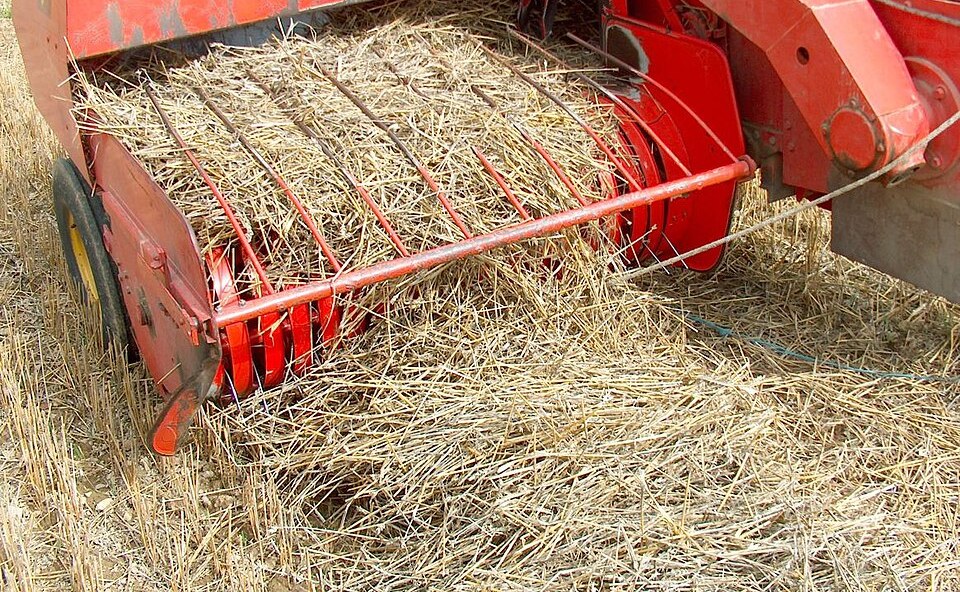
Field maintenance guidance treats tines as wear parts. University of Nebraska–Lincoln’s CropWatch notes that “pick-up teeth on balers and on rakes frequently are broken or bent” and advises replacing defective teeth before the season (UNL CropWatch, 2016). Virginia Cooperative Extension recommends checking pickup components regularly “for missing or bent tines” (Virginia Cooperative Extension, publication 442-454, 2025). It also warns that raking too close to the ground damages tines and adds soil to the forage. That is why dealers and machine builders keep tines in stock ahead of harvest.
Our agricultural machinery spring page covers the other springs on these machines, from cultivator coils to pedal return springs.
How to measure a worn or sample tine
Measure two or three tines from the same position on the machine, and use the least worn one. Tips wear and legs bend in service, so a single tine can mislead. Record each value in millimetres and photograph the tine beside a ruler.
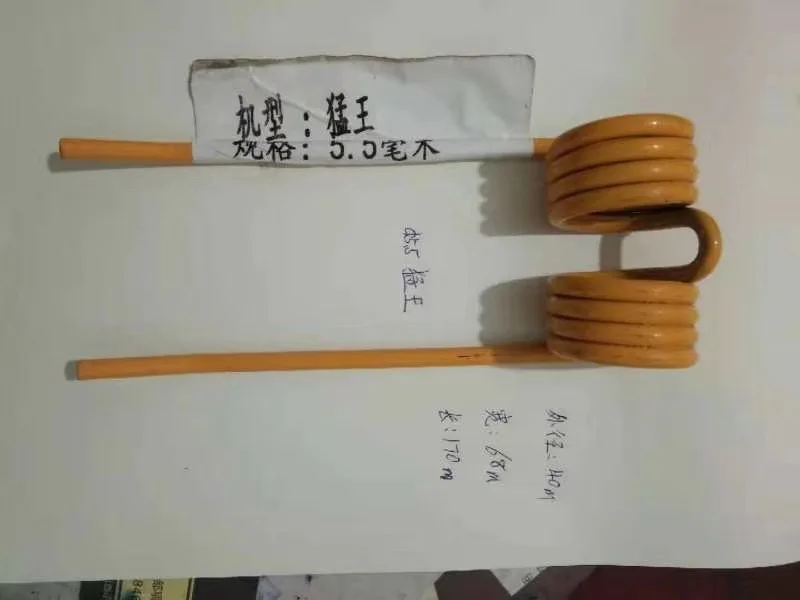
- Wire diameter (A). Use a caliper on a straight part of the leg, away from worn tips and chipped coating. If the tine is coated, scrape a small spot or subtract the coating thickness. Read to 0.1 mm.
- Coil outside diameter (B). Measure across one coil stack at right angles to the wire.
- Width over the coils (C). Measure outside to outside across both stacks. This, with the loop, decides whether the tine fits the bar.
- Leg length (D). Measure from the coil centre line to the tip, for each leg. Tedder and rake tines often have legs of different lengths.
- Mounting loop (E). Record the inside width and height, or the bar, bolt or clamp size it must fit.
- Coils per side (F). Count full turns on each stack, for example 4.5.
- Hand of wind (G). Hold the coil with its axis upright. If the visible strands rise to the right, like a normal screw thread, the coil is right-hand. If they rise to the left, it is left-hand. Record both stacks.
- Leg angle and bends (H). Note the angle between the loop and the teeth, and any crank or bend in the leg. Lay the tine on paper and trace it if you can.
- Coating colour (I). Note the original colour if the replacement must match the machine.
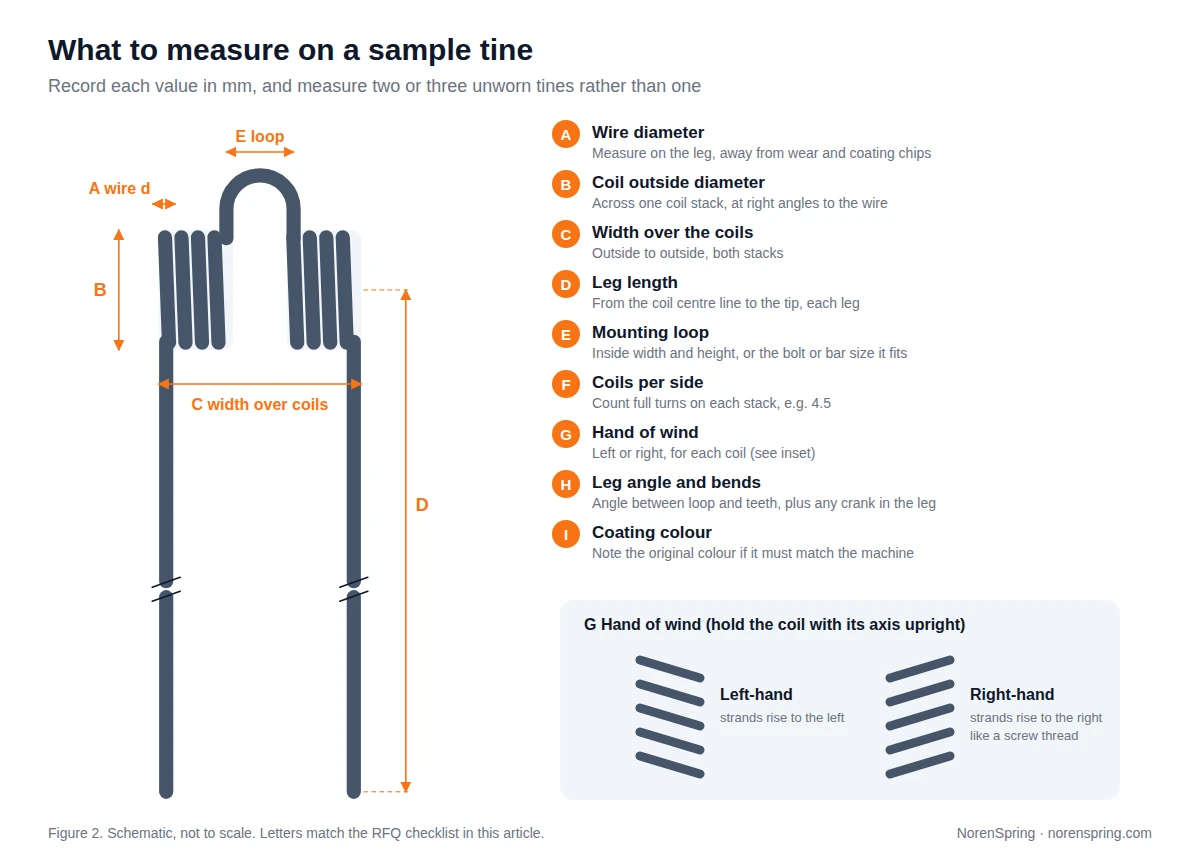
Hand of wind is easy to miss. A torsion spring should be loaded in the direction that winds up, or closes, its coils. Load it the other way and the coil opens, the stress pattern changes and the spring is more likely to fail early. On a double tine, the two coils are usually wound in opposite directions so that both teeth wind up when they are pushed back. Getting one side wrong creates a part that fits but fails early.
Why small dimension changes matter
Torsion spring stiffness rises with the fourth power of wire diameter and falls as the number of coils and the coil diameter grow. That is why a replacement that looks the same can feel much softer or harder on the machine.
To show the effect, we took the sample above (5.5 mm wire, 40 mm coil outside diameter, 4.5 coils per side, 170 mm overall length) and calculated how its torsional rate changes when one dimension changes. We assumed a 150 mm tooth from the coil centre to the tip and a 20 mm leg into the loop. We used the standard formula k = d⁴E / (10.8·D·Na) from Shigley’s Mechanical Engineering Design, with E = 200 GPa and mean coil diameter D = OD − d. Both legs were added to the active coils as (l1 + l2)/(3πD), which gives Na ≈ 5.0. Coil outside diameter was held constant when the wire size changed.
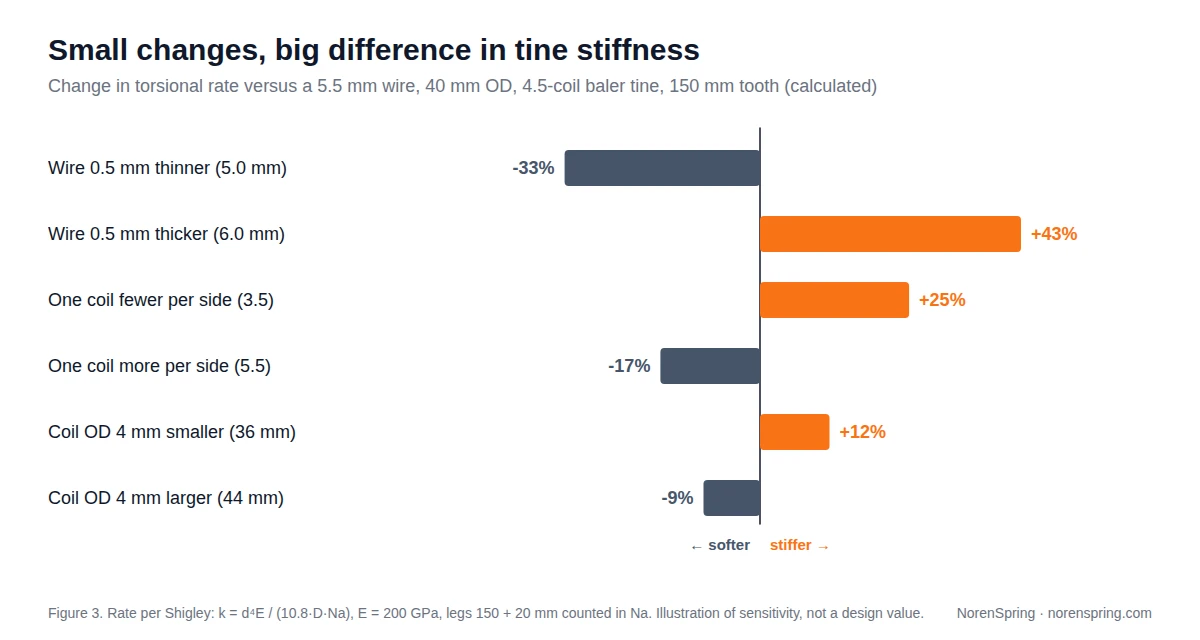
The results:
- Wire 0.5 mm thinner (5.0 mm): about 33% softer. The tooth folds back too easily and leaves crop behind.
- Wire 0.5 mm thicker (6.0 mm): about 43% stiffer. The tooth fights stones instead of yielding, which loads the bar and the coil exit harder.
- One coil fewer per side: about 25% stiffer. One coil more: about 17% softer.
- Coil outside diameter 4 mm smaller: about 12% stiffer. 4 mm larger: about 9% softer.
The base tine has a rate of about 98 N·m per turn. A 10° deflection of one tooth needs about 2.7 N·m of torque, or roughly 18 N at the 150 mm tip. The bending stress at the coil is then about 189 MPa, using Shigley’s inner-fibre bending correction factor (Ki ≈ 1.13 for a spring index of 6.3). These are calculations, not test results. They show why we ask for measured values and, where possible, a physical sample to compare against.
Why spring tines break, and what a replacement should keep
A spring tine fails by fatigue: thousands of small deflections, plus occasional large ones when a tooth hits a stone or digs into the ground. Cracks tend to start where stress is concentrated. On a double tine, that is often the bend where the leg leaves the coil (Figure 1), or a sharp bend in the leg.
Common causes of early tine breakage:
- Running the pickup or rake too low. Teeth strike the ground and stones on every pass. Virginia Cooperative Extension advises setting rake tines above the ground surface for this reason.
- A tight bend at the coil exit. A smaller inside bend radius concentrates stress. A replacement should copy the original radius, not just the overall shape.
- Wrong hand of wind. As above, the coil opens under load and cracks sooner.
- Coating damage and rust. Pits from corrosion become crack starters. Tines sit outdoors between seasons, so the finish matters as much as the steel.
- Overloading with heavy or wet crop. Some breakage is normal wear. If one position on the machine breaks far more often than others, check the setting before changing the tine.
On the ten tine parts listed on our torsion spring and wire form case pages, the wire is 50CrVA or SWOSC-V in sizes from 5 to 12 mm. Finishes include phosphate, black oxide, paint and powder coating; our spring finishes and coatings guide compares how each one holds up outdoors. The right combination for a new part is confirmed at engineering review against the original and the operating conditions.
Replacement spring tines compatible with your machine
Many inquiries start with a machine name rather than a drawing. We make replacement tines compatible with balers and headers from a range of brands. Among them are tines compatible with New Holland 5070, Massey Ferguson 1840 and Hesston by Massey Ferguson 2270XD balers, baler tines compatible with McHale balers, and reel tine springs compatible with Claas Lexion and Tucano headers.
Brand and model names identify compatibility only. NorenSpring is not affiliated with or endorsed by these manufacturers.
A machine name narrows the search, but it is not a specification. Tine designs change between model years and pickup widths, and aftermarket tines differ from OEM parts. We still check a sample or measurements before quoting.
From sample to batch production
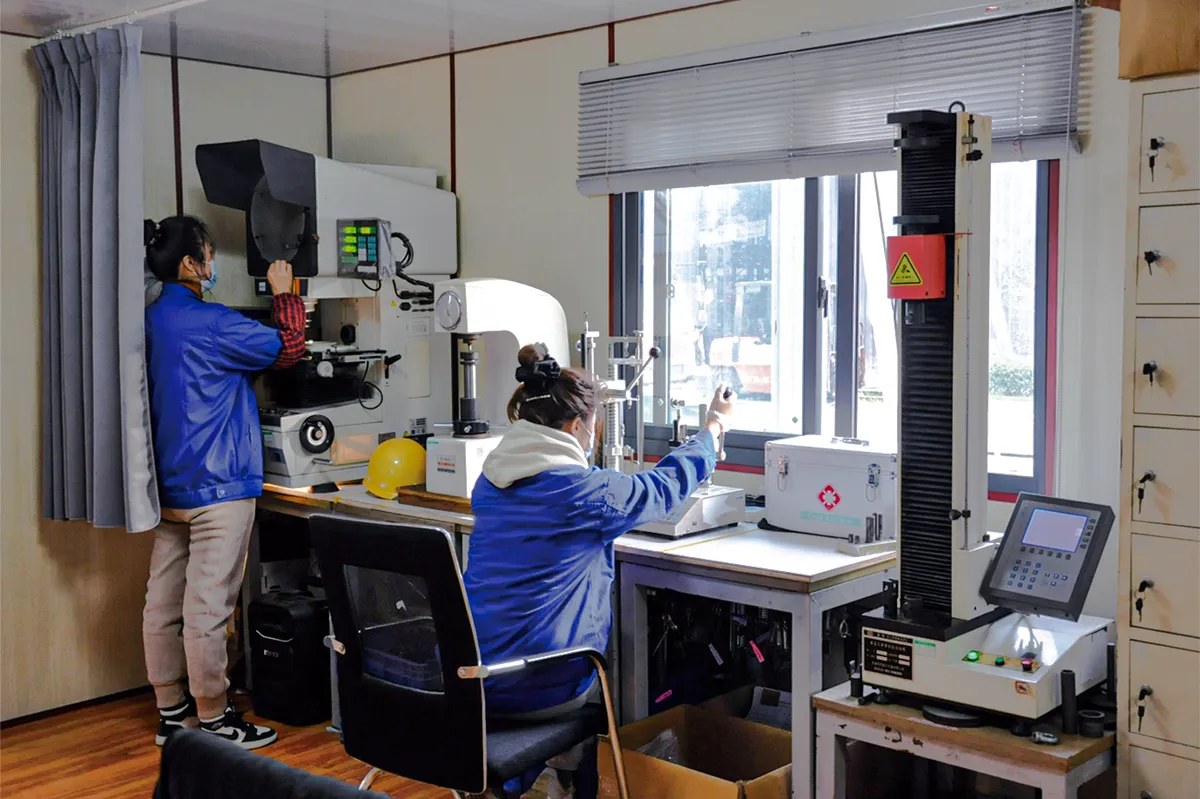
When a sample arrives, our engineers measure it, confirm manufacturability and send back engineering feedback or a quotation within 24 hours. Prototype tines are made for fit and load approval before production.
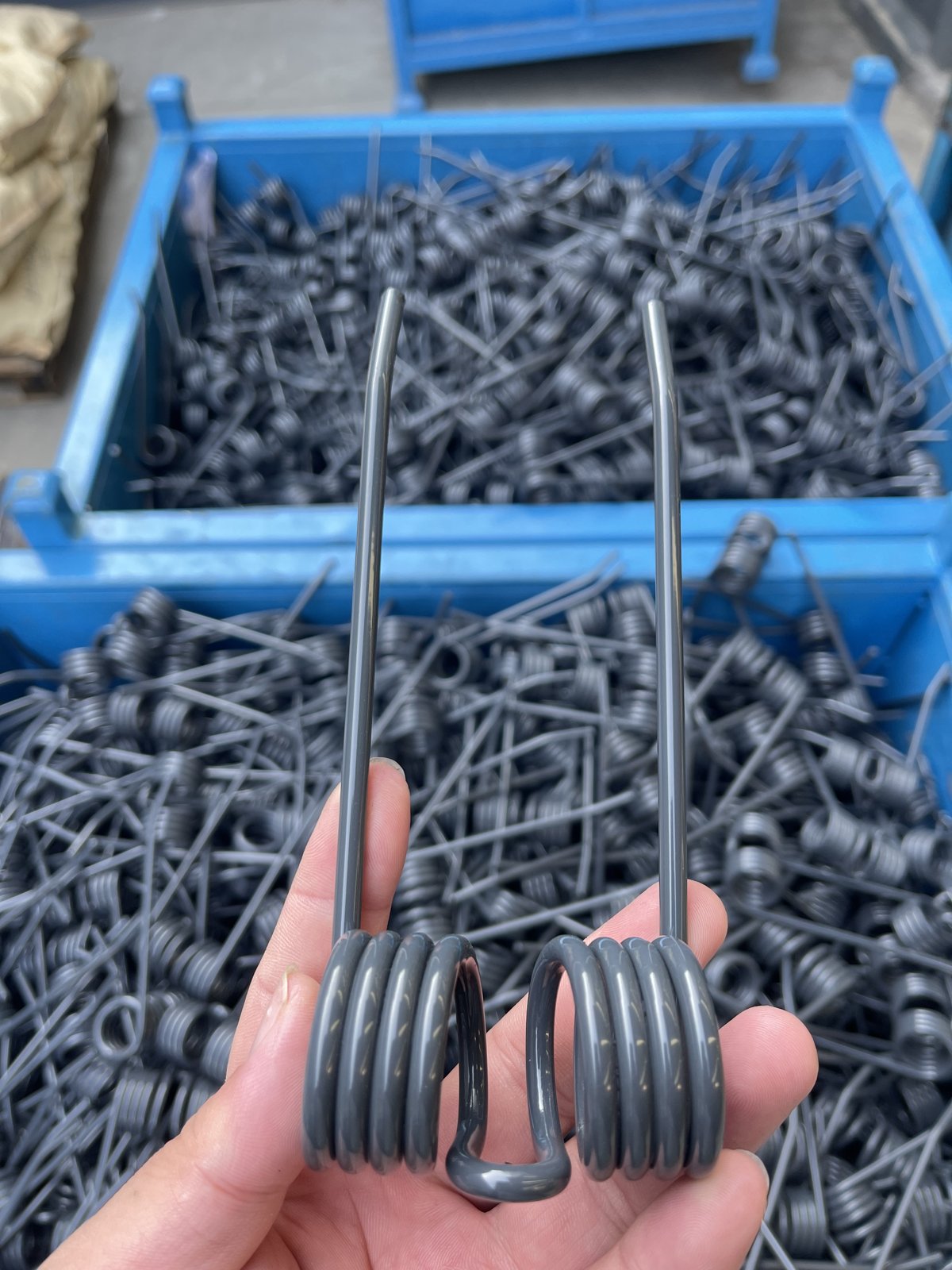
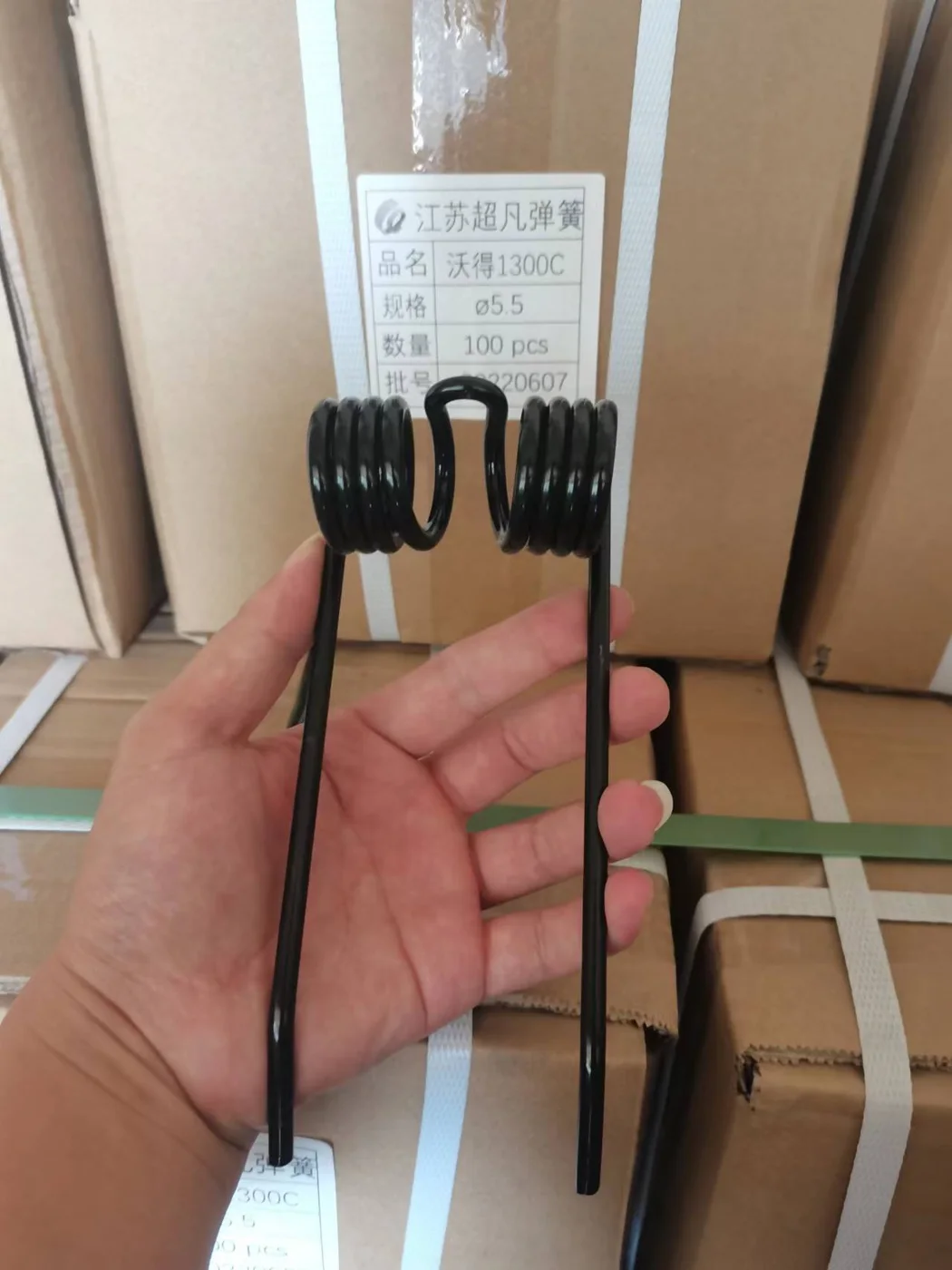
Batches are packed and labelled with part name, wire size, quantity and batch number, as on the carton below. That makes it easy to reorder the same tine for the next season.
Typical lead times are 7–15 working days for samples and 15–30 working days for production. There is no fixed minimum order; small replacement batches and high-volume runs are both possible. See our capabilities for the coiling, forming and testing equipment behind them.
Spring tine RFQ checklist
Copy this table into your inquiry and fill in what you have. Blank lines are fine; we will ask for anything we need.
| Item | Your value |
|---|---|
| Machine type and position (baler pickup, rotary rake, tedder, wheel rake, harrow) | |
| Machine brand and model (for compatibility reference) | |
| A. Wire diameter (mm) | |
| B. Coil outside diameter (mm) | |
| C. Width over the coils (mm) | |
| D. Leg length, each leg (mm) | |
| E. Mounting loop size, or the bar or bolt it fits | |
| F. Coils per side | |
| G. Hand of wind, each side (left / right) | |
| H. Leg angle and any bends (sketch or tracing) | |
| I. Coating colour | |
| Photos of the tine beside a ruler | |
| Sample available to send? | |
| Quantity per order and per year | |
| Where it breaks now, if it is a problem part |
Have a worn tine or a drawing?
Send a drawing, a sample or clear photos with the measurements above through our contact page. Our engineering team will review it and reply with feedback or a quotation within 24 hours. You can also browse our wire forms for other agricultural parts. For bend radius, datums and tolerances on any bent-wire part, see the wire forms design guide.
Visiting China this autumn? Bring your worn tines to our Booth N19B03 at CIAME 2026 in Tianjin, October 26–28, 2026.
Frequently asked questions
Can you copy a worn tine if we have no drawing?
Yes. We measure the sample, confirm the dimensions with you and make prototype tines for fit and load approval before production. Send two or three tines from the same position if you can, because one worn tine may have bent legs.
Can you quote from the machine model alone?
A model name helps us find the right family of tines, but we still need a sample, a drawing or measured dimensions. Tine designs vary between model years and pickup widths.
How do I check the hand of wind on a tine coil?
Hold the coil with its axis upright and look at the strands facing you. If they rise to the right, like a normal screw thread, it is right-hand. If they rise to the left, it is left-hand. On a double tine the two coils are normally opposite hands. Some rakes also use mirrored tines on each side of the rotor, so record where the sample came from.
Can you match the coating colour of the original?
Yes. Colour is confirmed at review. Our tine parts are supplied in black, red, blue, yellow, green and white coatings, as well as phosphate and black oxide finishes.
Is there a minimum order for replacement tines?
There is no fixed minimum. Small batches for dealers and large runs for machine builders are both supported. The practical quantity depends on the tine, tooling and material.
About the authors
This guide was prepared by the NorenSpring engineering team, which designs and manufactures custom compression, extension and torsion springs and wire forms in Xuzhou, China. Technical review by Feng Yulin, General Manager and senior structural engineer, who has 15 years of spring R&D experience and more than 30 national patents. NorenSpring holds IATF 16949, ISO 9001, ISO 13485, ISO 14001 and ISO 45001 certifications. More about NorenSpring.
Sources
- R. G. Budynas and J. K. Nisbett, Shigley’s Mechanical Engineering Design, McGraw-Hill, chapter on mechanical springs (helical torsion springs). Source for the torsional rate formula, the active coil allowance for legs, the bending stress correction factor and loading torsion springs to close the coils. Used for the worked example.
- EN 13906-3, Cylindrical helical springs made from round wire and bar. Calculation and design. Part 3: Torsion springs (SIS listing). Retrieved 2026-10-01.
- B. Anderson, Preseason Hay Equipment Maintenance, University of Nebraska–Lincoln CropWatch, 22 April 2016. Retrieved 2026-10-01.
- R. Grisso and J. Fike, Management Tips for Round Bale Hay Harvesting, Moving, and Storage, Virginia Cooperative Extension publication 442-454, 24 November 2025. Retrieved 2026-10-01.
- NorenSpring case pages, Torsion springs and Wire forms: materials, wire ranges and finishes of published agricultural tine parts.
- Baler pickup photo: Markus Hagenlocher, Wikimedia Commons, CC BY-SA 3.0, cropped. Wheel rake photo: Wikideas1, Wikimedia Commons, CC0 1.0.