










In this article
- Key takeaways
- Before you contact suppliers: define what you are buying
- The 10 checks for choosing a spring manufacturer
- Spring supplier scorecard
- Red flags when choosing a spring supplier
- Should you choose a local or an overseas spring manufacturer?
- How NorenSpring answers these checks
- Frequently asked questions
- About the authors
- Sources
How to choose a spring manufacturer comes down to ten checks made before you order, with evidence asked for at each one:
- Engineering review of your drawing
- Spring types and wire range
- Material traceability
- Control of heat treatment and finishing
- Inspection equipment and calibration
- Quality certificates for your industry
- Sample and production approval
- Tolerances they will commit to
- Capacity and lead time
- Communication, packing and export
Each check has a document or a sample you can ask for. A supplier that answers with evidence is safer than one that answers with promises.
This guide gives the ten checks, the evidence to ask for at each one, the red flags to watch for, and a scorecard you can copy. It is written for engineers and buyers choosing a custom spring manufacturer for compression, extension and torsion springs or wire forms, whether the supplier is local or overseas.
We are a spring manufacturer ourselves, so we have tried to keep the checks neutral: they are the questions any buyer should ask of every supplier on the shortlist, including us.
Key takeaways
- Judge the questions, not the brochure. A capable spring manufacturer asks about loads, working heights, space and duty before quoting. A quote with no questions on a custom spring is a warning sign.
- Ask for evidence at every check. Material certificates, a sample inspection report, a copy of the quality certificate and a written lead time tell you more than a factory tour video.
- Verify certificates yourself. Many accredited ISO certificates can be looked up in IAF CertSearch, and IATF 16949 certificates through the IATF database; if a certificate is not listed, ask the certification body named on it. Check the scope, the site address and the expiry date.
- Approve samples against your critical points. Agree the force at each working length, the tolerance grade and the report format before samples are made, not after.
- Match the paperwork to the industry. Automotive parts usually need IATF 16949 and a PPAP; medical device parts usually need ISO 13485; most industrial parts need ISO 9001 and a good first article report.
Before you contact suppliers: define what you are buying
The best way to compare spring manufacturers is to send every one of them the same, complete request. Suppliers can only be compared fairly when they quote the same thing.
A complete request for a custom spring covers four groups of information:
- The part. A drawing or sketch, or a physical sample. Without a drawing, wire diameter, outside diameter and free length are enough to start a compression spring, but the working loads matter more than any single dimension. Our guides to specifying custom compression springs, extension springs and torsion springs list what to send for each type.
- How it works. Force or torque at the working positions, travel, the bore or shaft it fits, temperature, corrosion and the expected number of cycles.
- Quantity. Prototype quantity, first order and expected annual volume. These decide tooling and the production route.
- Records. What documents you need with each lot: inspection report, material certificate, a PPAP or first article report, packing and labelling rules.
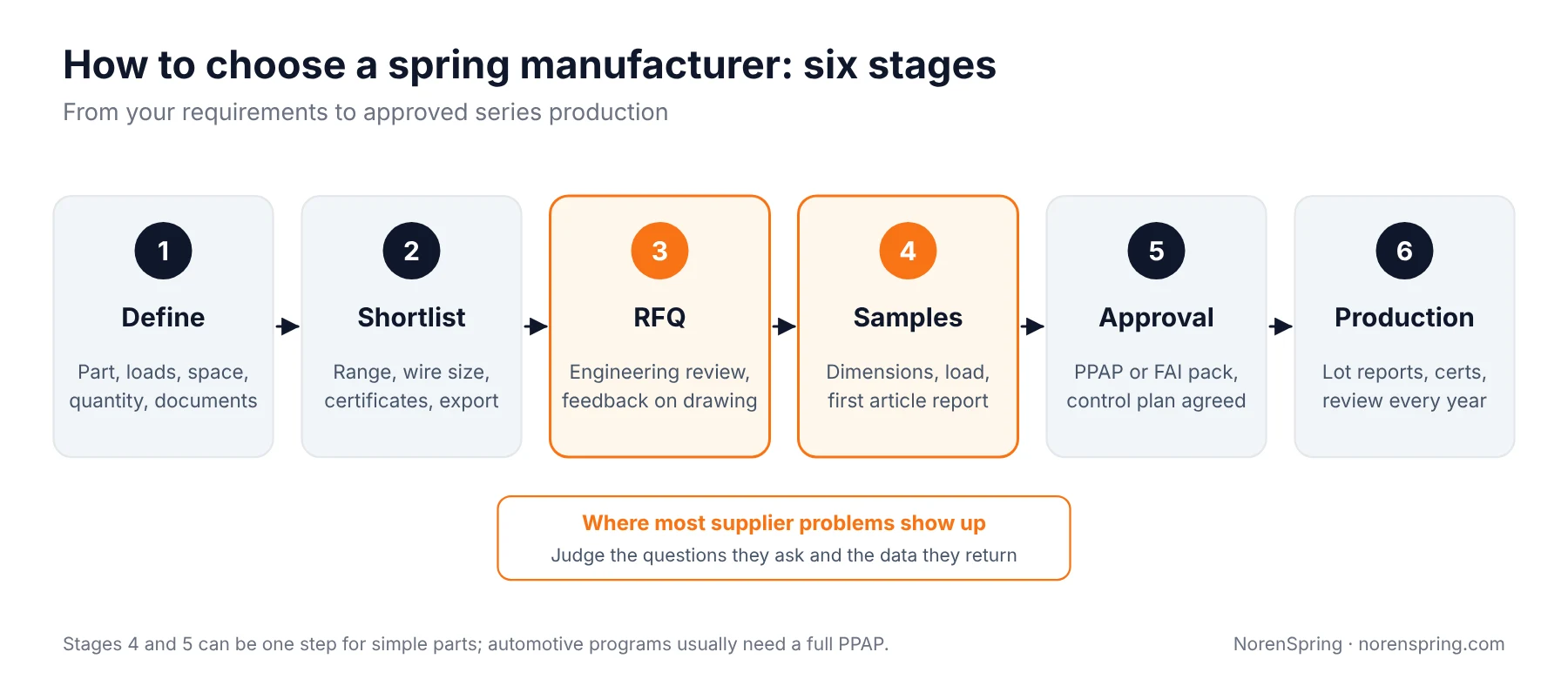
Figure 1 shows the whole process. Stages 3 and 4 are where you learn the most about a supplier, because that is where they have to engage with your part.
The 10 checks for choosing a spring manufacturer
1. Do they review your drawing before they quote?
A good spring manufacturer reads your drawing as an engineer, not as a price list. Look for feedback such as: the spring index is too low to coil cleanly, the stress at the second working length is too high for the wire you named, the hole is too small for the coil to expand into, or two tolerances on the drawing contradict each other.
A typical example: a drawing asks for a compression spring that uses about 90% of the travel available before the coils close at the second working length. A careful supplier will point out that the coils will almost touch, the stress will be close to the limit for the wire, and the force at that length will be hard to hold to tolerance, then suggest a longer free length or one more active coil. Our compression spring design guide shows how solid height and coil clearance are checked.
Ask for: written feedback on your drawing with the quote. A supplier that changes nothing on a new custom part either did not look or did not want to raise problems before the order.
2. Does their range cover your spring type and wire size?
Spring making is split by process. Small precision springs, heavy hot-coiled springs, flat springs and complex wire forms often come from different machines, and sometimes from different companies. Ask which spring types they make in house and the wire diameter range of their machines, then check your part sits comfortably inside it, not at the edge.
Very thick wire is a common limit. EN 15800 covers cold-coiled springs up to 16 mm wire [11], and thicker springs are usually hot coiled from bar and then hardened, which needs a different line. Our heavy duty compression springs guide explains where that boundary sits.
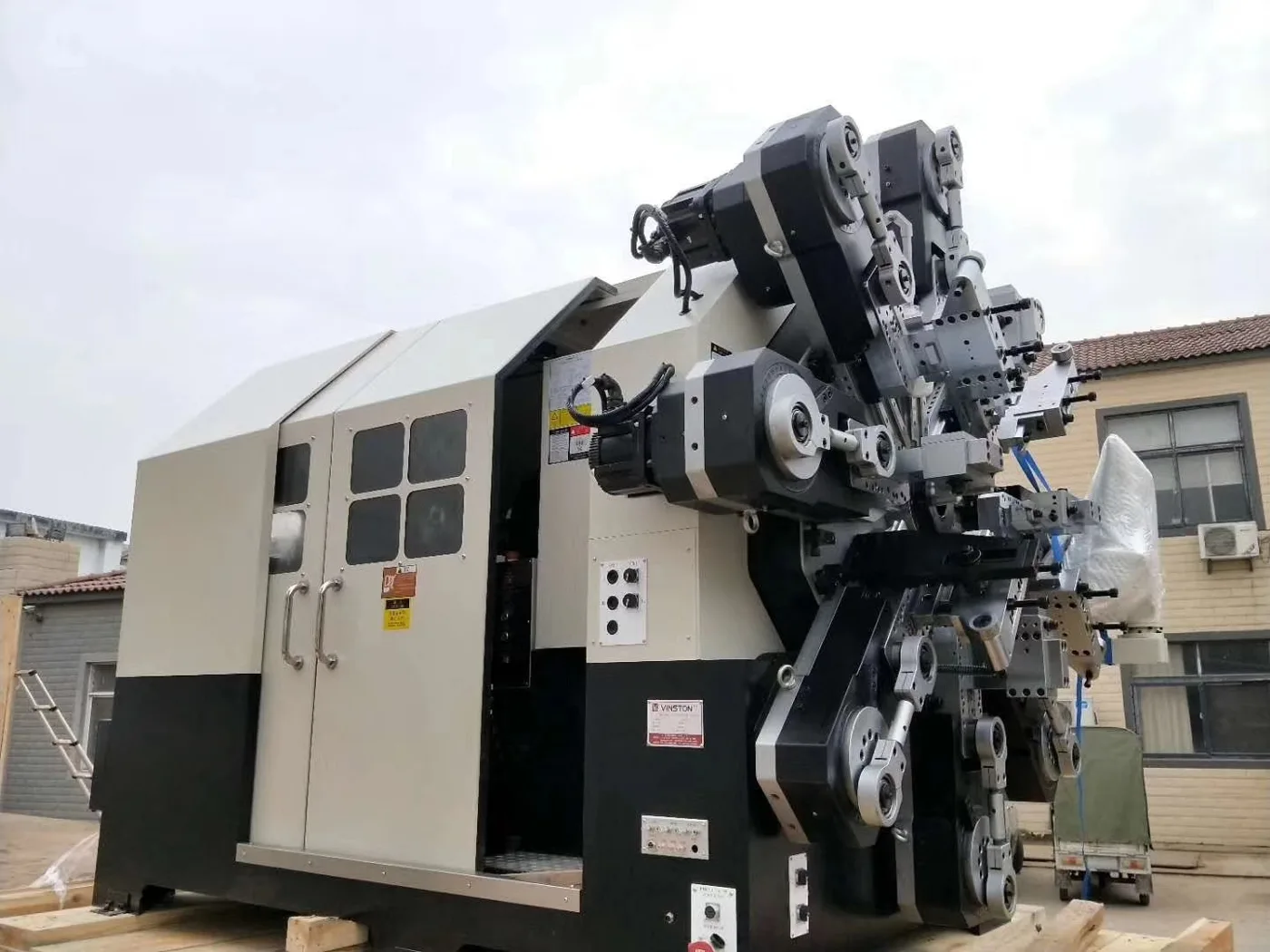
Ask for: the spring types and wire range they produce, and photos or a short video of the machine type that will make your part.
3. Can they trace the material in your springs?
Spring performance depends on the wire, so you should know what wire went into your lot. The European standard EN 10204 defines the types of inspection document a steel supplier can issue [1]:
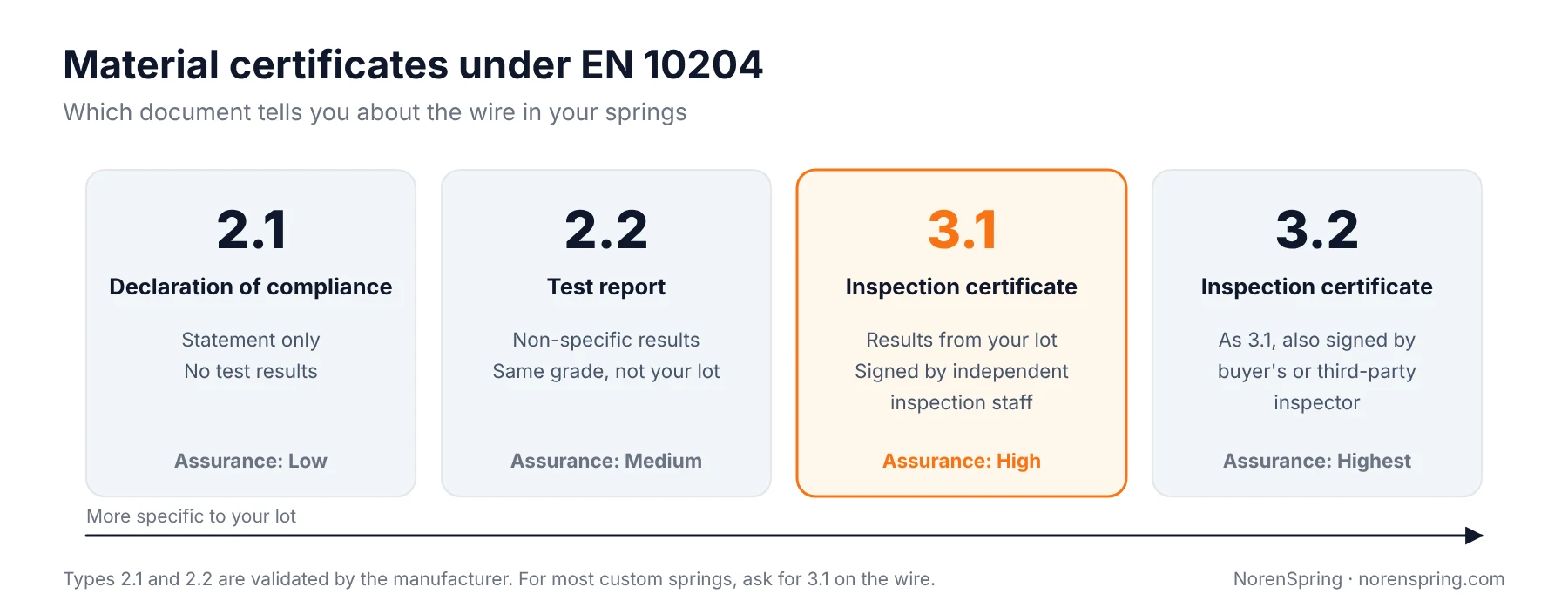
- Type 2.1 is a declaration of compliance with no test results.
- Type 2.2 is a test report with results from the producer’s routine testing, not necessarily from your lot.
- Type 3.1 is an inspection certificate with results from the delivered material, validated by the producer’s inspection staff who are independent of the manufacturing department.
- Type 3.2 adds validation by the purchaser’s representative or a third-party inspector.
For most custom springs a 3.1 certificate on the wire is a reasonable request, and many spring wires are supplied with one. Ask how the heat number is carried from the wire coil to your finished lot, and whether incoming wire is checked. Our spring wire material guide explains grades and equivalents if your drawing uses a standard from another country.
Ask for: a sample material certificate, and a description of how the heat or lot number reaches your label.
4. Which heat-treatment and finishing steps do they control?
Stress relieving, hardening, shot peening, presetting and plating all change how a spring performs, and they are often the steps that get outsourced. Outsourcing is normal; losing control of it is not. Ask which steps are done in house, which go to subcontractors, and how subcontracted steps are checked.
Plating deserves a specific question. Electroplated high-strength steel can suffer hydrogen embrittlement and crack after assembly, so plated springs are normally baked after plating to drive the hydrogen out. ASTM B850 is one guide to choosing the bake conditions [2]. Our spring finishes guide covers the options, and why springs fail shows what goes wrong when this step is missed.
Ask for: a process flow for your part showing which steps are in house, and confirmation that plated parts are baked.
5. What can they measure, and is it calibrated?
A spring manufacturer should be able to measure every characteristic on your drawing that is marked as critical. For most springs that means a spring load tester for force at length or torque at angle, a vision measuring system or optical comparator for dimensions, and a hardness tester for heat-treated parts. Fatigue rigs, salt-spray cabinets, material analysers and metallographic microscopes are a bonus, useful for specific risks.
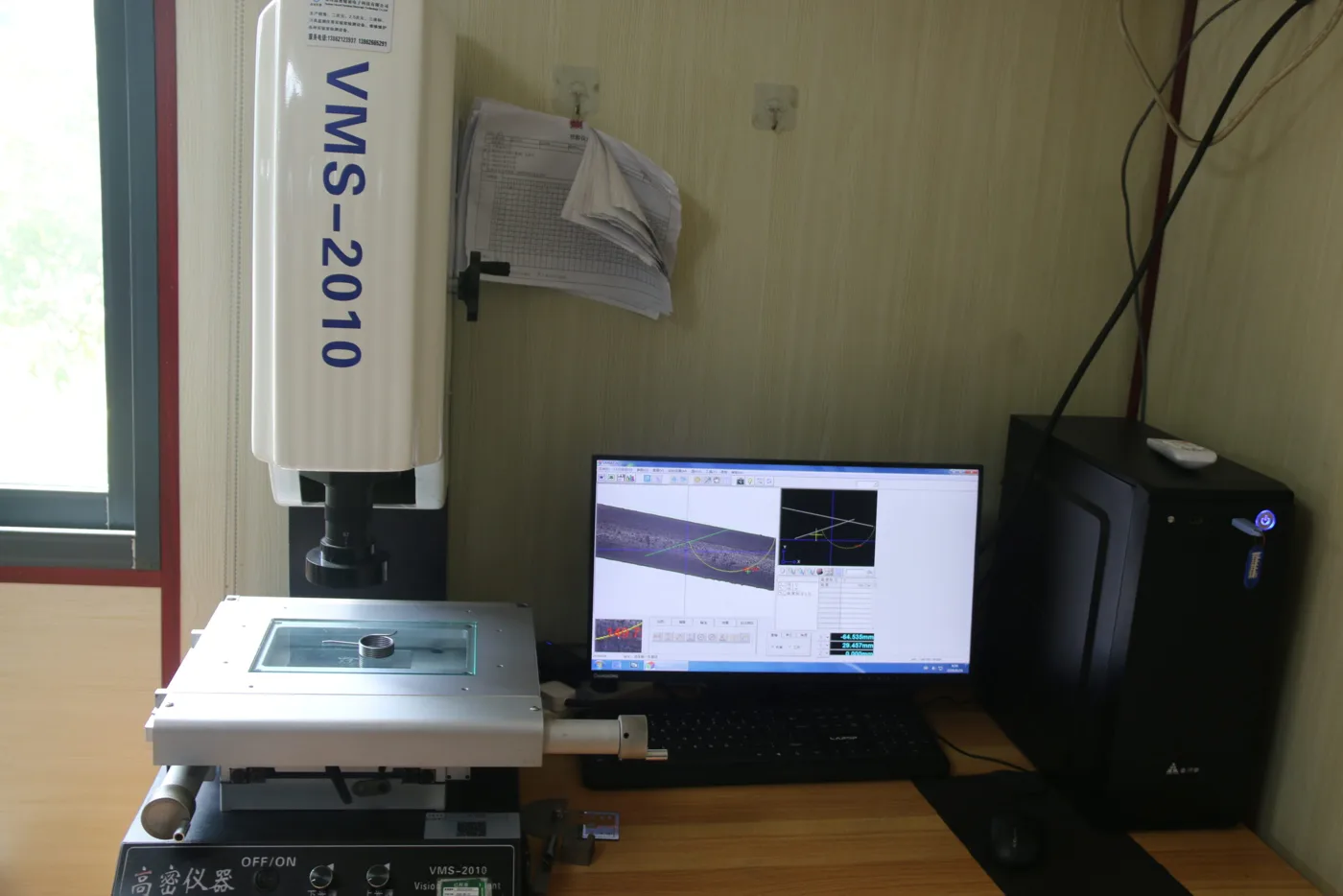
Equipment only matters if it is calibrated and the method matches yours. The force a spring gives at a length depends on how it is seated, the test speed and whether it is pre-compressed first. Our compression spring testing guide lists the test conditions to agree so your incoming inspection matches the supplier’s report.
Ask for: an equipment list, calibration dates for the load tester, and a sample inspection report from a similar part.
6. Are their quality certificates valid for your industry?
Quality management certificates tell you that a supplier runs a documented, audited system. The right certificate depends on what your springs go into:
| Industry | Certificate to look for | What it adds |
|---|---|---|
| General industrial | ISO 9001 | A documented, audited quality management system [3] |
| Automotive | IATF 16949 | Automotive requirements on top of ISO 9001, including PPAP and control plans [4] |
| Medical devices | ISO 13485 | Quality system requirements for medical device design and manufacture [5] |
| Aerospace | AS9100 / EN 9100 | Aerospace quality system requirements; first article inspection is often to AS9102 [6] |
Do not stop at the PDF. Many accredited ISO management system certificates can be checked in IAF CertSearch, the International Accreditation Forum’s global database, by company name or certificate number [7][8]. IATF 16949 certificates are issued only by IATF-recognised certification bodies and can be checked through the IATF database [9]. When you look one up, check three things: the scope covers springs or the parts you buy, the site address is the factory that will make your parts, and the expiry date is in the future.
Ask for: copies of the certificates, then verify them yourself.
7. How will samples and production be approved?
Samples are your chance to check the supplier before money is committed to a production lot. Agree before sampling what will be measured, how many pieces, and the report format. A first article inspection report should list every characteristic on the drawing, the specified value and the measured result.
Automotive programs usually go further. The AIAG Production Part Approval Process (PPAP) defines five submission levels, and Level 3 is the default unless the customer specifies otherwise [10]. Level 3 means the Part Submission Warrant, samples and the complete supporting data. Aerospace customers usually ask for a first article inspection to AS9102 [6]. If your industry needs either, say so in the RFQ, because it affects both cost and lead time.
Ask for: a sample inspection report template before samples are made, and the PPAP level or FAI format if your industry needs one.
8. Which tolerances will they commit to?
Spring tolerances are wider than machined-part tolerances, and they are linked. The force at a given length, the free length and the coil diameter cannot all be held tight at once, because they depend on the same wire and coiling. EN 15800 sets three quality grades for cold-coiled compression springs, covering coil diameter, free length, force at a given length, and the squareness and parallelism of ground ends [11].
A good supplier will tell you which grade they can hold for your part and suggest which dimensions to mark as reference. Over-tolerancing raises cost and can make a part impossible to make. Our compression spring design guide covers which dimensions to control.
Ask for: the tolerance grade or values they will commit to, in writing, for each critical characteristic.
9. Can they meet your volume and lead time?
Ask how lead time is built up rather than accepting a single number: material availability, tooling, sampling, production and any approval steps. A supplier who can explain each part of it is more likely to meet it. Ask how many machines can run your part, so one breakdown does not stop your supply, and whether there is a minimum order quantity at prototype and production stage.
Ask for: sample lead time and production lead time in writing, any minimum order quantity, and how the first lot will be scheduled.
10. How will they communicate, pack and ship?
Many supply problems start as communication problems. Ask who your contact will be, whether they can discuss technical points in your language, and how quickly they reply to engineering questions. For export, agree the Incoterms rule, the packing method and the export documents. Incoterms 2020 is the current set of rules from the International Chamber of Commerce [12]. Springs tangle, so ask how they are separated in the box, and how cartons are labelled for your goods-in team.
Ask for: a named contact, a packing photo of a similar part, and the Incoterms rule and documents they will provide.
Spring supplier scorecard
Score each spring manufacturer on your shortlist against the ten checks. The scale is simple: 0 for no evidence, 1 for a verbal answer, 2 for a document, 3 for a document you have checked against your own part.
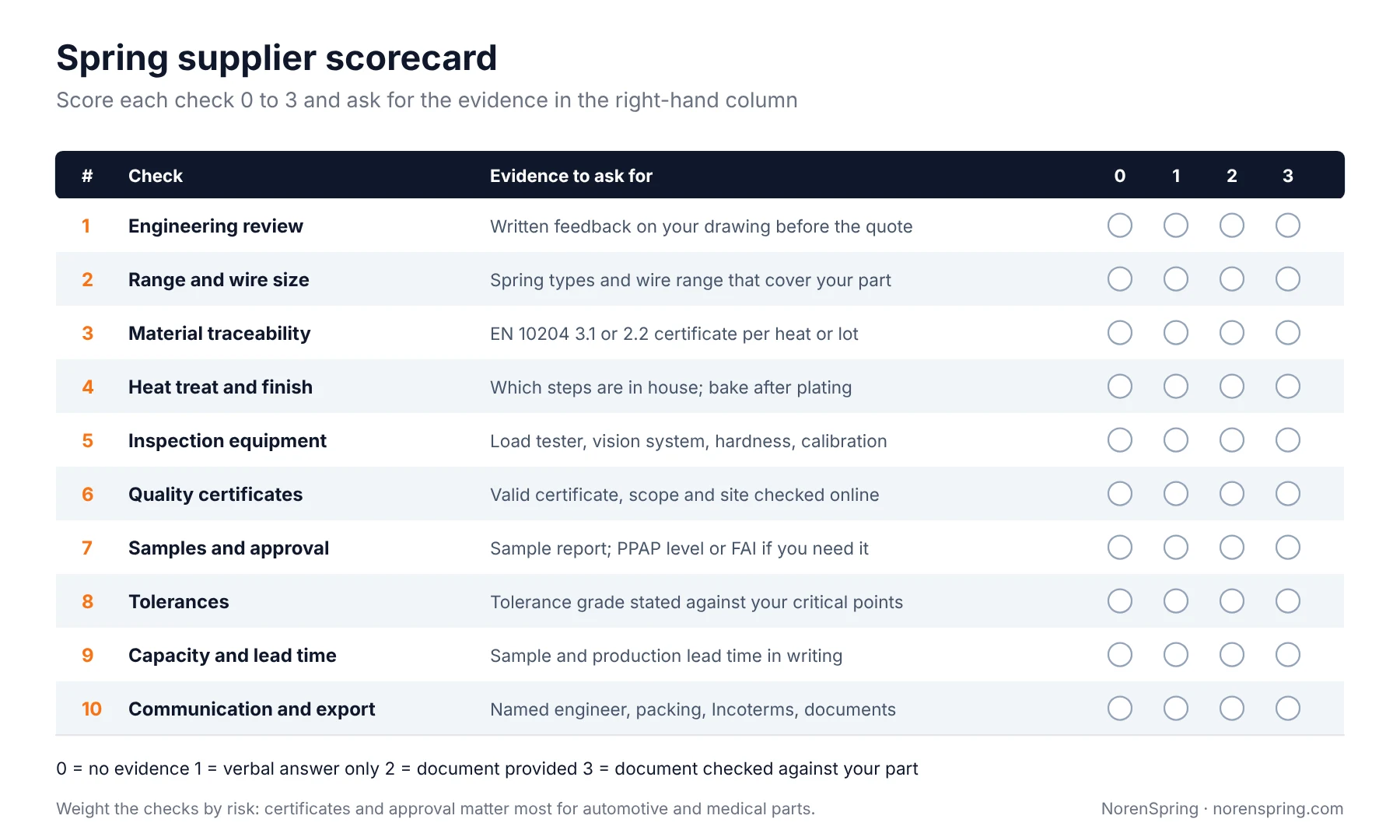
| Check | Evidence to ask for | Score (0–3) |
|---|---|---|
| 1. Engineering review | Written feedback on your drawing before the quote | |
| 2. Range and wire size | Spring types and wire range that cover your part | |
| 3. Material traceability | EN 10204 3.1 or 2.2 certificate per heat or lot | |
| 4. Heat treatment and finish | Which steps are in house; baking after plating | |
| 5. Inspection equipment | Load tester, vision system, hardness tester, calibration dates | |
| 6. Quality certificates | Valid certificate, scope and site checked online | |
| 7. Samples and approval | Sample report; PPAP level or FAI if you need it | |
| 8. Tolerances | Tolerance grade stated against your critical points | |
| 9. Capacity and lead time | Sample and production lead time in writing | |
| 10. Communication and export | Named contact, packing, Incoterms rule, documents |
Weight the checks by risk. For an automotive safety part, certificates and approval (checks 6 and 7) matter most. For a low-cost clip on agricultural equipment, range, lead time and packing may matter more. For a real example, see how a Spanish automotive buyer ran a factory audit for seat wire forms after receiving our quotation.
Red flags when choosing a spring supplier
| Red flag | Why it matters |
|---|---|
| A quote with no questions on a new custom spring | Nobody checked whether the spring works or can be made |
| No material certificate, or one that names a different grade | You cannot trace the wire if a lot fails |
| Certificate that cannot be confirmed in IAF CertSearch, the IATF database or with the issuing certification body, or a scope that does not mention springs | The certificate may be expired, unaccredited or for another site |
| Every tolerance accepted without comment | They will either sort parts at your expense or not meet the drawing |
| No inspection report with samples | You have no baseline to compare production lots against |
| Plated springs with no mention of baking | Risk of hydrogen embrittlement and delayed fracture |
| Lead time given as a single number with no breakdown | It is a sales answer, not a plan |
Should you choose a local or an overseas spring manufacturer?
Both can work. The choice depends on the part, the volume and how often the design changes.
A local supplier makes sense when you need parts within days, when the design is still changing every week, or when the volume is too small to justify freight and approval effort. An overseas manufacturer makes sense when volumes are steady, when you need a wide range of spring types and wire forms from one source, or when the local market lacks capacity for your size range.
If you compare spring manufacturers overseas, the ten checks matter more, not less, because problems take longer to fix. Approve samples before the first production order, agree the inspection method in writing, ask for a lot inspection report and material certificate with every shipment, and order the first lot early enough to absorb one round of corrections.
How NorenSpring answers these checks
As a custom spring manufacturer in China, here is how we answer the same ten checks, so you can compare like with like:
- Engineering review: most projects start from a drawing, sketch or sample, and manufacturability is confirmed before we quote. Engineering feedback is returned within 24 hours. We have 28+ engineers.
- Range: compression, extension and torsion springs, wire forms and special-shaped springs, from 0.1 mm to 80 mm wire, cold coiled and hot coiled. See our capabilities.
- Material and records: inspection reports, material certificates, dimensional records and traceability are agreed at project setup. Zinc-plated springs are baked after plating to relieve hydrogen.
- Inspection: our in-house laboratory has spring load testers, an automatic spring tester, torsion testers, vision and video measuring systems, Rockwell and Vickers hardness testers, a fatigue tester, a salt-spray tester, a material composition analyser and a metallographic microscope.
- Certificates: IATF 16949, ISO 9001, ISO 13485, ISO 14001 and ISO 45001. Copies are on our About page. We do not hold AS9100; for aerospace programs we prepare FAIR packages to the customer’s requirements.
- Approval: prototype and pre-production samples for dimensional, load and application approval; PPAP and FAIR packages for automotive and aerospace programs.
- Volume and lead time: no fixed minimum order quantity, from prototypes to high volume, with capacity of more than 4,000,000 springs a month. Samples usually take 7 to 15 working days and production 15 to 30 working days; we confirm the lead time for your part with the quotation.
- Export: we have shipped to more than 60 countries. We have three production facilities, are headquartered in Xuzhou, Jiangsu, and have made springs since 2001.
You can see examples of real parts, with anonymised project details, in our compression spring case studies.
Frequently asked questions
How do I find a reliable spring manufacturer?
Shortlist suppliers whose spring types and wire range cover your part, send them all the same complete RFQ, and compare the engineering feedback, sample reports and documents they return. Verify their quality certificates in IAF CertSearch or the IATF database before you approve samples.
What certifications should a spring manufacturer have?
ISO 9001 is the baseline for industrial parts. Automotive buyers usually require IATF 16949, medical device makers ISO 13485, and aerospace buyers AS9100 or EN 9100. Check the scope and site address on the certificate, not just the standard number.
What should I send in a spring RFQ?
Send a drawing, sketch or sample; the force or torque at each working position and the travel; the space the spring must fit; the environment and expected cycles; quantities; and the documents you need with each lot. Without a drawing, wire diameter, outside diameter and free length are enough for a compression spring to start.
Is a material certificate type 2.2 good enough for springs?
It depends on the risk. A type 2.2 report shows results from non-specific inspection, not necessarily from your lot. For safety-related, automotive or medical springs, ask for a type 3.1 certificate, which gives results from the delivered material.
How long does it take to make custom spring samples?
It depends on the spring type, material, tooling and quantity. Simple springs from stock wire can be sampled quickly; hot-coiled springs, special materials and new tooling take longer. At NorenSpring, samples usually take 7 to 15 working days. Ask each supplier to break the lead time down by step.
About the authors
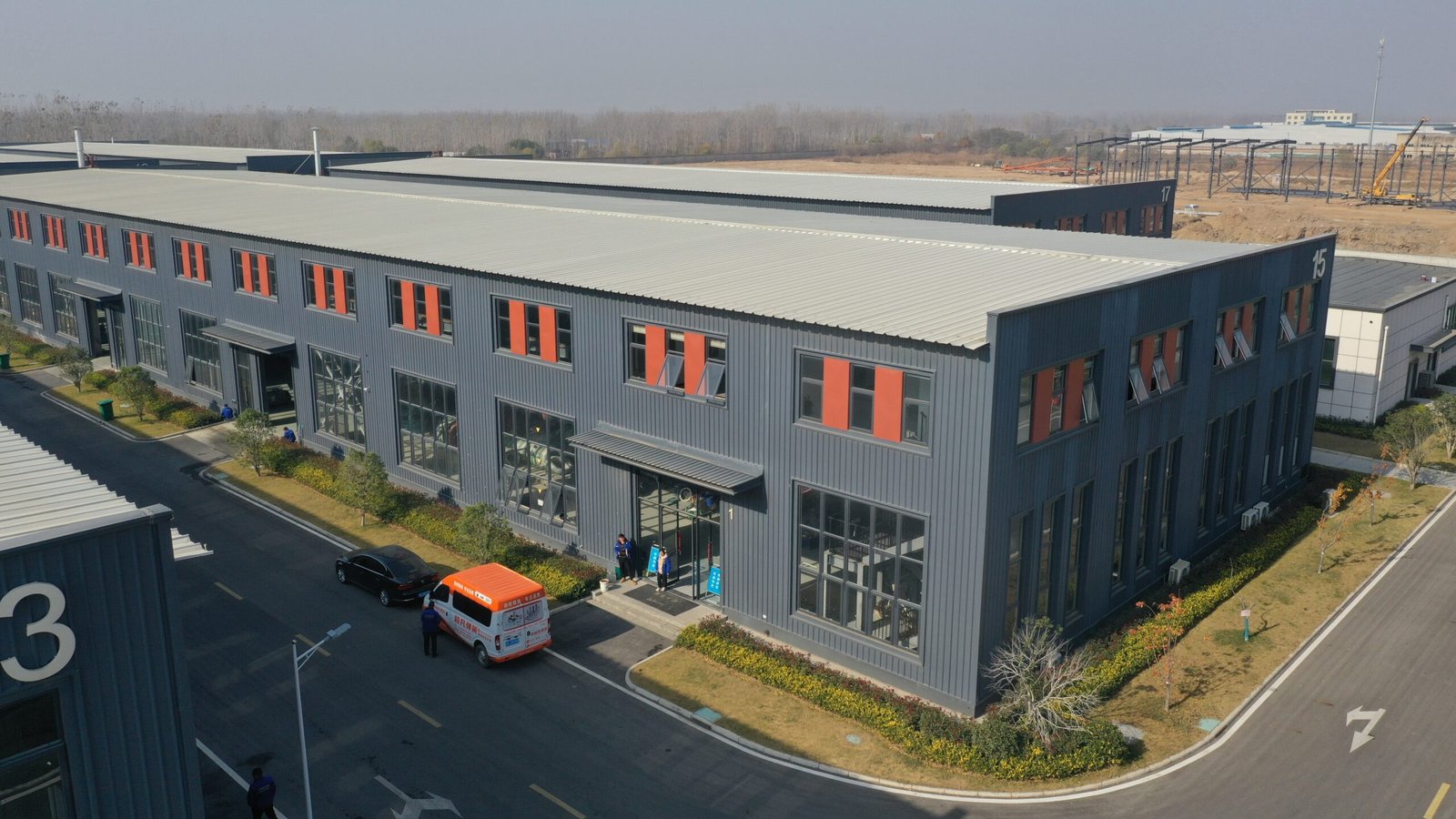
This guide was prepared by the NorenSpring engineering team, which designs and manufactures custom compression, extension and torsion springs and wire forms in Xuzhou, China. Technical review by Feng Yulin, General Manager and senior structural engineer, who has 15 years of spring R&D experience and more than 30 national patents. NorenSpring holds IATF 16949, ISO 9001, ISO 13485, ISO 14001 and ISO 45001 certifications. Photos are from our own plants. Sources were last checked on October 19, 2026.
Comparing spring suppliers for a new part? Send us your drawing or sample and we will return engineering feedback with the quotation, so you can score us against the same ten checks.
Sources
The numbers in square brackets in the text refer to this list.
- BSI, EN 10204, Metallic products, Types of inspection documents. Source for the definitions of document types 2.1, 2.2, 3.1 and 3.2. Retrieved 2026-10-19.
- ASTM International, ASTM B850, Standard Guide for Post-Coating Treatments of Steel for Reducing the Risk of Hydrogen Embrittlement. Retrieved 2026-10-19.
- ISO, ISO 9001:2015, Quality management systems, Requirements. Retrieved 2026-10-19.
- International Automotive Task Force, IATF Global Oversight. Source for IATF 16949 and the IATF certification scheme. Retrieved 2026-10-19.
- ISO, ISO 13485:2016, Medical devices, Quality management systems, Requirements for regulatory purposes. Retrieved 2026-10-19.
- SAE International, AS9102C, Aerospace First Article Inspection Requirement. Retrieved 2026-10-19.
- International Accreditation Forum, IAF CertSearch. Retrieved 2026-10-19.
- ISO, How to verify an accredited certification. Source for searching IAF CertSearch by company name or certificate number. Retrieved 2026-10-19.
- VDA QMC, IATF 16949 certificates globally. Source for IATF 16949 certificate validity checks through the IATF database. Retrieved 2026-10-19.
- AIAG, Production Part Approval Process (PPAP), 4th edition, 2006, AIAG publications at the ANSI Webstore. Source for the five submission levels and Level 3 as the default. Retrieved 2026-10-19.
- BSI, BS EN 15800, Cylindrical helical springs made of round wire, Quality specifications for cold coiled compression springs. Retrieved 2026-10-19.
- International Chamber of Commerce, Incoterms rules. Retrieved 2026-10-19.



